

Paper Menu >>
Journal Menu >>
 Journal of Minerals and Materials Characterization and Engineering, 2012, 11, 1063-1068 Published Online November 2012 (http://www.SciRP.org/journal/jmmce) Identifica ti on o f Growth Promoter to Fabrication SiCp/Al2O3 Ceramic Matrix Composites Prepared by Directed Metal Oxidation of an Al Alloy Malkapuram Devaiah1,2, Thodeti Srihari3, Thankappan Pillai Rajasekharan1 1Ceramics & Composites Group, Defence Metallurgical Research Laboratory, Hyderabad, India. 2Department of Mechanical Engineering, Geethanjali College of Engineering & Technology, Hyderabad, India 3Department of Mechanical Engineering, Sha dan College of Engineering & Technology, Hyderabad, India Email: [email protected], Received July 3, 2012; revised August 7, 2012; accepted August 14, 2012 ABSTRACT SiC particulates reinforced alumina matrix composites were fabricated using Directed Metal Oxidation (DIMOX) pro- cess. Continuous oxidation of an Al-Si-Mg-Zn alloy with different interlayers (dopents) as growth promoters, will en- compasses the early heating of the alloy ingot, melting and continued heating to temperature in the narrow range of 950˚C to 980˚C in an atmosphere of oxygen. Varying interlayers (dopents) are incorporated to examine the growth con- ditions of the composite materials and to identification of suitable growth promoter. The process is extremely difficult because molten aluminum does not oxidize after prolonged duration at high temperatures due to the formation of a pas- sivating oxide layer. It is known that the Lanxide Corporation had used a combination of dopents to cause the growth of alumina from molten metal. This growth was directed, i.e. the growth is allowed only in the required direction and re- stricted in the other directions. The react nature of the dopants was a trade secret. Though it is roughly known that Mg and Si in the Al melt can aid growth, additional dopents used, the temperatures at which the process was carried out, the experimental configurations that aided directed growth were not precisely known. In this paper we have evaluated the conditions in which co mposites can be grown in large enough sizes for evaluation applicatio n and have arriv ed at a pro- cedure that enables the fabrication of large composite samples by determining the suitable growth promoter (dopant). Scanning electron microscopic, EDS analysis of the composite was found to contain a continuous network of Al2O3, which was predominantly free of grain-boundary phases, a continuous network of Al alloy. Fabrication of large enough samples was done only by the inventor company and the property measurements by the company were confirmed to those needed to enable immediate applications. Since there are a large number of variable affecting robust grow th of the composite, fabrication large sized samples for measurements is a difficult task. In the present work, to identify a suit- able window of parameters that enables robust growth of the composite has been attempted. Keywords: Ceramic-Matrix Composites; Scanning Electron Microscopy; Liquid Metal Infiltration; Al2O3, SiC 1. Introduction The directed oxidation of molten metal has been utilized to produce ceramic composites. This process offers the ability to produce unreinforced [1 ], particulate-reinforced [2] and fiber-reinforced [3,4] composites with a wide range of composition and microstructures. The composite formation process involves the rapid reaction of a molten metal with a gaseous oxidant: for example, the reactions of a molten aluminum alloy containing a growth dopant such as a few wt% of Mg and a group IVA elements (Si, Ge, Sn, or Pb) with air to form alpha aluminum oxide [2]. The reaction is sustained by the wicking of liquid me- tal—along interconnected microscope channels in the re- action pro duc t . Numerous studies now exist of the oxidative grow th of Al2O3/Al composites from Al alloys into free space [5-7], experiments on the infiltration of preforms, which are fewer, including the work of Manor et al. [8] into SiC and of Nagelberg [9] into Al2O3. As an example, the re- action of an aluminum alloy with oxygen produces an Al2O3/metal composite containing both ceramic and me- tal as three dimensionally interconnected networks [4]. The directed oxidation produced composite materials is quite flexible and offers the ability to make near-net- shape low-porosity in situ composites with a wide range of composition and microstructures [10]. These compos- ites can, in principle, be designated to have good tough- Copyright © 2012 SciRes. JMMCE 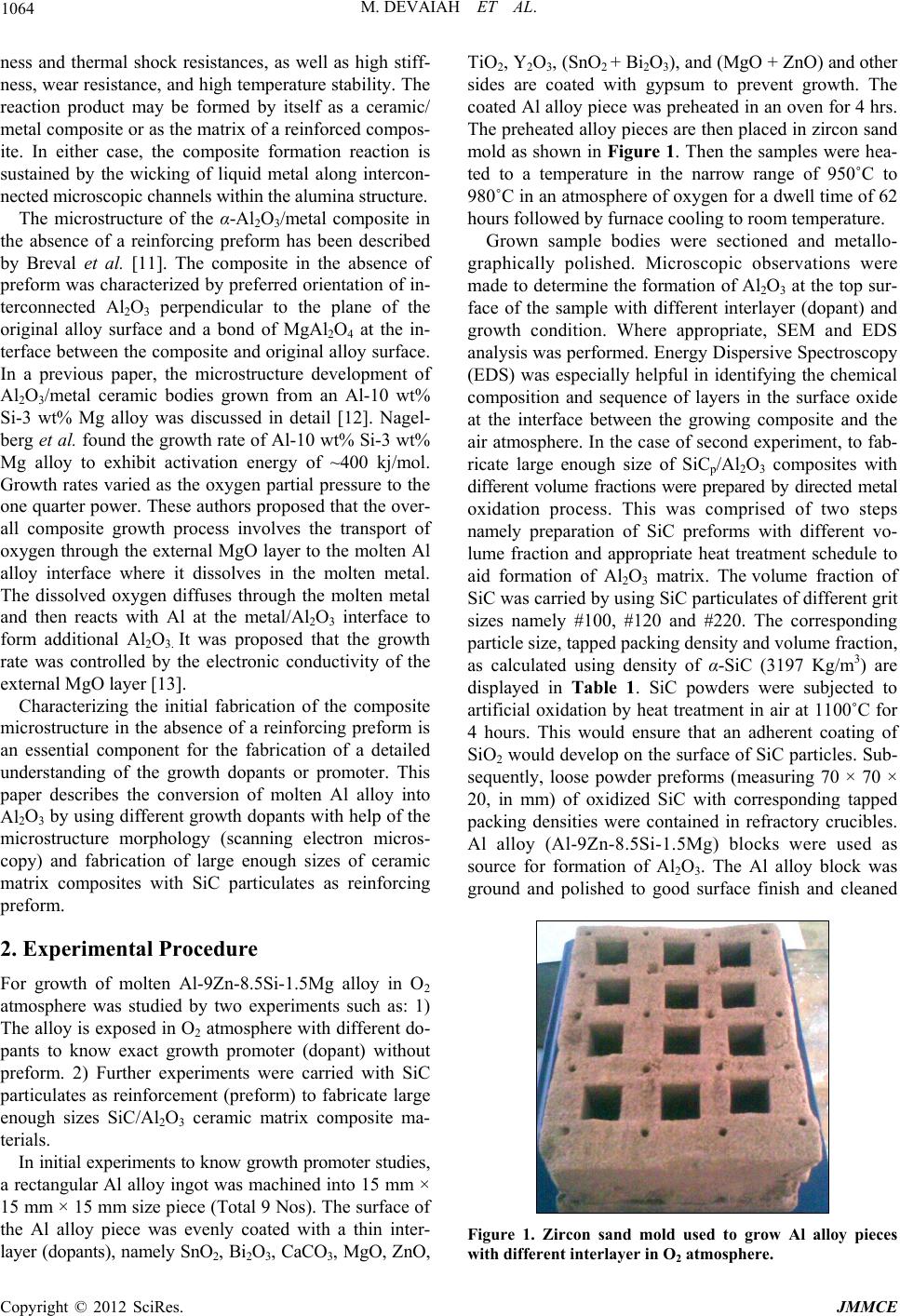 M. DEVAIAH ET AL. 1064 ness and thermal shock resistances, as well as high stiff- ness, wear resistance, and high temperature stability. The reaction product may be formed by itself as a ceramic/ metal composite or as the matrix of a reinforced compos- ite. In either case, the composite formation reaction is sustained by the wicking of liquid metal along intercon- nected microscopic channels within the alumina structure. The microstructure of the α-Al2O3/metal composite in the absence of a reinforcing preform has been described by Breval et al. [11]. The composite in the absence of preform was characterized by preferred orientation of in- terconnected Al2O3 perpendicular to the plane of the original alloy surface and a bond of MgAl2O4 at the in- terface between the composite and original alloy surface. In a previous paper, the microstructure development of Al2O3/metal ceramic bodies grown from an Al-10 wt% Si-3 wt% Mg alloy was discussed in detail [12]. Nagel- berg et al. found the growth rate of Al-10 w t% Si-3 wt% Mg alloy to exhibit activation energy of ~400 kj/mol. Growth rates varied as the oxygen partial pressure to the one quarter power. These authors proposed that the over- all composite growth process involves the transport of oxygen through the external MgO layer to the molten Al alloy interface where it dissolves in the molten metal. The dissolved oxygen diffuses through the molten metal and then reacts with Al at the metal/Al2O3 interface to form additional Al2O3. It was proposed that the growth rate was controlled by the electronic conductivity of the external MgO layer [13]. Characterizing the initial fabrication of the composite microstructure in the absence of a reinforcing preform is an essential component for the fabrication of a detailed understanding of the growth dopants or promoter. This paper describes the conversion of molten Al alloy into Al2O3 by using different growth dopants with help of the microstructure morphology (scanning electron micros- copy) and fabrication of large enough sizes of ceramic matrix composites with SiC particulates as reinforcing preform. 2. Experimental Procedure For growth of molten Al-9Zn-8.5Si-1.5Mg alloy in O2 atmosphere was studied by two experiments such as: 1) The alloy is exposed in O2 atmosphere with different do- pants to know exact growth promoter (dopant) without preform. 2) Further experiments were carried with SiC particulates as reinforcement (preform) to fabricate large enough sizes SiC/Al2O3 ceramic matrix composite ma- terials. In initial experiments to know growth promoter studies, a rectangular Al alloy ingot was machined into 15 mm × 15 mm × 15 mm size piece (Total 9 Nos). The surface of the Al alloy piece was evenly coated with a thin inter- layer (dopants), namely SnO2, Bi2O3, CaCO3, MgO, ZnO, TiO2, Y2O3, (SnO2 + Bi2O3), and (MgO + ZnO) and other sides are coated with gypsum to prevent growth. The coated Al alloy piece was preheated in an oven for 4 hrs. The preheated alloy pieces are then placed in zircon sand mold as shown in Figure 1. Then the samples were hea- ted to a temperature in the narrow range of 950˚C to 980˚C in an atmosphere of oxygen for a dwell time of 62 hours followed by furnace cooling to room temperature. Grown sample bodies were sectioned and metallo- graphically polished. Microscopic observations were made to determine the formatio n of Al2O3 at the top sur- face of the sample with different interlayer (dopant) and growth condition. Where appropriate, SEM and EDS analysis was performed. Energy Dispersive Spectroscopy (EDS) was especially helpful in identifying the chemical composition and sequence of layers in the surface oxide at the interface between the growing composite and the air atmosphere. In the case of second experiment, to fab- ricate large enough size of SiCp/Al2O3 composites with different volume fractions were prepared by directed metal oxidation process. This was comprised of two steps namely preparation of SiC preforms with different vo- lume fraction and appropriate heat treatment schedule to aid formation of Al2O3 matrix. The volume fraction of SiC was carried by using SiC particulates of different grit sizes namely #100, #120 and #220. The corresponding particle size, tapped packing density and volume fraction, as calculated using density of α-SiC (3197 Kg/m3) are displayed in Table 1. SiC powders were subjected to artificial oxidation by heat treatment in air at 1100˚C for 4 hours. This would ensure that an adherent coating of SiO2 would develop on the surface of SiC particles. Sub- sequently, loose powder preforms (measuring 70 × 70 × 20, in mm) of oxidized SiC with corresponding tapped packing densities were contained in refractory crucibles. Al alloy (Al-9Zn-8.5Si-1.5Mg) blocks were used as source for formation of Al2O3. The Al alloy block was ground and polished to good surface finish and cleaned Figure 1. Zircon sand mold used to grow Al alloy pieces with different interlayer in O2 at m o sphere. Copyright © 2012 SciRes. JMMCE 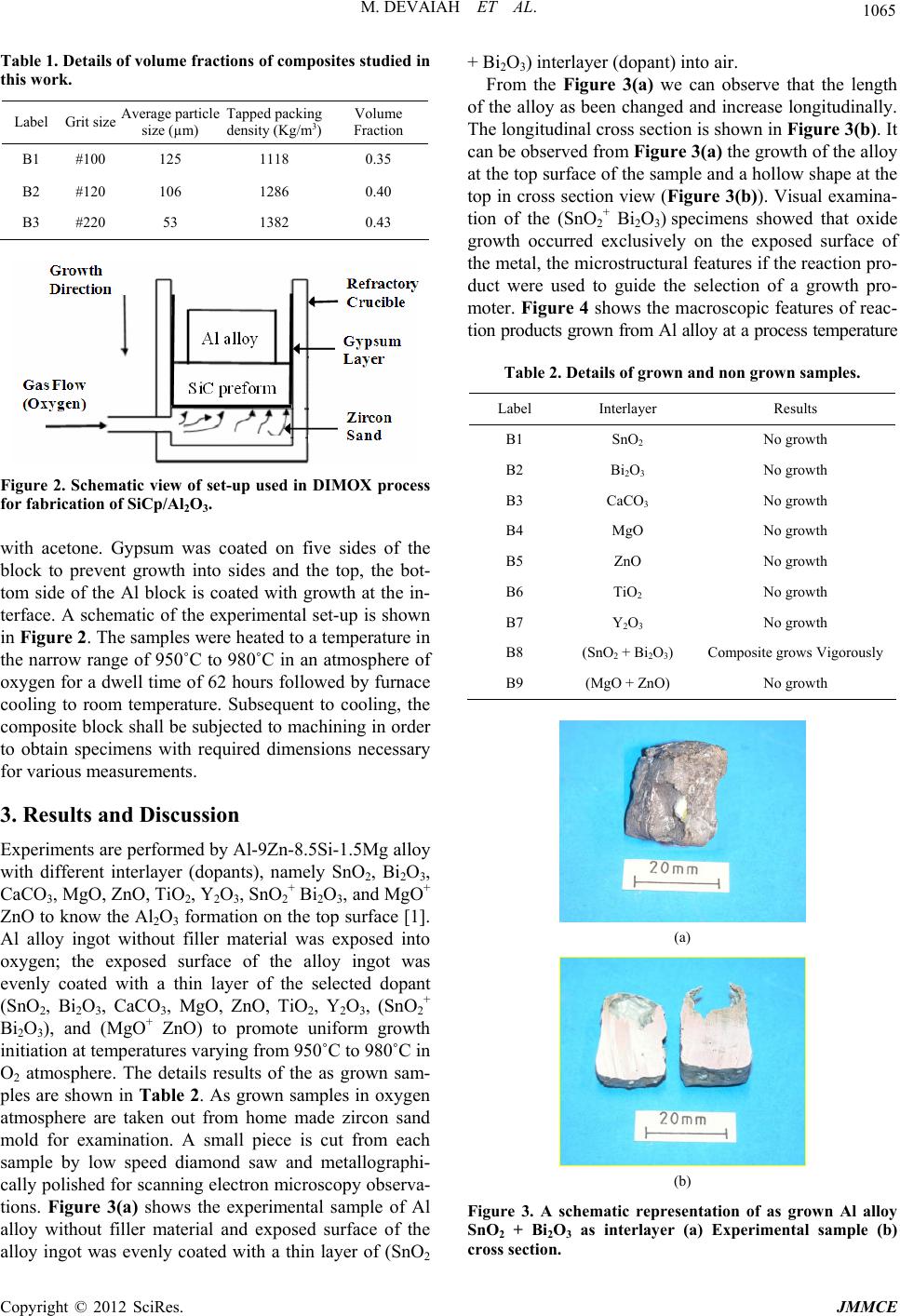 M. DEVAIAH ET AL. 1065 Table 1. Details of volume fractions of composites studied in this work. Label Grit size Average particle size (µm) Tapped packing density (Kg/m3) Volume Fraction B1 #100 125 1118 0.35 B2 #120 106 1286 0.40 B3 #220 53 1382 0.43 Figure 2. Schematic view of set-up used in DIMOX process for fabrication of SiCp/Al2O3. with acetone. Gypsum was coated on five sides of the block to prevent growth into sides and the top, the bot- tom side of the Al block is coated with growth at the in- terface. A schematic of the experimental set-up is shown in Figure 2. The samples were heated to a temperature in the narrow range of 950˚C to 980˚C in an atmosphere of oxygen for a dwell time of 62 hours followed by furnace cooling to room temperature. Subsequent to cooling, the composite block shall be subjected to machining in order to obtain specimens with required dimensions necessary for various measurements. 3. Results and Discussion Experiments are performed by Al-9Zn-8.5Si-1.5Mg alloy with different interlayer (dopants), namely SnO2, Bi2O3, CaCO3, MgO, ZnO, TiO2, Y2O3, SnO2+ Bi2O3, and MgO+ ZnO to know the Al2O3 formation on the top surface [1]. Al alloy ingot without filler material was exposed into oxygen; the exposed surface of the alloy ingot was evenly coated with a thin layer of the selected dopant (SnO2, Bi2O3, CaCO3, MgO, ZnO, TiO2, Y2O3, (SnO2+ Bi2O3), and (MgO+ ZnO) to promote uniform growth initiation at temperatures varying from 950˚C to 980˚C in O2 atmosphere. The details results of the as grown sam- ples are shown in Table 2. As grown samples in oxygen atmosphere are taken out from home made zircon sand mold for examination. A small piece is cut from each sample by low speed diamond saw and metallographi- cally polished for scanning electron microscopy observa- tions. Figure 3(a) shows the experimental sample of Al alloy without filler material and exposed surface of the alloy ingot was evenly coated with a thin layer of (SnO2 + Bi2O3) interlayer (dopant) into air. From the Figure 3(a) we can observe that the length of the alloy as been changed and increase longitudinally. The longitudinal cross section is shown in Figure 3(b). It can be observed from Figure 3(a) the growth of the alloy at the top surface of the sample and a hollow shape at the top in cross section view (Figure 3(b)). Visual examina- tion of the (SnO2+ Bi2O3) specimens showed that oxide growth occurred exclusively on the exposed surface of the metal, the microstructural features if the reaction pro- duct were used to guide the selection of a growth pro- moter. Figure 4 shows the macroscopic features of reac- tion products grown from Al alloy at a process temperature Table 2. Details of grown and non grown samples. Label Interlayer Results B1 SnO2 No growth B2 Bi2O3 No growth B3 CaCO3 No growth B4 MgO No growth B5 ZnO No growth B6 TiO2 No growth B7 Y2O3 No growth B8 (SnO2 + Bi2O3) Composite grows Vigorously B9 (MgO + ZnO) No growth (a) (b) Figure 3. A schematic representation of as grown Al alloy SnO2 + Bi2O3 as interlayer (a) Experimental sample (b) cross section. Copyright © 2012 SciRes. JMMCE 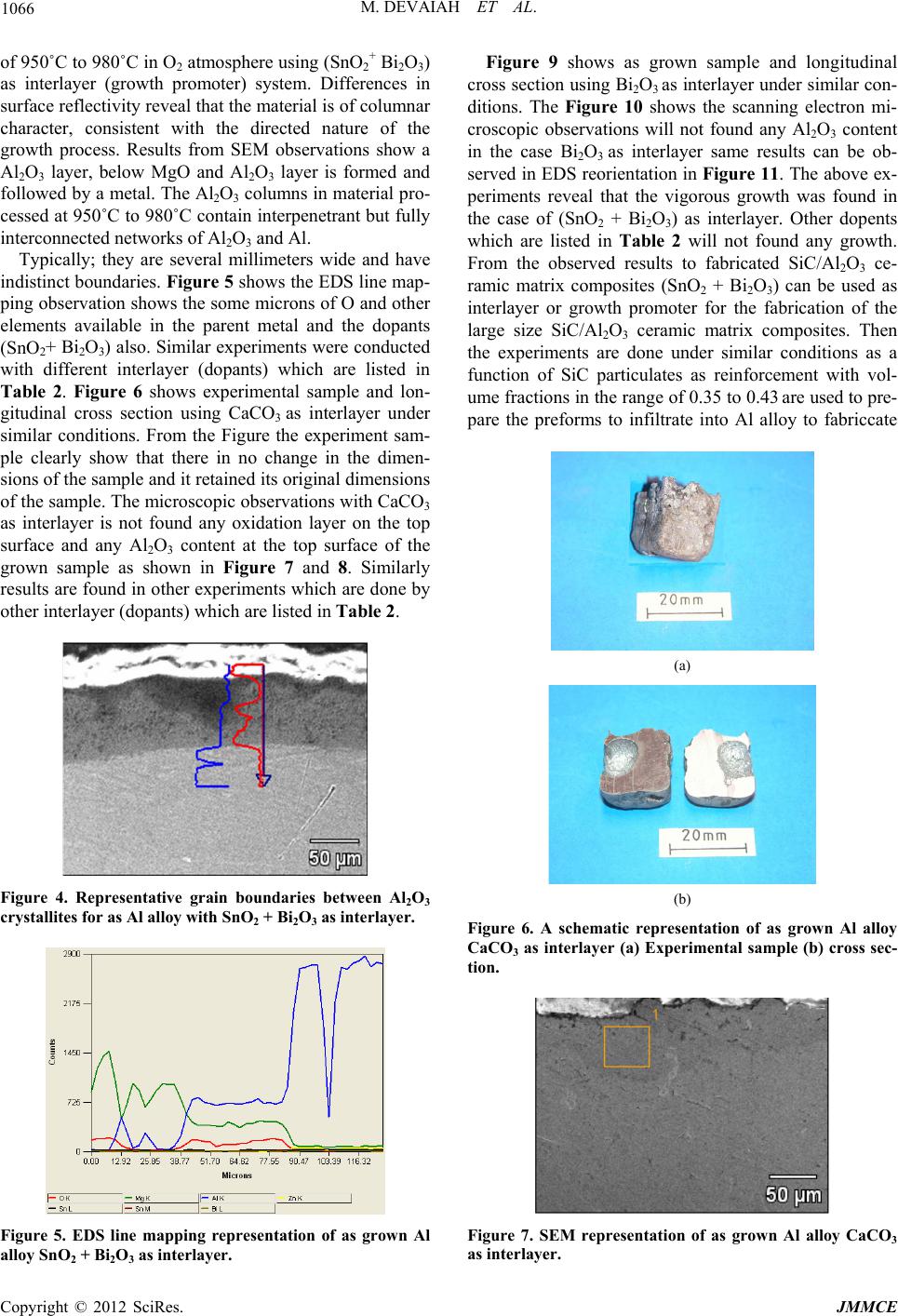 M. DEVAIAH ET AL. 1066 of 950˚C to 980˚C in O2 atmosphere using (SnO2+ Bi2O3) as interlayer (growth promoter) system. Differences in surface reflectivity reveal that the material is of columnar character, consistent with the directed nature of the growth process. Results from SEM observations show a Al2O3 layer, below MgO and Al2O3 layer is formed and followed by a metal. The Al2O3 columns in material pro- cessed at 950˚C to 980˚C contain interpenetrant but fu lly interconnected networks of Al2O3 and Al. Typically; they are several millimeters wide and have indistinct bound aries. Figure 5 show s the EDS line map- ping observation shows the some microns of O and other elements available in the parent metal and the dopants (SnO2+ Bi2O3) also. Similar experiments were conducted with different interlayer (dopants) which are listed in Table 2. Figure 6 shows experimental sample and lon- gitudinal cross section using CaCO3 as interlayer under similar conditions. From the Figure the experiment sam- ple clearly show that there in no change in the dimen- sions of the sample and it retained its original dimension s of the sample. The microscopic observations with CaCO3 as interlayer is not found any oxidation layer on the top surface and any Al2O3 content at the top surface of the grown sample as shown in Figure 7 and 8. Similarly results are found in other experiments which are done by other interlayer (dopants) which are listed in Table 2. Figure 4. Representative grain boundaries between Al2O3 crystallites for as Al alloy with SnO2 + Bi2O3 as interlayer. Figure 5. EDS line mapping representation of as grown Al alloy SnO2 + Bi2O3 as interlayer. Figure 9 shows as grown sample and longitudinal cross section using Bi2O3 as interlayer under similar con- ditions. The Figure 10 shows the scanning electron mi- croscopic observations will not found any Al2O3 content in the case Bi2O3 as interlayer same results can be ob- served in EDS reorientation in Figure 11. The above ex- periments reveal that the vigorous growth was found in the case of (SnO2 + Bi2O3) as interlayer. Other dopents which are listed in Table 2 will not found any growth. From the observed results to fabricated SiC/Al2O3 ce- ramic matrix composites (SnO2 + Bi2O3) can be used as interlayer or growth promoter for the fabrication of the large size SiC/Al2O3 ceramic matrix composites. Then the experiments are done under similar conditions as a function of SiC particulates as reinforcement with vol- ume fractions in the range of 0.35 to 0.43 are used to pre- pare the preforms to infiltrate into Al alloy to fabriccate (a) (b) Figure 6. A schematic representation of as grown Al alloy CaCO3 as interlayer (a) Experimental sample (b) cross sec- tion. Figure 7. SEM representation of as grown Al alloy CaCO3 as interlayer. Copyright © 2012 SciRes. JMMCE  M. DEVAIAH ET AL. 1067 Figure 8. EDS of as grown Al alloy with CaCO3 as Inter- layer. (a) (b) Figure 9. A schematic representation of as grown Al alloy Bi2O3 as interlayer (a) Experimental sample (b) cross sec- tion. Figure 10. SEM representation of as grown Al alloy with Bi2O3 as interlayer. Figure 11. EDS representation of as grown Al alloy with Bi2O3 as interlayer. large size SiCp/Al2O3 ceramic matrix composites. Figure 12 shows the different dimension of SiCp/Al2O3 ceramic matrix composites are fabricated in the present work with dimensions. Figure 12(b) with dimensions measuring 70 × 70 × 20, in mm. (a) (b) Com p osite Hollow re g ion Residua l metal (c) Figure 12. Examples of composite growth obtained in the present work (a) the aluminum alloy is allowed to oxidize and grow into SiC particulate preform in a conical refrac- tory mold. We note that the shape of the mould could be replicated in the composite. (b) We also note the large size (70 mm × 70 mm × 20 mm) of the composite samples. An example of growth of composite from a rectangular mold. (c) a example showing the way the composite grows-the growth process was stopped midway, the outer surface was cleaned and suitably machined to reveal the salient features. The aluminum left after the process can be seen at the bottom. The hollow region is the region from where the Al was used up in the oxidation growth. The top is the composite that grow. The composite is machined to reveal the absence of macroscopic porosity. The edges of the alloy retain a box shape because of the suppression of melting due to the presence of gypsum coating. Copyright © 2012 SciRes. JMMCE  M. DEVAIAH ET AL. Copyright © 2012 SciRes. JMMCE 1068 4. Conclusion The process details are reported for the specific example of oxidation of molten Al in oxygen atmosphere to form Al2O3. In the present work, the experiments are per- formed with and without reinforcement to fabricate large size SiCp/Al2O3 ceramic matrix composites. (SnO2 + Bi2O3) was identified as suitable growth promoter for fabrication SiCp/Al2O3 ceramic matrix composites. The scanning electron observations r evealed that the conversion of me- tal to oxide was po ssible on ly with (SnO2+ Bi2O3) dopant as growth promoter. Other did not cause any growth of oxide from molten metal. So, the (SnO2+ Bi2O3) dopant was used as growth promoter for the fabrication of SiCp/ Al2O3 ceramic matrix composites. SiCp/Al2O3 ceramic matrix composites are successfully fabricated with SiC particulates as reinforcement with volume fractions in th e range of 0.35 to 0.43 with dimensions measuring 70 × 70 × 20, in mm. the sample are used for different mechani- cal and physical property measurements. REFERENCES [1] M. S. Newkirk, A. W. Urquhart and H. R. Zwicker, “Formation of Lanxide Ceramic Composite,” Journal of Materials Research, Vol. 1, No. 1, 1986, pp. 81-89. doi:10.1557/JMR.1986.0081 [2] M. S. Newkirk, H. D. Lesher and D. R. White, “Forma- tion of Lanxide Ceramic Matrix Composites: Matrix Formation by the Directed Oxidation of Molten Metals,” Ceramic Engineering & Science Proceedings, Vol. 8, No. 7-8, 1987, pp. 879-885. doi:10.1002/9780470320402.ch46 [3] P. Barron-Antolin, G. H. Schiroky, and C. A. Anderson, “Properties of Fiber-Reinforced Alumina Matrix Com- posites,” Ceramic Engineering & Science Proceedings, Vol. 9, No. 7-8, 1988, pp. 759-766. doi:10.1002/9780470310496.ch27 [4] K. Aghajanian, N. H. MacMillan, C. R. Kennedy, S. J. Luszcz and R. Roy, “Properties and Microstructures of Lanxide Al2O3-Al Ceramic Composite Materials,” Jour- nal of Materials Science, Vol. 24, No. 2, 1989, pp. 658- 670. doi:10.1007/BF01107457 [5] A. S. Nagelberg, “Growth Kinetics of Al2O3/Metal Com- posites from a Complex Aluminum Alloy,” Solid State Ionics, Vol. 32-33, 1989, pp. 783-788. doi:10.1016/0167-2738(89)90358-5 [6] A. S. Nagelberg, S. Antolin and A. W. Urquhart, “Forma- tion of Al2O3/Metal Composites by the Directed Oxida- tion of Molten Aluminum-Magnesium-Silicon Alloys: Part II, Growth Kinetics,” Journal of the American Ce- ramic Society, Vol. 75, No. 2, 1992, pp. 455-462. doi:10.1111/j.1151-2916.1992.tb08201.x [7] O. Salas, H. Ni, V. Jaya ram, K.C. Vlach, C.Q. Levi and R. Mehrabian, “Nucleation and Growth of Al2O3/Metal Composites by Oxidation of Aluminum Alloys,” Journal of Materials Research, Vol. 6, No. 9, 1991, pp. 1964- 1981. doi:10.1557/JMR.1991.1964 [8] E. Monar, H. Ni, C.G. Levi. and R. Meharabin, “Forma- tion of Al2O3/Metal Composites by the Directed Oxida- tion of Molten Aluminum-Magnesium-Silicon Alloys: Part II, Growth Kinetics,” Journal of the American Ceramic Society, Vol. 75, No. 2, 1992, pp. 455-462. doi:10.1111/j.1151-2916.1992.tb08201.x [9] A. S. Nagelberg, “The Effect of Processing Parameters on the Growth Rate and Microstructure of Al2O3/Metal Ma- trix Composites,” Materials Research Society Symposium Proceedings, Vol. 155, 1989, pp. 155-275. [10] A. W. Urquhart. “Molten Metals Sire MMC’s, CMC’s,” Advanced Materials and Processes, Vol. 140, No. 1, 1991, pp. 25-29. [11] E. Breval, M. Aghajanian and S. Luszcz, “Microstruc- ture and Composition of Alumina/Aluminum Composites Made by Directed Oxidation of Aluminum,” Journal of the American Ceramic Society, Vol. 73, No. 9, 1990, pp. 2610-2614. doi:10.1111/j.1151-2916.1990.tb06735.x [12] S. Antolin and A. S. Nagelberg, “Formation of Al2O3/ Metal Composites by the Directed Oxidation of Molten Aluminum-Magnesium-Silicon Alloy: Part I, Micro- structural Development,” Journal of the American Ce- ramic Society, Vol. 75, No. 2, 1992, pp. 447-454. doi:10.1111/j.1151-2916.1992.tb08200.x [13] A. S. Nagelberg and S. Antolin, “Formation of Al2O3/ Metal Composites by the Directed Oxidation of Molten Aluminum-Magnesium-Silicon Alloy: Part II, Growth Kinetics,” Journal of the American Ceramic Society, Vol. 75, No. 2, 1992, pp. 455-462. doi:10.1111/j.1151-2916.1992.tb08201.x |