

Paper Menu >>
Journal Menu >>
 Journal of Minerals and Materials Characterization and Engineering, 2012, 11, 1055-1062 Published Online November 2012 (http://www.SciRP.org/journal/jmmce) Value Addition to Red Sediment Placer Sillimanite Using Microwave Energy and in Depth Structural and Morphological Characterization of Mullite Satya Sai Srikant1, Saroj Kumar Singh2, Partha Sarathi Mukherjee2, Raghupatruni Bhima Rao3 1Sri Ramaswamy Memorial University, Delhi NCR Campus, Modinagar, India 2Council for Scientific and Industrial Research (CSIR), Institute of Minerals and Materials Technology, Bhubaneswar, India 3Aryan Institute of Engineering and Technology, BP University of Technology, Bhubaneswar, India Email: [email protected] Received July 1, 2012; revised August 3, 2012; accepted August 13, 2012 ABSTRACT This paper deals with the effect of microwave energy for mullite formation from placer sillimanite. A mullite formation is seen when 60 % SiC and 5% binder are used with the composite charge material, i.e. sillimanite (60%) and Al2O3 (40%). The maximum temperature of the microwave sintering furnace achieved is 1355˚C at 2450 W microwave power. Addition of 10 % binder to the same charge material with 60% SiC, the furnace temperature achieved is 1384˚C at mi- crowave power 1900 W. Mullite is formed within 25 minutes from the sillimanite, under the above experimental condi- tions. Whereas under the similar additive conditions, the mullite formed from sillimanite in conventional furnace hea- ting, it took 3 hours at 1300˚C. XRD data show the mullite phase for both the products obtained from microwave sinter- ing furnace and conventional furnace. FESEM image analysis shows the mullite formations, SiC fibrous cluster and alumina needles in microwave treated sample. Thus microwave heat source is much more effective for value addition to red sediment placer sillimanite to form mullite in compare to conventional furnace. Keywords: Microwave Heat Energy; Sillimanite; Mullite; Value Addition 1. Introduction This paper provides a simple theoretical model to inves- tigate determinants of the vertical IIT based on Bertrand price competition. We find that the volume of trade is higher among countries where R&D investments are lar- ger. In addition, the vertical IIT share increases with the similarity between two countries in terms of technology and per-capita income. Our theoretical findings are con- sistent with recent empirical findings. 2. Introduction Red sediments in India are recent geological formations. These red sediments occur in badlands topography. These sediments essentially contain industrial placer heavy mi- nerals such as ilmenite, sillimanite, rutile, zircon, mona- zite and other heavy minerals. Sillimanite (Al2O3. SiO2) is mineral which has special property of undergoing con- version into mullite (3Al2O3.2SiO2) and vitreous silica (cristobalite) on heating between 1350˚C and 1500˚C. Thus the placer minerals which contain considerable amount of sillimanite can be made use of mulite forma- tion for industrial applications. The decomposition of sil- limanite to mullite and silica is as follows 23 22322 2AlO.SiO3AlO.2SiOSiO On heating the placer sillimanite between 1500˚C and 1650˚C with conventional heating process, it decomposes to mullite and silica [1] in such a way that their decom- positions produce a mixture of the mullite 3:2 plus free silica. Due to presence of rejected silica phase, the impu- rities become segregated at the grain boundaries. How- ever, it is logical to believe that incorporating alumina to react with the rejected silica to form a single-phase mul- lite structure can minimize this disadvantage. Use of con- ventional furnaces for preparation of mullite from silli- manite is a universally known process. Several publica- tions and patents are available in the literature on this as- pect. Literature pertaining on the preparation of mullite using microwave heat source is very much restricted. The ava ilable literature is on formation of mullite from kao- linite or kaolin clay. The literature reveals that Elias and Ruth [2] observed the mullite phase in XRD analysis for the sample treated by microwave carbothermal reduction of kaolin. Ebadzadeh, et al. [3] observed about mullite behavior from the reaction sintering of clay and alumina Copyright © 2012 SciRes. JMMCE 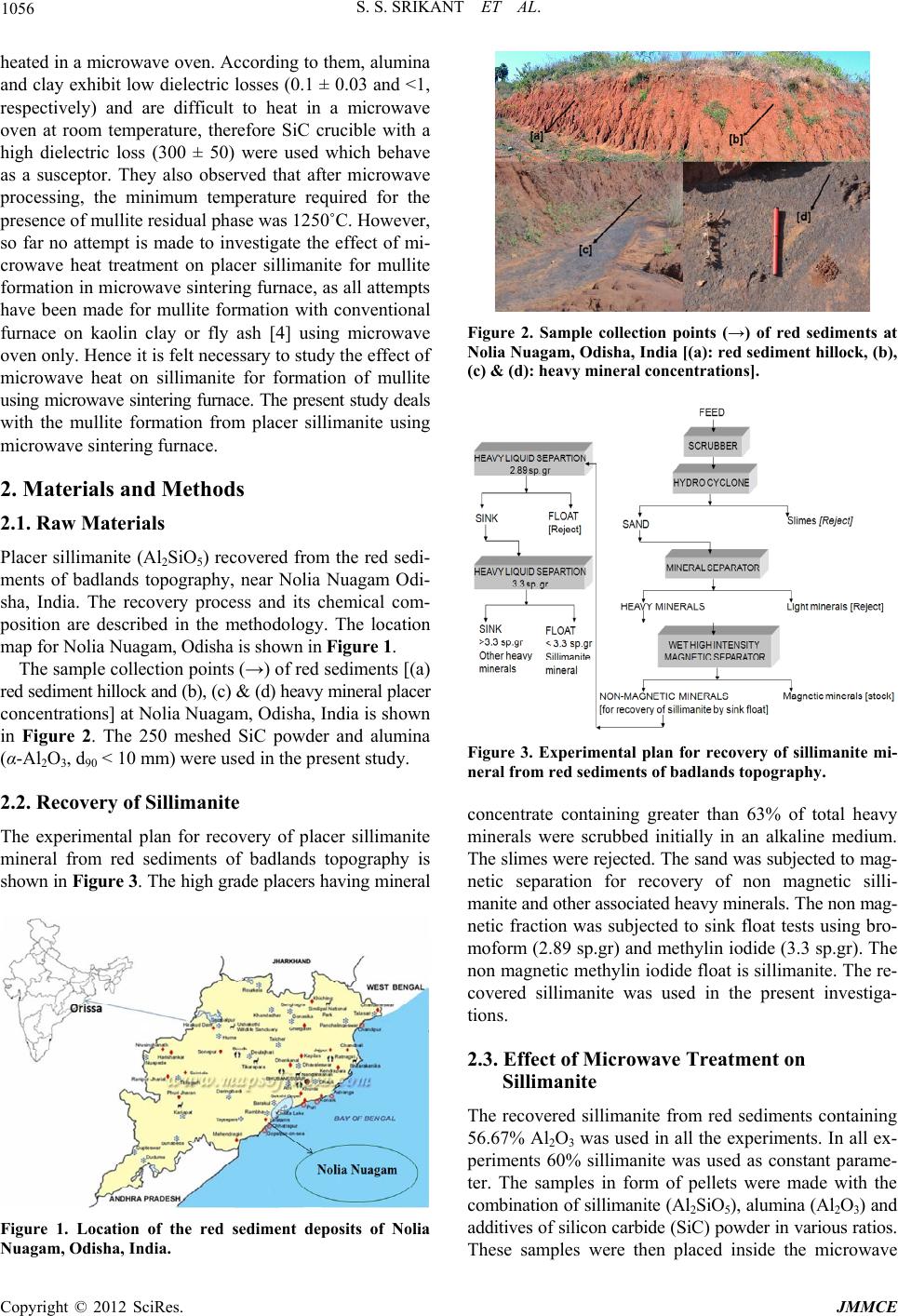 S. S. SRIKANT ET AL. 1056 heated in a microwave oven. According to them, alumina and clay exhibit low dielectric losses (0.1 ± 0.03 and <1, respectively) and are difficult to heat in a microwave oven at room temperature, therefore SiC crucible with a high dielectric loss (300 ± 50) were used which behave as a susceptor. They also observed that after microwave processing, the minimum temperature required for the presence of mullite residual phase was 1250˚C. However, so far no attempt is made to investigate the effect of mi- crowave heat treatment on placer sillimanite for mullite formation in microwave sintering furnace, as all attempts have been made for mullite formation with conventional furnace on kaolin clay or fly ash [4] using microwave oven only. Hence it is felt necessary to study the effect of microwave heat on sillimanite for formation of mullite using microwave sintering furnace. The present study deals with the mullite formation from placer sillimanite using microwave sintering furnace. 2. Materials and Methods 2.1. Raw Materials Placer sillimanite (Al2SiO5) recovered from the red sedi- ments of badlands topography, near Nolia Nuagam Odi- sha, India. The recovery process and its chemical com- position are described in the methodology. The location map for Nolia Nuagam, Odisha is shown in Figure 1. The sample collection points (→) of red sediments [(a) red sediment hillock and (b), (c) & (d) heavy mineral placer concentrations] at Nolia Nuagam, Odisha, India is shown in Figure 2. The 250 meshed SiC powder and alumina (α-Al2O3, d90 < 10 mm) were used in the present study. 2.2. Recovery of Sillimanite The experimental plan for recovery of placer sillimanite mineral from red sediments of badlands topography is shown in Figure 3. The high grade placers having mineral Figure 1. Location of the red sediment deposits of Nolia Nuagam, Odisha, India. Figure 2. Sample collection points (→) of red sediments at Nolia Nuagam, Odisha, India [(a): red sediment hillock, (b), (c) & (d): heavy mineral concentrations]. Figure 3. Experimental plan for recovery of sillimanite mi- neral from red sediments of badlands topography. concentrate containing greater than 63% of total heavy minerals were scrubbed initially in an alkaline medium. The slimes were rejected. The sand was subjected to mag- netic separation for recovery of non magnetic silli- manite and other associated heavy minerals. The non mag- netic fraction was subjected to sink float tests using bro- moform (2.89 sp.gr) and methylin iodide (3.3 sp.gr). The non magnetic methylin iodide float is sillimanite. The re- covered sillimanite was used in the present investiga- tions. 2.3. Effect of Microwave Treatment on Sillimanite The recovered sillimanite from red sediments containing 56.67% Al2O3 was used in all the experiments. In all ex- periments 60% sillimanite was used as constant parame- ter. The samples in form of pellets were made with the combination of sillimanite (Al2SiO5), alumina (Al2O3) and additives of silicon carbide (SiC) powder in various ratios. These samples were then placed inside the microwave Copyright © 2012 SciRes. JMMCE 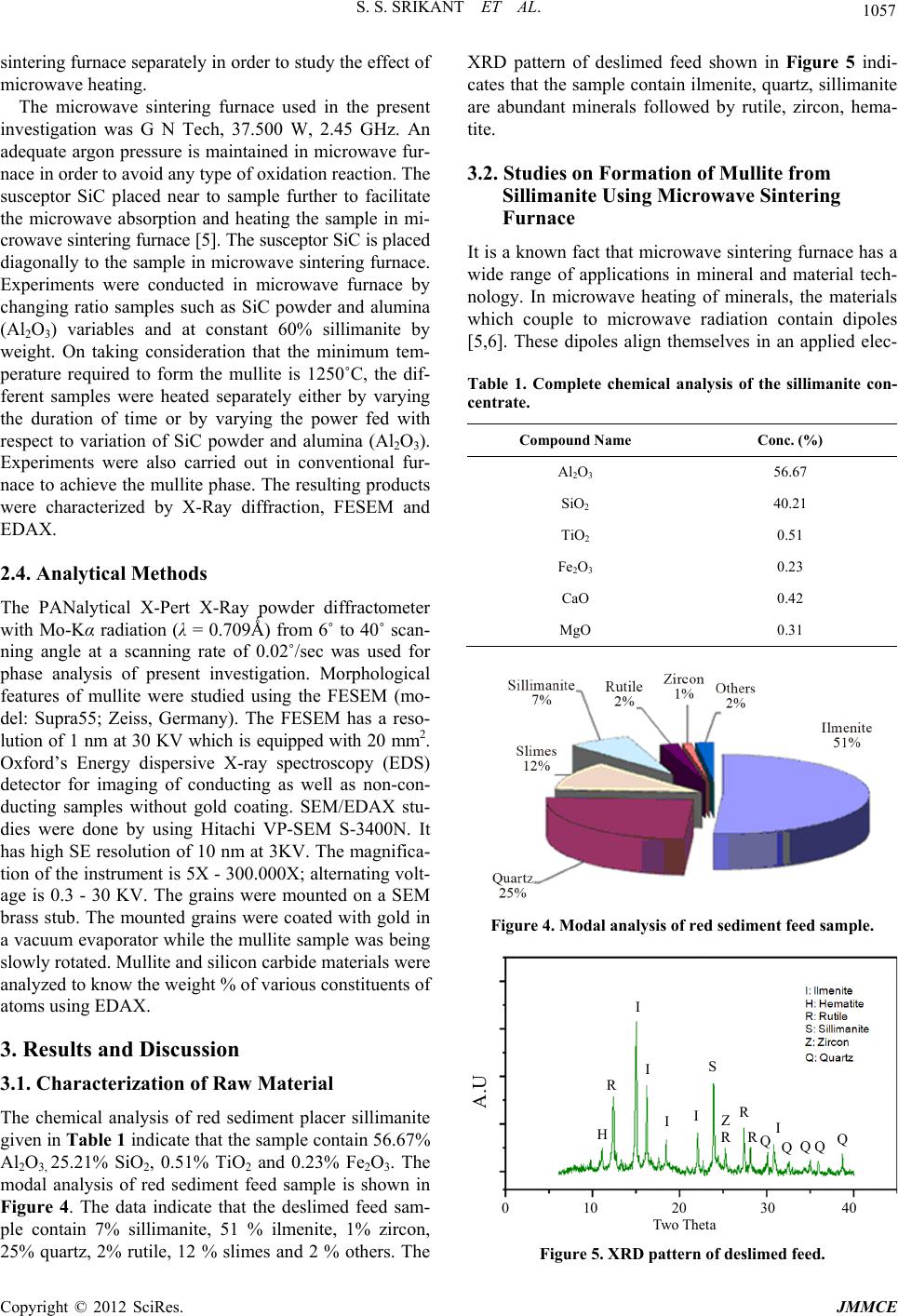 S. S. SRIKANT ET AL. 1057 sintering furnace separately in order to study the effect of microwave heating. The microwave sintering furnace used in the present investigation was G N Tech, 37.500 W, 2.45 GHz. An adequate argon pressure is maintained in microwave fur- nace in order to avoid any type of oxidation reaction. The susceptor SiC placed near to sample further to facilitate the microwave absorption and heating the sample in mi- crowave sintering furnace [5]. The susceptor SiC is placed diagonally to the sample in microwave sintering furnace. Experiments were conducted in microwave furnace by changing ratio samples such as SiC powder and alumina (Al2O3) variables and at constant 60% sillimanite by weight. On taking consideration that the minimum tem- perature required to form the mullite is 1250˚C, the dif- ferent samples were heated separately either by varying the duration of time or by varying the power fed with respect to variation of SiC powder and alumina (Al2O3). Experiments were also carried out in conventional fur- nace to achieve the mullite phase. The resulting products were characterized by X-Ray diffraction, FESEM and EDAX. 2.4. Analytical Methods The PANalytical X-Pert X-Ray powder diffractometer with Mo-Kα radiation (λ = 0.709Ǻ) from 6˚ to 40˚ scan- ning angle at a scanning rate of 0.02˚/sec was used for phase analysis of present investigation. Morphological features of mullite were studied using the FESEM (mo- del: Supra55; Zeiss, Germany). The FESEM has a reso- lution of 1 nm at 30 KV which is equipped with 20 mm2. Oxford’s Energy dispersive X-ray spectroscopy (EDS) detector for imaging of conducting as well as non-con- ducting samples without gold coating. SEM/EDAX stu- dies were done by using Hitachi VP-SEM S-3400N. It has high SE resolution of 10 nm at 3KV. The magnifica- tion of the instrument is 5X - 300.000X; alternating volt- age is 0.3 - 30 KV. The grains were mounted on a SEM brass stub. The mounted grains were coated with gold in a vacuum evaporator while the mullite sample was being slowly rotated. Mullite and silicon carbide materials were analyzed to know the weight % of various constituents of atoms using EDAX. 3. Results and Discussion 3.1. Characterization of Raw Material The chemical analysis of red sediment placer sillimanite given in Table 1 indicate that the sample contain 56.67% Al2O3, 25.21% SiO2, 0.51% TiO2 and 0.23% Fe2O3. The modal analysis of red sediment feed sample is shown in Figure 4. The data indicate that the deslimed feed sam- ple contain 7% sillimanite, 51 % ilmenite, 1% zircon, 25% quartz, 2% rutile, 12 % slimes and 2 % others. The XRD pattern of deslimed feed shown in Figure 5 indi- cates that the sample contain ilmenite, quartz, sillimanite are abundant minerals followed by rutile, zircon, hema- tite. 3.2. Studies on Formation of Mullite from Sillimanite Using Microwave Sintering Furnace It is a known fact that microwave sintering furnace has a wide range of applications in mineral and material tech- nology. In microwave heating of minerals, the materials which couple to microwave radiation contain dipoles [5,6]. These dipoles align themselves in an applied elec- Table 1. Complete chemical analysis of the sillimanite con- centrate. Compound Name Conc. (%) Al2O3 56.67 SiO2 40.21 TiO2 0.51 Fe2O3 0.23 CaO 0.42 MgO 0.31 Figure 4. Modal analysis of red sediment feed sample. H R I I II S Z R R R Q I Q Q QQ 0 10 20 30 40 Two Theta A.U Figure 5. XRD pattern of deslimed feed. Copyright © 2012 SciRes. JMMCE 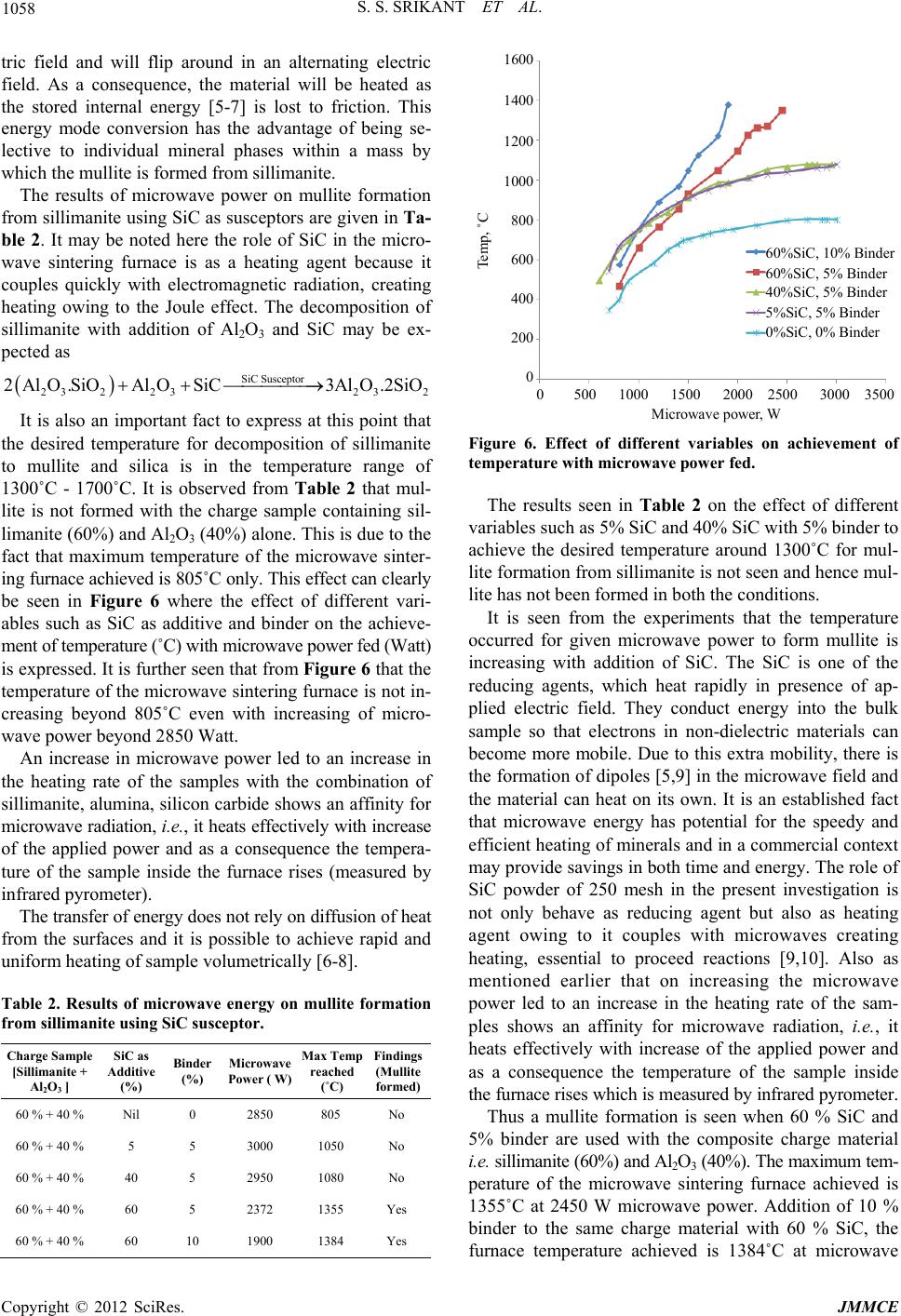 S. S. SRIKANT ET AL. 1058 tric field electric rmation fr and will flip around in an alternating field. As a consequence, the material will be heated as the stored internal energy [5-7] is lost to friction. This energy mode conversion has the advantage of being se- lective to individual mineral phases within a mass by which the mullite is formed from sillimanite. The results of microwave power on mullite fo om sillimanite using SiC as susceptors are given in Ta- ble 2. It may be noted here the role of SiC in the micro- wave sintering furnace is as a heating agent because it couples quickly with electromagnetic radiation, creating heating owing to the Joule effect. The decomposition of sillimanite with addition of Al2O3 and SiC may be ex- pected as SiC Susceptor 23 223232 2Al O .SiOAl OSiC3Al O .2SiO It is also an important fact to express at this point that th er led to an increase in th gy does not rely on diffusion of heat fr able 2. Results of microwave energy on mullite formation Additive Binder Microwave Max Temp Findings e desired temperature for decomposition of sillimanite to mullite and silica is in the temperature range of 1300˚C - 1700˚C. It is observed from Table 2 that mul- lite is not formed with the charge sample containing sil- limanite (60%) and Al2O3 (40%) alone. This is due to the fact that maximum temperature of the microwave sinter- ing furnace achieved is 805˚C only. This effect can clearly be seen in Figure 6 where the effect of different vari- ables such as SiC as additive and binder on the achieve- ment of temperature (˚C) with microwave power fed (Watt) is expressed. It is further seen that from Figure 6 that the temperature of the microwave sintering furnace is not in- creasing beyond 805˚C even with increasing of micro- wave power beyond 2850 Watt. An increase in microwave pow e heating rate of the samples with the combination of sillimanite, alumina, silicon carbide shows an affinity for microwave radiation, i.e., it heats effectively with increase of the applied power and as a consequence the tempera- ture of the sample inside the furnace rises (measured by infrared pyrometer). The transfer of ener om the surfaces and it is possible to achieve rapid and uniform heating of sample volumetrically [6-8]. T from sillimanite using SiC susceptor. Charge Sample SiC as [Sillimanite + Al2O3 ] (%) (%) Power ( W) reached (˚C) (Mullite formed) 60 0 2850 % + 40 %Nil 805 No 60 % + 40 % 5 5 3000 1600 1400 1200 1000 800 600 400 200 0 60%SiC, 10% Binder 60%SiC, 5% Binder 40%SiC, 5% Binder 5%SiC, 5% Binder 0%SiC, 0% Binder 0 500 1000 1500 2000 2500 3000 3500 Microwave p ower, W Temp, ˚C Figure 6. Effect of different variables on achievement o ffect of different a f temperature with microwave power fed. The results seen in Table 2 on the e vriables such as 5% SiC and 40% SiC with 5% binder to achieve the desired temperature around 1300˚C for mul- lite formation from sillimanite is not seen and hence mul- lite has not been formed in both the conditions. It is seen from the experiments that the temperature occurred for given microwave power to form mullite is increasing with addition of SiC. The SiC is one of the reducing agents, which heat rapidly in presence of ap- plied electric field. They conduct energy into the bulk sample so that electrons in non-dielectric materials can become more mobile. Due to this extra mobility, there is the formation of dipoles [5,9] in the microwave field and the material can heat on its own. It is an established fact that microwave energy has potential for the speedy and efficient heating of minerals and in a commercial context may provide savings in both time and energy. The role of SiC powder of 250 mesh in the present investigation is not only behave as reducing agent but also as heating agent owing to it couples with microwaves creating heating, essential to proceed reactions [9,10]. Also as mentioned earlier that on increasing the microwave power led to an increase in the heating rate of the sam- ples shows an affinity for microwave radiation, i.e., it heats effectively with increase of the applied power and as a consequence the temperature of the sample inside the furnace rises which is measured by infrared pyrometer. Thus a mullite formation is seen when 60 % SiC and 5% binder are used with the composite charge material i.e. sillimanite (60%) and Al2O3 (40%). The maximum tem- perature of the microwave sintering furnace achieved is 1355˚C at 2450 W microwave power. Addition of 10 % binder to the same charge material with 60 % SiC, the furnace temperature achieved is 1384˚C at microwave 10 10 50 No 60 % + 40 % 40 5 2950 1080 No 60 % + 40 % 60 5 2372 1355 Yes 60 % + 40 % 60 1900 1384 Yes Copyright © 2012 SciRes. JMMCE 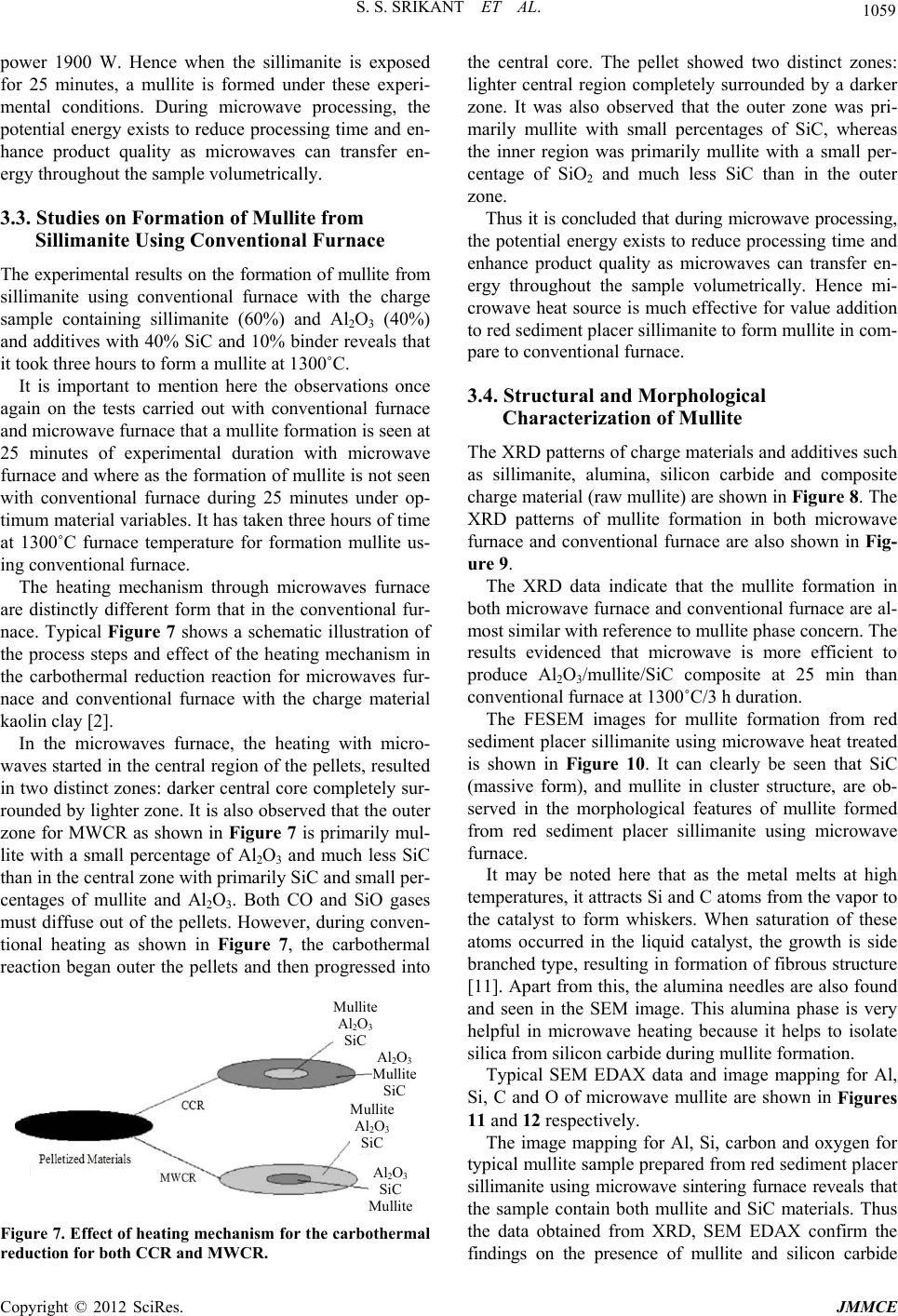 S. S. SRIKANT ET AL. 1059 power 1900 W. Hence when the sillimanite is exposed for 25 minutes, a mullite is formed under these experi- mental conditions. During microwave processing, the potential energy exists to reduce processing time and en- hance product quality as microwaves can transfer en- ergy throughout the sample volumetrically. 3.3. Studies on Formation of Mullite from Sillimanite Using Conventional Furnace from sillim arge l furnace an that in the conventional fur- na central region of the pellets, resulted in The experimental results on the formation of mullite anite using conventional furnace with the ch sample containing sillimanite (60%) and Al2O3 (40%) and additives with 40% SiC and 10% binder reveals that it took three hours to form a mullite at 1300˚C. It is important to mention here the observations once again on the tests carried out with conventiona d microwave furnace that a mullite formation is seen at 25 minutes of experimental duration with microwave furnace and where as the formation of mullite is not seen with conventional furnace during 25 minutes under op- timum material variables. It has taken three hours of time at 1300˚C furnace temperature for formation mullite us- ing conventional furnace. The heating mechanism through microwaves furnace are distinctly different form ce. Typical Figure 7 shows a schematic illustration of the process steps and effect of the heating mechanism in the carbothermal reduction reaction for microwaves fur- nace and conventional furnace with the charge material kaolin clay [2]. In the microwaves furnace, the heating with micro- waves started in the two distinct zones: darker central core completely sur- rounded by lighter zone. It is also observed that the outer zone for MWCR as shown in Figure 7 is primarily mul- lite with a small percentage of Al2O3 and much less SiC than in the central zone with primarily SiC and small per- centages of mullite and Al2O3. Both CO and SiO gases must diffuse out of the pellets. However, during conven- tional heating as shown in Figure 7, the carbothermal reaction began outer the pellets and then progressed into Mullit e Al O the central core. The pellet showed two distinct zones: lighter central region completely surrounded by a darker zone. It was also observed that the outer zone was pri- marily mullite with small percentages of SiC, whereas the inner region was primarily mullite with a small per- centage of SiO2 and much less SiC than in the outer zone. Thus it is concluded that during microwave processing, the pot 2 3 SiC Al 2 O 3 Mulli t e SiC Mullite Al 2 O 3 SiC Al 2 O 3 SiC Mulli t e Figure 7. Effect of heating mechanism for the carbothermal reduction for both CCR and MWCR. additives such as silliposite s, it attracts Si and C atoms from the vapor to th ential energy exists to reduce processing time and enhance product quality as microwaves can transfer en- ergy throughout the sample volumetrically. Hence mi- crowave heat source is much effective for value addition to red sediment placer sillimanite to form mullite in com- pare to conventional furnace. 3.4. Structural and Morphological Characterization of Mullite The XRD patterns of charge materials and manite, alumina, silicon carbide and com charge material (raw mullite) are shown in Figure 8. The XRD patterns of mullite formation in both microwave furnace and conventional furnace are also shown in Fig- ure 9. The XRD data indicate that the mullite formation in both microwave furnace and conventional furnace are al- most similar with reference to mullite phase concern. The results evidenced that microwave is more efficient to produce Al2O3/mullite/SiC composite at 25 min than conventional furnace at 1300˚C/3 h duration. The FESEM images for mullite formation from red sediment placer sillimanite using microwave heat treated is shown in Figure 10. It can clearly be seen that SiC (massive form), and mullite in cluster structure, are ob- served in the morphological features of mullite formed from red sediment placer sillimanite using microwave furnace. It may be noted here that as the metal melts at high temperature e catalyst to form whiskers. When saturation of these atoms occurred in the liquid catalyst, the growth is side branched type, resulting in formation of fibrous structure [11]. Apart from this, the alumina needles are also found and seen in the SEM image. This alumina phase is very helpful in microwave heating because it helps to isolate silica from silicon carbide during mullite formation. Typical SEM EDAX data and image mapping for Al, Si, C and O of microwave mullite are shown in Figures 11 and 12 respectively. The image mapping for Al, Si, carbon and oxygen for typical mullite sample prepared from red sediment placer sillimanite using microwave sintering furnace reveals that the sample contain both mullite and SiC materials. Thus the data obtained from XRD, SEM EDAX confirm the findings on the presence of mullite and silicon carbide Copyright © 2012 SciRes. JMMCE 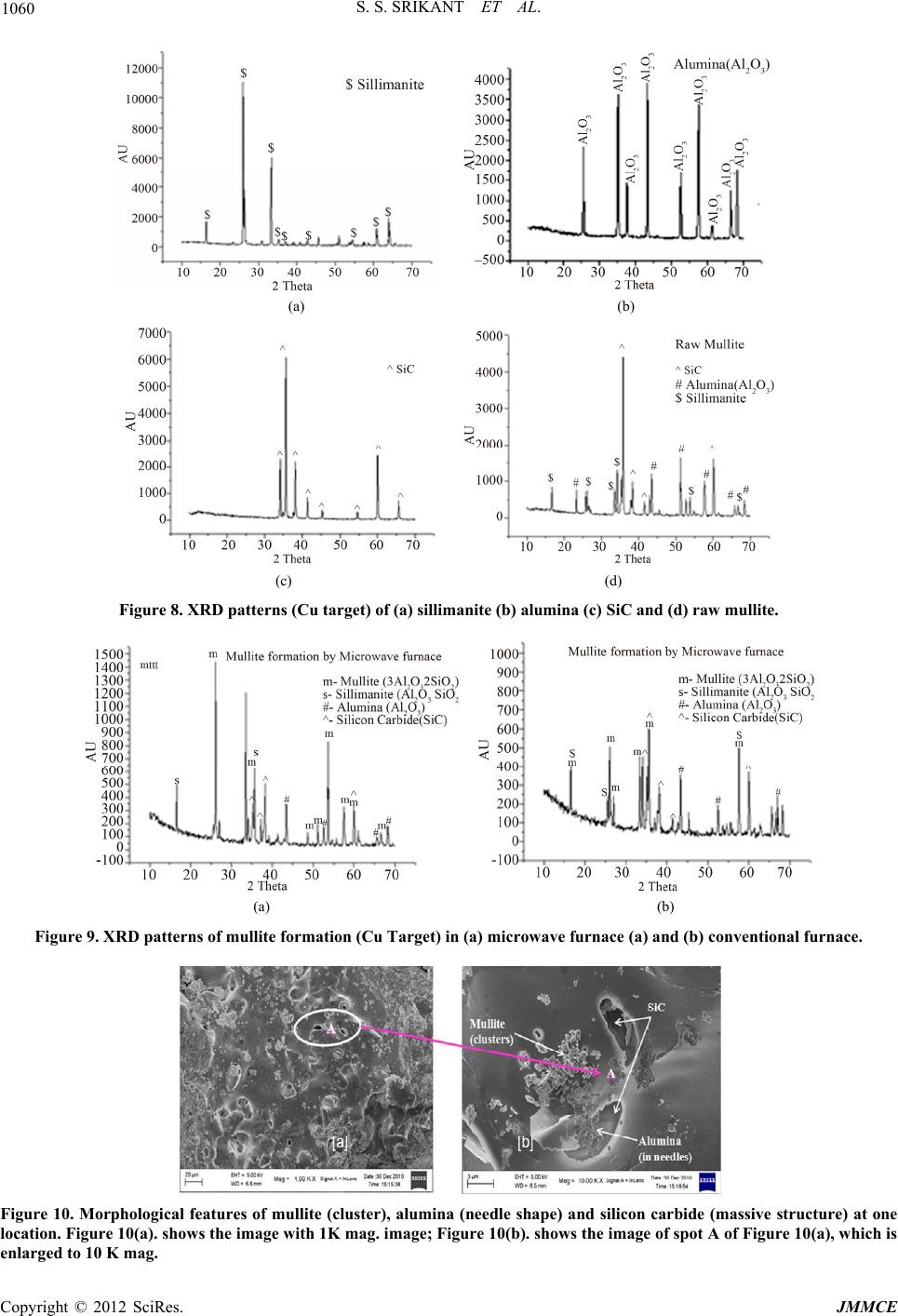 S. S. SRIKANT ET AL. Copyright © 2012 SciRes. JMMCE 1060 (a) (b) (c) (d) Figure 8. XRD patterns (Cu target) of (a) sillimanite (b) alumina (c) SiC and (d) raw mullite . (a) (b) Figure 9. XRD patterns of mul) conventional face. lite formation (Cu Target) inrowave furnace (a) and (b (a) micurn Figure 10. Morphological features of mullite (cluster), alumina (needle shape) and silicon carbide (massive structure) at one location. Figure 10(a). shows the image with 1K mag. image; Figure 10(b). shows the image of spot A of Figure 10(a), which is enlarged to 10 K mag. 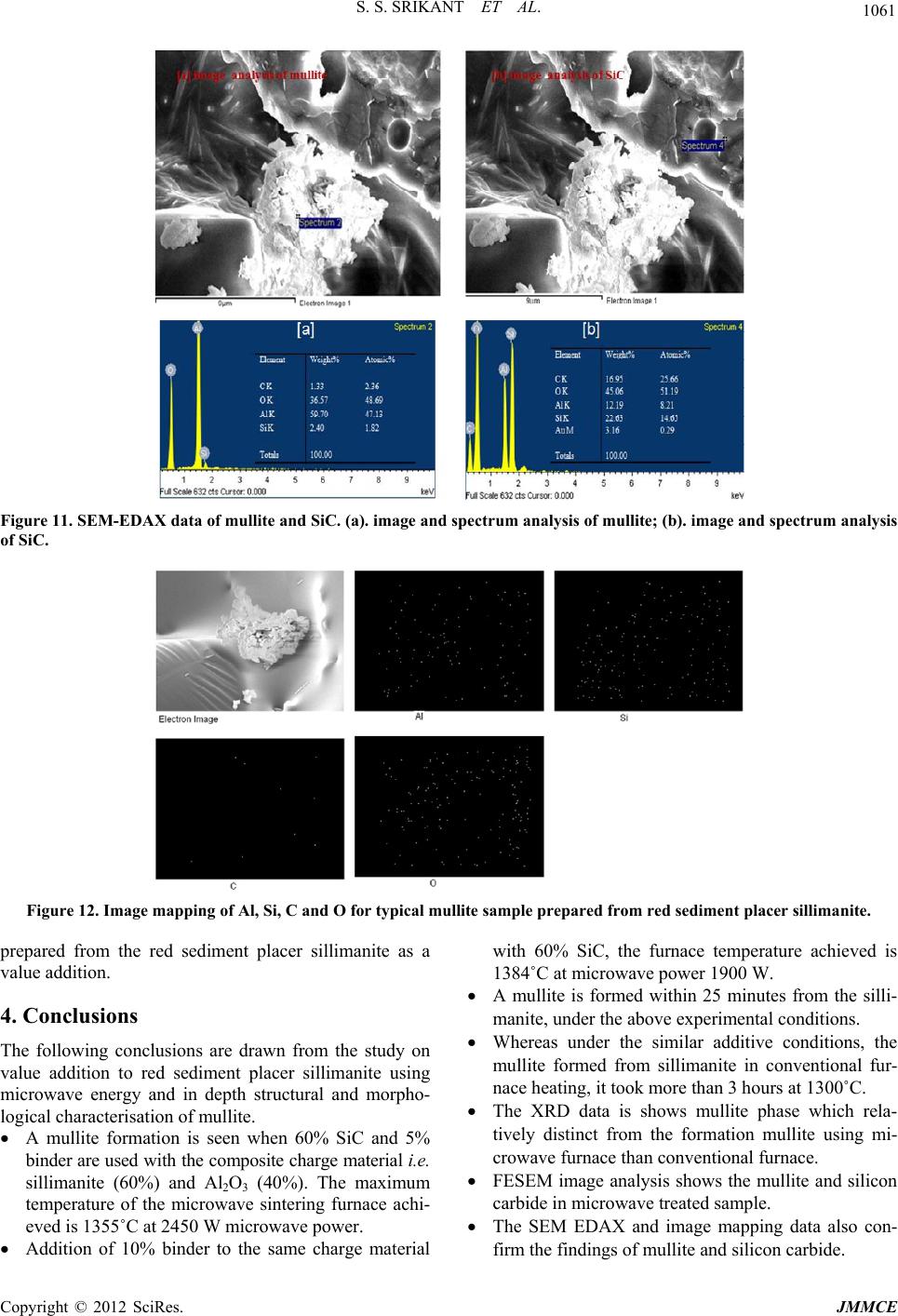 S. S. SRIKANT ET AL. 1061 Figure 11. SEM-EDAX data of mullite and SiC. (a). image and spectrum analysis of mullite; (b). image and spectrum analysis of SiC. Figure 12. Image mapping of Al, Si, C and O for typical mullite sample prepared from red sediment placer sillimanite. prepared from the red sediment placer sillimanite as a al The following conclusions are drawn from the stud ed sediment placer sillimanite using with 60% SiC, the furnace temhieved is vue addition. 1384˚C at microwave power 1900 W. 4. Conclusions y on Whereas under the similar additive conditions, the mullite formed from sillimanite in conventional fur- nace heating, it took more than 3 hours at 1300˚C. value addition to r microwave energy and in depth structural and morpho- logical characterisation of mullite. A mullite formation is seen when 60% SiC and 5% binder are used with the composite charge material i.e. sillimanite (60%) and AlO (4 2 30%). The maximum temperature of the microwave sintering furnace achi- eved is 1355˚C at 2450 W microwave power. Addition of 10% binder to the same charge material A mullite is formed within 25 minutes from the silli- manite, under the above experimental conditions. perature ac The XRD data is shows mullite phase which rela- tively distinct from the formation mullite using mi- crowave furnace than conventional furnace. FESEM image analysis shows the mullite and silicon carbide in microwave treated sample. The SEM EDAX and image mapping data also con- firm the findings of mullite and silicon carbide. Copyright © 2012 SciRes. JMMCE 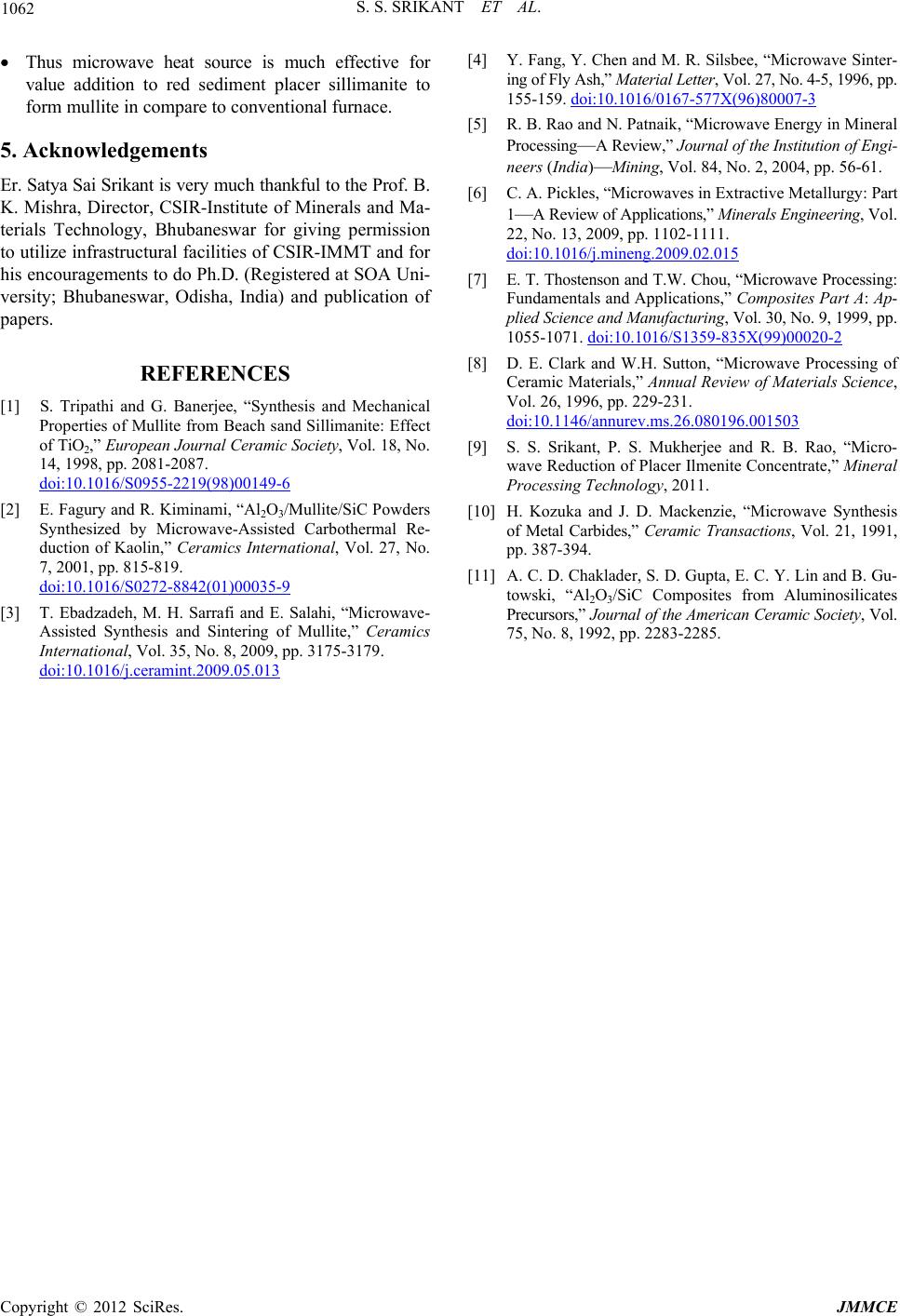 S. S. SRIKANT ET AL. 1062 Thus microwave heat source is much effective for value addition to red sediment placer sillimanite to for (Registered at SOA a, India) and publication of 1998, pp. 2081-2087. doi:10.1016/S0955-2219(98)00149-6 form mullite in compare to conventional furnace. 5. Acknowledgements . Satya Sai Srikant is very much thankful to the ProErf. B. K. Mishra, Director, CSIR-Institute of Minerals and Ma- terials Technology, Bhubaneswar for giving permission to utilize infrastructural facilities of CSIR-IMMT and his encouragements to do Ph.D. versity; Bhubaneswar, Odish Uni- papers. REFERENCES [1] S. Tripathi and G. Banerjee, “Synthesis and Mechanical Properties of Mullite from Beach sand Sillimanite: Effect of TiO2,” European Journal Ceramic Society, Vol. 18, No. 14, [2] E. Fagury andullite/SiC Powders Synthesized bthermal Re- R. Kiminami, “Al2O3/M y Microwave-Assisted Carbo duction of Kaolin,” Ceramics International, Vol. 27, No. 7, 2001, pp. 815-819. doi:10.1016/S0272-8842(01)00035-9 [3] T. Ebadzadeh, M. H. Sarrafi and E. S Assisted Synthesis and Sintering of alahi, “Microwave- Mullite,” Ceramics International, Vol. 35, No. 8, 2009, pp. 3175-3179. doi:10.1016/j.ceramint.2009.05.013 [4] Y. Fang, Y. Chen and M. R. Silsbee, “Microwave Sinter- ing of Fly Ash,” Material Letter, Vol. 27, No. 4-5, 1996, pp. 155-159. doi:10.1016/0167-577X(96)80007-3 [5] R. B. Rao and N. Patnaik, “Microwave Energy in Mineral Processing—A Review,” Journal of the Institution of Engi- neers (India)—Mining, Vol. 84, No. 2, 2004, pp. 56-61. C. A. Pickles, “Microwaves in Extractive Metal[6] lurgy: Part 1—A Review of Applications,” Minerals Engineering, Vol. 22, No. 13, 2009, pp. 1102-1111. doi:10.1016/j.mineng.2009.02.015 [7] E. T. Thostenson and T.W. Chou, “Microwave Processing: Fundamentals and Applications,” Composites Part A: Ap- plied Science and Manufacturing, Vo 1055-1071. l. 30, No. 9, 1999, pp. X(99)00020-2doi:10.1016/S1359-835 [8] D. E. Clark and W.H. Sutton, “Microwave Processing of Ceramic Materials,” Annual Review of Materials Science, Vol. 26, 1996, pp. 229-231. doi:10.1146/annurev.ms.26.080196.001503 [9] S. S. Srikant, P. S. Mukherjee and R. B. Rao, “Micro- wave Reduction of Placer Ilmenite Concentrate,” Mineral Processing Technology, 2011. [10] H. Kozuka and J. D. Mackenzie, “Microwa ve Synthesis a, E. C. Y. Lin and B. Gu- , pp. 2283-2285. of Metal Carbides,” Ceramic Transactions, Vol. 21, 1991, pp. 387-394. [11] A. C. D. Chaklader, S. D. Gupt towski, “Al2O3/SiC Composites from Aluminosilicates Precursors,” Journal of the American Ceramic Society, Vol. 75, No. 8, 1992 Copyright © 2012 SciRes. JMMCE |