

Paper Menu >>
Journal Menu >>
 Atmospheric and Climate Sciences, 2012, 2, 518-524 http://dx.doi.org/10.4236/acs.2012.24046 Published Online October 2012 (http://www.SciRP.org/journal/acs) Interannual Variability of Energy Flux in Atmospheric Instability Conditions at Pantanal of Mato Grosso-Brazil Leone Francisco Amorim Curado, José de Souza Nogueira, Luciana Sanches, Marcelo Sacardis Biudes, Thiago Rangel Rodrigues Programa de Pós-Graduação em Física Ambiental-UFMT, Brazil Email: [email protected] Received July 25, 2012; revised August 27, 2012; accepted September 7, 2012 ABSTRACT The energy balance partitions in wetlands have gained notoriety due to the dynamics and importance of these areas for regional and local climate. Thus, the study was conducted about seasonal and interannual behavior energy fluxes, as well as the influences of the conditions of atmospheric stability and instability. The results showed highest fluxes happened in instability atmospheric conditions. The fluxes of latent and sensible heat showed seasonal variation, indicating that the water availability in the atmosphere has influence on the site energy partition, but the interannual patterns remained similar during the two years of study. Keywords: Latent Heat; Sensible Heat; Energy Partition; Wetlands 1. Introduction The flood pulse is considered the driving force of the Pantanal and the intensification of the season of dry and wet seasons are the result of multi-annual fluctuations in water level that influence the limnological seasonal char- acteristics, ecological and biological [1]. October months are the rains begin and it finish between February and May, July and August are characterized as dry months in this region, often causing hidric stress to the plants [2]. Vochysiadivergens is considered an invasive species in Pantanal having a good adapting in flood area. This species incursion in the Pantanal happened in the early 70 s, after the end of an intense and multi-annual period of dry [3]. In not flooded areas the presence of Vochy- siadivergens is rare or absent, but present a better devel- opment in newly sedimented areas along rivers [4]. In wetlands, there is no problem with this species, but when it reaches the highest parts of Pantanal and advancing toward fields forming forests, it becomes a problem, be- cause it occupies Pasture areas [5]. The apparent cause of the spread of the species in the region may be related to the alternation of major floods and droughts that occur in the Pantanal and also by de- forestation caused by livestock farmers in the region, increasing the area available for the plant to establish. These factors can cause shrinkage of native vegetation and increases in populations of this species, giving the vegetation an irregular character in time and space than may lead to short and medium term changes in Pantanal region climate [3]. The flux of latent and sensible heat can be obtained by micrometeorological methods, direct and indirect (esti- mated), the last one having the advantage of not altering the environment. For direct measurement methods has the eddy covariance system, which takes into considera- tion the fluctuation of the concentration of water vapor, temperature and fluctuation of wind speed to calculate- ing the flux and latent heat sensitive respectively [6,7]. The advantage of using direct measures is that small fluc- tuations in very low intervals of time are obtained, the disadvantage is the value for the acquisition of the equip- ment. The LE and H quantification by Bowen ratio method have been widely used in the last decade, for determining the energy balance in many studies about the energy dy- namics of forest and the management availability of wa- ter for certain crops by evapo transpiration estimated by the latent heat flux [8-12]. The atmospheric stability can be defined as a condition in which atmospheric air upward movements are absent or permanently inhibited, whereas the condition of insta- bility is defined as the atmospheric state in which prevail the vertical movements. The characterization of these atmospheric conditions is realized according to the tem- perature distribution of air, i.e., an air layer is considered stable or unstable depending on the value of vertical temperature gradient observed in the layer. It should also consider the situation in which the vertical temperature C opyright © 2012 SciRes. ACS 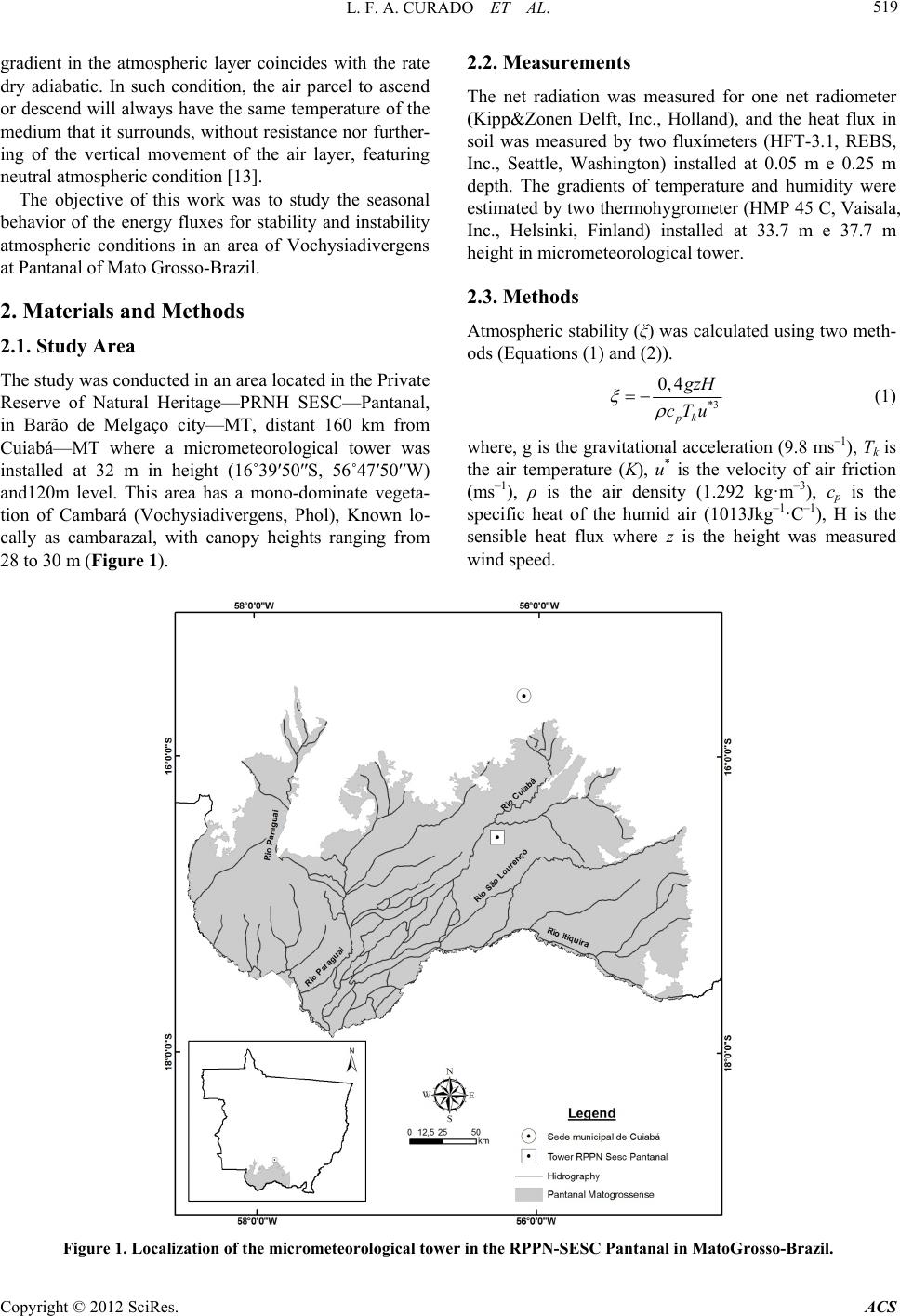 L. F. A. CURADO ET AL. 519 gradient in the atmospheric layer coincides with the rate dry adiabatic. In such condition, the air parcel to ascend or descend will always have the same temperature of the medium that it surrounds, without resistance nor further- ing of the vertical movement of the air layer, featuring neutral atmospheric condition [13]. The objective of this work was to study the seasonal behavior of the energy fluxes for stability and instability atmospheric conditions in an area of Vochysiadivergens at Pantanal of Mato Grosso-Brazil. 2. Materials and Methods 2.1. Study Area The study was conducted in an area located in the Private Reserve of Natural Heritage—PRNH SESC—Pantanal, in Barão de Melgaço city—MT, distant 160 km from Cuiabá—MT where a micrometeorological tower was installed at 32 m in height (16˚39′50″S, 56˚47′50″W) and120m level. This area has a mono-dominate vegeta- tion of Cambará (Vochysiadivergens, Phol), Known lo- cally as cambarazal, with canopy heights ranging from 28 to 30 m (Figure 1). 2.2. Measurements The net radiation was measured for one net radiometer (Kipp&Zonen Delft, Inc., Holland), and the heat flux in soil was measured by two fluxímeters (HFT-3.1, REBS, Inc., Seattle, Washington) installed at 0.05 m e 0.25 m depth. The gradients of temperature and humidity were estimated by two thermohygrometer (HMP 45 C, Vaisala, Inc., Helsinki, Finland) installed at 33.7 m e 37.7 m height in micrometeorological tower. 2.3. Methods Atmospheric stability (ξ) was calculated using two meth- ods (Equations (1) and (2)). *3 0,4 pk g zH cTu (1) where, g is the gravitational acceleration (9.8 ms–1), Tk is the air temperature (K), u* is the velocity of air friction (ms–1), ρ is the air density (1.292 kg·m–3), cp is the specific heat of the humid air (1013Jkg–1·C–1), H is the sensible heat flux where z is the height was measured wind speed. Figure 1. Localization of the micrometeorological tower in the RPPN-SESC Pantanal in MatoGrosso-Brazil. Copyright © 2012 SciRes. ACS 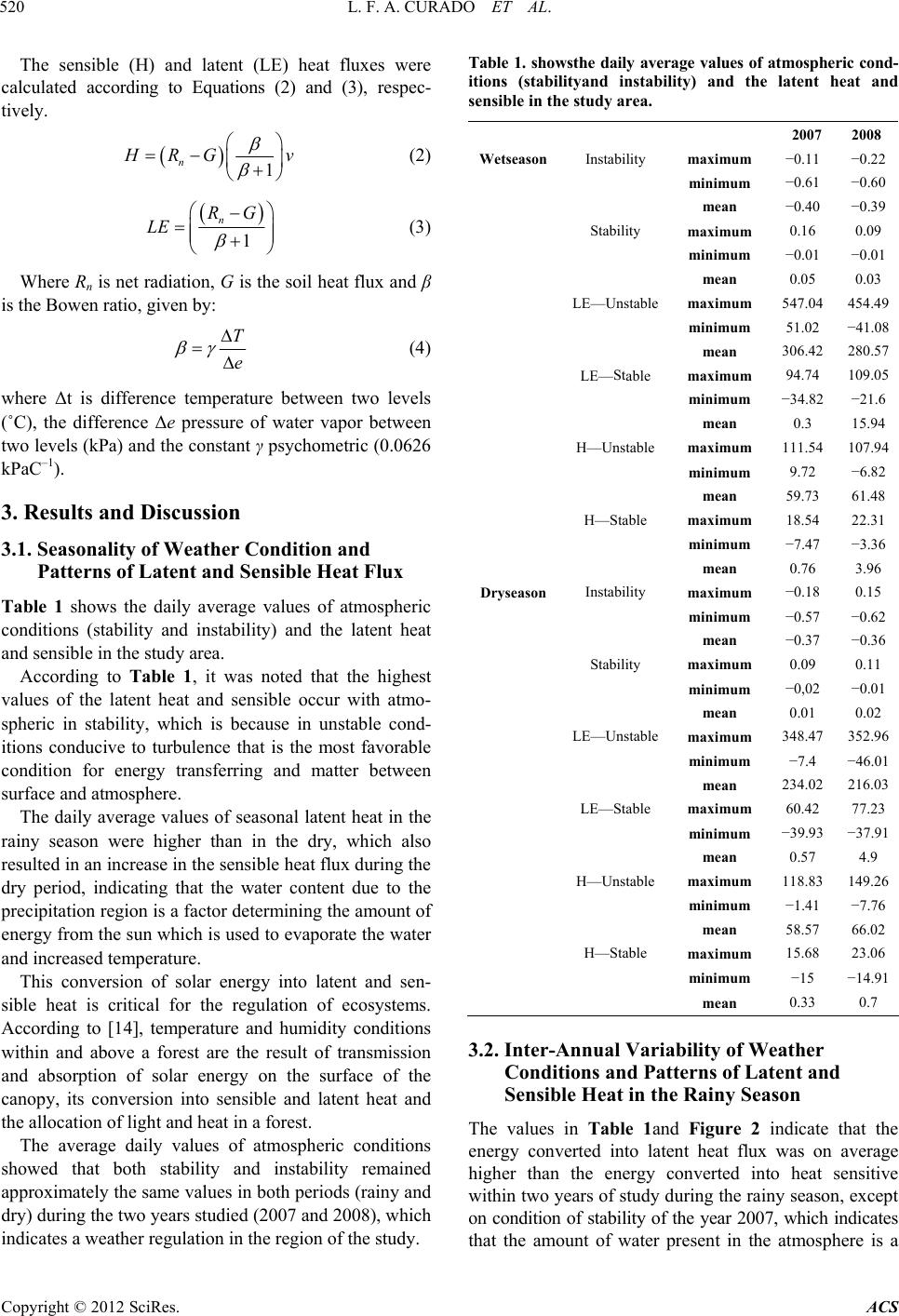 L. F. A. CURADO ET AL. 520 The sensible (H) and latent (LE) heat fluxes were calculated according to Equations (2) and (3), respec- tively. 1 n H RG v (2) 1 n RG LE (3) Where Rn is net radiation, G is the soil heat flux and β is the Bowen ratio, given by: T e (4) where Δt is difference temperature between two levels 3. Results and Discussion ondition and ux Tab ric as noted that the highest va es of seasonal latent heat in the rai energy into latent and sen- si ric conditions sh Table 1. showsthe daily average values of atmospheric cond- (˚C), the difference Δe pressure of water vapor between two levels (kPa) and the constant γ psychometric (0.0626 kPaC–1). 3.1. Seasonality of Weather C Patterns of Latent and Sensible Heat Fl le 1 shows the daily average values of atmosphe conditions (stability and instability) and the latent heat and sensible in the study area. According to Table 1, it w lues of the latent heat and sensible occur with atmo- spheric in stability, which is because in unstable cond- itions conducive to turbulence that is the most favorable condition for energy transferring and matter between surface and atmosphere. The daily average valu ny season were higher than in the dry, which also resulted in an increase in the sensible heat flux during the dry period, indicating that the water content due to the precipitation region is a factor determining the amount of energy from the sun which is used to evaporate the water and increased temperature. This conversion of solar ble heat is critical for the regulation of ecosystems. According to [14], temperature and humidity conditions within and above a forest are the result of transmission and absorption of solar energy on the surface of the canopy, its conversion into sensible and latent heat and the allocation of light and heat in a forest. The average daily values of atmosphe owed that both stability and instability remained approximately the same values in both periods (rainy and dry) during the two years studied (2007 and 2008), which indicates a weather regulation in the region of the study. itions (stabilityand instability) and the latent heat and sensible in the study area. 2007 2008 Wetseason Instability maximum −0.11 −0.22 Staity mi LE—U stable mi − LE—able mi H—Utable mi H—able mi Dryseason Instability mi Staity mi LE—U stable mi − LE—able mi H—Utable mi − H—able mi minimum −0.61 −0.60 mean −0.40 −0.39 bilmaximum 0.16 0.09 nimum −0.01 −0.01 mean 0.05 0.03 nmaximum 547.04 454.49 nimum 51.02 41.08 mean 306.42 280.57 Stmaximum 94.74 109.05 nimum −34.82 −21.6 mean 0.3 15.94 nsmaximum 111.54 107.94 nimum 9.72 −6.82 mean 59.73 61.48 Stmaximum 18.54 22.31 nimum −7.47 −3.36 mean 0.76 3.96 maximum −0.18 0.15 nimum −0.57 −0.62 mean −0.37 −0.36 bilmaximum 0.09 0.11 nimum −0,02 −0.01 mean 0.01 0.02 nmaximum 348.47 352.96 nimum −7.4 46.01 mean 234.02 216.03 Stmaximum 60.42 77.23 nimum −39.93 −37.91 mean 0.57 4.9 nsmaximum 118.83 149.26 nimum −1.41 7.76 mean 58.57 66.02 Stmaximum 15.68 23.06 nimum −15 −14.91 mean 0.33 0.7 3.2. Inter-Annual Variabil Wea Conditions and Patterns of Latent and The t the eneron average ity ofther Sensible Heat in the Rainy Season values in Table 1an d Figure 2 indicate tha gy converted into latent heat flux was higher than the energy converted into heat sensitive within two years of study during the rainy season, except on condition of stability of the year 2007, which indicates that the amount of water present in the atmosphere is a Copyright © 2012 SciRes. ACS 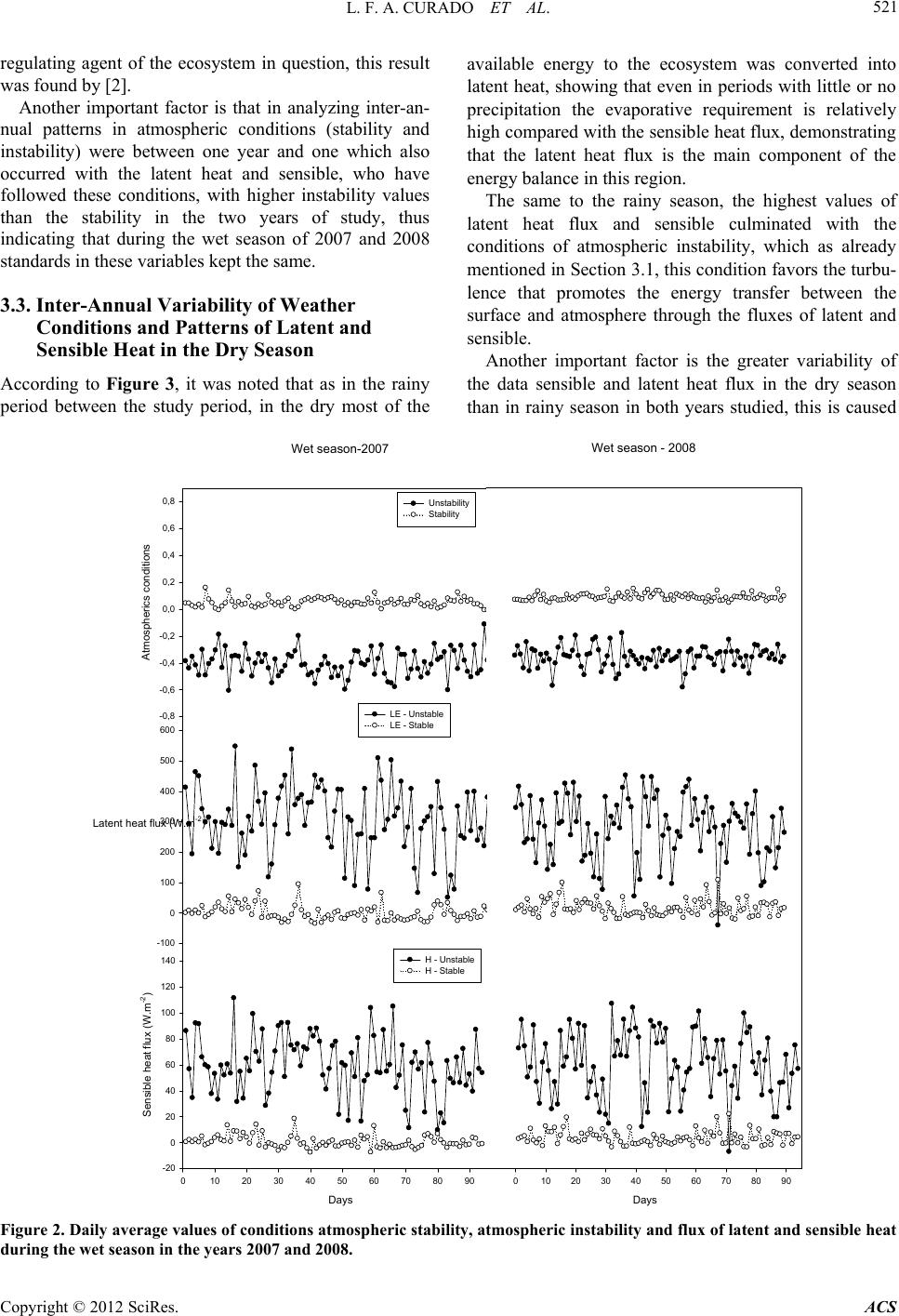 L. F. A. CURADO ET AL. 521 regulating agent of the ecosystem in question, this result was found by [2]. Another important factor is that in analyzing inter-an- nual patterns in atmospheric conditions (stability and in her Conditions and Patterns of Latent and Acco y perioy most of the stability) were between one year and one which also occurred with the latent heat and sensible, who have followed these conditions, with higher instability values than the stability in the two years of study, thus indicating that during the wet season of 2007 and 2008 standards in these variables kept the same. 3.3. Inter-Annual Variability of Weat Sensible Heat in the Dry Season rding to Figure 3, it was noted that as in the rain d between the study period, in the dr available energy to the ecosystem was converted into latent heat, showing that even in periods with little or no precipitation the evaporative requirement is relatively high compared with the sensible heat flux, demonstrating that the latent heat flux is the main component of the energy balance in this region. The same to the rainy season, the highest values of latent heat flux and sensible culminated with the conditions of atmospheric instability, which as already mentioned in Section 3.1, this condition favors the turbu- lence that promotes the energy transfer between the surface and atmosphere through the fluxes of latent and sensible. Another important factor is the greater variability of the data sensible and latent heat flux in the dry season than in rainy season in both years studied, this is caused Wet season - 2008 Wet season-2007 Atmosph erics conditions -0,8 -0,6 -0,4 -0,2 0,0 0,2 0,4 0,6 0,8 Unstability Stability Latent heat flux (W .m -2 ) LE - Unstable LE - Stable -100 0 100 200 300 400 500 600 Days 0 102030405060708090 Sensible heat flux (W.m -2 ) -20 0 20 40 60 80 100 120 140 H - Unstable H - Stable 0 102030405060708090 Days Figure 2. Daily average values of conditions atmospheric stability, atmospheric instability and flux of latent and sensible heat during the wet season in the years 2007 and 2008. Copyright © 2012 SciRes. ACS 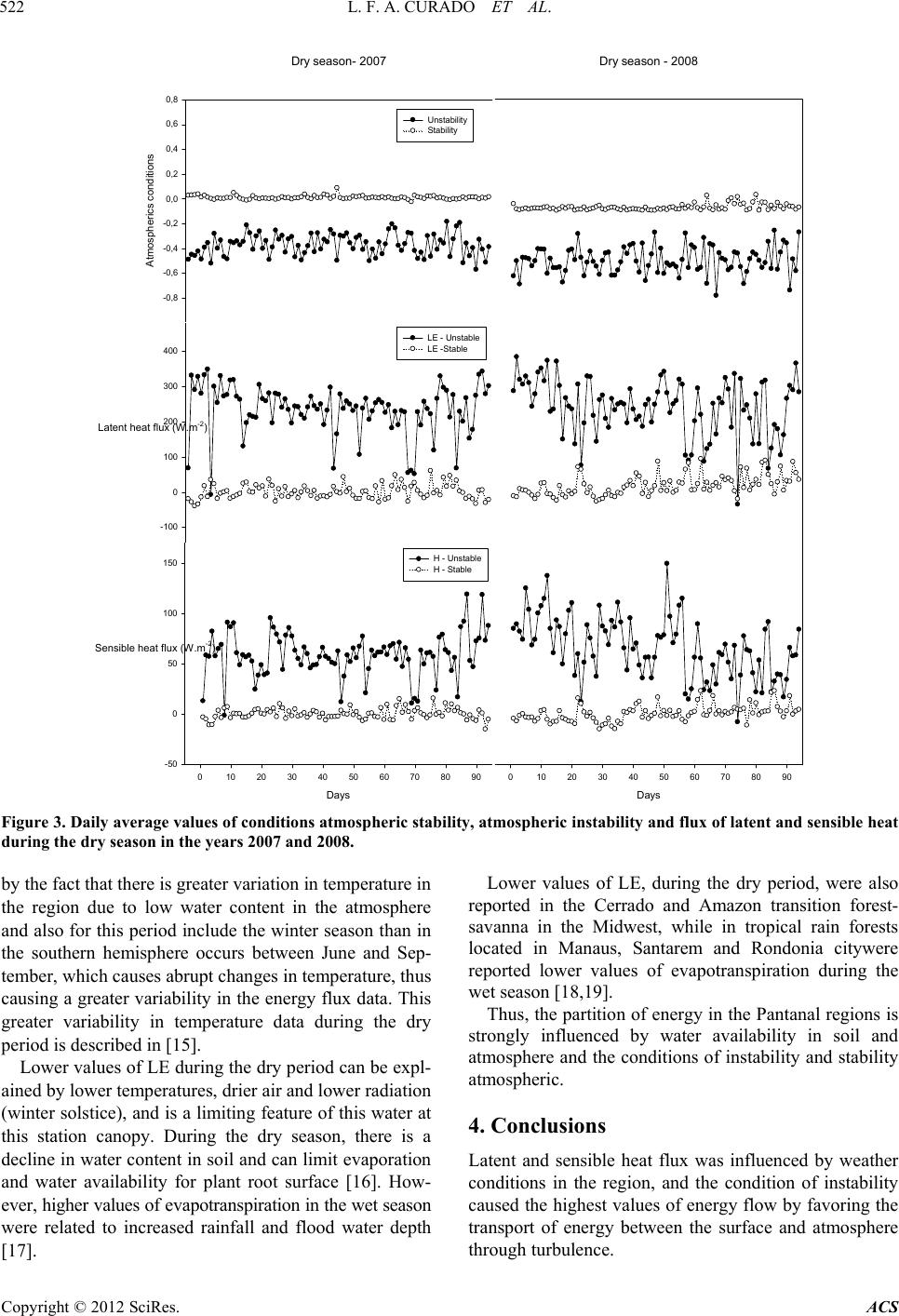 L. F. A. CURADO ET AL. 522 Dry season- 2007Dry season - 2008 -0,8 -0,6 -0,4 -0,2 0,0 0,2 0,4 0,6 0,8 Unstability Stability Atmospherics conditions Latent heat flux (W.m -2 ) LE - Unstable LE -Stable -100 0 100 200 300 400 Days 0 102030405060708090 Days 0 102030405060708090 Sensible heat flux (W .m -2 ) H - Unstable -50 0 50 100 150 H - Stable Figure 3. Daily average values of conditions atmospheric stability, atmospheric instability and flux of latent and sensible heat during the dry season in the years 2007 and 2008. mosphere , drier air and lower radiation [17]. reported in the Cerrado and Amazon transition forest- hest values of energy flow by favoring the between the surface and atmosphere by the fact that there is greater variation in temperature in e region due to low water content in the at Lower values of LE, during the dry period, were also th and also for this period include the winter season than in the southern hemisphere occurs between June and Sep- tember, which causes abrupt changes in temperature, thus causing a greater variability in the energy flux data. This greater variability in temperature data during the dry period is described in [15]. Lower values of LE during the dry period can be expl- ained by lower temperatures (winter solstice), and is a limiting feature of this water at this station canopy. During the dry season, there is a decline in water content in soil and can limit evaporation and water availability for plant root surface [16]. How- ever, higher values of evapotranspiration in the wet season were related to increased rainfall and flood water depth savanna in the Midwest, while in tropical rain forests located in Manaus, Santarem and Rondonia citywere reported lower values of evapotranspiration during the wet season [18,19]. Thus, the partition of energy in the Pantanal regions is strongly influenced by water availability in soil and atmosphere and the conditions of instability and stability atmospheric. 4. Conclusions Latent and sensible heat flux was influenced by weather conditions in the region, and the condition of instability caused the hig transport of energy through turbulence. Copyright © 2012 SciRes. ACS 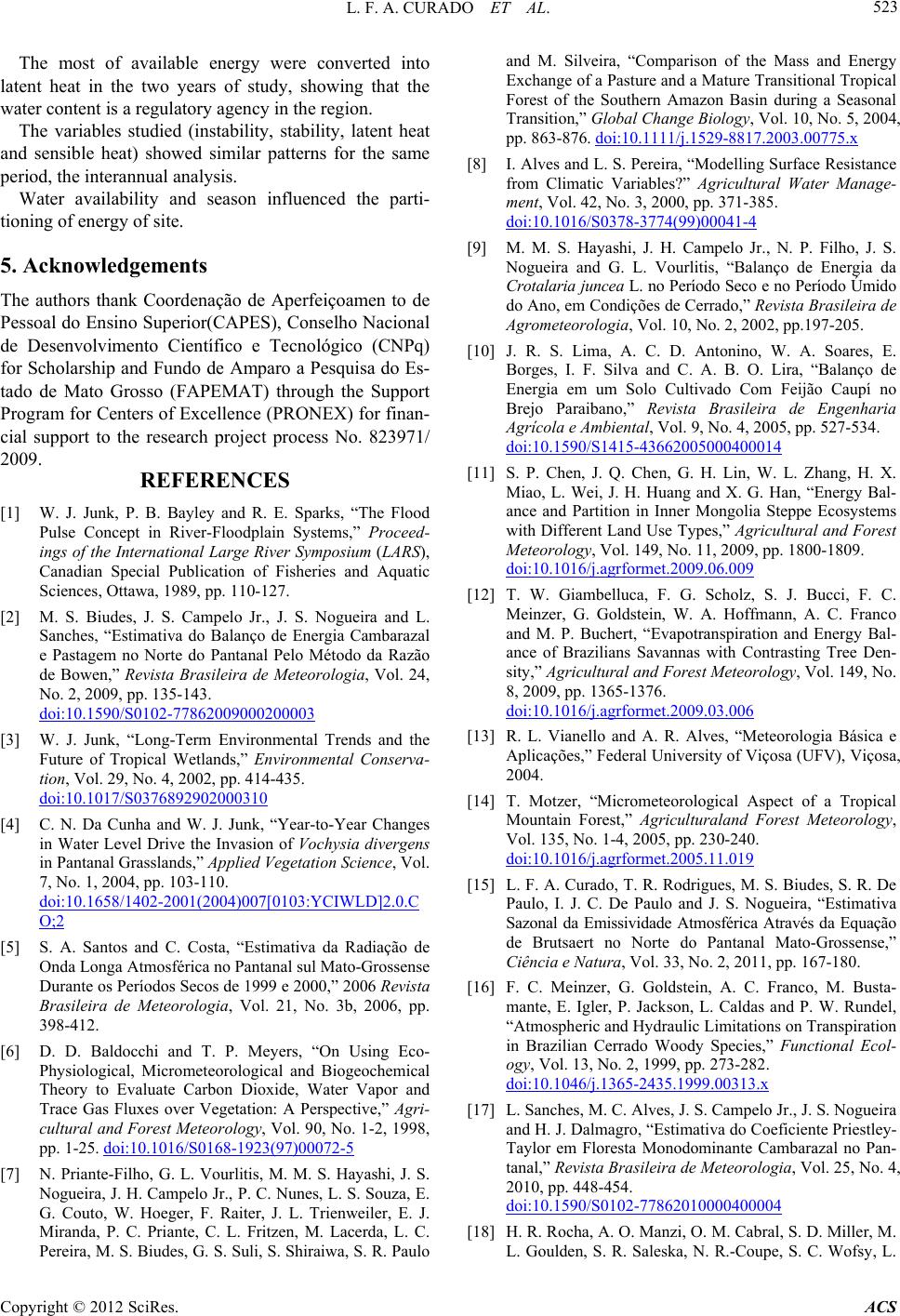 L. F. A. CURADO ET AL. 523 The most of available energy were converted into latent heat in the two years of study, showing that the water content is a regulatory agency in the region. The variables studied (instability, stability, latent heat and sensible heat) showed similar patterns for the same pe ntífico e Tecnológico (CNPq) Amparo a Pesquisa do MAT) through the Support anadian Special Publication of Fisheries and Aquatic Sciences, Otta riod, the interannual analysis. Water availability and season influenced the parti- tioning of energy of site. 5. Acknowledgements The authors thank Coordenação de Aperfeiçoamen to de Pessoal do Ensino Superior(CAPES), Conselho Nacional de Desenvolvimento Cie for Scholarship and Fundo de tado de Mato Grosso (FAPE Es- Program for Centers of Excellence (PRONEX) for finan- cial support to the research project process No. 823971/ 2009. REFERENCES [1] W. J. Junk, P. B. Bayley and R. E. Sparks, “The Flood Pulse Concept in River-Floodplain Systems,” Proceed- ings of the International Large River Symposium (LARS), C wa, 1989, pp. 110-127. [2] M. S. Biudes, J. S. Campelo Jr., J. S. Nogueira and L. Sanches, “Estimativa do Balanço de Energia Cambarazal e Pastagem no Norte do Pantanal Pelo Método da Razão de Bowen,” Revista Brasileira de Meteorologia, Vol. 24, No. 2, 2009, pp. 135-143. doi:10.1590/S0102-77862009000200003 [3] W. J. Junk, “Long-Term Environmental Trends and the Future of Tropical Wetlands,” Environmental Conserva- tion, Vol. 29, No. 4, 2002, pp. 414-435. doi:10.1017/S0376892902000310 [4] C. N. Da Cunha and W. J. Junk, “Year-to-Year Changes YCIWLD]2.0.C in Water Level Drive the Invasion of Vochysia divergens in Pantanal Grasslands,” Applied Vegetation Science, Vol. 7, No. 1, 2004, pp. 103-110. doi:10.1658/1402-2001(2004)007[0103: O;2 [5] S. A. Santos and C. Costa, “Estimativa da Radiação de Onda Longa Atmosférica no Pantanal sul Mato-Grossense Durante os Períodos Secos de 1999 e 2000,” 2006 Revista Brasileira de Meteorologia, Vol. 21, No. 3b, 2006, pp 398-412. . [6] D. D. Baldocchi and T. P. Meyers, “On Using Eco- Physiological, Micrometeorological and Biogeochemical Theory to Evaluate Carbon Dioxide, Water Vapor and Trace Gas Fluxes over Vegetation: A Perspective,” Agri- cultural and Forest Meteorology, Vol. 90, No. 1-2, 1998, pp. 1-25. doi:10.1016/S0168-1923(97)00072-5 [7] N. Priante-Filho, G. L. Vourlitis, M. M. S. Hayashi, J. S. Nogueira, J. H. Campelo Jr., P. C. Nunes, L. S. Souza, E. G. Couto, W. Hoeger, F. Raiter, J. L. Trienweiler, E. J. Miranda, P. C. Priante, C. L. Fritzen, M. Lacerda, L. C. Pereira, M. S. Biudes, G. S. Suli, S. Shiraiwa, S. R. Paulo and M. Silveira, “Comparison of the Mass and Energy Exchange of a Pasture and a Mature Transitional Tropical Forest of the Southern Amazon Basin during a Seasonal Transition,” Global Change Biology, Vol. 10, No. 5, 2004, pp. 863-876. doi:10.1111/j.1529-8817.2003.00775.x [8] I. Alves and L. S. Pereira, “Modelling Surface Resistance from Climatic Variables?” Agricultural Water Manage- ment, Vol. 42, No. 3, 2000, pp. 371-385. doi:10.1016/S0378-3774(99)00041-4 [9] M. M. S. Hayashi, J. H. Campelo Jr., N. P. Filho, J. S. Nogueira and G. L. Vourlitis, “Balanço de Energia da .197-205. . A. Soares, E. Crotalaria juncea L. no Período Seco e no Período Úmido do Ano, em Condições de Cerrado,” Revista Brasileira de Agrometeorologia, Vol. 10, No. 2, 2002, pp [10] J. R. S. Lima, A. C. D. Antonino, W Borges, I. F. Silva and C. A. B. O. Lira, “Balanço de Energia em um Solo Cultivado Com Feijão Caupí no Brejo Paraibano,” Revista Brasileira de Engenharia Agrícola e Ambiental, Vol. 9, No. 4, 2005, pp. 527-534. doi:10.1590/S1415-43662005000400014 [11] S. P. Chen, J. Q. Chen, G. H. Lin, W. L. Zhang, H. X. Miao, L. Wei, J. H. Huang and X. G. Han, “Energy Bal- ance and Partition in Inner Mongolia Steppe Ecosystems with Different Land Use Types,” Agricultural and Forest Meteorology, Vol. 149, No. 11, 2009, pp. 1800-1809. doi:10.1016/j.agrformet.2009.06.009 [12] T. W. Giambelluca, F. G. Scholz, S. J. Bucci, F. C. Meinzer, G. Goldstein, W. A. Hoffmann, A. C. Franco and M. P. Buchert, “Evapotranspiration and Energy Bal- ance of Brazilians Savannas with Contrasting Tree Den- sity,” Agricultural and Forest Meteorology, Vol. 149, N 8, 2009, pp. 1365-1376. o. doi:10.1016/j.agrformet.2009.03.006 [13] R. L. Vianello and A. R. Alves, “Meteorologia Básica e Aplicações,” Federal University of Viçosa (UFV), Viçosa, 2004. [14] T. Motzer, “Micrometeorological Aspect of a Tropical Mountain Forest,” Agriculturaland Forest M Vol. 135, No. 1-4, 2005, pp. 230-240. eteorology, doi:10.1016/j.agrformet.2005.11.019 [15] L. F. A. Curado, T. R. Rodrigues, M. S. Biudes, S. R. De Paulo, I. J. C. De Paulo and J. S. Nogueira, “Estimativa pp. 167-180. Franco, M. Busta- Sazonal da Emissividade Atmosférica Através da Equação de Brutsaert no Norte do Pantanal Mato-Grossense,” Ciência e Natura, Vol. 33, No. 2, 2011, [16] F. C. Meinzer, G. Goldstein, A. C. mante, E. Igler, P. Jackson, L. Caldas and P. W. Rundel, “Atmospheric and Hydraulic Limitations on Transpiration in Brazilian Cerrado Woody Species,” Functional Ecol- ogy, Vol. 13, No. 2, 1999, pp. 273-282. doi:10.1046/j.1365-2435.1999.00313.x [17] L. Sanches, M. C. Alves, J. S. Campelo Jr., J. S. Nogueira and H. J. Dalmagro, “Estimativa do Coeficiente Priestley- Taylor em Floresta Monodominante Cambarazal no Pan- tanal,” Revista Brasileira de Meteorologia, Vol. 25, No. 4, 2010, pp. 448-454. doi:10.1590/S0102-77862010000400004 [18] H. R. Rocha, A. O. Manzi, O. M. Cabral, S. D. Miller, M. L. Goulden, S. R. Saleska, N. R.-Coupe, S. C. Wofsy, L. Copyright © 2012 SciRes. ACS  L. F. A. CURADO ET AL. Copyright © 2012 SciRes. ACS 524 r and J. F. Maia, “Patterns of Water from Tr S. Borma, P. Artaxo, G. Vourlitis, J. S. Nogueira, F. L. Cardoso, A. O D. Nobre, B. Kruijt, H. C. Freitas, C. Von Randow, R. G. Aguia and Heat Flux across a Biome Gradient Fore opical st to Savanna in Brazil,” Journal of Geophysical Re- search, Vol. 114, 2009, Article ID: G00B12. doi:10.1029/2007JG000640 [19] A. C. Miranda, H. S. Miranda, J. Lloyd, J. Grace, R. J. Francey, J. A. Macintryre, P. Meir, P. Riggan wood and J. Brass, “Fluxes o , R. Lock- f Carbon, Water, and Energy over Brazilian Cerrado: An Analysis Using Eddy Covari- ance and Stable Isotopes,” Plant, Cell and Environment, Vol. 20, No. 3, 1997, pp. 315-328. doi:10.1046/j.1365-3040.1997.d01-80.x |