

Paper Menu >>
Journal Menu >>
 Atmospheric and Climate Sciences, 2012, 2, 474-478 http://dx.doi.org/10.4236/acs.2012.24041 Published Online October 2012 (http://www.SciRP.org/journal/acs) Temperature-Profile/Lapse-Rate Feedback: A Misunderstood Feedback of the Climate System Michael E. Schlesinger1, C. Bruce Entwistle2, Bin Li3 1Climate Research Group, Department of Atmospheric Sciences, University of Illinois at Urbana-Champaign, Urbana, USA 2Aviation Weather Center, National Weather Service, Kansas City, USA 3I. M. Systems Group, Inc. at EMC/NCEP/NOAA, College Park, USA Email: [email protected] Received July 19, 2012; revised August 20, 2012; accepted August 31, 2012 ABSTRACT This study shows that the heretofore assumed condition for no temperature-profile (TP)/lapse-rate feedback, s Tz T for all altitudes z, or dd0Tz z , in fact yields a negative feedback. The correct condition for no TP feedback is s s Tz TzTT for all z, where Ts is the surface temperature. This condition translates into a uniform increase (decrease) in lapse rate with altitude for an increase (decrease) in Ts. The temperature changes caused by a change in solar irradiance and/or planetary albedo satisfy the condition for no TP feedback. The temperature changes caused by a change in greenhouse gas concentration do not satisfy the condition for no TP feedback and, in- stead, yield a positive feedback. Keywords: Climate Feedback; Feedback Analysis; Lapse-Rate Feedback 1. Introduction Feedback due to changes in the vertical temperature pro- file has been called lapse-rate feedback [1]. It has been assumed that the condition for this feedback to be zero is that s Tz T for all altitudes z, where Tz is the temperature at z and Ts is the surface temperature [2]. This condition is equivalent to Tz dd0z , that is, no change in lapse rate, hence the name lapse-rate feed- back when dd0Tz z. Here we first use a one-layer atmospheric model, and then a multilayer at- mospheric model, to show what we found 20 years ago [3], namely, that the correct answer for zero feedback is loglog s TzT or, equivalently, s s Tz TzTT for all z. When this condition is not satisfied, there is feedback. In particular, if s Tz T for all altitudes z, the feedback is negative. Since there is feedback when the lapse rate does not change, it is recommended that the name lapse-rate feedback be supplanted by the appella- tion temperature-profile (TP) feedback. 2. Feedback Analysis This section is based on the feedback analysis of Schlesinger [4-6]. The net downward radiation at the top of the atmosphere (TOA) per unit area, N, is given by 4 1 4 p ps NST (1) where S is the solar irradiance at TOA, p is the plane- tary albedo, σ is the Stefan-Boltzmann constant, and p is the planetary emissivity. The change in N due to ex- ternal radiative forcing F, say due to a change in S or the anthropogenic increase in the concentrations of green- house gases, can be written as d d j s j sjs I NN NF T TIT (2) where the second term on the right-hand side is the change in N due to the change in Ts alone, and the third term is the change in N due to the change in internal quantities j I —such as the temperature profile; water vapor amount; cloud amount, height and optical depth— through their dependence on Ts. From Equation (1) we can also write 34 44 pp p sss ss S NFTT T TT (3) 0NFor the new equilibrium, , hence by Equation (2) we have 1 o sf G TGF F f (4) C opyright © 2012 SciRes. ACS 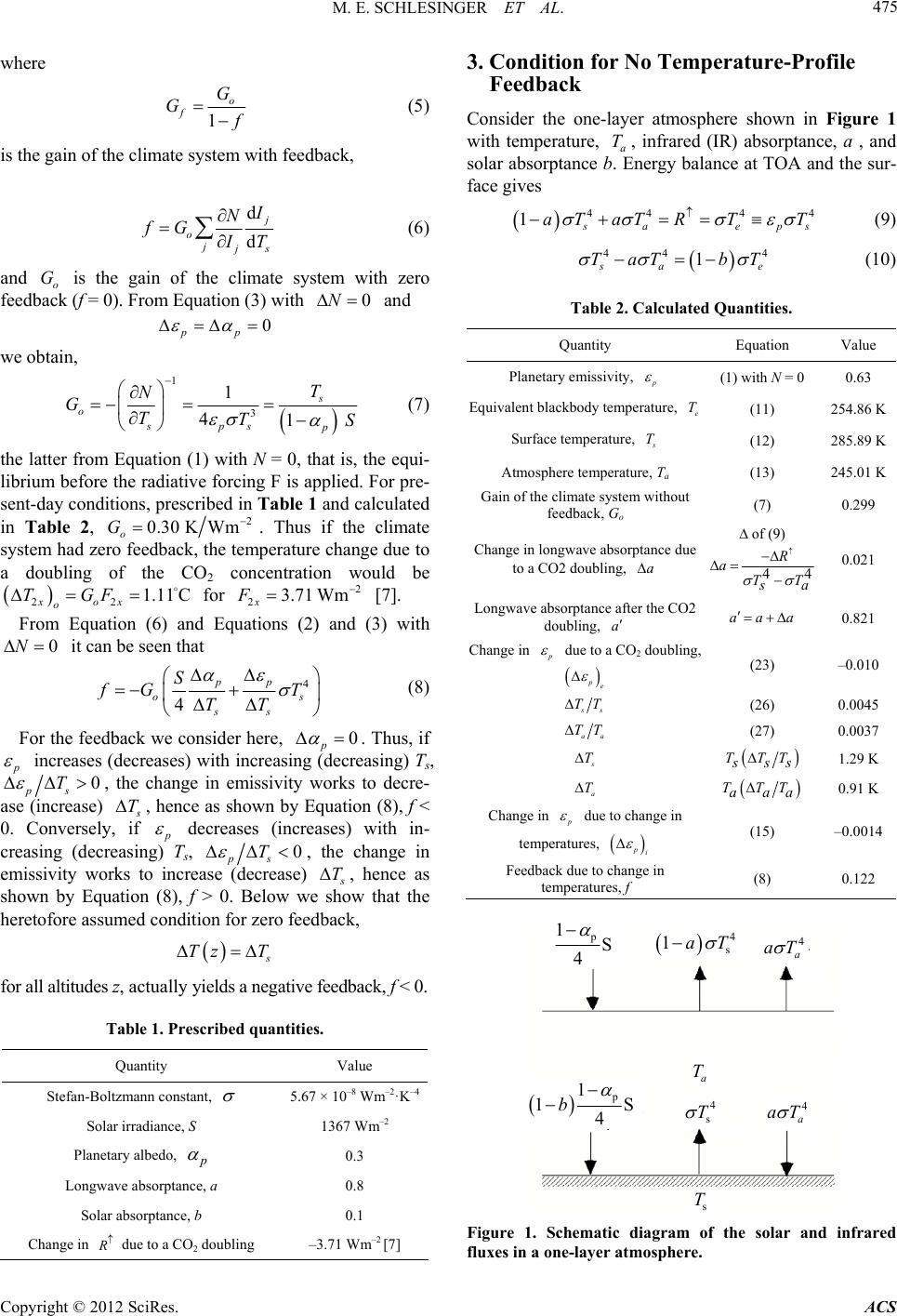 M. E. SCHLESINGER ET AL. 475 where 1 o f G G (5) f is the gain of the climate system with feedback, d d j o j j s I N fG I T G 0N 0 pp (6) and o is the gain of the climate system with zero feedback (f = 0). From Equation (3) with and we obtain, 1 3 1 4 o sps N GTT 1 s p T S (7) the latter from Equation (1) with N = 0, that is, the equi- librium before the radiative forcing F is applied. For pre- sent-day conditions, prescribed in Table 1 and calculated in Table 2, 2 30 KWm 2 3.71 Wm 0N 0. o G 22xox o TGF . Thus if the climate system had zero feedback, the temperature change due to a doubling of the CO2 concentration would be for [7]. 1.11 C2x F From Equation (6) and Equations (2) and (3) with it can be seen that 4 pp os ss 4 S f GT TT 0 (8) For the feedback we consider here, p . Thus, if p increases (decreases) with increasing (decreasing) Ts, 0T ps , the change in emissivity works to decre- ase (increase) s T, hence as shown by Equation (8), f < 0. Conversely, if p decreases (increases) with in- creasing (decreasing) Ts, 0T ps , the change in emissivity works to increase (decrease) s T , hence as shown by Equation (8), f > 0. Below we show that the heretofore assumed condition for zero feedback, s Tz T for all altitudes z, actually yields a negative feedback, f < 0. Table 1. Prescribed quantities. Quantity Value Stefan-Boltzmann constant, 3. Condition for No Temperature-Profile Feedback Consider the one-layer atmosphere shown in Figure 1 with temperature, a, infrared (IR) absorptance, a , and solar absorptance b. Energy balance at TOA and the sur- face gives T 444 4 1 5.67 × 10⁻⁸ Wm–2·K–4 Solar irradiance, S 1367 Wm–2 Planetary albedo, p R 0.3 Longwave absorptance, a 0.8 Solar absorptance, b 0.1 Change in due to a CO2 doubling –3.71 Wm–2 [7] s aeps aT aTRTT 44 4 1 (9) s ae TaT bT (10) Table 2. Calculated Quantities. Quantity Equation Value Planetary emissivity, p (1) with N = 0 0.63 Equivalent blackbody temperature, e T(11) 254.86 K Surface temperature, s T a (12) 285.89 K Atmosphere temperature, Ta (13) 245.01 K Gain of the climate system without feedback, Go (7) 0.299 Change in longwave absorptance due to a CO2 doubling, ∆ of (9) 44 R a TT s a a 0.021 Longwave absorptance after the CO2 doubling, aa a p 0.821 Change in due to a CO2 dou b ling, pe (23) –0.010 s s TT (26) 0.0045 aa TT (27) 0.0037 s T TTT s ss a T 1.29 K TTT aaa p 0.91 K Change in due to change in temperatures, pi (15) –0.0014 Feedback due to change in temperatures, f (8) 0.122 p 1S 4 4 s 1aT 4 a aT 4 a aT p 1 1S 4 b a T 4 s T s T Figure 1. Schematic diagram of the solar and infrared fluxes in a one-layer atmosphere. Copyright © 2012 SciRes. ACS 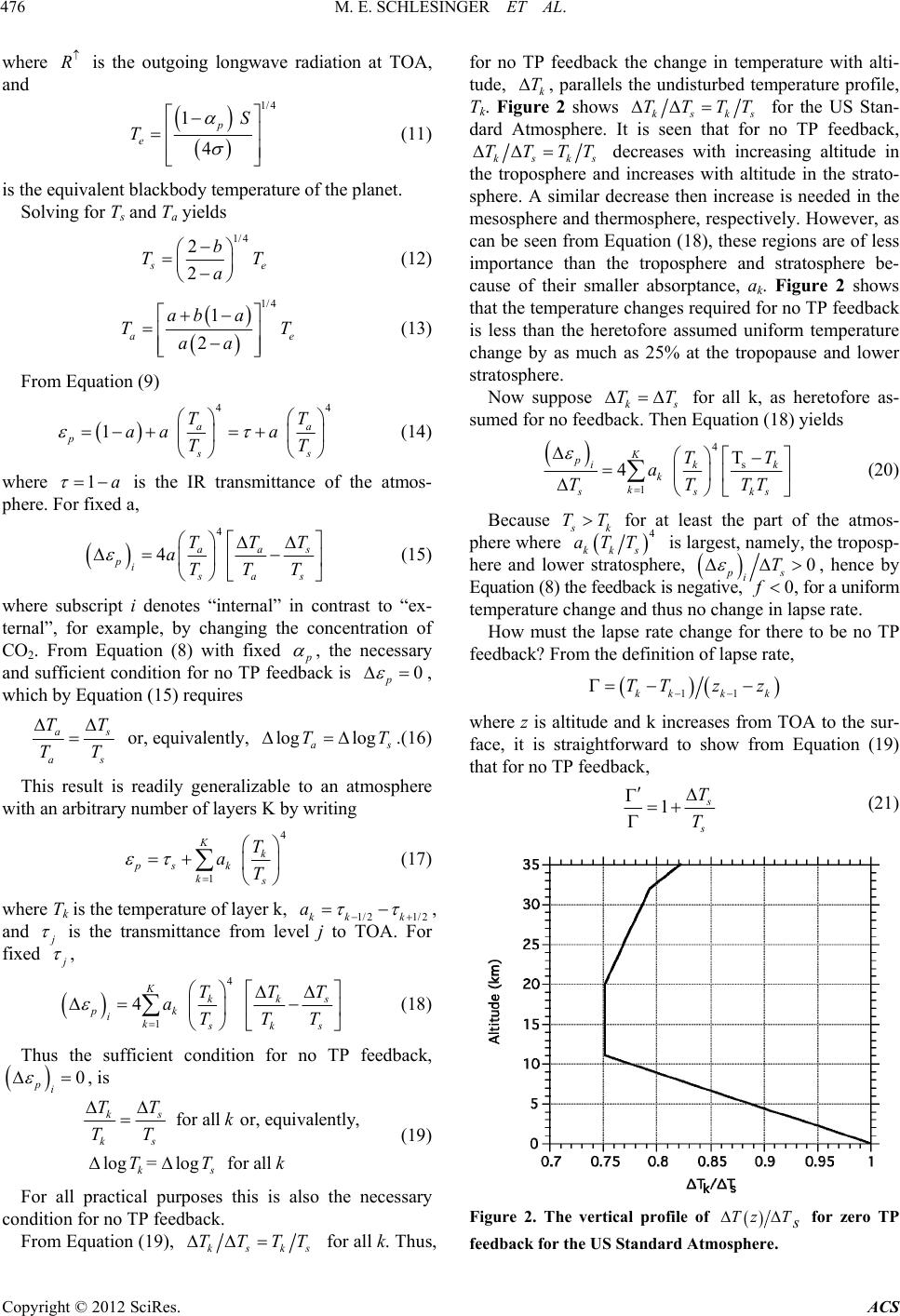 M. E. SCHLESINGER ET AL. 476 where is the outgoing longwave radiation at TOA, and R 1/4 1 4 pS e T (11) is the equivalent blackbody temperature of the planet. Solving for Ts and Ta yields 1/4 2 2 s e b TT a (12) 1/4 1 2 ae a TT aa ab (13) From Equation (9) 44 aa ss TT a TT 1a 1 paa (14) where is the IR transmittance of the atmos- phere. For fixed a, 4 4 pia aas sas TTT TTT (15) where subscript i denotes “internal” in contrast to “ex- ternal”, for example, by changing the concentration of CO2. From Equation (8) with fixed p , the necessary and sufficient condition for no TP feedback is 0 p , which by Equation (15) requires as as TT TT log log as TT or, equivalently, .(16) This result is readily generalizable to an atmosphere with an arbitrary number of layers K by writing 4 1 K k k ks T aT ps (17) where Tk is the temperature of layer k, 1/21/ 2kk k a , and j is the transmittance from level j to TOA. For fixed j , 4 1 4 K kks pk iksks TTT aTTT 0 pi (18) Thus the sufficient condition for no TP feedback, , is for all or log= log for al ks ks ks TT k TT TT , equivalently, l k (19) For all practical purposes this is also the necessary condition for no TP feedback. From Equation (19), ksks TTTT T for all k. Thus, for no TP feedback the change in temperature with alti- tude, k , parallels the undisturbed temperature profile, Tk. Figure 2 shows ksks TTTT for the US Stan- dard Atmosphere. It is seen that for no TP feedback, ksks TTTT TT decreases with increasing altitude in the troposphere and increases with altitude in the strato- sphere. A similar decrease then increase is needed in the mesosphere and thermosphere, respectively. However, as can be seen from Equation (18), these regions are of less importance than the troposphere and stratosphere be- cause of their smaller absorptance, ak. Figure 2 shows that the temperature changes required for no TP feedback is less than the heretofore assumed uniform temperature change by as much as 25% at the tropopause and lower stratosphere. Now suppose ks for all k, as heretofore as- sumed for no feedback. Then Equation (18) yields 4 s 1 T 4 K pikk k k ssks TT a TTTT (20) Because s k TT for at least the part of the atmos- phere where 4 aTT kks is largest, namely, the troposp- here and lower stratosphere, 0 s T 0f p i, hence by Equation (8) the feedback is negative, , for a uniform temperature change and thus no change in lapse rate. How must the lapse rate change for there to be no TP feedback? From the definition of lapse rate, 11kkk k TTz z where z is altitude and k increases from TOA to the sur- face, it is straightforward to show from Equation (19) that for no TP feedback, 1 s s T T (21) Figure 2. The vertical profile of Tz T s for zero TP feedback for the US Standard Atmosphere. Copyright © 2012 SciRes. ACS  M. E. SCHLESINGER ET AL. 477 where 11kk kk TTT T 1kk zz 0T . Thus for no TP feedback the lapse rate must increase uniformly with altitude for surface warming, s 0T , and must decrease uniformly with altitude for surface cooling, s. These changes in lapse rate are not large—for a 3˚C global temperature change they are about 1% of the undisturbed lapse rate. 4. Application to Solar Forcing We now return to the one-layer atmosphere of Figure 1. From Equations (11)-(13) for fixed a and b it is straight- forward to show that 1/4 1 4 pS 1 ase asee TTT TTTT (22) Thus the response of the atmospheric temperature to a change in Ta, either through a change in the solar irradi- ance or planetary albedo or both, satisfies the require- ment for no TP feedback. Figure 3 shows the profile of kk ss TTTT in response to a 2% increase in the solar irradiance cal- culated by our 26-layer stratosphere/troposphere radia- tive-convective model [3] with the convective adjustment turned off and no temperature dependence of the infrared transmittances. It is seen that 1 ss TT kk TT for all 26 layers, hence TP feedback is zero for solar forcing. Figure 3. Vertical profile of (∆Tk/Tk)/(∆Ts/Ts) versus pres- sure simulated for a 2% increase in solar irradiance and a CO2 doubling by a 26-layer stratosphere/troposphere ra- diative-convective model [3] with the convective adjustment turned off and no temperature dependence of the longwave transmittances. 5. Application to Infrared Forcing In this section we show that condition (16) for no TP feedback is not satisfied for radiative forcing in the infra- red, such as from changing the concentration of green- house gases, which changes a to . By Equa- tion (14) this will change the planetary emissivity by aa a 4 1a pes Ta T (23) a where the subscript e denotes an “external” change. The new equilibrium is given by Equations (9) and (10) with a replaced by , s T by s s, and a T by aa TT TT . This yields after using the binomial expansion and linearizing, 4 114 x xxx , 33 44 1 4 ssaasa a aT TaT TTT (24) 334 4 s saa a a TT aTTT (25) Solving these Equations yields 42 s s Ta Ta (26) 4 1 42 sa a a TT Ta Ta a (27) From Equations (26) and (27), together with Equations (12) and (13), we obtain 2 12 1 aa ss ab TT a TTaa ba aa (28) Setting Equation (28) equal to unity, assuming and solving yields two solutions, b = 0 and a = 2, the former having an unphysical solar absorptance and the latter an unphysical infrared absorptance. Consequently, for the case of infrared forcing, the condition required for zero TP feedback given by Equation (16) cannot be satis- fied. The values of aa TT , s s, pi TT and f calc- ulated for a CO2 doubling for the prescribed values shown in Table 1 are presented in Table 2. It can be seen that the change in the temperature profile yields a nega- ive pi twhich is the same sign as the change in pe due to the doubling of the CO2 concentration. As a result the feedback is positive and rather large. This positive TP feedback increases the surface tem- perature change by 16% from its zero feedback value of 1.11 K to 1.29 K. It occurs even in the absence of a stratosphere, which the one-layer atmospheric model does not possess. The presence of a stratosphere would Copyright © 2012 SciRes. ACS 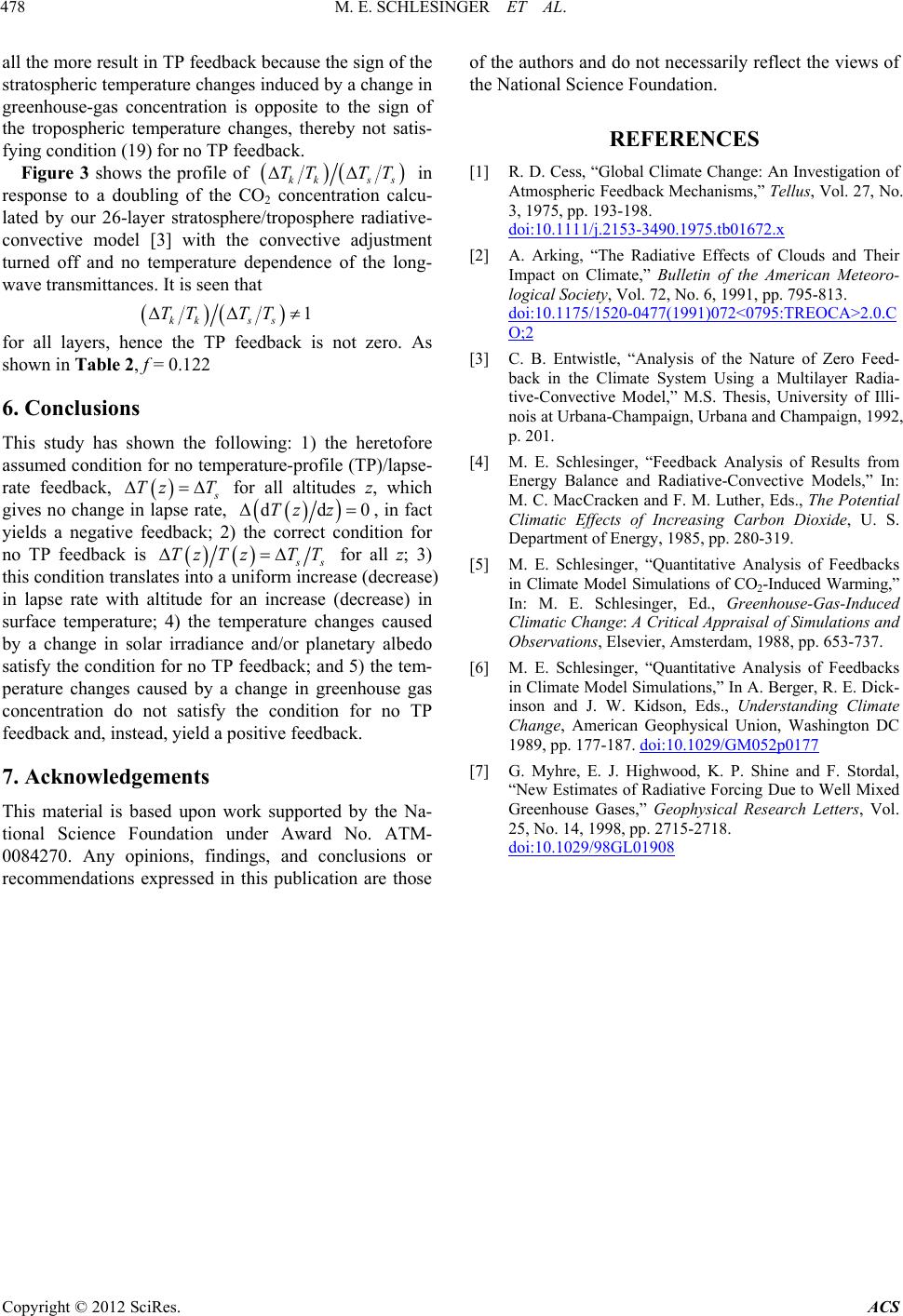 M. E. SCHLESINGER ET AL. Copyright © 2012 SciRes. ACS 478 all the more result in TP feedback because the sign of the stratospheric temperature changes induced by a change in greenhouse-gas concentration is opposite to the sign of the tropospheric temperature changes, thereby not satis- fying condition (19) for no TP feedback. Figure 3 shows the profile of kk ss in response to a doubling of the CO2 concentration calcu- lated by our 26-layer stratosphere/troposphere radiative- convective model [3] with the convective adjustment turned off and no temperature dependence of the long- wave transmittances. It is seen that TT TT 1 ss TT kk TT for all layers, hence the TP feedback is not zero. As shown in Table 2, f = 0.122 6. Conclusions This study has shown the following: 1) the heretofore assumed condition for no temperature-profile (TP)/lapse- rate feedback, s Tz T for all altitudes z, which gives no change in lapse rate, dd0Tz z , in fact yields a negative feedback; 2) the correct condition for no TP feedback is s s for all z; 3) this condition translates into a uniform increase (decrease) in lapse rate with altitude for an increase (decrease) in surface temperature; 4) the temperature changes caused by a change in solar irradiance and/or planetary albedo satisfy the condition for no TP feedback; and 5) the tem- perature changes caused by a change in greenhouse gas concentration do not satisfy the condition for no TP feedback and, instead, yield a positive feedback. TzTz TT 7. Acknowledgements This material is based upon work supported by the Na- tional Science Foundation under Award No. ATM- 0084270. Any opinions, findings, and conclusions or recommendations expressed in this publication are those of the authors and do not necessarily reflect the views of the National Science Foundation. REFERENCES [1] R. D. Cess, “Global Climate Change: An Investigation of Atmospheric Feedback Mechanisms,” Tellus, Vol. 27, No. 3, 1975, pp. 193-198. doi:10.1111/j.2153-3490.1975.tb01672.x [2] A. Arking, “The Radiative Effects of Clouds and Their Impact on Climate,” Bulletin of the American Meteoro- logical Society, Vol. 72, No. 6, 1991, pp. 795-813. doi:10.1175/1520-0477(1991)072<0795:TREOCA>2.0.C O;2 [3] C. B. Entwistle, “Analysis of the Nature of Zero Feed- back in the Climate System Using a Multilayer Radia- tive-Convective Model,” M.S. Thesis, University of Illi- nois at Urbana-Champaign, Urbana and Champaign, 1992, p. 201. [4] M. E. Schlesinger, “Feedback Analysis of Results from Energy Balance and Radiative-Convective Models,” In: M. C. MacCracken and F. M. Luther, Eds., The Potential Climatic Effects of Increasing Carbon Dioxide, U. S. Department of Energy, 1985, pp. 280-319. [5] M. E. Schlesinger, “Quantitative Analysis of Feedbacks in Climate Model Simulations of CO2-Induced Warming,” In: M. E. Schlesinger, Ed., Greenhouse-Gas-Induced Climatic Change: A Critical Appraisal of Simulations and Observations, Elsevier, Amsterdam, 1988, pp. 653-737. [6] M. E. Schlesinger, “Quantitative Analysis of Feedbacks in Climate Model Simulations,” In A. Berger, R. E. Dick- inson and J. W. Kidson, Eds., Understanding Climate Change, American Geophysical Union, Washington DC 1989, pp. 177-187. doi:10.1029/GM052p0177 [7] G. Myhre, E. J. Highwood, K. P. Shine and F. Stordal, “New Estimates of Radiative Forcing Due to Well Mixed Greenhouse Gases,” Geophysical Research Letters, Vol. 25, No. 14, 1998, pp. 2715-2718. doi:10.1029/98GL01908 |