

Paper Menu >>
Journal Menu >>
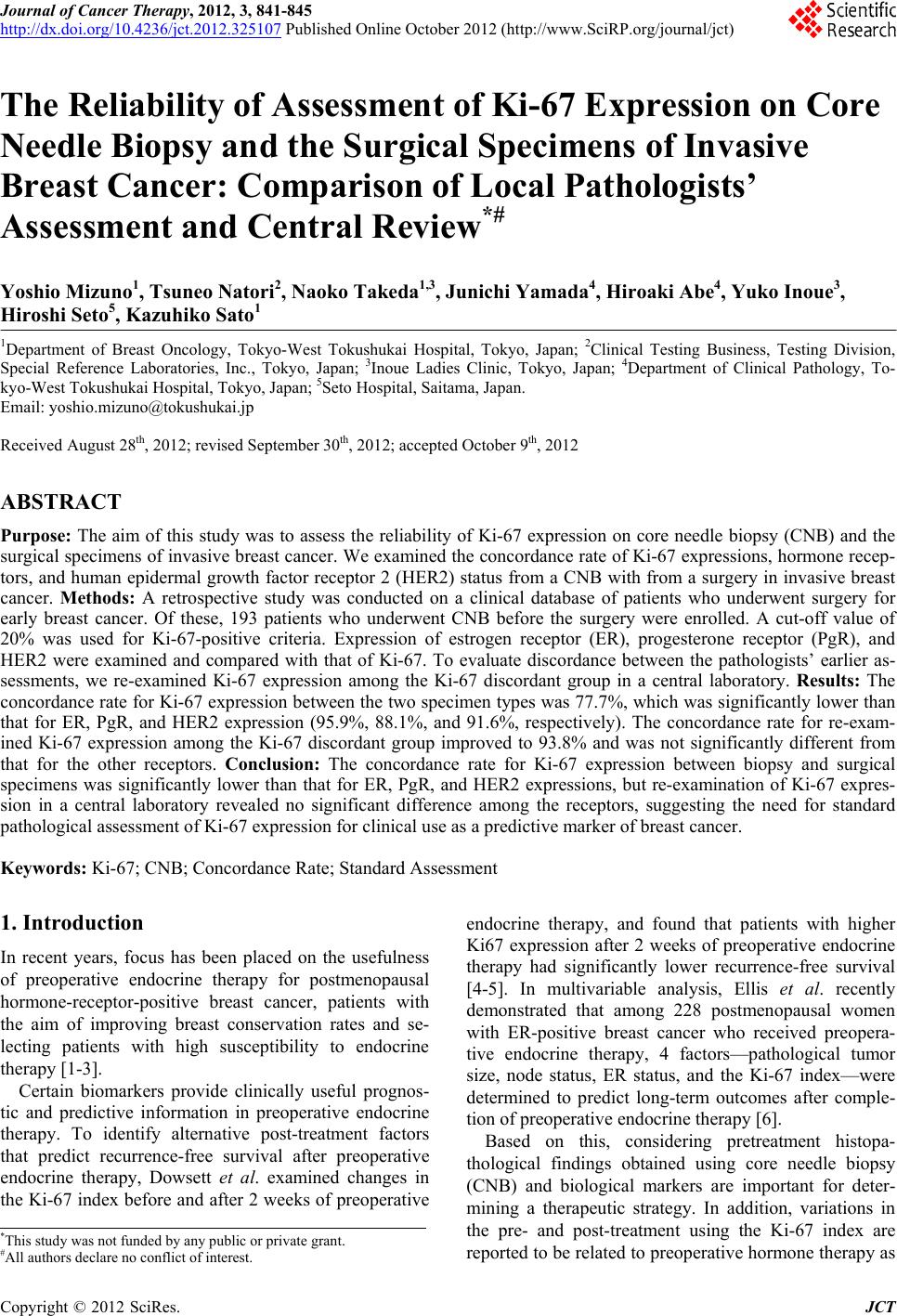 Journal of Cancer Therapy, 2012, 3, 841-845 http://dx.doi.org/10.4236/jct.2012.325107 Published Online October 2012 (http://www.SciRP.org/journal/jct) 841 The Reliability of Assessment of Ki-67 Expression on Core Needle Biopsy and the Surgical Specimens of Invasive Breast Cancer: Comparison of Local Pathologists’ Assessment and Central Review*# Yoshio Mizuno1, Tsuneo Natori2, Naoko Takeda1,3, Junichi Yamada4, Hiroaki Abe4, Yuko Inoue3, Hiroshi Seto5, Kazuhiko Sato1 1Department of Breast Oncology, Tokyo-West Tokushukai Hospital, Tokyo, Japan; 2Clinical Testing Business, Testing Division, Special Reference Laboratories, Inc., Tokyo, Japan; 3Inoue Ladies Clinic, Tokyo, Japan; 4Department of Clinical Pathology, To- kyo-West Tokushukai Hospital, Tokyo, Japan; 5Seto Hospital, Saitama, Japan. Email: [email protected] Received August 28th, 2012; revised September 30th, 2012; accepted October 9th, 2012 ABSTRACT Purpose: The aim of this study was to assess the reliability of Ki-67 expression on core needle biopsy (CNB) and the surgical specimens of invasive breast cancer. We examined the concordance rate of Ki-67 expressions, hormone recep- tors, and human epidermal growth factor receptor 2 (HER2) status from a CNB with from a surgery in invasive breast cancer. Methods: A retrospective study was conducted on a clinical database of patients who underwent surgery for early breast cancer. Of these, 193 patients who underwent CNB before the surgery were enrolled. A cut-off value of 20% was used for Ki-67-positive criteria. Expression of estrogen receptor (ER), progesterone receptor (PgR), and HER2 were examined and compared with that of Ki-67. To evaluate discordance between the pathologists’ earlier as- sessments, we re-examined Ki-67 expression among the Ki-67 discordant group in a central laboratory. Results: The concordance rate for Ki-67 expression between the two specimen types was 77.7%, which was significantly lower than that for ER, PgR, and HER2 expression (95.9%, 88.1%, and 91.6%, respectively). The concordance rate for re-exam- ined Ki-67 expression among the Ki-67 discordant group improved to 93.8% and was not significantly different from that for the other receptors. Conclusion: The concordance rate for Ki-67 expression between biopsy and surgical specimens was significantly lower than that for ER, PgR, and HER2 expressions, but re-examination of Ki-67 expres- sion in a central laboratory revealed no significant difference among the receptors, suggesting the need for standard pathological assessment of Ki-67 expression for clinical use as a predictive marker of breast cancer. Keywords: Ki-67; CNB; Concordance Rate; Standard Assessment 1. Introduction In recent years, focus has been placed on the usefulness of preoperative endocrine therapy for postmenopausal hormone-receptor-positive breast cancer, patients with the aim of improving breast conservation rates and se- lecting patients with high susceptibility to endocrine therapy [1-3]. Certain biomarkers provide clinically useful prognos- tic and predictive information in preoperative endocrine therapy. To identify alternative post-treatment factors that predict recurrence-free survival after preoperative endocrine therapy, Dowsett et al. examined changes in the Ki-67 index before and after 2 weeks of preoperative endocrine therapy, and found that patients with higher Ki67 expression after 2 weeks of preoperative endocrine therapy had significantly lower recurrence-free survival [4-5]. In multivariable analysis, Ellis et al. recently demonstrated that among 228 postmenopausal women with ER-positive breast cancer who received preopera- tive endocrine therapy, 4 factors—pathological tumor size, node status, ER status, and the Ki-67 index—were determined to predict long-term outcomes after comple- tion of preoperative endocrine therapy [6]. Based on this, considering pretreatment histopa- thological findings obtained using core needle biopsy (CNB) and biological markers are important for deter- mining a therapeutic strategy. In addition, variations in the pre- and post-treatment using the Ki-67 index are reported to be related to preoperative hormone therapy as *This study was not funded by any public or private grant. #All authors declare no conflict of interest. Copyright © 2012 SciRes. JCT 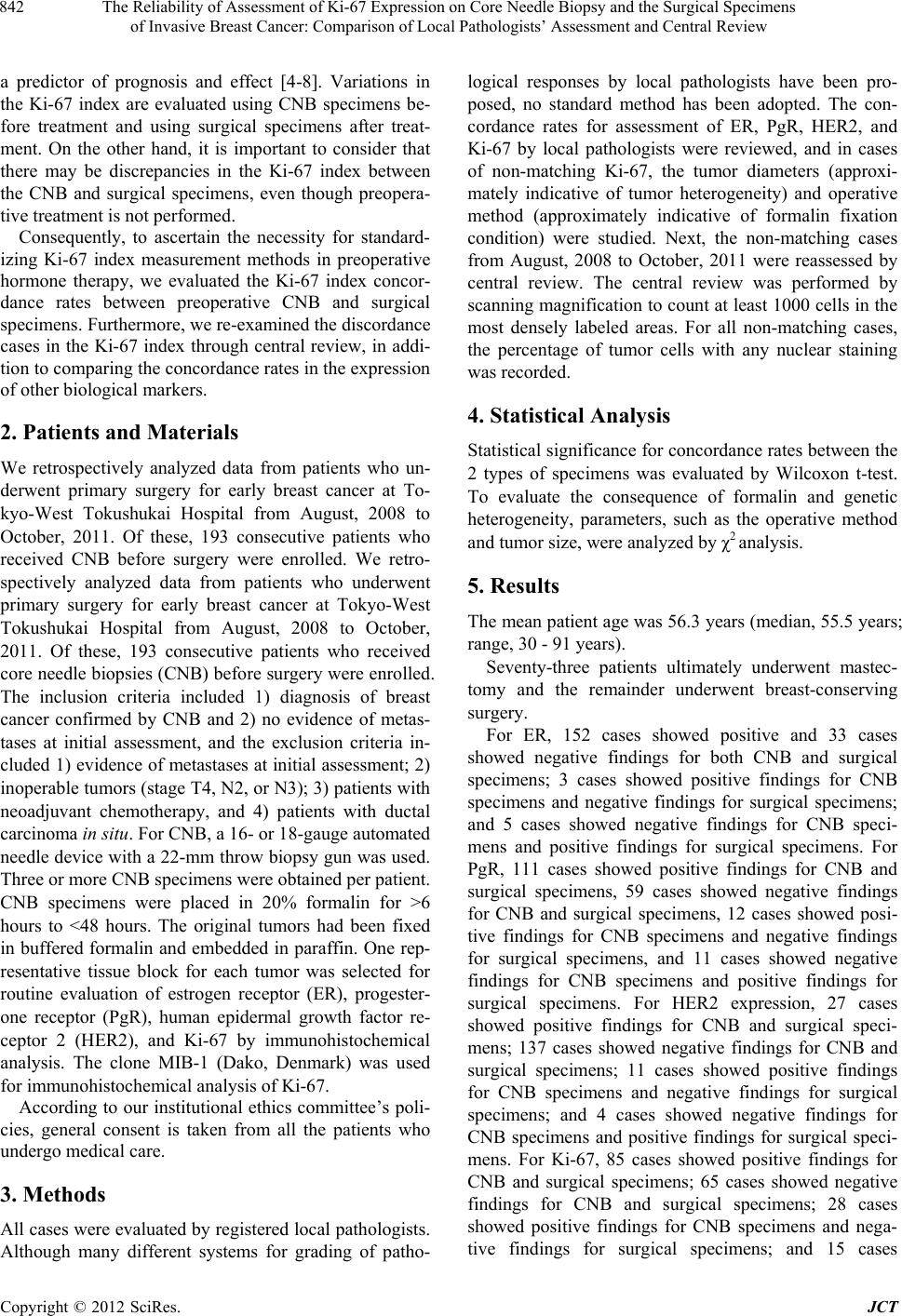 The Reliability of Assessment of Ki-67 Expression on Core Needle Biopsy and the Surgical Specimens of Invasive Breast Cancer: Comparison of Local Pathologists’ Assessment and Central Review 842 a predictor of prognosis and effect [4-8]. Variations in the Ki-67 index are evaluated using CNB specimens be- fore treatment and using surgical specimens after treat- ment. On the other hand, it is important to consider that there may be discrepancies in the Ki-67 index between the CNB and surgical specimens, even though preopera- tive treatment is not performed. Consequently, to ascertain the necessity for standard- izing Ki-67 index measurement methods in preoperative hormone therapy, we evaluated the Ki-67 index concor- dance rates between preoperative CNB and surgical specimens. Furthermore, we re-examined the discordance cases in the Ki-67 index through central review, in addi- tion to comparing the concordance rates in the expression of other biological markers. 2. Patients and Materials We retrospectively analyzed data from patients who un- derwent primary surgery for early breast cancer at To- kyo-West Tokushukai Hospital from August, 2008 to October, 2011. Of these, 193 consecutive patients who received CNB before surgery were enrolled. We retro- spectively analyzed data from patients who underwent primary surgery for early breast cancer at Tokyo-West Tokushukai Hospital from August, 2008 to October, 2011. Of these, 193 consecutive patients who received core needle biopsies (CNB) before surgery were enrolled. The inclusion criteria included 1) diagnosis of breast cancer confirmed by CNB and 2) no evidence of metas- tases at initial assessment, and the exclusion criteria in- cluded 1) evidence of metastases at initial assessment; 2) inoperable tumors (stage T4, N2, or N3); 3) patients with neoadjuvant chemotherapy, and 4) patients with ductal carcinoma in situ. For CNB, a 16- or 18-gauge automated needle device with a 22-mm throw biopsy gun was used. Three or more CNB specimens were obtained per patient. CNB specimens were placed in 20% formalin for >6 hours to <48 hours. The original tumors had been fixed in buffered formalin and embedded in paraffin. One rep- resentative tissue block for each tumor was selected for routine evaluation of estrogen receptor (ER), progester- one receptor (PgR), human epidermal growth factor re- ceptor 2 (HER2), and Ki-67 by immunohistochemical analysis. The clone MIB-1 (Dako, Denmark) was used for immunohistochemical analysis of Ki-67. According to our institutional ethics committee’s poli- cies, general consent is taken from all the patients who undergo medical care. 3. Methods All cases were evaluated by registered local pathologists. Although many different systems for grading of patho- logical responses by local pathologists have been pro- posed, no standard method has been adopted. The con- cordance rates for assessment of ER, PgR, HER2, and Ki-67 by local pathologists were reviewed, and in cases of non-matching Ki-67, the tumor diameters (approxi- mately indicative of tumor heterogeneity) and operative method (approximately indicative of formalin fixation condition) were studied. Next, the non-matching cases from August, 2008 to October, 2011 were reassessed by central review. The central review was performed by scanning magnification to count at least 1000 cells in the most densely labeled areas. For all non-matching cases, the percentage of tumor cells with any nuclear staining was recorded. 4. Statistical Analysis Statistical significance for concordance rates between the 2 types of specimens was evaluated by Wilcoxon t-test. To evaluate the consequence of formalin and genetic heterogeneity, parameters, such as the operative method and tumor size, were analyzed by χ2 analysis. 5. Results The mean patient age was 56.3 years (median, 55.5 years; range, 30 - 91 years). Seventy-three patients ultimately underwent mastec- tomy and the remainder underwent breast-conserving surgery. For ER, 152 cases showed positive and 33 cases showed negative findings for both CNB and surgical specimens; 3 cases showed positive findings for CNB specimens and negative findings for surgical specimens; and 5 cases showed negative findings for CNB speci- mens and positive findings for surgical specimens. For PgR, 111 cases showed positive findings for CNB and surgical specimens, 59 cases showed negative findings for CNB and surgical specimens, 12 cases showed posi- tive findings for CNB specimens and negative findings for surgical specimens, and 11 cases showed negative findings for CNB specimens and positive findings for surgical specimens. For HER2 expression, 27 cases showed positive findings for CNB and surgical speci- mens; 137 cases showed negative findings for CNB and surgical specimens; 11 cases showed positive findings for CNB specimens and negative findings for surgical specimens; and 4 cases showed negative findings for CNB specimens and positive findings for surgical speci- mens. For Ki-67, 85 cases showed positive findings for CNB and surgical specimens; 65 cases showed negative findings for CNB and surgical specimens; 28 cases showed positive findings for CNB specimens and nega- tive findings for surgical specimens; and 15 cases Copyright © 2012 SciRes. JCT 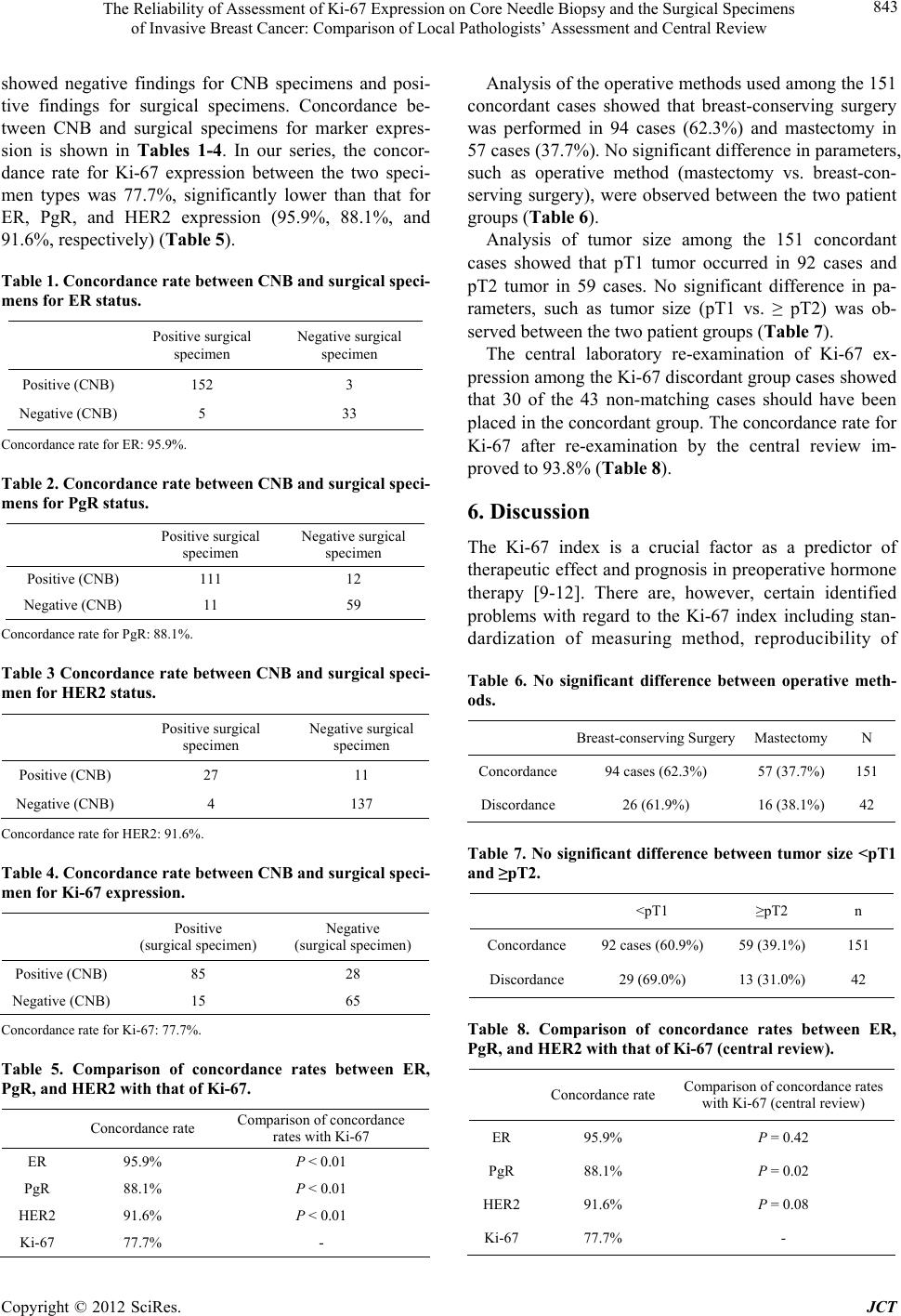 The Reliability of Assessment of Ki-67 Expression on Core Needle Biopsy and the Surgical Specimens of Invasive Breast Cancer: Comparison of Local Pathologists’ Assessment and Central Review 843 showed negative findings for CNB specimens and posi- tive findings for surgical specimens. Concordance be- tween CNB and surgical specimens for marker expres- sion is shown in Tables 1-4. In our series, the concor- dance rate for Ki-67 expression between the two speci- men types was 77.7%, significantly lower than that for ER, PgR, and HER2 expression (95.9%, 88.1%, and 91.6%, respectively) (Table 5). Table 1. Concordance rate between CNB and surgical speci- mens for ER status. Positive surgical specimen Negative surgical specimen Positive (CNB) 152 3 Negative (CNB) 5 33 Concordance rate for ER: 95.9%. Table 2. Concordance rate between CNB and surgical speci- mens for PgR status. Positive surgical specimen Negative surgical specimen Positive (CNB) 111 12 Negative (CNB) 11 59 Concordance rate for PgR: 88.1%. Table 3 Concordance rate between CNB and surgical speci- men for HER2 status. Positive surgical specimen Negative surgical specimen Positive (CNB) 27 11 Negative (CNB) 4 137 Concordance rate for HER2: 91.6%. Table 4. Concordance rate between CNB and surgical speci- men for Ki-67 expression. Positive (surgical specimen) Negative (surgical specimen) Positive (CNB) 85 28 Negative (CNB) 15 65 Concordance rate for Ki-67: 77.7%. Table 5. Comparison of concordance rates between ER, PgR, and HER2 with that of Ki-67. Concordance rate Comparison of concordance rates with Ki-67 ER 95.9% P < 0.01 PgR 88.1% P < 0.01 HER2 91.6% P < 0.01 Ki-67 77.7% - Analysis of the operative methods used among the 151 concordant cases showed that breast-conserving surgery was performed in 94 cases (62.3%) and mastectomy in 57 cases (37.7%). No significant difference in parameters, such as operative method (mastectomy vs. breast-con- serving surgery), were observed between the two patient groups (Table 6). Analysis of tumor size among the 151 concordant cases showed that pT1 tumor occurred in 92 cases and pT2 tumor in 59 cases. No significant difference in pa- rameters, such as tumor size (pT1 vs. ≥ pT2) was ob- served between the two patient groups (Table 7). The central laboratory re-examination of Ki-67 ex- pression among the Ki-67 discordant group cases showed that 30 of the 43 non-matching cases should have been placed in the concordant group. The concordance rate for Ki-67 after re-examination by the central review im- proved to 93.8% (Table 8). 6. Discussion The Ki-67 index is a crucial factor as a predictor of therapeutic effect and prognosis in preoperative hormone therapy [9-12]. There are, however, certain identified problems with regard to the Ki-67 index including stan- dardization of measuring method, reproducibility of Table 6. No significant difference between operative meth- ods. Breast-conserving Surgery MastectomyN Concordance94 cases (62.3%) 57 (37.7%)151 Discordance26 (61.9%) 16 (38.1%)42 Table 7. No significant difference between tumor size <pT1 and ≥pT2. <pT1 ≥pT2 n Concordance 92 cases (60.9%) 59 (39.1%) 151 Discordance 29 (69.0%) 13 (31.0%) 42 Table 8. Comparison of concordance rates between ER, PgR, and HER2 with that of Ki-67 (central review). Concordance rate Comparison of concordance rates with Ki-67 (central review) ER 95.9% P = 0.42 PgR 88.1% P = 0.02 HER291.6% P = 0.08 Ki-67 77.7% - Copyright © 2012 SciRes. JCT 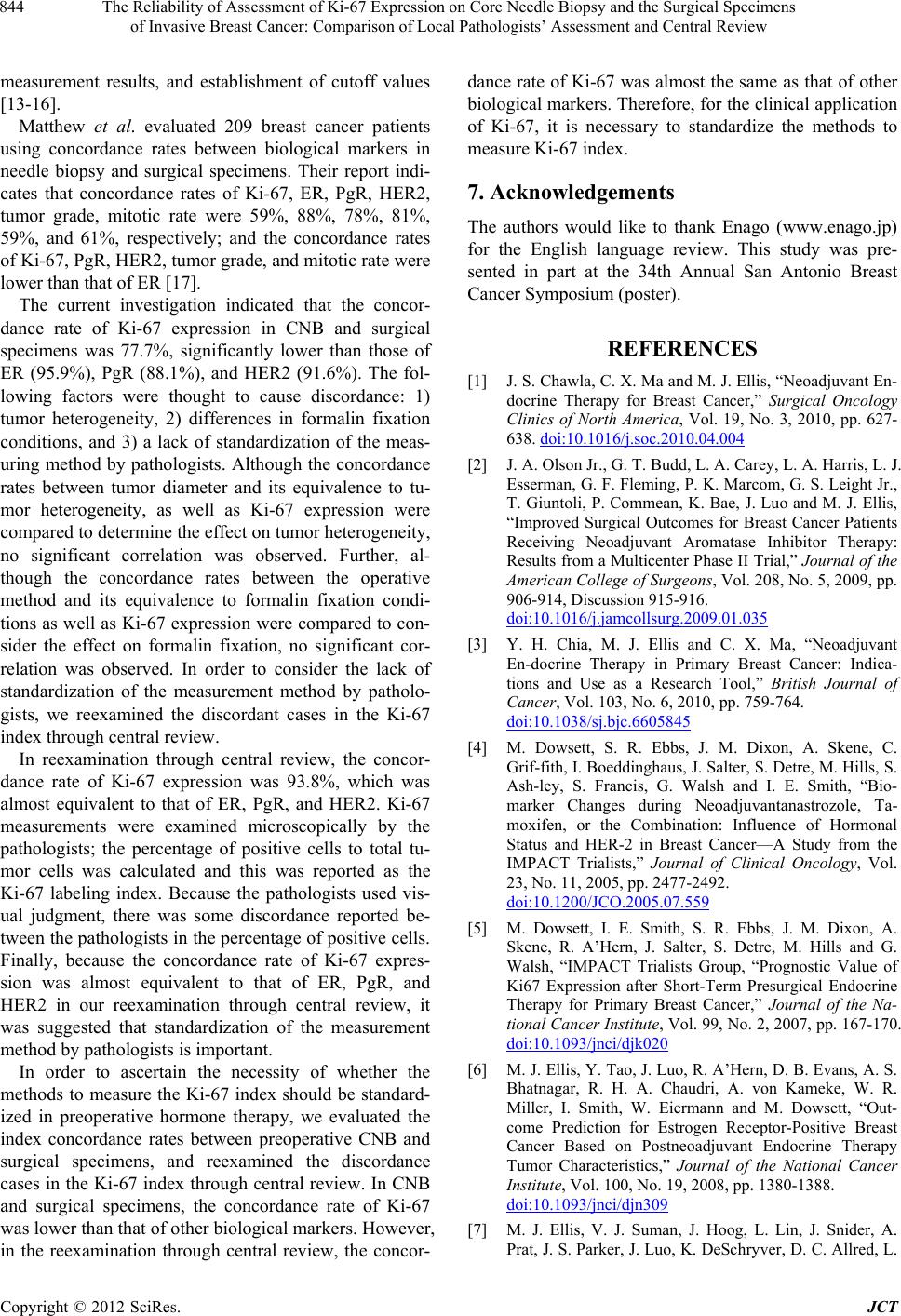 The Reliability of Assessment of Ki-67 Expression on Core Needle Biopsy and the Surgical Specimens of Invasive Breast Cancer: Comparison of Local Pathologists’ Assessment and Central Review 844 measurement results, and establishment of cutoff values [13-16]. Matthew et al. evaluated 209 breast cancer patients using concordance rates between biological markers in needle biopsy and surgical specimens. Their report indi- cates that concordance rates of Ki-67, ER, PgR, HER2, tumor grade, mitotic rate were 59%, 88%, 78%, 81%, 59%, and 61%, respectively; and the concordance rates of Ki-67, PgR, HER2, tumor grade, and mitotic rate were lower than that of ER [17]. The current investigation indicated that the concor- dance rate of Ki-67 expression in CNB and surgical specimens was 77.7%, significantly lower than those of ER (95.9%), PgR (88.1%), and HER2 (91.6%). The fol- lowing factors were thought to cause discordance: 1) tumor heterogeneity, 2) differences in formalin fixation conditions, and 3) a lack of standardization of the meas- uring method by pathologists. Although the concordance rates between tumor diameter and its equivalence to tu- mor heterogeneity, as well as Ki-67 expression were compared to determine the effect on tumor heterogeneity, no significant correlation was observed. Further, al- though the concordance rates between the operative method and its equivalence to formalin fixation condi- tions as well as Ki-67 expression were compared to con- sider the effect on formalin fixation, no significant cor- relation was observed. In order to consider the lack of standardization of the measurement method by patholo- gists, we reexamined the discordant cases in the Ki-67 index through central review. In reexamination through central review, the concor- dance rate of Ki-67 expression was 93.8%, which was almost equivalent to that of ER, PgR, and HER2. Ki-67 measurements were examined microscopically by the pathologists; the percentage of positive cells to total tu- mor cells was calculated and this was reported as the Ki-67 labeling index. Because the pathologists used vis- ual judgment, there was some discordance reported be- tween the pathologists in the percentage of positive cells. Finally, because the concordance rate of Ki-67 expres- sion was almost equivalent to that of ER, PgR, and HER2 in our reexamination through central review, it was suggested that standardization of the measurement method by pathologists is important. In order to ascertain the necessity of whether the methods to measure the Ki-67 index should be standard- ized in preoperative hormone therapy, we evaluated the index concordance rates between preoperative CNB and surgical specimens, and reexamined the discordance cases in the Ki-67 index through central review. In CNB and surgical specimens, the concordance rate of Ki-67 was lower than that of other biological markers. However, in the reexamination through central review, the concor- dance rate of Ki-67 was almost the same as that of other biological markers. Therefore, for the clinical application of Ki-67, it is necessary to standardize the methods to measure Ki-67 index. 7. Acknowledgements The authors would like to thank Enago (www.enago.jp) for the English language review. This study was pre- sented in part at the 34th Annual San Antonio Breast Cancer Symposium (poster). REFERENCES [1] J. S. Chawla, C. X. Ma and M. J. Ellis, “Neoadjuvant En- docrine Therapy for Breast Cancer,” Surgical Oncology Clinics of North America, Vol. 19, No. 3, 2010, pp. 627- 638. doi:10.1016/j.soc.2010.04.004 [2] J. A. Olson Jr., G. T. Budd, L. A. Carey, L. A. Harris, L. J. Esserman, G. F. Fleming, P. K. Marcom, G. S. Leight Jr., T. Giuntoli, P. Commean, K. Bae, J. Luo and M. J. Ellis, “Improved Surgical Outcomes for Breast Cancer Patients Receiving Neoadjuvant Aromatase Inhibitor Therapy: Results from a Multicenter Phase II Trial,” Journal of the American College of Surgeons, Vol. 208, No. 5, 2009, pp. 906-914, Discussion 915-916. doi:10.1016/j.jamcollsurg.2009.01.035 [3] Y. H. Chia, M. J. Ellis and C. X. Ma, “Neoadjuvant En-docrine Therapy in Primary Breast Cancer: Indica- tions and Use as a Research Tool,” British Journal of Cancer, Vol. 103, No. 6, 2010, pp. 759-764. doi:10.1038/sj.bjc.6605845 [4] M. Dowsett, S. R. Ebbs, J. M. Dixon, A. Skene, C. Grif-fith, I. Boeddinghaus, J. Salter, S. Detre, M. Hills, S. Ash-ley, S. Francis, G. Walsh and I. E. Smith, “Bio- marker Changes during Neoadjuvantanastrozole, Ta- moxifen, or the Combination: Influence of Hormonal Status and HER-2 in Breast Cancer—A Study from the IMPACT Trialists,” Journal of Clinical Oncology, Vol. 23, No. 11, 2005, pp. 2477-2492. doi:10.1200/JCO.2005.07.559 [5] M. Dowsett, I. E. Smith, S. R. Ebbs, J. M. Dixon, A. Skene, R. A’Hern, J. Salter, S. Detre, M. Hills and G. Walsh, “IMPACT Trialists Group, “Prognostic Value of Ki67 Expression after Short-Term Presurgical Endocrine Therapy for Primary Breast Cancer,” Journal of the Na- tional Cancer Institute, Vol. 99, No. 2, 2007, pp. 167-170. doi:10.1093/jnci/djk020 [6] M. J. Ellis, Y. Tao, J. Luo, R. A’Hern, D. B. Evans, A. S. Bhatnagar, R. H. A. Chaudri, A. von Kameke, W. R. Miller, I. Smith, W. Eiermann and M. Dowsett, “Out- come Prediction for Estrogen Receptor-Positive Breast Cancer Based on Postneoadjuvant Endocrine Therapy Tumor Characteristics,” Journal of the National Cancer Institute, Vol. 100, No. 19, 2008, pp. 1380-1388. doi:10.1093/jnci/djn309 [7] M. J. Ellis, V. J. Suman, J. Hoog, L. Lin, J. Snider, A. Prat, J. S. Parker, J. Luo, K. DeSchryver, D. C. Allred, L. Copyright © 2012 SciRes. JCT  The Reliability of Assessment of Ki-67 Expression on Core Needle Biopsy and the Surgical Specimens of Invasive Breast Cancer: Comparison of Local Pathologists’ Assessment and Central Review Copyright © 2012 SciRes. JCT 845 J. Esserman, G. W. Unzeitig, J. Margenthaler, G. V. Ba-biera, P. K. Marcom, J. M. Guenther, M. A. Watson, M. Leitch, K. Hunt and J. A. Olson, “Randomized Phase II Neoadjuvant Comparison between Letrozole, Anastro- zole, and Exemestane for Postmenopausal Women with Estro-gen Receptor-Rich Stage 2 to 3 Breast Cancer: Clinical and Biomarker Outcomes and Predictive Value of the Baseline PAM50-Based Intrinsic Subtype— ACOSOG Z1031,” Journal of Clinical Oncology, Vol. 29, No. 17, 2011, pp. 2342-2349. doi:10.1200/JCO.2010.31.6950 [8] M. J. Ellis and C. Ma, “Letrozole in the Neoadjuvant Setting: The P024 Trial,” Breast Cancer Research and Treatment, Vol. 105, Suppl. 1, 2007, pp. 33-43. doi:10.1007/s10549-007-9701-x [9] C X. Ma, C. G. Sanchez and M. J. Ellis, “Predicting En-docrine Therapy Responsiveness in Breast Cancer,” Oncology, Vol. 23, No. 2, 2009, pp. 133-142. [10] M. Dowsett, I. E. Smith, S. R. Ebbs, J. M. Dixon, A. Skene, C. Griffith, I. Boeddinghaus, J. Salter, S. Detre, M Hills, S. Ashley, S. Francis, G. Walsh and R. A’Hern, “Proliferation and Apoptosis as Markers of Benefit in Neoadjuvant Endocrine Therapy of Breast Cancer,” Cli- nical Cancer Research, Vol. 12, Part 2, 2006, pp. 1024s- 1030s. doi:10.1158/1078-0432.CCR-05-2127 [11] M. J. Ellis, W. R. Miller, Y. Tao, D. B. Evans, R. H. A. Chaudri, Y. Miki, T. Suzuki and H. Sasano, “Aromatase Expression and Outcomes in the P024 Neoadjuvant En-docrine Therapy Trial,” Breast Cancer Research and Treatment, Vol. 116, No. 2, 2009, pp. 371-378. doi:10.1007/s10549-008-0161-8 [12] M. Toi, H. Sasano and M. J. Ellis, “Future Prospects of Neoadjuvant Endocrine Therapy in Postmenopausal Breast Cancer,” Japanese Journal of Cancer and Che- motherapy, Vol. 36, No. 6, 2009, pp. 1035-1042. [13] M. Dowsett, T. O. Nielsen, R. A’Hern, J. Bartlett, R. C. Coombes, J. Cuzick, M. Ellis, N. L. Henry, J. C. Hugh, T. Lively, L. McShane, S. Paik, F. Penault-Llorca, L. Prud-kin, M. Regan, J. Salter, C. Sotiriou, I. E. Smith, G. Viale, J. A. Zujewski and D. F. Hayes, “Assessment of Ki67 in Breast Cancer: Recommendations from the In- ternational Ki67 in Breast Cancer Working Group,” Journal of the National Cancer Institute, Vol. 103, No. 22, 2011, pp. 1656-1664. doi:10.1093/jnci/djr393 [14] E. Luporsi, F. André, F. Spyratos, P. M. Martin, J. Jac- quemier, F. Penault-Llorca, N. Tubiana-Mathieu, B. Si- gal-Zafrani, L. Arnould, A. Gompel, C. Egele, B. Poulet, K B. Clough, H. Crouet, A. Fourquet, J. P. Lefranc, C. Mathelin, N. Rouyer, D. Serin, M. Spielmann, M. Haugh, M. P. Chenard, E. Brain, P. de Cremoux and J. P. Bellocq, “Ki-67: Level of Evidence and Methodological Con- sid-erations for Its Role in the Clinical Management of Breast Cancer: Analytical and Critical Review,” Breast Cancer Research and Treatment, Vol. 132, No. 3, 2012, pp. 895-915. doi:10.1007/s10549-011-1837-z [15] R. Yerushalmi, R. Woods, P. M. Ravdin, M. M. Hayes and K. A. Gelmon, “Ki67 in Breast Cancer: Prognostic and Predictive Potential,” The Lancet Oncology, Vol. 11, No. 2, 2010, pp. 174-183. doi:10.1016/S1470-2045(09)70262-1 [16] M. T. Weigel and M. Dowsett, “Current and Emerging Biomarkers in Breast Cancer: Prognosis and Prediction,” Endocrine-Related Cancer, Vol. 17, 4, 2010, pp. R245- R262. doi:10.1677/ERC-10-0136 [17] M. Ough, J. Velasco and T. J. Hieken, “A Comparative Analysis of Core Needle Biopsy and Final Excision for Breast Cancer: Histology and Marker Expression,” The American Journal of Surgery, Vol. 201, No. 5, 2011, pp. pp. 692-694. doi:10.1016/j.amjsurg.2010.02.015 |