

Paper Menu >>
Journal Menu >>
 Sociology Mind 2012. Vol.2, No.4, 435-440 Published Online October 2012 in SciRes (http://www.SciRP.org/journal/sm) http://dx.doi.org/10.4236/sm.2012.24056 Copyright © 2012 SciRes. 435 Center-Based Child Extended Care: Implications for Young Children’s Development in a Five-Year Follow-Up Tokie Anme1, Emiko Tanaka1, Ryoji Shinohara1, Yuka Sugisawa1, Taeko Watanabe1, Etsuko Tomisaki1, Uma A. Segal2 1University of Tsukuba, Tsukuba, Japan 2University of Missouri, St. Louis, USA Email: [email protected] Received March 30th, 2012; revised May 17th, 2012; accepted May 28th, 2012 Effects of early extended child care on children’s functioning from age one year through the end of year six were examined in the Japan Child Care Cohort Study. This longitudinal project sought to assess the developmental and adaptation effects on children. Parents completed a survey on the childrearing envi- ronment at home, their feelings of self-efficacy, and the available support for childcare. Childcare profes- sionals evaluated the development of children. The results, using a panel cohort method, indicated that although parenting was a stronger and more consistent predictor of children’s development than was the early extended child-care experience, support from the spouse predicted higher vocabulary development. Keywords: Extended Child Care; Child Development; Child Rearing Environment; Self-Efficacy Introduction Large numbers of children in Japan experience routine non- maternal child care during their infant, toddler, and preschool years. In 2011, 2.1 million (33.1%) Japanese children, under the age of five years, were in child care (Ministry of Health, La- bour and Welfare, 2011). The increased number of working mothers has led to the dramatic expansion of center-based child care. As nonmaternal child care has become more common, researchers and policy makers have become increasingly con- cerned about its effects on children’s development (Belsky, 1988, 2001; Clarke-Stewart, 1989; Greenspan, 2003). High- quality center-based extended care is essential for children whose parents are employed in long hours that also include the evening and night hours. Some researchers have highlighted potentially beneficial consequences of early child care, especially of high-quality care, on social functioning (Peisner-Feinberg, 1997; Vandell, 1988), as well as on cognitive-linguistic development or academic achievement (Broberg, 1997; Burchinal, 2000). Others have mentioned potentially adverse consequences, especially of long hours of care initiated early in life, on socioemotional func- tioning, including the emergence of behavior problems (Belsky, 2001; Vandell, 1990). Moreover, some have contended that child-care “effects,” whether beneficial or detrimental, do not endure beyond the preschool or early elementary school years (Blau, 1999; Colwell, 2001; Deater-Deckard, 1996; Egeland, 1995), whereas others have claimed that child-care “effects” are more long lasting (Belsky, 1988; Vandell, 1990) or endure for some time, at least in the case of low-income children in high- quality care (Campbell, 2001). While studies of nonmaternal care are prevalent, there is less empirical information regarding the effects of placing children in nonmaternal care for long periods of time (11 + hours). Few studies have assessed the influence of center-based extended care on child development (Anme, 2010). Therefore, in the present work, we used panel cohort data from the Japan Child Care Cohort to ascertain whether the amount of time and child rearing environment affected children’s social competence or vocabulary/motor/intelligence development after five years. Methods Setting an d S am pl e All authorized child-day-care centers across Japan partici- pated in the study. Centers unauthorized by the government were excluded as they often do not cooperate with external investigators. The subjects were all parents and service provid- ers in the authorized facilities. Parents who had a one-year-old child were surveyed regarding the home environment, and ser- vice providers evaluated the development of each child in the facility. The valid response rate was 71.5% (1242) both for parents and service providers. Children with diagnosed disabili- ties and health problems were excluded from the study as these characteristics were expected to confound results. Of the 1242 children sampled at age one, 888 were sampled again at age five years, with both parents and service-providers evaluating the children. Table 1 provides the gender and age composition of the child population that was evaluated and the family struc- ture, siblings, economic status, type of child care, and occupa- tions of the parents. The distribution of boys, 449 (50.6%), and girls, 439 (49.4%), was fairly even. Overview of Measures Indicators of child-care quantity, quality, stability, and type (normal vs long) along with measures of family background, mothering, child characteristics and child adaptation to cen- ter-based care were obtained from questionnaires completed by the parents responsible for the children in the first six years of their lives (Appendix 1). Parents completed Japanese versions of questionnaires on the child-rearing environment (Caldwell, 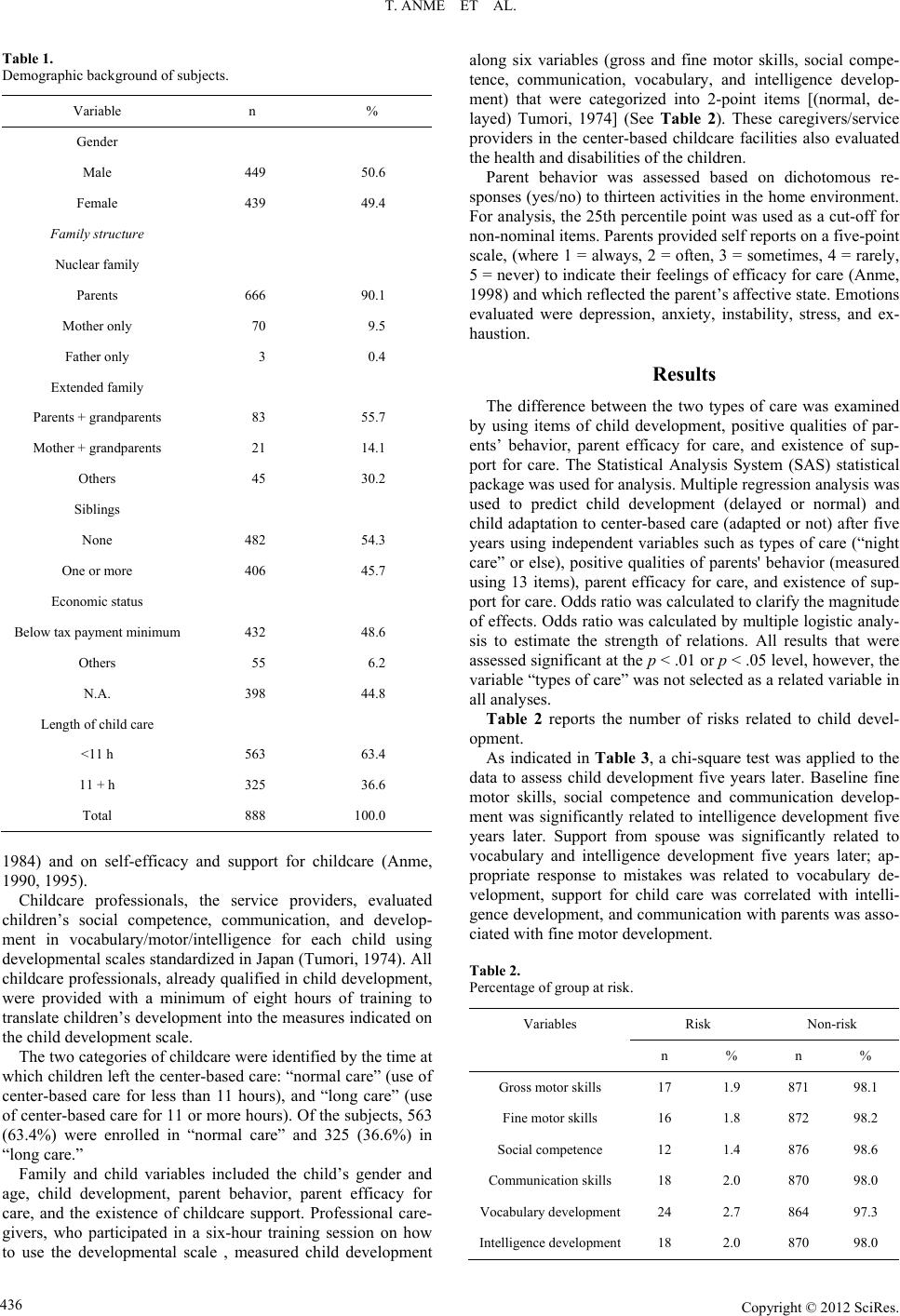 T. ANME ET AL. Table 1. Demographic background of subjects. Variable n % Gender Male 449 50.6 Female 439 49.4 Family structure Nuclear family Parents 666 90.1 Mother only 70 9.5 Father only 3 0.4 Extended family Parents + grandparents 83 55.7 Mother + grandparents 21 14.1 Others 45 30.2 Siblings None 482 54.3 One or more 406 45.7 Economic status Below tax payment minimum 432 48.6 Others 55 6.2 N.A. 398 44.8 Length of child care <11 h 563 63.4 11 + h 325 36.6 Total 888 100.0 1984) and on self-efficacy and support for childcare (Anme, 1990, 1995). Childcare professionals, the service providers, evaluated children’s social competence, communication, and develop- ment in vocabulary/motor/intelligence for each child using developmental scales standardized in Japan (Tumori, 1974). All childcare professionals, already qualified in child development, were provided with a minimum of eight hours of training to translate children’s development into the measures indicated on the child development scale. The two categories of childcare were identified by the time at which children left the center-based care: “normal care” (use of center-based care for less than 11 hours), and “long care” (use of center-based care for 11 or more hours). Of the subjects, 563 (63.4%) were enrolled in “normal care” and 325 (36.6%) in “long care.” Family and child variables included the child’s gender and age, child development, parent behavior, parent efficacy for care, and the existence of childcare support. Professional care- givers, who participated in a six-hour training session on how to use the developmental scale , measured child development along six variables (gross and fine motor skills, social compe- tence, communication, vocabulary, and intelligence develop- ment) that were categorized into 2-point items [(normal, de- layed) Tumori, 1974] (See Table 2). These caregivers/service providers in the center-based childcare facilities also evaluated the health and disabilities of the children. Parent behavior was assessed based on dichotomous re- sponses (yes/no) to thirteen activities in the home environment. For analysis, the 25th percentile point was used as a cut-off for non-nominal items. Parents provided self reports on a five-point scale, (where 1 = always, 2 = often, 3 = sometimes, 4 = rarely, 5 = never) to indicate their feelings of efficacy for care (Anme, 1998) and which reflected the parent’s affective state. Emotions evaluated were depression, anxiety, instability, stress, and ex- haustion. Results The difference between the two types of care was examined by using items of child development, positive qualities of par- ents’ behavior, parent efficacy for care, and existence of sup- port for care. The Statistical Analysis System (SAS) statistical package was used for analysis. Multiple regression analysis was used to predict child development (delayed or normal) and child adaptation to center-based care (adapted or not) after five years using independent variables such as types of care (“night care” or else), positive qualities of parents' behavior (measured using 13 items), parent efficacy for care, and existence of sup- port for care. Odds ratio was calculated to clarify the magnitude of effects. Odds ratio was calculated by multiple logistic analy- sis to estimate the strength of relations. All results that were assessed significant at the p < .01 or p < .05 level, however, the variable “types of care” was not selected as a related variable in all analyses. Table 2 reports the number of risks related to child devel- opment. As indicated in Table 3, a chi-square test was applied to the data to assess child development five years later. Baseline fine motor skills, social competence and communication develop- ment was significantly related to intelligence development five years later. Support from spouse was significantly related to vocabulary and intelligence development five years later; ap- propriate response to mistakes was related to vocabulary de- velopment, support for child care was correlated with intelli- gence development, and communication with parents was asso- ciated with fine motor development. Table 2. Percentage of group at risk. Variables Risk Non-risk n % n % Gross motor skills 17 1.9 871 98.1 Fine motor skills 16 1.8 872 98.2 Social competence 12 1.4 876 98.6 Communication skills 18 2.0 870 98.0 Vocabulary development24 2.7 864 97.3 Intelligence development18 2.0 870 98.0 Copyright © 2012 SciRes. 436 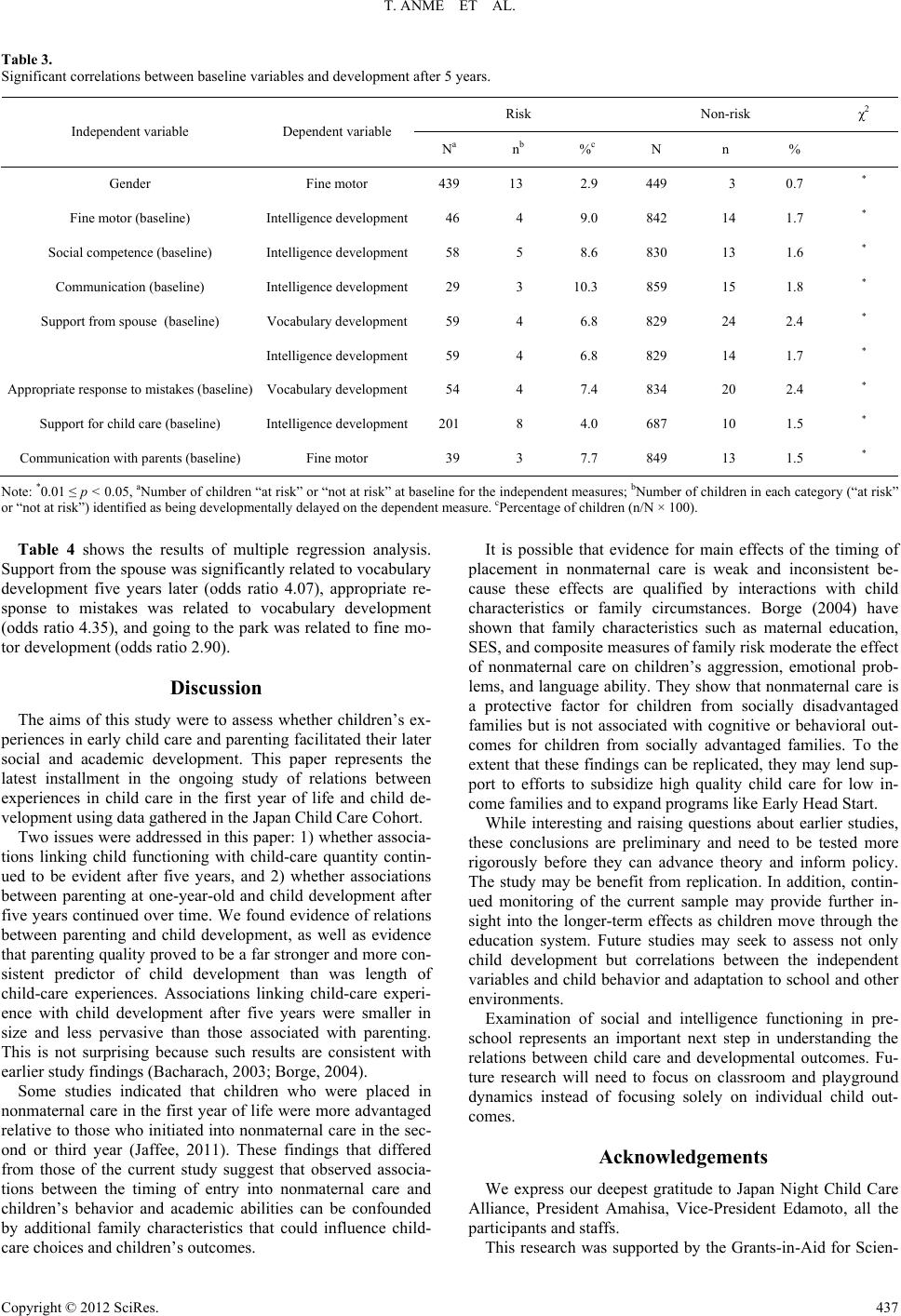 T. ANME ET AL. Copyright © 2012 SciRes. 437 Table 3. Significant correlations between baseline variables and development after 5 years. Risk Non-risk χ2 Independent variable Dependent variable Na n b % c N n % Gender Fine motor 439 13 2.9 449 3 0.7 * Fine motor (baseline) Intelligence development46 4 9.0 842 14 1.7 * Social competence (baseline) Intelligence development58 5 8.6 830 13 1.6 * Communication (baseline) Intelligence development29 3 10.3 859 15 1.8 * Support from spouse (baseline) Vocabulary development59 4 6.8 829 24 2.4 * Intelligence development59 4 6.8 829 14 1.7 * Appropriate response to mistakes (baseline) Vocabulary development54 4 7.4 834 20 2.4 * Support for child care (baseline) Intelligence development201 8 4.0 687 10 1.5 * Communication with parents (baseline) Fine motor 39 3 7.7 849 13 1.5 * Note: *0.01 ≤ p < 0.05, aNumber of children “at risk” or “not at risk” at baseline for the independent measures; bNumber of children in each category (“at risk” or “not at risk”) identified as being developmentally delayed on the dependent measure. cPercentage of children (n/N × 100). Table 4 shows the results of multiple regression analysis. Support from the spouse was significantly related to vocabulary development five years later (odds ratio 4.07), appropriate re- sponse to mistakes was related to vocabulary development (odds ratio 4.35), and going to the park was related to fine mo- tor development (odds ratio 2.90). Discussion The aims of this study were to assess whether children’s ex- periences in early child care and parenting facilitated their later social and academic development. This paper represents the latest installment in the ongoing study of relations between experiences in child care in the first year of life and child de- velopment using data gathered in the Japan Child Care Cohort. Two issues were addressed in this paper: 1) whether associa- tions linking child functioning with child-care quantity contin- ued to be evident after five years, and 2) whether associations between parenting at one-year-old and child development after five years continued over time. We found evidence of relations between parenting and child development, as well as evidence that parenting quality proved to be a far stronger and more con- sistent predictor of child development than was length of child-care experiences. Associations linking child-care experi- ence with child development after five years were smaller in size and less pervasive than those associated with parenting. This is not surprising because such results are consistent with earlier study findings (Bacharach, 2003; Borge, 2004). Some studies indicated that children who were placed in nonmaternal care in the first year of life were more advantaged relative to those who initiated into nonmaternal care in the sec- ond or third year (Jaffee, 2011). These findings that differed from those of the current study suggest that observed associa- tions between the timing of entry into nonmaternal care and children’s behavior and academic abilities can be confounded by additional family characteristics that could influence child- care choices and children’s outcomes. It is possible that evidence for main effects of the timing of placement in nonmaternal care is weak and inconsistent be- cause these effects are qualified by interactions with child characteristics or family circumstances. Borge (2004) have shown that family characteristics such as maternal education, SES, and composite measures of family risk moderate the effect of nonmaternal care on children’s aggression, emotional prob- lems, and language ability. They show that nonmaternal care is a protective factor for children from socially disadvantaged families but is not associated with cognitive or behavioral out- comes for children from socially advantaged families. To the extent that these findings can be replicated, they may lend sup- port to efforts to subsidize high quality child care for low in- come families and to expand programs like Early Head Start. While interesting and raising questions about earlier studies, these conclusions are preliminary and need to be tested more rigorously before they can advance theory and inform policy. The study may be benefit from replication. In addition, contin- ued monitoring of the current sample may provide further in- sight into the longer-term effects as children move through the education system. Future studies may seek to assess not only child development but correlations between the independent variables and child behavior and adaptation to school and other environments. Examination of social and intelligence functioning in pre- school represents an important next step in understanding the relations between child care and developmental outcomes. Fu- ture research will need to focus on classroom and playground dynamics instead of focusing solely on individual child out- comes. Acknowledgements We express our deepest gratitude to Japan Night Child Care Alliance, President Amahisa, Vice-President Edamoto, all the participants and staffs. This research was supported by the Grants-in-Aid for Scien- 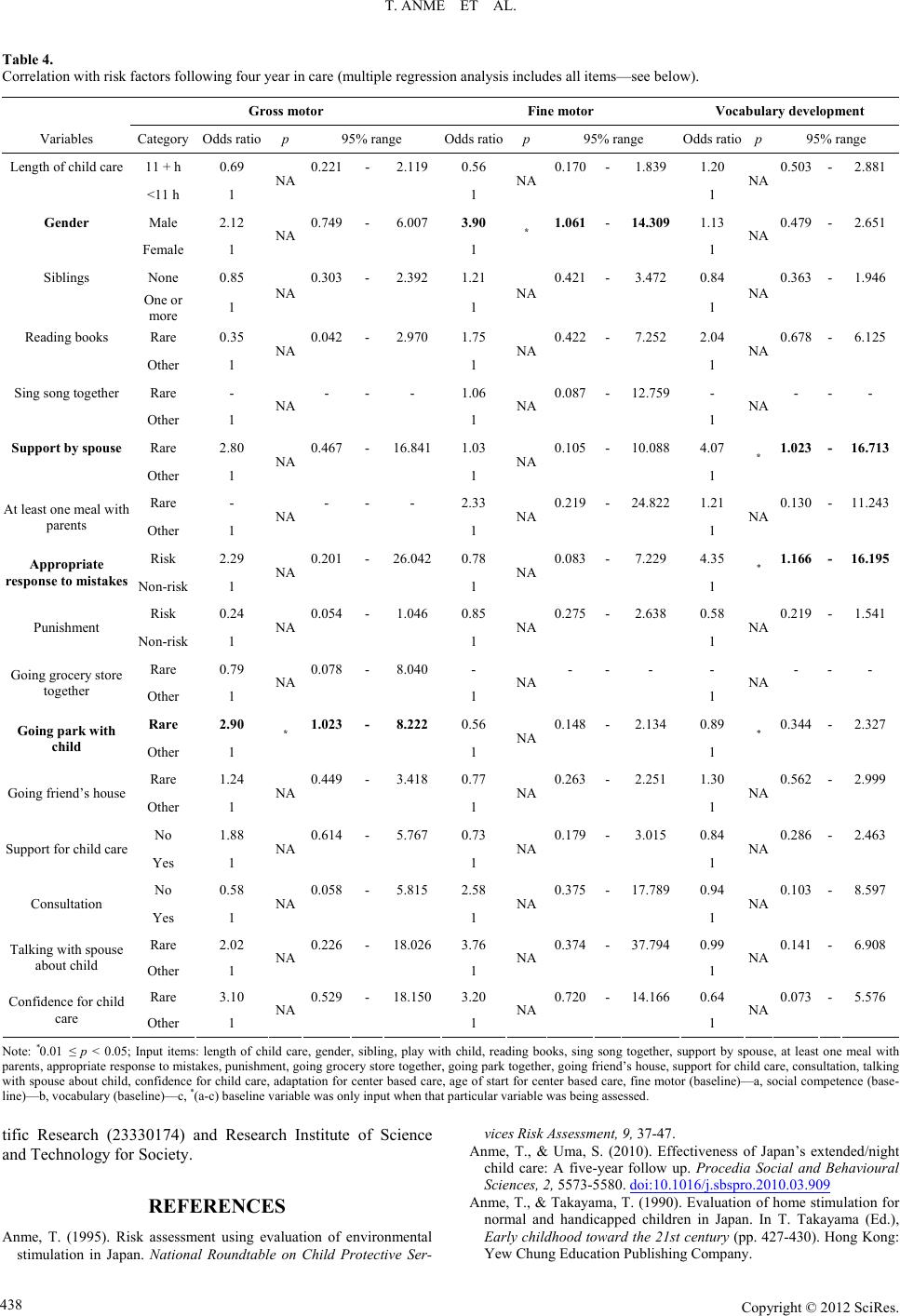 T. ANME ET AL. Table 4. Correlation with risk factors following four year in care (multiple regression analysis includes all items—see below). Gross motor Fine motor Vocabulary development Variables Category Odds ratio p 95% range Odds ratiop 95% range Odds ratio p 95% range Length of child care 11 + h 0.69 0.221 -2.1190.56 0.170-1.8391.20 0.503-2.881 <11 h 1 NA 1 NA 1 NA Gender Male 2.12 0.749 -6.0073.90 1.061-14.309 1.13 0.479-2.651 Female 1 NA 1 * 1 NA Siblings None 0.85 0.303 -2.3921.21 0.421-3.4720.84 0.363-1.946 One or more 1 NA 1 NA 1 NA Reading books Rare 0.35 0.042 -2.9701.75 0.422-7.2522.04 0.678-6.125 Other 1 NA 1 NA 1 NA Sing song together Rare - - -- 1.06 0.087-12.759- - -- Other 1 NA 1 NA 1 NA Support by spouse Rare 2.80 0.467 -16.8411.03 0.105-10.0884.07 1.023 -16.713 Other 1 NA 1 NA 1 * Rare - - -- 2.33 0.219-24.8221.21 0.130-11.243 At least one meal with parents Other 1 NA 1 NA 1 NA Risk 2.29 0.201 -26.0420.78 0.083-7.2294.35 1.166 -16.195 Appropriate response to mistakes Non-risk 1 NA 1 NA 1 * Risk 0.24 0.054 -1.0460.85 0.275-2.6380.58 0.219-1.541 Punishment Non-risk 1 NA 1 NA 1 NA Rare 0.79 0.078 -8.040 - - -- - - -- Going grocery store together Other 1 NA 1 NA 1 NA Rare 2.90 1.023 -8.2220.56 0.148-2.1340.89 0.344-2.327 Going park with child Other 1 * 1 NA 1 * Rare 1.24 0.449 -3.4180.77 0.263-2.2511.30 0.562-2.999 Going friend’s house Other 1 NA 1 NA 1 NA No 1.88 0.614 -5.7670.73 0.179-3.0150.84 0.286-2.463 Support for child care Yes 1 NA 1 NA 1 NA No 0.58 0.058 -5.8152.58 0.375-17.7890.94 0.103-8.597 Consultation Yes 1 NA 1 NA 1 NA Rare 2.02 0.226 -18.0263.76 0.374-37.7940.99 0.141-6.908 Talking with spouse about child Other 1 NA 1 NA 1 NA Rare 3.10 0.529 -18.1503.20 0.720-14.1660.64 0.073-5.576 Confidence for child care Other 1 NA 1 NA 1 NA Note: *0.01 ≤ p < 0.05; Input items: length of child care, gender, sibling, play with child, reading books, sing song together, support by spouse, at least one meal with parents, appropriate response to mistakes, punishment, going grocery store together, going park together, going friend’s house, support for child care, consultation, talking with spouse about child, confidence for child care, adaptation for center based care, age of start for center based care, fine motor (baseline)—a, social competence (base- line)—b, vocabulary (baseline)—c, *(a-c) baseline variable was only input when that particular variable was being assessed. tific Research (23330174) and Research Institute of Science and Technology for Society. REFERENCES Anme, T. (1995). Risk assessment using evaluation of environmental stimulation in Japan. National Roundtable on Child Protective Ser- vices Risk Assessment, 9, 37-47. Anme, T., & Uma, S. (2010). Effectiveness of Japan’s extended/night child care: A five-year follow up. Procedia Social and Behavioural Sciences, 2, 5573-5580. doi:10.1016/j.sbspro.2010.03.909 Anme, T., & Takayama, T. (1990). Evaluation of home stimulation for normal and handicapped children in Japan. In T. Takayama (Ed.), Early childhood toward the 21st century (pp. 427-430). Hong Kong: Yew Chung Education Publishing Company. Copyright © 2012 SciRes. 438  T. ANME ET AL. Bacharach, V. R., & Baumeister, A. A. (2003). Child care and severe externalizing behavior in kindergarten children. Applied Develop- mental Psychology, 23, 527-537. doi:10.1016/S0193-3973(02)00140-5 Belsky, J. (1988). The “effects” of infant day care reconsidered. Early Childhood Research Quarterly, 3 , 235-272. doi:10.1016/0885-2006(88)90003-8 Belsky, J. (2001). Developmental risks (still) associated with early child care. Journal of Ch ild Psychology and Psychiatry, 42, 845-859. doi:10.1111/1469-7610.00782 Blau, D. (1999). The effects of child care characteristics on child de- velopment. Journal of Hu man Resources, 34, 786-822. doi:10.2307/146417 Borge, A. I., Rutter, M., Cote, S., & Tremblay, R. E. (2004). Early childcare and physical aggression: Differentiating social selection from social causation. Journal of Child Psychology and Psychiatry, 45, 367-376. doi:10.1111/j.1469-7610.2004.00227.x Broberg, A. G., Wessels, H., Lamb, M. E., & Hwang, C. P. (1997). Effects of day care on the development of cognitive abilities in 8-year-old: A longitudinal study. Developmental Psychology, 33, 62- 69. doi:10.1037/0012-1649.33.1.62 Burchinal, M. R., Roberts, J. E., Riggins, R., Zeisel, S., Neebe, E., & Bryant, M. (2000). Relating quality of center child care to early cog- nitive and language development longitudinally. Child Development, 71, 339-357. doi:10.1111/1467-8624.00149 Caldwell, B. M., & Bradley, R. H. (1984). Home observation for meas- urement of the environment. Little Rock: University of Arkansas at Little Rock. Campbell, F. A., Pungello, E. P., Miller-Johnson, S., Burchinal, M. R., & Ramey, C. (2001). The development of cognitive and academic abilities: Growth curves from an early intervention educational ex- periment. Developmental Psychology, 37, 231-242. doi:10.1037/0012-1649.37.2.231 Clarke-Stewart, K. A. (1989). Infant day care: Maligned or malignant? American Psychologist, 44, 266-273. doi:10.1037/0003-066X.44.2.266 Colwell, M., Pettit, G., Meece, D., Bates, J. E., & Dodge, K. A. (2001). Cumulative risk and continuity in nonparental care from infancy to early adolescence. Merrill-Palmer Quarterly, 47, 207-234. doi:10.1353/mpq.2001.0009 Deater-Deckard, K. A., Pinkerton, R., & Scarr, S. (1996). Child care quality and children’s behavioral adjustment: A four-year longitudi- nal study. Journal of Child Psychology and Psychiatry, 37, 937-948. doi:10.1111/j.1469-7610.1996.tb01491.x Egeland, B., & Hiester, M. (1995). The long-term consequences of infant day-care and mother-infant attachment. Child Dev elo pm ent , 66, 474-485. doi:10.2307/1131591 Greenspan, S. I. (2003). Child care research: A clinical perspective. Child Development, 74, 1064-1068. doi:10.1111/1467-8624.00591 Jaffee, S. R., Hulle, C. V., & Rodgers, J. L.(2011). Effects of nonma- ternal care in the first 3 years on children’s academic skills and be- havioral functioning in childhood and early adolescence: A sibling comparison study. Child Development, 82, 1076-1091. doi:10.1111/j.1467-8624.2011.01611.x Ministry of Health, Labour and Welfare (2011). Fact sheet of child care 2011. http://www.mhlw.go.jp/english/org/pamphlet/dl/pamphlet-about_mhl w.pdf#page=24 Peisner-Feinberg, E., & Burchinal, M. (1997). Concurrent relations between child care quality and child outcomes: The study of cost, quality and outcomes in child care centers. Merrill-Palmer Quarterly, 43, 451-477. Tumori, S. (1974). Developmental evaluation. Kyusu: Kyusu Daigaku Syuppan. Vandell, D. L., Henderson, V. K., & Wilson, K. S. (1988). A longitu- dinal study of children with day-care experiences of varying quality. Child Development, 59, 1286-1292. doi:10.2307/1130491 Copyright © 2012 SciRes. 439  T. ANME ET AL. Appendix 1. Questionnaire (Extract) 1. How often do you play with your child per wee k? 1) rarely 2) 1 - 2 weeks 3) 3 - 4 weeks 4) 5 - 6 weeks 5) almost every day 6) other ( ) 2. How often do y ou go shopping with your child? 1) rarely 2) 1 - 2 months 3) 1 - 2 weeks 4) 3 - 4 weeks 5) almost every day 6) other ( ) 3. How often do you read to your child? 1) rarely 2) 1 - 2 months 3) 1 - 2 weeks 4) 3 - 4 weeks 5) almost every day 6) other ( ) 4. How often do you sing songs with your child? 1) rarely 2) 1 - 2 months 3) 1 - 2 weeks 4) 3 - 4 weeks 5) almost every day 6) other ( ) 5. How often do you go to the park with your child? 1) rarely 2) 1 - 2 months 3) 1 - 2 weeks 4) 3 - 4 weeks 5) almost every day 6) other ( ) 6. How often do you and your child meet with friends or relatives with children of a similar age? 1) rarely 2) 1 - 2 months 3) 1 - 2 weeks 4) 3 - 4 weeks 5) almost every day 6) other ( ) 7. How often does your spouse, partner, or other care giver help you with the child? 1) rarely 2) 1 - 2 months 3) 1 - 2 weeks 4) 3 - 4 weeks 5) almost every day 6) other ( ) 8. How often does your child eat meals together with both parents? 1) rarely 2) 1 - 2 months 3) 1 - 2 weeks 4) 3 - 4 weeks 5) almost every day 6) other ( ) 9. What do you do if your child spills milk purposely? 1) hit the child 2) scold the child 3) discipline in another way 4) determine how to prevent it in the future 5) other ( ) 10. How many times did you hit or kick your child last week? 1) never 2) 1 - 2 times 3) 3 - 4times 4) 4 - 5 times 5) almost every day 6) other ( ) 11. How many times do you have a chance to talk with your partner about your child? 1) very little 2) 1 - 2 months 3) 1 - 2 weeks 4) 3 - 4 weeks 5) almost every day 6) other ( ) 12. Does someone help you take care of your child? 1) Yes 2) No 3) other ( ) If yes, circle all the following that apply: 1) spouse 2) grandparent 3) friend 4) relative 5) neighbor 6) child care professionals from the nursery 7) director of nursery 8) baby-sitter 9) other staff at the nursery 10) other ( ) 13. Do you have someone to consult with about childcare? 1) Yes 2) No 3) other ( ) If yes, circle all the following that apply: 1) spouse 2) grandparent 3) friend 4) relative 5) neighbor 6) child care professionals from the nursery 7) director of nursery 8) baby-sitter 9) other staff at the nursery 10) other ( ) Copyright © 2012 SciRes. 440 |