

Paper Menu >>
Journal Menu >>
 Theoretical Economics Letters, 2012, 2, 385-390 http://dx.doi.org/10.4236/tel.2012.24071 Published Online October 2012 (http://www.SciRP.org/journal/tel) Anonymous Giving as a Vice: An Application of Image Motivation Masaoki Tamura Graduate School of Economics, University of Tokyo, Tokyo, Japan Email: [email protected] Received June 6, 2012; revised July 2, 2012; accepted August 1, 2012 ABSTRACT While some donors boast about their giving, others give anonymously. A novel feature of this paper is that anonymity is endogenously con trolled by dono rs themselves, not exogenously controlled by fundraisers. Is anonymous giving really a virtue, as is generally recognised? Paradoxically, this p aper proves that anonymity is a vice for fun draisers even if it is what donors desire. If many altruists (a good type) switch from known to anonymous giving, it relatively lowers the group reputation of known donors and enhances that of non-donors. These effects dilute the incentive for other indi- viduals to become known donors, if they have psychological “image motivation”. I suggest a practical method to con- trol the expected number of anonymous donors: fundraisers remove the “check boxes” from their web sites. Keywords: Giving; Anonymity; Altruism; Image; Fundraising 1. Introduction Many studies, including [1-3], show that if experimenters control the anonymity of examinees, the examinees change their prosocial behaviour. The more anonymity experimenters provide, the less altruistic the examinees become. A novel feature of this paper is that anonymity is endogenously determined by the donors themselves. While some donors boast about their giving, others give anonymously. Is anonymous giving worth the same as known giving to fundraisers? Is anonymous giving really a virtue, as is generally recognised? Paradoxically, this paper proves that anonymous giving is a vice, even if the donors themselves desire anonymity. We extend Benabou and Tirole’s image signalling frame- work to the case in which “anonymity” is redefined and individuals themselves choose anonymity level. Since people care about their social reputations, even non-al- truists donate to conceal their selfishness and enhance their reputations. The key lies in this “hypocritical” be- haviour of donors. Such behaviour is possible because altruism is private information and the donation amount is what others observe; giving enables non-altruists to mimic altruists and achieve recogn ition as altru ists. How- ever, if we allow donors an option to anonymous giving, it is clear that not all donors choose the same anonymity level. It is essential to identify wh o donates anonymous ly, because it determines whether anonymous giving is in- dependent of or related to the hypocritical behaviour. Our result is that those who prefer anonymous giving are the best “target” for the non-altruists to mimic, and the exis- tence of anonymous donors negatively affects the hypo- critical behaviour of non-altruists and the total amount of donation. Practically, fundraisers should control the expected number of anonymous donors. However, we can find one example that exaggerates the existence of anonymous donors. Currently, many fundraisers solicit contributions via the Internet in addition to normal fundraising activi- ties. On their Web sites, some fundraisers place check boxes for donors to select anonymous or known dona- tions. Figure 1 shows how a typical such site looks. On the page, donors fill out not only the information about the amount of donation, name, address, and credit card number but also the check box “I prefer to make this do- nation anonymously”. By providing the check boxes, these fundraisers intend to make it convenient to donate anonymously. The problem, however, is that, when fac- ing the choice, donors expect that fundraisers provided the check box in response to many requests from a sub- stantial number of anonymous donors. In other words, the check box exaggerates the number of anonymous do- nors. The contribution of this paper is threefold. First and foremost, it suggests how fundraising campaigns can be more efficiently designed: fundraisers should all ow anony - mous donation only as an exception and should not exag- gerate the number of anonymous donors. Specifically, we can identify inefficiency in some fundraising Web sites and suggest an improvement. Such sites can impose a small “foot cost” on anonymous giving. Second, this is the first paper that studies a model in which an onymity is C opyright © 2012 SciRes. TEL 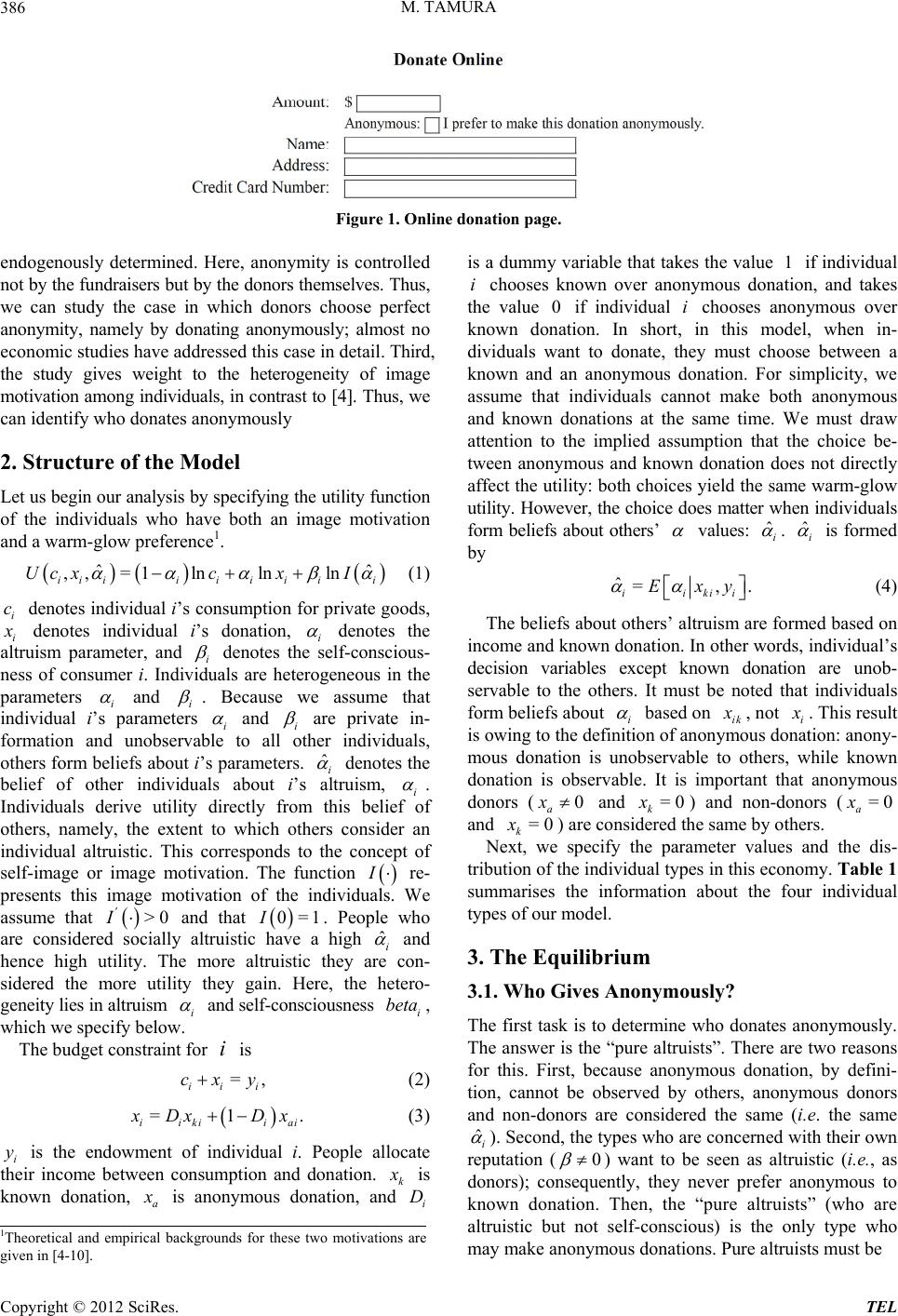 M. TAMURA 386 Figure 1. Online donation page. endogenously determined. Here, anonymity is controlled not by the fundraisers but by the donors themselves. Thus, we can study the case in which donors choose perfect anonymity, namely by donating anonymously; almost no economic studies have addressed this case in detail. Third, the study gives weight to the heterogeneity of image motivation among individuals, in contrast to [4]. Thus, we can identify who donates anonymously 2. Structure of the Model Let us begin our analysis by specifying the utility function of the individuals who have both an image motivation and a warm-glow preference1. ˆˆ ,,= 1lnlnln ii iiiiiii Ucxc x I (1) i c denotes individual i’s consumption for private goods, i x denotes individual i’s donation, i denotes the altruism parameter, and i denotes the self-conscious- ness of consumer i. Individuals are heterogeneous in the parameters i and i . Because we assume that individual i’s parameters i and i are private in- formation and unobservable to all other individuals, others form beliefs about i’s parameters. ˆi denotes the belief of other individuals about i’s altruism, i . Individuals derive utility directly from this belief of others, namely, the extent to which others consider an individual altruistic. This corresponds to the concept of self-image or image motivation. The function I re- presents this image motivation of the individuals. We assume that and that . People who are considered socially altruistic have a high i >0 ' I 0=1Iˆ and hence high utility. The more altruistic they are con- sidered the more utility they gain. Here, the hetero- geneit y lies in altruis m i and self-consciousness , which we specify below. i beta The budget constraint for is i =, ii i cx y (2) =1 iiki ia . i x DxD x (3) i is the endowment of individual i. People allocate their income between consumption and donation. y k x is known donation, a x is anonymous donation, and i D is a dummy variable th at takes the value if individual chooses known over anonymous donation, and takes the value if individual chooses anonymous over known donation. In short, in this model, when in- dividuals want to donate, they must choose between a known and an anonymous donation. For simplicity, we assume that individuals cannot make both anonymous and known donations at the same time. We must draw attention to the implied assumption that the choice be- tween anonymous and known donation does not directly affect the utility: both choices yield the same warm-glow utility. However, the choice does matter when individuals form beliefs about others’ 1 i0i values: ˆi . ˆi is formed by ˆki y= ii Ex , i . (4) The beliefs about others’ altruism are formed based on income and known donation. In other words, individual’s decision variables except known donation are unob- servable to the others. It must be noted that individuals form beliefs about i based on ik x , not i x . This result is owing to the definitio n of anon ymou s donatio n : anon y- mous donation is unobservable to others, while known donation is observable. It is important that anonymous donors (0 a x and k) and non-donors ( and ) are considered the same by others. =0x=0 a x =0 k Next, we specify the parameter values and the dis- tribution of the individual types in th is economy. Table 1 summarises the information about the four individual types of our model. x 3. The Equilibrium 3.1. Who Gives Anonymously? The first task is to determine who donates anonymously. The answer is the “pure altruists”. There are two reasons for this. First, because anonymous donation, by defini- tion, cannot be observed by others, anonymous donors and non-donors are considered the same (i.e. the same ˆi ). Second, the types who ar e concern ed with their own reputation (0 ) want to be seen as altruistic (i.e., as donors); consequently, they never prefer anonymous to known donation. Then, the “pure altruists” (who are altruistic but not self-conscious) is the only type who may make anonymous donations. Pure altruists must be 1Theoretical and empirical backgrounds for these two motivations are given in [4-10]. Copyright © 2012 SciRes. TEL 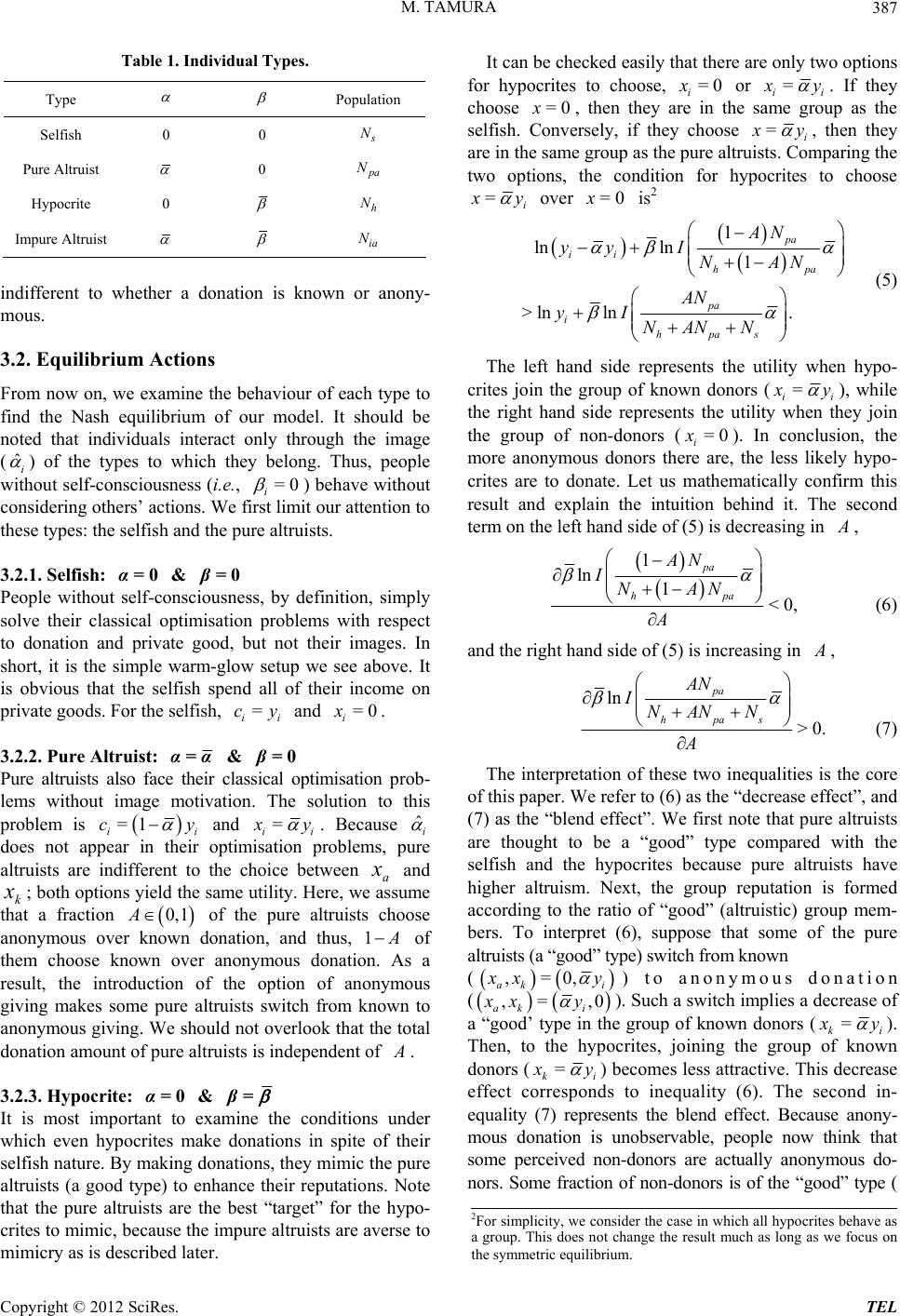 M. TAMURA 387 Table 1. Individual Types. Type Population Selfish 0 0 s N Pure Altruist 0 p a N Hypocrite 0 h N Impure Altruist ia N indifferent to whether a donation is known or anony- mous. 3.2. Equilibrium Actions From now on, we examine the behaviour of each type to find the Nash equilibrium of our model. It should be noted that individuals interact only through the image (ˆi ) of the types to which they belong. Thus, people without self-consciousness (i.e., =0 i ) behave without considering others’ actions. We first limit our attention to these types: the selfish and the pure altruists. 3.2.1. Selfis h : & =0α0β= People without self-consciousness, by definition, simply solve their classical optimisation problems with respect to donation and private good, but not their images. In short, it is the simple warm-glow setup we see above. It is obvious that the selfish spend all of their income on private goods. For the selfish, i and . = i cy =0 i x 3.2.2. Pure Altrui st: α=α & 0β= Pure altruists also face their classical optimisation prob- lems without image motivation. The solution to this problem is =1 ii cy and = ii x y . Because ˆi does not appear in their optimisation problems, pure altruists are indifferent to the choice between a and k; both options yield the same utility. Here, we assume that a fraction of the pure altruists choose anonymous over known donation, and thus, 1 x x 0,1A A of them choose known over anonymous donation. As a result, the introduction of the option of anonymous giving makes some pure altruists switch from known to anonymous giving. We should not overlook that the total donation amount of pure altruists is independent of A . 3.2.3. Hypocrite: & =0αβ= It is most important to examine the conditions under which even hypocrites make donations in spite of their selfish nature. By making donations, th ey mimic the pure altruists (a good type) to enhance their reputations. Note that the pure altruists are the best “target” for the hypo- crites to mimic, becau se the impure altruists are averse to mimicry as is described later. It can be checked easily that there are only two options for hypocrites to choose, or =0 i x= ii x y . If they choose , then they are in the same group as the selfish. Conversely, if they choose =0x=i x y , then they are in the same group as the pure altruists. Comparing the two options, the condition for hypocrites to choose =i x y over is2 =0x 1 lnln1 >lnln. pa ii hp pa ihpas AN yy I NAN AN yI NAN N a (5) The left hand side represents the utility when hypo- crites join the group of known donors (= ii x y ), while the right hand side represents the utility when they join the group of non-donors (). In conclusion, the more anonymous donors there are, the less likely hypo- crites are to donate. Let us mathematically confirm this result and explain the intuition behind it. The second term on the left hand side of (5) is decreasing in =0 i x A , 1 ln 1<0, pa hpa AN INAN A (6) and the right hand side of (5) is increasing in A , ln >0. pa hpas AN INANN A (7) The interpretation of these two inequalities is the core of this paper. We refer to (6) as the “decrease effect”, and (7) as the “blend effect”. We first note that pure altruists are thought to be a “good” type compared with the selfish and the hypocrites because pure altruists have higher altruism. Next, the group reputation is formed according to the ratio of “good” (altruistic) group mem- bers. To interpret (6), suppose that some of the pure altruists (a “good” ty pe) switch from known ( ,=0, ak i x x y) to anonymous donation ( ,= ,0 ak i xx y ). Such a switch implies a decrease of a “good’ type in the group of known donors (= ki x y ). Then, to the hypocrites, joining the group of known donors (= ki x y ) becomes less attractive. This decrease effect corresponds to inequality (6). The second in- equality (7) represents the blend effect. Because anony- mous donation is unobservable, people now think that some perceived non-donors are actually anonymous do- nors. Some fraction of non-donors is of the “good” type ( 2For simplicity, we consider the case in which all hypo crites behave as a group. This does not change the result much as long as we focus on the symmetric equilibrium. Copyright © 2012 SciRes. TEL 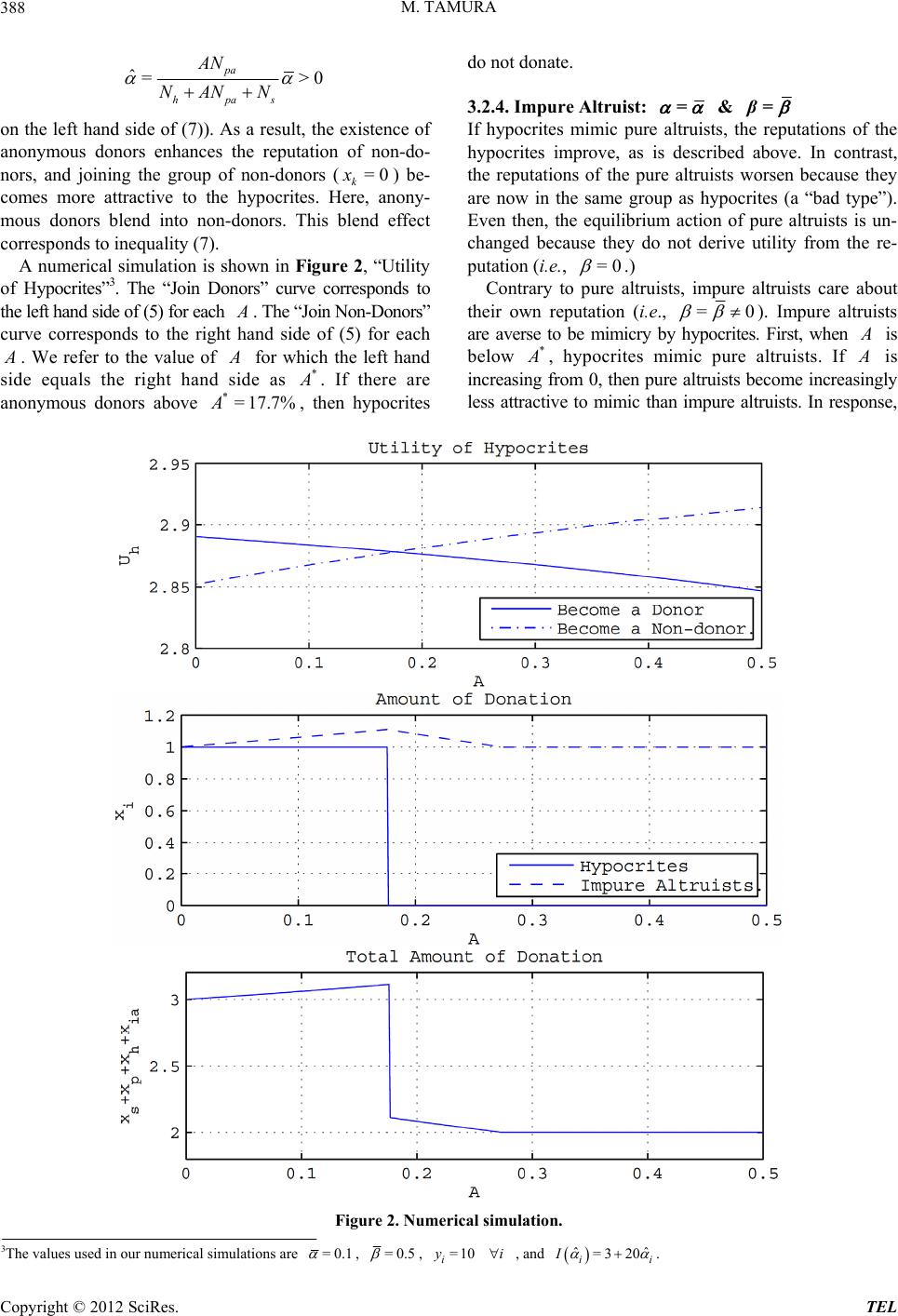 M. TAMURA Copyright © 2012 SciRes. TEL 388 ˆ=> pa hpas AN NAN N 0 do not donate. 3.2.4. Impure Altruist: = & β= on the left hand side of (7)). As a result, the existence of anonymous donors enhances the reputation of non-do- nors, and joining the group of non-donors () be- comes more attractive to the hypocrites. Here, anony- mous donors blend into non-donors. This blend effect corresponds to inequality (7). =0 k x If hypocrites mimic pure altruists, the reputations of the hypocrites improve, as is described above. In contrast, the reputations of the pure altruists worsen because they are now in the same group as hypocrites (a “bad type”). Even then, the equilibrium action of pure altruists is un- changed because they do not derive utility from the re- putation (i.e., =0 .) A numerical simulation is shown in Figure 2, “Utility of Hypocrites”3. The “Join Donors” curve corresponds to the left hand side of (5) for each A . The “Join Non-Donors” curve corresponds to the right hand side of (5) for each A . We refer to the value of A for which the left hand side equals the right hand side as * A . If there are anonymous donors above , then hypocrites *=17.7%A Contrary to pure altruists, impure altruists care about their own reputation (i.e., = 0). Impure altruists are averse to be mimicry by hypocrites. First, when A is below * A , hypocrites mimic pure altruists. If A is increasing from 0, then pure altruists become increasingly less attractive to mimic than impure altruists. In response, Figure 2. Numerical simulation. 3The values used in o u r numerical simulations are =0.1 , =0.5 , =10 i yi , and ˆˆ =3 20 ii I . 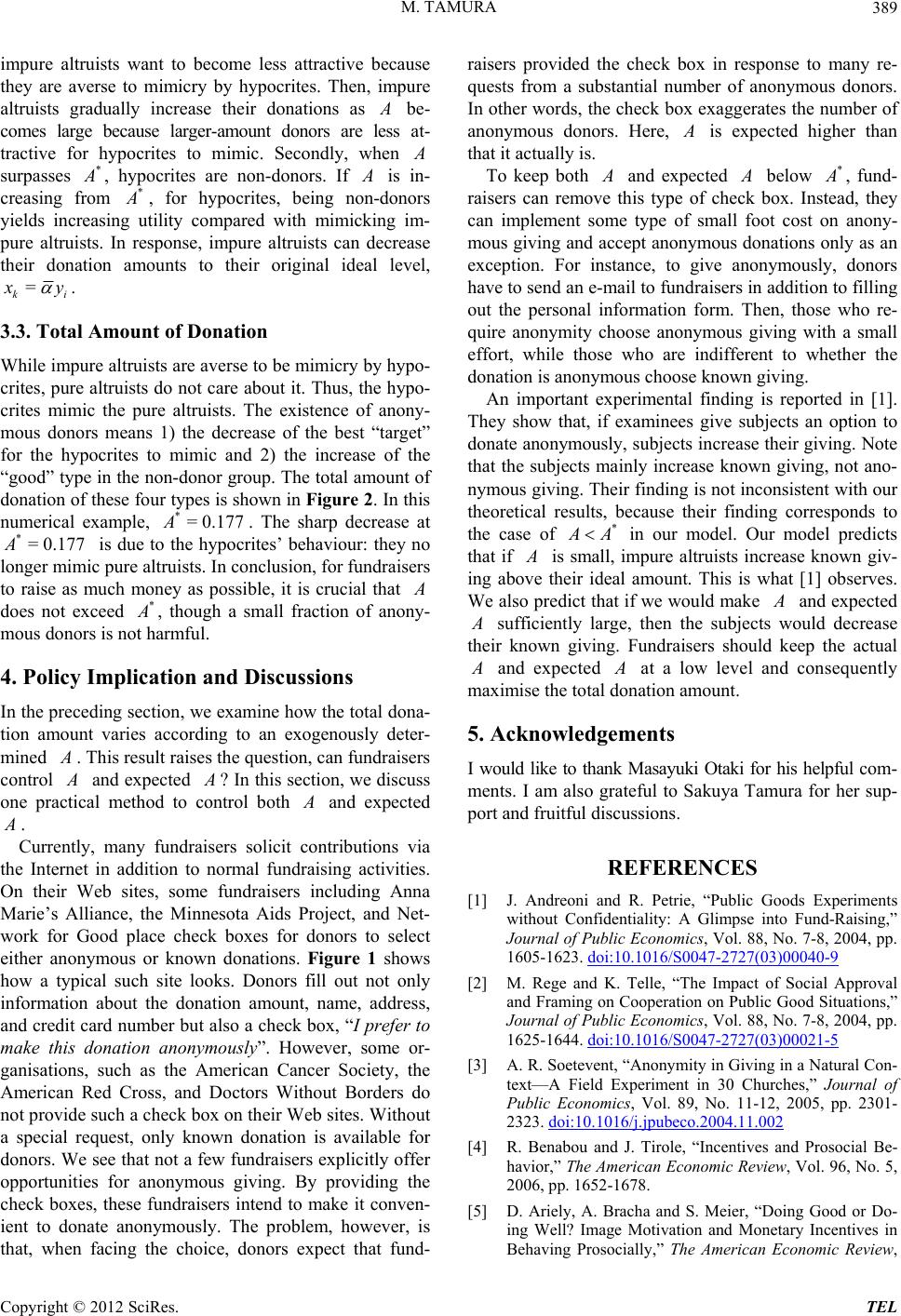 M. TAMURA 389 impure altruists want to become less attractive because they are averse to mimicry by hypocrites. Then, impure altruists gradually increase their donations as A be- comes large because larger-amount donors are less at- tractive for hypocrites to mimic. Secondly, when A surpasses * A , hypocrites are non-donors. If A is in- creasing from * A , for hypocrites, being non-donors yields increasing utility compared with mimicking im- pure altruists. In response, impure altruists can decrease their donation amounts to their original ideal level, = ki x y . 3.3. Total Amount of Donation While impure altruists are averse to be mimicry by hypo- crites, pure altruists do not care about it. Thus, the hypo- crites mimic the pure altruists. The existence of anony- mous donors means 1) the decrease of the best “target” for the hypocrites to mimic and 2) the increase of the “good” type in the non-donor group. The total amount of donation of these four types is shown in Figure 2. In this numerical example, . The sharp decrease at is due to the hypocrites’ behaviour: they no longer mimic pure altruists. In conclusion, for fundraisers to raise as much money as possible, it is crucial that *=0.177A *=0.177A A does not exceed * A , though a small fraction of anony- mous donors is not harmful. 4. Policy Implication and Discussions In the preceding section, we examine how the total dona- tion amount varies according to an exogenously deter- mined A . This result raises the question, can fundraisers control A and expected A ? Inthis section, we discuss one practical method to control both A and expected A . Currently, many fundraisers solicit contributions via the Internet in addition to normal fundraising activities. On their Web sites, some fundraisers including Anna Marie’s Alliance, the Minnesota Aids Project, and Net- work for Good place check boxes for donors to select either anonymous or known donations. Figure 1 shows how a typical such site looks. Donors fill out not only information about the donation amount, name, address, and credit card number but also a check box, “I prefer to make this donation anonymously”. However, some or- ganisations, such as the American Cancer Society, the American Red Cross, and Doctors Without Borders do not provide such a ch eck box on th eir Web sites. Witho ut a special request, only known donation is available for donors. We see that not a few fundraisers explicitly offer opportunities for anonymous giving. By providing the check boxes, these fundraisers intend to make it conven- ient to donate anonymously. The problem, however, is that, when facing the choice, donors expect that fund- raisers provided the check box in response to many re- quests from a substantial number of anonymous donors. In other words, the check box exaggerates the number of anonymous donors. Here, A is expected higher than that it actually is. To keep both A and expected A below * A , fund- raisers can remove this type of check box. Instead, they can implement some type of small foot cost on anony- mous giving and accept anonymous donations only as an exception. For instance, to give anonymously, donors have to send an e-mail to fund raisers in addition to filling out the personal information form. Then, those who re- quire anonymity choose anonymous giving with a small effort, while those who are indifferent to whether the donation is anonymous choose known giving. An important experimental finding is reported in [1]. They show that, if examinees give subjects an option to donate anonymously, subjects increase their giving. Note that the subjects mainly increase known giving, not ano- nymous giving. Their finding is not inconsistent with our theoretical results, because their finding corresponds to the case of * A A in our model. Our model predicts that if A is small, impure altruists increase known giv- ing above their ideal amount. This is what [1] observes. We also predict that if we would make A and expected A sufficiently large, then the subjects would decrease their known giving. Fundraisers should keep the actual A and expected A at a low level and consequently maximise the total donation amount. 5. Acknowledgements I would like to thank Masayuki Otaki for his helpful com- ments. I am also grateful to Sakuya Tamura for her sup- port and fruitful discussions. REFERENCES [1] J. Andreoni and R. Petrie, “Public Goods Experiments without Confidentiality: A Glimpse into Fund-Raising,” Journal of Public Economics, Vol. 88, No. 7-8, 2004, pp. 1605-1623. doi:10.1016/S0047-2727(03)00040-9 [2] M. Rege and K. Telle, “The Impact of Social Approval and Framing on Cooperation on Public Good Situations,” Journal of Public Economics, Vol. 88, No. 7-8, 2004, pp. 1625-1644. doi:10.1016/S0047-2727(03)00021-5 [3] A. R. Soetevent, “Anonymity in Giving in a Natural Con- text—A Field Experiment in 30 Churches,” Journal of Public Economics, Vol. 89, No. 11-12, 2005, pp. 2301- 2323. doi:10.1016/j.jpubeco.2004.11.002 [4] R. Benabou and J. Tirole, “Incentives and Prosocial Be- havior,” The American Economic Review, Vol. 96, No. 5, 2006, pp. 1652-1678. [5] D. Ariely, A. Bracha and S. Meier, “Doing Good or Do- ing Well? Image Motivation and Monetary Incentives in Behaving Prosocially,” The American Economic Review, Copyright © 2012 SciRes. TEL  M. TAMURA 390 Vol. 99, No. 1, 2009, pp. 544-555. doi:10.1257/aer.99.1.544 [6] J. Carpenter and C. K. Myers, “Why Volunteer? Evidence on the Role of Altruism, Image, and Incentives,” Journal of Public Economics, Vol. 94, No. 11-12, 2010, pp. 911- 920. doi:10.1016/j.jpubeco.2010.07.007 [7] J. Andreoni, “Giving with Impure Altruism: Applications to Charity and Ricardian Equivalence,” Journal of Politi- cal Economy, Vol. 97, No. 6, 1989, pp. 1447-58. doi:10.1086/261662 [8] J. Andreoni, “Impure Altruism and Donations to Public Goods: A Theory of Warm-Glow Giving,” The Economic Journal, Vol. 100, No. 401, 1990, pp. 464-477. doi:10.2307/2234133 [9] H. Crumpler and P. J. Grossman, “An Experimental Test of Warm Glow Giving,” Journal of Public Economics, Vol. 92, No. 5-6, 2008, pp. 1011-1021. doi:10.1016/j.jpubeco.2007.12.014 [10] T. R. Palfrey and J. E. Prisbrey, “Anomalous Behavior in Public Goods Experiments: How Much and Why?” The American Economic Review, Vol. 87, No. 5, 1997, pp. 829- 846. Copyright © 2012 SciRes. TEL |