

Paper Menu >>
Journal Menu >>
 Theoretical Economics Letters, 2012, 2, 379-384 http://dx.doi.org/10.4236/tel.2012.24070 Published Online October 2012 (http://www.SciRP.org/journal/tel) A Matching Model on the Use of Immigrant Social Networks and Referral Hiring Mónica García-Pérez Department of Economics, St. Cloud State University, St. Cloud, USA Email: migarciape[email protected] Received August 8, 2012; revised September 7, 2012; accepted October 9, 2012 ABSTRACT Using a simple search model, with urn-ball derived matching function, this paper investigates the effect of firm owner’s and coworkers’ nativity on hiring patterns and wages. In the model, social networks reduce search frictions and wages are derived endogenously as a function of the efficiency of the social ties of current employees. As a result, individuals with more efficient connections tend to receive higher wages and lower unemployment rate. However, because this ef- ficiency depends on matching with same-type owners and coworkers, there is also a differential effect among workers’ wages in the same firm. This analysis highlights the potential importance of social connections and social capital for understanding employment opportunities and wage differentials between these groups. Keywords: Immigration; Search Models; Social Networks; Wage Differential; Hiring Process 1. Introduction Previous work has studied the effects of networks in the labor market to explain labor market inequalities as a function of differential social capital (social resources, network structures, network resources). Minority indi- viduals are generally connected to other minority-group workers who can only provide them with limited oppor- tunities to change their employment outcomes. In this context, personal networks are then considered an addi- tional determinant of inequality [1]. For instance, His- panics and blacks are disadvantaged because they are likely to match with same-kind job contacts, and end up working in lower wage workplaces where other Hispan- ics and blacks work (see [2]). This paper intends to model the interconnection be- tween owner’s and coworkers’ nativity and workers’ hiring patterns and wages. We use a simple search model where social networks reduce search frictions to develop the theoretical implications o f social ties between owners and workers for individual labor outcomes. In the model, wages are derived endogenously as a function of the effi- ciency of the social ties of current employees. Firms can fill their vacancies either by posting their offers or by using their current workers’ connections. However, em- ployers may use this mechanism differently for different worker types, depending on their ability to take advan- tage of their workers’ connections. Given their cultural, linguistic, and social backgrounds, immigrant employers have an advantage, compared to natives, in exploiting their immigrant workers’ social connections. As a result, individuals with better connections—a combination of owner type and coworkers type—tend to have higher wages. Two forces drive that result. First, current work- ers provide a costless recruitment mechanism to the firm. Second, workers will produce more new hires in the fu- ture and for those unemployed, a better social connection would result in more job offers. The rest of the paper is arranged as follows: Section 2 provides a background on the discussion on the use of networks in the labor market, particularly by minority groups; Section 3 provides reasoning behind the assump- tions in the model; Section 4 presents the model; and Section 5 off ers concluding re marks. 2. Background 2.1. On the Effect of Firm Owners and Coworkers Both employers and employees may make use of their contacts to find each other. On the job seeker side, for instance, three direct beneficial effects can be related to the use of contacts. First, contacts can provide job op- portunities that may not be widely known by the public. Also, contacts can increase the chances of getting a par- ticular job by being a referred candidate. Third, contacts may offer additional information about the job environ- ment (i.e. internal structure and boss-employee relation)1. 1See [3,4], among others. C opyright © 2012 SciRes. TEL  M. GARCÍA-PÉREZ 380 The potential benefits of the use of this mechan ism by employers are also documented. The personnel literature has discussed the employers hiring procedures, with spe- cial attention to certain informal methods of recruitment, such as those which rely on current employees for dis- semination of information (see [5,6]). Also the role of employee referrals in the understanding of ethnic divi- sions of labor and allocation of jobs has been considered (see [2]). Current workers may increase the number of appli- cants by spreading the words about a new opening. This process is generally costless for the firm. Furthermore, in the labor market generally employers have imperfect information about the candidate unobserved ability. To correct for this, firms could use employee referrals as a useful screening device. Personal contacts might transmit information about productivity of applicants that other- wise would be difficult to obtain from a simple evalua- tion of the candidate Current workers give information for future candidates, because workers tend to refer indi- viduals with similar characteristics to themselves ([6] called “inbreeding bias”), or tend to refer high-qualified candidates given that their reputation would depend on this new candidates performances. Therefore, current work- ers’ information may reduce uncertainty about future w o r k - ers’ productivity. Additionally, employers can obtain more information about candidate qualities such as work ethic and leader- ship, providing a higher chance of a “better match”. Fi- nally, employers can also benefit from the potential co- operation among coworkers in the workplace. On-the-job training can be provided by older employees at zero cost for the firm, generating a faster assimilation for new com- ers. On wage effects, previous research has suggested that much of the unexplained variation in wages among em- ployees is linked to characteristics of their firms, such as size and industry2. Not only individual characteristics explain wage differentials between immigrants and na- tives, but potentially so do other characteristics, such as the birthplace or ethnicity of em ployers and coworke rs. 2.2. Social Networks, Ethnic/Racial Groups and Immigrant Segregation Empirical literature has also discussed the racial an d eth- nic differences in informal job matching (see [2,5]). These differences arise because informal channels permit race and other characteristics in the network to play a more prominent role in the hiring process than it does when formal mechanisms are used. As noted by [2], one of the puzzles during 1980s and 1990s was the worsening of less educated blacks in the labor markets while the same markets were absorbing thousands of new immigrant workers. Surprisingly, these new workers had, on aver- age, similar characteristics to blacks: low formal educa- tion and high geographic segregation. So the question of job distribution became to be a first order issue, espe- cially in the topics of immigration and immigrant as- similation. According to [10], the answer for this puzzle has been focused in the use of social networks by differ- ent groups for fi n di n g em ployment. Meanwhile the role of prospective employers in the use of these mechanisms has been ignored. The differen- tial use of job referral by the employers is also relevant when we examine who is hired and how the benefits are distributed in the firm. For instance, immigrants will be hired most likely by immigrant firms with high share of immigrant workers than by native firms with high share of immigrant workers. This tendency promotes the crea- tion of what [1] called immigrant economies. 3. Modeling the Importance of Social Networks and Labor Outcomes [5] is the first theoretical discussion of firms’ hiring pro- cedures. However, no implications for wages were ana- lyzed. The hypothesis is that networks may reduce costs and the uncertainty about workers’ productivity. Since screening workers, negotiating wages, supervising, and enforcing contracts are all part of the administrative costs of a firm, firm owners may improve efficiency by using network connections available to workers with similar social backgrounds. We can think then that information networks may work better within groups (ethnic/race of employers and employees) than between them. A second group of studies consider job information networks as exogenous and investigate the impact of networks on wages (see [6]). Networks solve the infor- mational problem that employers face when they cannot observe the underlying ability of potential workers. In these models, the equilibrium wage distribution increases with the probability that an offer comes from a contact. These works further evaluate the link between wages and the strength of social ties (strong versus weak). Their models assume that firms post wages above or below the market wage based on the distribution of skill across in- dividuals, and then workers decide whether to accept the offer or do otherwise. Because there is not a reservation wage developed in the model, individuals who reject offers or do not receive any offer must find employment in the anonymous market, so there is not employment differential across worker types. More recent studies have explicitly modeled the struc- ture of networks to analyze the effect of network dynam- ics on wages and unemployment (see [11,12]). In these models, the topology of the social ties is defined and built with detail and networks also work as instruments 2See [7-9]. Copyright © 2012 SciRes. TEL 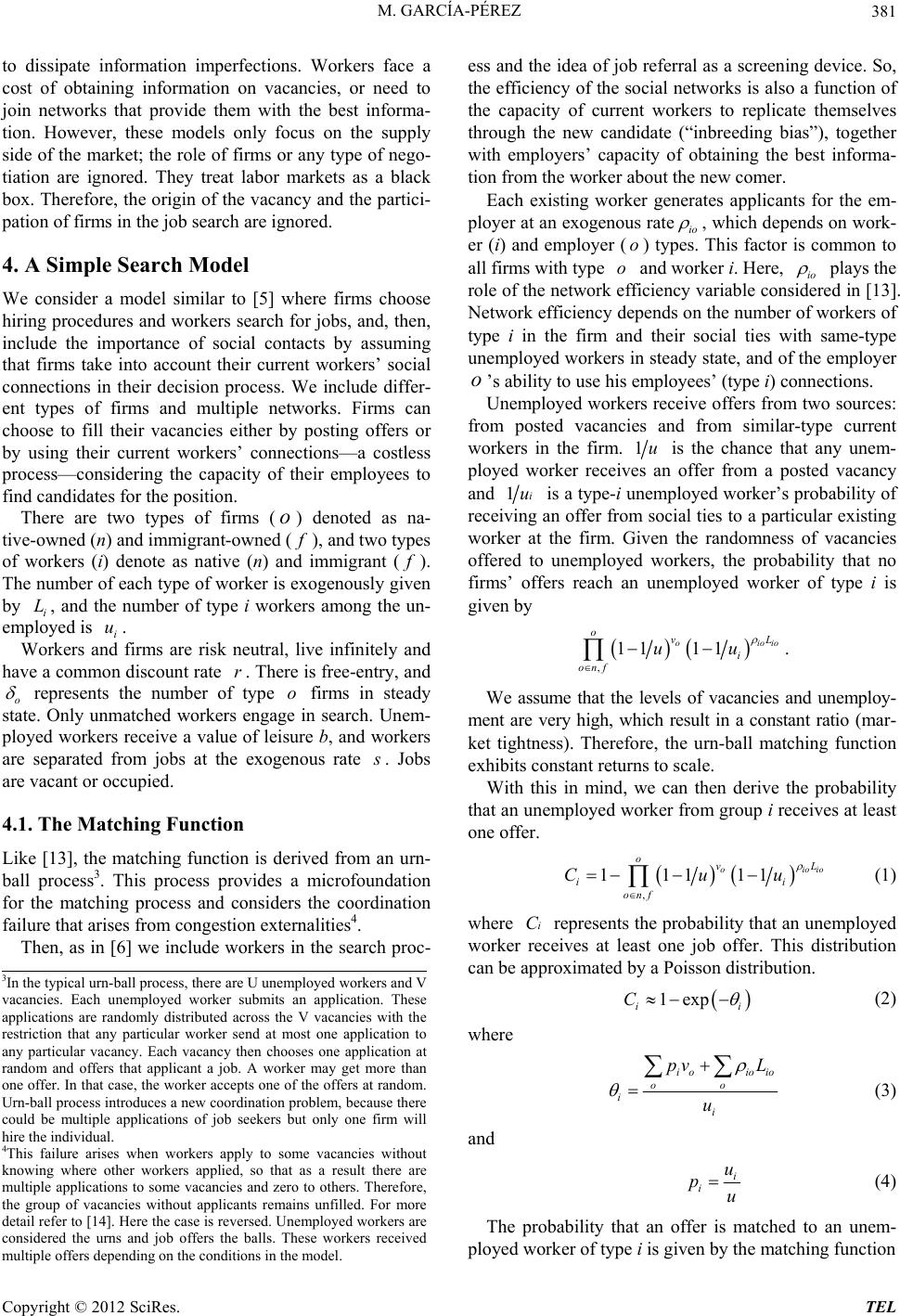 M. GARCÍA-PÉREZ 381 to dissipate information imperfections. Workers face a cost of obtaining information on vacancies, or need to join networks that provide them with the best informa- tion. However, these models only focus on the supply side of the market; the role of firms or any type of nego- tiation are ignored. They treat labor markets as a black box. Therefore, the origin of the vacancy and the partici- pation of firms in the job search are ignored. 4. A Simple Search Model We consider a model similar to [5] where firms choose hiring procedures and workers sear ch for jobs, and, then, include the importance of social contacts by assuming that firms take into account their current workers’ social connections in their decision process. We include differ- ent types of firms and multiple networks. Firms can choose to fill their vacancies either by posting offers or by using their current workers’ connections—a costless process—considering the capacity of their employees to find candidates for the position. There are two types of firms () denoted as na- tive-owned (n) and immigrant-owned ( o f ),d two types of workers (i) denote as native (n) and immigrant ( an f ). The number of each type of worker is exogenously given by i L, and the number of type i workers among the un- employed is i u. Workers and firms are risk neutral, live infinitely and have a common discount rate . There is free-entry, and o r represents the number of type firms in steady state. Only unmatched workers engage in search. Unem- ployed workers receive a value of leisure b, and workers are separated from jobs at the exogenous rate o s . Jobs are vacant or occupied. 4.1. The Matching Function Like [13], the matching function is derived from an urn- ball process3. This process provides a microfoundation for the matching process and considers the coordination failure that arises from congestion externalities4. Then, as in [6] we include workers in the search proc- ess and the idea of job referral as a screening device. So, the efficiency of the social networks is also a function of the capacity of current workers to replicate themselves through the new candidate (“inbreeding bias”), together with employers’ capacity of obtaining the best informa- tion from the worker about the new comer. Each existing worker generates applicants for the em- ployer at an exogenous rateio , which depends on work- er (i) and employer (o) types. This factor is common to all firms with type ond worker i. Here, io a ays the role of the network efficiency variable con sidered in [13]. Network efficiency depends on the number of workers of type i in the firm and their social ties with same-type unemployed workers in steady state, and of the employer o’s ability to ue his employees’ (type i) connections. Unemployed pl s workers receive offers from two sources: from posted vacancies and from similar-type current workers in the firm. 1u is the chance that any unem- ployed worker receiven offer from a posted vacancy and s a 1iu is a type-i unemployed worker’s probability of receiving an offer from social ties to a particular existing worker at the firm. Given the randomness of vacancies offered to unemployed workers, the probability that no firms’ offers reach an unemployed worker of type i is given by , 1111 io io o o L v i onf uu . We assume that the levels of vacancies and unemploy- m derive the probability th ent are very high, which result in a constant ratio (mar- ket tightness). Therefore, the urn-ball matching function exhibits constant returns to scale. With this in mind, we can then at an unemployed worker from group i receives at least one offer. , 11111 io io o o L v ii onf Cu u (1) where represents the probability that an un employed iC worker receives at least one job offer. This distribution can be approximated by a Poisson distribution. 1exp ii C 3In the typical urn-ball process, there are U unemployed workers and V vacancies. Each unemployed worker submits an application.These applications are randomly distributed across the V vacancies with the restriction that any particular worker send at most one application to any particular vacancy. Each vacancy then chooses one application at random and offers that applicant a job. A worker may get more than one offer. In that c ase, the worker accepts one of the offers at rando m. Urn- b all process introduces a new coordination problem, because there could be multiple applications of job seekers but only one firm will hire the individual. 4This failure arises when workers apply to some vacancies without knowing where other workers applied, so that as a result there are multiple applications to some vacancies and zero to others. Therefore, the group of vacancies without applicants remains unfilled. For more detail refer to [14]. Here the case is reversed. Unemployed workers are considered the urns and job offers the balls. These workers received multiple offers depending on the conditions in the model. (2) where i oioio oo ii pv L u (3) and i i u pu (4) The probability that an offer is matched to an unem- ployed worker of type i is given by the matching function Copyright © 2012 SciRes. TEL 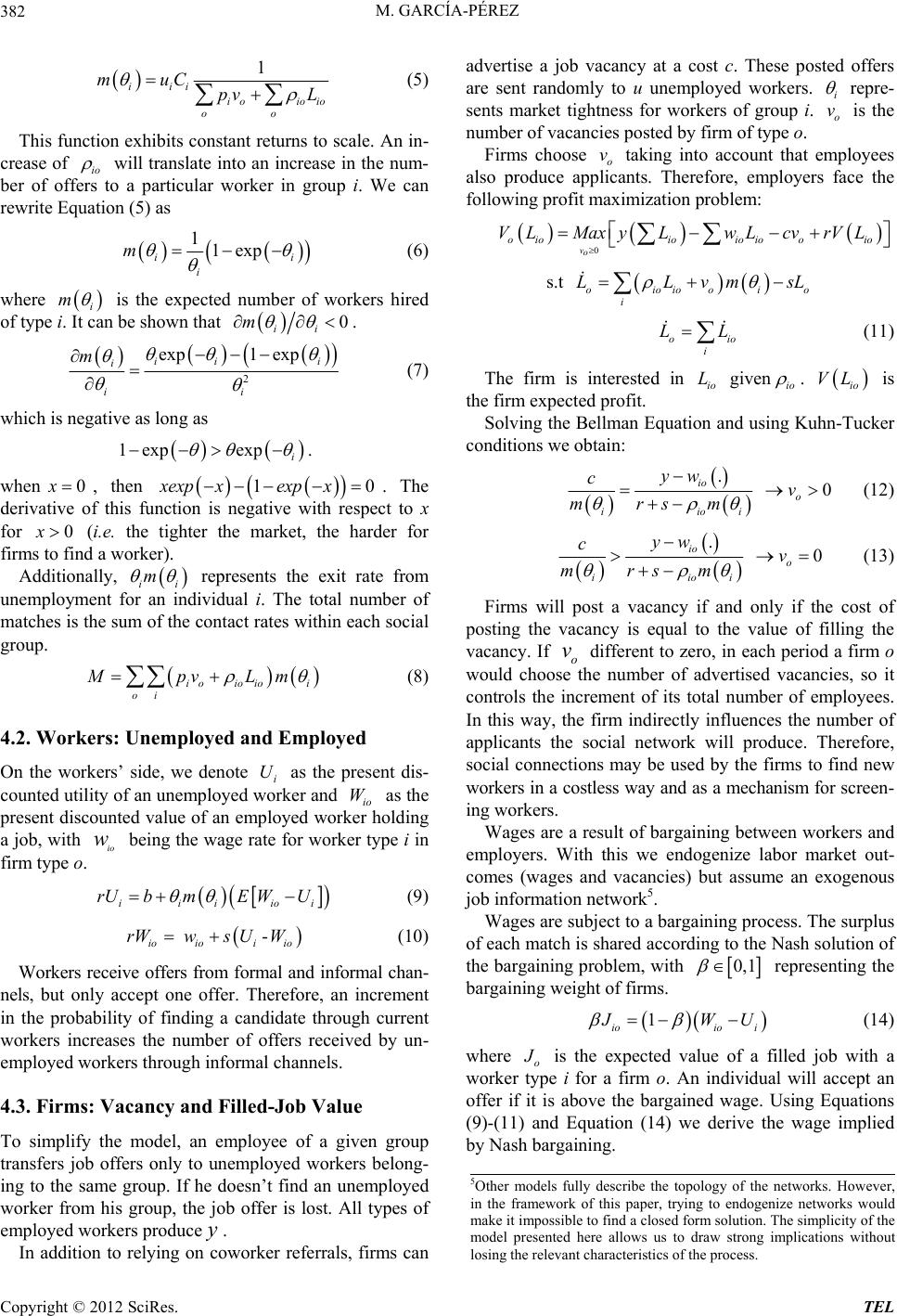 M. GARCÍA-PÉREZ 382 1 muC (5) iiiioio io oo pv L This function exhibits constan t returns to scale. An in- crease of io will translate into an increase in the num- ber of offers to a particular worker in group i. We can rewrite Equation (5) as 11exp ii i m (6) where i m i. It canis the expected number of workers hired of type be shown that 0 ii m . 2 1 expi ii exp ii i m (7) which is negative as long as 1exp exp i . when , then 0 . The ofi 0x tive of 1xexp xexp x ction is negative with respec deriva this funt to x for 0x (i.e. the tighter the market, the harder for firmst nd a worker). Additionally, ii m represents the exit rate from unoemployment fividual i. The total number of matches is the sum of the contact rates within each social group. r an ind ioio ioi oi MpvLm (8) 4.2. Workers: Unemployed and Employed t dis-On the workers’ side, we denote i U as the presen counted utility of an unemployed worker and io W as the present discounted value of an employed workolding a job, with io w being the wage rate for worker type i in firm type o. er h iiiio rUbmE WU i (9) - ioioi io rWws UW Workers receive offers from formal an ne group (10) d informal chan- ls, but only accept one offer. Therefore, an increment in the probability of finding a candidate through current workers increases the number of offers received by un- employed workers through informal channels. 4.3. Firms: Vacancy and Filled-Job Value To simplify the model, an employee of a given transfers job offers only to unemployed workers belong- ing to the same group. If he doesn’t find an unemployed worker from his group, the job offer is lost. All types of employed worke rs prod uce y . In addition to relying on coworker referrals, firms can advertise a job vacancy at coa st c. These posted offers are sent randomly to u unemployed workers. i repre- sents market tightness for workers of group i. o v is the number of vacancies posted by firm of type o. Firms choose o v taking into account that eployees also produce applicants. Therefore, employers m face the foallowing profit mximization problem: 0vo oioio ioio VLMaxyLwLcvrVL o io oioiooi i LLvm o sL s.t oi i LL o (11) The firm is interested in g io Liven io . io VL is the firm expected profit. si Kuhn-Solving the Bellman Equation and ungTucker conditions we obtain: . io yw c mr 0 o ii oi v sm (12) . 0 io o iioi yw cv mrsm (13) Firms will post a vacancy if and only if th posting the vacancy is equal to the value of filling the va ith this we endogenize labor market out- co ording to the Nash solution of th e cost of cancy. If o v different to zero, in each period a firm o would choose the number of advertised vacancies, so it controls the increment of its total number of employees. In this way, the firm indirectly influences the number of applicants the social network will produce. Therefore, social connections may be used by the firms to find new workers in a costless way and as a mechanism for scr een - ing workers. Wages are a result of bargaining between workers and employers. W mes (wages and vacancies) but assume an exogenous job information network5. Wages are subject to a bargaining process. The surplus of each match is shared acc e bargaining problem, with 0,1 representing the bargaining weight of firms. 1 io io i J WU (14) o J type where is the expected value of a worker i for a firm o. An individu it filled job with a al will accept an offer ifis above the bargained wage. Using Equations (9)-(11) and Equation (14) we derive the wage implied by Nash bargaining. 5Other models fully describe the topology of the networks. However, in the framework of this paper, trying to endogenize networks would make it impossible to find a closed form solution. The simplicity of the model presented here allows us to draw strong implications without losing the relevant characteristics of the process. Copyright © 2012 SciRes. TEL 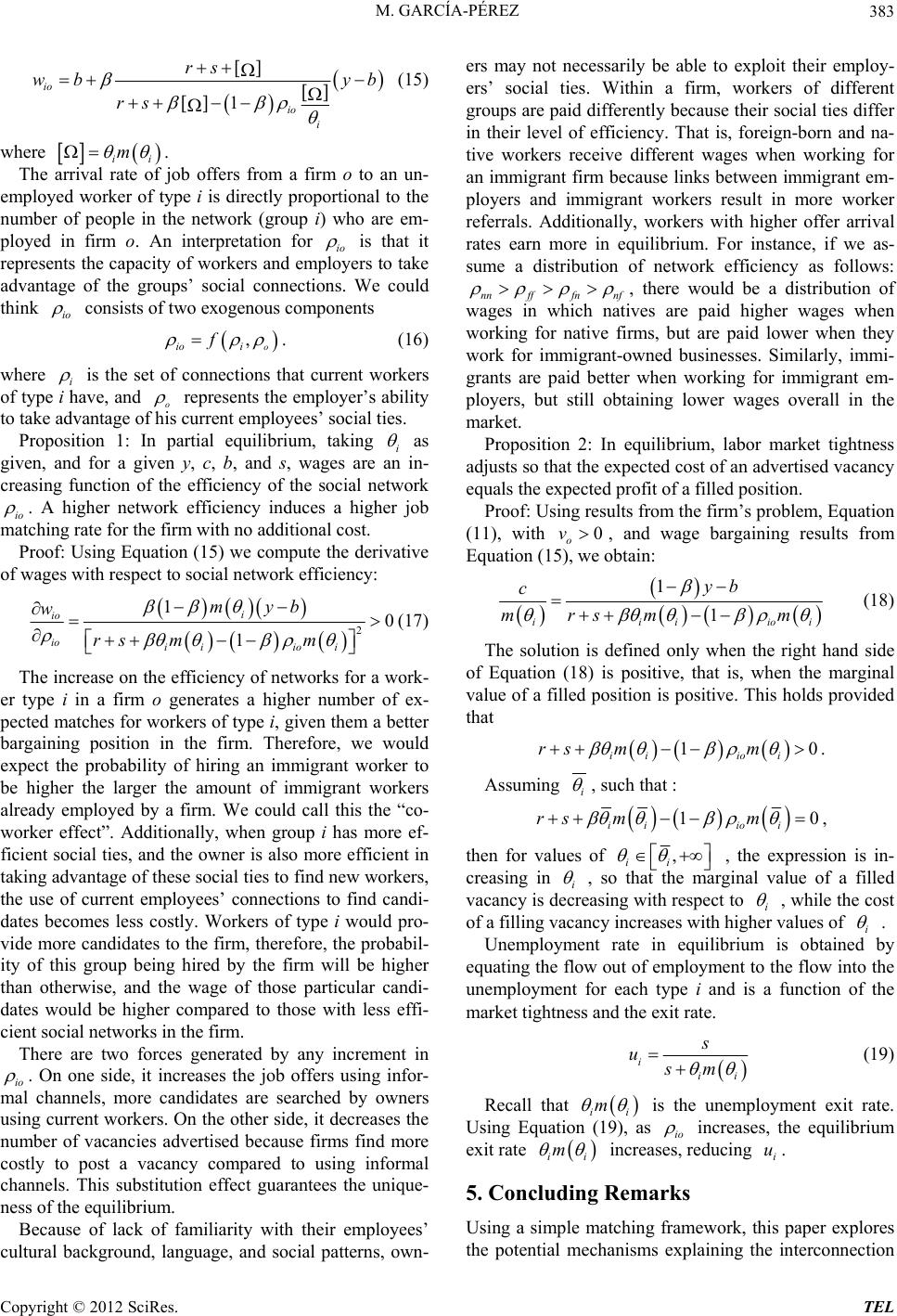 M. GARCÍA-PÉREZ 383 io rs wb yb rs (15) 1io i where ii m . rival rate of The arjob offers from a firm o to an un- ed worker of i is directly proportional to the employ type number of people in the network (group i) who are em- ployed in firm o. An interpretation for io is that it represents the capacity of workers and employers to take advantage of the groups’ social connections. We could think io consists of two exogenous components ,o io i f . (16) where i i hais the set of connections that current workers of typeve, and o represents the employer’s ability to take ntage of his current employees’ social ties. Proposition 1: In partial equilibrium, taking i adva as given, and for a given y, c, b, and s, wages are an in- creasing function of the efficiency of the social network io . A higher network efficiency induces a higher job matching rate for the firm with no additional cost. Proof: Using Equation (15) we compute the derivative of wages with respect to social network efficiency: 2 10 1 i io io myb w rs mm (17) ii ioi The incr ease on the eff iciency of n etworks for a w er type i in a firm o generates a higher number of ex- pe ork- cted matches for workers of typ e i, given them a better bargaining position in the firm. Therefore, we would expect the probability of hiring an immigrant worker to be higher the larger the amount of immigrant workers already employed by a firm. We could call this the “co- worker effect”. Additionally, when group i has more ef- ficient social ties, and the owner is also more efficient in taking advantage of these social ties to find new workers, the use of current employees’ connections to find candi- dates becomes less costly. Workers of type i would pro- vide more candidates to the firm, therefore, the probabil- ity of this group being hired by the firm will be higher than otherwise, and the wage of those particular candi- dates would be higher compared to those with less effi- cient social networks in the firm. There are two forces generated by any increment in io . On one side, it increases the job offers using infor- m us able to exploit their employ- er al channels, more candidates are searched by owners ing current workers. On the other side, it decreases the number of vacancies advertised because firms find more costly to post a vacancy compared to using informal channels. This substitution effect guarantees the unique- ness of the equilibrium. Because of lack of familiarity with their employees’ cultural background, language, and social patterns, own- ers may not necessarily be s’ social ties. Within a firm, workers of different groups are paid differently because their social ties differ in their level of efficiency. That is, foreign-born and na- tive workers receive different wages when working for an immigrant firm because links between immigrant em- ployers and immigrant workers result in more worker referrals. Additionally, workers with higher offer arrival rates earn more in equilibrium. For instance, if we as- sume a distribution of network efficiency as follows: nnfffn nf , there would be a distribution of wages in which natives are paid higher wages when working for native firms, but are paid lower when they owned businesses. Similarly, immi- grants are paid better when working for immigrant em- ployers, but still obtaining lower wages overall in the market. Proposition 2: In equilibrium, labor market tightness adjusts so that the expected cost of an advertised vacancy equals the work for immigrant- expected profit of a filled position. Proof: Using results from the firm’s problem, Equation (11), with 0 o v, and wage bargaining results from Equation (15), we obtain: 1 1 ii yb c mrsm m iioi (18) The solution is defined only when the right ha of Equation (18) is positive, that is, when the value of a filled position is positive. This holds provided th nd side marginal at 10 ii ioi rs mm . As i , such that : suming 10 ii ioi rs mm th s , en for valueof , ii , the expression is in- creasing in i r, so that the marginal value of a filled vacancy is deceasing with respect to i , whilost ncreases wite the c of a filling vacancy ih higher values of i . Unemployent rate in equilibrium is obtained by equating the flow out of employment to the flow into the unemployment for each type i and is a function of the m market tightness and the exit rate. ii s usm i (19) Recall that ii m n (19), as is the unemploym Using Equatioent exit rate. io increas exit rate es, the equilibrium ii m increases, reducing . imple misaper explores the potential mechanisms explaining the interconnection i 5. Concluding Remarks Using a satching framework, th p u Copyright © 2012 SciRes. TEL 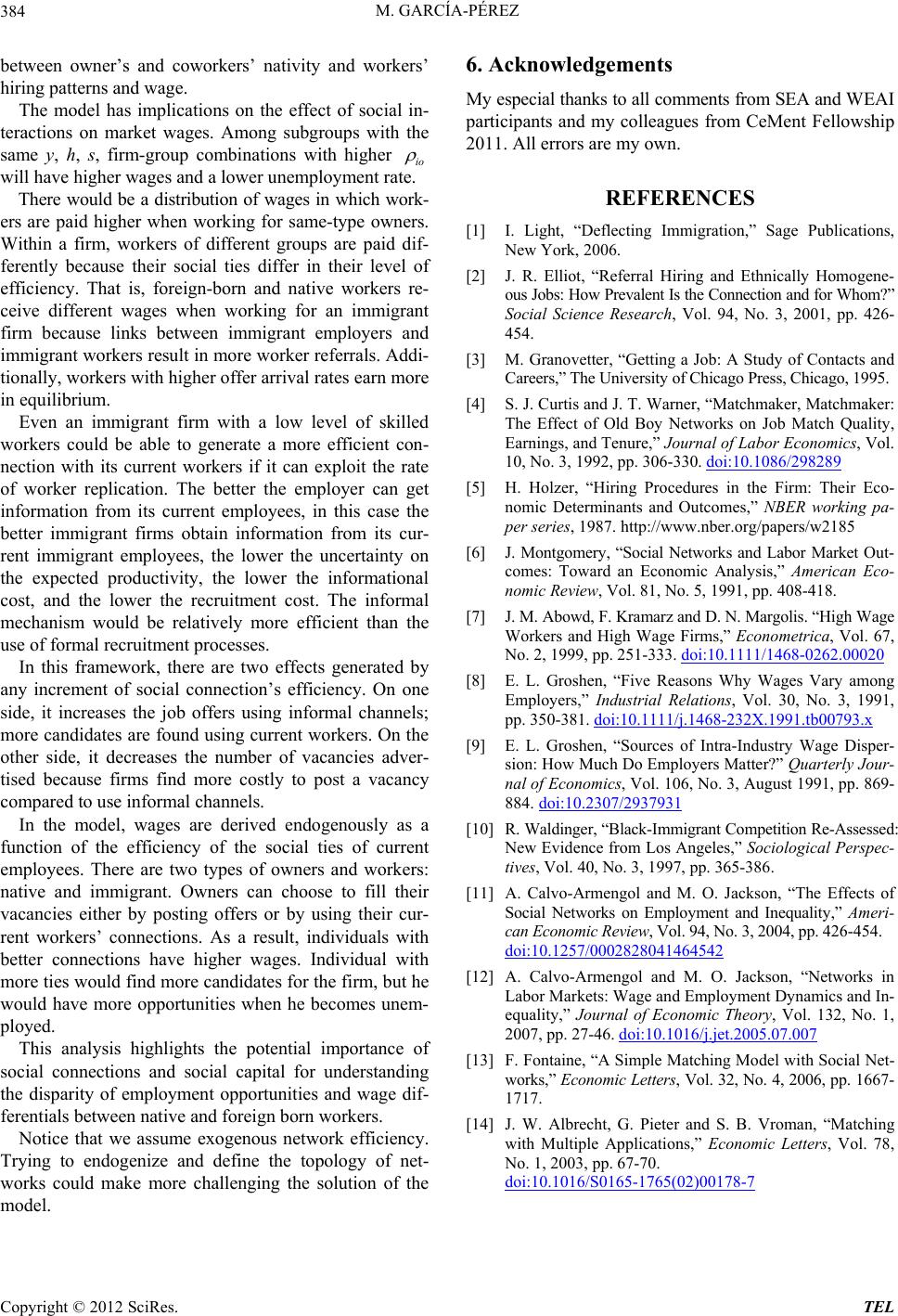 M. GARCÍA-PÉREZ Copyright © 2012 SciRes. TEL 384 ’ nativity and workers’ 6. Acknowledgements My espe between owner’s and coworkers hiring patterns and wage. The model has implications on the effect of social in- teractions on market wages. Among subgroups with the same y, h, s, firm-group combinations with higher cial thanks to all comments fro m SEA and WEA I om CeMent Fellowship [1] I. Light, “Deflecting Immigration,” Sage Publications, New York, 20 [2] J. R. Elliot, “nically Homogene- arch, Vol. 94, No. 3, 2001, pp. 426- urtis and J. T. Warner, “Matchmaker, Matchmaker: participants and my colleagues fr 2011. All errors are my own. io will have higher wages and a lower unem ployment rate. There would be a distribution of wages in which work- ers are paid higher when working for same-type owners. Within a firm, workers of different groups are paid dif- fer REFERENCES 06. Referral Hiring and Eth ently because their social ties differ in their level of efficiency. That is, foreign-born and native workers re- ceive different wages when working for an immigrant firm because links between immigrant employers and immigrant work ers result in more w orker referrals. Add i- tionally, workers with higher offer arrival rates earn more in equilibrium. Even an immigrant firm with a low level of skilled workers could be able to generate a more efficient con- nection with its current workers if it can exploit the rate of ous Jobs: How Prevalent Is the Connection and for Whom?” Social Science Rese 454. [3] M. Granovetter, “Getting a Job: A Study of Contacts and Careers,” The University of Chicago Press, Chicago, 1995. [4] S. J. C The Effect of Old Boy Networks on Job Match Quality, Earnings, and Tenure,” Journal of Labor Economics, Vol. 10, No. 3, 1992, pp. 306-330. doi:10.1086/298289 [5] H. Holzer, “Hiring Procedures in the Firm: Their Eco- nomic Determinants and Outcomes,” NBER working pa- per series, 1987. http://www.nber.org/papers/w2185 worker replication. The better the employer can get information from its current employees, in this case the better immigrant firms obtain information from its cur- rent immigrant employees, the lower the uncertainty on the expected productivity, the lower the informational cost, and the lower the recruitment cost. The informal mechanism would be relatively more efficient than the use of formal recruitment processes. In this framework, there are two effects generated by any increment of social connection’s efficiency. On one side, it increases the job offers using informal channels; mo 0020 [6] J. Montgomery, “Social Networks and Labor Market Out- comes: Toward an Economic Analysis,” American Eco- nomic Review, Vol. 81, No. 5, 1991, pp. 408-418. [7] J. M. Abowd, F. Kramarz and D. N. Margolis. “Hi gh Wage Workers and High Wage Firms,” Econometrica, Vol. 67, No. 2, 1999, pp. 251-333. doi:10.1111/1468-0262.0 [8] E. L. Groshen, “Five Reasons Why Wages Vary among Employers,” Industrial Relations, Vol. 30, No. 3, 1991, pp. 350-381. doi:10.1111/j.1468-232X.1991.tb00793.x re candidates are found using current workers. On the other side, it decreases the number of vacancies adver- tised because firms find more costly to post a vacancy compared to use informal channels. In the model, wages are derived endogenously as a function of the efficiency of the social ties of current employees. There are two types of owners and workers: na [9] E. L. Groshen, “Sources of Intra-Industry Wage Disper- sion: How Much Do Employers Matter?” Quarterly Jour- nal of Economics, Vol. 106, No. 3, August 1991, pp. 869- 884. doi:10.2307/2937931 [10] R. Waldinger, “Black-Immigrant Competition Re-Assessed: New Evidence from Los Angeles,” Sociological Perspec- tives, Vol. 40, No. 3, 1997, pp. 365-386. 4, pp. 426-454. tive and immigrant. Owners can choose to fill their vacancies either by posting offers or by using their cur- rent workers’ connections. As a result, individuals with better connections have higher wages. Individual with more ties would find more candidates for the firm, but he would have more opportunities when he becomes unem- ployed. This analysis highlights the potential importance of social connections and social capital for understanding the disparity of employment opportunities and wage dif- fer [11] A. Calvo-Armengol and M. O. Jackson, “The Effects of Social Networks on Employment and Inequality,” Ameri- can Economic Review, Vol. 94, No. 3, 200 doi:10.1257/0002828041464542 [12] A. Calvo-Armengol and M. O. Jackson, “Networks in Labor Markets: Wage and Employment Dynamics and In- equality,” Journal of Economic Theory, Vol. 132, No. 1, 2007, pp. 27-46. doi:10.1016/j.jet.2005.07.007 [13] F. Fontaine, “A Simple Matching Model with Social Net- works,” Economic Letters, Vol. 32, No. 4, 2006, pp. 1667- 1717. entials between native and foreign bor n w or ker s . Notice that we assume exogenous network efficiency. Trying to endogenize and define the topology of net- works could make more challenging the solution of the model. [14] J. W. Albrecht, G. Pieter and S. B. Vroman, “Matching with Multiple Applications,” Economic Letters, Vol. 78, No. 1, 20 03, pp. 67-70. doi:10.1016/S0165-1765(02)00178-7 |