

Paper Menu >>
Journal Menu >>
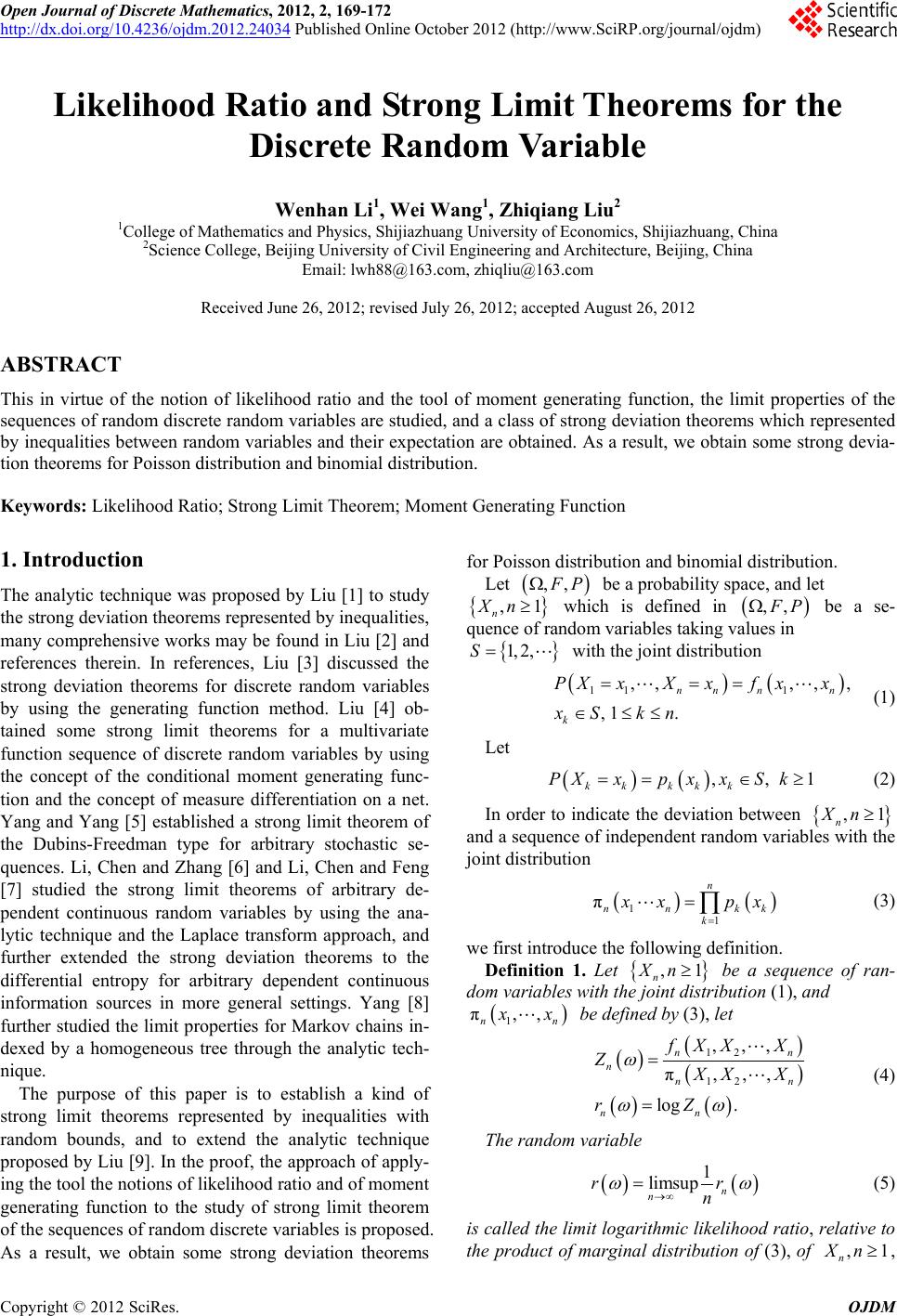 Open Journal of Discrete Mathematics, 2012, 2, 169-172 http://dx.doi.org/10.4236/ojdm.2012.24034 Published Online October 2012 (http://www.SciRP.org/journal/ojdm) Likelihood Ratio and Strong Limit Theorems for the Discrete Random Variable Wenhan Li1, Wei Wang1, Zhiqiang Liu2 1College of Mathematics and Physics, Shijiazhuang University of Economics, Shijiazhuang, China 2Science College, Beijing University of Civil Engineering and Architecture, Beijing, China Email: [email protected], [email protected] Received June 26, 2012; revised July 26, 2012; accepted August 26, 2012 ABSTRACT This in virtue of the notion of likelihood ratio and the tool of moment generating function, the limit properties of the sequences of random discrete random variables are studied, and a class of strong deviation theorems which represented by inequalities between random variables and their expectation are obtained. As a result, we obtain some strong devia- tion theorems for Poisson distribution and binomial distribution. Keywords: Likelihood Ratio; Strong Limit Theorem; Moment Generating Function 1. Introduction The analytic technique was proposed by Liu [1] to study the strong deviation theorems represented by inequalities, many comprehensive works may be found in Liu [2] and references therein. In references, Liu [3] discussed the strong deviation theorems for discrete random variables by using the generating function method. Liu [4] ob- tained some strong limit theorems for a multivariate function sequence of discrete random variables by using the concept of the conditional moment generating func- tion and the concept of measure differentiation on a net. Yang and Yang [5] established a strong limit theorem of the Dubins-Freedman type for arbitrary stochastic se- quences. Li, Chen and Zhang [6] and Li, Chen and Feng [7] studied the strong limit theorems of arbitrary de- pendent continuous random variables by using the ana- lytic technique and the Laplace transform approach, and further extended the strong deviation theorems to the differential entropy for arbitrary dependent continuous information sources in more general settings. Yang [8] further studied the limit properties for Markov chains in- dexed by a homogeneous tree through the analytic tech- nique. The purpose of this paper is to establish a kind of strong limit theorems represented by inequalities with random bounds, and to extend the analytic technique proposed by Liu [9]. In the proof, the approach of apply- ing the tool the notions of likelihood ratio and of moment generating function to the study of strong limit theorem of the sequences of random discrete variables is proposed. As a result, we obtain some strong deviation theorems for Poisson distribution and binomial distribution. Let F P be a probability space, and let 1 n Xn which is defined in F P be a se- quence of random variables taking values in 2,1,S with the joint distribution 11 1 ,,,, , ,1 nn nn k PXxXxf xx xS kn (1) Let 1 kk kkk PXxpxxS k (2) In order to indicate the deviation between 1 n Xn and a sequence of independent random variables with the joint distribution 1 1 π n nn k k k x xp x (3) we first introduce the following definition. Definition 1. Let 1Xn n be a sequence of ran- dom variables with the joint distribution (1), and 1 πnn x x be defined by (3), let 12 12 , π, log nn nn nn n f XX X Z X XX rZ (4) The random variable 1 limsup n n r nr (5) is called the limit logarithmic likelihood ratio, relative to the product of marginal distribution of (3), of , ,1 n Xn C opyright © 2012 SciRes. OJDM 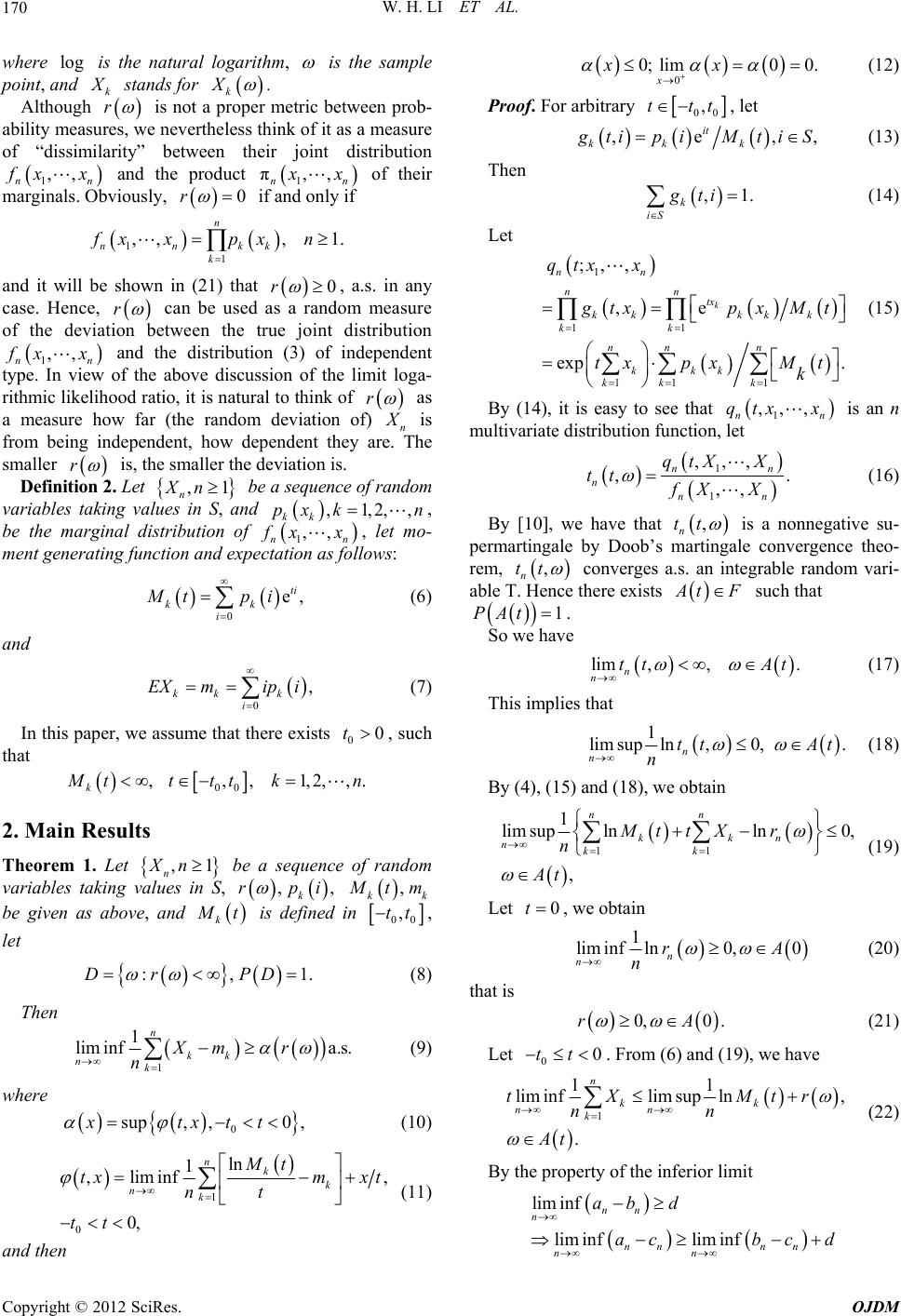 W. H. LI ET AL. 170 where is the natural logarithm, log is the sample point, and k X stands for k X . Although r is not a proper metric between prob- ability measures, we nevertheless think of it as a measure of “dissimilarity” between their joint distribution 1nn f xx and the product nn 1 π x x of their marginals. Obviously, 0 r if and only if 11 nn k x k n 1 n k px fx r and it will be shown in (21) that , a.s. in any case. Hence, 0r can be used as a random measure of the deviation between the true joint distribution 1nn f xx and the distribution (3) of independent type. In view of the above discussion of the limit loga- rithmic likelihood ratio, it is natural to think of r as a measure how far (the random deviation of) n X is from being independent, how dependent they are. The smaller r is, the smaller the deviation is. Definition 2. Let n be a sequence of random variables taking values in S, and , be the marginal distribution of n Xn 1 kk px 1n 12k n f x ti k i x , let mo- ment generating funct ion and expect at i on as follows: e k Mt i 0 k i p 0 kk i m ip (6) and EX (7) In this paper, we assume that there exists , such that 00t 00 12 k M tttt 1 r k k p n 2. Main Results Theorem 1. Let n be a sequence of random variables taking values in S, Xn i kk M tm be given as above, and k M t is defined in 00 tt , let Dr P 1D (8) Then kk Xm 0 xt r t 1 1a s n k n lim n inf (9) where sup 0xt (10) 1 ln nk nt 0 tx 1 lim inf 0 k nk Mt xt m tt (11) and then 0 0lim0 0 x xx (12) Proof. For arbitrary 00 ttt , let eit g kk k tip iMt iS (13) Then 1 k iS gti (14) Let 1 11 11 1 e exp k nn nn tx kkkk k kk nn n kkk kk k qtx x g txp xMt tx pxMt k (15) By (14), it is easy to see that is an n multivariate distribution function, let 1n qtx x n 1 1 n nnn qtX X tt fX X n (16) By [10], we have that n tt is a nonnegative su- permartingale by Doob’s martingale convergence theo- rem, n tt converges a.s. an integrable random vari- able T. Hence there exists A tF such that 1tPA . So we have lim n ntt At (17) This implies that 1 lim supln0 n ntt At n (18) By (4), (15) and (18), we obtain 11 1 lim suplnln0 nn kkn nkk Mtt Xr n At (19) Let 0t , we obtain 1 lim infln00 n nr n A (20) that is 0r 0A (21) Let 00tt . From (6) and (19), we have 1 11 lim inflim supln n kk nn k tX Mtr nn At (22) By the property of the inferior limit lim inf lim inflim inf nn n nn nn nn ab d acbcd Copyright © 2012 SciRes. OJDM 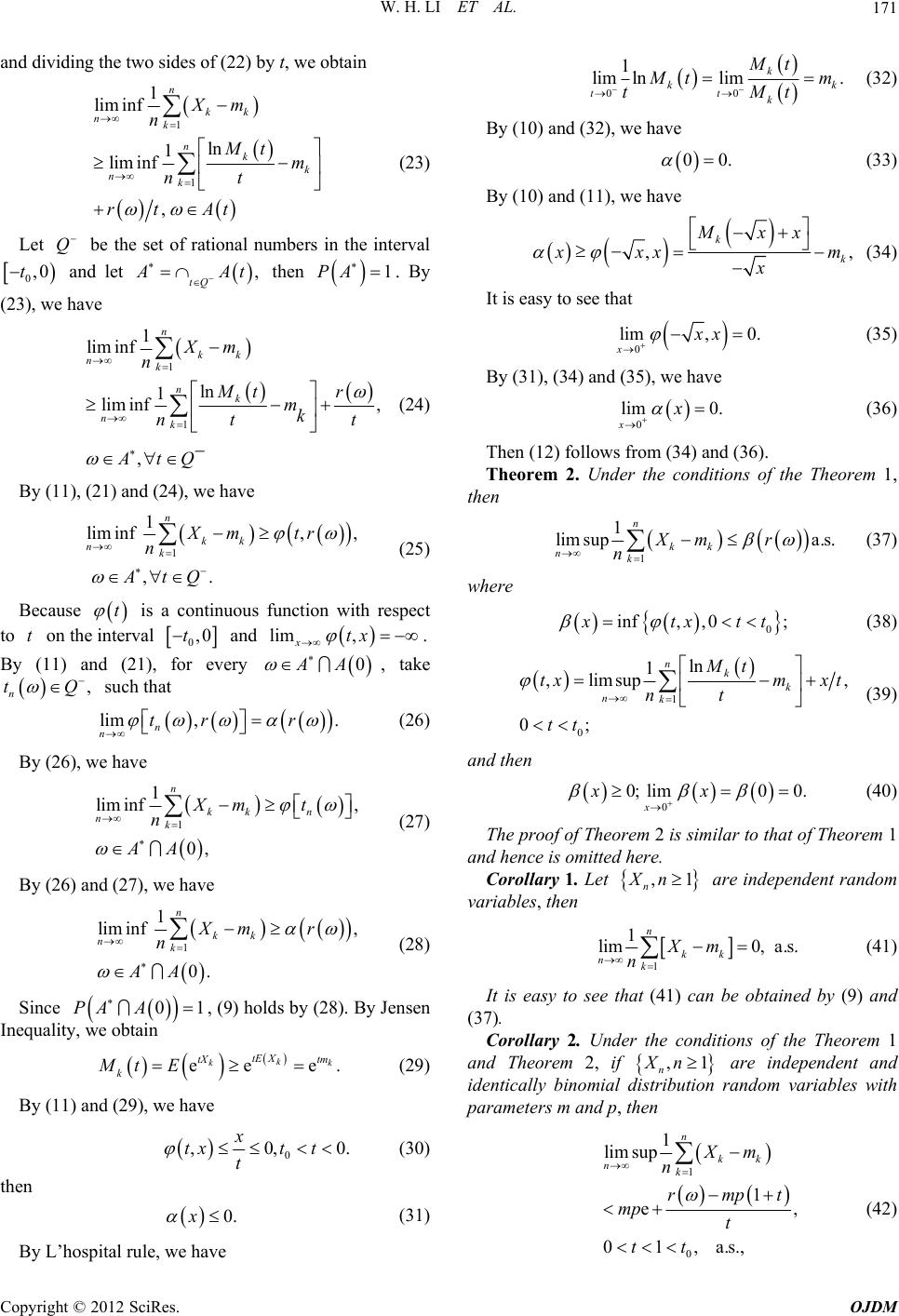 W. H. LI ET AL. 171 and dividing the two sides of (22) by t, we obtain 1 1 1 lim inf lim inf n kk nk k nk Xm n m nt rt At (23) Let be the set of rational numbers let ln 1nk Mt Q and in the interval 00t tQ A At then 1PA . By (23), we have 1 1 1n lim inf n ln 1 lim inf kk k nk nk Xm n Mt r mk nt t AtQ (24) By (11), (21) and (24), we have 1 1 lim inf n kk nk Xm tr n AtQ (25) Because is a continuous function with respect to on th t e interval t 00t and By (11) and (21), for every , take suc (2 By (26), w limxt x. 0AA h that n tQ r lim n tr 6) n e have 1 1 lim inf 0 n kk n nk Xm t n A A By (26) and (27), we have (27) 0AA 1 1 lim inf n kk nk Xm r n (28) Since , (9) holds by (28). By Jensen Inequality, we (29) hav 01PA A obtain ee e k kk tE X tX tm k Mt E By (11) and (29), wee 0 00 (30) x txtt t then 0x (31) By L’hospital rule, we have 0 1 lim lnk kk t Mt M 0 lim t k tm t Mt (32) By (10) and (32), we have 00 By (10) and (11), we have (33) k k Mxx x xx m x (34) It is easy to see that 0 lim 0 xxx we have (35) By (31), (34) and (35), 0 lim 0 xx (36) Then (12) follows from (34) and (36). of the Theorem 1, then Theorem 2. Under the conditions lim supkk nXm r n 1a s n (37) 1k where 0 inf 0 x txt t (38) 1 0 ln 1 lim sup 0 nkk nk Mt txm xt nt tt (39) and then 0 0lim0 0 x xx The proof of Theorem 2 is similar to that of Theorem 1 is omitted here. Corollary 1. Let (40) and hence 1 n Xn are independ variables, then ent random 1 lim nXm 1 0a s kk k n (41) e that (41) can be obtained by (9) and (37). Corollary 2. Under the conditions of th and Theorem 2, if n It is easy to se e Theorem 1 1 n Xn are independent and id eters m and p , then entically binomial distribution random variables with param 1 1 lim s e n kk nk m n mp 0 up 1, 01,as X rm pt t tt (42) Copyright © 2012 SciRes. OJDM 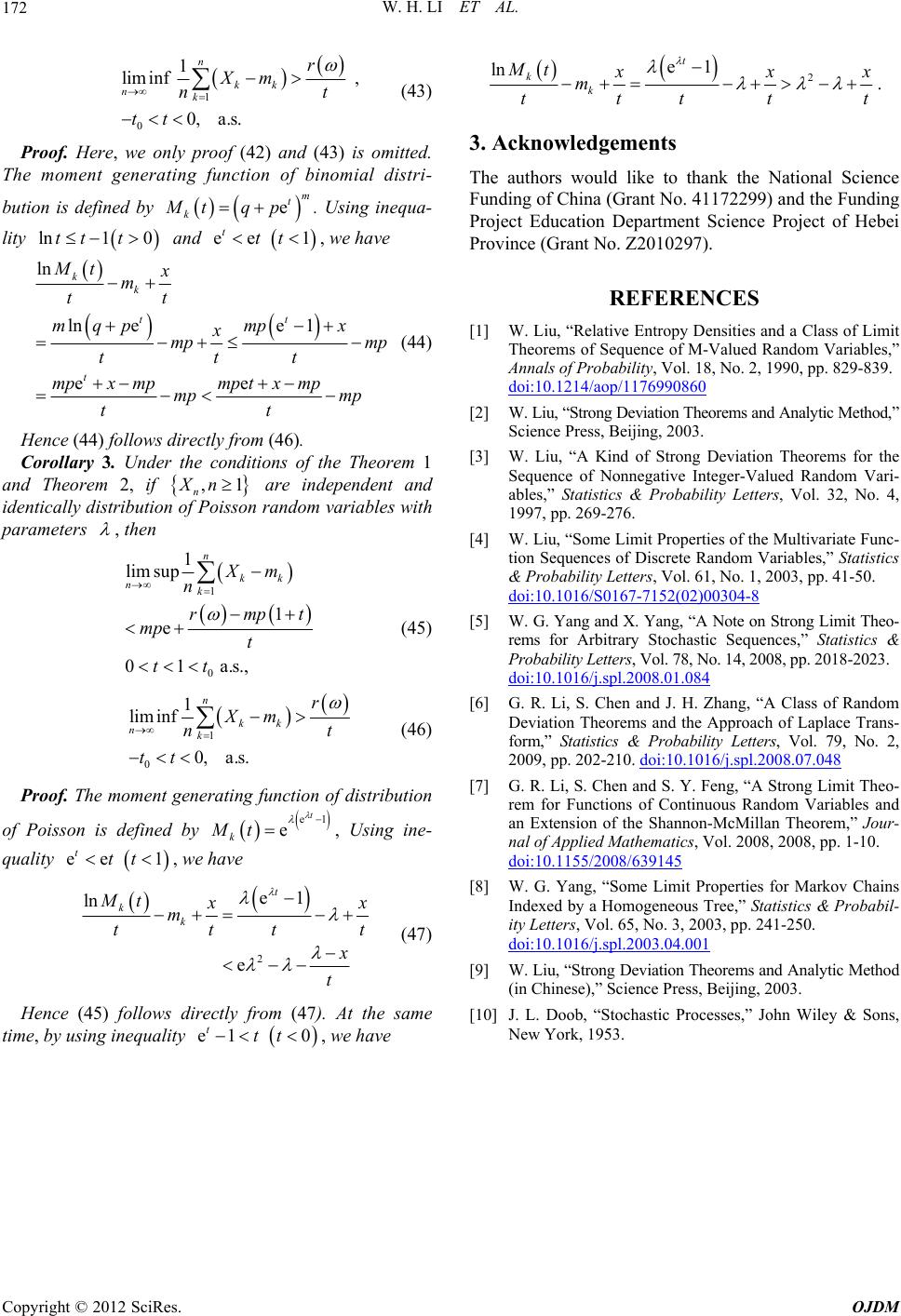 W. H. LI ET AL. Copyright © 2012 SciRes. OJDM 172 1 0 1 lim inf, 0,a s n kk nk r Xm nt tt (43) Proof. Here, we only proof (42) and (43) is omitted. The moment generating function of binomial distri- bution is defined by. Using inequa- lity and em t k Mt qp t ln1 0tt t ee 1tt , we have ln Mt lnee 1 k tt m tt mq pmp x x ee k t x mp t mp xmpmptxmp tt Hence (44) follows directly from (46). Corollary 3. Under the conditions of the Theorem and Theorem 2, if are independen identically distribution andom variables with parameters mp tt (44) mp mp 1 1 n Xn of Poisson rt and , then 1 lim supkk nk Xm n 0 1n 1 e 01 as rm pt mp t tt (45) 1 0 1 lim inf 0,a s n kk nk r Xm nt tt (46) Proof. The moment generating function of distribution of Poisson is defined by Using ine- quality we have e1 e t k Mt , ee1 ttt, 2 e1 ln e t kk Mt x x m tttt x t (45) follows directly from (47). At the sa time, by using inequality we have (47) Hence me e10 ttt, 2 e1 ln t kk Mt x xx tt t m tt . 3. Acknowledgements The authors would like to thank the National Science 41172299) and the Funding ES [1] W. Liu, “Relative Entropy Densities and a Class of Limit Theorems of Sandom Variables,” Annals of Prob990, pp. 829-839. Funding of China (Grant No. Project Education Department Science Project of Hebei Province (Grant No. Z2010297). REFERENC equence of M-Valued R ability, Vol. 18, No. 2, 1 doi:10.1214/aop/1176990860 [2] W. Liu, “Strong Deviation Theorems and Analytic Method,” Science Press, Beijing, 2003. [3] W. Liu, “A Kind of Strong Deviation Theorems for the Sequence of Nonnegative Integer-Valued Random Vari- ables,” Statistics & Probability Letters, Vol. 32, No. 4, s, Vol. 61, No. 1, 2003, pp. 41-50. 1997, pp. 269-276. [4] W. Liu, “Some Limit Properties of the Multivariate Func- tion Sequences of Discrete Random Variables,” Statistics & Probability Letter doi:10.1016/S0167-7152(02)00304-8 [5] W. G. Yang and X. Yang, “A Note on Strong Limit Theo- rems for Arbitrary Stochastic Sequences,” Statistics & Probability Letters, Vol. 78, No. 14, 200 8, pp. 2018-2023. doi:10.1016/j.spl.2008.01.084 [6] G. R. Li, S. Chen and J. H. Zhang, “A Class of Random Deviation Theorems and the Approach of Laplace Trans- form,” Statistics & Probability Letters, Vol. 79, No. 2, 2009, pp. 202-210. doi:10.1016/j.spl.2008.07.048 [7] G. R. Li, S. Chen and S. Y. Feng, “A Strong Limit Theo- rem for Functions of Continuous Random Variables and an Extension of the Shannon-McMillan Theorem,” Jour- nal of Applied Mathematics, Vol. 2008, 2008, pp. 1-10. doi:10.1155/2008/639145 [8] W. G. Yang, “Some Limit Properties for Markov Chains Indexed by a Homogeneous Tree,” Statistics & Probabil- ity Letters, Vol. 65, No. 3, 2 003, pp. 241-250. doi:10.1016/j.spl.2003.04.001 [9] W. Liu, “Strong Deviation Theorems and Analytic Method (in Chinese),” Science Press, Beijing, 2003. [10] J. L. Doob, “Stochastic Processes,” John Wiley & Sons, New York, 1953. |