

Paper Menu >>
Journal Menu >>
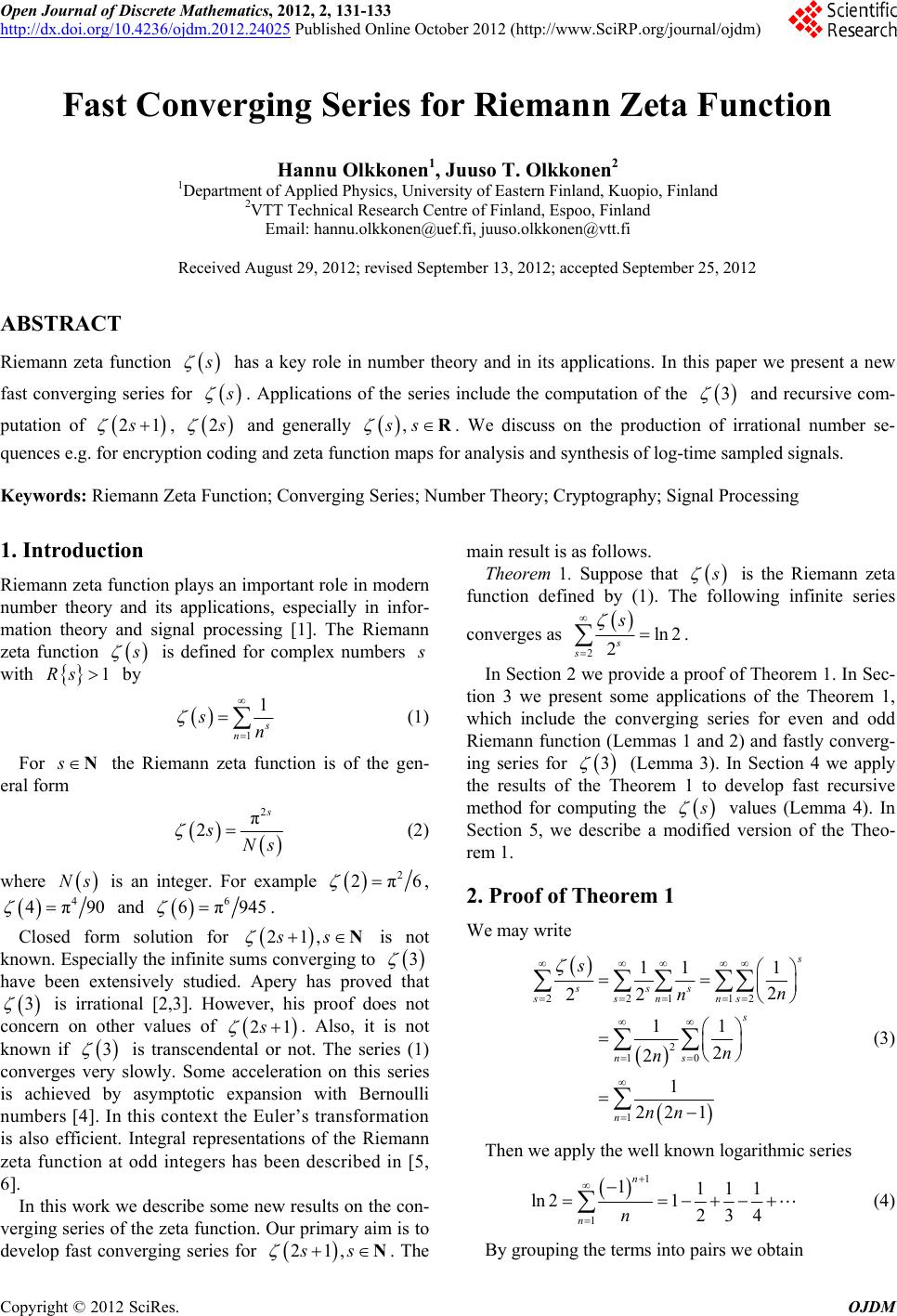 Open Journal of Discrete Mathematics, 2012, 2, 131-133 http://dx.doi.org/10.4236/ojdm.2012.24025 Published Online October 2012 (http://www.SciRP.org/journal/ojdm) Fast Converging Series for Riemann Zeta Function Hannu Olkkonen1, Juuso T. Olkkonen2 1Department of Applied Physics, University of Eastern Finland, Kuopio, Finland 2VTT Technical Research Centre of Finland, Espoo, Finland Email: hannu.olkkonen@uef.fi, [email protected] Received August 29, 2012; revised September 13, 2012; accepted September 25, 2012 ABSTRACT Riemann zeta function s has a key role in number theory and in its applications. In this paper we present a new fast converging series for s . Applications of the series include the computation of the and recursive com- putation of , 3 21s 2 s and generally ,ss R. We discuss on the production of irrational number se- quences e.g. for encryption coding and zeta function maps for analysis and synthesis of log-time sampled signals. Keywords: Riemann Zeta Function; Converging Series; Number Theory; Cryptography; Signal Processing 1. Introduction Riemann zeta function plays an important role in modern number theory and its applications, especially in infor- mation theory and signal processing [1]. The Riemann zeta function s is defined for complex numbers s with by Rs1 1 1 s n sn (1) For the Riemann zeta function is of the gen- eral form sN 2 π 2 s sNs (2) where is an integer. For example Ns 2 2π6 , 4 π904 and 6 6π945 . Closed form solution for is not known. Especially the infinite sums converging to 21,ss N 3 have been extensively studied. Apery has proved that is irrational [2,3]. However, his proof does not concern on other values of 3 21s . Also, it is not known if 3 is transcendental or not. The series (1) converges very slowly. Some acceleration on this series is achieved by asymptotic expansion with Bernoulli numbers [4]. In this context the Euler’s transformation is also efficient. Integral representations of the Riemann zeta function at odd integers has been described in [5, 6]. In this work we describe some new results on the con- verging series of the zeta function. Our primary aim is to main result is as follows. Theorem 1. Suppose th s e foll develop fast converging series for . The at 21,ss N is the Riemann zeta function defined by (1). Thowing infinite series converges as 2 ln 2 2s s s . 2 we provide a proof of Theorem 1. In Sec- tio In Section n 3 we present some applications of the Theorem 1, which include the converging series for even and odd Riemann function (Lemmas 1 and 2) and fastly converg- ing series for 3 (Lemma 3). In Section 4 we apply the results of heorem 1 to develop fast recursive method for computing the the T s values (Lemma 4). In Section 5, we describe a md version of the Theo- rem 1. odifie 2. Proof of Theorem 1 We may write 22112 2 10 1 11 1 2 22 11 2 2 1 22 1 s sss ssnns s ns n s n n n n nn (3) Then we apply the well known logarithmic series 1 1111 n 1 ln 21 234 nn (4) By grouping the terms into pairs we obtain C opyright © 2012 SciRes. OJDM 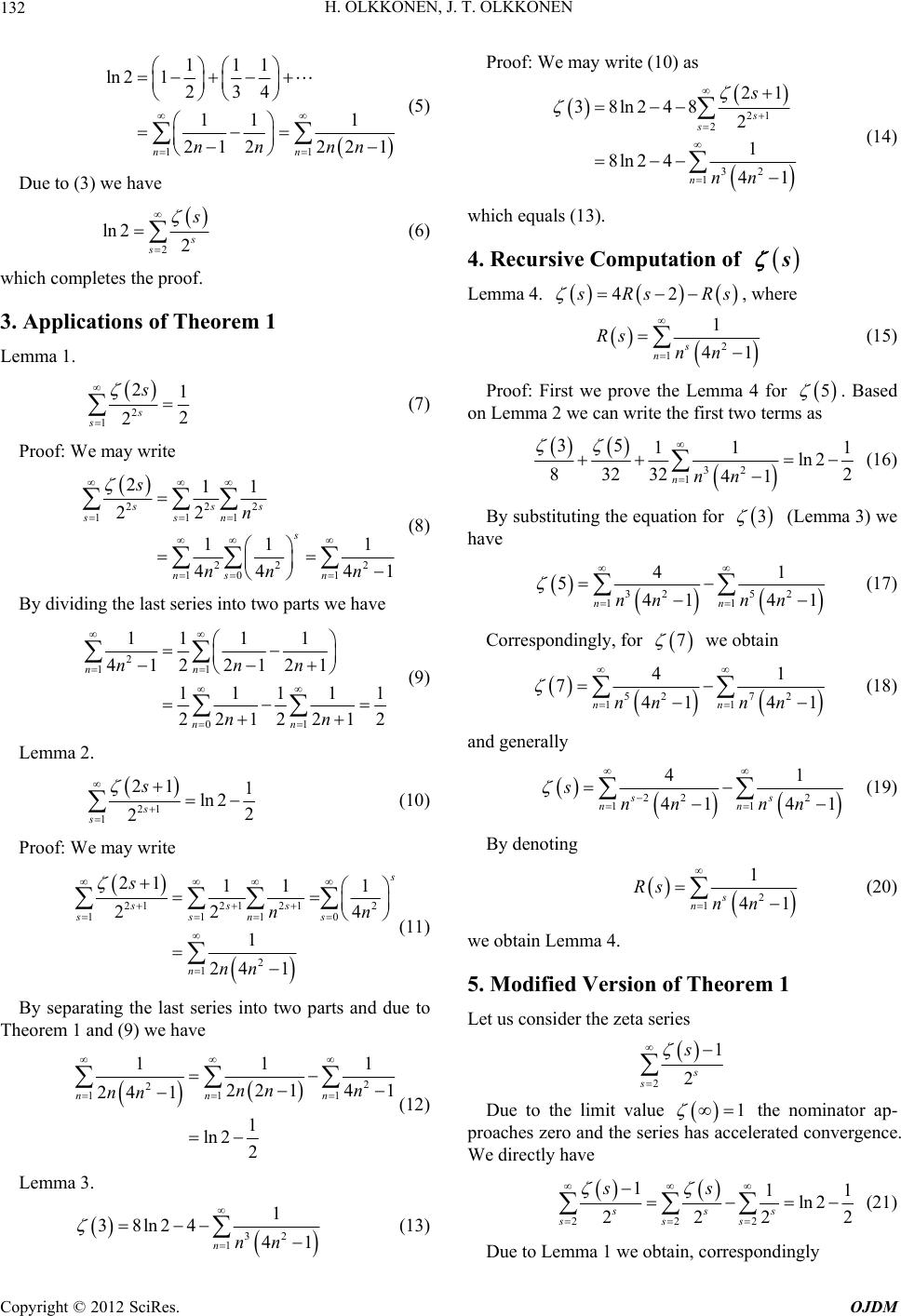 H. OLKKONEN, J. T. OLKKONEN 132 111 ln 21 11 23 4 11 1 212 221 nn nn nn (5) Due to (3) we have 2 ln 22 s s s (6) which completes the proof. rem 1 3. Applications of Theo Lemma 1. 2 1 21 2 2s s s (7) Proof: We may write 222 111 22 2 10 1 2s 11 22 11 1 44 41 sss ssn s ns n n nn n (8) By dividing the last series into two parts we have 2 11 01 11 1 1 22121 41 11111 2212212 nn nn nn n nn (9) Lemma 2. 21 1 21 1 ln 22 2s s s (10) Proof: We may write 2121 212 1110 2 1 21 11 1 22 4 1 24 1 s sss ssns n nn nn (11) By separating the last series into two parts and due to Th s eorem 1 and (9) we have 2 2 111 1 11 22 141 241 1 ln 22 nnn nn n nn (12) Lemma 3. 32 1 1 38ln24 41 nnn (13) Proof: We may write (10) as 21 2 32 1 21 38ln248 2 1 8ln2 441 s s n s nn (14) which equals (13). 4. Recursive Computation of s Lemma 4. 42 s Rs Rs, where 2 1 1 s Rs 4 nnn (15) Proof: First we prove the Lemma 4 fo 1 r 5 . Based terms as on Lemma 2 we can write the first two 32 1 35 11 1 83232 2 41 nnn ln 2 (16) By substituting the equation for (Lemma have 3 3) we 32 2 41 541nn n 5 11 41 nn n (17) 7 we obtain Correspondingly, for 52 72 11 41 4 nn n nn 41 71n (18) and generally 22 2 11 41 41 41 ss nn snn nn (19) By denoting 2 1 1 41 s n Rs nn (20) we obtain Lemma 4. 5. Modified Version of Theorem 1 series Let us consider the zeta 22 s 1 s s Due to the limit value the nominator ap- proaches zero and the seriesrated convergence. We directly have 1 has accele 222 111 ln 22 222 sss sss ss (21) Due to Lemma 1 we obtain, correspondingly Copyright © 2012 SciRes. OJDM 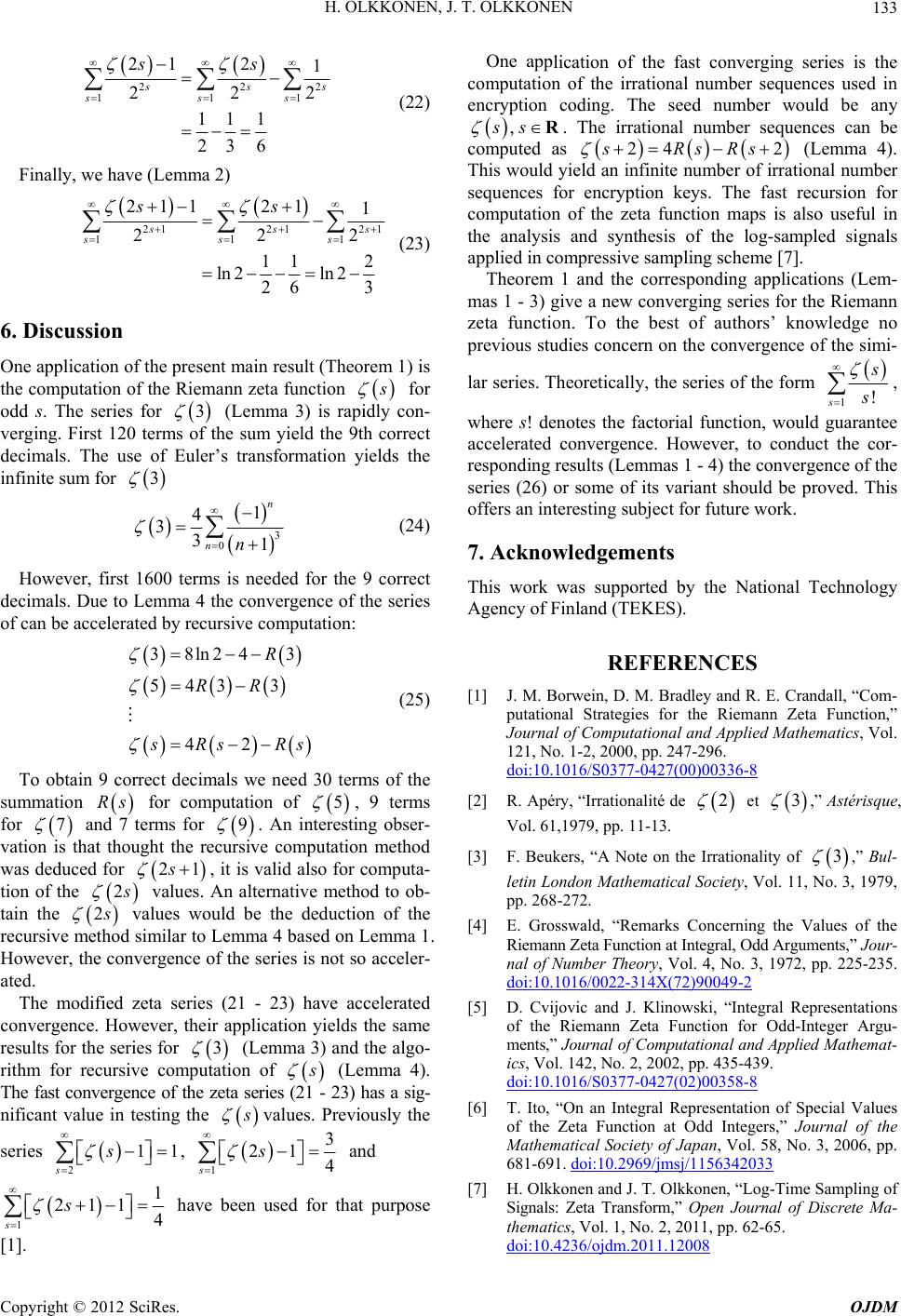 H. OLKKONEN, J. T. OLKKONEN Copyright © 2012 SciRes. OJDM 133 22 11 212 1 22 2 1 2 23 6 11 1 s ss sss ss (22) Finally, we have (Lemma 2) 2121 21 11 211 21 1 22 2 11 2 ln 2 26 3 sss sss ss (23) 6. Discussion One application of the present main result (Theorem 1) is the computation of the Riemann zeta function 1 ln 2 s rapidly h corr for for (Lemma 3) is con- erme sum yield the 9tect odd s. The series verging. First 120 t 3 s of th decimals. The use of Euler’s transformation yields the infinite sum for 3 3 0 1 4 331 n nn (24) However, first0 term 160s is needed for the 9 correct decimals. Due to Lemma 4 the convergence of the series of can be accelerated by recursive computation: 38ln24 3 42 R 54 3 3RR s Rs Rs (25) To obtain 9 correct decimals we need summation for computation of for ms for 30 terms of the 5 , 9 terms Rs and 7 ter 7 9 e recursiv . Ang ob vaht the comn method w interestin putatio ser- tion is that thoug 2 as deduced for 21s , it is valid also for computa- tion of the s values. An alternatethod to ob- he 2 i tain ve m t s values d be the deduction of the recursive method similar to Lemma 4 based on Lemma 1. However, the conof the series is not so acceler- ated. The mo zeta series (21 - 23) have accelerated convergence. However, their application yields the same results for the series for 3 (Lemma 3) and the algo- rithm for rec woul vergence dified ursive comof putation s (Lemm Th a 4). e fast convergence of the zeta series (21 - 23) has a sig- nificant value in testing the s values. Previously the series 2 11 s s , 1 3 21 4 s s and 1 1 211 4 s s have used for that purpose been [1]. lication of the fast converging series is the tation of the irrational number sequed in encryption coding. The seed number would be any One app compunces use ,ss R computed as . The irrational number sequences can be 24 2sRsRs eld an infinite number of irrat (Lemma 4). iional number se applied in co nd the corresponding appli This would y quences for encryption keys. The fast recursion for computation of the zeta function maps is also useful in the analysis and synthesis of the log-sampled signals mpressive sampling scheme [7]. Theorem 1 acations (Lem- mas 1 - 3) give a new converging series for the Riemann zeta function. To the best of authors’ knowledge no previous studies concern on the convergence of the simi- lar series. Theoretically, the series of the form s 1! s s where s! denotes the factorial function, would guarantee accelerated convergence. However, to conduct the cor- responding results (Lemmas 1 - 4) the convergence of the series (26) or some of its variant should be proved. This , NCES ley and R. E. Crandall, “Com- nd Applied Mathematics, Vol. . doi:10.1016/S0377-0427(00)00336-8 offers an interesting subject for future work. 7. Acknowledgements This work was supported by the National Technology Agency of Finland (TEKES). REFERE [1] J. M. Borwein, D. M. Brad putational Strategies for the Riemann Zeta Function,” Journal of Computational a 121, No. 1-2, 2000, pp. 247-296 [2] R. Apéry, “Irr,” Asté risque, ationalité de 2 et 3 Vol. 61,1979, pp. 11-13. [3] F. Beukers, “A Note on the Irrationality of 3 ,” Bul- letin London Mathematical Society pp. 268-272. , Vol. 11, No. 3, 1979, ol. 4, No. 3, 1972, pp. 225-235. [4] E. Grosswald, “Remarks Concerning the Values of the Riemann Zeta Function at Integral, Odd Arguments,” Jour- nal of Number Theory, V doi:10.1016/0022-314X(72)90049-2 [5] D. Cvijovic and J. Klinowski, “Integral Representations of the Riemann Zeta Function for Odd-Integer Argu- ments,” Journal of Computational and Applied M athe mat- ics, Vol. 142, No. 2, 2002, pp. 435-439. doi:10.1016/S0377-0427(02)00358-8 [6] T. Ito, “On an Integral Representation of Special Values of the Zeta Function at Odd Integers,” Journal of the Mathematical Society of Japan, Vol. 58, No. 3, 2006, pp. 681-691. doi:10.2969/jmsj/1156342033 [7] H. Olkkonen and J. T. Olkkonen, “Log-Time Sampling of Signals: Zeta Transform,” Open Journal of Discrete Ma- thematics, Vol. 1, No. 2, 2011, pp. 62-65. doi:10.4236/ojdm.2011.12008 |