

Paper Menu >>
Journal Menu >>
 Advances in Chemical Engineering and Science, 2012, 2, 519-523 http://dx.doi.org/10.4236/aces.2012.24064 Published Online October 2012 (http://www.SciRP.org/journal/aces) Chemical Composition of the Cashew Apple Bagasse and Potential Use for Ethanol Production Flávia Cristina dos Santos Lima1, Flávio Luiz Honorato da Silva2, Josivanda Palmeira Gomes3, José Mariano da Silva Neto1 1Department of Chemical Engineering, Center of Sciences and Techn o l o gy, Federal Universi t y of C a m p i na Gran de, Campina Grande, Brazil 2Department of Chemical Engineering, Center of Technology, Federal University of Paraiba, João Pessoa, Brazil 3Department of Agricultural Engineer in g, Center o f Science and Technology, Federal University of Campina Grande, Campina Grande, Brazil Email: [email protected], flavioluizh@yahoo.com.br, [email protected], [email protected] Received August 23, 2012; revised September 25, 2012; accepted October 5, 2012 ABSTRACT On the world scene, the energy requirements are mainly based on fossil fuels, however, these compounds reserves are finite and their exploitation has caused serious environmental problems. As a consequence, the demand for alternative renewable sources has been intensified in substitution the rising demand for energy and raw materials. The biomass is emerging as one of the few sources that have potential to meet these challenges of sustainability, as is currently the largest energy resource in the world, and only carbon-rich material available on the planet, apart from fossils. Form, the cashew crop has great potential for technological development of alternative sources of energy, from its industrial waste processing cashew adding value to the product. In this sense, this paper aims to study the characterization of the cashew apple bagasse and to verify (by acid prehydrolysis) the potentia l of this material for ethanol produ ction. Initially it was carried out physicochemical characterization of cashew bagasse used (pH, moisture content, soluble solids, sugars, cellulose, hemicellulose and lignin). Following it was carried prehydrolysis at 105˚C for 1 h to obtain fermentable sugars. Analyses of the samples were carried out on HPLC the results showed the saccharification of biomass with glucose (1537.49 mg/L), xylose (3823.22 mg/L) and arabinose (7131.11 mg/L) as well as the capacity of the biomass for ethanol production. Keywords: Pre-Hydrolyze; Ethanol; Cashew Apple Bagasse 1. Introduction The world’s energy needs are based on fossil fuels, however, the impending shortage of fossil oil and envi- ronmental problems that its holding concerned, it has aroused in the scientific community interest in new al- ternative energy sources renewable and sustainable [1,2]. In this context, the biomass comes as one of the sources having this potential, because when produced sustainably, can dramatically reduce emissions of greenhouse gases compared to fossil fuels, as the only carbon-rich material available on the planet [3,4], which can be used for energy, heat, liquid and gaseous fuels, and also serves as a raw material for chemicals and materials. Brazil is enjoying a comfortable position in the world with the technology of ethanol production. In this sector, the United States is currently the largest prod ucer, except that the bioethanol produced from corn (cost three times higher than derived from cane sugar), followed by Brazil which uses cane sugar, with an ethanol production of 27.7 billion liters, respectively, in the harvest of 2008/ 2009 [5]. The lignocellulosic biomass represent an abundant source of sugars by biotechnological processes can be converted to products of industrial interest such as ethanol. This biofuel is currently produced from virtually raw beet and starch, cane sugar and maize, respectively. However, researchers are developing new processes for the most economically viable use of the component of lignocellu- losic biomass such as agricultural residues (straw and bagasse of sugar cane, wheat straw and corn stover) and forest residues (dust and waste wood), for production of fuel ethanol (second generation ethanol) [6, 7]. In Brazil, the cashew nut harvest (2008/2009) ac- counted for 11% of world production, which represents more than 6 million tons of cashew [8]. However, in the Northeast, cashew agroindustry has an outstanding role in the local economy, because, in industrial processes 40% (w/w) of bagasse is normally discarded by the in- C opyright © 2012 SciRes. ACES 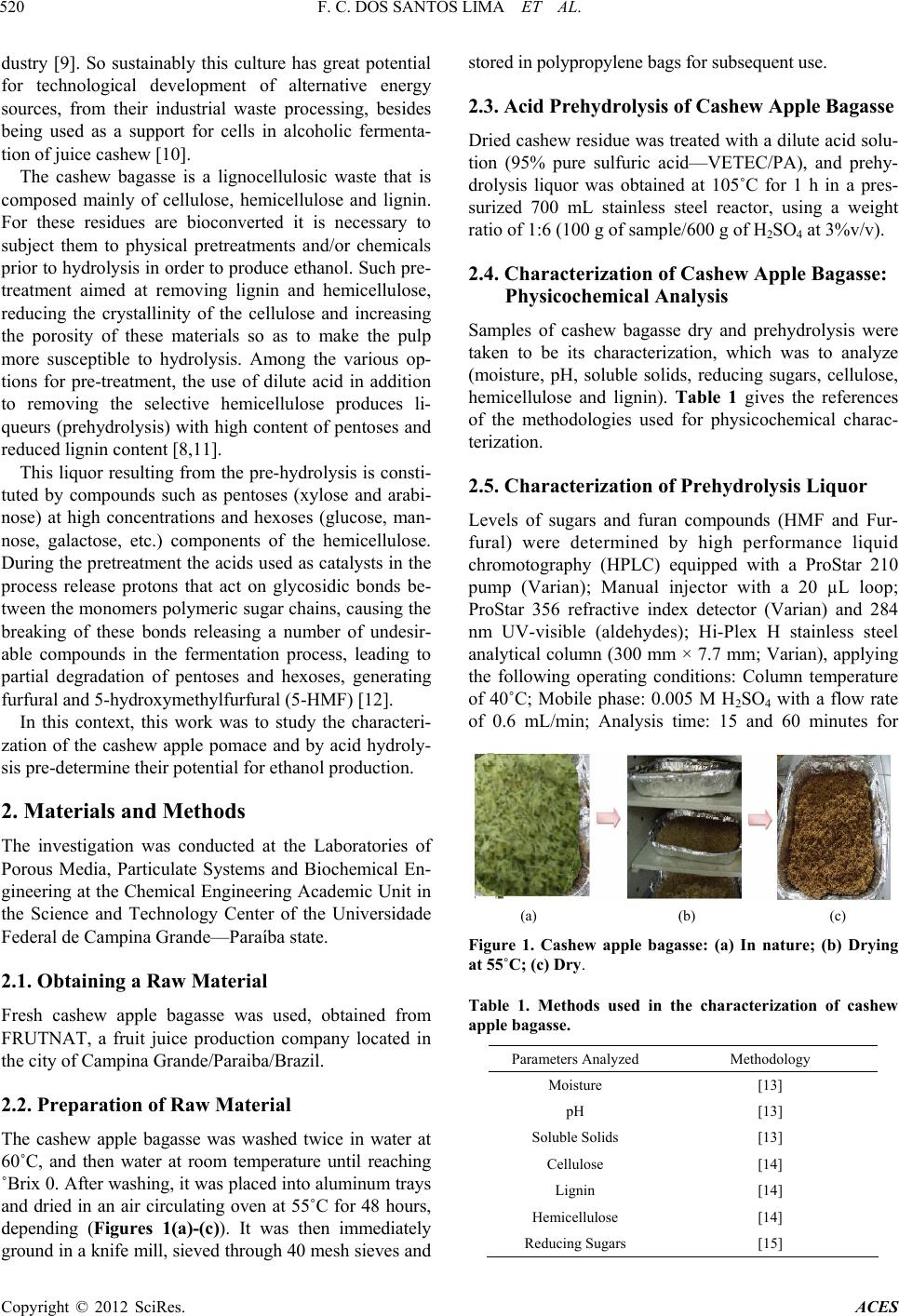 F. C. DOS SANTOS LIMA ET AL. 520 dustry [9]. So sustainably this culture has great potential for technological development of alternative energy sources, from their industrial waste processing, besides being used as a support for cells in alcoholic fermenta- tion of juice cashew [10]. The cashew bagasse is a lignocellulosic waste that is composed mainly of cellulose, hemicellulose and lignin. For these residues are bioconverted it is necessary to subject them to physical pretreatments and/or chemicals prior to hydro lysis in order to produce ethanol. Su ch pre- treatment aimed at removing lignin and hemicellulose, reducing the crystallinity of the cellulose and increasing the porosity of these materials so as to make the pulp more susceptible to hydrolysis. Among the various op- tions for pre-treatment, the use of dilute acid in addition to removing the selective hemicellulose produces li- queurs (prehydrolysis) with high content of pentoses and reduced lignin content [8,11]. This liquor resulting from the pre-hydrolysis is consti- tuted by compounds such as pentoses (xylose and arabi- nose) at high concentrations and hexoses (glucose, man- nose, galactose, etc.) components of the hemicellulose. During the pretreatment the acid s used as catalysts in the process release protons that act on glycosidic bonds be- tween the monomers polymeric sugar chains, causing the breaking of these bonds releasing a number of undesir- able compounds in the fermentation process, leading to partial degradation of pentoses and hexoses, generating furfural and 5- hydroxym et hy lfu rfural (5-HM F) [1 2]. In this context, this work was to study the characteri- zation of the cashew apple pomace and by acid hydroly- sis pre-determine their potential for ethanol production. 2. Materials and Methods The investigation was conducted at the Laboratories of Porous Media, Particulate Systems and Biochemical En- gineering at the Chemical Engine ering Academic Unit in the Science and Technology Center of the Universidade Federal de Campina Grande—Paraíba state. 2.1. Obtaining a Raw Material Fresh cashew apple bagasse was used, obtained from FRUTNAT, a fruit juice production company located in the city of Campina Grande/Paraiba/Brazil. 2.2. Preparation of Raw Material The cashew apple bagasse was washed twice in water at 60˚C, and then water at room temperature until reaching ˚Brix 0. After washing, it was placed into aluminum trays and dried in an air circulating oven at 55˚C for 48 hours, depending (Figures 1(a)-(c)). It was then immediately ground in a knife mill, sieved through 40 mesh sieves and stored in polyp ropy l ene bags for subsequent use. 2.3. Acid Prehydrolysis of Cashew Apple Bagasse Dried cashew residue was treated with a dilute acid solu- tion (95% pure sulfuric acid—VETEC/PA), and prehy- drolysis liquor was obtained at 105˚C for 1 h in a pres- surized 700 mL stainless steel reactor, using a weight ratio of 1:6 (10 0 g of sample/600 g o f H2SO4 at 3%v/v). 2.4. Characterization of Cashew Apple Bagasse: Physicochemical Analysis Samples of cashew bagasse dry and prehydrolysis were taken to be its characterization, which was to analyze (moisture, pH, soluble solids, reducing sugars, cellulose, hemicellulose and lignin). Table 1 gives the references of the methodologies used for physicochemical charac- terization. 2.5. Characterization of Prehydrolysis Liquor Levels of sugars and furan compounds (HMF and Fur- fural) were determined by high performance liquid chromotography (HPLC) equipped with a ProStar 210 pump (Varian); Manual injector with a 20 µL loop; ProStar 356 refractive index detector (Varian) and 284 nm UV-visible (aldehydes); Hi-Plex H stainless steel analytical column (300 mm × 7.7 mm; Varian), applying the following operating conditions: Column temperature of 40˚C; Mobile phase: 0.005 M H2SO4 with a flow rate of 0.6 mL/min; Analysis time: 15 and 60 minutes for (a) (b) (c) Figure 1. Cashew apple bagasse: (a) In nature; (b) Drying at 55˚C; (c) Dry. Table 1. Methods used in the characterization of cashew apple bagasse. Parameters Analyzed Methodology Moisture [13] pH [13] Soluble Solids [13] Cellulose [14] Lignin [14] Hemicellulose [14] Reducing Sugars [15] Copyright © 2012 SciRes. ACES  F. C. DOS SANTOS LIMA ET AL. 521 sugar and aldehyde content, respectively. Internal stan- dard solution for sugars: glucose, xylose, arabinose and sucrose (Sigma 99.99% HPLC grade), congeners 5-hy- droxymethylfurfural—HMF (Aldrich 99.98%) and fur- fural (Vetec 99.9 UV/HPLC) were used to quantify the component s of liquor. 3. Results and Discussion The physicochemical characterization of cashew bagasse dry and prehydrolyzed shown in Table 2, aims to ana- lyze its composition with respect to nutrient content and for future comparison with the bagasse hydrolyzate. According to the results shown in Table 1 shows that the analysis of dry bagasse resulted in 9.29% ± 0.07% moisture, however, [16] analyzing the cashew stalk resi- due dried in a vacuum oven at 65˚C found 6.99% mois- ture. For the analysis of the pH value of 4.23 ± 0.01 was found no significant difference with the values reported by [16,17] at pH 4.01 and 4.52. For soluble solids was found to be the result of 0, this is because the pulp was well washed to remove the remaining sugar prior to dry- ing. Now for the AR value was higher than that reported by [18] who studied the efficiency of solvents in the ex- tractives content in pulp of the cashew apple, finding the dry bagasse at 55˚C the value 0.31%. Analyzing prehydrolyzed the bagasse it is found that the values of moisture, pH, Brix and AR found for dry pomace cashew are similar to those found in [19] to study the acid hydrolysis of bagasse from the stalk of the cashew, which was reported at 14.51% moisture, pH 1.77 and 0.10% of ˚Brix. A comparison of the chemical composition of dry ba- gasse cashew pre-treated is shown in Table 3. In terms of cellulose, hemicellulose and lignin, the pulp of the cashew apple dry values were similar to that found by [8] 19.21% ± 0.35%, 12.05% ± 0.37% and 38.11% ± Table 2. Physicochemical characterization of the cashew apple bagasse in natura and after pretre atment. Parameters analyzed Cashew bagasse dry Bagasse of cashew prehydrolyzed Moisture (%) 9.29 ± 0.07 23.85 ± 0.05 pH 4.23 ± 0.01 1.70 ± 0.04 Soluble solids (˚Brix) 0.00 ± 0.00 0.00 ± 0.00 Reducing Sugars (%) 0.56 ± 0.02 1.80 ± 0.08 Table 3. Comparison between the chemical composition of dried and crushed cashew pretreated. Parameters analyzed Cashew bagasse dry Bagasse of cashew prehydrolyzed Cellulose (%) 18.31 ± 0.07 31.50 ± 0.02 Hemicellulose (%) 27.18 ± 0.01 19.30 ± 0.09 Lignin (%) 23.91 ± 0.02 32.21 ± 0.07 0.08% for the cashew apple bagasse in nature, [20] 38.4%, 10.2% and 2.8% for soybean hulls, however, [21] studied the same residue found 36%, 12.5% and 18.2%. It was observed for wheat straw 31, 26 and 24%, re- spectively [22]. The values related to lignin were higher than those found by different authors. As can be seen the cashew bagasse dry compared to other residues men- tioned, appears to be quite promising for bioconversion products of hig h a dde d val ue such as ethanol. Bagasse from cashew stalk when subjected to pre-hy- drolysis with dilute acid changes most of the hemicellu- lose fraction monosaccharides by hydrolysis (xylose, ara- binose, and others). Consequently, the pulp prehydrolyzed has a browning in relation to the dry material due to the formation of degradation products of carbohydrates under acid catalysis [23] as shown in Figure 2(b). It can be seen in Table 3 , values for cellulose, hemicellulos e and lignin. Compared to the straw marabout 39.5%, 15.9% and 31.6% of cellulose, hemicellulose and lignin, respectively [24] can be observed that the amount of pulp was higher, however, hemicell ulose and l igni n were si m il ar. As can be seen in Table 4, the pre-hydrolysis with dilute acid not only solubilizing hemicellulose, but also has the power to convert it into fermentable sugars, the resulting liquor is composed of sugars (glucose, xylose and arabinose), making it an important residue which can be used for producing ethanol, as shown in Figure 3 as a percentage. 4. Conclusion Depending on the results presented here, we can conclude Figure 2. Peduncle of cashew bagasse (a) dry and (b) prehydrolyzed. Table 4. Concentration (mg/L) and sugar compounds toxic liquor bagasse prehydrolyzed of the cashew apple. Component Content (mg/L) Glucose 1758.66 Xylose 5458.70 Arabinose 7640.72 Acetic acid 5.66 HMF 49.17 Furfural 0.04 Copyright © 2012 SciRes. ACES  F. C. DOS SANTOS LIMA ET AL. 522 Figure 3. Percentage of sugar in the liquor prehydrolyzed bagasse peduncle of c a shew. that the cashew bagasse biomass has great potential for bioprocess after prehydrolysis, is a promising raw mate- rial for bioethanol production, with 12% of hexoses, and 88% pentoses. 5. Acknowledgements The authors would like to express thanks to Their Bra- zilian agencies MCT/CNPq/CTBio for financial support through the Notice MCT/CNPq/CTAgro/CTBio No. 39/ 2007-Vanguard Technologies for the Production of Eth- anol and Biod iesel (Case No. 5528 15/2007-1). CNPq for doctoral fell o w ships and underg rad uat e r esearch. REFERENCES [1] C. Piccolo and F. Bezzo, “A Techno-Economic Com- parison between Two Technologies for Bioethanol Pro- duction from Lignocellulose,” Biomass and Bioenergy, Vol. 33, No. 3, 2009, pp. 478-491. doi:10.1016/j.biombioe.2008.08.008 [2] M. E. Himmel, S. Y. Ding, D. K. Johnson, W. S. Adney, M. R. Nimlos, J. W. Brady and T. D. Foust, “Biomass Recalcitrance: Engineering Plants and Enzymes for Biofuels Production,” Science, Vol. 315, No. 5813, 2007, pp. 804-807. doi:10.1126/science.1137016 [3] International Energy Agency (IEA), “Bioenergy: Poten- tial Contribution of Bioenergy to the World’s Future En- ergy Demand,” Report No. ExCo:2, IEA Bioenergy, Wha- karewarewa, 2007. [4] E. Wit and J. McClure, “Statistics for Microarrays: De- sign, Analysis, and Inference,” 5th Edition, John Wiley & Sons, Ltd., Chichester, 2004. [5] L. A. B. Cortez, “Bioetanol de Cana-de-Açúcar: P&D Para Produtividade e Sustentabilidade,” Blucher, 2010. [6] Y. I. Zheng, Z. Pan, R. Zhang and D. Wang, “Enzymatic Saccharization of Dilute Acid Pretreated Saline Crops for Fermentable Sugar Production,” Applied Energy, Vol. 86, No. 11, 2009, pp. 2459-2465. doi:10.1016/j.apenergy.2009.03.012 [7] V. M. P. Rocha, H. T. S. Rodrigues, M. M. V. Melo, L. R. B. Gonçalves and G. R. Macedo, “Cashew Apple Bagasse as a Source of Sugars for Ethanol Production by Klu- yveromyces Marxianus CE025,” Journal of Industrial Microbiology & Biotechnology, Vol. 38, No. 8, 2011, pp. 1099-1107. doi:10.1007/s10295-010-0889-0 [8] V. M. P. Rocha, H. T. S. Rodrigues, G. R. Macedo and L. R. B. Gonçalves, “Enzymatic Hydroly sis and Fermentation of Pretreated Cashew Apple Bagasse with Alkali and Diluted Sulfuric Acid for Bioethanol Production,” Applied Biochemistry and Biotechnology, Vo l. 15 5, No. 1-3, 2009, pp. 104-114. doi:10.1007/s12010-008-8432-8 [9] H. T. S. Rodrigues, V. M. P. Rocha, G. R. Macedo and L. R. B. Gonçalves, “Ethanol Production from Cashew Apple Bagasse: Improvement of Enzymatic Hydrolysis by Microwave-Assisted Alkali Pretreatment,” Applied Biochemistry and Biotechnology, Vol. 164, No. 6, 2011, pp. 929-943. doi:10.1007/s12010-011-9185-3 [10] A. M. Pacheco, D. R. Gondim and L. R. B. Gonçalves, “Ethanol Production by Fermentation Using Immobilized Cells of Saccharomyces cerevisiae in Cashew Apple Ba- gasse,” Applied Biochemistry and Biotechnology, Vol. 16, No. 1-8, 2010, pp. 209-217. doi:10.1007/s12010-009-8781-y [11] Y. Sun and J. J. Cheng, “Dilute Acid Pretreatment of Rye Straw and Bermudagrass for Ethanol Production,” Biore- source Technology, Vol. 96, No. 14, 2005, pp. 1599-1606. doi:10.1016/j.biortech.2004.12.022 [12] E. Palmqvist and B. Hahn-Hägerdal, “Fermentation of Lignocellulosic Hydrolysates II: Inhibitors and Mecha- nisms of Inhibition,” Bioresource Technology, Vol. 74, No. 1, 2000, pp. 25-33. doi:10.1016/S0960-8524(99)00161-3 [13] BRASIL, “Métodos Físico-Químicos para Análises de Alimentos/Ministério da Saúde,” Instituto Adolfo Lutz, 2005. [14] TAPPI—Technical Association of the Pulp and Paper Industry, “Official Test Methods (OM), Provisional Test Methods (PM) and Useful Test Methods (UM),” One Dunwoody Park, Atlanta, 2010 [15] NREL—National Renewable Energy Laboratory, “De- termination of Sugars, Byproducts, and Degradation Pro- ducts in Liquid Fraction Process Samples,” Technical Re- port, Laboratory Analytical Procedure (LAP), Golden, 2008. [16] A. M .A. Uchoa, J. M. C. Costa, G. A. Maia, E. M. C. Silva, A. F. F. U. Carvalho and T. R. Meira, “Physico- chemical Parameters, Fiber Content and Gross Food Pow- ders Obtained Food Waste Fruits,” Food and Nutrition Security, Vol. 15, 2008, pp. 58-65. (In Portuguese) [17] M. F. O Matias, E. L. Oliveira, E. G. Guedes and M. M. A. Magalhães, “Use of Fibres Obtained from the Cashew (Anacardium Ocidentale, L) and Guava (Psidium Guayava) Fruits for Enrichment of Food Products,” Brazilian Ar- chives of Biology and Technology, Curitiba, Vol. 48, Spe- cial Issue, 2005, pp. 143-150. doi:10.1590/S1516-89132005000400018 [18] E Lima, F. C. S. Lima, F. L. H. Silva, J. M. S. Neto and A. S. Silva, “Reviews of Pretreatment for Delignification of the Cashew Apple Pomace for Subsequent Saccharification Process,” In: XVIII Simpósio Nacional de Bioprocessos, Universidade de Caxias do Sul, 2011, pp. 1-6. (In Portu- guese) Copyright © 2012 SciRes. ACES  F. C. DOS SANTOS LIMA ET AL. Copyright © 2012 SciRes. ACES 523 [19] J. M. Silva Neto, F. L. H. Silva, E. E Lima and F. C. S. Lima, “Acid Hydrolysis of Bagasse Peduncle of Cashew,” In: XVIII Simpósio Nacional de Bioprocessos, Universi- dade de Caxias do Sul, 2011, pp. 1-6. (In Portuguese) [20] J. R. Mielenz, J. S. Bardsley and C. E. Wyman, “Fermen- tation of Soybean Hulls to Ethanol While Preserving Pro- tein Value,” Bioresource Technology, Vol. 100, No. 14, 2009, pp. 3532-3539. doi:10.1016/j.biortech.2009.02.044 [21] D. Y. Corredor, X. S. Sun, J. M. Salazar, K. L. Hohn and D. Wang, “Enzymatic Hydrolysis of Soybean Hulls Using Dilute Acid and Modified Steam-Explosion Pretreat- ments,” Journal of Biobased Materials and Bioenergy, Vol. 2, No. 1, 2008, pp. 1-8. doi:10.1166/jbmb.2008.201 [22] L. Canilha, W. Carvalho and J. B. A Silva, “Xylitol Bio- production from Wheat Straw: Hemicellulose Hydrolysis and Hydrolizate Fermentation,” Journal of the Science of Food and Agriculture, Vol. 86, No. 9, 2006, pp. 1371- 1376. doi:10.1002/jsfa.2524 [23] M. O. Petersen, J. Larsen and M. H. Thomsen, “Optimi- zation of Hydrothermal Pretreatment of Wheat Straw for Production of Bioethanol at Low Water Consumption without Addition of Chemicals,” Biomass and Bioenergy, Vol. 33, No. 5, 2009, pp. 834-840. doi:10.1016/j.biombioe.2009.01.004 [24] V. P. Soudham, D. R. Odriguez, G. J. M. Rocha, M. J. Taherzadeh and C. Martin, “ Acetosolv Delignification of Marabou (Dichrostachys Cinerea) Wood with and without Acid Prehydrolysis,” Forestry Studies in China, Vol. 13, No. 1, 2011, pp. 64-70. doi:10.1007/s11632-011-0106-x |