

Paper Menu >>
Journal Menu >>
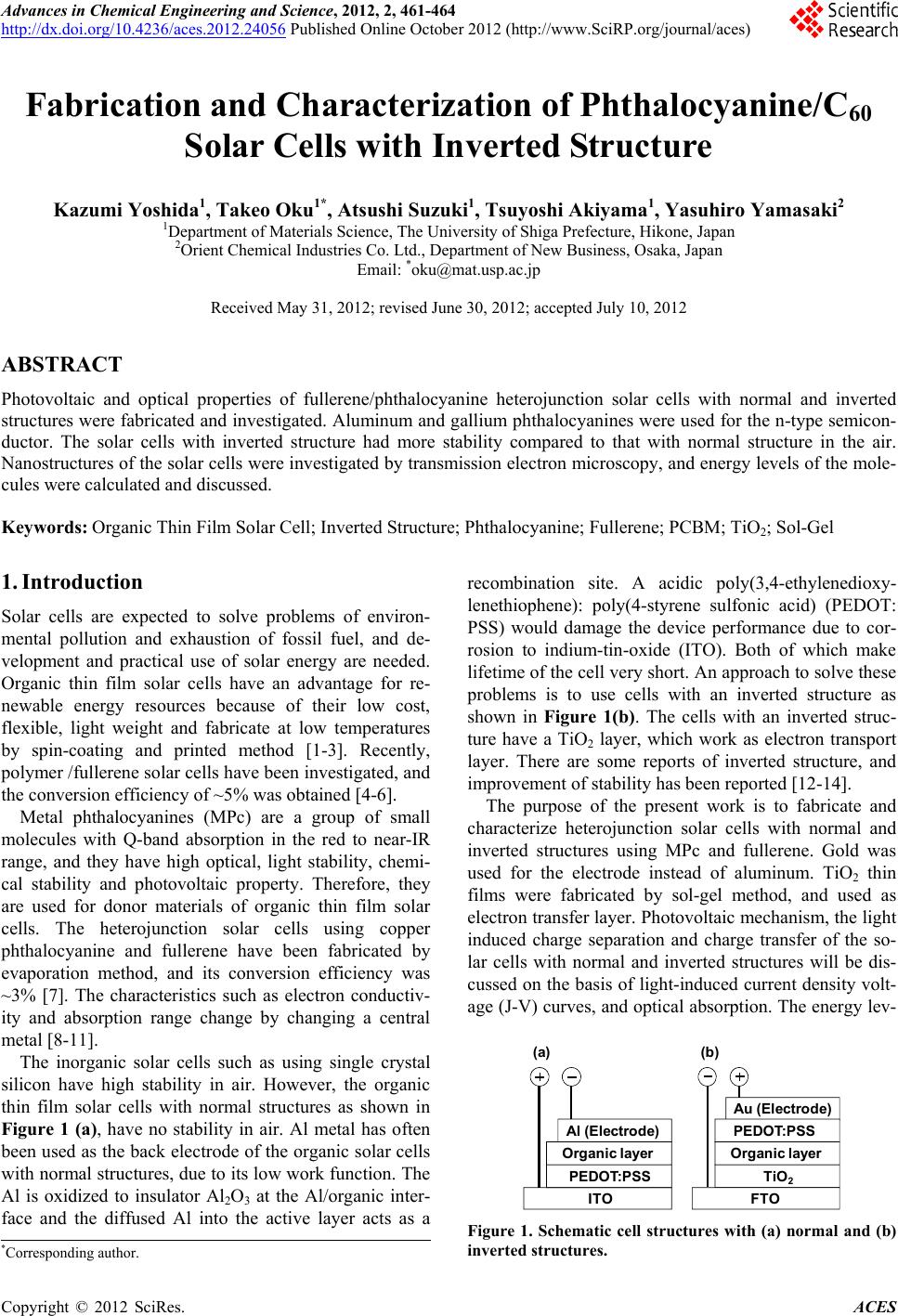 Advances in Chemical Engineering and Science, 2012, 2, 461-464 http://dx.doi.org/10.4236/aces.2012.24056 Published Online October 2012 (http://www.SciRP.org/journal/aces) Fabrication and Characterization of Phthalocyanine/C60 Solar Cells with Inverted Structure Kazumi Yoshida1, Takeo Oku1*, Atsushi Suzuki1, Tsuyoshi Akiyama1, Yasuhiro Yamasaki2 1Department of Materials Science, The University of Shiga Prefecture, Hikone, Japan 2Orient Chemical Industries Co. Ltd., Department of New Business, Osaka, Japan Email: *[email protected] Received May 31, 2012; revised June 30, 2012; accepted July 10, 2012 ABSTRACT Photovoltaic and optical properties of fullerene/phthalocyanine heterojunction solar cells with normal and inverted structures were fabricated and investigated. Aluminum and gallium phthalocyanines were used for the n-type semicon- ductor. The solar cells with inverted structure had more stability compared to that with normal structure in the air. Nanostructures of the solar cells were investigated by transmission electron microscopy, and energy levels of the mole- cules were calculated and discussed. Keywords: Organic Thin Film Solar Cell; Inverted Structure; Phthalocyanine; Fullerene; PCBM; TiO2; Sol-Gel 1. Introduction Solar cells are expected to solve problems of environ- mental pollution and exhaustion of fossil fuel, and de- velopment and practical use of solar energy are needed. Organic thin film solar cells have an advantage for re- newable energy resources because of their low cost, flexible, light weight and fabricate at low temperatures by spin-coating and printed method [1-3]. Recently, polymer /fullerene solar cells have been investigated, and the conversion efficiency of ~5% was obtained [4-6]. Metal phthalocyanines (MPc) are a group of small molecules with Q-band absorption in the red to near-IR range, and they have high optical, light stability, chemi- cal stability and photovoltaic property. Therefore, they are used for donor materials of organic thin film solar cells. The heterojunction solar cells using copper phthalocyanine and fullerene have been fabricated by evaporation method, and its conversion efficiency was ~3% [7]. The characteristics such as electron conductiv- ity and absorption range change by changing a central metal [8-11]. The inorganic solar cells such as using single crystal silicon have high stability in air. However, the organic thin film solar cells with normal structures as shown in Figure 1 (a), have no stability in air. Al metal has often been used as the back electrode of the organic solar cells with normal structures, due to its low work function. The Al is oxidized to insulator Al2O3 at the Al/organic inter- face and the diffused Al into the active layer acts as a recombination site. A acidic poly(3,4-ethylenedioxy- lenethiophene): poly(4-styrene sulfonic acid) (PEDOT: PSS) would damage the device performance due to cor- rosion to indium-tin-oxide (ITO). Both of which make lifetime of the cell very short. An approach to solve these problems is to use cells with an inverted structure as shown in Figure 1(b). The cells with an inverted struc- ture have a TiO2 layer, which work as electron transport layer. There are some reports of inverted structure, and improvement of stability has been reported [12-14]. The purpose of the present work is to fabricate and characterize heterojunction solar cells with normal and inverted structures using MPc and fullerene. Gold was used for the electrode instead of aluminum. TiO2 thin films were fabricated by sol-gel method, and used as electron transfer layer. Photovoltaic mechanism, the light induced charge separation and charge transfer of the so- lar cells with normal and inverted structures will be dis- cussed on the basis of light-induced current density volt- age (J-V) curves, and optical absorption. The energy lev- PEDOT:PSS Organic layer Al (Electrode) Au (Electrode) PEDOT:PSS Organic layer TiO 2 ITO ITO FTO (a) (b) Figure 1. Schematic cell structures with (a) normal and (b) inverted structures. *Corresponding author. C opyright © 2012 SciRes. ACES 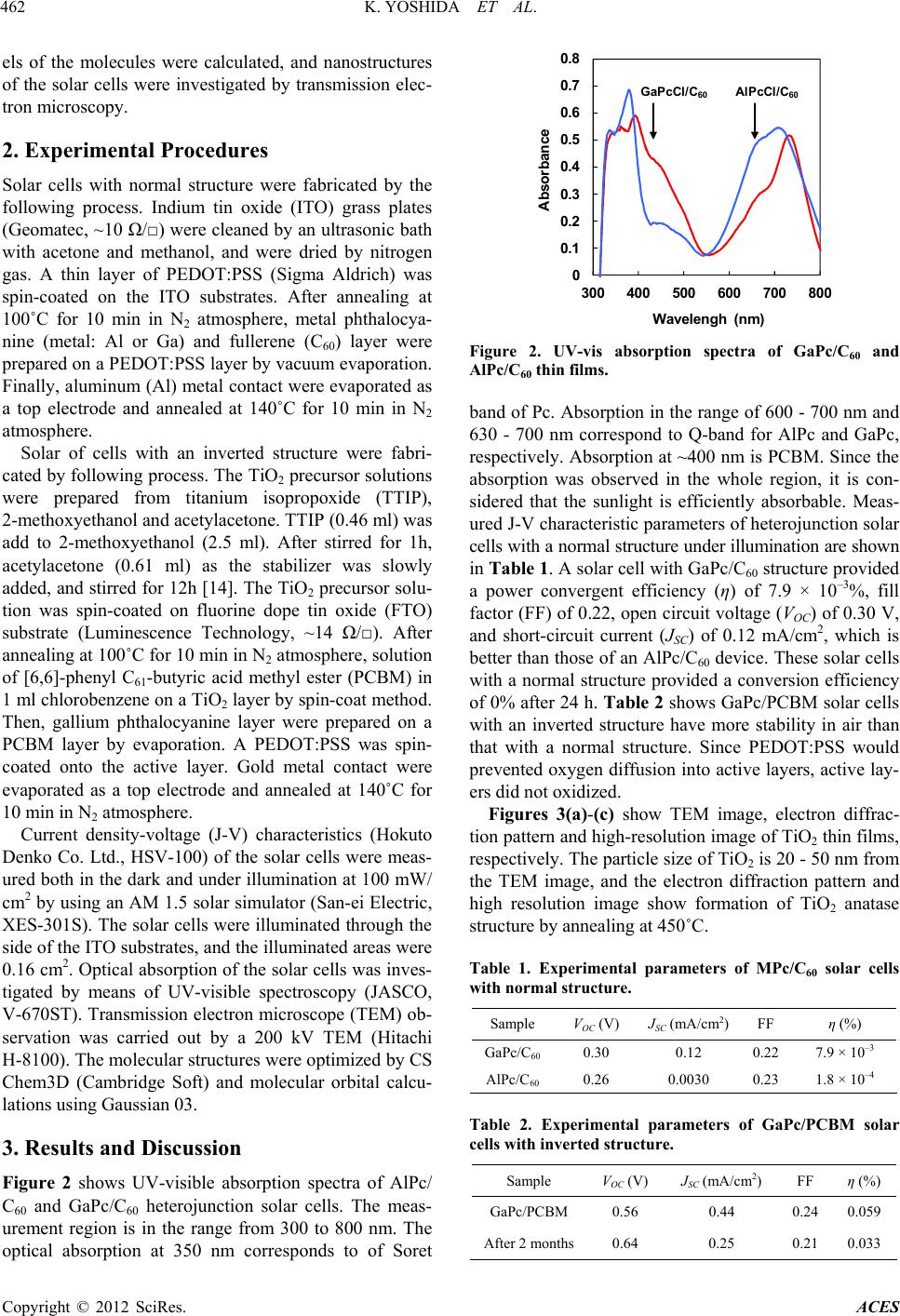 K. YOSHIDA ET AL. 462 els of the molecules were calculated, and nanostructures of the solar cells were investigated by transmission elec- tron microscopy. 0 0.1 0.2 0.3 0.4 0.5 0.6 0.7 0.8 300 400 500 600 700 800 Absorbance Wavelengh (nm) GaPcCl/C 60 Al PcCl/C 60 2. Experimental Procedures Solar cells with normal structure were fabricated by the following process. Indium tin oxide (ITO) grass plates (Geomatec, ~10 Ω/□) were cleaned by an ultrasonic bath with acetone and methanol, and were dried by nitrogen gas. A thin layer of PEDOT:PSS (Sigma Aldrich) was spin-coated on the ITO substrates. After annealing at 100˚C for 10 min in N2 atmosphere, metal phthalocya- nine (metal: Al or Ga) and fullerene (C60) layer were prepared on a PEDOT:PSS layer by vacuum evaporation. Finally, aluminum (Al) metal contact were evaporated as a top electrode and annealed at 140˚C for 10 min in N2 atmosphere. Solar of cells with an inverted structure were fabri- cated by following process. The TiO2 precursor solutions were prepared from titanium isopropoxide (TTIP), 2-methoxyethanol and acetylacetone. TTIP (0.46 ml) was add to 2-methoxyethanol (2.5 ml). After stirred for 1h, acetylacetone (0.61 ml) as the stabilizer was slowly added, and stirred for 12h [14]. The TiO2 precursor solu- tion was spin-coated on fluorine dope tin oxide (FTO) substrate (Luminescence Technology, ~14 Ω/□). After annealing at 100˚C for 10 min in N2 atmosphere, solution of [6,6]-phenyl C61-butyric acid methyl ester (PCBM) in 1 ml chlorobenzene on a TiO2 layer by spin-coat method. Then, gallium phthalocyanine layer were prepared on a PCBM layer by evaporation. A PEDOT:PSS was spin- coated onto the active layer. Gold metal contact were evaporated as a top electrode and annealed at 140˚C for 10 min in N2 atmosphere. Current density-voltage (J-V) characteristics (Hokuto Denko Co. Ltd., HSV-100) of the solar cells were meas- ured both in the dark and under illumination at 100 mW/ cm2 by using an AM 1.5 solar simulator (San-ei Electric, XES-301S). The solar cells were illuminated through the side of the ITO substrates, and the illuminated areas were 0.16 cm2. Optical absorption of the solar cells was inves- tigated by means of UV-visible spectroscopy (JASCO, V-670ST). Transmission electron microscope (TEM) ob- servation was carried out by a 200 kV TEM (Hitachi H-8100). The molecular structures were optimized by CS Chem3D (Cambridge Soft) and molecular orbital calcu- lations using Gaussian 03. 3. Results and Discussion Figure 2 shows UV-visible absorption spectra of AlPc/ C60 and GaPc/C60 heterojunction solar cells. The meas- urement region is in the range from 300 to 800 nm. The optical absorption at 350 nm corresponds to of Soret Figure 2. UV-vis absorption spectra of GaPc/C60 and AlPc/C60 thin films. band of Pc. Absorption in the range of 600 - 700 nm and 630 - 700 nm correspond to Q-band for AlPc and GaPc, respectively. Absorption at ~400 nm is PCBM. Since the absorption was observed in the whole region, it is con- sidered that the sunlight is efficiently absorbable. Meas- ured J-V characteristic parameters of heterojunction solar cells with a normal structure under illumination are shown in Table 1. A solar cell with GaPc/C60 structure provided a power convergent efficiency (η) of 7.9 × 10⁻³%, fill factor (FF) of 0.22, open circuit voltage (VOC) of 0.30 V, and short-circuit current (JSC) of 0.12 mA/cm2, which is better than those of an AlPc/C60 device. These solar cells with a normal structure provided a conversion efficiency of 0% after 24 h. Ta ble 2 shows GaPc/PCBM solar cells with an inverted structure have more stability in air than that with a normal structure. Since PEDOT:PSS would prevented oxygen diffusion into active layers, active lay- ers did not oxidized. Figures 3(a)-(c) show TEM image, electron diffrac- tion pattern and high-resolution image of TiO2 thin films, respectively. The particle size of TiO2 is 20 - 50 nm from the TEM image, and the electron diffraction pattern and high resolution image show formation of TiO2 anatase structure by annealing at 450˚C. Table 1. Experimental parameters of MPc/C60 solar cells with normal structure. Sample VOC (V) JSC (mA/cm2) FF η (%) GaPc/C60 0.30 0.12 0.22 7.9 × 10⁻³ AlPc/C60 0.26 0.0030 0.23 1.8 × 10⁻⁴ Table 2. Experimental parameters of GaPc/PCBM solar cells with inverted structure. Sample VOC (V) JSC (mA/cm2) FF η (%) GaPc/PCBM 0.56 0.44 0.240.059 After 2 months0.64 0.25 0.210.033 Copyright © 2012 SciRes. ACES 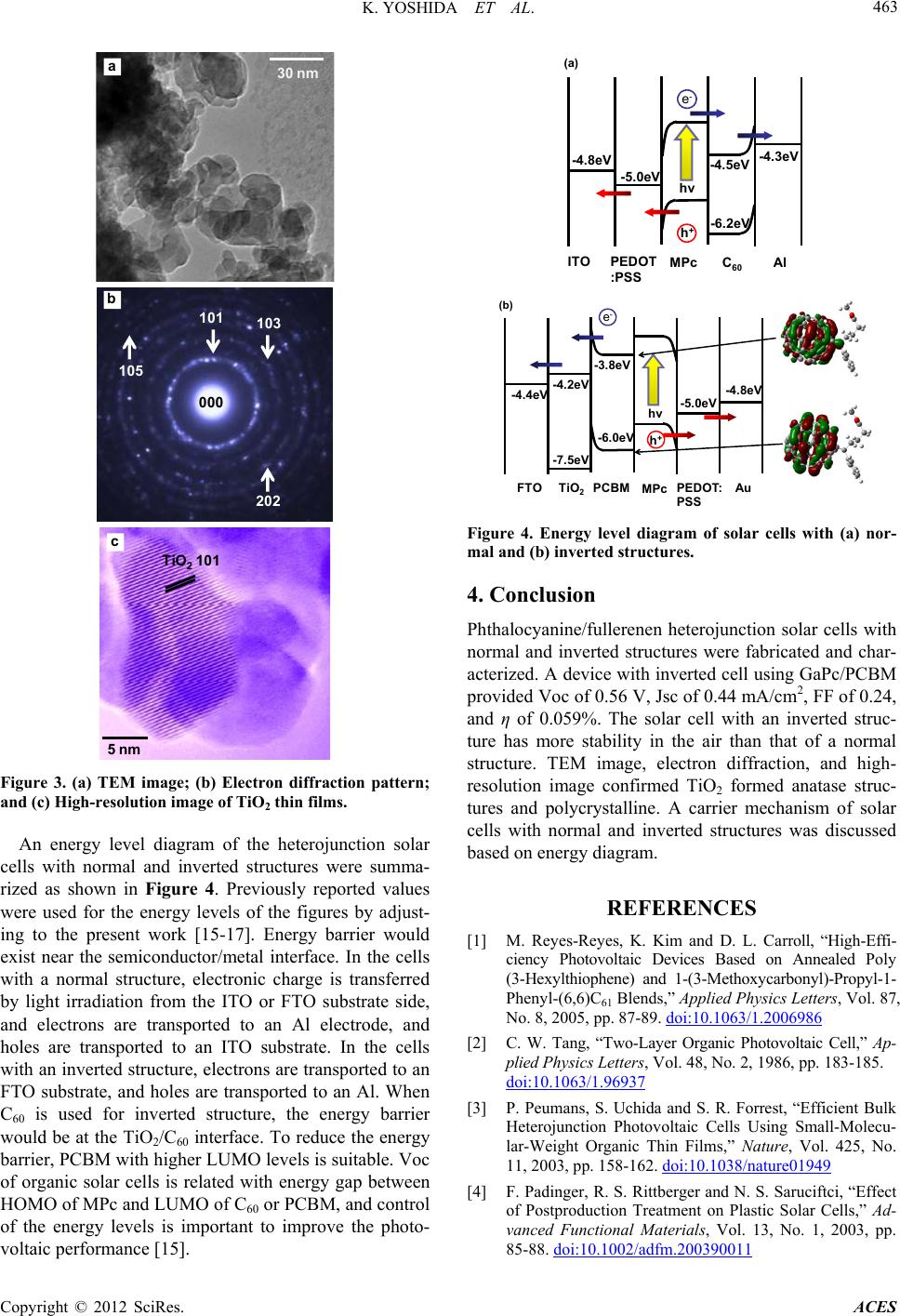 K. YOSHIDA ET AL. 463 TiO 2 101 101 000 103 202 30 nm 105 b a c 5nm e - Figure 3. (a) TEM image; (b) Electron diffraction pattern; and (c) High-resolution image of TiO2 thin films. An energy level diagram of the heterojunction solar cells with normal and inverted structures were summa- rized as shown in Figure 4. Previously reported values were used for the energy levels of the figures by adjust- ing to the present work [15-17]. Energy barrier would exist near the semiconductor/metal interface. In the cells with a normal structure, electronic charge is transferred by light irradiation from the ITO or FTO substrate side, and electrons are transported to an Al electrode, and holes are transported to an ITO substrate. In the cells with an inverted structure, electrons are transported to an FTO substrate, and holes are transported to an Al. When C60 is used for inverted structure, the energy barrier would be at the TiO2/C60 interface. To reduce the energy barrier, PCBM with higher LUMO levels is suitable. Voc of organic solar cells is related with energy gap between HOMO of MPc and LUMO of C60 or PCBM, and control of the energy levels is important to improve the photo- voltaic performance [15]. h + -4.8eV -5.0eV hν -4.3eV -4.5eV -6.2eV PEDOT :PSS ITO MPc C 60 Al (a) TiO 2 Au FTO PEDOT: PSS PCBM MPc (b) e - -4.8eV h + -4.4eV -5.0eV -3.8eV -4.2eV -7.5eV -6.0eV hν Figure 4. Energy level diagram of solar cells with (a) nor- mal and (b) inverted structures. 4. Conclusion Phthalocyanine/fullerenen heterojunction solar cells with normal and inverted structures were fabricated and char- acterized. A device with inverted cell using GaPc/PCBM provided Voc of 0.56 V, Jsc of 0.44 mA/cm2, FF of 0.24, and η of 0.059%. The solar cell with an inverted struc- ture has more stability in the air than that of a normal structure. TEM image, electron diffraction, and high- resolution image confirmed TiO2 formed anatase struc- tures and polycrystalline. A carrier mechanism of solar cells with normal and inverted structures was discussed based on energy diagram. REFERENCES [1] M. Reyes-Reyes, K. Kim and D. L. Carroll, “High-Effi- ciency Photovoltaic Devices Based on Annealed Poly (3-Hexylthiophene) and 1-(3-Methoxycarbonyl)-Propyl-1- Phenyl-(6,6)C61 Blends,” Applied Physics Letters, Vol. 87, No. 8, 2005, pp. 87-89. doi:10.1063/1.2006986 [2] C. W. Tang, “Two-Layer Organic Photovoltaic Cell,” Ap- plied Physics Letters, Vol. 48, No. 2, 1986, pp. 183-185. doi:10.1063/1.96937 [3] P. Peumans, S. Uchida and S. R. Forrest, “Efficient Bulk Heterojunction Photovoltaic Cells Using Small-Molecu- lar-Weight Organic Thin Films,” Nature, Vol. 425, No. 11, 2003, pp. 158-162. doi:10.1038/nature01949 [4] F. Padinger, R. S. Rittberger and N. S. Saruciftci, “Effect of Postproduction Treatment on Plastic Solar Cells,” Ad- vanced Functional Materials, Vol. 13, No. 1, 2003, pp. 85-88. doi:10.1002/adfm.200390011 Copyright © 2012 SciRes. ACES  K. YOSHIDA ET AL. Copyright © 2012 SciRes. ACES 464 [5] W. Ma, et al., “Thermally Stable, Efficient Polymer Solar Cells with Nanoscale Control of the Interpenetrating Net- work Morphology,” Advanced Functional Materials, Vol. 15, No. 10, 2005, pp. 1617-1622. doi:10.1002/adfm.200500211 [6] A. J. Hauch, et al., “Flexible Organic P3HT:PCBM Bulk- Heterojunction Modules with More than 1 Year Outdoor Lifetime,” Solar Energy Materials and Solar Cells, Vol. 92, No. 7, 2008, pp. 727-731. doi:10.1016/j.solmat.2008.01.004 [7] P. Peumans and S. R. Forrest, “Very-High-Efficiency Double-Heterostructure Copper Phthalocyanine/C60 Photo- voltaic Cells,” Applied Physics Letters, Vol. 79, No. 1, 2001, pp. 126-128. doi:10.1063/1.1384001 [8] L. Li, et al., “Organic Thin-Film Transistors of Phthalo- cyanines,” Pure and Applied Chemistry, Vol. 80, No. 11, 2008, pp. 2231-2240. doi:10.1351/pac200880112231 [9] N. M. Bamsey, et al., “Integration of an M-Phthalocya- nine Layer into Solution-Processed Organic Photovoltaic Cells for Improved Spectral Coverage,” Solar Energy Materials and Solar Cells, Vol. 95, No. 7, 2008, pp. 1970-1973. doi:10.1016/j.solmat.2011.01.042 [10] N. M. Bamsey, et al., “Heteromorphic Chloroindium Phthalocyanine Films for Improved Photovoltaic Per- formance,” Solar Energy Materials and Solar Cells, Vol. 95, No. 10, 2011, pp. 2937-2940. doi:10.1016/j.solmat.2011.06.006 [11] D. Y. Kim, F. So and Y. Gao, “Aluminum Phthalocya- ninechloride/C60 Organic Photovoltaic Cells with High Open-Circuit Voltages,” Solar Energy Materials and So- lar Cells, Vol. 93, No. 9, 2009, pp. 1688-1691. doi:10.1016/j.solmat.2009.04.003 [12] F. C. Krebs, “Air Stable Polymer Photovoltaics Based on a Process Free from Vacuum Steps and Fullerenes,” Solar Energy Materials and Solar Cells, Vol. 92, No. 7, 2008, pp. 715-726. doi:10.1016/j.solmat.2008.01.013 [13] T. Kuwabara, et al., ”Highly Durable Inverted-Type Or- ganic Solar Cell Using Amorphous Titanium Oxide as Electron Collection Electrode Inserted between ITO and Organic Layer,” Solar Energy Materials and Solar Cells, Vol. 92, No. 11, 2008, pp. 1476-1482. doi:10.1016/j.solmat.2008.06.012 [14] Y. Lin, et al., “High-efficiency Inverted Polymer Solar Cells with Solution-Processed Metal Oxides,” Solar En- ergy Materials and Solar Cells, Vol. 95, No. 8, 2011, pp. 2511-2515. doi:10.1016/j.solmat.2011.05.005 [15] T. Oku, et al., “Fabrication and Characterization of Full- erene-Based Bulk Heterojunction Solar Cells with Por- phyrin, CuInS2, Diamond and Exciton-Diffusion Block- ing Layer,” Energies, Vol. 3, No. 4, 2010, pp. 671-685. doi:10.3390/en3040671 [16] T. Oku, et al., “Fabrication and Characterization of Full- erene/Porphyrin Bulk Heterojunction Solar Cells,” Jour- nal of Physics and Chemistry of Solids, Vol. 71, No. 4, 2010, pp. 551-555. doi:10.1016/j.jpcs.2009.12.034 [17] T. Oku, et al., “Formation and Characterization of Poly- mer/Fullerene Bulk Heterojunction Solar Cells,” Journal of Physics and Chemistry of Solids, Vol. 69, No. 5-6, 2008, pp. 1276-1279. doi:10.1016/j.jpcs.2007.10.117 |