

Paper Menu >>
Journal Menu >>
 Advances in Chemical Engineering and Science, 2012, 2, 435-443 http://dx.doi.org/10.4236/aces.2012.24053 Published Online October 2012 (http://www.SciRP.org/journal/aces) Effects of Side-Chain on Conformational Characteristics of Poly(3,5-Dimethyl-Phenyl-Acrylate) in Toluene at 40˚C Nasrollah Hamidi1*, Stanley Ihekweazu2, Christopher A. Wiredu3, Onize H. Isa4, Kevin Watley4, Christopher Rowe3, Briante’ Nimmons3, Alexis Prezzy4,5, Shane Scoville4, Quentin Hills4,5, Judith Salley1 1Department of Biological and Physical Sciences, South Carolina State University, Orangeburg, SC, USA 2Department of Civil and Mechanical Engineering Technology, South Carolina State University, Orangeburg, SC, USA 3North High School, North, SC, USA 4Orangeburg Wilkinson High School, Orangeburg, SC, USA 5Claflin University, Orangeburg, SC, USA Email: *[email protected] Received August 11, 2012; revised September 13, 2012; accepted September 22, 2012 ABSTRACT The intrinsic viscosity [η] of poly(3,5-dimethyl-phenyl-acrylate) (35PDMPA) solutions were evaluated throughout the measurements of the flow times of toluene and polymer solutions by classical Huggins, and Kraemer’s methods using a Cannon-Ubbelohde semi-micro-dilution capillary viscometer in a Cannon thermostated water bath at 40˚C ± 0.02˚C. The values of Huggins’ constant estimated ranged from 0.2 to 0.4 which were within expectations. The intrinsic viscosities and molecular weight relationship was established with the two-parameter classical models of Staudinger-Mark-Houwink- Sakurada and Stockmayer-Fixman. Conformational parameter C∞ and σ indicated 35PDMPA be semi flexible. Also, the rigidity of 35PDMPA was confirmed by Yamakawa-Fuji wormlike theory modified by Bohdanecký. The molecular parameters were estimated and compared. The results showed that 35PDMPA behaves like a semi-rigid polymer in toluene at 40˚C rather than a random coil flexible macromolecule. Keywords: Intrinsic Viscosity; Poly(3,5-Dimethyl-Phenyl-Acrylate); Conformational Parameters; Rigidity Factor; Kuhn Statistical Length 1. Introduction The influence of temperature and side chain groups on the physical properties of polyethylene chains is well documented [1]. In the case of polyacrylates, interests have focused on the changes induced by altering the length of alkyl ester group [2] or identity of the ester linkage such as phenyl with alkyl substituent in various positions [3]. One way to evaluate and analyze the prop- erties of such polymers is at least to correlate the depend- ence of their equilibrium configuration to their structure. Among the methods of evaluating configurational prop- erties are the application of matrix methods in the form of rotational isomeric state (RIS) model to calculate conformational properties such as Flory’s characteristic ratio (C∞) [4] and or application of the wormlike model based on Yamakawa-Fujiitheory [5] and its simplified form byBohdanecký [6]. Neither the RIS nor the worm- like model has been applied to evaluate the influence of side chain on unperturbed dimensions of 35PDMPA. This paper presents experimental findings pertaining to dilute solution properties of 35PDMPA in toluene at 40˚C. The intrinsic viscosity of a macromolecule in a dilute solution is a measure of its hydrodynamic average size, form, and shape in the solution. Many studies were found that explored the empirical relationships between coil dimensions of synthetic polymers with their intrinsic viscosity [1-7]. The most frequently used relationship between intrinsic viscosity, [η], and the weight-average molecularmass, Mw, is the Mark-Houwink-Kuhn-Saku- rada (MH) Equation: w K M; (1) where, the parameter α is a measure of the thermody- namic power of solvent and Kα is a measure of coil vol- ume for an unperturbed condition or ideal solvent called θ-condition for random coil polymers. Numerous re- searchers [1-8] have demonstrated the validity of the MH equation applied to random coiled polymers for molecu- lar weights ranging in several orders of magnitude. By increasing thermodynamic strengths of solvents, the magnitude of coefficient α would increase while the magnitude of Kα would decrease. Generally, for the ran- *Corresponding author. C opyright © 2012 SciRes. ACES 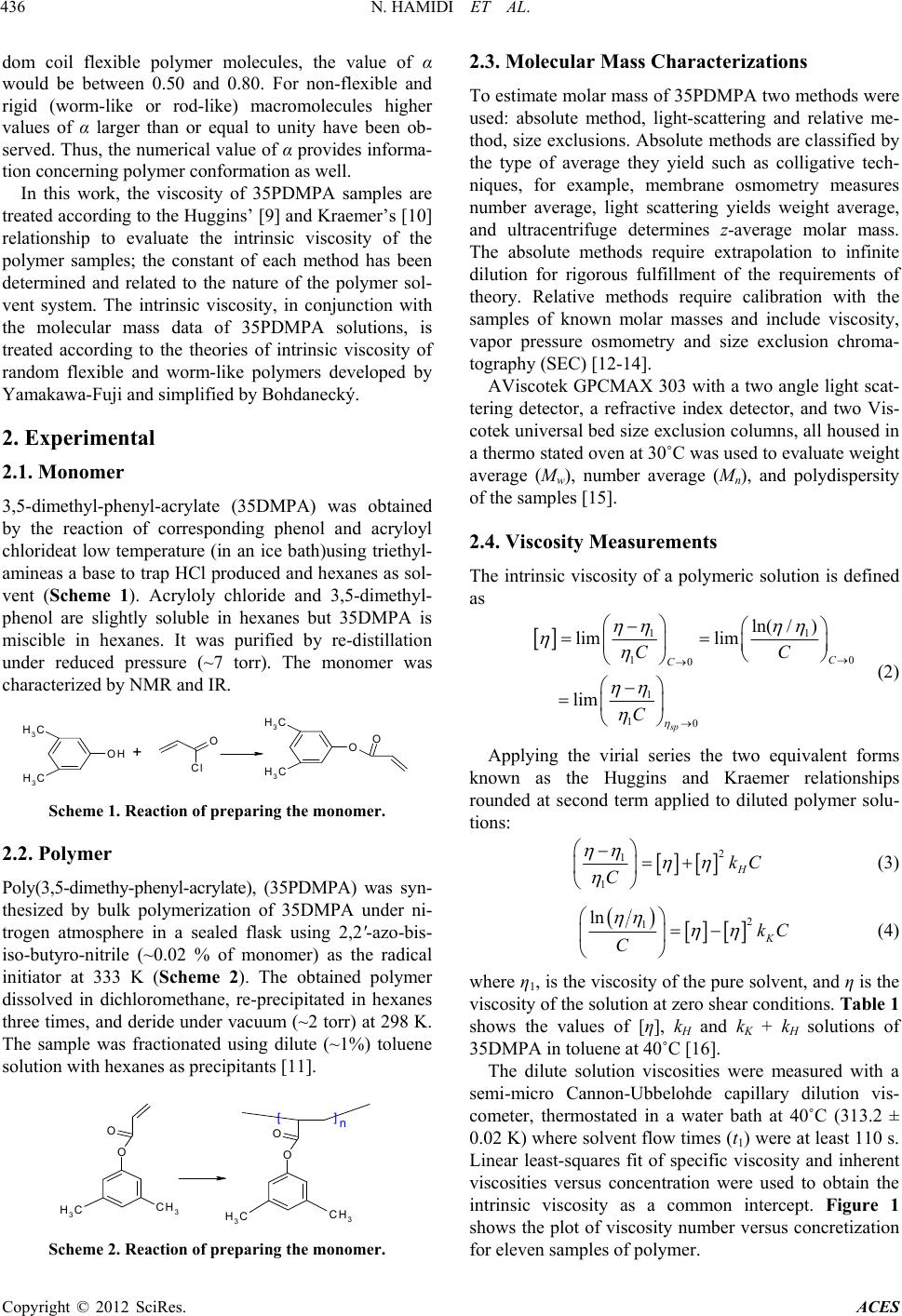 N. HAMIDI ET AL. 436 dom coil flexible polymer molecules, the value of α would be between 0.50 and 0.80. For non-flexible and rigid (worm-like or rod-like) macromolecules higher values of α larger than or equal to unity have been ob- served. Thus, the numerical value of α provides informa- tion concerning polymer conformation as well. In this work, the viscosity of 35PDMPA samples are treated according to the Huggins’ [9] and Kraemer’s [10] relationship to evaluate the intrinsic viscosity of the polymer samples; the constant of each method has been determined and related to the nature of the polymer sol- vent system. The intrinsic viscosity, in conjunction with the molecular mass data of 35PDMPA solutions, is treated according to the theories of intrinsic viscosity of random flexible and worm-like polymers developed by Yamakawa-Fuji and simplified by Bohdanecký. 2. Experimental 2.1. Monomer 3,5-dimethyl-phenyl-acrylate (35DMPA) was obtained by the reaction of corresponding phenol and acryloyl chlorideat low temperature (in an ice bath)using triethyl- amineas a base to trap HCl produced and hexanes as sol- vent (Scheme 1). Acryloly chloride and 3,5-dimethyl- phenol are slightly soluble in hexanes but 35DMPA is miscible in hexanes. It was purified by re-distillation under reduced pressure (~7 torr). The monomer was characterized by NMR and IR. CH3 CH3 OH O Cl CH3 CH3 OO + Scheme 1. Reaction of preparing the monomer. 2.2. Polymer Poly(3,5-dimethy-phenyl-acrylate), (35PDMPA) was syn- thesized by bulk polymerization of 35DMPA under ni- trogen atmosphere in a sealed flask using 2,2'-azo-bis- iso-butyro-nitrile (~0.02 % of monomer) as the radical initiator at 333 K (Scheme 2). The obtained polymer dissolved in dichloromethane, re-precipitated in hexanes three times, and deride under vacuum (~2 torr) at 298 K. The sample was fractionated using dilute (~1%) toluene solution with hexanes as precipitants [11]. CH3 CH3 O O CH3 CH3 O O [ ]n Scheme 2. Reaction of preparing the monomer. 2.3. Molecular Mass Characterizations To estimate molar mass of 35PDMPA two methods were used: absolute method, light-scattering and relative me- thod, size exclusions. Absolute methods are classified by the type of average they yield such as colligative tech- niques, for example, membrane osmometry measures number average, light scattering yields weight average, and ultracentrifuge determines z-average molar mass. The absolute methods require extrapolation to infinite dilution for rigorous fulfillment of the requirements of theory. Relative methods require calibration with the samples of known molar masses and include viscosity, vapor pressure osmometry and size exclusion chroma- tography (SEC) [12-14]. AViscotek GPCMAX 303 with a two angle light scat- tering detector, a refractive index detector, and two Vis- cotek universal bed size exclusion columns, all housed in a thermo stated oven at 30˚C was used to evaluate weight average (Mw), number average (Mn), and polydispersity of the samples [15]. 2.4. Viscosity Measurements The intrinsic viscosity of a polymeric solution is defined as 11 10 0 1 10 ln( /) lim lim lim sp C C CC C (2) Applying the virial series the two equivalent forms known as the Huggins and Kraemer relationships rounded at second term applied to diluted polymer solu- tions: 2 1 1 H kC C (3) 2 1 ln K kC C (4) where η1, is the viscosity of the pure solvent, and η is the viscosity of the solution at zero shear conditions. Table 1 shows the values of [η], kH and kK + kH solutions of 35DMPA in toluene at 40˚C [16]. The dilute solution viscosities were measured with a semi-micro Cannon-Ubbelohde capillary dilution vis- cometer, thermostated in a water bath at 40˚C (313.2 ± 0.02 K) where solvent flow times (t1) were at least 110 s. Linear least-squares fit of specific viscosity and inherent viscosities versus concentration were used to obtain the intrinsic viscosity as a common intercept. Figure 1 shows the plot of viscosity number versus concretization for eleven samples of polymer. Copyright © 2012 SciRes. ACES 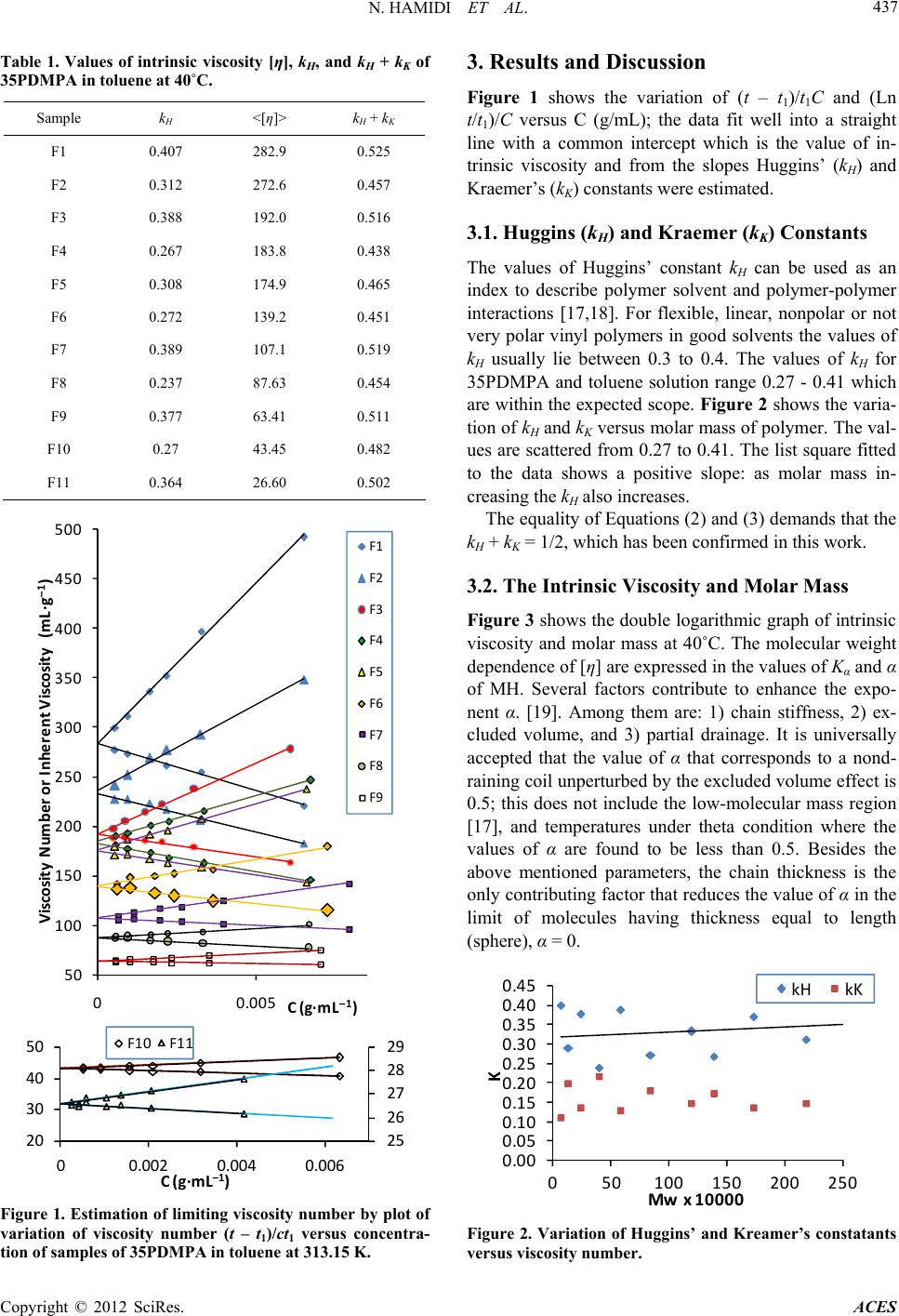 N. HAMIDI ET AL. 437 Table 1. Values of intrinsic viscosity [η], kH, and kH + kK of 35PDMPA in toluene at 40˚C. Sample kH <[η]> kH + kK F1 0.407 282.9 0.525 F2 0.312 272.6 0.457 F3 0.388 192.0 0.516 F4 0.267 183.8 0.438 F5 0.308 174.9 0.465 F6 0.272 139.2 0.451 F7 0.389 107.1 0.519 F8 0.237 87.63 0.454 F9 0.377 63.41 0.511 F10 0.27 43.45 0.482 F11 0.364 26.60 0.502 50 100 150 200 250 300 350 400 450 500 00 ViscosityNumberorInherentViscosity(mL∙g –1 ) C .005 (g∙mL –1 ) F1 F2 F3 F4 F5 F6 F7 F8 F9 25 26 27 28 29 0.006 20 30 40 50 00.002 0.004 C(g∙mL–1) F10 F11 Figure 1. Estimation of limiting viscosity number by plot of variation of viscosity number (t – t1)/ct1 versus concentra- tion of samples of 35PDMPA in toluene at 313.15 K. 3. Results and Discussion Figure 1 shows the variation of (t – t1)/t1C and (Ln t/t1)/C versus C (g/mL); the data fit well into a straight line with a common intercept which is the value of in- trinsic viscosity and from the slopes Huggins’ (kH) and Kraemer’s (kK) constants were estimated. 3.1. Huggins (kH) and Kraemer (kK) Constants The values of Huggins’ constant kH can be used as an index to describe polymer solvent and polymer-polymer interactions [17,18]. For flexible, linear, nonpolar or not very polar vinyl polymers in good solvents the values of kH usually lie between 0.3 to 0.4. The values of kH for 35PDMPA and toluene solution range 0.27 - 0.41 which are within the expected scope. Figure 2 shows the varia- tion of kH and kK versus molar mass of polymer. The val- ues are scattered from 0.27 to 0.41. The list square fitted to the data shows a positive slope: as molar mass in- creasing the kH also increases. The equality of Equations (2) and (3) demands that the kH + kK = 1/2, which has been confirmed in this work. 3.2. The Intrinsic Viscosity and Molar Mass Figure 3 shows the double logarithmic graph of intrinsic viscosity and molar mass at 40˚C. The molecular weight dependence of [η] are expressed in the values of Kα and α of MH. Several factors contribute to enhance the expo- nent α. [19]. Among them are: 1) chain stiffness, 2) ex- cluded volume, and 3) partial drainage. It is universally accepted that the value of α that corresponds to a nond- raining coil unperturbed by the excluded volume effect is 0.5; this does not include the low-molecular mass region [17], and temperatures under theta condition where the values of α are found to be less than 0.5. Besides the above mentioned parameters, the chain thickness is the only contributing factor that reduces the value of α in the limit of molecules having thickness equal to length (sphere), α = 0. 0.00 0.05 0.10 0.15 0.20 0.25 0.30 0.35 0.40 0.45 050100 150 200 250 K Mw x10000 kH kK Figure 2. Variation of Huggins’ and Kreamer’s constatants versus viscosity number. Copyright © 2012 SciRes. ACES 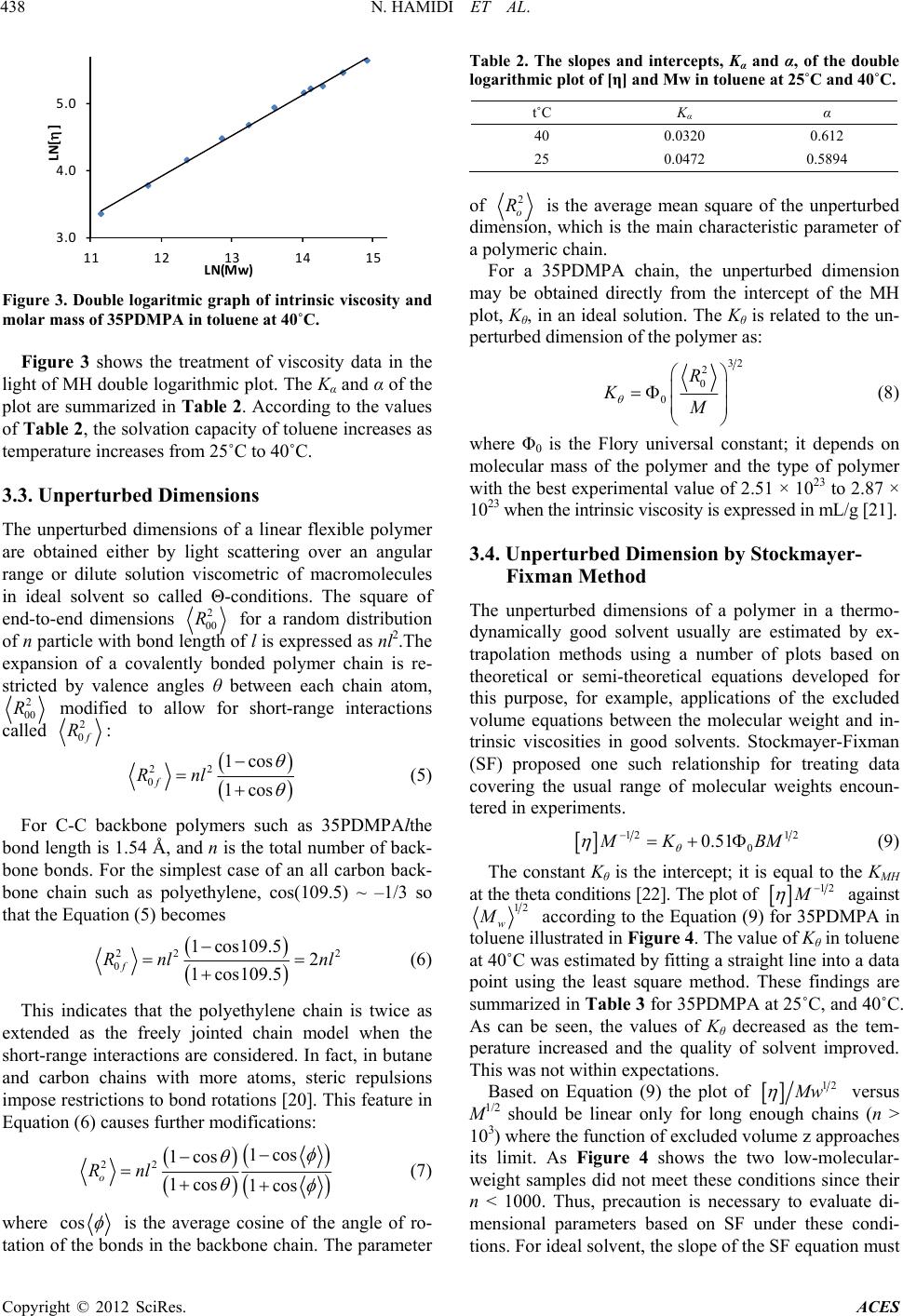 N. HAMIDI ET AL. 438 3.0 4.0 5.0 11 12 13 LN[] LN(Mw) 14 15 Figure 3. Double logaritmic graph of intrinsic viscosity and molar mass of 35PDMPA in toluene at 40˚C. Figure 3 shows the treatment of viscosity data in the light of MH double logarithmic plot. The Kα and α of the plot are summarized in Table 2. According to the values of Table 2, the solvation capacity of toluene increases as temperature increases from 25˚C to 40˚C. 3.3. Unperturbed Dimensions The unperturbed dimensions of a linear flexible polymer are obtained either by light scattering over an angular range or dilute solution viscometric of macromolecules in ideal solvent so called Θ-conditions. The square of end-to-end dimensions 2 R00 for a random distribution of n particle with bond length of l is expressed as nl2.The expansion of a covalently bonded polymer chain is re- stricted by valence angles θ between each chain atom, 2 R00 modified to allow for short-range interactions called 2 0 f R: 22 0 1cos 1cos f Rnl (5) For C-C backbone polymers such as 35PDMPAlthe bond length is 1.54 Å, and n is the total number of back- bone bonds. For the simplest case of an all carbon back- bone chain such as polyethylene, cos(109.5) ~ –1/3 so that the Equation (5) becomes 22 0 1 cos 1 cos1 f Rnl 2 109.5 2 09.5 nl (6) This indicates that the polyethylene chain is twice as extended as the freely jointed chain model when the short-range interactions are considered. In fact, in butane and carbon chains with more atoms, steric repulsions impose restrictions to bond rotations [20]. This feature in Equation (6) causes further modifications: 22 1c os 1cos o Rnl 1cos 1c os (7) where cos is the average cosine of the angle of ro- tation of the bonds in the backbone chain. The parameter Table 2. The slopes and intercepts, Kα and α, of the double logarithmic plot of [η] and Mw in toluene at 25˚C and 40˚C. t˚C Kα α 40 0.0320 0.612 25 0.0472 0.5894 2 R of o is the average mean square of the unperturbed dimension, which is the main characteristic parameter of a polymeric chain. For a 35PDMPA chain, the unperturbed dimension may be obtained directly from the intercept of the MH plot, Kθ, in an ideal solution. The Kθ is related to the un- perturbed dimension of the polymer as: 32 2 0 0 R KM (8) where Φ0 is the Flory universal constant; it depends on molecular mass of the polymer and the type of polymer with the best experimental value of 2.51 × 10²³ to 2.87 × 10²³ when the intrinsic viscosity is expressed in mL/g [21]. 3.4. Unperturbed Dimension by Stockmayer- Fixman Method The unperturbed dimensions of a polymer in a thermo- dynamically good solvent usually are estimated by ex- trapolation methods using a number of plots based on theoretical or semi-theoretical equations developed for this purpose, for example, applications of the excluded volume equations between the molecular weight and in- trinsic viscosities in good solvents. Stockmayer-Fixman (SF) proposed one such relationship for treating data covering the usual range of molecular weights encoun- tered in experiments. 12 12 0 0.51 M KBM (9) The constant Kθ is the intercept; it is equal to the KMH at the theta conditions [22]. The plot of 12 M against 12 w according to the Equation (9) for 35PDMPA in toluene illustrated in Figure 4. The value of Kθ in toluene at 40˚C was estimated by fitting a straight line into a data point using the least square method. These findings are summarized in Table 3 for 35PDMPA at 25˚C, and 40˚C. As can be seen, the values of Kθ decreased as the tem- perature increased and the quality of solvent improved. This was not within expectations. M 12 M w Based on Equation (9) the plot of versus M1/2 should be linear only for long enough chains (n > 103) where the function of excluded volume z approaches its limit. As Figure 4 shows the two low-molecular- weight samples did not meet these conditions since their n < 1000. Thus, precaution is necessary to evaluate di- mensional parameters based on SF under these condi- tions. For ideal solvent, the slope of the SF equation must Copyright © 2012 SciRes. ACES  N. HAMIDI ET AL. 439 0.08 0.11 0.14 0500 1000 []Mw –1 Mw 1/2 1 222 00f RR 1500 Figure 4. Stockmayer-Fixman plot, Equation (9), for 35PDMPA in toluene at 40˚C. Table 3. Values of Kθ, 12 2 0 RM , σ and C∞ from SF plot and Bohdaneck ý. Method Kθ 12 2 0 RM s C∞ SF 25˚ 0.122 0.783 3.37 22.78 SF 40˚ 0.109 0.753 3.25 21.08 H-Mw 40˚ 0.124 0.786 3.39 22.98 At M∞ 0.170 0.875 3.77 28.44 Bohdaneck ý 0.171 0.877 3.78 28.56 be zero. In a good solvent such as toluene, the slope is positive. Two different factors may contribute in deter- mining a high value of Kθ for a polymeric chain such as 35PDMPA: the nature of the main chain and the effects of side chains and solvent. In the case of 35PDMPA, the nature of the main chain, which is composed of a simple hydrocarbon chain, may not contribute to the Kθ as the hindered voluminous side phenyl ester groups. The 3,5-dimethyl-phenyl lateral chains occupy a large volume and hinder the backbone internal rotations by establish- ing orientational correlations between themselves. 3.5. Evaluation of Conformational Characteristics Reliable values of the characteristic parameters of the conformation and flexibility of polymer chains such as Flory characteristic ratio C∞, steric factor σ, and Kuhn statistical segment length lK are needed for the interpreta- tion of various properties, including the rheological be- havior of melts. The conformation of 35PDMPA chains currently can be characterized by the Flory characteristic ratio C∞ or the steric factor σ. The latter two quantities are defined by the Equations (10) and (12). For more complex chains, such as 35PDMPA containing ring and heteroatom, an estimated σ is obtained from (10) The mean square unperturbed end-to-end distance, 2 R0 can be obtained experimentally from the value of Kθ, Equation (8), which is related to the rigidity factor σ, or to the characteristic ratio C∞, by the expression 12 13 212 00 20 02 f RKM l R (11) 23 2 00 2 20 00 2 R K M Cl R (12) where M0 is the molecular mass of the monomer. The values of σ and C∞ based on Equations (11) and (12) are also tabulated in the Table 3. 3.6. Wormlike Cylinder Another method of evaluation of the characteristic pa- rameters of 35PDMPA is by the theory for the worm-like touched-bead model [23,24]. Based on this theory, the intrinsic viscosity at theta condition depends not only on the unperturbed mean-square end-to-end distance 2 R0, but also on the cross-sectional dimensions of polymer- called the diameter of the bead, db, the small units that compose the macromolecule. The results of the theory have been expressed in a simple form convenient for use even with very short chains by Bohdaneck ý [25] 12 0 0 A KM (13) 32 2 00,0 KRM with: (14) 12 00brk A KAd M (15) brb K ddl (16) 2 0 K L lRMM (17) 1 M K KL lM (18) 2 0 RM 2 0 R is the ratio of and M is the random coil limit, and Φ0,∞ is the Flory viscosity constant for random coils in the non-draining regime, A0(dbr) is a function of the reduced bead diameter dbr, db is the bead diameter, lK and MK are, respectively, the length and mo- lecular weight of the Kuhn statistical segment, and ML is the shift factor which is usually set equal to the molecu- lar weight per unit contour length of the chain at full ex- tension. One of the simplest forms of description of mo- lecular-weight dependence of the intrinsic viscosity in good solvents by theoretical and semi-empirical equa- 1LK ≡ 2q ≡ λ–1. Copyright © 2012 SciRes. ACES  N. HAMIDI ET AL. 440 tions is [26] 1K Cn z 31.5 3 3 0 (19) This is valid for only [27]. It is used here because most of the values are in this range. The symbol αη stands for the viscosity-radius expansion fac- tor, nK is the number of Kuhn segments in the chain, z is the excluded-volume variable and B reflects the poly- mer–solvent interaction. 32 2 12 zB M 32 0 3 2π R M (20) The impact of chain stiffness on the onset of the ex- cluded-volume effect becomes manifested in the chain- length dependence of the coefficient Cη(nK) [28-32]. This function is not known. In practice, it is usually replaced by the function (3/4). CηK(nK) where K(nK) was derived by Yamakawa and Stockmayer [12] from the expansion factor 222 0 RR R . This function is approximated by the equations: 1 0.875 K 12 4 312.033 KK K nn n for nK > 6 (21A) 12 1 exp 6.6110.9198 KKK 0.03516 K K nn n n Cź for nK < 6 (21B) Then, Equation (19) can be modified to 31 (22) where ź is the scaled excluded-volume variable [24,25] 34 K ź K nz 1.14C (23A) (23B) Combining Equations (13), (19), (20), (22) and (23), yields: 3 2 12 33 42π C 12 0 32 2 0 1 K AKM RKn BM M (24A) (24B)2 3 0K K 322 20 3 322 20 12 0 33 42π 33 42π R A AC M R KnBK M KC M KnBM 12 6 15.640.16205.691 10 M M (24C) Therefore, the interpretation of the intrinsic viscosity of 35PDMPA requires estimation of three characteristic parameters: cross sectional chain diameter, Aη, flexibility of the chain, K0, and polymer–solvent interaction, B. Polynomial regression of [η] and 12 M in Figure 5 results in Equation (24C). By comparing Equations (24B) and (24C) we get: 15.6A (25A) 3 322 20 0 33 0.162 42πK R AC KnBK M (25B) 3 322 20 0 33 5.69E 6 42πK R KC KnB M 00.1625K (25C) (25D) 3 322 20 33 6.45E3 42πK R CKnB M (25E) 3.6.1. Application of Equation (24) by Plotting [η] vs 12 M Equation (24) shows that the plot of [η] vs 12 M should be linear over the whole range of molecular weights in theta solvents where B = 0. In good solvents where B > 0, linearity is restricted to a region where the term 32 2 0 K BR MKn is very low, such as in the case of 35PDMPA in toluene at 40˚C. This implies alsothat the ratio 2 0 RM is very high which is the case of stiff chains. Moreover, Equation (24) will be linear where K(nK) ~ 0 represents short chains for both flexible and stiff polymers. At higher molecular weights the plot becomes curved upward as the function K(nK) and the value of z increases with increasing M. Toluene at 40˚C is not a theta solvent, therefore B ≠ 0. In good solvents where B > 0, linearity is restricted to the condition that the term 32 2 0K BRM Kn is very 2 3 322 2012 12 0 3 322 20 12 0 3 34 2π 3 34. 2π K K R A AC KnBMKM M R KMCK nBM M Copyright © 2012 SciRes. ACES  N. HAMIDI ET AL. 441 y=0.173x‐ 19.77 R²=0.999 y=5.691E‐06x 2 +1.620E‐01x ‐1.564E+01 R²=9.992E‐01 ‐20 30 80 130 180 230 280 330 05001000 1500 2000 [](cm 3 g –1 ) Mw 1/2 Figure 5. Plot of [η] versus Mw1/2 for 35PDMPA in toluene at 40˚C. low such as in the case of 35PDMPA in toluene at 40˚C, Equation (24E). In this case, the ratio 2 0 RM is very high which represent stiff chains. Since 35PDMPA is composed of the unit -CH2-CHR- the backbone of the polymer does not introduce rigidity. Then the rigidity must be caused by the side chains effects. Hence, the excluded-volume effect also is not negligible with the lowest molecular weights. As Figure 5 shows, also, the plot of [η] vs 12 Mw for 35PDMPA homologues series fits to a straight line with r2 = 0.9986. 112 0.1729 w 2 019.663AKM M (26A) 32 0.173M 2 00 , 0 KF R (26B) The value of Kθ calculated in this manner is only 6.4% higher than the former polynomial adjustment. Table 4 summarizes the molecular parameters of 35PDMPA in toluene at 40˚C. The molecular weight of the Kuhn sta- tistical segment MK is about 15 times higher than that of the chain repeating unit. This is an indication of chain stiffness of the 35DMPA in toluene at 40˚C. Most of the vinyl polymers and derivatives of poly (acrylic acid) and poly (methacrylic acid) with various side groups showed the proportionality of [η] and 12 M over a broad span of molecular weights as reported in reference [25]. However, they do not show semi-rigid characteristics as in the case of 35PDMPA. In the case of 35PDMPA, large size side chains increases the cross- sectional chain diameter and the orientation of side chains produce a high impediment around the polymer chain. To verify the value of Kθ,∞ a plot of 12 w M vs 12 M w such as shown in Figure 6 will be useful. The intercept of the plot Kθ,∞ = 0.170 obtained at infinite Mw. Table 4. Characteristics parameters of 35PDMPA. Data of other polymer also is gathering to compare PHE [25] and PDiPF [24]. Polymer 35PDMPA PHE PDiPF Characteristics LinealPolynom Ref 25 Ref 24 ML (cm) × 10–8 57 57 20 134 K0 (cm) 0.173 0.163 0.150 - 2 0 R M × 1016 0.782 0.751 0.711 - lK (cm) × 10–8 45 43 14 220 MK 2560 2456 278 29,480 Mk/M0 15 14 1 294 -A 19.77 15.64 0.000 - -A0 2.259 1.942 0.000 - dbr 0.120 0.179 0.540 - db (cm) × 108 5.36 7.68 7.60 14.00 0.1 0.13 0.16 00.001 0.002 0.003 0.004 []Mw –1 /2 (Mw) –1 /2 Figure 6. Plot of [η]/Mw–1/2 versus M–1/2. Extrapolation to infant Mw gave account for Kθ,∞. Kθ,∞ is very close to the value of the slope of [η] and 12 M 02.95.36 br w According to the Yoshizaki-Nitta-Yamakawa theory [23], the hydrodynamic interaction depends on the re- duced bead diameter dbr which, in the range 0.3 ≤ dbr ≤ 0.8, is related to the A0 parameter by [33] which is the value of K0,∞ of Equation (26B). A d (27) Table 4 shows the characteristic parameters of 35PDMPA. Also, for the sake of comparison, character- istics parameter of a very flexible chain such as bisphe- nol-A based poly(hydroxyethers) (PHE) from reference [25] and an stiff polymer, Poly(disopropylfumarate), (PDiPF) from reference [24] are sited. The high values of lK and MK of 35PDMPA suggests a semi flexible mac- romolecule. 3.6.2. Comments on 12 M vs 12 M (SF) plot [34,35] 12 w M Based on Equation (24), the plot of versus Copyright © 2012 SciRes. ACES  N. HAMIDI ET AL. 442 12 M should be linear only for long enough chains (n < 103) where the absolute value of Aη is much lower than 12 K 0w M and the function K(nK) approaches its limit. As Figure 4 illustrates the two low-molecular-weight sam- ples are not met in this condition. Thus precaution is nec- essary to evaluate dimensional parameters based on BSF. In the case of Aη = 0, the BSF plot can be modified to 12 M vs 12 Kn M K which should be linear and can be extrapolated to M = 0. This, however, is not the case of 35PDMPA in toluene that has a negative Aη value. If Aη is not equal to zero, both the original and modified SF plots are non-linear as shown in Figure 4. They can have a minimum if Aη > 0 or bend downward with de- creasing molecular weight if Aη < 0 (such asin the case of 35PDMPA, Figure 4). In either case, the extrapolation to M = 0 based on BSF is not justified [36]. 3.7. Conclusions and Remarks As previously mentioned, the nature of the main chain of a 35PDMPA polymer may not contribute to the high value of C∞ and σ as much as the 3,5-dimethyl-phenyl ester side chains. The 3,5-dimethyl-phenyl lateral chains occupy a larger volume (thus posing steric hindrances) and more importantly, they may hinder the backbone internal rotations by establishing orientational correla- tions between themselves. The stiffening of the polymer chain due to the presence of large aromatic groups and long n-alkyl pendant groups has already been reported for some other polymers by several researchers. Also, it is known that the interaction of elements of polymer chains with solvent molecules could affect the probabil- ity distribution of the angles of internal rotation in the chain [37]. This observation was confirmed both theo- retically and experimentally by a number of researchers [38,39] and here is confirmed by application of wormlike cylinder model. The values of C∞ of 35PDMPA (21 - 23) are much higher than values observed for other polyacrylates. For example, the value of C∞ for polyphenylmethacrylate, PPMA, both theta solvents and good solvents (12.2 and 13.3) are larger than ones for many atactic vinyl polymers, which are in the range of 5 < C∞ <10 usually found in the literature. It should also be remarked that the value of C∞ in good solvents probably has been underestimated as they were obtained by extrapolating to M = 0 the mo- lecular weight region of the Stockmayer-Fixman plot in which the effect of stiffness is coupled with excluded volume. And, also, it is overestimated by extrapolation to M = ∞. However, chain rigidity may be contributing to the slope so that the results obtained for Kθ and C∞ could be inaccurate. An indication that the positive slope in this plot may include the effect of chain stiffness comes from the convergent trend observed in the curves at high mo- lecular weights. This leveling of the slope cannot be ac- counted for by the theory of flexible coils perturbed by excluded volume but has been predicted by wormlike models of stiff chains. The value of C∞ of 35PDMPA (29) obtained by ex- trapolating to M = ∞ using SFthe molecular weight region in which the effect of excluded volume levels is much higher than values observed for the same polymer by SF extrapolation to M = 0. The same effect was observed for other polymers. An example is polyphenylmethacrylate, PPMA, both theta solvents and good solvents. 4. Acknowledgements We appreciate the financial support of 1890 Research at South Carolina State University, and the U.S. Air Force Laboratory/Clarkson Aerospace/Minority Leadership Pro- gram to financially support teachers and high school stu- dents involved in this project. Also, many thanks to the Department of Biological and Physical Sciences for pro- viding lab space, materials, supplies and instrumentation in conjunction with 1890-Reserch Grant Project SCX- 420-24-04 and the USDA Evans-Allen Research pro- gram. Many thanks to MS. P. Laursen for the helps in technical writings. REFERENCES [1] P. J. Flory, “Statistical Mechanics of Chain Molecules,” Interscience, New York, 1969. [2] Z. Xu, N. Hadjichristidis and L. J. Fetterss, “Solution Properties and Chain Dimensions of Poly(n-Alkyl Metha- crylates),” Macromolecules, Vol. 17, No. 11, 1984, pp. 2303-2306. doi:10.1021/ma00141a019 [3] L. Gargallo, N. Hamidi and D. Radic, “Synthesis, Solu- tion Properties and Chain Flexibility of Poly(2,6-Di- methylphenyl Methacrylate),” Polymer, Vol. 31, No. 5, 1990, pp. 924-927. doi:10.1016/0032-3861(90)90057-6 [4] Y. Abe and P. J. Flory, “Configurational Statistics of 1,4-Polybutadiene Chains,” Macromolecules, Vol. 4, No. 2, 1971, pp. 219-230. doi:10.1021/ma60020a017 [5] H. Yamakawa and M. Fujii, “Intrinsic Viscosity of Wormlike Chains. Determination of the Shift Factor,” Macromolecules, Vol. 7, No. 1, 1974, pp. 128-135. doi:10.1021/ma60037a024 [6] M. Bohdanecký, “New Method for Estimating the Pa- rameters of the Wormlike Chain Model from the Intrinsic Viscosity of Stiff-Chain Polymers,” Macromolecules, Vol. 16, No. 9, 1983, pp. 1483-1492. doi:10.1021/ma00243a014 [7] H. Morawetz, “Macromolecules in Solution,” Interscience Publishers, New York, 1958. [8] E. Brandrup, H. Immergut and E. A. Grulke, Eds., “Polymer Handbook,” 4th Edition, John Wily & Sons, Inc. New York, 1999. [9] M. L. Huggins, “The Viscosity of Dilute Solutions of Long-Chain Molecules. IV. Dependence on Concentra- Copyright © 2012 SciRes. ACES  N. HAMIDI ET AL. Copyright © 2012 SciRes. ACES 443 tion,” Journal of the American Chemical Society, Vol. 64, No. 11, 1942, pp. 2716-2718. doi:10.1021/ja01263a056 [10] E. O. Kraemer, “Molecular Weights of Celluloses and Cellulose Derivates,” Industrial & Engineering Chemis- try, Vol. 30, No. 10, 1938, pp. 1200-1203. doi:10.1021/ie50346a023 [11] N. Hamidi, “Synthesis and Characterization of Poly(3,5- Dimethyl-Phenyl-Acrylate) in Toluene at 40˚C By Two- Angle Light-Scattering and Differential Pressure Vis- cometry,” International Journal of Applied Science and Technology, Vol. 2, No. 3, 2012, pp. 7-23. [12] J. M. G. Cowie, “Polymers: Chemistry & Physics of Modern Materials,” 2nd Edition, Chapman & Hall, Lon- don, 1991, (1a) pp. 165, 191-192 and 219; (1b) p. 217; (1c) p. 218. [13] P. J. Flory, “Principles of Polymer Chemistry,” Cornell University Press, Ithaca, 1953, (2a) p. 27, (2b) p. 310, (3c) p. 617. [14] H. Yamakawa, “Modern Theory of Polymer Solution,” Harper and Row Publishers, New York, 1971. [15] N. Hamidi, L. Sealey and B. Hamidi, “Diluted Solution Properties of Poly (3,5-Dimethyl-Phenyl-Acrylate) in Tol- uene At 25˚C and 30˚C,” International Journal of Applied Science and Technology, Vol. 2, No. 3, 2012, pp. 7-23. [16] N. Hamidi, S. Ihekweazu, C. A. Wiredu, O. H. Isa, K. Watley, C. Rowe, B. Nimmons, A. Prezzy, T. Govan, S. Scoville and Q. Hills, “Solution Viscosity of Poly(3,5- Dimethyl-Phenyl-Acrylate) in Toluene at 40˚C,” 63rd Southeaster Regional Meeting of American Chemical So- ciety, Richmond, 26-29 October 2011. [17] J. M. Barrales-Rienda, C. Romero Galicia, J. J. Freire and A. Horta, “Dilute Solution Properties of Poly[N-(n-Oc- tadecyl)Maleimide]. 2. Molecular Weight Dependence of the Intrinsic Viscosity in a Few Good Solvents,” Macro- molecules, Vol. 16, 1983, p. 1940. [18] W. R. Moore, “Viscosities of Dilute Polymer Solutions,” Progress in Polymer Science, Vol. 1, 1967, pp. 1-43. doi:10.1016/0079-6700(67)90001-9 [19] J. M. Barrales-Rienda, C. R. Galicia, J. J. Freire and A. Horta, “Dilute Solution Properties of Poly[N-(n-Octade- cyl)Maleimide]. 4. Cloud Points, θ Solvents, and Mo- lecular Weight Dependence of Intrinsic Viscosity in n- Alkyl Alcohols as θ Solvents,” Macromolecules, Vol. 16, No. 11, 1983, pp. 1707-1714. doi:10.1021/ma00245a006 [20] A. E. Tonelli, NMR Spectroscopy and Polymer Micro- structure, the Conformational Connection,” VHC Pub- lishers, New York, 1989, p. 56. [21] Y. Miyaki, Y. Einaga, H. Fujita and M. Fukuda, “Flory’s Viscosity Factor for the System Polystyrene + Cyclohex- ane at 34.5˚C,” Macromolecules, Vol. 13, No. 3, 1980, pp. 588-592. doi:10.1021/ma60075a021 [22] H. Yamakawa and M. Fuji, “Intrinsic Viscosity of Worm- like Chains. Determination of the Shift Factor,” Macro- molecules, Vol. 7, No. 1, 1974, pp. 128-135. doi:10.1021/ma60037a024 [23] T. Yoshizaki, J. Nitta and H. Yamakawa, “Transport Coefficients of Helical Wormlike Chains. 4. Intrinsic Vis- cosity of the Touched-Bead Model,” Macromolecules, Vol. 21, No. 1, 1988, pp. 165-171. doi:10.1021/ma00179a033 [24] A. Kaštánek, S. Podzimek, J. Dostál, L. Šimek and M. Bohdaneck ý, “Estimation of Conformational Characteris- tics of Bisphenol-A Based Poly(Hydroxyethers),” Poly- mer, Vol. 41, No. 8, 2000, pp. 2865-2870. doi:10.1016/S0032-3861(99)00474-7 [25] M. Bohdaneck ý and M. Netopilík, “Note on the Applica- tion of the Yoshizaki-Nitta-Yamakawa Theory of the In- trinsic Viscosity of the Touched-Bead Model,” Die Mak- romolekulare Chemie, Rapid Communications, Vol. 14, No. 7, 1993, pp. 383-386. doi:10.1002/marc.1993.030140703 [26] T. Yoshizaki, J. Nitta and H. Yamakawa, “Transport Co- efficients of Helical Wormlike Chains. 4. Intrinsic Vis- cosity of the Touched-Bead Model,” Macromolekules, Vol. 21, No. 1, 1988, pp. 165-171. [27] H. Yamakawa, “Modern Theory of Polymer Solutions,” Harper and Row, New York, 1971. [28] H. Fujita, “Polymer Solutions,” Elsevier, Amsterdam, 1990. [29] H. Yamakawa and W. H. Stockmayer, “Statistical Me- chanics of Wormlike Chains. II. Excluded Volume Ef- fects,” Journal of Chemical Physics, Vol. 57, No. 7, 1972, p. 2843. doi:10.1063/1.1678675 [30] T. Norisuye and H. Fujita, “Excluded-Volume Effects in Dilute Polymer Solutions. XIII. Effects of Chain Stiff- ness,” Polymer Journal, Vol. 14, No. 2, 1982, pp. 143- 147. doi:10.1295/polymj.14.143 [31] H. Yamakawa and J. Shimada, “Stiffness and Excluded— Volume Effects in Polymer Chains,” Journal of Chemical Physics, Vol. 83, No. 5, 1985, pp. 2607-2611. doi:10.1063/1.449254 [32] J. Shimada and H. Yamakawa, “Statistical Mechanics of Helical Worm-Like chains. XV. Excluded-Volume Ef- fects,” Journal of Chemical Physics, Vol. 85, No. 1, 1976, pp. 591-601. [33] W. Burchard, “ÜBer den Einfluß der Lösungsmittel Auf die Struktur Linearer Makromoleküle. I,” Die Makro- molekulare Chemie, Vol. 50, No. 1, 1961, p. 210. doi:10.1002/macp.1961.020500102 [34] W. H. Stockmayer and M. Fixman, “On the Estimation of Unperturbed Dimensions from Intrinsic Viscosities,” Jour- nal of Polymer Science, Part C, No. 1, 1963, p. 137. [35] M. Bohdaneck ý, J. Kovár and I. Fortel ý, “Partial Draining of Low-Molecular Weight Polymers with Flexible Chains,” Polymer, Vol. 20, No. 7, 1979, pp. 813-817. [36] S. Lifson and I. Oppenheim, “Neighbor Interactions and Internal Rotations in Polymer Molecules. IV. Solvent Ef- fect on Internal Rotations,” Journal of Chemical Physics, Vol. 33, No. 1, 1960, p. 109. doi:10.1063/1.1731064 [37] D. J. Joon, P. R. Sundarajan and P. J. Flory, “Conforma- tional Characteristics of Polystyrene,” Macromolecules, Vol. 8, No. 6, 1975, pp. 776-783. doi:10.1021/ma60048a019 [38] T. Beha and L. Valko, “Theoretical Estimation of the Effect of Solvent on Unperturbed Dimensions: 1. Isotactic Poly(Vinyl Alcohol),” Polymer, Vol. 17, No. 4, 1976, pp. 298-302. doi:10.1016/0032-3861(76)90185-3 |