

Paper Menu >>
Journal Menu >>
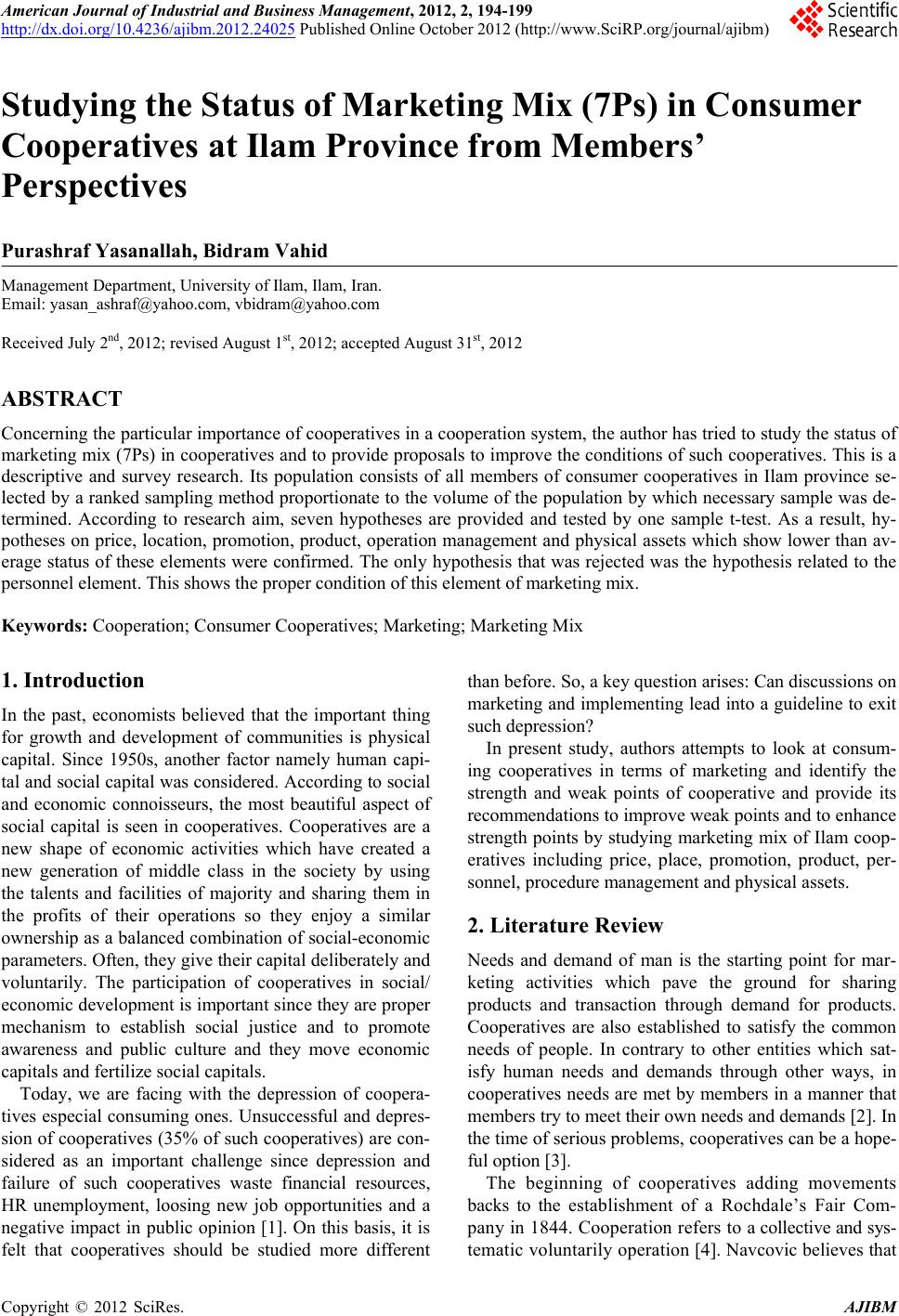 American Journal of Industrial and Business Management, 2012, 2, 194-199 http://dx.doi.org/10.4236/ajibm.2012.24025 Published Online October 2012 (http://www.SciRP.org/journal/ajibm) Studying the Status of Marketing Mix (7Ps) in Consumer Cooperatives at Ilam Province from Members’ Perspectives Purashraf Yasanallah, Bidram Vahid Management Department, University of Ilam, Ilam, Iran. Email: [email protected], [email protected] Received July 2nd, 2012; revised August 1st, 2012; accepted August 31st, 2012 ABSTRACT Concerning the particular importance of cooperatives in a cooperation system, the author has tried to study the status of marketing mix (7Ps) in cooperatives and to provide proposals to i mprove the conditions of su ch cooperatives. This is a descriptive and survey research. Its population consists of all members of consumer cooperatives in Ilam province se- lected by a ranked sampling method proportionate to the volume of the population by which necessary sample was de- termined. According to research aim, seven hypotheses are provided and tested by one sample t-test. As a result, hy- potheses on price, location, promotion, product, operation management and physical assets which show lower than av- erage status of these elements were confirmed. The only hypothesis that was rejected was the hypothesis related to the personnel element. This shows th e prop er condition of this element of marketing mix. Keywords: Cooperation; Consumer Cooperatives; Marketing; Marketing Mix 1. Introduction In the past, economists believed that the important thing for growth and development of communities is physical capital. Since 1950s, another factor namely human capi- tal and social capital was considered. According to social and economic connoisseurs, the most beautiful aspect of social capital is seen in cooperatives. Cooperatives are a new shape of economic activities which have created a new generation of middle class in the society by using the talents and facilities of majority and sharing them in the profits of their operations so they enjoy a similar ownership as a balanced combination of social-economic parameters. Often, they give their capital deliberately and voluntarily. The participation of cooperatives in social/ economic development is important since they are proper mechanism to establish social justice and to promote awareness and public culture and they move economic capitals and fertilize social capitals. Today, we are facing with the depression of coopera- tives especial consuming ones. Unsuccessful and depres- sion of cooperatives (35% of such cooperatives) are con- sidered as an important challenge since depression and failure of such cooperatives waste financial resources, HR unemployment, loosing new job opportunities and a negative impact in public opinion [1]. On this basis, it is felt that cooperatives should be studied more different than before. So, a key question arises: Can discussions on marketing and implementing lead into a guideline to exit such depression? In present study, authors attempts to look at consum- ing cooperatives in terms of marketing and identify the strength and weak points of cooperative and provide its recommendations to improv e weak poin ts and to en hance strength points by studying marketing mix of Ilam coop- eratives including price, place, promotion, product, per- sonnel, procedure management and physical assets. 2. Literature Review Needs and demand of man is the starting point for mar- keting activities which pave the ground for sharing products and transaction through demand for products. Cooperatives are also established to satisfy the common needs of people. In contrary to other entities which sat- isfy human needs and demands through other ways, in cooperatives needs are met by member s in a ma nner that members try to meet their own needs and demands [2]. In the time of serious problems, cooperatives can be a hope- ful option [3]. The beginning of cooperatives adding movements backs to the establishment of a Rochdale’s Fair Com- pany in 1844. Cooperation refers to a collective and sys- tema tic v olun tar ily op erat ion [4]. Navcovic believes that Copyright © 2012 SciRes. AJIBM 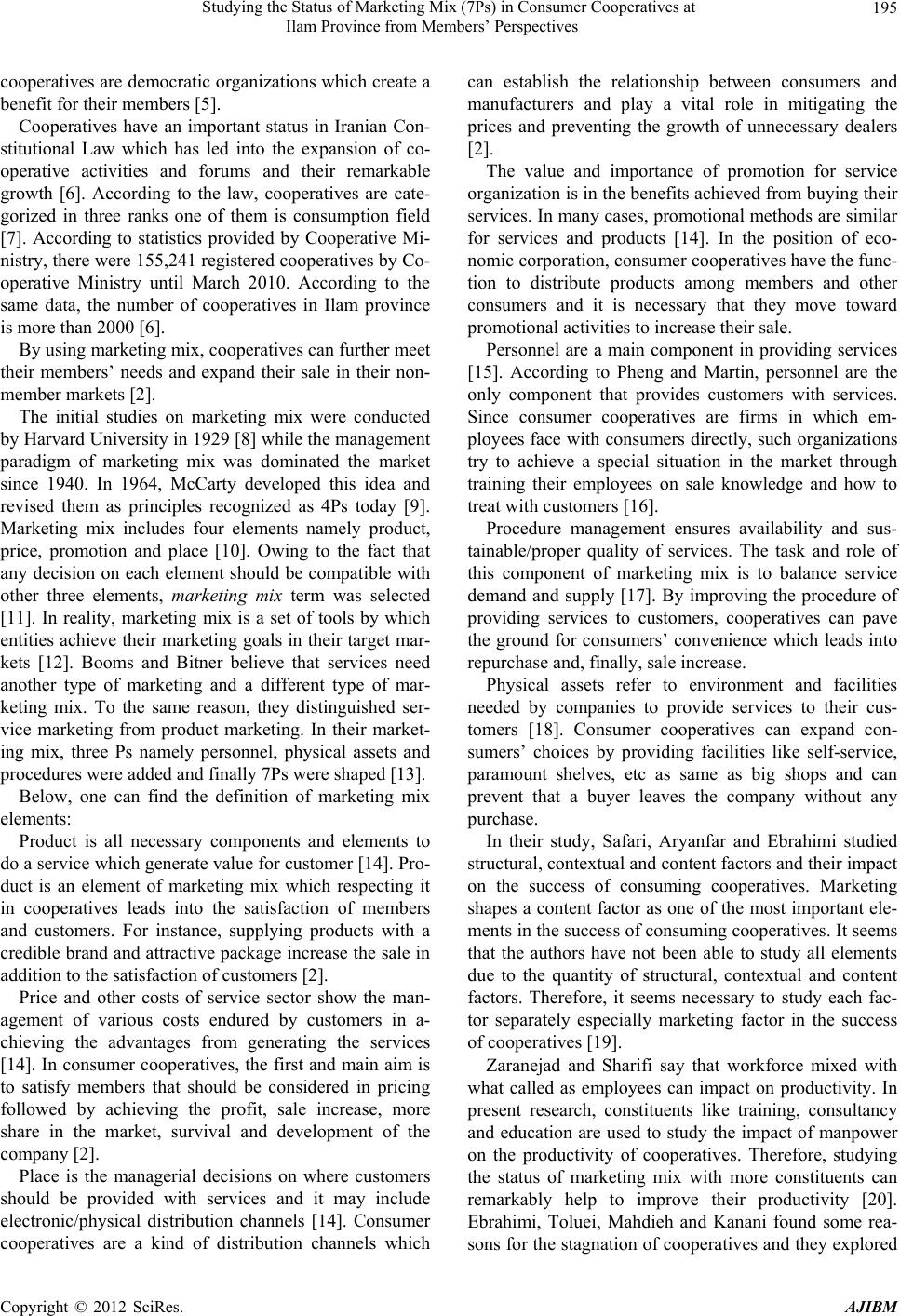 Studying the Status of Marketing Mix (7Ps) in Consumer Cooperatives at Ilam Province from Members’ Perspectives 195 cooperatives are democratic organizations which create a benefit for their members [5]. Cooperatives have an important status in Iranian Con- stitutional Law which has led into the expansion of co- operative activities and forums and their remarkable growth [6]. According to the law, cooperatives are cate- gorized in three ranks one of them is consumption field [7]. According to statistics provided by Cooperative Mi- nistry, there were 155,241 registered cooperatives by Co- operative Ministry until March 2010. According to the same data, the number of cooperatives in Ilam province is more than 2000 [6]. By using marketing mix, cooperatives can further meet their members’ needs and expand their sale in their non- member markets [2 ]. The initial studies on marketing mix were conducted by Harvard University in 1929 [8 ] while th e manage ment paradigm of marketing mix was dominated the market since 1940. In 1964, McCarty developed this idea and revised them as principles recognized as 4Ps today [9]. Marketing mix includes four elements namely product, price, promotion and place [10]. Owing to the fact that any decision on each element should be compatible with other three elements, marketing mix term was selected [11]. In reality, marketing mix is a set of tools by which entities achieve their marketing goals in their target mar- kets [12]. Booms and Bitner believe that services need another type of marketing and a different type of mar- keting mix. To the same reason, they distinguished ser- vice marketing from product marketing. In their market- ing mix, three Ps namely personnel, physical assets and procedures were added and fi n a l l y 7Ps were shaped [13]. Below, one can find the definition of marketing mix elements: Product is all necessary components and elements to do a service which generate value for customer [14]. Pro- duct is an element of marketing mix which respecting it in cooperatives leads into the satisfaction of members and customers. For instance, supplying products with a credible brand and attractive package increase the sale in addition to the satisfaction of customers [2]. Price and other costs of service sector show the man- agement of various costs endured by customers in a- chieving the advantages from generating the services [14]. In consumer cooperatives, the first and main aim is to satisfy members that should be considered in pricing followed by achieving the profit, sale increase, more share in the market, survival and development of the company [2]. Place is the managerial decisions on where customers should be provided with services and it may include electronic/physical distribution channels [14]. Consumer cooperatives are a kind of distribution channels which can establish the relationship between consumers and manufacturers and play a vital role in mitigating the prices and preventing the growth of unnecessary dealers [2]. The value and importance of promotion for service organization is in the benefits achieved from buying their services. In many cases, promotional methods are similar for services and products [14]. In the position of eco- nomic corporation, consumer cooperatives have the func- tion to distribute products among members and other consumers and it is necessary that they move toward promotional activities to increase their sale. Personnel are a main component in providing services [15]. According to Pheng and Martin, personnel are the only component that provides customers with services. Since consumer cooperatives are firms in which em- ployees face with consumers directly, such organizations try to achieve a special situation in the market through training their employees on sale knowledge and how to treat with customers [16]. Procedure management ensures availability and sus- tainable/proper quality of services. The task and role of this component of marketing mix is to balance service demand and supply [17]. By improving the procedure of providing services to customers, cooperatives can pave the ground for consumers’ convenience which leads into repurchase and, finally, sale increase. Physical assets refer to environment and facilities needed by companies to provide services to their cus- tomers [18]. Consumer cooperatives can expand con- sumers’ choices by providing facilities like self-service, paramount shelves, etc as same as big shops and can prevent that a buyer leaves the company without any purchase. In their study, Safari, Aryanfar and Ebrahimi studied structural, contextual and content factors and their impact on the success of consuming cooperatives. Marketing shapes a content factor as one of the most important ele- ments in the success of consuming cooperatives. It seems that the authors have not been able to study all elements due to the quantity of structural, contextual and content factors. Therefore, it seems necessary to study each fac- tor separately especially marketing factor in the success of cooperatives [19]. Zaranejad and Sharifi say that workforce mixed with what called as employees can impact on productivity. In present research, constituents like training, consultancy and education are used to study the impact of manpower on the productivity of cooperatives. Therefore, studying the status of marketing mix with more constituents can remarkably help to improve their productivity [20]. Ebrahimi, Toluei, Mahdieh and Kanani found some rea- sons for the stagnation of cooperatives and they explored Copyright © 2012 SciRes. AJIBM 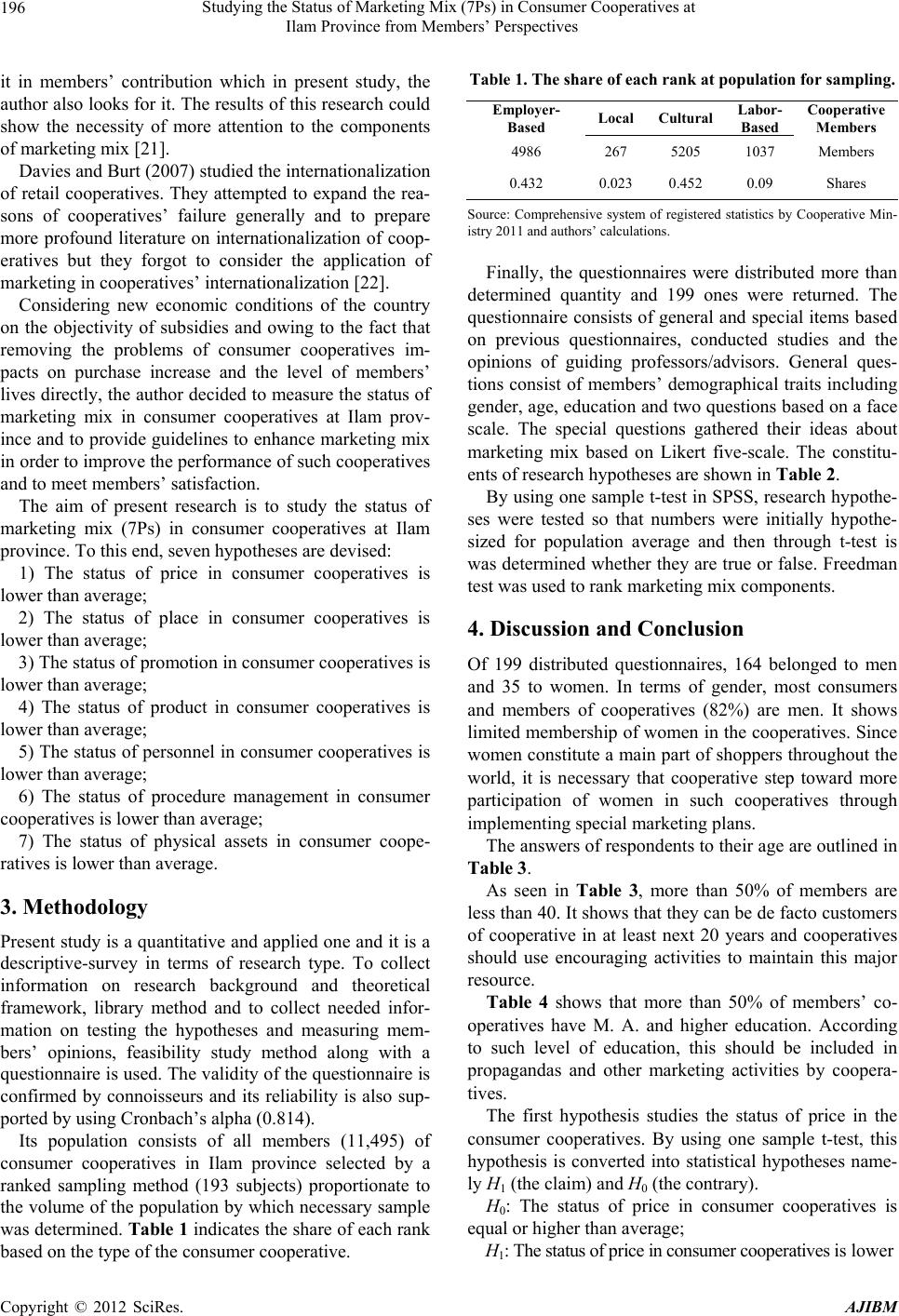 Studying the Status of Marketing Mix (7Ps) in Consumer Cooperatives at Ilam Province from Members’ Perspectives 196 it in members’ contribution which in present study, the author also looks for it. The results of this research could show the necessity of more attention to the components of marketing mix [21]. Davies and Burt (2007) studied the internationalization of retail cooperatives. They attempted to expand the rea- sons of cooperatives’ failure generally and to prepare more profound literature on internationalization of coop- eratives but they forgot to consider the application of marketing in coop eratives’ internationalization [22]. Considering new economic conditions of the country on the objectivity of subsidies and owing to the fact that removing the problems of consumer cooperatives im- pacts on purchase increase and the level of members’ lives directly, the author decided to measure the status of marketing mix in consumer cooperatives at Ilam prov- ince and to provide guidelin es to enhance marketing mix in order to improve the p erformance of such cooperatives and to meet members’ satisfaction. The aim of present research is to study the status of marketing mix (7Ps) in consumer cooperatives at Ilam province. To this end, seven hypotheses are devised: 1) The status of price in consumer cooperatives is lower than average; 2) The status of place in consumer cooperatives is lower than average; 3) The status of promotion in consumer cooperatives is lower than average; 4) The status of product in consumer cooperatives is lower than average; 5) The status of personnel in consumer cooperatives is lower than average; 6) The status of procedure management in consumer cooperatives is lower than average; 7) The status of physical assets in consumer coope- ratives is lower than average. 3. Methodology Present study is a quantitative and ap plied one and it is a descriptive-survey in terms of research type. To collect information on research background and theoretical framework, library method and to collect needed infor- mation on testing the hypotheses and measuring mem- bers’ opinions, feasibility study method along with a questionnaire is used . The validity of the questionnaire is confirmed by connoisseurs and its reliability is also sup- ported by using Cronbach’s alpha (0.814). Its population consists of all members (11,495) of consumer cooperatives in Ilam province selected by a ranked sampling method (193 subjects) proportionate to the volume of the population by which necessary sample was determined. Table 1 indicates the share of each rank based on the type of the consumer cooperative. Table 1. The share of each rank at population for sampling. Cooperative Members Labor- Based Cultural Local Employer- Based Members 1037 5205 267 4986 Shares 0.09 0.452 0.0230.432 Source: Co mprehensi ve system of register ed statistics by C ooperative Min- istry 2011 and authors’ calculations. Finally, the questionnaires were distributed more than determined quantity and 199 ones were returned. The questionnaire consists of general and special items based on previous questionnaires, conducted studies and the opinions of guiding professors/advisors. General ques- tions consist of members’ demographical traits including gender, age, education and two questions based on a face scale. The special questions gathered their ideas about marketing mix based on Likert five-scale. The constitu- ents of research hypotheses are shown in Table 2. By using one sample t-test in SPSS, research hypothe- ses were tested so that numbers were initially hypothe- sized for population average and then through t-test is was determined whether they are true or false. Freedman test was used to rank marketing mix components. 4. Discussion and Conclusion Of 199 distributed questionnaires, 164 belonged to men and 35 to women. In terms of gender, most consumers and members of cooperatives (82%) are men. It shows limited membersh ip of women in the cooperatives. Since women constitute a main p art of shoppers throughout the world, it is necessary that cooperative step toward more participation of women in such cooperatives through implementing special marketing plans. The answers of respondents to their age are ou tlined in Table 3. As seen in Table 3, more than 50% of members are less than 40. It shows that they can be de facto customers of cooperative in at least next 20 years and cooperatives should use encouraging activities to maintain this major resource. Table 4 shows that more than 50% of members’ co- operatives have M. A. and higher education. According to such level of education, this should be included in propagandas and other marketing activities by coopera- tives. The first hypothesis studies the status of price in the consumer cooperatives. By using one sample t-test, this hypothesis is converted into statistical hypotheses name- ly H1 (the claim) and H0 (the contrary). H0: The status of price in consumer cooperatives is equal or higher than average; H1: The status of price in consumer cooperatives is lower Copyright © 2012 SciRes. AJIBM 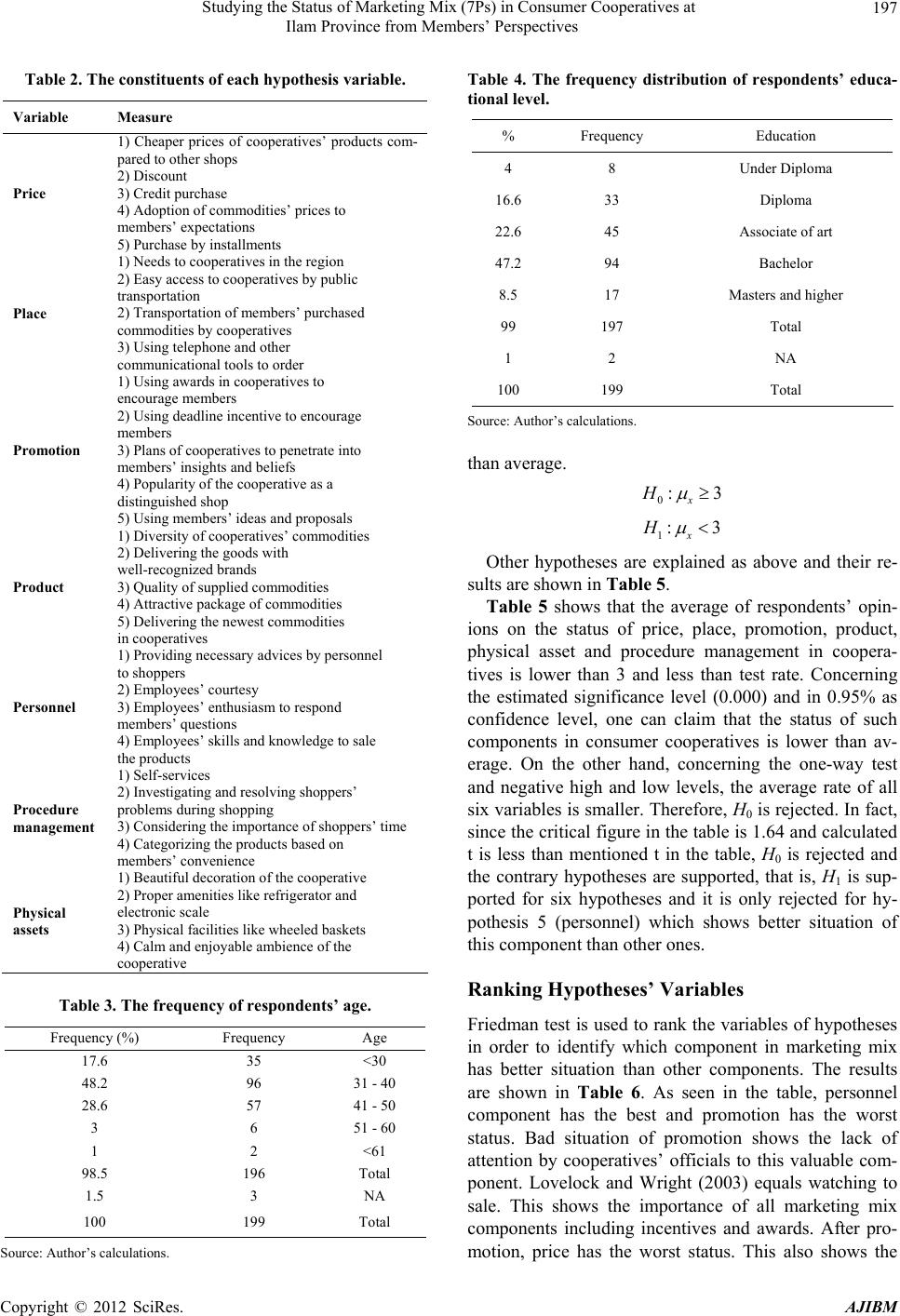 Studying the Status of Marketing Mix (7Ps) in Consumer Cooperatives at Ilam Province from Members’ Perspectives 197 Table 2. The constituents of each hypothesis variable. Variable Measure Price 1) Cheaper prices of cooperatives’ products com- pared to other shops 2) Discount 3) Credit purchase 4) Adoption of commodities’ prices to members’ expectations 5) Purchase by instal l ments Place 1) Needs to cooperatives in the region 2) Easy access to coo p e ratives by public transportation 2) Transportation of members’ purchased commodities by cooperatives 3) Using telephone and other communicational tools to order Promotion 1) Using awards in cooperatives to encourage members 2) Using deadline incentive to encourage members 3) Plans of cooperatives to penetrate into members’ i n s i g hts and beliefs 4) Popularity of the cooperative as a distinguished shop 5) Using members’ ideas and proposals Product 1) Diversity of cooperatives’ commodities 2) Delivering the goods with well-recognized brands 3) Quality of supplied commod iti es 4) Attractive package of commodities 5) Delivering the newest commodities in cooperatives Personnel 1) Providing necessa ry advices by personnel to shoppers 2) Employees’ courtesy 3) Employees’ enthusiasm to respond members’ quest ion s 4) Employees’ skills and knowledge to sale the products Procedure management 1) Self-services 2) Investigating and r esolving shoppers’ problems during shopping 3) Considering the i mportance of shoppers’ time 4) Categorizing the p roducts based on members’ convenience Physical assets 1) Beautiful decoration of the cooperative 2) Proper amenities like refrigerator and electronic scale 3) Physical facilities like wheeled baskets 4) Calm and enjoyable ambience of the cooperative Table 3. The frequency of respondents’ age . Age Frequency Frequency (%) <30 35 17.6 31 - 40 96 48.2 41 - 50 57 28.6 51 - 60 6 3 <61 2 1 Total 196 98.5 NA 3 1.5 Total 199 100 Source: Author’s calculations. Table 4. The frequency distribution of respondents’ educa- tional level. Education Frequency % Under Diploma 8 4 Diploma 33 16.6 Associate of art 45 22.6 Bachelor 94 47.2 Masters and higher 17 8.5 Total 197 99 NA 2 1 Total 199 100 Source: Author’s calculations. than average. 0:3 x H 1:3 x H Other hypotheses are explained as above and their re- sults are shown in Table 5. Table 5 shows that the average of respondents’ opin- ions on the status of price, place, promotion, product, physical asset and procedure management in coopera- tives is lower than 3 and less than test rate. Concerning the estimated significance level (0.000) and in 0.95% as confidence level, one can claim that the status of such components in consumer cooperatives is lower than av- erage. On the other hand, concerning the one-way test and negative high and low levels, the average rate of all six variables is smaller. Therefore, H0 is rejected. In fact, since the critical figure in the table is 1.64 and calculated t is less than mentioned t in the table, H0 is rejected and the contrary hypotheses are supported, that is, H1 is sup- ported for six hypotheses and it is only rejected for hy- pothesis 5 (personnel) which shows better situation of this component than other ones. Ranking Hypotheses’ Variables Friedman test is used to rank th e variables of hypotheses in order to identify which component in marketing mix has better situation than other components. The results are shown in Table 6. As seen in the table, personnel component has the best and promotion has the worst status. Bad situation of promotion shows the lack of attention by cooperatives’ officials to this valuable com- ponent. Lovelock and Wright (2003) equals watching to sale. This shows the importance of all marketing mix components including incentives and awards. After pro- otion, price has the worst status. This also shows the m Copyright © 2012 SciRes. AJIBM 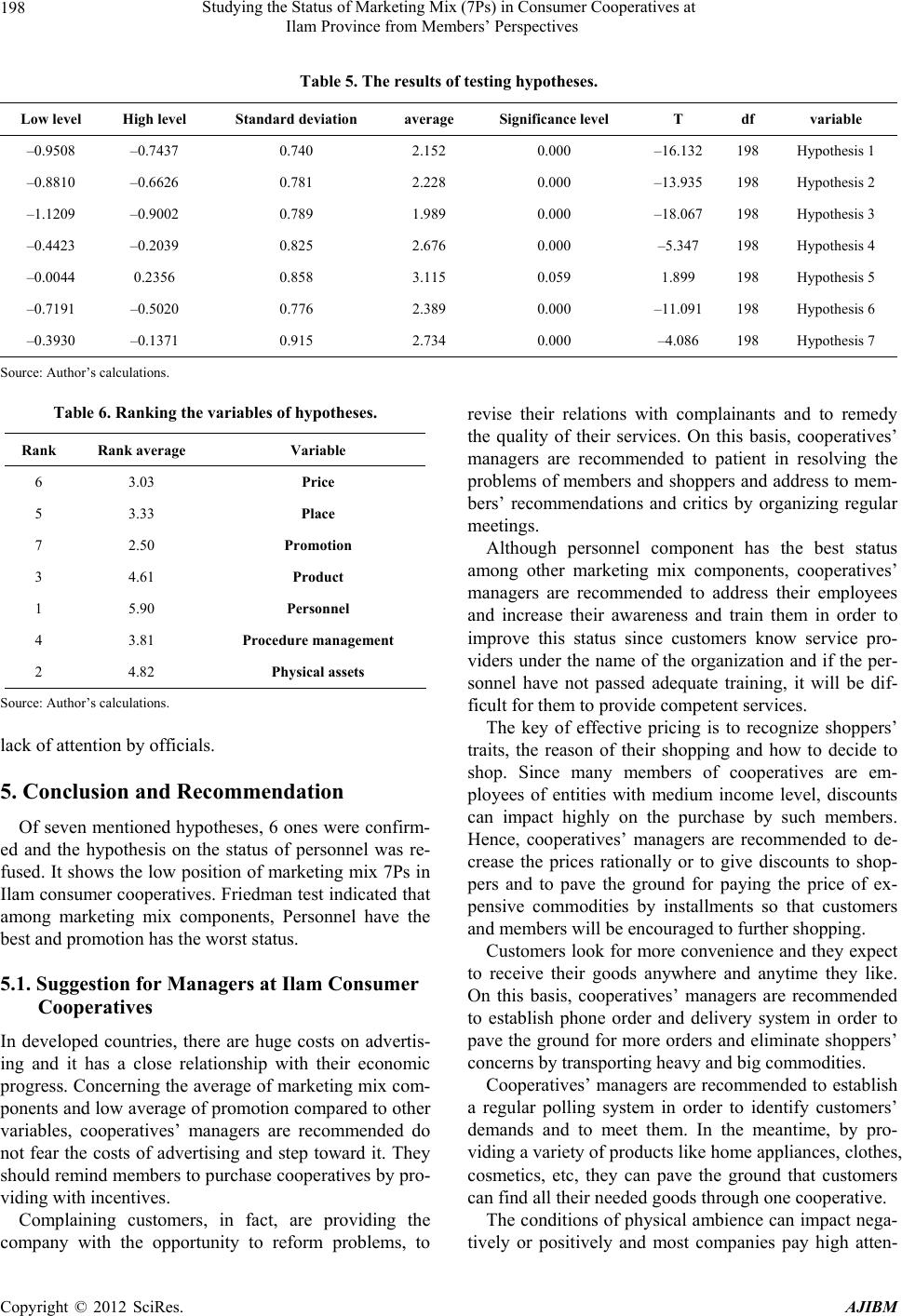 Studying the Status of Marketing Mix (7Ps) in Consumer Cooperatives at Ilam Province from Members’ Perspectives Copyright © 2012 SciRes. AJIBM 198 Table 5. The results of testing hypotheses. variable df T Significance level average Standard deviation High level Low level Hypothesis 1 198 –16.132 0.000 2.152 0.740 –0.7437 –0.9508 Hypothesis 2 198 –13.935 0.000 2.228 0.781 –0.6626 –0.8810 Hypothesis 3 198 –18.067 0.000 1.989 0.789 –0.9002 –1.1209 Hypothesis 4 198 –5.347 0.000 2.676 0.825 –0.2039 –0.4423 Hypothesis 5 198 1.899 0.059 3.115 0.858 0.2356 –0.0044 Hypothesis 6 198 –11.091 0.000 2.389 0.776 –0.5020 –0.7191 Hypothesis 7 198 –4.086 0.000 2.734 0.915 –0.1371 –0.3930 Source: Author’s calculations. Table 6. Ranking the variables of hypotheses. Variable Rank average Rank Price 3.03 6 Place 3.33 5 Promotion 2.50 7 Product 4.61 3 Personnel 5.90 1 Procedure management 3.81 4 Physical assets 4.82 2 Source: Author’s calculations. lack of attention by officials. 5. Conclusion and Recommendation Of seven mentioned hypotheses, 6 ones were confirm- ed and the hypothesis on the status of personnel was re- fused. It shows the low positio n of marketing mix 7Ps in Ilam consumer cooperatives. Friedman test indicated that among marketing mix components, Personnel have the best and promotion has the worst status. 5.1. Suggestion for Managers at Ilam Consumer Cooperatives In developed countries, there are huge costs on advertis- ing and it has a close relationship with their economic progress. Concerning the average of marketing mix com- ponents and low average of promotion compared to other variables, cooperatives’ managers are recommended do not fear the costs of advertising and step toward it. They should remind members to purchase cooperatives by pro- viding with incentives. Complaining customers, in fact, are providing the company with the opportunity to reform problems, to revise their relations with complainants and to remedy the quality of their services. On this basis, cooperatives’ managers are recommended to patient in resolving the problems of members and shoppers and address to mem- bers’ recommendations and critics by organizing regular meetings. Although personnel component has the best status among other marketing mix components, cooperatives’ managers are recommended to address their employees and increase their awareness and train them in order to improve this status since customers know service pro- viders under the name of the organization and if the per- sonnel have not passed adequate training, it will be dif- ficult for them to provide competent services. The key of effective pricing is to recognize shoppers’ traits, the reason of their shopping and how to decide to shop. Since many members of cooperatives are em- ployees of entities with medium income level, discounts can impact highly on the purchase by such members. Hence, cooperatives’ managers are recommended to de- crease the prices rationally or to give discounts to shop- pers and to pave the ground for paying the price of ex- pensive commodities by installments so that customers and members will be encouraged to further shopping . Customers look for more convenience and they expect to receive their goods anywhere and anytime they like. On this basis, cooperatives’ managers are recommended to establish phone order and delivery system in order to pave the ground for more orders an d eliminate shoppers’ concerns by transporting heavy and big co mmodities. Cooperatives’ managers are recommended to estab lish a regular polling system in order to identify customers’ demands and to meet them. In the meantime, by pro- viding a variety of products like home appliances, clothes, cosmetics, etc, they can pave the ground that customers can find all their needed goods through one cooperative. The conditions of physical ambience can impact nega- tively or positively and most companies pay high atten-  Studying the Status of Marketing Mix (7Ps) in Consumer Cooperatives at Ilam Province from Members’ Perspectives 199 tion to this issue. Unfortunately, it is neglected in most cooperatives at Ilam. The appearance of the environment aids to proper feeling and reflection of customers and personnel. On this basis, cooperatives’ managers are re- commended to create conditions for buyers to purchase in an enjoyable sense by designing a nice, clean and heal- thy physical ambience. Since shoppers tend to buy commodities with broad propaganda or in other words, to buy modern goods, co- operatives’ managers are recommended to supply such goods. Shoppers prefer to find commodities in different brands when they enter cooperatives. 5.2. Suggestion for Future Study Future researchers are recommended to study the status of marketing mix in consumer cooperatives in next year’s and compare their findings with this research and then investigate about the reasons of improving or wors- ening the situation. Since the author has simply studied the status of mar- keting mix in members’ perspective, future authors are recommended to study the status of marketing mix in other cooperatives including manufacturing ones. According to findings of promotion component with the worst status among other elements of marketing mix, future authors are recommended to study this element separately. Since the author has simply studied the status of mar- keting mix in members’ perspective, future authors are recommended to study it in managers’ perspective and compare the ideas of both groups. 6. Research Limitations The lack of precise and updated information on con- suming cooperatives in Ilam Cooperative Directorate made it difficult for author to access such cooperatives. Since Ilam is a border province, it has special political and geographical status which makes it difficult to con- duct such researches and t o ga t her needed data. REFERENCES [1] A. Samadi, “Studying the Dynamism or Stagnation of Manufacturing Cooperatives in Hamedan,” A Research Proposal by Hamedan Cooperative Directorate, 2000. [2] M. H. Mostaani, “The Management of Consumer Coop- eratives,” Paygan Publications, Tehran, 2005. [3] K. Mikami, “Capital Procurement of a Consumer Coop- erative: Role of the Membership Market,” Economic Sys- tems, Vol. 34, No. 2, 2010, pp. 178-197. doi:10.1016/j.ecosys.2009.09.004 [4] M. Abbassi, “Cooperative Belief, Iran Rural Develop- ment Publications,” Tehran, 2010. [5] S. Navcovic, “Defining the Coperative Difference,” The Journal of Socio-Economics, Vol. 37, No. 6, 2008, pp. 2168-2177. doi:10.1016/j.socec.2008.02.009 [6] Cooperative Ministry, “Statistics and Profiles of Em- ployed and Unemployed Population,” Office of Statistics and Information Technology, Tehran, 2010. [7] Cooperative Ministry, “Business in Cooperatives,” Sab- zan Publications, Tehran, 2007. [8] M. Baker, “Marketing Strategy and Management,” Mc- Millan, London, 2000. [9] L. G. Chai, “A Review of Marketing Mix: 4Ps or More? ” International Journal of Marketing Studies, Vol. 1. No. 1, 2009, pp. 2-15. [10] D. Jobber, “Principles & Practice of Marketing,” 3rd Edition, McGraw-Hill, England, 2001. [11] J. Mullins, O. Walker and H. Boyd, “Marketing Man- agement,” 6th Edition, McGraw-Hill, New York, 2008. [12] H. Alvedari, “Marketing and Market Management,” Pa- yam Noor University, Tehran, 2005. [13] M. Rafiq and P. K. Ahmed, “Using the 7Ps as a Generic Marketing Mix: an Exploratory Survey of UK and Euro- pean Marketing Academics,” Marketing Intelligence & Planning, Vol. 13, No. 9, 1995, pp. 4-15. doi:10.1108/02634509510097793 [14] C. Lovelock and L. Wright, “Marketing Principles and Services,” SAMT Publications, Tehran, 2003. [15] P. Dargi, “Service Marketing Through Iranian Market Perspective,” Rasa Publications, Tehran, 2009. [16] L. S. Pheng and M. Tan, “A Convergence of Western Mar - keting Mix Concepts and Oriental Strategic Thinking,” Marketing Intelligence & Planning, Vol. 13, No .2, 1995, pp. 11-36. [17] A. Rusta, D. Venus and A. Ebrahimi, “Marketing Man- agement,” SAMT Publications, Tehran, 2005. [18] R. E. Goldsmith, “The Personalized Marketplace: Bey ond the 4Ps,” Marketing Intelligence & Planning, Vol. 14, No. 4, 1999, pp. 178-185. doi:10.1108/02634509910275917 [19] H. Safari, K. Aryanfar and A. Ebrahimi, “Affecting Fac- tors on the Success of Superior Consumer Cooperatives,” Taavon, Vol. 212, No. 20, 2009, pp. 33-51. [20] M. Zaranejad and B. Sharifi, “Studying the Attitudes of Members and Managers of Consumer Cooperatives on Affecting Factors on Productivity Improvement,” Liberal Arts and Social Science Research Letter, Vol. 29, No. 8, 2008, pp. 97-118. [21] A. Ebrahimi, A. Taati, O. Mahdieh and A. Kanaani, “Af- fecting Factors on Promoting Members’ Contribution in Unions and Consumer Cooperatives,” Taavon, Vol. 2, No. 21, 2010, pp. 129-153. [22] K. Davies and S. Burt, “Consumer Cooperatives and Re- tail Internationalization: Problems and Prospects,” Inter- national Journal of Retail & Distribution Management, Vol. 35, No. 2, 2007, pp. 156-177. Copyright © 2012 SciRes. AJIBM |