

Paper Menu >>
Journal Menu >>
 Open Journal of Composite Materials, 2012, 2, 119-124 http://dx.doi.org/10.4236/ojcm.2012.24014 Published Online October 2012 (http://www.SciRP.org/journal/ojcm) 119 Magnetic Properties Hard-Soft SmCo5-FeNi and SmCo5-FeCo Composites Prepared by Electroless Coating Technique M. Lamichanne1, B. K. Rai1, S. R. Mishra1*, V. V. Nguyen2, J. P. Liu2 1Department of Physics, The University of Memphis, Memphis, USA; 2Department of Physics, The University of Texas, Arlington, USA. Email: *[email protected] Received May 25th, 2012; revised June 27th, 2012; accepted July 8th, 2012 ABSTRACT Composites of SmCo5-FeNi and SmCo5-FeCo, hard-soft magnetic materials, have been synthesized via electroless plating of magnetically hard SmCo5 powder particles with magnetically soft FeNi and FeCo, respectively. The influence of coating thickness of soft magnetic layers on the structure and magnetic properties of the composite has been studied. Overall FeNi coating was found to be less dense compared to FeCo for the same plating duration. Structurally the coat ing was found to be nodular in morphology. These coating have dramatic effect on the overall magnetic property of the composite. As compared to FeNi coated SmCo5 composite, two-fold increase in the saturation magnetization has been observed upon coating SmCo5 (Ms ~ 28 emu/g) with FeCo to a value 56 emu/g. The coercivity of composite powder was found to decrease with increasing the coating layer thickness. The absence of exchange spring behavior in the hard-soft composite is attributed to magnetically soft layer thickness exceeding the theoretical length limit for ex- change-spring coupling. Keywords: Electroless Plating; Hard-Soft Composites; Exchange Spring 1. Introduction Permanent magnetic materials are characterized by their figure of merit, (BH)max energy product, which is the maximum rectangular area under the second quadrant of the hysteresis loop. The increase in (BH)max is possible by increasing the coercivity (HC) and the saturation magnetization (Ms). For materials with high HC values (HC > 2Ms), the theoretical limit for the energy product is limited only by Ms and is given by (BH)max (2Ms)2. Methods to overcome this limitation have focused on developing high anisotropy materials with high Ms and Curie temperatures (TC), materials which are based on rare-earth (RE)-transition metal (TM) intermetallics such as SmCo5, Sm2Fe17 and their boride or nitride com- pounds such as Nd2Fe14B and Sm2Fe17Nx [1-3]. In spite of the considerable improvement in the magnetocrystal line anisotropy, these materials still exhibit lower Ms than Co, Fe or Fe65Co35, which have 4Ms values of 18, 21, and 24 kG, respectively [1]. The concept of an “Exchange-Spring” or “Exchange- hardened” magnet was proposed by Kneller and Hawig [4] to overcome the limitations outlined above. The spring magnet is essentially a composite of two ferro- magnetic (FM) phases; hard and soft magnetic phases. The soft phase, rich in transition metal, enhances satura tion magnetization, while the hard phase provides the required magnetic anisotropy and stabilizes the exchange coupled soft phase from demagnetization. Most of the re- ported literature on spring magnets is based on Nd2Fe14B or Sm2Fe17 (hard)-α-Fe or Fe3B (soft) [5-7]. Insufficient temperature stability and poor corrosion re sistance are main factors limiting applications of Nd2Fe14B-based magnets. However, the family of sa marium based alloys such as SmCo5 and Sm2Fe17Nx could be an attractive candidate material since it can be used as the hard phase due to its high magnetization (SmCo5, Ms ~ 0.84 MAm−1, Sm2Fe17Nx, Ms ~ 1.22 MAm−1) and high Curie tempera- ture, TC, (SmCo5, TC ~ 720˚C, Sm2Fe17Nx, TC ~ 476˚C) which are comparable to those of Nd2Fe14B (Ms ~ 1.28 MAm−1, TC ~ 312˚C, HC ~ 6.0 MAm−1) [8]. The exchange-spring magnets have been fabricated by melt-spinning, hot-compaction [9], mechanical alloying [10,11], however these techniques yields nanocomposites with random dispersion and orientation of hard magnetic phase and often having no control on the growth of soft- phase [6,12]. Thus, if the soft phase size could be re- *Corresponding author. Copyright © 2012 SciRes. OJCM 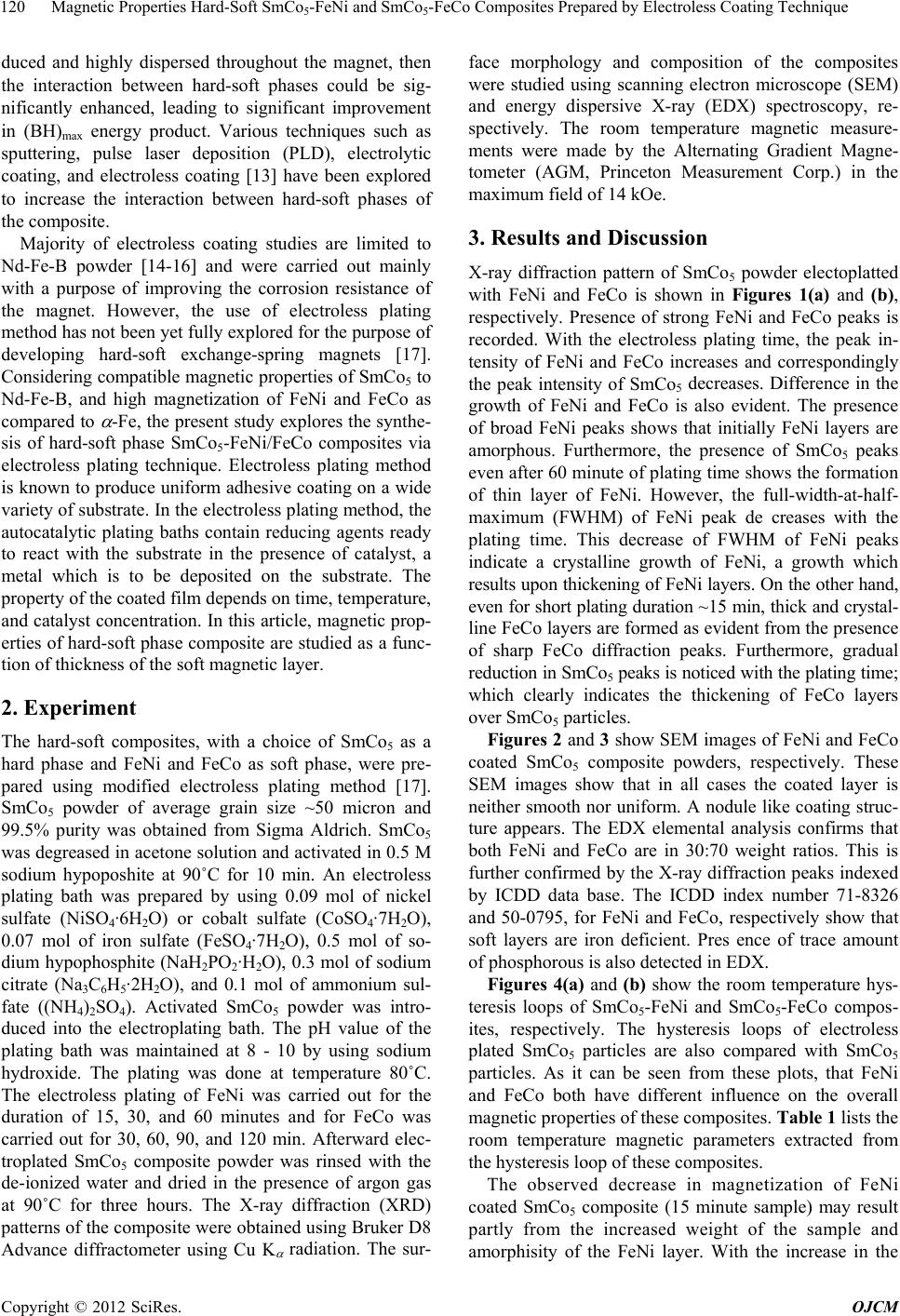 Magnetic Properties Hard-Soft SmCo5-FeNi and SmCo5-FeCo Composites Prepared by Electroless Coating Technique 120 duced and highly dispersed throughout the magnet, then the interaction between hard-soft phases could be sig- nificantly enhanced, leading to significant improvement in (BH)max energy product. Various techniques such as sputtering, pulse laser deposition (PLD), electrolytic coating, and electroless coating [13] have been explored to increase the interaction between hard-soft phases of the composite. Majority of electroless coating studies are limited to Nd-Fe-B powder [14-16] and were carried out mainly with a purpose of improving the corrosion resistance of the magnet. However, the use of electroless plating method has not been yet fully explored for the purpose of developing hard-soft exchange-spring magnets [17]. Considering compatible magnetic properties of SmCo5 to Nd-Fe-B, and high magnetization of FeNi and FeCo as compared to -Fe, the present study explores the synthe- sis of hard-soft phase SmCo5-FeNi/FeCo composites via electroless plating technique. Electroless plating method is known to produce uniform adhesive coating on a wide variety of substrate. In the electroless plating method, the autocatalytic plating baths contain reducing agents ready to react with the substrate in the presence of catalyst, a metal which is to be deposited on the substrate. The property of the coated film depends on time, temperature, and catalyst concentration. In this article, magnetic prop- erties of hard-soft phase composite are studied as a func- tion of thickness of the soft magnetic layer. 2. Experiment The hard-soft composites, with a choice of SmCo5 as a hard phase and FeNi and FeCo as soft phase, were pre- pared using modified electroless plating method [17]. SmCo5 powder of average grain size ~50 micron and 99.5% purity was obtained from Sigma Aldrich. SmCo5 was degreased in acetone solution and activated in 0.5 M sodium hypoposhite at 90˚C for 10 min. An electroless plating bath was prepared by using 0.09 mol of nickel sulfate (NiSO4·6H2O) or cobalt sulfate (CoSO4·7H2O), 0.07 mol of iron sulfate (FeSO4·7H2O), 0.5 mol of so- dium hypophosphite (NaH2PO2·H2O), 0.3 mol of sodium citrate (Na3C6H5·2H2O), and 0.1 mol of ammonium sul- fate ((NH4)2SO4). Activated SmCo5 powder was intro- duced into the electroplating bath. The pH value of the plating bath was maintained at 8 - 10 by using sodium hydroxide. The plating was done at temperature 80˚C. The electroless plating of FeNi was carried out for the duration of 15, 30, and 60 minutes and for FeCo was carried out for 30, 60, 90, and 120 min. Afterward elec- troplated SmCo5 composite powder was rinsed with the de-ionized water and dried in the presence of argon gas at 90˚C for three hours. The X-ray diffraction (XRD) patterns of the composite were obtained using Bruker D8 Advance diffractometer using Cu K radiation. The sur- face morphology and composition of the composites were studied using scanning electron microscope (SEM) and energy dispersive X-ray (EDX) spectroscopy, re- spectively. The room temperature magnetic measure- ments were made by the Alternating Gradient Magne- tometer (AGM, Princeton Measurement Corp.) in the maximum field of 14 kOe. 3. Results and Discussion X-ray diffraction pattern of SmCo5 powder electoplatted with FeNi and FeCo is shown in Figures 1(a) and (b), respectively. Presence of strong FeNi and FeCo peaks is recorded. With the electroless plating time, the peak in- tensity of FeNi and FeCo increases and correspondingly the peak intensity of SmCo5 decreases. Difference in the growth of FeNi and FeCo is also evident. The presence of broad FeNi peaks shows that initially FeNi layers are amorphous. Furthermore, the presence of SmCo5 peaks even after 60 minute of plating time shows the formation of thin layer of FeNi. However, the full-width-at-half- maximum (FWHM) of FeNi peak de creases with the plating time. This decrease of FWHM of FeNi peaks indicate a crystalline growth of FeNi, a growth which results upon thickening of FeNi layers. On the other hand, even for short plating duration ~15 min, thick and crystal- line FeCo layers are formed as evident from the presence of sharp FeCo diffraction peaks. Furthermore, gradual reduction in SmCo5 peaks is noticed with the plating time; which clearly indicates the thickening of FeCo layers over SmCo5 particles. Figures 2 and 3 show SEM images of FeNi and FeCo coated SmCo5 composite powders, respectively. These SEM images show that in all cases the coated layer is neither smooth nor uniform. A nodule like coating struc- ture appears. The EDX elemental analysis confirms that both FeNi and FeCo are in 30:70 weight ratios. This is further confirmed by the X-ray diffraction peaks indexed by ICDD data base. The ICDD index number 71-8326 and 50-0795, for FeNi and FeCo, respectively show that soft layers are iron deficient. Pres ence of trace amount of phosphorous is also detected in EDX. Figures 4(a) and (b) show the room temperature hys- teresis loops of SmCo5-FeNi and SmCo5-FeCo compos- ites, respectively. The hysteresis loops of electroless plated SmCo5 particles are also compared with SmCo5 particles. As it can be seen from these plots, that FeNi and FeCo both have different influence on the overall magnetic properties of these composites. Table 1 lists the room temperature magnetic parameters extracted from the hysteresis loop of these composites. The observed decrease in magnetization of FeNi coated SmCo5 composite (15 minute sample) may result partly from the increased weight of the sample and amorphisity of the FeNi layer. With the increase in the Copyright © 2012 SciRes. OJCM 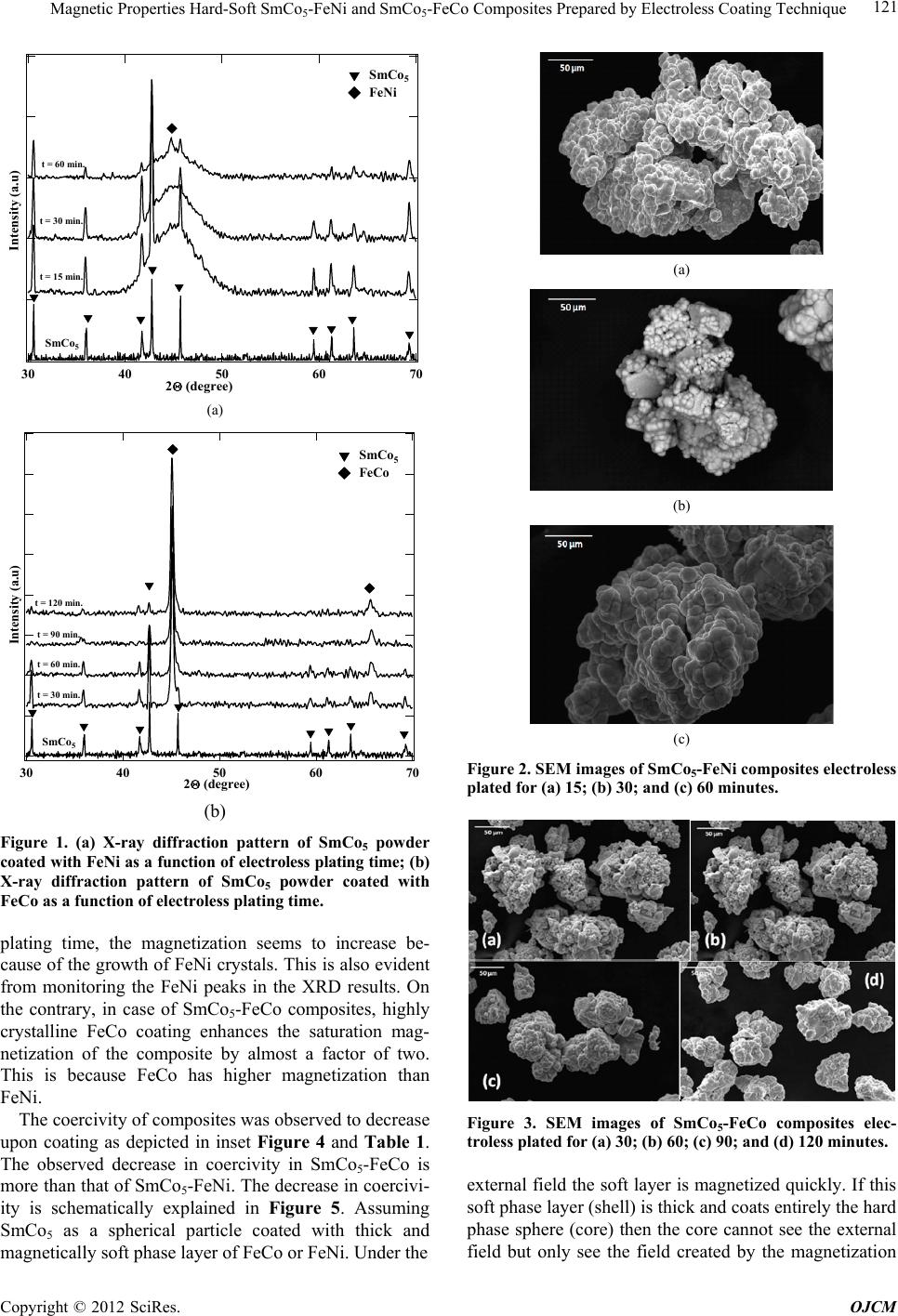 Magnetic Properties Hard-Soft SmCo5-FeNi and SmCo5-FeCo Composites Prepared by Electroless Coating Technique 121 Intensity ( a.u) 7060504030 2 (degree) SmCo5 FeNi SmCo 5 t = 15 min. t = 30 min. t = 60 min. (a) Intensity (a.u) 7060504030 2 (degree) SmCo 5 FeCo SmCo 5 t = 30 min. t = 60 min. t = 90 min. t = 120 min. (b) Figure 1. (a) X-ray diffraction pattern of SmCo5 powder coated with FeNi as a functi on of electroless plating time; (b) X-ray diffraction pattern of SmCo5 powder coated with FeCo as a function of electroless plating time. plating time, the magnetization seems to increase be- cause of the growth of FeNi crystals. This is also evident from monitoring the FeNi peaks in the XRD results. On the contrary, in case of SmCo5-FeCo composites, highly crystalline FeCo coating enhances the saturation mag- netization of the composite by almost a factor of two. This is because FeCo has higher magnetization than FeNi. The coercivity of composites was observed to decrease upon coating as depicted in inset Figure 4 and Table 1. The observed decrease in coercivity in SmCo5-FeCo is more than that of SmCo5-FeNi. The decrease in coercivi- ity is schematically explained in Figure 5. Assuming SmCo5 as a spherical particle coated with thick and magnetically soft phase layer of FeCo or FeNi. Under the (a) (b) (c) Figure 2. SEM images of SmCo5-FeNi composites electroless plated for (a) 15; (b) 30; and (c) 60 minutes. Figure 3. SEM images of SmCo5-FeCo composites elec- troless plated for (a) 30; (b) 60; (c) 90; and (d) 120 minutes. external field the soft layer is magnetized quickly. If this soft phase layer (shell) is thick and coats entirely the hard phase sphere (core) then the core cannot see the external field but only see the field created by the magnetization Copyright © 2012 SciRes. OJCM 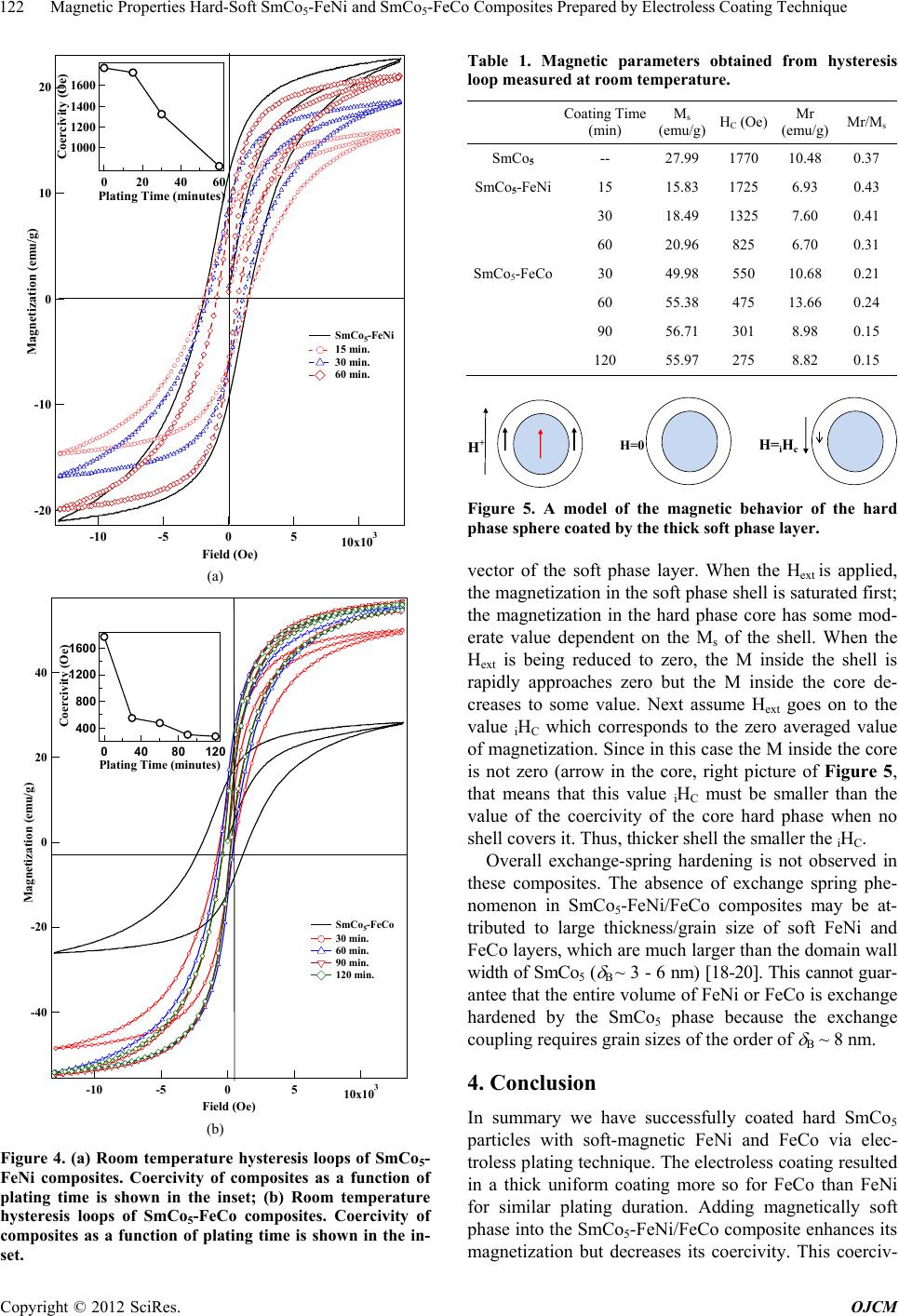 Magnetic Properties Hard-Soft SmCo5-FeNi and SmCo5-FeCo Composites Prepared by Electroless Coating Technique 122 1600 1400 1200 1000 Coercivity (Oe) 6040200 Plating Time (minutes) 20 10 0 -10 -20 Magnetization (emu/g) 10x10 3 50-5-10 Field ( Oe ) SmCo 5 -FeNi 15 min. 30 min. 60 min. (a) 1600 1200 800 400 Coercivity (Oe) 12080400 Plating Time ( minutes) 40 20 0 -20 -40 Magnetization (emu/g) 10x10 3 50-5-10 Field (Oe) SmCo 5 -FeCo 30 min. 60 min. 90 min. 120 min. (b) Figure 4. (a) Room temperature hysteresis loops of SmCo5- FeNi composites. Coercivity of composites as a function of plating time is shown in the inset; (b) Room temperature hysteresis loops of SmCo5-FeCo composites. Coercivity of composites as a function of plating time is shown in the in- set. Table 1. Magnetic parameters obtained from hysteresis loop measured at room temperature. Coating Time (min) Ms (emu/g) HC (Oe) Mr (emu/g) Mr/Ms SmCo5 -- 27.99 1770 10.480.37 SmCo5-FeNi15 15.83 1725 6.93 0.43 30 18.49 1325 7.60 0.41 60 20.96 825 6.70 0.31 SmCo5-FeCo30 49.98 550 10.680.21 60 55.38 475 13.660.24 90 56.71 301 8.98 0.15 120 55.97 275 8.82 0.15 H + H= i H c H=0 Figure 5. A model of the magnetic behavior of the hard phase sphere coated by the thick soft phase layer. vector of the soft phase layer. When the Hext is applied, the magnetization in the soft phase shell is saturated first; the magnetization in the hard phase core has some mod- erate value dependent on the Ms of the shell. When the Hext is being reduced to zero, the M inside the shell is rapidly approaches zero but the M inside the core de- creases to some value. Next assume Hext goes on to the value iHC which corresponds to the zero averaged value of magnetization. Since in this case the M inside the core is not zero (arrow in the core, right picture of Figure 5, that means that this value iHC must be smaller than the value of the coercivity of the core hard phase when no shell covers it. Thus, thicker shell the smaller the iHC. Overall exchange-spring hardening is not observed in these composites. The absence of exchange spring phe- nomenon in SmCo5-FeNi/FeCo composites may be at- tributed to large thickness/grain size of soft FeNi and FeCo layers, which are much larger than the domain wall width of SmCo5 ( B ~ 3 - 6 nm) [18-20]. This cannot guar- antee that the entire volume of FeNi or FeCo is exchange hardened by the SmCo5 phase because the exchange coupling requires grain sizes of the order of B ~ 8 nm. 4. Conclusion In summary we have successfully coated hard SmCo5 particles with soft-magnetic FeNi and FeCo via elec- troless plating technique. The electroless coating resulted in a thick uniform coating more so for FeCo than FeNi for similar plating duration. Adding magnetically soft phase into the SmCo5-FeNi/FeCo composite enhances its magnetization but decreases its coercivity. This coerciv- Copyright © 2012 SciRes. OJCM  Magnetic Properties Hard-Soft SmCo5-FeNi and SmCo5-FeCo Composites Prepared by Electroless Coating Technique 123 ity reduction is explained on the bases of increased amount of magnetic softness of the coated layer. An in- dependently tuning the size and composition of the indi- vidual building blocks of the composite is necessary in order to enhance exchange coupling between hard-soft phases of the composite. It is expected that composite magnets of SmCo5-FeNi or FeCo could be obtained with core-particles’ coercivity exceeding 10 kOe, which can be attained either via ball milling technique [21-23] or wet-chemical method [24]. It is also evident from the present study that the growth rate of soft magnetic layer needs to be better controlled in order to form a fine uni- form coating of a few nanometer thicknesses on core particles to meet the theoretical exchanges spring inter- action length limit. 5. Acknowledgements This work was supported by DMR NSF-EAGER, Grant #0965801. REFERENCES [1] J. F. Herbst, “R2Fe14B Materials: Intrinsic Properties and Technological Aspects,” Reviews of Modern Physics, Vol. 63, No. 4, 199, pp. 819-898. [2] K. H. J. Buschow, “New Developments in Hard Magnetic Materials,” Reports on Progress in Physics, Vol. 54, No. 9, 1991, p. 1123. doi:10.1088/0034-4885/54/9/001 [3] J. M. D. Coey, “Industrial Applications of Permanent Mag- netism,” Physica Scripta, Vol. 66, No. T66, 1996, p. 60. doi:10.1088/0031-8949/1996/T66/008 [4] E. F. Kneller and R. Hawig, “The Exchange-Spring Mag- net: A New Material Principle for Permanent Magnets,” IEEE Transactions on Magnetics, Vol. 27, No. 4, 1991, pp. 3588-3600. doi:10.1109/20.102931 [5] V. Patel, M. El-Hilo, K. O’Grady and R. W. Chantrell, “Nucleation Fields in an Exchange Spring Hard Magnet,” Journal of Physics D: Applied Physics, Vol. 26, No. 9, 1993, p. 1453. doi:10.1088/0022-3727/26/9/018 [6] R. Coehoorn, D. B. Mooji and C. D. de Waard, “Melt- Spun Permanent Magnet Materials Containing Fe3B as the Main Phase,” Journal of Magnetism and Magnetic Materials, Vol. 80, No. 1, 1989, pp. 101-104. doi:10.1016/0304-8853(89)90333-8 [7] J. Ding, P. G. McCormick and R. Street, “Remanence Enhancement in Mechanically Alloyed Isotropic Sm7Fe93- Nitride,” Journal of Magnetism and Magnetic Materials, Vol. 124, No. 1-2, 1993, pp. 1-4. doi:10.1016/0304-8853(93)90060-F [8] J. M. D. Coey, “Permanent Magnetism,” Solid State Com- munications, Vol. 102, No. 2-3, 1997, pp. 101-105. doi:10.1016/S0038-1098(96)00712-0 [9] D. Lee, S. Bauser, A. Higgins, C. Chen, S. Liu, M. Q. Huang, Y. G. Peng and D. E. Laughlin, “Bulk Anisot- ropic Composite Rare Earth Magnets,” Journal of Ap- plied Physics, Vol. 99, No. 8, 2006, p. 08B516. [10] J. Wecker, M. Katter and L. Schultz, “Mechanically Al- loyed Sm-Co Materials,” Journal of Applied Physics, Vol. 69, No. 8, 1991, pp. 6058-6060. doi:10.1063/1.347769 [11] S. K. Chen, J. L. Tsai and T. S. Chin, “Nanocomposite Sm2Co17/Co Permanent Magnets by Mechanical Alloy- ing,” Journal of Applied Physics, Vol. 79, No. 8, 1996, pp. 5964-5966. doi:10.1063/1.362121 [12] K. H. J. Buschow, D. B. De Mooij and R. Coehoorn, “Metastable Ferromagnetic Materials for Permanent Mag- nets,” Journal of the Less Common Metals, Vol. 145, 1988, pp. 601-611. doi:10.1016/0022-5088(88)90318-9 [13] S. Liu, A. Higgins, E. Shin, S. Bauser, C. Chen, D. Lee, Y. Shen, Y. He and M. Q. Huang, “Enhancing Magnetic Properties of Bulk Anisotropic Nd-Fe-B/ -Fe Composite Magnets by Applying Powder Coating Technologies,” IEEE Transactions on Magnetics, Vol. 42, No. 10, 2006, pp. 2912-2914. doi:10.1109/TMAG.2006.879905 [14] Z. Chen, A. Ng, J. Yi and X. Chen, “Multi-Layered Elec- Troless Ni-P Coatings on Powder-Sintered Nd-Fe-B Per- Manent Magnet,” Journal of Magnetism and Magnetic Materials, Vol. 302, No. 1, 2006, pp. 216-222. [15] P. Mitchell, “Corrosion Protection of Nd-Fe-B Magnets,” IEEE Transactions on Magnetics, Vol. 26, No. 5, 1990, p. 1933. doi:10.1109/20.104575 [16] C. W. Cheng, F. T. Cheng and H. C. Man, “Improvement of Protective Coating on Nd-Fe-B Magnet by Pulse Nickel Plating,” Journal of Applied Physics, Vol. 83, No. 11, 1998, pp. 6417-6419. doi:10.1063/1.367921 [17] Q. Zheng, Y. Zhang, M. J. Bonder and G. C. Hadji- panayis, “Fabrication of Sm-Co/Co (Fe) Composites by Electroless Co and Co-Fe Plating,” Journal of Applied Phys- ics, Vol. 93, No. 10, 2003, pp. 6498-6410. doi:10.1063/1.1558246 [18] Y. K. Takahashi, T. Ohkubo and K. Hono, “Microstruc- ture and Magnetic Properties of SmCo5 Thin Films De- posited on Cu and Pt Underlayers,” Journal of Applied Physics, Vol. 100, No. 5, 2006, pp. 053913-053915. doi:10.1063/1.2266247 [19] M. F. De Campos and F. J. Gomes-Landgra, “Determina- tion of Intrinsic Magnetic Parameters of SmCo5 Phase in Sintered Samples,” Materials Science Forum, Vol. 498- 499, 2005, pp. 129-133. doi:10.4028/www.scientific.net/MSF.498-499.129 [20] T. Inoue, K. Goto and T. Sakurai, “Magnetic Domains of Single-Domain Particles of SmCo5 Observed by the Col- loid-SEM Method,” Japanese Journal of Applied Physics, Vol. 22, 1983, pp. L695-L697. doi:10.1143/JJAP.22.L695 [21] Y. Wang, Y. Li, C. Rong and J. P. Liu, “Sm-Co Hard Magnetic Nanoparticles Prepared by Surfactant-Assisted Ball Milling,” Nanotechnology, Vol. 18, No. 46, 2007, p. 465701. doi:10.1088/0957-4484/18/46/465701 [22] V. M. Chakka, B. Altuncevahir, Z. Q. Jin, Y. Li and J. P. Liu, “Magnetic Nanoparticles Produced by Surfactant- Assisted Ball Milling,” Journal of Applied Physics, Vol. 99, No. 8, 2006, p. 08E912. [23] N. Akdogan, G. Hadjipanayis and D. J. Sellmyer, “Ani- sotropic Sm-(Co, Fe) Nanoparticles by Surfactant-Assisted Copyright © 2012 SciRes. OJCM  Magnetic Properties Hard-Soft SmCo5-FeNi and SmCo5-FeCo Composites Prepared by Electroless Coating Technique Copyright © 2012 SciRes. OJCM 124 Ball Milling,” Journal of Applied Physics, Vol. 105, No. 7, 2009, pp. 07A710-07A712. [24] Y. Hou, Z. Xu, S. Peng, C. Rong, J. P. Liu and S. Sun, “A Facile Synthesis of SmCo5 Magnets from Core/Shell Co/ Sm2O3 Nanoparticles,” Advanced Materials, Vol. 19, 2007, pp. 3349-3352. doi:10.1002/adma.200700891 |