

Paper Menu >>
Journal Menu >>
 American Journal of Industrial and Business Management, 2012, 2, 128-135 http://dx.doi.org/10.4236/ajibm.2012.24017 Published Online October 2012 (http://www.SciRP.org/journal/ajibm) Cost Analysis of Introducing a Log Identification System Using RFID in the Wood Supply Chain: A Case Study at a Swedish Forest Company Daniel Timpe, Leif Olsson, Johan Sidén Department of Information Technology and Media, Mid Sweden University, Sundsvall, Sweden. Email: [email protected] Received June 2nd, 2012; revised June 29th, 2012; accepted July 30th, 2012 ABSTRACT A cost analysis for the possibility of a log identification system using Radio Frequency Identification (RFID) is pre- sented in this paper. The introduction provides a brief description of the RFID technology and its usefulness within the area of forest logistics. Information network mapping is used to facilitate an understanding of the current information flow and identification requirements along the supply chain. The cost analysis is performed using the method of break-even analysis using nine different scenarios by means of a case study at the Ortviken paper mill, which is located in central Sweden. The analyses of the processes in the supply chain revealed that the poten tial exists to streamline op- erations and to make more efficient use of the available resources by implementing an open loop RFID-based log tracking system in the supply chain using read only tags. Furthermore, this study indicates that even in those cases in which RFID does not provide any major improvements to the firm’s inventory management; it is still possible to achieve economic benefits. However, implementation of such a system will require further development of, in particular, the RFID tags to satisfy the feasibility requirements in the wood supply chain. Keywords: Log Stamping; Forest Logistics; Track and Trace; Break-Even Analysis; RFID 1. Introduction There has been a steady increase in the use of informa- tion technology in the transport and logistics sector. These information systems consist of advanced business systems, decision support systems using operation re- search methods [1] and different devices for track and trace of the products along the supply chain. One possi- ble technology for track and trace is Radio Frequency Identification (RFID). The term RFID describes technologies that use radio waves to extract data from a microchip to a reader. The data stored on the microchip can be used to identify peo- ple and various kinds of objects on which the microchip can be mounted. The microchip and the small antenna attached to it are called an RFID tag and general techni- cal information of its advantages and disadvantages can be found in [2]. At present more and more attention is being paid to RFID in a variety of industries. As the prices continue to drop, more and more companies are exploring the bene- fits possible through the implementation of this technol- ogy. Typical applications of RFID range from the identi- fication of pets and livestock, access control and toll col- lection, to baggage and parcel identification and object tracking in various industrial supply chains. Some dif- ferent RFID tags are depicted in Figure 1. Tags can be active, meaning the requirement of a bat- tery which results in longer maximum read ranges but also a higher cost and a limited lifetime of five to ten years. Alternatively they can be passive, thus no battery is necessary, but, in this case, the requirement is then for the power to be supplied by the reader’s interrogating radio wave. Tags may be distinguished from one another based on whether they are Read-Only (RO) tags, Read- Write (RW) tags or belong to the Write Once-Read Many (WORM) class of tags. According to [3] passive RO tags are the simplest and cheapest RFID tags and are pre-programmed by the chip manufacturer. They carry a serial number, which can be retrieved by reading the tag, but no additional d ata can be stored on the chip. If these tags are used in an application where additional data is required on the tagged item, a central database is necessary where the serial number of the tagged items is linked to any required addition al data for the object. Passive RO RFID tags are evaluated in this study since they are well suited for use within the forestry supply chain. Copyright © 2012 SciRes. AJIBM 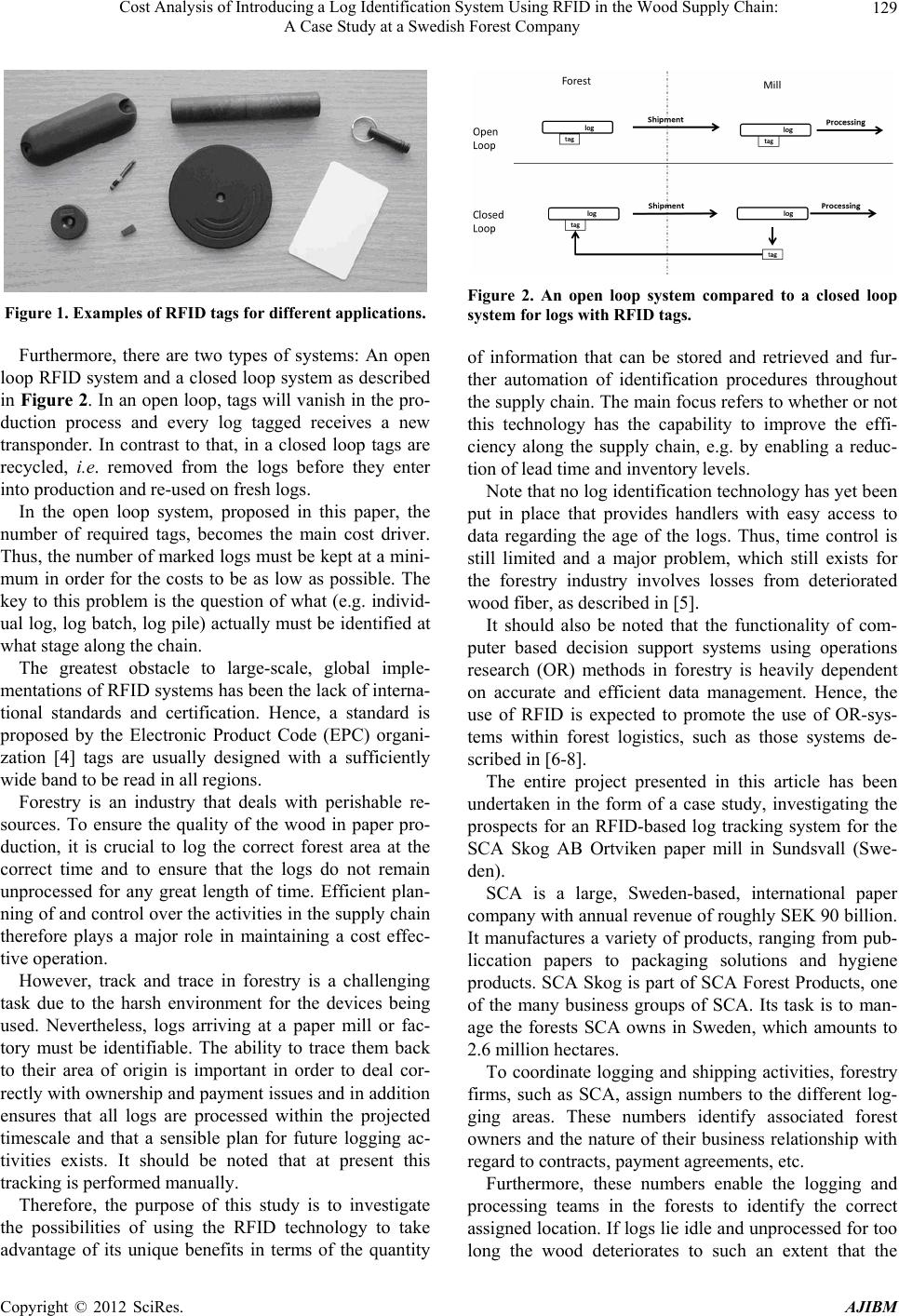 Cost Analysis of Introducing a Log Identification System Using RFID in the Wood Supply Chain: A Case Study at a Swedish Forest Company 129 Figure 1. Examples of RFID tags for different applications. Furthermore, there are two types of systems: An open loop RFID system and a closed loop system as described in Figure 2. In an open loop, tags will van ish in the pro- duction process and every log tagged receives a new transponder. In contrast to that, in a closed loop tags are recycled, i.e. removed from the logs before they enter into productio n and re-used on fresh lo gs. In the open loop system, proposed in this paper, the number of required tags, becomes the main cost driver. Thus, the number of marked logs must be kept at a mini- mum in order for the costs to be as low as possible. The key to this problem is the question of what (e.g. individ- ual log, log batch, log pile) actually must be identified at what stage along the chain. The greatest obstacle to large-scale, global imple- mentations of RFID systems has been the lack of interna- tional standards and certification. Hence, a standard is proposed by the Electronic Product Code (EPC) organi- zation [4] tags are usually designed with a sufficiently wide band to be read in all regions. Forestry is an industry that deals with perishable re- sources. To ensure the quality of the wood in paper pro- duction, it is crucial to log the correct forest area at the correct time and to ensure that the logs do not remain unprocessed for any great length of time. Efficient plan- ning of and control o ver the activities in the supp ly chain therefore plays a major role in maintaining a cost effec- tive operation. However, track and trace in forestry is a challenging task due to the harsh environment for the devices being used. Nevertheless, logs arriving at a paper mill or fac- tory must be identifiable. The ability to trace them back to their area of origin is important in order to deal cor- rectly with ownership and payment issues and in addition ensures that all logs are processed within the projected timescale and that a sensible plan for future logging ac- tivities exists. It should be noted that at present this tracking is performed manually. Therefore, the purpose of this study is to investigate the possibilities of using the RFID technology to take advantage of its unique benefits in terms of the quantity Figure 2. An open loop system compared to a closed loop system for logs with RFID tags. of information that can be stored and retrieved and fur- ther automation of identification procedures throughout the supply chain. The main focus refers to whether or not this technology has the capability to improve the effi- ciency along the supply chain, e.g. by enabling a reduc- tion of lead time and inventory levels. Note that no log iden tification technolog y has yet been put in place that provides handlers with easy access to data regarding the age of the logs. Thus, time control is still limited and a major problem, which still exists for the forestry industry involves losses from deteriorated wood fiber, as described in [5]. It should also be noted that the functionality of com- puter based decision support systems using operations research (OR) methods in forestry is heavily dependent on accurate and efficient data management. Hence, the use of RFID is expected to promote the use of OR-sys- tems within forest logistics, such as those systems de- scribed in [6-8]. The entire project presented in this article has been undertaken in the form of a case study, investigating the prospects for an RFID-based log tracking system for the SCA Skog AB Ortviken paper mill in Sundsvall (Swe- den). SCA is a large, Sweden-based, international paper company with annual revenue of rough ly SEK 90 billion. It manufactures a variety of products, ranging from pub- liccation papers to packaging solutions and hygiene products. SCA Skog is part of SCA Forest Products, one of the many business groups of SCA. Its task is to man- age the forests SCA owns in Sweden, which amounts to 2.6 million hectares. To coordinate logging and shipping activities, forestry firms, such as SCA, assign numbers to the different log- ging areas. These numbers identify associated forest owners and the nature of their business relationship with regard to contracts, payment agreements, etc. Furthermore, these numbers enable the logging and processing teams in the forests to identify the correct assigned location. If logs lie idle and unprocessed for too long the wood deteriorates to such an extent that the Copyright © 2012 SciRes. AJIBM 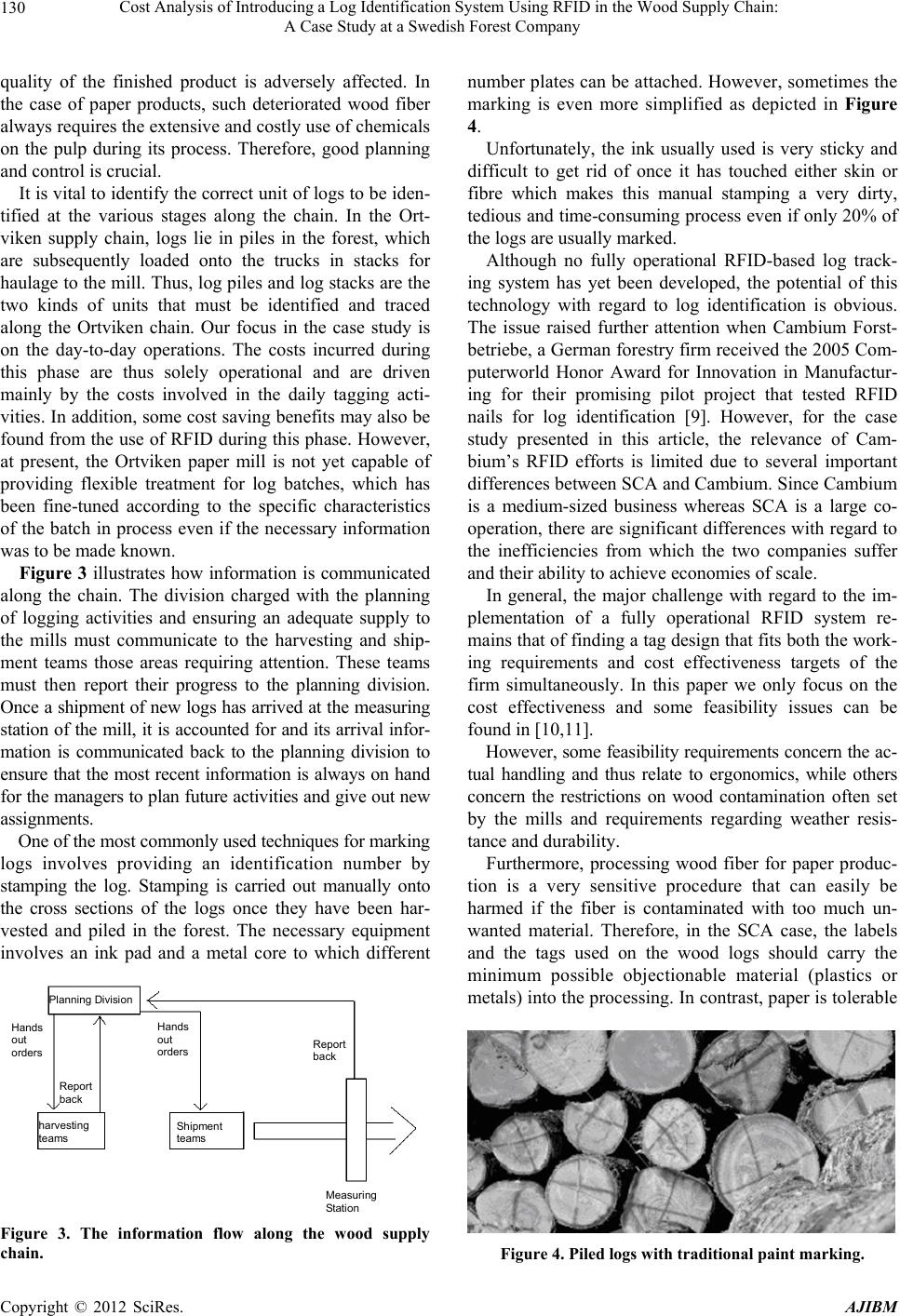 Cost Analysis of Introducing a Log Identification System Using RFID in the Wood Supply Chain: A Case Study at a Swedish Forest Company 130 quality of the finished product is adversely affected. In the case of paper products, such deteriorated wood fiber always requires the extensive and costly use of chemicals on the pulp during its process. Therefore, good planning and control is crucial. It is vital to identify th e correct unit of logs to b e iden- tified at the various stages along the chain. In the Ort- viken supply chain, logs lie in piles in the forest, which are subsequently loaded onto the trucks in stacks for haulage to the mill. Thus, log piles and log stacks are the two kinds of units that must be identified and traced along the Ortviken chain. Our focus in the case study is on the day-to-day operations. The costs incurred during this phase are thus solely operational and are driven mainly by the costs involved in the daily tagging acti- vities. In addition, some cost saving b enefits may also be found from the use of RFID during this phase. However, at present, the Ortviken paper mill is not yet capable of providing flexible treatment for log batches, which has been fine-tuned according to the specific characteristics of the batch in process even if the necessary information was to be made known. Figure 3 illustrates how information is communicated along the chain. The division charged with the planning of logging activities and ensuring an adequate supply to the mills must communicate to the harvesting and ship- ment teams those areas requiring attention. These teams must then report their progress to the planning division. Once a shipment of new logs has arrived at the measuring station of the mill, it is accounted for and its arrival infor- mation is communicated back to the planning division to ensure that the most recent information is always on hand for the managers to plan future activities and give out new assignments. One of the most commonly used techniques for marking logs involves providing an identification number by stamping the log. Stamping is carried out manually onto the cross sections of the logs once they have been har- vested and piled in the forest. The necessary equipment involves an ink pad and a metal core to which different Hands o ut o rders Hands out orders Report back Report back Planning Division Shipment teams harvesting teams Meas uring Station Figure 3. The information flow along the wood supply chain. number plates can be attached. However, sometimes the marking is even more simplified as depicted in Figure 4. Unfortunately, the ink usually used is very sticky and difficult to get rid of once it has touched either skin or fibre which makes this manual stamping a very dirty, tedious and time-consuming process even if only 20% of the logs are usually marked. Although no fully operational RFID-based log track- ing system has yet been developed, the potential of this technology with regard to log identification is obvious. The issue raised further attention when Cambium Forst- betriebe, a German forestry firm received the 2005 Com- puterworld Honor Award for Innovation in Manufactur- ing for their promising pilot project that tested RFID nails for log identification [9]. However, for the case study presented in this article, the relevance of Cam- bium’s RFID efforts is limited due to several important differences between SCA and Cambium. Since Cambium is a medium-sized business whereas SCA is a large co- operation, there are significant differen ces with regard to the inefficiencies from which the two companies suffer and their ability to ach ieve economies of scale. In general, the major challenge with regard to the im- plementation of a fully operational RFID system re- mains that of find ing a tag design that fits both the work- ing requirements and cost effectiveness targets of the firm simultaneously. In this paper we only focus on the cost effectiveness and some feasibility issues can be found in [10,11 ]. However, some feasibility requirements concern the ac- tual handling and thus relate to ergonomics, while others concern the restrictions on wood contamination often set by the mills and requirements regarding weather resis- tance and durability. Furthermore, processing wood fiber for paper produc- tion is a very sensitive procedure that can easily be harmed if the fiber is contaminated with too much un- wanted material. Therefore, in the SCA case, the labels and the tags used on the wood logs should carry the minimum possible objectionable material (plastics or metals) into the processing. In contrast, paper is tolerable Figure 4. Piled logs with traditional paint marking. Copyright © 2012 SciRes. AJIBM  Cost Analysis of Introducing a Log Identification System Using RFID in the Wood Supply Chain: A Case Study at a Swedish Forest Company 131 as a tagging or labeling material as it unable to withstand the high temperatures involved in processing the fiber and thus simply vanishes. The handling and shipping of logs involves a great deal of heavy machinery, which requires the label or tag in question to be very robust and rugged. Moreover, the tags or labels must be sufficiently weather resistant to remain unharmed if left unprocessed outdoors for several weeks. With respect to the above-described requirements, for instance, barcodes are not feasible alternative to RFID as described in more detail by [10]. Hence, this cheap al- ternative is no option in the forestry supply chain. The organisation of the rest of this paper includes a brief discussion about research methods in section two, and then the results from case study follow in section three. Conclusions and the discussion are in section four. This paper concludes with acknowledgements and refer- ences. 2. Model and Method At the very beginning of the investigation an exploratory and empirical approach to the subject was required in order to obtain a deeper understanding of the problem. To understand the processes involved in forest logistics, the A-R-A model, developed in Ford [12] proved to be very useful. At a later stage, information network mapping was required in order to facilitate the comprehension of the current information flow and identification requirements along the chain. The concept of value-adding time vs. non- value-adding time, introduced in [13] has then been ap- plied in order to categorize the activities along the supply chain and identify those processes that are the least effi- cient. An analysis of the cost structure along the Ortviken paper mill supply chain was conducted to identify those costs that were expected to change if RFID technology was deployed. It should be noticed that the effect of RFID technology on lead times and inventory levels were not known. Hence, breakeven analysis using sce- narios was the cho s en method. Different assumptions have been made with regard to the changes involved in these costs and different sce- narios have been developed based on these assumptions. In a break -even anal ysis the break -even point in terms of the price per RFID tag was identified for all the nine scenarios, assuming different marking frequencies. As will be shown below, two cost categories were ex- pected to be influenced by the deployment of RFID and thus formed the foundation for the break-even analysis. That results in the following: Total expected cost change = change in cost category A + change in cost category B For both categories we developed 3 assumptions re- garding their possible behavior in an RFID system. Thus the scenarios developed as follows: Scenario 1: 1st assumed change in category A + 1st assumed change in category B Scenario 2: 1st assumed change in category A + 2nd assumed change in category B Scenario 3: 2nd assumed ch ange in category A + 2nd assumed change in category B The key question of the analysis then was: How much may an RFID tag cost under a given marking frequency to make the total costs of scenario x match present day total costs along the supply chain? The answer to that question yields the upper price limit that is tolerable un- der the assumption that the costs of categories A and B behave in a certain way if RFID in utilized. A break-even point was thus reached as the following formula des- cribes: Break-even point scenario x: present day costs = costs for RFID tagging(x) + change in category A(x) + change in category B(x) When presenting the relevant costs, only those expect- ed to be influenced by an implementation of RFID are taken into account. All other costs can be disregarded since they are irrelevant to the question regarding the circumstances under which an RFID application becomes cost effective. Note, furthermore, that the actual details of costs and volumes are confidential information for SCA. Hence, the results are presented using relative volumes and no specific details about the involved costs. The relevant costs are described below. One of the costs that are taken into account is the marking of logs, which consists of the stamping ma- terial and labour; Another cost category that must be considered in- volves inventory costs. They represent the capital lock- up caused by materials lying idle at various points along the chain; Due to the deterioration of wood fibers a certain amount of wood must be downgraded to a lower qua- lity class. One of the expected benefits of RFID is better control over lead times, which should result in a better utilization of resources and more precise ti me planning of shipping activities. The most interesting variable to investigate is the price per RFID tag. It is the main cost driver of the system and finding the right price level is crucial in order to maintain the economic viability of the system. As tag prices and properties vary greatly, it is crucial to know the break- even point for the price per tag. As was explained above, there are two factors, namely inventory and downgrading Copyright © 2012 SciRes. AJIBM 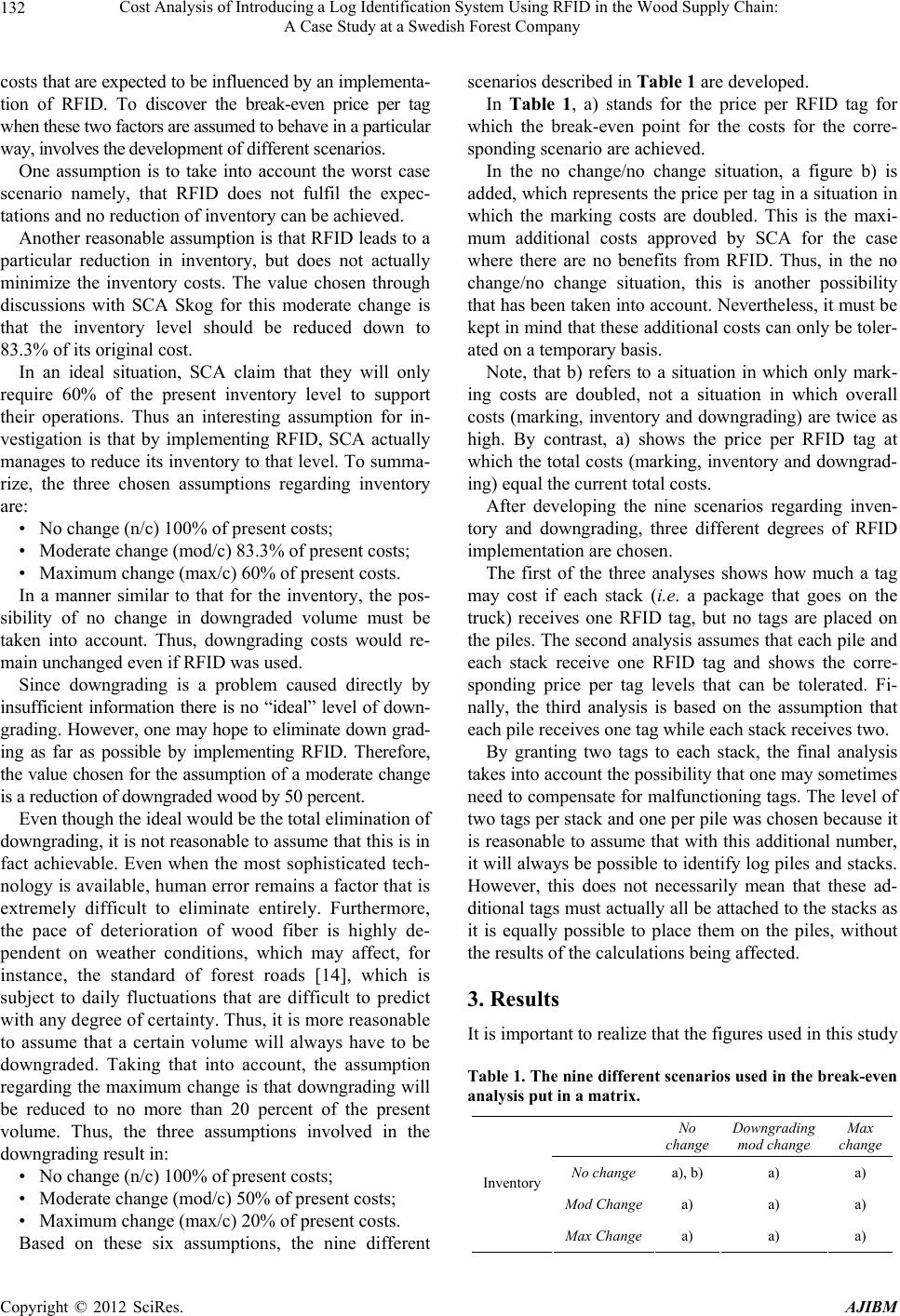 Cost Analysis of Introducing a Log Identification System Using RFID in the Wood Supply Chain: A Case Study at a Swedish Forest Company 132 co s t s t h at are expected to be influenced by an implementa- tion of RFID. To discover the break-even price per tag when these t wo fact ors a re assu med to behave i n a particul ar way , i n v o l v e s t h e d e vel opment of different scenari os. One assumption is to take into account the worst case scenario namely, that RFID does not fulfil the expec- tations and no reduction of inventory can be achieved. Another reasonable assu mption is that RFID leads to a particular reduction in inventory, but does not actually minimize the inventory costs. The value chosen through discussions with SCA Skog for this moderate change is that the inventory level should be reduced down to 83.3% of its original cost. In an ideal situation, SCA claim that they will only require 60% of the present inventory level to support their operations. Thus an interesting assumption for in- vestigation is that by implementing RFID, SCA actually manages to reduce its inventory to that level. To summa- rize, the three chosen assumptions regarding inventory are: • No change (n/c ) 10 0% o f p resent costs; • Moderate change (mod/c) 83.3% of present costs; • Maximum change (max/c) 60% of present costs. In a manner similar to that for the inventory, the pos- sibility of no change in downgraded volume must be taken into account. Thus, downgrading costs would re- main unchanged even if RFID was used. Since downgrading is a problem caused directly by insufficient information there is no “ideal” level of down- gr ading . However, one may hope to eliminate down grad- ing as far as possible by implementing RFID. Therefore, the value chosen for the assumption of a moderate change is a reduction of downgraded wood by 50 percent . Even though the id eal would be the total elimination of downgrading, it is no t reasonable to assume that this is in fact achievable. Even when the most sophisticated tech- nology is available, human error remains a factor that is extremely difficult to eliminate entirely. Furthermore, the pace of deterioration of wood fiber is highly de- pendent on weather conditions, which may affect, for instance, the standard of forest roads [14], which is subject to daily fluctuations that are difficult to predict with an y d egr ee of c er ta in ty. Thu s, it is more r e ason ab le to assume that a certain volume will always have to be downgraded. Taking that into account, the assumption regarding the maximum change is that downgrading will be reduced to no more than 20 percent of the present volume. Thus, the three assumptions involved in the downgrading result in: • No change (n/c ) 10 0% o f p resent costs; • Moderate change (mod/c) 50% of present costs; • Maximum change (max/c) 20% of present costs. Based on these six assumptions, the nine different scenarios descri bed i n Table 1 are developed. In Table 1, a) stands for the price per RFID tag for which the break-even point for the costs for the corre- sponding scenario are achieved . In the no change/no change situation, a figure b) is added, which represen ts the price per tag in a situation in which the marking costs are doubled. This is the maxi- mum additional costs approved by SCA for the case where there are no benefits from RFID. Thus, in the no change/no change situation, this is another possibility that has been taken into account. Nevertheless, it must be kept in mind that these additional costs can only be toler- ated on a temporary basis. Note, that b) refers to a situation in which only mark- ing costs are doubled, not a situation in which overall costs (marking, inventory and downgrading) are twice as high. By contrast, a) shows the price per RFID tag at which the total costs (marking, inventory and downgrad- ing) equal the current total costs. After developing the nine scenarios regarding inven- tory and downgrading, three different degrees of RFID implementation are chosen. The first of the three analyses shows how much a tag may cost if each stack (i.e. a package that goes on the truck) receives one RFID tag, but no tags are placed on the piles. The second analysis assumes that each pile and each stack receive one RFID tag and shows the corre- sponding price per tag levels that can be tolerated. Fi- nally, the third analysis is based on the assumption that each pile receives one tag while each stack receives two. By granting two tags to each stack, the final analysis takes into account the possibility that on e may sometimes need to compensate for malfunctioning tags. The level of two tags per stack and one per pile was chosen because it is reasonable to assume that with th is additional number, it will always be possible to identify log piles and stacks. However, this does not necessarily mean that these ad- ditional tags mu st actually all be attached to the stacks as it is equally possible to place them on the piles, without the results of the calculations being affected. 3. Results It is important to realize that the figures used in this study Table 1. The nine different scenarios used in the break-even analysis put in a matrix. No change Downgrading mod change Max change No change a), b) a) a) Mod Changea) a) a) Inventory Max Changea) a) a) Copyright © 2012 SciRes. AJIBM 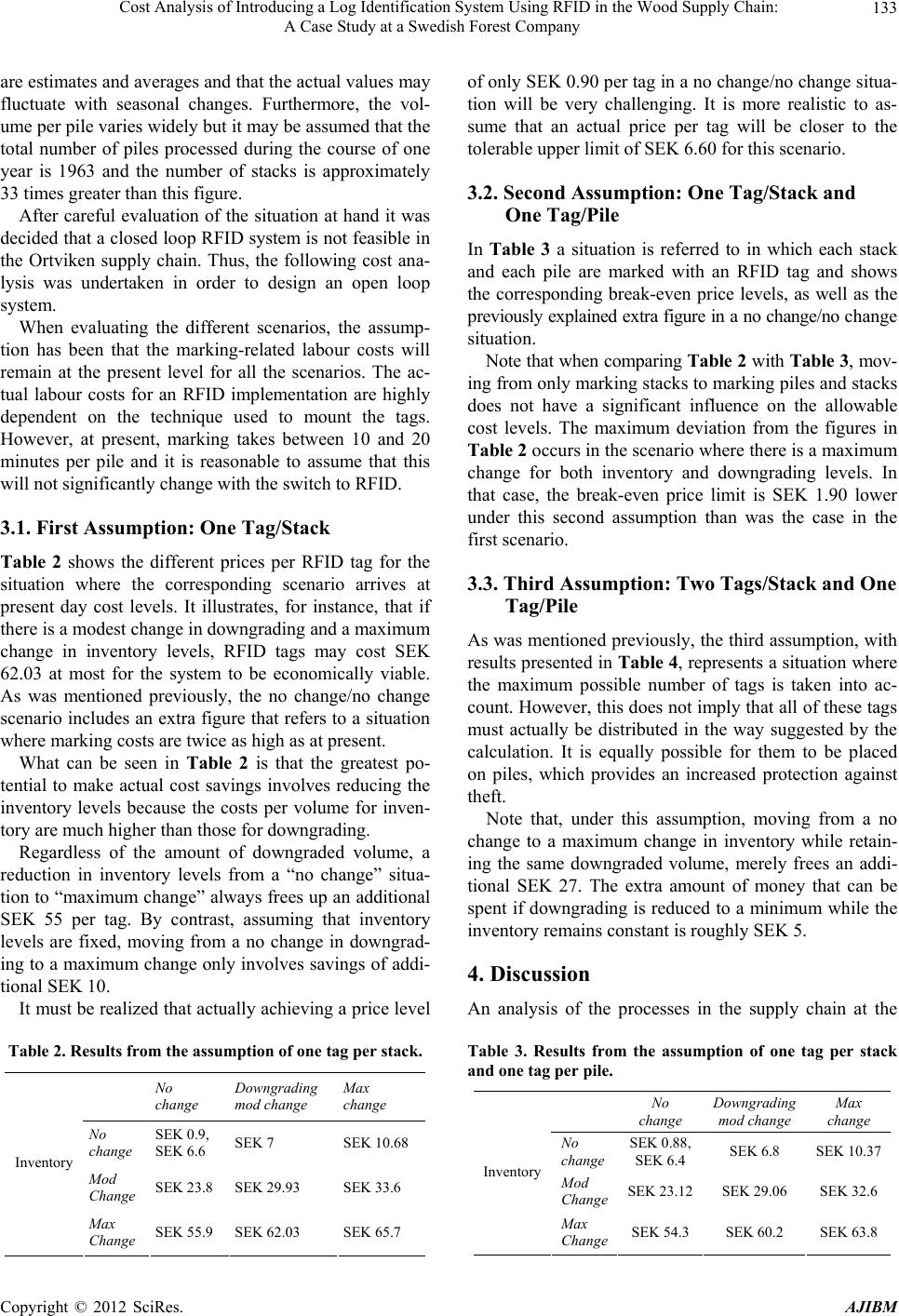 Cost Analysis of Introducing a Log Identification System Using RFID in the Wood Supply Chain: A Case Study at a Swedish Forest Company 133 are estimates and averages and that the actual values may fluctuate with seasonal changes. Furthermore, the vol- ume per pile varies widely but it may be assumed that the total number of piles processed during the course of one year is 1963 and the number of stacks is approximately 33 times greater than this figure. After careful evaluation of the situation at hand it was decided that a closed loop RFID system is not feasible in the Ortviken supply chain. Thus, the following cost ana- lysis was undertaken in order to design an open loop system. When evaluating the different scenarios, the assump- tion has been that the marking-related labour costs will remain at the present level for all the scenarios. The ac- tual labour costs for an RFID implementation are highly dependent on the technique used to mount the tags. However, at present, marking takes between 10 and 20 minutes per pile and it is reasonable to assume that this will not significantly change with the switch to RFID. 3.1. First Assumption: One Tag/Stack Table 2 shows the different prices per RFID tag for the situation where the corresponding scenario arrives at present day cost levels. It illustrates, for instance, that if there is a modest change in downgrading and a maximum change in inventory levels, RFID tags may cost SEK 62.03 at most for the system to be economically viable. As was mentioned previously, the no change/no change scenario includes an extra figure that refers to a situation where marking costs are twice as high as at present. What can be seen in Table 2 is that the greatest po- tential to make actual cost savings involves reducing the inventory levels because the costs per volume for inven- tory are much higher than those for downgrading. Regardless of the amount of downgraded volume, a reduction in inventory levels from a “no change” situa- tion to “maximum change” always frees up an additional SEK 55 per tag. By contrast, assuming that inventory levels are fixed, moving from a no change in downgrad- ing to a maximum change only involves savings of addi- tional SEK 10. It must be realized that actually achieving a price level Table 2. Results from the assumption of one tag per stack. No change Downgrading mod change Max change No change SEK 0.9, SEK 6.6 SEK 7 SEK 10.68 Mod Change SEK 23.8 SEK 29.93 SEK 33.6 Inventory Max Change SEK 55.9 SEK 62.03 SEK 65.7 of only SEK 0.90 per tag in a no change/no change situa- tion will be very challenging. It is more realistic to as- sume that an actual price per tag will be closer to the tolerable upper limit of SEK 6.60 for this scenario. 3.2. Second Assumption: One Tag/Stack and One Tag/Pile In Table 3 a situation is referred to in which each stack and each pile are marked with an RFID tag and shows the corresponding break-even price levels, as well as the pr eviously explained extra figure in a no change/no c ha ng e situation. Note that when comparing Ta ble 2 with Table 3, mov- ing from only marking stacks to marking piles and stacks does not have a significant influence on the allowable cost levels. The maximum deviation from the figures in Table 2 occu rs in th e sc en ar io wher e th e re is a max i mu m change for both inventory and downgrading levels. In that case, the break-even price limit is SEK 1.90 lower under this second assumption than was the case in the first scenario. 3.3. Third Assumption: Two Tags/Stack and One Tag/Pile As was mentioned previously, the third assumpt ion, with results presented in Table 4, represents a situation where the maximum possible number of tags is taken into ac- count. However, this does not imply that all of these tags must actually be distributed in the way suggested by the calculation. It is equally possible for them to be placed on piles, which provides an increased protection against theft. Note that, under this assumption, moving from a no change to a maximum change in inventory while retain- ing the same downgraded volume, merely frees an addi- tional SEK 27. The extra amount of money that can be spent if downgrading is reduced to a minimum while the inventory remains constant is roughly SEK 5. 4. Discussion An analysis of the processes in the supply chain at the Table 3. Results from the assumption of one tag per stack and one tag per pile. No change Downgrading mod change Max change No change SEK 0.88, SEK 6.4 SEK 6.8 SEK 10.37 Mod Change SEK 23.12 SEK 29. 06 SEK 32.6 Inventory Max Change SEK 54.3 SEK 60.2 SEK 63.8 Copyright © 2012 SciRes. AJIBM  Cost Analysis of Introducing a Log Identification System Using RFID in the Wood Supply Chain: A Case Study at a Swedish Forest Company 134 Table 4. Results from the assumption of two tags per stack and one tag per pile. No change Downgrading mod change Max change No change SEK 0.45, SEK 3.25SEK 3.45 SEK 5.25 Mod Change SEK 11.73SEK 14.75 SEK 16.55 Inventory Max Change SEK 27.45SEK 30.55 SEK 32.36 Ortviken paper mill revealed that the potential exists to streamline operations and make more efficient use of resources by implementing an RFID-based log tracking system in this supply chain. This system should be an open loop, using inexpensive, passive, RO RFID devices. However, it is impossible to provide general recom- mendations with regards to the specific properties for future RFID log tracking systems as they are dependent on the specific requirements of the particular supply chain. Technically, satisfying both the material cons- traints set by paper mills and the requirements for the working environment is challenging but not impossible. When considering an implementation of RFID, two issues must be considered carefully. One involves the question regarding what log units need to be identifiable at what point in the chain. Once these units and points have been identified a decision must be taken regarding whether to implement a closed loop system or an open loop system. Furthermore, the analysis of cost structures along the chain and the examination of the various scenarios have shown that there is considerable potential to design a customized tag without exceeding tolerable cost levels regarding prices per tag. It can also be shown that fa- vourable changes in inventory levels and the volume of downgraded wood resulting from RFID both lead to sig- nificant cost savings. That, in turn, enables additional money to be spent on RFID tags without violating break- even price limits. It is reasonable to assume that a suitable tag for the application can be designed without violating the price limit of SEK 3.25 (ca. US-$ 0.43), calculated for the worst case scenario using the highest percentage of marked logs. Thus, it can be concluded that the prospect exists to create an RFID-based log tracking system using customized RO RFID labels that operates at tolerable price levels for day-to-day operations, even when the assumption is made that no reduction in inventory levels or downgraded volume can be achieved. Therefore, it makes sense to further investigate the technical aspects of such customization, while bearing the cost restrictions in mind. Furthermore, it is advisable to investigate how RFID can be integrated with other technologies (e.g. GPS) to further au tomate and facilitate log tracking procedures in the wood supply chain for the future. 5. Acknowledgements First of all we thank Daniel Timpe for doing his his bachelor thesis at Mid Sweden University and an Intern- ship at SCA Skog working with the presented problems. We thank Mårten Larsson and Per Anders Hedström at SCA Skog and Hans-Erik Nilsson at Mid Sweden Uni- versity for their assistance and guidance throughout this project. We also thank FSCN at MIUN and SCA Skog for financing the investigation. REFERENCES [1] R. L. Rardin, “Optimization in Operations Research,” Prentice-Hall, Upper Saddle River, 1998. [2] K. Finkenzeller, “RFID Handbook,” John Wiley & Sons, Hoboken, 2003. doi:10.1002/0470868023 [3] C. Engberg, A. Forsman and C. Johansson, “Viktiga Frå- gor Vid Införande Av Rfid,” Mid Swed en University, Sunds- vall, 2002. [4] EPC Global, 2012. www.gs1.org [5] E. Persson, “Storage of Spruce Pulpwood—Effects on Wood and Mechanical Pulp,” Swedish University of Ag- ricultural Sciences, Uppsala, 2001. [6] H. Gunnarsson, J. Lundgren and M. Rönnqvist, “Decision Support System/Tools: Optimization of Transportation, Storage and Chipping of Forest Fuel,” Proceedings of the 2nd Forest Engineering Conference, Växjö, 12-15 May 2003, pp. 74-82. [7] J. Eriksson and M. Rönnqvist, “Decision Support Sys- tem/Tools: Transportation and Ro ute Planning: Åk arweb— A Web Based Planning System,” Proceedings of the 2nd Forest Engineering Conference, Växjö, 12-15 May 2003, pp. 48-57. [8] M. Forsberg and M. Rönnqvist, “Decision Support Sys- tem/Tools: Integrated Logistics Management in the Forest Supply Chain,” Proceedings of the 2nd Forest Engineer- ing Conference, Växjö, 12-15 May 2003, pp. 64-73. [9] Cambium, 2012. www.cwhonors.org/archives/case_studies/cambium.pdf [10] D. Timpe, “Barcode and RFID Technologies: Alternatives for Log Stamping in Forestry,” FSCN Report R-05-61, Mid Sweden University, Sundsvall, 2005. [11] D. Timpe, “Rfid in Forestry: Prospects of an RFID-Based Log Tracking System as an Alternative to Stamping,” FSCN Report R-06-63, Mid Sweden University, Sund- svall, 2006. [12] D. Ford, “Understanding Business Marketing and Pur- chasing,” Thomson Learning, London, 2002. Copyright © 2012 SciRes. AJIBM  Cost Analysis of Introducing a Log Identification System Using RFID in the Wood Supply Chain: A Case Study at a Swedish Forest Company Copyright © 2012 SciRes. AJIBM 135 [13] M. Christopher, “Logistics and Supply Chain Manage- ment,” Financial Times Pitman Publishing, 1998. [14] L. Olsson, “Optimisation of Forest Road Investments and the Roundwood Supply Chain,” Swedish University of Agricultural Sciences, Uppsala, 2004. |