

Paper Menu >>
Journal Menu >>
 Open Journal of Psychiatry, 2012, 2, 317-320 OJPsych http://dx.doi.org/10.4236/ojpsych.2012.24044 Published Online October 2012 (http://www.SciRP.org/journal/ojpsych/) Toward an integrative model for alcohol use and dependence Serge Combaluzier Department of Psychology, University of Rouen, Rouen, France Email: [email protected] Received 21 July 2012; revised 25 August 2012; accepted 5 September 2012 ABSTRACT Background: If the alcohol use and dependence disor- ders are differentiated by the pharmaco-dependence, they share complex relationships with other clinical disorders and personality disorders. The purpose of this paper is to produce a model that reflects its rela- tions both among users than among addicts. Method: Data from questionnaires measuring key variables selected for this study have been collected from peo- ple with alcohol misuse (n = 83) and alcohol-depen- dent (n = 81) in rehab. A model of drug dependence has been produced from these data that gives com- plete satisfaction to the criteria of SEM. Discussion: This model reflects the shift from abuse to a depen- dent consumption by the presence of feedbacks in- volving pharmaco-dependence, disturbance of the al- cohol consumption by psychological distress and de- pressive traits. To further guarantee its validity, how- ever it should be tested by collecting data from other surveys. Keywords: Structural Equation Modelling; Alcohol Abuse; Alcohol Dependence 1. INTRODUCTION Several decades of studies on alcohol related disorders have collected much evidence of their interactions with clinical features, especially anxious or depressive (Hall, Degenhardt and Tesson, 2009 [1]; Schukit et al., 2009 [2]; Allan, 1995 [3]; Schuckit et al., 1994 [4]; Brady & Lydiard, 1993 [5]; Turbull & Gomberg, 1990 [6]; Helzer & Pryzbeck, 1990 [7]) or personality features (Dejong et al., 1993 [8]; Movalli et al., 1996 [9]) on alcohol use dis- orders. There are two concurrent interpretations for these co-morbidities. For some authors the mental disorders are primary to this addiction, for some others they are secondary that means induced by the alcoholism (F10.8). Alcoholic behaviours have been studied through the motives for drinking. They are implied in the disturbance of the alcoholic behaviours and can lead, as Goldsmith, Tran, Smith and How (2009) [10] have explained re- cently to major problems in alcohol drinking among young- er people. Of course, other motives for drinking have been identified according to Pelc (1978) [11]: Search for social contacts, taste for alcohol, psychological prob- lems, sensation seeking, and pharmaco-dependency. This last factor is one of the main differential diagnostic between alcohol use (F10.1) and alcohol dependence (F10.2.x). The aim of this study is to produce a model of this main symptom that includes both the alcoholic beha- viours and their components, clinical and personality features, and that can explain these among people with alcohol abusing or depending disorders. 2. METHOD To measure the disturbance of alcoholic behaviour and the motives for drinking, we have used the Questionnaire of the Habits of Alcoholic Drink, devised by Pelc [11]. This self-questionnaire explores 5 dimensions of the mo- tives for drinking, as described above, and provides a score for the disturbance of the alcoholic behaviour. Ac- cording to Pelc, a score higher than 24 reflects an ab- normal drinking behaviour. To measure the intensity of the clinical features we have used the French version (Pariente and Guelfi, 1998 [12]) of Derogatis’s Symptoms Check List 90r [13] that estimates the intensity of such clinical features as somatisation, obsession, sensitivity, hostility, anxiety, depression phobia, psychosis or para- noia. Finally, for to estimate the personality disorders we have used the French version (Cottraux et al., 1985 [14]) of the Dysfunction Attitude Scale (DAS) by Weisman and Beck (1978) [15]. Then, we have presented these questionnaires to a large sample (n = 81) of persons in detoxification for their alcohol-dependencies and to a large sample (n = 83) of people who drink alcohol in public houses, bars or night clubs. After randomization, we kept 40 protocols of the first group and 52 of the second one. OPEN ACCESS 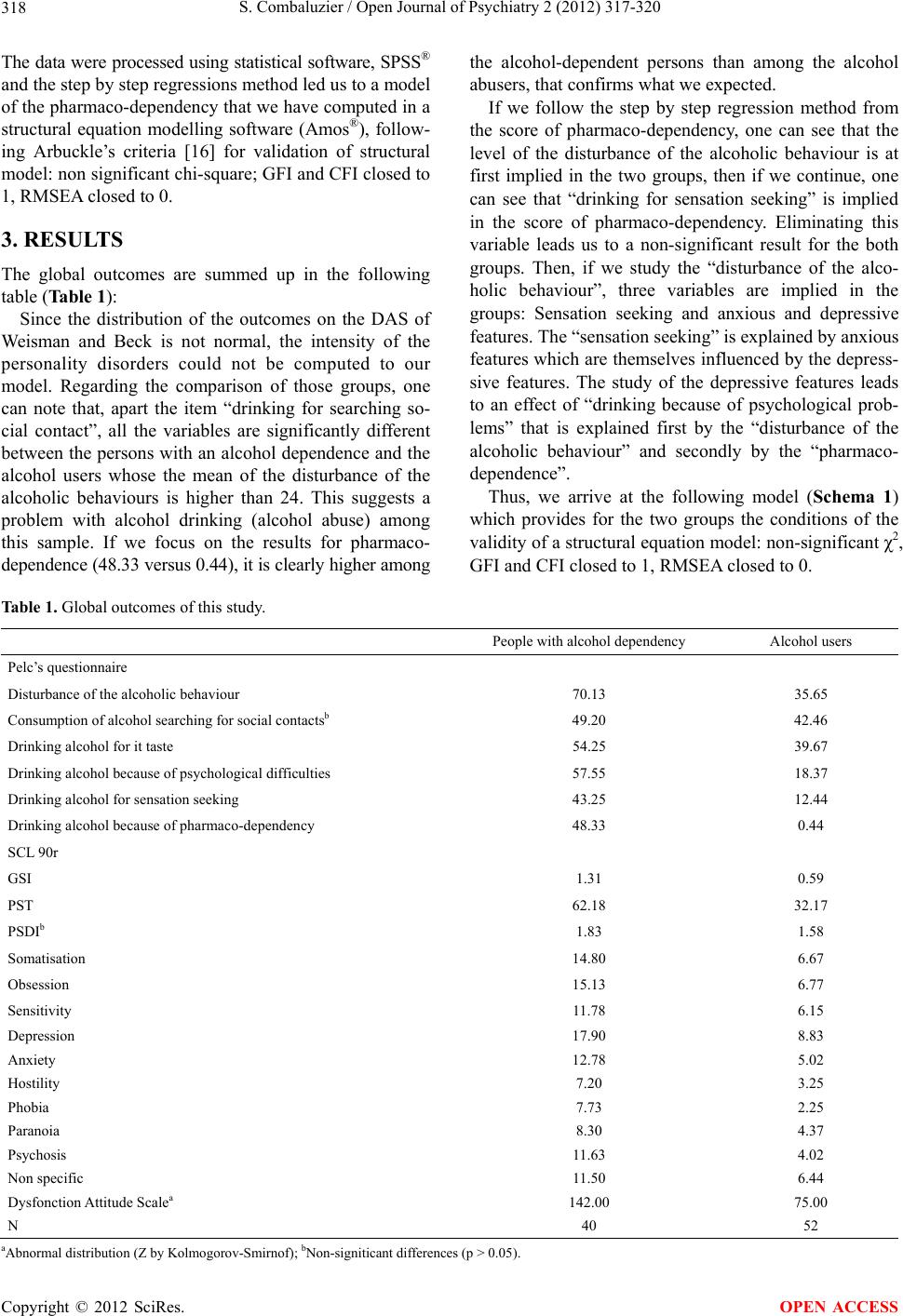 S. Combaluzier / Open Journal of Psychiatry 2 (2012) 317-320 318 The data were processed using statistical software, SPSS® and the step by step regressions method led us to a model of the pharmaco-dependency that we have computed in a structural equation modelling software (Amos®), follow- ing Arbuckle’s criteria [16] for validation of structural model: non significant chi-square; GFI and CFI closed to 1, RMSEA closed to 0. 3. RESULTS The global outcomes are summed up in the following table (Table 1): Since the distribution of the outcomes on the DAS of Weisman and Beck is not normal, the intensity of the personality disorders could not be computed to our model. Regarding the comparison of those groups, one can note that, apart the item “drinking for searching so- cial contact”, all the variables are significantly different between the persons with an alcohol dependence and the alcohol users whose the mean of the disturbance of the alcoholic behaviours is higher than 24. This suggests a problem with alcohol drinking (alcohol abuse) among this sample. If we focus on the results for pharmaco- dependence (48.33 versus 0.44), it is clearly higher among the alcohol-dependent persons than among the alcohol abusers, that confirms what we expected. If we follow the step by step regression method from the score of pharmaco-dependency, one can see that the level of the disturbance of the alcoholic behaviour is at first implied in the two groups, then if we continue, one can see that “drinking for sensation seeking” is implied in the score of pharmaco-dependency. Eliminating this variable leads us to a non-significant result for the both groups. Then, if we study the “disturbance of the alco- holic behaviour”, three variables are implied in the groups: Sensation seeking and anxious and depressive features. The “sensation seeking” is explained by anxious features which are themselves influenced by the depress- sive features. The study of the depressive features leads to an effect of “drinking because of psychological prob- lems” that is explained first by the “disturbance of the alcoholic behaviour” and secondly by the “pharmaco- dependence”. Thus, we arrive at the following model (Schema 1) which provides for the two groups the conditions of the validity of a structural equation model: non-significant χ2, GFI and CFI closed to 1, RMSEA closed to 0. Table 1. Global outcomes of this study. People with alcohol dependency Alcohol users Pelc’s questionnaire Disturbance of the alcoholic behaviour 70.13 35.65 Consumption of alcohol searching for social contactsb 49.20 42.46 Drinking alcohol for it taste 54.25 39.67 Drinking alcohol because of psychological difficulties 57.55 18.37 Drinking alcohol for sensation seeking 43.25 12.44 Drinking alcohol because of pharmaco-dependency 48.33 0.44 SCL 90r GSI 1.31 0.59 PST 62.18 32.17 PSDIb 1.83 1.58 Somatisation 14.80 6.67 Obsession 15.13 6.77 Sensitivity 11.78 6.15 Depression 17.90 8.83 Anxiety 12.78 5.02 Hostility 7.20 3.25 Phobia 7.73 2.25 Paranoia 8.30 4.37 Psychosis 11.63 4.02 Non specific 11.50 6.44 Dysfonction Attitude Scalea 142.00 75.00 N 40 52 aAbnormal distribution (Z by Kolmogorov-Smirnof); bNon-signiticant differences (p > 0.05). Copyright © 2012 SciRes. OPEN ACCESS 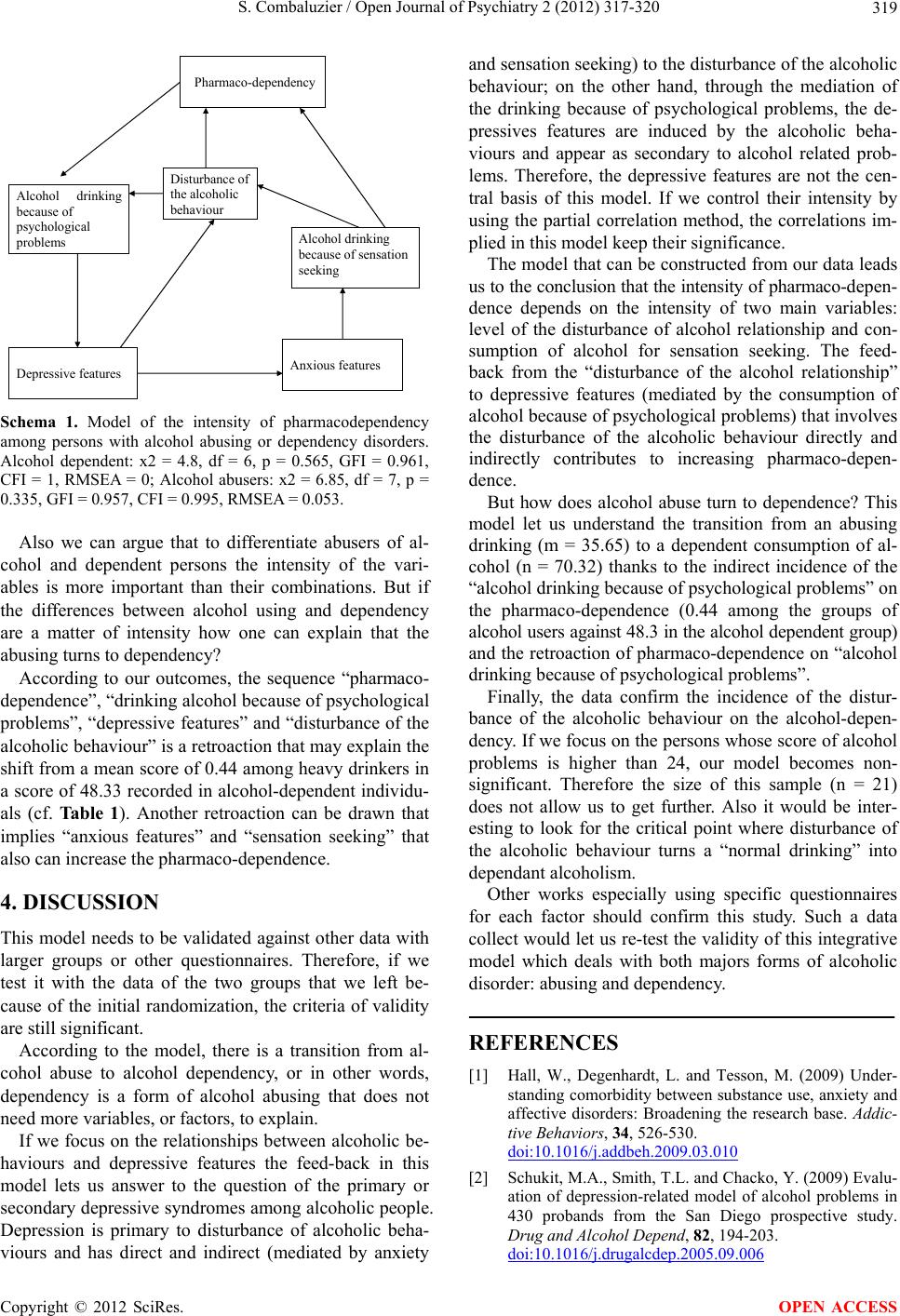 S. Combaluzier / Open Journal of Psychiatry 2 (2012) 317-320 319 Disturbance of the alcoholic b ehavio u r Alcohol drinking because of sensation seeking Alcohol drinking because of psychological problems Depressive features Anxious features Pharmaco-dependency Schema 1. Model of the intensity of pharmacodependency among persons with alcohol abusing or dependency disorders. Alcohol dependent: x2 = 4.8, df = 6, p = 0.565, GFI = 0.961, CFI = 1, RMSEA = 0; Alcohol abusers: x2 = 6.85, df = 7, p = 0.335, GFI = 0.957, CFI = 0.995, RMSEA = 0.053. Also we can argue that to differentiate abusers of al- cohol and dependent persons the intensity of the vari- ables is more important than their combinations. But if the differences between alcohol using and dependency are a matter of intensity how one can explain that the abusing turns to dependency? According to our outcomes, the sequence “pharmaco- dependence”, “drinking alcohol because of psychological problems”, “depressive features” and “disturbance of the alcoholic behaviour” is a retroaction that may explain the shift from a mean score of 0.44 among heavy drinkers in a score of 48.33 recorded in alcohol-dependent individu- als (cf. Ta b l e 1 ). Another retroaction can be drawn that implies “anxious features” and “sensation seeking” that also can increase the pharmaco-dependence. 4. DISCUSSION This model needs to be validated against other data with larger groups or other questionnaires. Therefore, if we test it with the data of the two groups that we left be- cause of the initial randomization, the criteria of validity are still significant. According to the model, there is a transition from al- cohol abuse to alcohol dependency, or in other words, dependency is a form of alcohol abusing that does not need more variables, or factors, to explain. If we focus on the relationships between alcoholic be- haviours and depressive features the feed-back in this model lets us answer to the question of the primary or secondary depressive syndromes among alcoholic people. Depression is primary to disturbance of alcoholic beha- viours and has direct and indirect (mediated by anxiety and sensation seeking) to the disturbance of the alcoholic behaviour; on the other hand, through the mediation of the drinking because of psychological problems, the de- pressives features are induced by the alcoholic beha- viours and appear as secondary to alcohol related prob- lems. Therefore, the depressive features are not the cen- tral basis of this model. If we control their intensity by using the partial correlation method, the correlations im- plied in this model keep their significance. The model that can be constructed from our data leads us to the conclusion that the intensity of pharmaco-depen- dence depends on the intensity of two main variables: level of the disturbance of alcohol relationship and con- sumption of alcohol for sensation seeking. The feed- back from the “disturbance of the alcohol relationship” to depressive features (mediated by the consumption of alcohol because of psychological problems) that involves the disturbance of the alcoholic behaviour directly and indirectly contributes to increasing pharmaco-depen- dence. But how does alcohol abuse turn to dependence? This model let us understand the transition from an abusing drinking (m = 35.65) to a dependent consumption of al- cohol (n = 70.32) thanks to the indirect incidence of the “alcohol drinking because of psychological problems” on the pharmaco-dependence (0.44 among the groups of alcohol users against 48.3 in the alcohol dependent group) and the retroaction of pharmaco-dependence on “alcohol drinking because of psychological problems”. Finally, the data confirm the incidence of the distur- bance of the alcoholic behaviour on the alcohol-depen- dency. If we focus on the persons whose score of alcohol problems is higher than 24, our model becomes non- significant. Therefore the size of this sample (n = 21) does not allow us to get further. Also it would be inter- esting to look for the critical point where disturbance of the alcoholic behaviour turns a “normal drinking” into dependant alcoholism. Other works especially using specific questionnaires for each factor should confirm this study. Such a data collect would let us re-test the validity of this integrative model which deals with both majors forms of alcoholic disorder: abusing and dependency. REFERENCES [1] Hall, W., Degenhardt, L. and Tesson, M. (2009) Under- standing comorbidity between substance use, anxiety and affective disorders: Broadening the research base. Addic- tive Behaviors, 34, 526-530. doi:10.1016/j.addbeh.2009.03.010 [2] Schukit, M.A., Smith, T.L. and Chacko, Y. (2009) Evalu- ation of depression-related model of alcohol problems in 430 probands from the San Diego prospective study. Drug and Alcohol Depend, 82, 194-203. doi:10.1016/j.drugalcdep.2005.09.006 Copyright © 2012 SciRes. OPEN ACCESS  S. Combaluzier / Open Journal of Psychiatry 2 (2012) 317-320 320 [3] Allan, C.A. (1995) Alcohol problems and anxiety disor- ders—A critical review. Alco Alcoholism, 30, 145-151. [4] Schuckit, M.A. (1994) The relationship between alcohol problems, substance abuse and psychiatric syndromes. American Psychiatr ic Ass oci ati on, 1, 1994, 45-66. [5] Brady, K.T. and Lydiard, B. (1993) The association of alcoholism and anxiety. Psychiatric Quarterly, 30, 135- 149. doi:10.1007/BF01065866 [6] Turnbull, J.E. and Gomberg, E.S.L. (1990) The structure of depression in alcoholic women. Journal of Studies on Alcohol and Drugs, 51, 549-555. [7] Helzer, J.E. and Prysbeck, T.R. (1988) The co-occurrence of alcoholism and other psychiatric disorders in the gen- eral population and its impact on treatment. Journal of Studies on alcohol, 49, 219-224 [8] DeJong, C.A., Van der Brink, W., Harteveld, F.M. and Van der Wielen, G.M. (1993) Personality disorders in al- coholics and drug addicts. Comprehensive Psychiatric, 34, 87-94. doi:10.1016/0010-440X(93)90052-6 [9] Movalli, M.G., Madeddu, F., Fossati, A. and Maffei, C. (1996) Personality disorders (DSM III-r, DSM IV): Preva- lence in alcoholics and influence on droup out from treat- ment, Alcoologia, 8, 47-52. [10] Goldsmith, A.A., Tran, G.Q., Smith, J.P. and Howe, S.R. (2009) Alcohol expectancies and drinking motives in college drinkers: Mediating effects on the relationship between generalized anxiety and heavy drinking in nega- tive-affect situations. Addictive Behaviors, 34, 503-513. doi:10.1016/j.addbeh.2009.01.003 [11] Pelc, I. (1978) Contribution to the abnormal psychology of the chronic alcoholism. Ph.D. Thesis, Université libre de Bruxelles, Brussels. [12] Pariente, P. and Guelfi, J.-D. (1990) Self-assessment inven- tories of psychopathology in adults, Part 1: Multidimensional inventories. Psychiatr Psychobiol, 5, 49-63. [13] DeRogatis, L.R. (1977) SCL-90r (revised) version manual I. clinical psychometrics research unit. John Hoppkinks University School of Medicine, Baltimore. [14] Cottraux, J., Bouvard, M. and Legeron, P. (1985) Methods and behavior rating scales. Psychological Editions and Ap- plications, Paris. [15] Weissman, A. and Beck, A.T. (1978) Development and validation of the dysfunctional attitude scale. Paper pre- sented at the annual meeting of the Association for Ad- vancement of Behavior Therapy, Chicago. [16] Arbuckle, J.L. (2003) Amos 5.0. Smallwaters Corps, Chi- cago. Copyright © 2012 SciRes. OPEN ACCESS |