

Paper Menu >>
Journal Menu >>
 Journal of Minerals and Materials Characterization and Engineering, 2012, 11, 976-981 Published Online October 2012 (http://www.SciRP.org/journal/jmmce) Sol-Gel-Derived Porous Silica: Economic Synthesis and Characterization Enobong R. Essien1*, Oluyemi A. Olaniyi1, Luqman A. Adams2, Rafiu O. Shaibu2 1Department of Chemical Sciences, College of Natural Sciences, Bells University of Technology, Ota, Nigeria 2Department of Chemistry, Faculty of Science, University of Lagos, Lagos, Nigeria Email: [email protected] Received August 8, 2012; revised September 12, 2012; accepted September 20, 2012 ABSTRACT Porous silica was synthesized via the sol-gel process using clay obtained locally from Ijero-Ekiti in Ekiti State, Nigeria and compared with silica synthesized under similar conditions from sodium metasilicate (Na2SiO3) obtained comer- cially. The clay was initially refluxed with sodium hydroxide (NaOH) for 2 hours to extract SiO2 to form Na 2SiO3, which was subsequently hydrolyzed to form a gel. The gel obtained was washed with deionized water to get rid of im- purities, dried and calcined at 800˚C for 3 hours. The obtained silica powders were characterized using atomic absorp- tion spectrophotometer, Fourier transform infrared (FTIR) spectroscopy, X-ray diffraction (XRD) and scanning electron microscopy (SEM). Results showed that the vibrational modes and diffraction patterns of the silica derived from com- mercial Na2SiO3 and that prepared from clay were similar containing pure amorphous SiO2. The morphology of the commercially obtained silica showed better arrangement of particles and exhibited slightly lesser porosity (62.4%) compared to that derived from clay which had a porosity of 65.5%. The result indicates that clay has a potential for use as an environmentally safe and economic starting material for preparing porous silica instead of high quality precursors. Keywords: Clay; Sodium Metasilicate; Economic; Porous Silica; Environmentally Safe 1. Introduction Porous silica is used in many fields including biotech- nology, biomedical sciences, selective separation and ca- talysis [1,2]. Unlike conventional glass, which is a vis- cous fluid that results from the fusion of SiO2 at high temperature, sol-gel-derived silica is obtained at mild conditions [3] compatible with the stability of most bio- active compounds. The sol-gel process is capable of ge- nerating materials with controlled surface properties and pore structures between 1 - 500 nm [4-7]. The matrix of the silica thus formed can be exploited for immobili- zation of biomolecules or cations, inorganic membranes and support for catalysts [6-9]. Silica polymer networks may be obtained by hy- drolysis and condensation reactions of silica precursors such as tetraethyl orthosilicate (TEOS). By controlling synthesis conditions carefully, the sol morphology can be directed towards weakly branched polymeric systems or to particulate systems [7]. Important process parameters include water content, the solvent, the catalyst used and its concentration and type of alkoxide used [4,10,11]. Several methods, most of them based on TEOS as starting material have been used to prepare porous silica. The most popular is the sol-gel synthesis proposed by Stöber et al. [12] which is based on hydrolysis and con- densation of highly reactive silicon alkoxide precursor at low temperature. Consequently, silica particles with vari- ous characteristics were prepared by ammonia-catalyzed reactions of tetraethyl orthosilicate (TEOS) with water in low molecular weight alcohol [12,13]. Due to high cost, applicability of other precursors has been investigated. Thus, different types of silica sources have been used, such as sodium silicate [14,15] and even environmentally safe and renewable resources, like rice husk ash [16,17], rice hull ash [18] and rice straw ash [19] have also been exploited. In continuation of the search for a cheap and environ- mentally safe silica source, the work herein investigated the synthesis of porous silica from clay and sodium metasilicate under similar conditions for the purpose of comparing their physical and morphological characteri- stics. 2. Materials and Methods 2.1. Materials The chemicals used were sodium metasilicate (Na2SiO3), (Sigma-Aldrich) with composition SiO2 24.9 and Na2O 20.9 wt% respectively, clay from Ijero-Ekiti in Nigeria *Corresponding author. Copyright © 2012 SciRes. JMMCE  E. R. ESSIEN ET AL. 977 having composition (as previously analyzed by Olasupo and Omotoyinbo [20]) as shown in Table 1 and sulphuric acid (H2SO4), (Fluka, Germany). 2.2. Preparation of Porous Silica from Sodium Metasilicate (SS) Sodium metasilicate (5.0 g) was stirred in distilled water (10.0 ml) to give a clear solution. Thereafter, 10.0 ml of 2 M H2SO4 was added dropwise to the mixture under magnetic stirring at room temperature for about 2 hours to form a gel. Deionized water was added successively to the gel to wash and remove sodium sulphate (Na2SO4). Complete removal of sodium ions was indicated by ab- sence of white precipitate when the liquid from the last filtration was tested with dilute lead(II) ethanoate solu- tion. The washed gel was dried in an oven at 120˚C for 1 day, calcined at 800˚C for 3 hours in a furnace with a heating rate of 10˚C/min and thereafter milled to form powders and then labelled as SS. 2.3. Preparation of Porous Silica from Clay (CS) The as-received potter’s clay was dried in the sun, following which it was ground into powder in a ball mill and sieved through a 100 µm to remove oversize parti- cles. The obtained clay (10.0 g) was refluxed in 1 M NaOH solution (200.0 ml) for 2 hours, then allowed to cool before filtering to remove the residue which con- tained Al(OH)3 as major impurity. The filtrate obtained was evaporated to dryness to give as residue sodium metasilicate, Na2SiO3 (5.0 g). The basic sodium metasi- licate was dissolved in distilled water (10.0 ml). The solution was hydrolyzed with 2 M H2SO4 (20.0 ml) and subsequently treated the same way as in section 2.2 above to afford the silica powder which will henceforth be called CS. 3. Characterization X-ray diffraction (XRD) analysis was carried out in the 2θ range of 10˚ - 80˚ and 5˚ - 120˚ using Xpert PRO PANalytical diffractometer employing CuKα radiation Table 1. Mineralogical composition of Ijero-Ekiti clay. Minerals Amount (%) Oxides Composition (%) Kaolinite 72 SiO2 63.3 Quartz 22 Al2O3 16.5 Feldspar 4 Fe2O3 5.8 Illite 2 CaO 1.7 MgO 0.6 LoI 12.5 Others 0.8 LoI = Loss on ignition. (0.154060 nm) source operated at 40 kV and 40 mA. Fourier transform infrared spectroscopy (FTIR) studies were carried out using Buck Scientific 500 Infrared spec- trophotometer with KBr as reference in the wave number range of 600 - 4000 cm−1. Atomic absorption spectros- copy Perkin Elmer A Analyst 200 was used to determine residual amount of sodium ions (Na+) present in the silica networks. Morphological characterization of the samples regarding the particles and pore sizes distribution were performed using a SEM (EVO/MA10) at an accelerating voltage of 10 kV. The bulk densities, ρb of the silica particles were mea- sured from their weight to volume ratio using the formula b M V (1) where, M is the mass of the sample measured with a microbalance (10−5 g accuracy), and V is the volume measured by filling the silica particles in a column of known volume [21]. The porosity, P(%) was estimated using the relation- ship [22] 1 100 bp P (2) in which ρp is specific density assumed to be 2.0 g·cm−3 for amorphous silica particles based on the sperical model (a typical average density of silica prepared via wet-synthesis conditions [23]). 4. Results and Discussion 4.1. Hydrolysis and Gelation Acidic hydrolysis of sodium metasilicate (Na2SiO3) gives silicic acid [24] in solution. Sodium hydroxide is reacted with clay to initially afford sodium metasilicate in a strongly basic medium. The water glass obtained from the basic reaction is similarly hydrolysed to silicic acid which undergoes condensation to disilicic acid and further reaction to a polycondensed hydrogel [24] as shown in Scheme 1. Thereafter, the gel obtained from both precursor compounds were subjected to multiple washings [25] with deionised water to free the gel of sodium sulphate formed during hydrolysis that is trapped in the pores of the gel network. During aging, the 3-D framework of the silicate glass continues to grow and becomes more rigid by contracting and expelling liquid water present inside the pores [26]. Drying is important as it modifies the gel characteristics and involves two steps [27]. During the first step, the pores are emptied; the capillary gradient induces the liquid flow along the pore walls, towards the external surface where it evapo- rates. At the interior, the pores are still filled with liquid, while the air enters the most external pores, which can cause the opacity of gel. The pressure capillary gradient decreases gradually, the flow is increasingly slower then Copyright © 2012 SciRes. JMMCE  E. R. ESSIEN ET AL. Copyright © 2012 SciRes. JMMCE 978 Na2SiO3 H2SO4 HOSi OH OH OH Si OH O Si Si O Si OH O O Si OH O Si O O O OO O O O O Na2SiO3 H2OH2SO 4 H2O n (OH)4Si8Al4O20.nH2O + 16 NaOH poly- condensation 4Al(OH)3+(4 + n)H2O Extraction Sodium metasilicate -nH2O Polysilicic acid Silicic acid Clay + Na2SO4 ·nH 2 O Scheme 1. Hydrolysis and polycondensation of sodium metasilica te and clay. stops. In the second step the remaining liquid can then leave the gel only in gas form, with vapour diffusion towards the surface. After drying at 120˚C, the porous gel contains a small quantity of liquid trapped in the pores. Calcination at high temperature further removes absorbed water trapped in the pores. The efficiency of deionised water washings to free the gel from sodium sulphate was monitored by atomic absorption spectroscopy (AAS) analysis of the silicas obtained after drying. The result indicated that Na+ decreased from 36.5% (on the basis of stoichiometry) [25] to 1.6% in the SS-based silica and to 2.1% in the CS based silica. 4.2. Bulk Density and Porosity The silica obtained from SS and CS after calcination were found to have bulk density of 0.752 and 0.690 g cm−3 respectively. The difference may be due to better packing of the 3-D framework in the SS as a result of more efficient removal of the interfering Na+ from succe- ssive deionized water washings of the gels [28]. Their bulk densities as expected had influence on their porosity, as SS and CS exhibited 62.4% and 65.5% respectively. 4.3. FTIR The FTIR spectra obtained for the SS and CS-based silicas respectively are characterized by a broad band centred around 3400 cm−1 and a smaller signal around 1630 cm−1 that corresponds to O-H absorption band [29,30] as shown in Figures 1(a) and (b). Furthermore, a diagnostic Si-O-Si asymmetric stretching vibration is centred on 1132 cm−1 [31,32] and the absorption signal at 920 cm−1 is assigned to the stretching vibration of silanol groups on the surface of the amorphous solid [33]. 4.4. XRD The XRD spectra of the SS and CS powders obtained are shown in Figures 2(a) and (b) respectively. The diff- raction patterns are similar for both samples which appear as broad bands with reflection at 2θ = 22˚ in- dicating that the materials are amorphous and composed of SiO2 [34-36]. There are no additional peaks observed in both spectra. This result indicates the absence of im- purities in the gel networks after the deionised water washing removal of Na2SO4 formed during the gelation reaction (Scheme 1), the extent which was confirmed earlier with AAS. 4.5. SEM The particle sizes of the silicas measured by SEM are presented in the micrographs shown in Figure 3. The average particle size of SS was 353.95 nm, Figure 3(a) while that of CS was 755.35 nm, Figure 3(b). The differ- ence in particle sizes in the two samples may be the result of agglomeration [37] which is higher in CS than SS. This fact is more evident in Figure 4 where in the micrograph of SS, Figure 4(a), the particles appear as discrete with a few agglomerates, whereas the particles of CS as seen in the micrograph shown in Figure 4(b), appear to adhere to each other forming aggregate of par- ticles which results in irregular arrangement when compared to SS. It has been proposed [38] that the initial particle size distribution, polydispersity, concentration of particle size distribution, polydispersity, concentration of particles, viscosity of the continuous phase, Van der Waals forces of attraction, and hydrodynamic conditions govern the extent of inter-particle collisions, aggregation and the temporal evolution of the average diameter of aggregates. The morphology of CS therefore appears to be more porous than that of SS which agrees with the porosity values earlier obtained. According to studies [39], porosity arises from the assumed packing of pri- mary particles in the agglomerates. 5. Conclusion Porous silica has been successfully synthesized via an  E. R. ESSIEN ET AL. 979 Figure 1. (a) FTIR spectrum of SS-based silica; (b) FTIR spectrum of CS-based silica. Figure 2. XRD p atterns obtained from (a) SS and (b) CS powders. Figure 3. SEM micro graphs of samples (a) SS and (b) CS showing pa rticle sizes measur ed at different positions: Pa 1 and Pa 2 at positional angles of Pb 1 and Pb 2 respectively. Figure 4. SEM micrographs showing the porous morphology of the sol-gel-derived silicas. It can also be seen that SS, (a) contains better packed particles than CS, (b). Copyright © 2012 SciRes. JMMCE 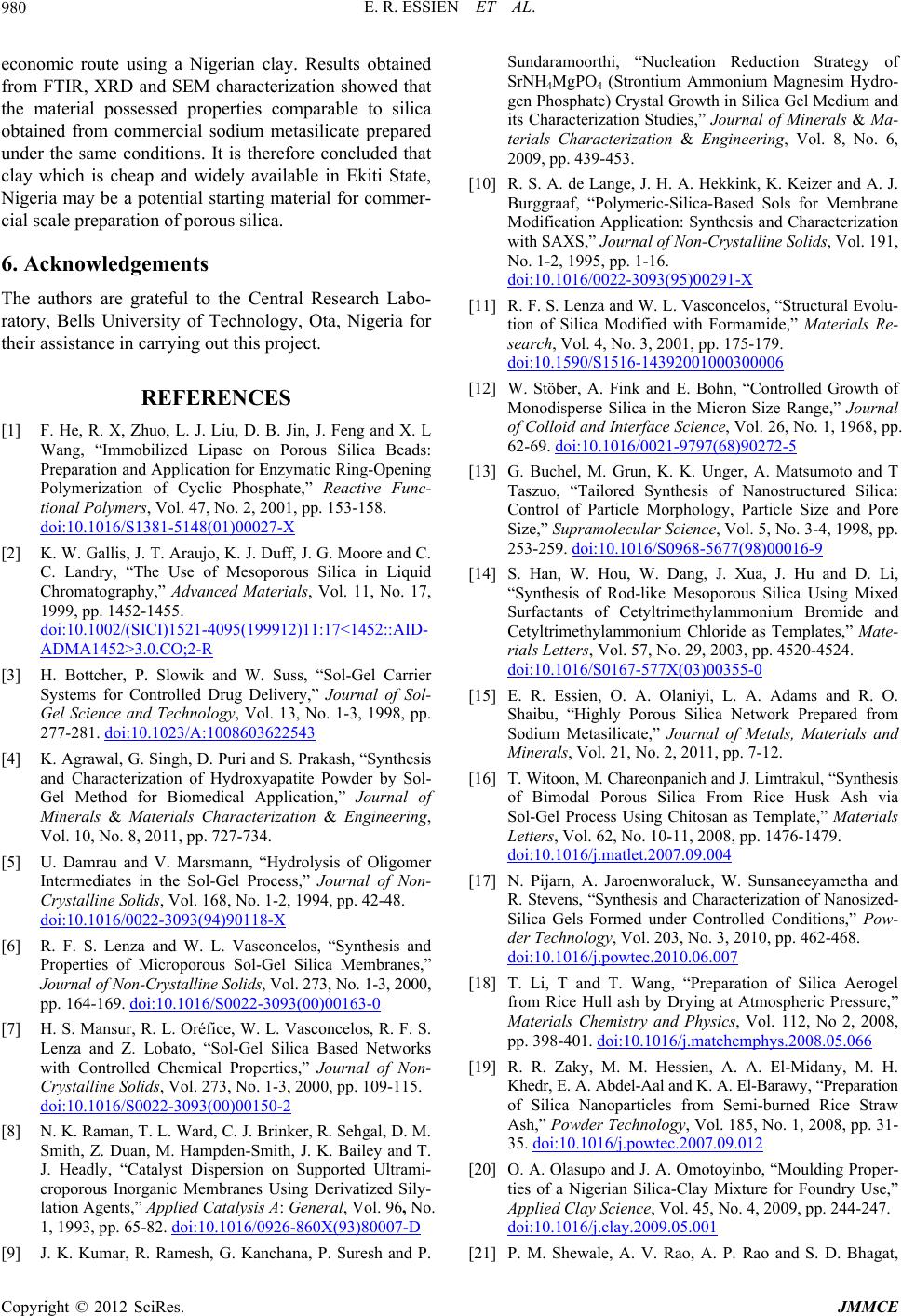 E. R. ESSIEN ET AL. 980 economic route using a Nigerian clay. Results obtained from FTIR, XRD and SEM characterization showed that the material possessed properties comparable to silica obtained from commercial sodium metasilicate prepared under the same conditions. It is therefore concluded that clay which is cheap and widely available in Ekiti State, Nigeria may be a potential starting material for commer- cial scale preparation of porous silica. 6. Acknowledgements The authors are grateful to the Central Research Labo- ratory, Bells University of Technology, Ota, Nigeria for their assistance in carrying out this project. REFERENCES [1] F. He, R. X, Zhuo, L. J. Liu, D. B. Jin, J. Feng and X. L Wang, “Immobilized Lipase on Porous Silica Beads: Preparation and Application for Enzymatic Ring-Opening Polymerization of Cyclic Phosphate,” Reactive Func- tional Polymers, Vol. 47, No. 2, 2001, pp. 153-158. doi:10.1016/S1381-5148(01)00027-X [2] K. W. Gallis, J. T. Araujo, K. J. Duff, J. G. Moore and C. C. Landry, “The Use of Mesoporous Silica in Liquid Chromatography,” Advanced Materials, Vol. 11, No. 17, 1999, pp. 1452-1455. doi:10.1002/(SICI)1521-4095(199912)11:17<1452::AID- ADMA1452>3.0.CO;2-R [3] H. Bottcher, P. Slowik and W. Suss, “Sol-Gel Carrier Systems for Controlled Drug Delivery,” Journal of Sol- Gel Science and Technology, Vol. 13, No. 1-3, 1998, pp. 277-281. doi:10.1023/A:1008603622543 [4] K. Agrawal, G. Singh, D. Puri and S. Prakash, “Synthesis and Characterization of Hydroxyapatite Powder by Sol- Gel Method for Biomedical Application,” Journal of Minerals & Materials Characterization & Engineering, Vol. 10, No. 8, 2011, pp. 727-734. [5] U. Damrau and V. Marsmann, “Hydrolysis of Oligomer Intermediates in the Sol-Gel Process,” Journal of Non- Crystalline Solids, Vol. 168, No. 1-2, 1994, pp. 42-48. doi:10.1016/0022-3093(94)90118-X [6] R. F. S. Lenza and W. L. Vasconcelos, “Synthesis and Properties of Microporous Sol-Gel Silica Membranes,” Journal of Non-Crystalline Solids, Vol. 273, No. 1-3, 2000, pp. 164-169. doi:10.1016/S0022-3093(00)00163-0 [7] H. S. Mansur, R. L. Oréfice, W. L. Vasconcelos, R. F. S. Lenza and Z. Lobato, “Sol-Gel Silica Based Networks with Controlled Chemical Properties,” Journal of Non- Crystalline Solids, Vol. 273, No. 1-3, 2000, pp. 109-115. doi:10.1016/S0022-3093(00)00150-2 [8] N. K. Raman, T. L. Ward, C. J. Brinker, R. Sehgal, D. M. Smith, Z. Duan, M. Hampden-Smith, J. K. Bailey and T. J. Headly, “Catalyst Dispersion on Supported Ultrami- croporous Inorganic Membranes Using Derivatized Sily- lation Agents,” Applied Catalysis A: General, Vol. 96, No. 1, 1993, pp. 65-82. doi:10.1016/0926-860X(93)80007-D [9] J. K. Kumar, R. Ramesh, G. Kanchana, P. Suresh and P. Sundaramoorthi, “Nucleation Reduction Strategy of SrNH4MgPO4 (Strontium Ammonium Magnesim Hydro- gen Phosphate) Crystal Growth in Silica Gel Medium and its Characterization Studies,” Journal of Minerals & Ma- terials Characterization & Engineering, Vol. 8, No. 6, 2009, pp. 439-453. [10] R. S. A. de Lange, J. H. A. Hekkink, K. Keizer and A. J. Burggraaf, “Polymeric-Silica-Based Sols for Membrane Modification Application: Synthesis and Characterization with SAXS,” Journal of Non-Crystalline Solids, Vol. 191, No. 1-2, 1995, pp. 1-16. doi:10.1016/0022-3093(95)00291-X [11] R. F. S. Lenza and W. L. Vasconcelos, “Structural Evolu- tion of Silica Modified with Formamide,” Materials Re- search, Vol. 4, No. 3, 2001, pp. 175-179. doi:10.1590/S1516-14392001000300006 [12] W. Stöber, A. Fink and E. Bohn, “Controlled Growth of Monodisperse Silica in the Micron Size Range,” Journal of Colloid and Interface Science, Vol. 26, No. 1, 1968, pp. 62-69. doi:10.1016/0021-9797(68)90272-5 [13] G. Buchel, M. Grun, K. K. Unger, A. Matsumoto and T Taszuo, “Tailored Synthesis of Nanostructured Silica: Control of Particle Morphology, Particle Size and Pore Size,” Supramolecular Science, Vol. 5, No. 3-4, 1998, pp. 253-259. doi:10.1016/S0968-5677(98)00016-9 [14] S. Han, W. Hou, W. Dang, J. Xua, J. Hu and D. Li, “Synthesis of Rod-like Mesoporous Silica Using Mixed Surfactants of Cetyltrimethylammonium Bromide and Cetyltrimethylammonium Chloride as Templates,” Mate- rials Letters, Vol. 57, No. 29, 2003, pp. 4520-4524. doi:10.1016/S0167-577X(03)00355-0 [15] E. R. Essien, O. A. Olaniyi, L. A. Adams and R. O. Shaibu, “Highly Porous Silica Network Prepared from Sodium Metasilicate,” Journal of Metals, Materials and Minerals, Vol. 21, No. 2, 2011, pp. 7-12. [16] T. Witoon, M. Chareonpanich and J. Limtrakul, “Synthesis of Bimodal Porous Silica From Rice Husk Ash via Sol-Gel Process Using Chitosan as Template,” Materials Letters, Vol. 62, No. 10-11, 2008, pp. 1476-1479. doi:10.1016/j.matlet.2007.09.004 [17] N. Pijarn, A. Jaroenworaluck, W. Sunsaneeyametha and R. Stevens, “Synthesis and Characterization of Nanosized- Silica Gels Formed under Controlled Conditions,” Pow- der Technology, Vol. 203, No. 3, 2010, pp. 462-468. doi:10.1016/j.powtec.2010.06.007 [18] T. Li, T and T. Wang, “Preparation of Silica Aerogel from Rice Hull ash by Drying at Atmospheric Pressure,” Materials Chemistry and Physics, Vol. 112, No 2, 2008, pp. 398-401. doi:10.1016/j.matchemphys.2008.05.066 [19] R. R. Zaky, M. M. Hessien, A. A. El-Midany, M. H. Khedr, E. A. Abdel-Aal and K. A. El-Barawy, “Preparation of Silica Nanoparticles from Semi-burned Rice Straw Ash,” Powder Technology, Vol. 185, No. 1, 2008, pp. 31- 35. doi:10.1016/j.powtec.2007.09.012 [20] O. A. Olasupo and J. A. Omotoyinbo, “Moulding Proper- ties of a Nigerian Silica-Clay Mixture for Foundry Use,” Applied Clay Science, Vol. 45, No. 4, 2009, pp. 244-247. doi:10.1016/j.clay.2009.05.001 [21] P. M. Shewale, A. V. Rao, A. P. Rao and S. D. Bhagat, Copyright © 2012 SciRes. JMMCE  E. R. ESSIEN ET AL. 981 “Synthesis of Transparent Silica Aerogels with Low Den- sity and Better Hydrophobicity by Controlled Sol-Gel Route and Subsequent Atmospheric Pressure Drying,” Journal of Sol-Gel Science and Technology, Vol. 49, No. 3, 2009, pp. 285-292. doi:10.1007/s10971-008-1888-8 [22] F. Bauer, H. J. Gläsel, U. Decker, H. Ernst, A. Freyer, E. Hartmann, V. Sauerland and R. Mehnert, “Trialkoxysi- lane Grafting onto Nanoparticles for the Preparation of Clear Coat Polyacrylate Systems with Excellent Scratch Performance,” Progress in Organic Coatings, Vol. 47, No. 2, 2003, pp. 147-153. doi:10.1016/S0300-9440(03)00117-6 [23] I. A. Rahman, P. Venjayakumaran, C. S. Sipaut, J. Ismail and C. K. Chee, “Effect of Drying Techniques on the Morphology of Silica Nanoparticles Synthesized Via Sol-Gel Process,” Ceramics International, Vol. 34, No. 8, 2008, pp. 2059-2066. doi:10.1016/j.ceramint.2007.08.014 [24] H. Wang, W. Zhong, Q. Du, Y. Yang, V. Okamoto and S. Inoue, “Novel Polyimide/Silica Nanohybrids from Water Glass,” Polymer Bulletin, Vol. 51, No. 1, 2003, pp. 63-68. doi:10.1007/s00289-003-0188-2 [25] U. K. Bangi, A. V. Rao and A. P. Rao, “A New Route for Preparation of Sodium-Silicate-Based Hydrophobic Silica Aerogels via Ambient-Pressure Drying,” Science and Technology of Advanced Materials, Vol. 9, No. 3, 2008, pp. 1-10. doi:10.1088/1468-6996/9/3/035006 [26] S. W. Hwang, T. Y. Kim and S. H. Hyun, “Effect of Sur- face Modification Conditions on the Synthesis of Mes- oporous Crack-Free Silica Aerogel Monoliths from Wa- terglass via Ambient-drying,” Microporous and Mesopor- ous Materials, Vol. 130, No. 1, 2010, pp. 295-302. doi:10.1016/j.micromeso.2009.11.024 [27] D. M. Schmidt, G. W. Scherer and J. M. Anderson, “Shrinkage During Drying of Silica Gel,” Journal of Non- Crystalline Solids, Vol. 188, No. 3, 1995, pp. 191-206. doi:10.1016/0022-3093(95)00187-5 [28] L. A. Adams, R. O. Shaibu, E. R. Essien and A. Oki, “Bentonite Clay and Waterglass Porous Monoliths via the Sol-Gel Process,” Journal of Metals, Materials and Min- erals, Vol. 21, No. 2, 2011, pp. 1-6. [29] C. J. Lee, G. S. Kim and S. H. Hyun, “Synthesis of Silica Aerogels from Water Glass via New Modified Ambient Drying,” Journal of Materials Science, Vol. 37, No. 11, 2002, pp. 2237-2241. doi:10.1023/A:1015309014546 [30] P. Suresh, G. Kanchawa and P. Sundaramoorthi, “Growth and Characterization Studies of MnHP Single Crystal in Silica Gel Medium,” Journal of Minerals & Materials Characterization & Engineering, Vol. 8, No. 5, 2009, pp. 439-453. [31] H. S. Mansur, R. L. Orefice and A. A. P. Mansur, “Char- acterization of Poly(vinyl alcohol)/Poly(ethylene glycol) Hydrogels and PVA-Derived Hybrids by Small-Angle Scattering and FTIR Spectroscopy,” Polymer, Vol. 45, No. 21, 2004, pp. 7193-7202. doi:10.1016/j.polymer.2004.08.036 [32] R. Almeida and G. Pantano, “Structural Investigation of Silica Gel Films by Infrared Spectroscopy,” Journal of Applied Physics, Vol. 68, No. 8, 1990, pp. 1225-1232. doi:10.1063/1.346213 [33] V. Lenza and W. L. Vasconcelos, “Preparation of Silica by Sol-gel Method Using Formamide,” Materials Re- search, Vol. 4, No. 3, 2001, pp. 189-194. doi:10.1590/S1516-14392001000300008 [34] C. Bhavornthanayod and P. Rungrojchaiporn, “Synthesis of Zeolite a Membrane from Rice Husk Ash,” Journal Metals, Materials and Minerals, Vol. 19, No. 2, 2009, pp. 79-83. [35] P. Sooksaen, S. Suttiruengwong, K. Oniem, K. Ngamla- miad and J. Atireklapwarodom, “Fabrication of Porous Bioactive Glass-Ceramics via Decomposition of Natural Fibres,” Journal of Metals, Materials and Minerals, Vol. 18, No. 2, 2008, pp. 85-91. [36] U. Kalapathy, A. Proctor and J. Shultz, “A Simple Method for Production of Pure Silica from Rice Hull Ash,” Bio- resource Technology, Vol. 73, No. 3, 2000, pp. 99-106. doi:10.1016/S0960-8524(99)00112-1 [37] B. Rager and V. Krysztafkiewicz, “Effect of Electrolytes and Surfactants on Physicochemical Properties and Po- rous Structures of Hydrated Silicas,” Colloids and Sur- faces A: Physicochemical and Engineering Aspects, Vol. 125, No. 2-3, 1997, pp. 121-130. doi:10.1016/S0927-7757(97)00063-0 [38] S. A. K. Jeeliani, G. Benoist, K. S. Joshi, R. Gunde, D. Kellenberger and E. J. Windhab “Creaming and Aggrega- tion of Particles in Suspensions,” Colloids and Surfaces A: Physicochemical and Engineering Aspects, Vol. 263, No. 1-3, 2005, pp. 379-389. doi:10.1016/j.colsurfa.2005.01.003 [39] D. G. Bika, M. Gentzler and V. Michaels, “Mechanical Properties of Agglomerates,” Powder Technology, Vol. 117, No. 1-2, 2001, pp. 98-112. doi:10.1016/S0032-5910(01)00318-7 Copyright © 2012 SciRes. JMMCE |