

Paper Menu >>
Journal Menu >>
 Open Journal of Psychiatry, 2012, 2, 301-304 OJPsych http://dx.doi.org/10.4236/ojpsych.2012.24042 Published Online October 2012 (http://www.SciRP.org/journal/ojpsych/) Alcohol dependence: Does the composition of the available beverages promote it? Mary W. Kuria, Yvonne Olando Department of Psychiatry, University of Nairobi, Nairobi, Kenya Email: [email protected] Received 8 September 2012; revised 7 October 2012; accepted 15 October 2012 ABSTRACT Affordability and availability of alcohol are factors that have been associated with alcohol dependence. Ethanol content in the alcoholic beverages is an im- portant determinant in alcohol dependence. Quality control of alcoholic beverages available in the market is important in safeguarding the health of alcohol consumers. Few studies in Kenya have determined the chemical composition of alcohol used by the study participants. Objective: To determine the chemical composition of alcoholic beverages used by a group of alcohol dependent study participants. Design: The study was a clinical trial with pre and post measure- ments. Method: The CIDI and WHO-ASSIST were administered to 188 alcohol-dependent persons at intake and after six months. A researcher-designed socio demographic questionnaire was also adminis- tered at intake. Alcohol beverages were randomly collected from the location of the study area and their chemical composition analyzed using gas chromatog- raphy. Results: The mean AUDIT score of the par- ticipant was 28.6 for male and 26.6 for females. Three of the alcohol samples collected was illicit brews col- lected while 11 were licit. Four out of the eleven licit brews had ethanol levels that did not complied with the set government standards. Conclusion: Illicit brews with high ethanol content are available in the Kenyan market, while some of the manufacturers of the licit brew do not comply with government set content recommendations. Keywords: Alcoholic Beverages; Ethanol; Composition; Illicit; Licit 1. INTRODUCTION The control of composition of alcohol standard is done by the Kenya bureau of standards (KEBS). The Kenya Bureau of Standards recommends spirits, gin whisky and brandy to contain a minimum 37.5% of alcohol by vo- lume, while beer should have 4% - 8%, fruit win 8% - 14% fortified wine 1 3% - 34 % alcohol by v olume. There is an overwhelming proliferation of illicit alco- holic brews both in the urban and rural parts of Kenya. This prompted the law makers to enact the new Alcohol Control Law. According to the newly passed law better control of alcohol quality and enforcement of the laws has been proposed. National Agency for the Campaign Against Drug Abuse (the government body responsible for dealing with substance abuse) acknowledges that abuse and misuse of alcohol and other drugs in Kenya has now reached magnitudes that may lead to a national disaster if timely measures are not put in place [1]. The Kenya Alcoholic Drinks Control Act, (2010) de- fines alcohol as “the product known as ethyl alcohol ob- tained by fermentation and distillation of any fermented alcoholic product”. “Alcoholic drink includes spirits, wine, beer, traditional alcoholic drink and any one or more such varieties containing one-half of one percent or more of alcohol by volume” [2]. Worldwide three types of alcoholic beverages namely, beer, wine and spirits. Beer and wine have lower alcohol content as compared to spirits. Ideally the definition of alcohol should be at an etha- nol content level low enough to include most of the al- coholic beverages consumed in the country. Such defini- tion takes into consideration the alcohol by volume con- tent of the drink [3]. Amounts of alcohol consumed by a person depend partly on the ethanol content. Estimates of both mean volume of alcohol consumption and heavy drinking amounts are influenced by variation in alcohol concentration and quantity [4]. People from poor com- munities prefer cheap and potent alcohol. The use and abuse of alcohol in Africa involves both local and industrialized typ es of alco hol [5 ] with as much as half of the consumption being unrecorded alcohol [6]. Traditional drinks including homemade brews and dis- tilled beverages accounts for 74% of the total alcohol consumption in Kenya [7]. The use of the local tradi- tional brews poses a danger to the society for a number OPEN ACCESS  M. W. Kuria, Y. Olando / Open Journal of Psychiatry 2 (2012) 301-304 302 of reasons. Firstly, the manufacture of the traditional brews is usually unhygienic and at times the brews have been laced with methanol resulting to deaths blindness and disabilities [8]. Secondly, most of the brews are manufactured illegally without control on the ethanol content. Thirdly, the cost of the brews is relatively lower than that of the legal brews and therefore the majority of the alcohol users can afford it. Kenya has currently passed a law to legalize traditional and illicit brews so as to regulate production, sale and consumption of alcoholic drinks [1]. Kenyans have a hazardous drinking pattern of alcohol which can cause social and medical harm [7,9] with an increasingly use by underage and young persons [10]. These coupled with a repo rted increase in lifetime drink- ing among young, black African; and use of drugs by females as a way to cope with current or past life stress- ors [11,12] demands that quality control of alcoholic brews be instituted and enforced. Anecdotal reports indicate that consuming killer sub- stances bottled in filthy backyards and cleverly labeled as fortified wine, gin, opaque beer, vodka, brandy or rum are currently sold in the Kenyan market. According to anecdotal reports the suspect drinks, said to control 80 per cent of the wines and spirits market, contravene all the mandatory requirements for manufacture as well as trade in alcoholic beverag es—tax obligation, quality cer- tification, wholesomeness and packaging. Cheap alcohol package in small quantities (250 milliliter) which have in the past being available in the Kenyan market has cur- rently being prohibited by the new Alcoholic Drinks Control Act, 2010. In Kenya, alcohol consumption is highest in poor communities where potent home brewed alcoho l is cheap and readily available. Quality control is weak; meaning ethanol content can at times be dangerously high. Ex am- ples of such home made brews include, “muratina”, “mnazi”, “changaa”, “mbangari”, “busaa”, and “kumi- kumi”. These are the illicit brews that the newly passed law (Alcohol Drinks Control Act) intends to make licit and industrialize the production in attempt to protect the alcohol users from harmful effects of contaminated il- licit brews (Kenya Gazette supplement, 2010). Since cost and availability of alcohol are factors that influ- ence alcohol use an increase in available licit types of alcohol in market may result to more people drinking alcohol. Illicit drug use has spread from urban and advantaged groups to rural and disadvantaged (poor) communities where youth associate alcohol use with enjoyment, fun and survival [13]. This is true for Kenya where use of illicit alcohol has become common among rural and in- formal settlement communities where dealing with the alcohol dependence problem is further complicated by the scarce resources in such communities. In spite of the high health and social economic costs associated with alcohol use disorders most African go- vernments depend heavily on alcohol industries for reve- nue received through taxation. These coupled with em- ployment opportunities for people gives the alcohol in- dustries a bargaining power when it comes to introduce- tion, implementation and enforcement of alcohol po licies in Africa. 2. METHOD Ethical approval for the study was obtained from the Kenyatta National Hospital/University of Nairobi ethi- cal review board. Permission to collect the illicit alco- hol brew samples was obtained from the Ministry of Public Health and all ethical considerations were ad- hered to. One hundred and eighty eight participants of a community based detoxification and rehabilitation pro- gramme were asked to indicate the types of alcohol beverages they were using in order of prevalence irre- spective of whether the brews were licit or illicit. Four- teen most commonly used brews were randomly pur- chased fro m the twelv e vi llage s lo cat ed wi thin the s tud y area. The purchased alcohol beverages were given a serial number and taken to the Government Chemist for che- mical, analysis principal investigator and a public health officer. The chemical composition of the alcohol samples was determined through gas chromatography. 3. RESULTS A total of 188 participants underwent community-based detoxification but only 156 were followed up for the six months. Majority (91.5%) was male and 8.5% were fe- male. Majority (60.5%) of the participants had begun drinking alcohol before the age of 18 years, with the mean AUDIT score being 28.6 for males and 26.6 for females. The mean age of the group was 31.9 years, with majority (84%) of the participants aged below 40 years. The majority (53.3%) of the participants earned an in- come of less than 143 United States dollars per month. The majority (51.1%) were married, while 38.9% were single. The remaining participants were either separated or divorced. Fourteen samples of alcoholic b everage were collected from the study area and labeled F517 - F527 for the licit brews and F480 - F482 for the illicit brews. Two of the illicit brews were within the beer range of alcoholic brews while the third one was within the spirit range. The results are shown in Table 1. Four out of the eleven licit brews had not complied with the recommended Kenya Bureau of Standards Copyright © 2012 SciRes. OPEN ACCESS 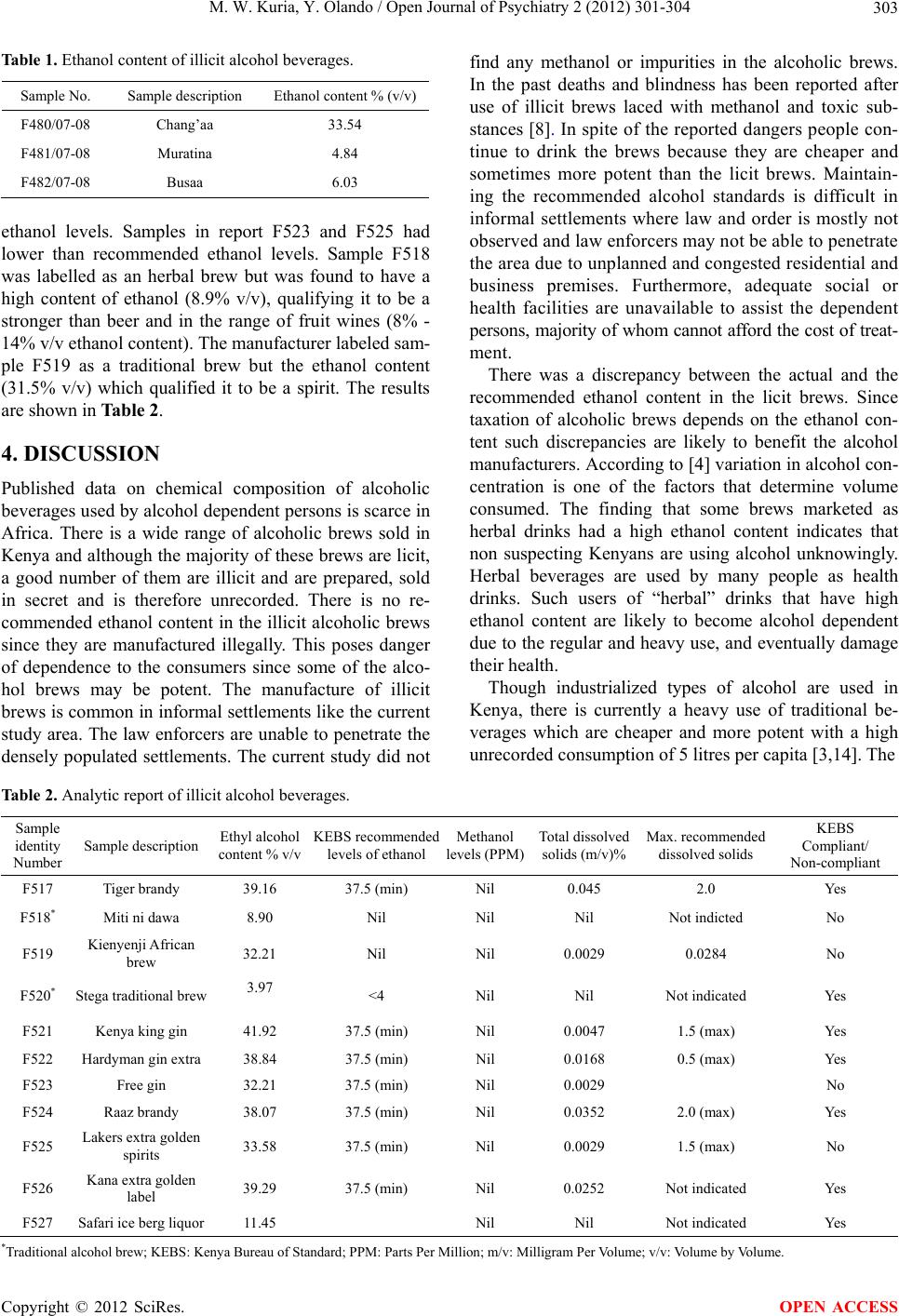 M. W. Kuria, Y. Olando / Open Journal of Psychiatry 2 (2012) 301-304 Copyright © 2012 SciRes. 303 OPEN ACCESS Table 1. Ethanol content of illicit alcohol beverages. Sample No. Sample description Ethanol content % (v/v) F480/07-08 Chang’aa 33.54 F481/07-08 Muratina 4.84 F482/07-08 Busaa 6.03 ethanol levels. Samples in report F523 and F525 had lower than recommended ethanol levels. Sample F518 was labelled as an herbal brew but was found to have a high content of ethanol (8.9% v/v), qualifying it to be a stronger than beer and in the range of fruit wines (8% - 14% v/v ethanol content). The manufacturer labeled sam- ple F519 as a traditional brew but the ethanol content (31.5% v/v) which qualified it to be a spirit. The results are shown in Table 2. 4. DISCUSSION Published data on chemical composition of alcoholic beverages used by alcohol dependent persons is scarce in Africa. There is a wide range of alcoholic brews sold in Kenya and although the majo rity of these brews are licit, a good number of them are illicit and are prepared, sold in secret and is therefore unrecorded. There is no re- commended ethano l content in the illicit alcoholic brews since they are manufactured illegally. This poses danger of dependence to the consumers since some of the alco- hol brews may be potent. The manufacture of illicit brews is common in informal settlements like th e current study area. The law enforcers are unable to penetrate the densely populated settlements. The current study did not find any methanol or impurities in the alcoholic brews. In the past deaths and blindness has been reported after use of illicit brews laced with methanol and toxic sub- stances [8]. In spite of the reported dangers people con- tinue to drink the brews because they are cheaper and sometimes more potent than the licit brews. Maintain- ing the recommended alcohol standards is difficult in informal settlements where law and order is mostly not observed and law enforcers may not be able to penetrate the area due to unplanned and congested residential and business premises. Furthermore, adequate social or health facilities are unavailable to assist the dependent persons, majority of whom cannot afford the cost of treat- men t. There was a discrepancy between the actual and the recommended ethanol content in the licit brews. Since taxation of alcoholic brews depends on the ethanol con- tent such discrepancies are likely to benefit the alcohol manufacturers. According to [4] variation in alcohol con- centration is one of the factors that determine volume consumed. The finding that some brews marketed as herbal drinks had a high ethanol content indicates that non suspecting Kenyans are using alcohol unknowingly. Herbal beverages are used by many people as health drinks. Such users of “herbal” drinks that have high ethanol content are likely to become alcohol dependent due to the regular and heavy use, and eventually damage their health. Though industrialized types of alcohol are used in Kenya, there is currently a heavy use of traditional be- verages which are cheaper and more potent with a high unrecorded consu mption of 5 litres per capita [3,14]. The Table 2. Analytic report of illicit alcohol beverages. Sample identity Number Sample description Ethyl alcohol content % v/v KEBS recommended levels of ethanol Methanol levels (PPM)Total diss olved solids (m/v)%Max. recomme nde d dissolved solids KEBS Compliant/ Non-compliant F517 Tiger brandy 39.16 37.5 (min) Nil 0.045 2.0 Yes F518* Miti ni dawa 8.90 Nil Nil Nil Not indicted No F519 Kienyenji African brew 32.21 Nil Nil 0.0029 0.0284 No F520* Stega traditional brew 3.97 <4 Nil Nil Not indicated Yes F521 Kenya king gin 41.92 37.5 (min) Nil 0.0047 1.5 (max) Yes F522 Hardyman gin extra 38.8 4 37.5 (min) Nil 0.0168 0.5 (max) Yes F523 Free gin 32.21 37.5 (min) Nil 0.0 029 No F524 Raaz brandy 38.07 37.5 (min) Nil 0.0352 2.0 (max) Yes F525 Lakers extra golden spirits 33.58 37.5 (min) Nil 0.0029 1.5 (max) No F526 Kana extra golden label 39.29 37.5 (min) N il 0.0252 Not indicated Yes F527 Safari ice berg liquor 11. 4 5 Nil Nil Not indicated Yes *Traditional alcohol brew; KEBS: Kenya Bureau of Standard; PPM : Parts Per Million; m /v: Mi lligram Per Volume ; v/v: Volume by Volume.  M. W. Kuria, Y. Olando / Open Journal of Psychiatry 2 (2012) 301-304 304 current study confirms that some of the traditional be- verages are highly po tent with the ethano l contents in the range of spirits. This coupled with a hazardous drinking pattern of Kenyans endangers the health of the users. A new alcohol law has been instituted to regulate the sale of alcohol to reduce the complications associated with their use. The challenge is law enforcement espe- cially in the informal settlements. Maintaining standard control of composition of alcoholic brews may help re- duce the prevalence and severity of alcohol dependence. 5. CONCLUSIONS The findings of the current study indicates not only dis- crepancies in the expected and real ethanol content in the Kenyan alcoholic brews but also high ethanol containing illicit brews alcohol beverages. Curbing of manufacture of illicit alcohol beverages and enforcing quality control on alcohol available in the market is important. Law enforcers should ensure that all alcoholic drinks in the market are licit and co mplies with set standards. REFERENCES [1] Kimani, J. (2006) NACADA, calling stakeholders to con- tribute to develop an alcohol policy. [2] Kenya Gazette (2010) The alcoholic drinks control act. Kenya Gazette supplements No. 58 (Acts No. 4). [3] World Health Organization (2004) Global status report on alcohol. Department of Mental Health and Substance Abuse, Geneva. [4] Nayak, M.B., Kerr, W., Greenfield, T.K. and Pillai, A. (2008) Alcohol not all drinks are created equal: Implica- tions for alcohol assessment in India. Alcohol and Alco- holism, 43, 713-718. doi:10.1093/alcalc/agn074 [5] Riley, L. and Marshal, M. (1999) Alcohol and public health in 8 developing countries. World Health Organiza- tion, Geneva. [6] Rehm, J., Rehn, N., Room, R., Monteiro, M., Gmel, G., Jernigan, D. and Frick U. (2003) The global distribution of average volume of alcohol consumption and patterns of drinking. European Addiction Research, 9, 147-156. doi:10.1159/000072221 PMid:12970583 [7] Obot, I.S. (2006) Alcohol use and related problems in Sub-Saharan Africa. Africa Journal of drug and Alcohol Studies, 5, 17-26. [8] Nordwall, S.P. (2000) Homemade alcohol kills 121 in Kenya. USA Today Airlington. In: Bahor, et al., Eds., Alcohol: No Ordinary Commodity, 3 [9] Shaffer, D.N., Njeri, R., Justice, A.C., Odero, W.W. and Tierney, W.M. (2004) Alcohol abuse among patients with and without HIV infection in public clinics in western Kenya. East Africa medical Journal, 81, 594-598. [10] Odejide, A.O., Ohaeri, J.U., Adelekan, M.F. and Ikuesan, B.A. (1987) Drinking behavior and social change among youths in Nigeria: A study of two cities. Drug and Alco- hol Dependence, 20, 227-233. doi:10.1016/0376-8716(87)90032-9 [11] Sawyer, K.M., Wechsberg, W.M. and Myers, B.J. (2006) Cultural similarities and differences between a sample of Black/African and colored women in South Africa: Con- vergence of risk related to substance use, sexual behavior and violence. Women Health, 43, 73-92. doi:10.1300/J013v43n02_05 [12] Morojele, N.K., Kachieng’a, M.A., Mokoko, E., Nkoko, M.A., Parry, C.D. and Nkowane, A.M. (2006) Alcohol use and sexual behavior among risky drinkers and bar and shebeen patrons in Gauteng province, South Africa. So- cial Science and Medicine, 62, 217-227. doi:10.1016/j.socscimed.2005.05.031 [13] Rocha-Silva, L. (2001) The nature and extent of drug use and the prevalence of related problems in South Africa: National surveillance. Human Sciences Research Council, Pretoria. [14] Rehm, J., Room, R. and Monteriro, M. (2004) Compara- tive quantification of health risks. Global and regional burden of disease attributable to selected major risk fac- tors. World Health Organization, Geneva, 959-1108. Copyright © 2012 SciRes. OPEN ACCESS |