

Paper Menu >>
Journal Menu >>
 Journal of Modern Physics, 2012, 3, 1530-1536 http://dx.doi.org/10.4236/jmp.2012.310189 Published Online October 2012 (http://www.SciRP.org/journal/jmp) Study of Heavy Quarkonium with Energy Dependent Potential Pramila Gupta, Indira Mehrotra Nuclear and Particle Physics Group, Department of Physics, University of Allahabad, Allahabad, India Email: [email protected] Received August 10, 2012; revised September 9, 2012; accepted September 17, 2012 ABSTRACT Heavy quark systems (cc and bb ) have been studied in the nonrelativistic framework using energy dependent inter- quark potential of the form harmonic oscillator with a small linear term as energy dependent as perturbation plus a in- verse square potential. This potential admits exact analytical solution of the Schrodinger equation. Mass spectra, lep- tonic decay width, root mean square radii 2 r, the expectation value of the radius rand 1r have been estimated for different quantum mechanical states for cc and bb systems. It is observed that energy dependent term in the potential leads to saturation of the mass spectra and degree of saturation is governed by the magnitude of pertur- bation. The calculated values of leptonic decay widths for 1s state are in very good agreement with the experimental data both for cc and bb systems. Keywords: Heavy Quark; Mass Spectrum; Energy Dependent Potential 1. Introduction Energy spectrum of heavy quarkonium are a rich source of information on the nature of the interquark force at distances <0.1 fm and >1.0 fm. Many features such as mass spectra and decay properties of heavy quarkonia could be described by applying the ordinary nonrelativis- tic Schrödinger wave equation to the two body quark- antiquark system. It is well known that the non-relativis- tic approach is justified when large quark masses are involved and level spacing between the energy levels is less than the constituent masses. A variety of forms for the interquark potential have been used in heavy quarkonia mass spectroscopy. These can be broadly classified as 1) QCD motivated potential [1-5] and 2) purely phenomenological potential [6-9]. A comprehensive list of potential models is described in the work of Lichtenberg [10]. All the potentials have almost similar behavior in the range of 0.1 fm r 0.1 fm, the characteristic interval of cc and bb systems but differ from each other outside this range. At present it is not possible to obtain exact interquark potential in the entire range of distances from the first principal of Quantum Chromodynamics. Moreover major shortcom- ing of the existing potentials is that they have not been able to account for the observed saturation pattern in the experimental spectra. A different category of potentials, which are energy dependent, have been known in physics for a long time. They occur in relativistic quantum mechanics at various places like with Pauli Schrodinger equation [11], in the Hamiltonian formulation of relativistic many body prob- lem in covariant formulation with constraints in nonlin- ear Hamiltonian evolution equation, and also in soliton propagation. In the non-relativistic physics energy de- pendent potentials offer the possibility of studying non- linear effects in the framework of Schrodinger equation. Lombard [12] have for the first time used an energy dependent potential to study the bound state properties of cc and bb systems. Initially they had used one di- mensional harmonic oscillator potential with a linear energy dependent term as perturbation to study the effect of energy dependence on the energy eigenvalues. Later they solved the problem for three dimensions with dif- ferent power law potentials (harmonic, linear and Cou- lomb) with energy dependence. Their main conclusion has been that energy dependence saturates the mass spectra. It is well known that any realistic interquark po- tential has two components: asymptotic and confinement. However Lombard’s potential has only one component either confinement (harmonic and linear) or asymptotic (Coulomb). In view of this in the present work we have used a more realistic interquark potential of the form harmonic plus inverse square with small linear energy C opyright © 2012 SciRes. JMP 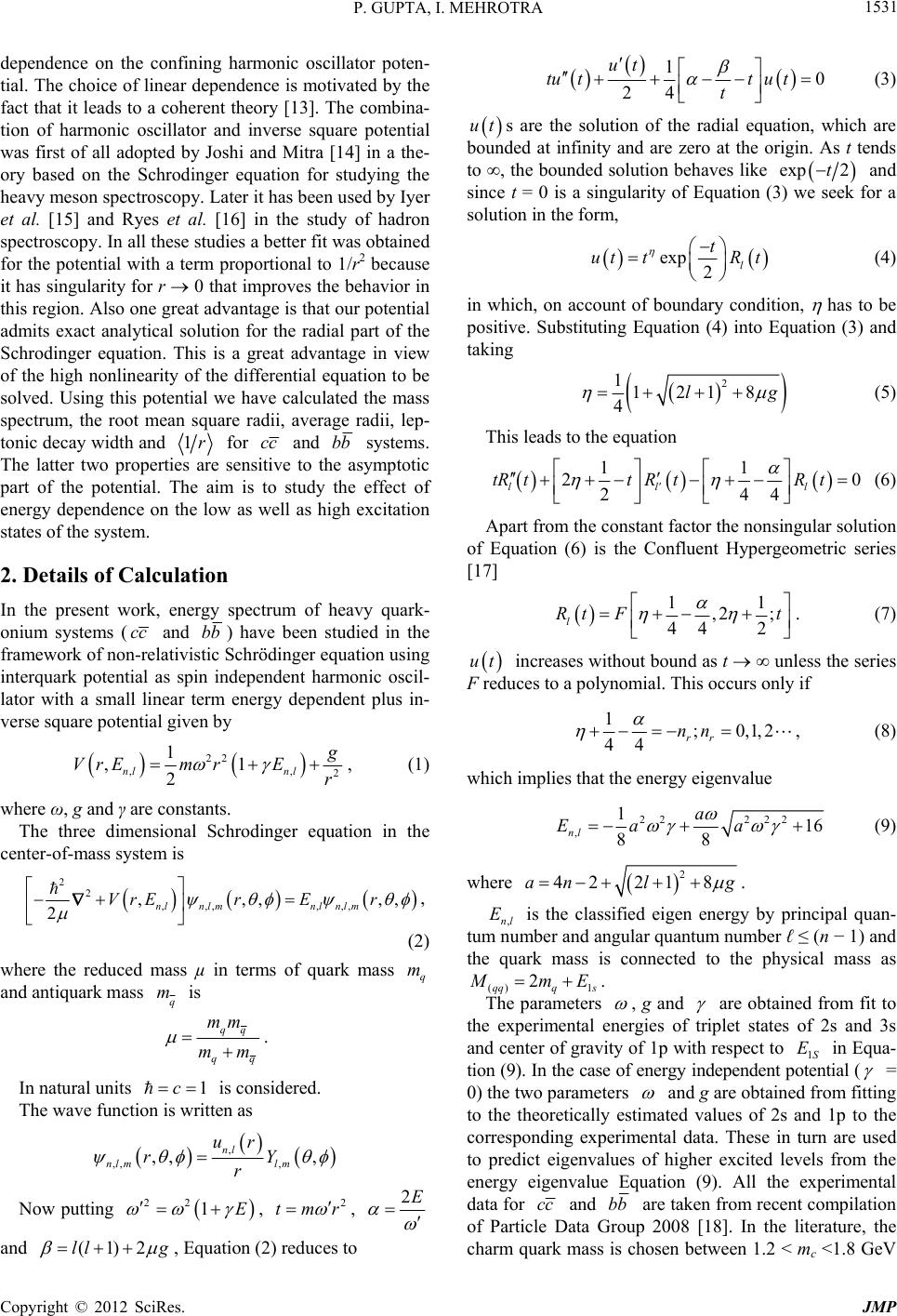 P. GUPTA, I. MEHROTRA 1531 dependence on the confining harmonic oscillator poten- tial. The choice of linear dependence is motivated by the fact that it leads to a coherent theory [13]. The combina- tion of harmonic oscillator and inverse square potential was first of all adopted by Joshi and Mitra [14] in a the- ory based on the Schrodinger equation for studying the heavy meson spectroscopy. Later it has been used by Iyer et al. [15] and Ryes et al. [16] in the study of hadron spectroscopy. In all these studies a better fit was obtained for the potential with a term proportional to 1/r2 because it has singularity for r 0 that improves the behavior in this region. Also one great advantage is that our potential admits exact analytical solution for the radial part of the Schrodinger equation. This is a great advantage in view of the high nonlinearity of the differential equation to be solved. Using this potential we have calculated the mass spectrum, the root mean square radii, average radii, lep- tonic decay width and 1r for cc and bb systems. The latter two properties are sensitive to the asymptotic part of the potential. The aim is to study the effect of energy dependence on the low as well as high excitation states of the system. 2. Details of Calculation In the present work, energy spectrum of heavy quark- onium systems (cc and bb ) have been studied in the framework of non-relativistic Schrödinger equation using interquark potential as spin independent harmonic oscil- lator with a small linear term energy dependent plus in- verse square potential given by 22 ,, 2 1 ,1 2 nl nl g VrEm rEr , (1) where ω, g and γ are constants. The three dimensional Schrodinger equation in the center-of-mass system is 2 2 ,,, ,,, ,,, 2nlnlmnl nlm VrEr Er ,, , (2) where the reduced mass µ in terms of quark mass and antiquark mass q m q m is qq qq mm mm . In natural units is considered. 1c The wave function is written as , ,, , ,, , nl nlm lm ur rY r Now putting 22 1E , 2 tmr , 2E and (1ll )2g , Equation (2) reduces to 10 24 ut tuttu t t (3) ut s are the solution of the radial equation, which are bounded at infinity and are zero at the origin. As t tends to , the bounded solution behaves like exp 2t and since t = 0 is a singularity of Equation (3) we seek for a solution in the form, exp 2l t uttRt (4) in which, on account of boundary condition, has to be positive. Substituting Equation (4) into Equation (3) and taking 2 11218 4lg (5) This leads to the equation 11 20 244 ll tR ttRtR t l (6) Apart from the constant factor the nonsingular solution of Equation (6) is the Confluent Hypergeometric series [17] 11 ,2 ; 44 2 l Rt Ft . (7) ut increases without bound as t unless the series F reduces to a polynomial. This occurs only if 1;0,1,2 44 rr nn , (8) which implies that the energy eigenvalue 22 222 , 116 88 nl a Ea a (9) where 2 4221 8an lg . ,nl is the classified eigen energy by principal quan- tum number and angular quantum number ℓ ≤ (n − 1) and the quark mass is connected to the physical mass as E qq() 1q s 2 M mE . The parameters , g and are obtained from fit to the experimental energies of triplet states of 2s and 3s and center of gravity of 1p with respect to 1S in Equa- tion (9). In the case of energy independent potential ( E = 0) the two parameters and g are obtained from fitting to the theoretically estimated values of 2s and 1p to the corresponding experimental data. These in turn are used to predict eigenvalues of higher excited levels from the energy eigenvalue Equation (9). All the experimental data for cc and bb are taken from recent compilation of Particle Data Group 2008 [18]. In the literature, the charm quark mass is chosen between 1.2 < mc <1.8 GeV Copyright © 2012 SciRes. JMP 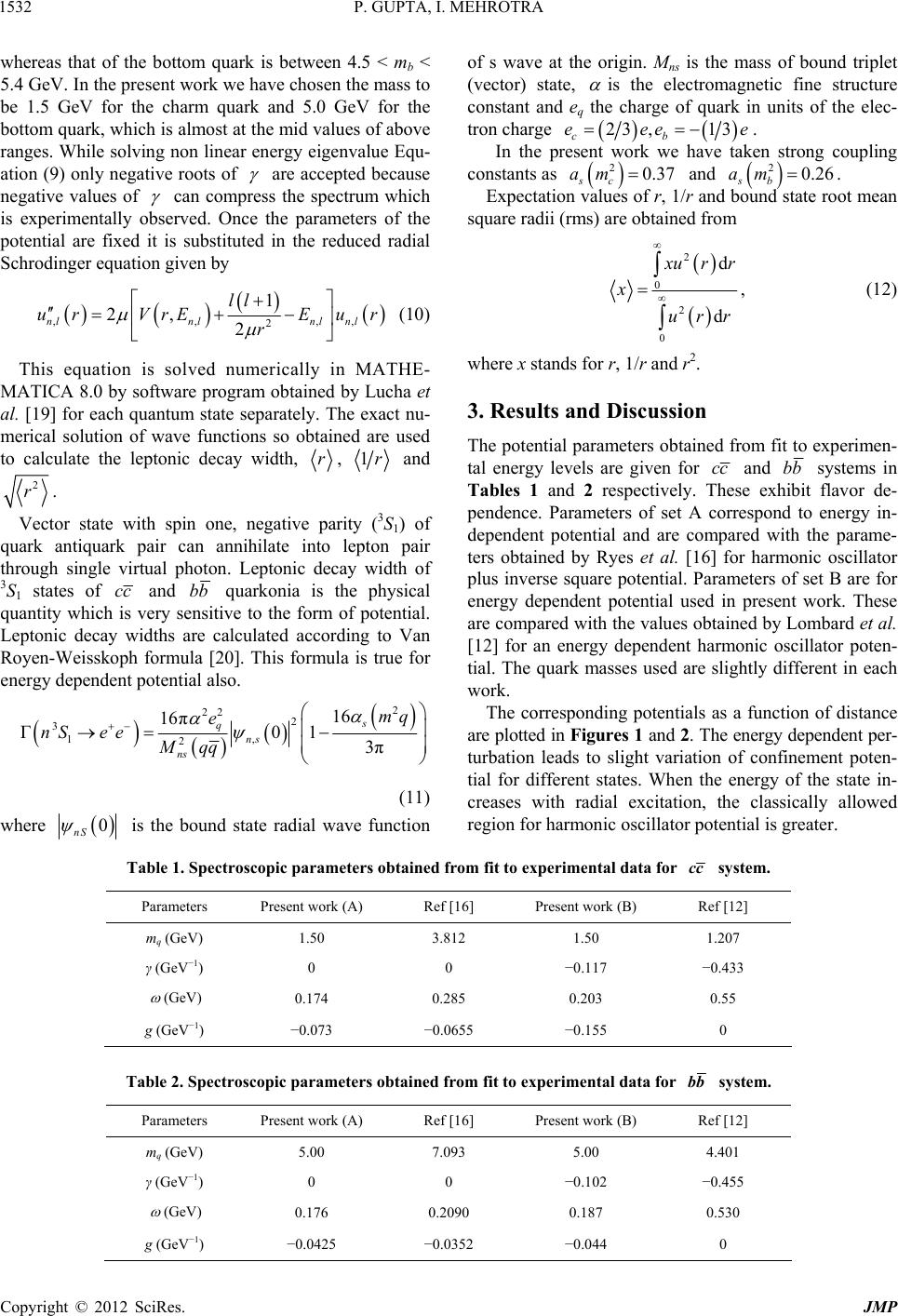 P. GUPTA, I. MEHROTRA Copyright © 2012 SciRes. JMP 1532 whereas that of the bottom quark is between 4.5 < mb < 5.4 GeV. In the present work we have chosen the mass to be 1.5 GeV for the charm quark and 5.0 GeV for the bottom quark, which is almost at the mid values of above ranges. While solving non linear energy eigenvalue Equ- ation (9) only negative roots of are accepted because negative values of can compress the spectrum which is experimentally observed. Once the parameters of the potential are fixed it is substituted in the reduced radial Schrodinger equation given by of s wave at the origin. Mns is the mass of bound triplet (vector) state, is the electromagnetic fine structure constant and eq the charge of quark in units of the elec- tron charge ,,, 2 1 , 2 nlnlnl nl ur rE Eur 2,Vll r (10) This equation is solved numerically in MATHE- MATICA 8.0 by software program obtained by Lucha et al. [19] for each quantum state separately. The exact nu- merical solution of wave functions so obtained are used to calculate the leptonic decay width, r, 1r and 2 r. Vector state with spin one, negative parity (3S1) of quark antiquark pair can annihilate into lepton pair through single virtual photon. Leptonic decay width of 3S1 states of cc and bb quarkonia is the physical quantity which is very sensitive to the form of potential. Leptonic decay widths are calculated according to Van Royen-Weisskoph formula [20]. This formula is true for energy dependent potential also. 2 22 2 3 1, ns 2 16 π Γ01 3π s q ns mq e nS eeMqq 16 (11) where 0 nS is the bound state radial wave function 23 ,13eee e cb In the present work we have taken strong coupling constants as . 20.37 sc am and . 20.26 sb am Expectation values of r, 1/r and bound state root mean square radii (rms) are obtained from 2 0 2 0 d d x urr x urr , (12) where x stands for r, 1/r and r2. 3. Results and Discussion The potential parameters obtained from fit to experimen- tal energy levels are given for cc and bb systems in Tables 1 and 2 respectively. These exhibit flavor de- pendence. Parameters of set A correspond to energy in- dependent potential and are compared with the parame- ters obtained by Ryes et al. [16] for harmonic oscillator plus inverse square potential. Parameters of set B are for energy dependent potential used in present work. These are compared with the values obtained by Lombard et al. [12] for an energy dependent harmonic oscillator poten- tial. The quark masses used are slightly different in each work. The corresponding potentials as a function of distance are plotted in Figures 1 and 2. The energy dependent per- turbation leads to slight variation of confinement poten- tial for different states. When the energy of the state in- creases with radial excitation, the classically allowed region for harmonic oscillator potential is greater. Table 1. Spectroscopic parameters obtained from fit to experimental data for cc system. Parameters Present work (A) Ref [16] Present work (B) Ref [12] mq (GeV) 1.50 3.812 1.50 1.207 γ (GeV−1) 0 0 −0.117 −0.433 (GeV) 0.174 0.285 0.203 0.55 g (GeV−1) −0.073 −0.0655 −0.155 0 Table 2. Spectroscopic parameters obtained from fit to experimental data for bb system. Parameters Present work (A) Ref [16] Present work (B) Ref [12] mq (GeV) 5.00 7.093 5.00 4.401 γ (GeV−1) 0 0 −0.102 −0.455 (GeV) 0.176 0.2090 0.187 0.530 g (GeV−1) −0.0425 −0.0352 −0.044 0 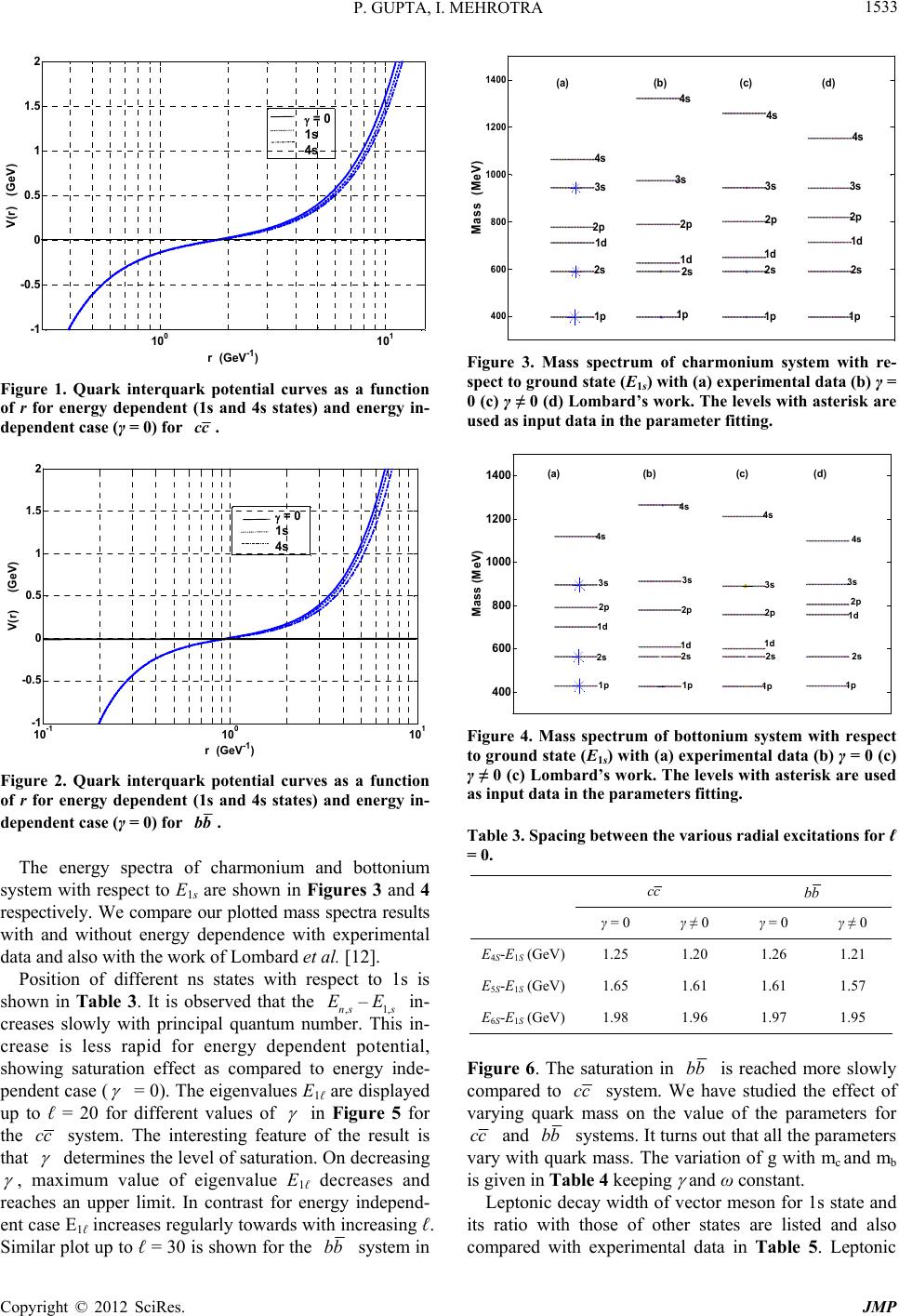 P. GUPTA, I. MEHROTRA 1533 10 0 10 1 -1 -0.5 0 0.5 1 1.5 2 r (GeV -1 ) V(r) (GeV) = 0 1s 4s Figure 1. Quark interquark potential curves as a function of r for energy dependent (1s and 4s states) and energy in- dependent case (γ = 0) for cc . 10 -1 10 0 10 1 -1 -0.5 0 0.5 1 1.5 2 r (GeV -1 ) V(r) (GeV) = 0 1s 4s Figure 2. Quark interquark potential curves as a function of r for energy dependent (1s and 4s states) and energy in- dependent case (γ = 0) for bb . The energy spectra of charmonium and bottonium system with respect to E1s are shown in Figures 3 and 4 respectively. We compare our plotted mass spectra results with and without energy dependence with experimental data and also with the work of Lombard et al. [12]. Position of different ns states with respect to 1s is shown in Table 3. It is observed that the ,1, in- creases slowly with principal quantum number. This in- crease is less rapid for energy dependent potential, showing saturation effect as compared to energy inde- pendent case ( – ns s EE = 0). The eigenvalues E1ℓ are displayed up to ℓ = 20 for different values of in Figure 5 for the cc system. The interesting feature of the result is that determines the level of saturation. On decreasing , maximum value of eigenvalue E1ℓ decreases and reaches an upper limit. In contrast for energy independ- ent case E1ℓ increases regularly towards with increasing ℓ. Similar plot up to ℓ = 30 is shown for the bb system in 400 600 800 1000 1200 1400 Mass (MeV) 1p 1p 1p 2s 2s 2s 2s 1d 1d 1d 1d 2p 2p 2p 2p 3s 3s 3s 3s 4s 4s 4s 4s (a) (b) (c) (d) 1p Figure 3. Mass spectrum of charmonium system with re- spect to ground state (E1s) with (a) experimental data (b) γ = 0 (c) γ ≠ 0 (d) Lombard’s work. The levels with asterisk are used as input data in the parameter fitting. 400 600 800 1000 1200 1400 Ma ss (M eV) (a) (b) (c) (d) 2s 2s 2s 1p 1p 1d 1d 1d 2p 2p 2p 3s 3s 3s 4s 4s 4s 4s 2s 1d 3s 1p 2p 1p Figure 4. Mass spectrum of bottonium system with respect to ground state (E1s) with (a) experimental data (b) γ = 0 (c) γ ≠ 0 (c) Lombard’s work. The levels with asterisk are used as input data in the parameters fitting. Table 3. Spacing between the various radial excitations for ℓ = 0. cc bb γ = 0 γ ≠ 0 γ = 0 γ ≠ 0 E4S-E1S (GeV)1.25 1.20 1.26 1.21 E5S-E1S (GeV)1.65 1.61 1.61 1.57 E6S-E1S (GeV)1.98 1.96 1.97 1.95 Figure 6. The saturation in bb is reached more slowly compared to cc system. We have studied the effect of varying quark mass on the value of the parameters for cc and bb systems. It turns out that all the parameters vary with quark mass. The variation of g with mc and mb is given in Table 4 keeping and ω constant. Leptonic decay width of vector meson for 1s state and its ratio with those of other states are listed and also compared with experimental data in Table 5. Leptonic Copyright © 2012 SciRes. JMP 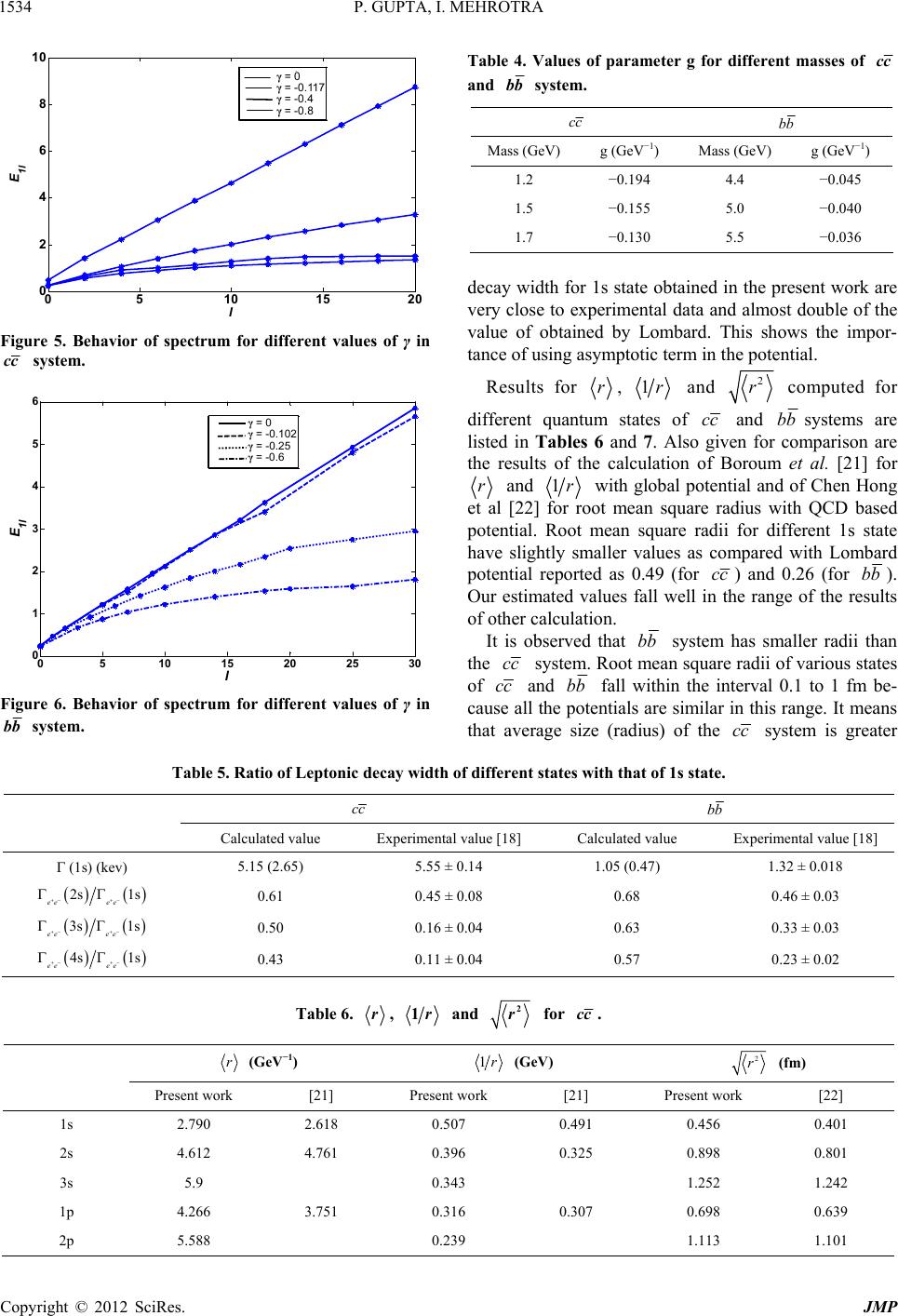 P. GUPTA, I. MEHROTRA 1534 05 10 15 20 0 2 4 6 8 10 l E1l = 0 = -.117 = -.4 = -.8 γ = 0 γ = -0.117 γ = -0.4 γ = -0.8 Figure 5. Behavior of spectrum for different values of γ in cc system. 05 10 15 20 25 30 0 1 2 3 4 5 6 l E 1l = 0 = -.102 = -.25 = -.6 γ = 0 γ = -0.102 γ = -0.25 γ = -0.6 Figure 6. Behavior of spectrum for different values of γ in bb system. Table 4. Values of parameter g for different masses of cc and bb system. cc bb Mass (GeV) g (GeV−1) Mass (GeV) g (GeV−1) 1.2 −0.194 4.4 −0.045 1.5 −0.155 5.0 −0.040 1.7 −0.130 5.5 −0.036 decay width for 1s state obtained in the present work are very close to experimental data and almost double of the value of obtained by Lombard. This shows the impor- tance of using asymptotic term in the potential. Results for r, 1r and 2 r computed for different quantum states of cc and bb systems are listed in Tables 6 and 7. Also given for comparison are the results of the calculation of Boroum et al. [21] for r and 1r with global potential and of Chen Hong et al [22] for root mean square radius with QCD based potential. Root mean square radii for different 1s state have slightly smaller values as compared with Lombard potential reported as 0.49 (for cc ) and 0.26 (for bb ). Our estimated values fall well in the range of the results of other calculation. It is observed that bb system has smaller radii than the cc system. Root mean square radii of various states of cc and bb fall within the interval 0.1 to 1 fm be- cause all the potentials are similar in this range. It means that average size (radius) of the cc system is greater Table 5. Ratio of Leptonic decay width of different states with that of 1s state. cc bb Calculated value Experimental value [18] Calculated value Experimental value [18] (1s) (kev) 5.15 (2.65) 5.55 ± 0.14 1.05 (0.47) 1.32 ± 0.018 2s 1s ee ee 0.61 0.45 ± 0.08 0.68 0.46 ± 0.03 3s 1s ee ee 0.50 0.16 ± 0.04 0.63 0.33 ± 0.03 4s 1s ee ee 0.43 0.11 ± 0.04 0.57 0.23 ± 0.02 Table 6. r, 1r and 2 r for cc . r (GeV−1) 1r (GeV) 2 r (fm) Present work [21] Present work [21] Present work [22] 1s 2.790 2.618 0.507 0.491 0.456 0.401 2s 4.612 4.761 0.396 0.325 0.898 0.801 3s 5.9 0.343 1.252 1.242 1p 4.266 3.751 0.316 0.307 0.698 0.639 2p 5.588 0.239 1.113 1.101 Copyright © 2012 SciRes. JMP 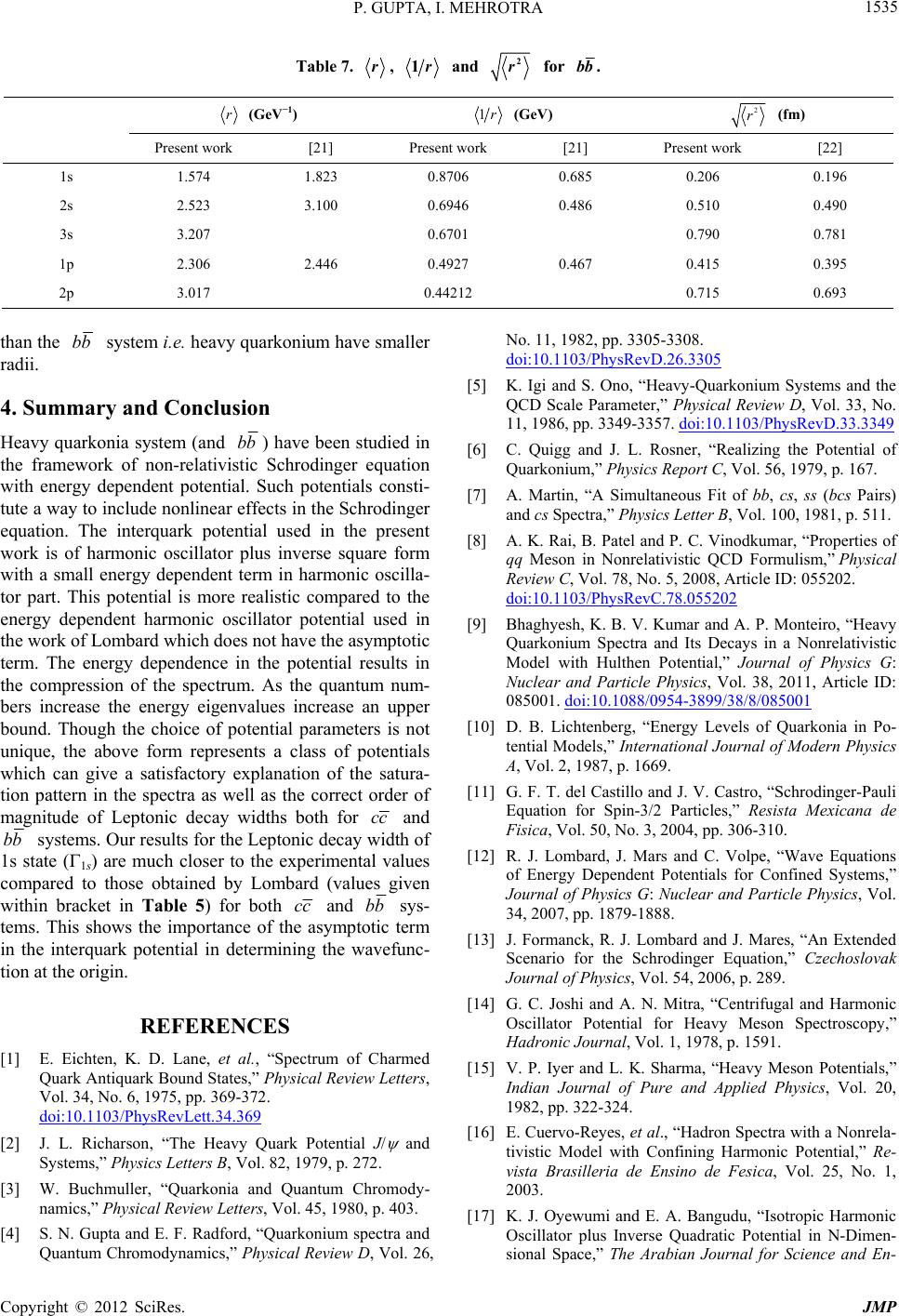 P. GUPTA, I. MEHROTRA 1535 Table 7. r, 1r and 2 r for bb . r (GeV−1) 1r (GeV) 2 r (fm) Present work [21] Present work [21] Present work [22] 1s 1.574 1.823 0.8706 0.685 0.206 0.196 2s 2.523 3.100 0.6946 0.486 0.510 0.490 3s 3.207 0.6701 0.790 0.781 1p 2.306 2.446 0.4927 0.467 0.415 0.395 2p 3.017 0.44212 0.715 0.693 than the bb system i.e. heavy quarkonium have smaller radii. 4. Summary and Conclusion Heavy quarkonia system (and bb) have been studied in the framework of non-relativistic Schrodinger equation with energy dependent potential. Such potentials consti- tute a way to include nonlinear effects in the Schrodinger equation. The interquark potential used in the present work is of harmonic oscillator plus inverse square form with a small energy dependent term in harmonic oscilla- tor part. This potential is more realistic compared to the energy dependent harmonic oscillator potential used in the work of Lombard which does not have the asymptotic term. The energy dependence in the potential results in the compression of the spectrum. As the quantum num- bers increase the energy eigenvalues increase an upper bound. Though the choice of potential parameters is not unique, the above form represents a class of potentials which can give a satisfactory explanation of the satura- tion pattern in the spectra as well as the correct order of magnitude of Leptonic decay widths both for cc and bb systems. Our results for the Leptonic decay width of 1s state (1s) are much closer to the experimental values compared to those obtained by Lombard (values given within bracket in Table 5) for both cc and bb sys- tems. This shows the importance of the asymptotic term in the interquark potential in determining the wavefunc- tion at the origin. REFERENCES [1] E. Eichten, K. D. Lane, et al., “Spectrum of Charmed Quark Antiquark Bound States,” Physical Review Letters, Vol. 34, No. 6, 1975, pp. 369-372. doi:10.1103/PhysRevLett.34.369 [2] J. L. Richarson, “The Heavy Quark Potential J/ and Systems,” Physics Letters B, Vol. 82, 1979, p. 272. [3] W. Buchmuller, “Quarkonia and Quantum Chromody- namics,” Physical Review Letters, Vol. 45, 1980, p. 403. [4] S. N. Gupta and E. F. Radford, “Quarkonium spectra and Quantum Chromodynamics,” Physical Review D, Vol. 26, No. 11, 1982, pp. 3305-3308. doi:10.1103/PhysRevD.26.3305 [5] K. Igi and S. Ono, “Heavy-Quarkonium Systems and the QCD Scale Parameter,” Physical Review D, Vol. 33, No. 11, 1986, pp. 3349-3357. doi:10.1103/PhysRevD.33.3349 [6] C. Quigg and J. L. Rosner, “Realizing the Potential of Quarkonium,” Physics Report C, Vol. 56, 1979, p. 167. [7] A. Martin, “A Simultaneous Fit of bb, cs, ss (bcs Pairs) and cs Spectra,” Physics Letter B, Vol. 100, 1981, p. 511. [8] A. K. Rai, B. Patel and P. C. Vinodkumar, “Properties of qq Meson in Nonrelativistic QCD Formulism,” Physical Review C, Vol. 78, No. 5, 2008, Article ID: 055202. doi:10.1103/PhysRevC.78.055202 [9] Bhaghyesh, K. B. V. Kumar and A. P. Monteiro, “Heavy Quarkonium Spectra and Its Decays in a Nonrelativistic Model with Hulthen Potential,” Journal of Physics G: Nuclear and Particle Physics, Vol. 38, 2011, Article ID: 085001. doi:10.1088/0954-3899/38/8/085001 [10] D. B. Lichtenberg, “Energy Levels of Quarkonia in Po- tential Models,” International Journal of Modern Physics A, Vol. 2, 1987, p. 1669. [11] G. F. T. del Castillo and J. V. Castro, “Schrodinger-Pauli Equation for Spin-3/2 Particles,” Resista Mexicana de Fisica, Vol. 50, No. 3, 2004, pp. 306-310. [12] R. J. Lombard, J. Mars and C. Volpe, “Wave Equations of Energy Dependent Potentials for Confined Systems,” Journal of Physics G: Nuclear and Particle Physics, Vol. 34, 2007, pp. 1879-1888. [13] J. Formanck, R. J. Lombard and J. Mares, “An Extended Scenario for the Schrodinger Equation,” Czechoslovak Journal of Physics, Vol. 54, 2006, p. 289. [14] G. C. Joshi and A. N. Mitra, “Centrifugal and Harmonic Oscillator Potential for Heavy Meson Spectroscopy,” Hadronic Journal, Vol. 1, 1978, p. 1591. [15] V. P. Iyer and L. K. Sharma, “Heavy Meson Potentials,” Indian Journal of Pure and Applied Physics, Vol. 20, 1982, pp. 322-324. [16] E. Cuervo-Reyes, et al., “Hadron Spectra with a Nonrela- tivistic Model with Confining Harmonic Potential,” Re- vista Brasilleria de Ensino de Fesica, Vol. 25, No. 1, 2003. [17] K. J. Oyewumi and E. A. Bangudu, “Isotropic Harmonic Oscillator plus Inverse Quadratic Potential in N-Dimen- sional Space,” The Arabian Journal for Science and En- Copyright © 2012 SciRes. JMP  P. GUPTA, I. MEHROTRA 1536 gineering, Vol. 28, No. 2A, 2003, p. 173. [18] C. Ansler, et al., “Particle Data Group,” Physics Letters B, Vol. 667, 2008, Article ID: 010001. http://pdg.lbl.gov. [19] F. F. Schoberl and W. Lucha, “Solving the Schroedinger Equation for Bound States with Mathematica,” Interna- tional Journal of Modern Physics C, Vol. 10, 1999, pp. 607-620. [20] R. Van Royen and V. F. Weisskoph, “Vector Meson Leptonic Decay Width,” Il Nuovo Cimento A, Vol. 50, No. 3, 1967, pp. 617-645. doi:10.1007/BF02823542 [21] G. R. Boroum and H. Abdolmalki, “Variational and Exact Solutions of the Wavefunction at Origin (WFO) for Hea- vy Quarkonium by Using a Global Potential,” Physica Scripta, Vol. 80, 2009, Article ID: 065003. [22] H. Chen, J. Zhang, Y.-B. Dong and P.-N. Shen, “Heavy Quarkonium Spectra in a Quark Potential Model,” Chi- nese Physics Letters, Vol. 18, No. 12, 2001, p. 1558. doi:10.1088/0256-307X/18/12/305 Copyright © 2012 SciRes. JMP |