

Paper Menu >>
Journal Menu >>
 Open Journal of Psychiatry, 2012, 2, 258-261 OJPsych http://dx.doi.org/10.4236/ojpsych.2012.24035 Published Online October 2012 (http://www.SciRP.org/journal/ojpsych/) Bipolar I disorder and expressed emotion of families: A cohort study in Japan Shinji Shimodera1*, Yukiko Yonekura2, Sosei Yamaguchi3, Aoi Kawamura1, Masafumi Mizuno4, Shimpei Inoue1, Toshi A. Furukawa5, Yoshio Mino6 1Department of Neuropsychiatry, Kochi Medical School, Kochi University, Kochi, Japan 2Department of Social Welfare, Kansai University of Social Welfare, Hyogo, Japan 3Department of Psychiatric Rehabilitation, National Institute of Mental Health, National Center of Neurology and Psychiatry, Tokyo, Japan 4Department of Neuropsychiatry, Toho University School of Medicine, Tokyo, Japan 5Department of Cognitive-Behavioral Medicine, Kyoto University Graduate School of Medicine/School of Public Health, Kyoto, Japan 6Department of Psychiatry, Mino Clinic, Okayama, Japan Email: *[email protected] Received 4 September 2012; revised 1 October 2012; accepted 9 October 2012 ABSTRACT The relationships between expressed emotion (EE) of the families and the course of bipolar disorder have been examined only in a limited number of cohort studies. No study has yet been reported from Asia. The subjects were 12 patients that had been diag- nosed with bipolar I disorder according to DSM-IV and their 12 key family members. The families of the patients were interviewed using the Camberwell Fa- mily Interview (CFI) within 2 weeks of the admission of the patients, and their EE were evaluated. The pa- tients were then followed up for 9 months after their discharge from the hospital. The patients were di- vided into a high-EE group and a low-EE group using the cut-off based on the number of critical comments (CC) and emotional overinvolvement (EOI), and the 9-month relapse risk was compared. When the sub- jects with 3 or more CC or an EOI score of 3 or more were regarded as the high-EE group, and the others as the low-EE group, the 9-month relapse risk was 100% (3/3) for the high EE group and 0% (0/9) for the low EE group. (Fisher’s exact test p = 0.005) EE based on the CFI appear to be correlated with relapse in bipolar I disorder in Japan. Keywords: Expressed Emotion; Family; Bipolar Disorder 1. INTRODUCTION The expressed emotion (EE) of families of patients has been studied in schizophrenia, and its effects on the course of the disease have been confirmed in a number of world regions [1,2]. The relationships between fami- lies’ EE and relapse of schizophrenia, social functions, and depressive symptoms have also been clarified in Japan, which has a different culture than Western socie- ties [3-5]. Studies on the relationships of EE with mood disorders such as depression have also been reported [6-9], and a similar study has been reported from Japan [10]. Bipolar disorders are thought to have a weaker rela- tionship with familial stress than other mental disorder including depression [11]. However, there have been a few EE studies that suggest that families’ EE effects on the course of this illness [7,8]. This suggest that “stress vulnerability model” may be applicable in bipolar disor- der. However, there has been no study from Asia on this topic. Bipolar disorder is an important mood disorder. Epi- demiologically, lifetime risk of bipolar I disorder has varied from 0.4% to 1.6%, and it is a recurrent disorder. Life time risk of bipolar II disorder is 0.5% [12]. Social cost for the disorders has been considerable [13]. There- fore it is important to clarify factors that affect the course of the disorder. The purpose of the current study is to evaluate the re- lationships between families’ EE and the course of bipo- lar I disorder using a cohort study design in Japan. 2. METHODS 2.1. Subjects and Procedure Consecutive patients with bipolar I disorder admitted to the department of neuropsychiatry, Kochi Medical School between April, 1997 and April, 2002 and their *Corresponding author. OPEN ACCESS 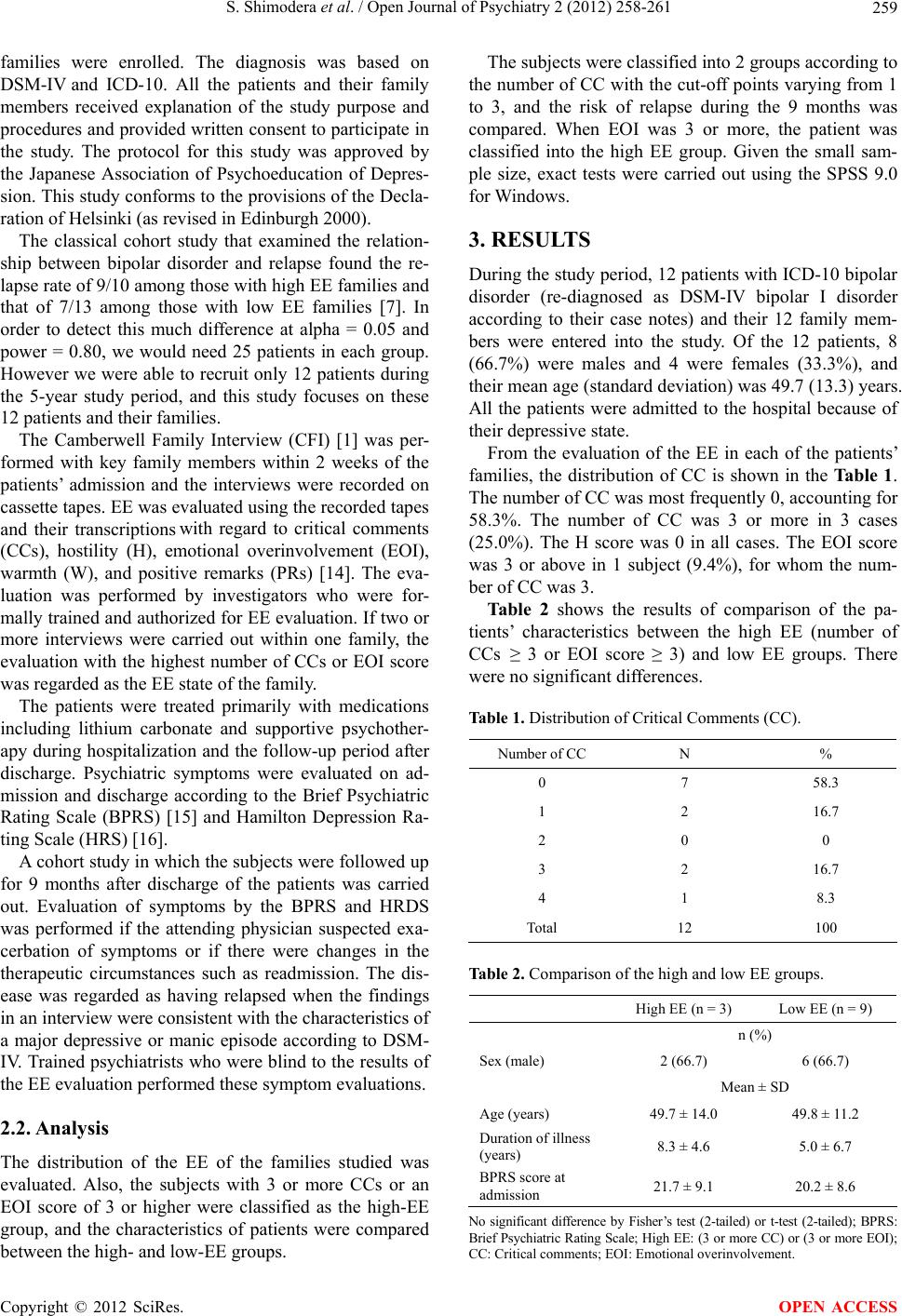 S. Shimodera et al. / Open Journal of Psychiatry 2 (2012) 258-261 259 families were enrolled. The diagnosis was based on DSM-IV and ICD-10. All the patients and their family members received explanation of the study purpose and procedures and provided written consent to participate in the study. The protocol for this study was approved by the Japanese Association of Psychoeducation of Depres- sion. This study conforms to the provisions of the Decla- ration of Helsinki (as revised in Edinburgh 2000). The classical cohort study that examined the relation- ship between bipolar disorder and relapse found the re- lapse rate of 9/10 among those with high EE families and that of 7/13 among those with low EE families [7]. In order to detect this much difference at alpha = 0.05 and power = 0.80, we would need 25 patients in each group. However we were able to recruit only 12 patients during the 5-year study period, and this study focuses on these 12 patients and their families. The Camberwell Family Interview (CFI) [1] was per- formed with key family members within 2 weeks of the patients’ admission and the interviews were recorded on cassette tapes. EE was evaluated using the recorded tapes and their transcriptions with regard to critical comments (CCs), hostility (H), emotional overinvolvement (EOI), warmth (W), and positive remarks (PRs) [14]. The eva- luation was performed by investigators who were for- mally trained and authorized for EE evaluation. If two or more interviews were carried out within one family, the evaluation with the highest number of CCs or EOI score was regarded as the EE state of the family. The patients were treated primarily with medications including lithium carbonate and supportive psychother- apy during hospitalization and the follow-up period after discharge. Psychiatric symptoms were evaluated on ad- mission and discharge according to the Brief Psychiatric Rating Scale (BPRS) [15] and Hamilton Depression Ra- ting Scale (HRS) [16]. A cohort study in which the subjects were followed up for 9 months after discharge of the patients was carried out. Evaluation of symptoms by the BPRS and HRDS was performed if the attending physician suspected exa- cerbation of symptoms or if there were changes in the therapeutic circumstances such as readmission. The dis- ease was regarded as having relapsed when the findings in an interview were consistent with the characteristics of a major depressive or manic episode according to DSM- IV. Trained psychiatrists who were blind to the results of the EE evaluation performed these symptom evaluations. 2.2. Analysis The distribution of the EE of the families studied was evaluated. Also, the subjects with 3 or more CCs or an EOI score of 3 or higher were classified as the high-EE group, and the characteristics of patients were compared between the high- and low-EE groups. The subjects were classified into 2 groups according to the number of CC with the cut-off points varying from 1 to 3, and the risk of relapse during the 9 months was compared. When EOI was 3 or more, the patient was classified into the high EE group. Given the small sam- ple size, exact tests were carried out using the SPSS 9.0 for Windows. 3. RESULTS During the study period, 12 patients with ICD-10 bipolar disorder (re-diagnosed as DSM-IV bipolar I disorder according to their case notes) and their 12 family mem- bers were entered into the study. Of the 12 patients, 8 (66.7%) were males and 4 were females (33.3%), and their mean age (standard deviation) was 49.7 (13.3) years. All the patients were admitted to the hospital because of their depressive state. From the evaluation of the EE in each of the patients’ families, the distribution of CC is shown in the Tabl e 1 . The number of CC was most frequently 0, accounting for 58.3%. The number of CC was 3 or more in 3 cases (25.0%). The H score was 0 in all cases. The EOI score was 3 or above in 1 subject (9.4%), for whom the num- ber of CC was 3. Table 2 shows the results of comparison of the pa- tients’ characteristics between the high EE (number of CCs ≥ 3 or EOI score ≥ 3) and low EE groups. There were no significant differences. Table 1. Distribution of Critical Comments (CC). Number of CC N % 0 7 58.3 1 2 16.7 2 0 0 3 2 16.7 4 1 8.3 Total 12 100 Table 2. Comparison of the high and low EE groups. High EE (n = 3) Low EE (n = 9) n (%) Sex (male) 2 (66.7) 6 (66.7) Mean ± SD Age (years) 49.7 ± 14.0 49.8 ± 11.2 Duration of illness (years) 8.3 ± 4.6 5.0 ± 6.7 BPRS score at admission 21.7 ± 9.1 20.2 ± 8.6 No significant difference by Fisher’s test (2-tailed) or t-test (2-tailed); BPRS: Brief Psychiatric Rating Scale; High EE: (3 or more CC) or (3 or more EOI); CC: Critical comments; EOI: Emotional overinvolvement. Copyright © 2012 SciRes. OPEN ACCESS 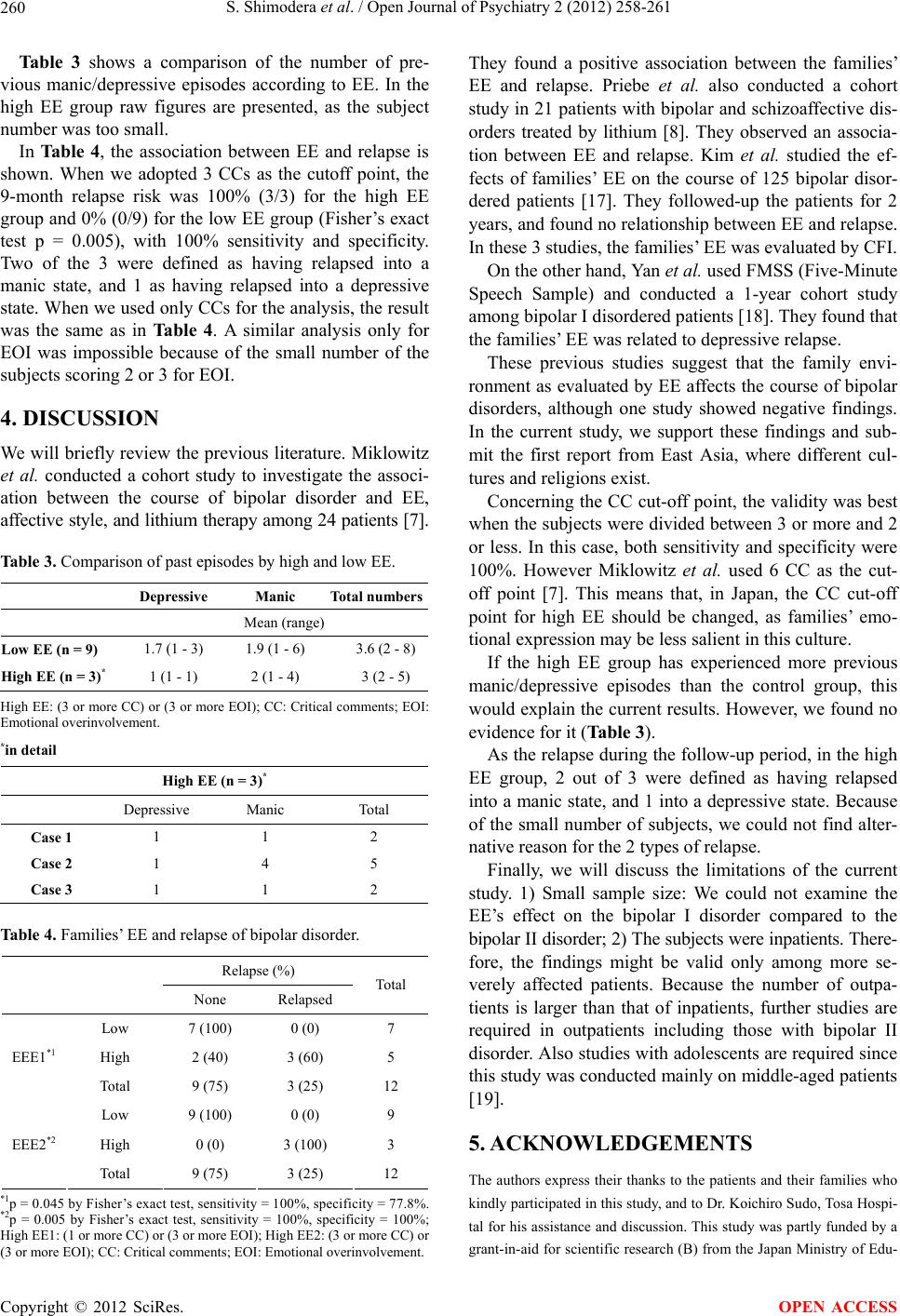 S. Shimodera et al. / Open Journal of Psychiatry 2 (2012) 258-261 260 Table 3 shows a comparison of the number of pre- vious manic/depressive episodes according to EE. In the high EE group raw figures are presented, as the subject number was too small. In Ta b le 4, the association between EE and relapse is shown. When we adopted 3 CCs as the cutoff point, the 9-month relapse risk was 100% (3/3) for the high EE group and 0% (0/9) for the low EE group (Fisher’s exact test p = 0.005), with 100% sensitivity and specificity. Two of the 3 were defined as having relapsed into a manic state, and 1 as having relapsed into a depressive state. When we used only CCs for the analysis, the result was the same as in Ta b l e 4 . A similar analysis only for EOI was impossible because of the small number of the subjects scoring 2 or 3 for EOI. 4. DISCUSSION We will briefly review the previous literature. Miklowitz et al. conducted a cohort study to investigate the associ- ation between the course of bipolar disorder and EE, affective style, and lithium therapy among 24 patients [7]. Table 3. Comparison of past episodes by high and low EE. Depressive Manic Total numbers Mean (range) Low EE (n = 9) 1.7 (1 - 3) 1.9 (1 - 6) 3.6 (2 - 8) High EE (n = 3)* 1 (1 - 1) 2 (1 - 4) 3 (2 - 5) High EE: (3 or more CC) or (3 or more EOI); CC: Critical comments; EOI: Emotional overinvolvement. *in detail High EE (n = 3)* Depressive Manic Total Case 1 1 1 2 Case 2 1 4 5 Case 3 1 1 2 Table 4. Families’ EE and relapse of bipolar disorder. Relapse (%) None Relapsed Total Low 7 (100) 0 (0) 7 High 2 (40) 3 (60) 5 EEE1*1 Total 9 (75) 3 (25) 12 Low 9 (100) 0 (0) 9 High 0 (0) 3 (100) 3 EEE2*2 Total 9 (75) 3 (25) 12 *1p = 0.045 by Fisher’s exact test, sensitivity = 100%, specificity = 77.8%. *2p = 0.005 by Fisher’s exact test, sensitivity = 100%, specificity = 100%; High EE1: (1 or more CC) or (3 or more EOI); High EE2: (3 or more CC) or (3 or more EOI); CC: Critical comments; EOI: Emotional overinvolvement. They found a positive association between the families’ EE and relapse. Priebe et al. also conducted a cohort study in 21 patients with bipolar and schizoaffective dis- orders treated by lithium [8]. They observed an associa- tion between EE and relapse. Kim et al. studied the ef- fects of families’ EE on the course of 125 bipolar disor- dered patients [17]. They followed-up the patients for 2 years, and found no relationship between EE and relapse. In these 3 studies, the families’ EE was evaluated by CFI. On the other hand, Yan et al. used FMSS (Five-Minute Speech Sample) and conducted a 1-year cohort study among bipolar I disordered patients [18]. They found that the families’ EE was related to depressive relapse. These previous studies suggest that the family envi- ronment as evaluated by EE affects the course of bipolar disorders, although one study showed negative findings. In the current study, we support these findings and sub- mit the first report from East Asia, where different cul- tures and religions exist. Concerning the CC cut-off point, the validity was best when the subjects were divided between 3 or more and 2 or less. In this case, both sensitivity and specificity were 100%. However Miklowitz et al. used 6 CC as the cut- off point [7]. This means that, in Japan, the CC cut-off point for high EE should be changed, as families’ emo- tional expression may be less salient in this culture. If the high EE group has experienced more previous manic/depressive episodes than the control group, this would explain the current results. However, we found no evidence for it (Table 3). As the relapse during the follow-up period, in the high EE group, 2 out of 3 were defined as having relapsed into a manic state, and 1 into a depressive state. Because of the small number of subjects, we could not find alter- native reason for the 2 types of relapse. Finally, we will discuss the limitations of the current study. 1) Small sample size: We could not examine the EE’s effect on the bipolar I disorder compared to the bipolar II disorder; 2) The subjects were inpatients. There- fore, the findings might be valid only among more se- verely affected patients. Because the number of outpa- tients is larger than that of inpatients, further studies are required in outpatients including those with bipolar II disorder. Also studies with adolescents are required since this study was conducted mainly on middle-aged patients [19]. 5. ACKNOWLEDGEMENTS The authors express their thanks to the patients and their families who kindly participated in this study, and to Dr. Koichiro Sudo, Tosa Hospi- tal for his assistance and discussion. This study was partly funded by a grant-in-aid for scientific research (B) from the Japan Ministry of Edu- Copyright © 2012 SciRes. OPEN ACCESS  S. Shimodera et al. / Open Journal of Psychiatry 2 (2012) 258-261 Copyright © 2012 SciRes. 261 [10] Mino, Y., et al. (2001) Expressed emotion of families and the course of mood disorders: A cohort study in Japan. Journal of Affective Disorders, 63, 43-49. doi:10.1016/S0165-0327(00)00185-3 cation, Science, Sports and Culture (grant No. 17390191). REFERENCES [11] Fukuzawa, K., et al. (2011) Family psychoeducation for major depression: Randomized controlled trial. British Journal of Psychiatry, 198, 385-390. doi:10.1192/bjp.bp.110.078626 [1] Leff, J. and Vaughn, C. (1985) Expressed emotion in families. Guilford Press, New York. [2] Butzlaff, R.L. and Hooley, J.M. (1998) Expressed emo- tion and psychiatric relapse, a meta-analysis. Archives of General Psychiatry, 55, 547-552. doi:10.1001/archpsyc.55.6.547 [12] World Health Organization (1992) The ICD-10 classifi- cation of mental and behavioural disorders, clinical de- scription and diagnostic guidelines. WHO, Geneva. [3] Tanaka, S., Mino, Y. and Inoue, S. (1995) Expressed emo- tion and schizophrenic course in Japan. British Journal of Psychiatry, 167, 794-798. doi:10.1192/bjp.167.6.794 [13] American Psychiatric Association (1994) Diagnostic and statistical manual of mental disorders. 4th Edition, APA, Washington DC. [4] Mino, Y., Inoue, S., Tanaka, S. and Tsuda T. (1997) Ex- pressed emotion among families and course of schizo- phrenia in Japan: A 2-year cohort study. Schizophrenia Research, 24, 333-339. doi:10.1016/S0920-9964(96)00129-6 [14] Mino, Y., et al. (1995) Training in evaluation of ex- pressed emotion using the Japanese version of Camber- well Family Interview. Acta Psychiatrica Scandinavica, 92, 183-186. doi:10.1111/j.1600-0447.1995.tb09565.x [15] Overall, J.E. and Gorham, D.R. (1962) The brief psychi- atric rating scale. Psychological Reports, 10, 799-812. doi:10.2466/pr0.1962.10.3.799 [5] Mino, Y., et al. (1998) Expressed emotion of families and negative/depressive symptoms in schizophrenia: A cohort study in Japan. Schizophrenia Research, 34, 159-168. [16] Hamilton, M. (1967) Development of a rating scale for primary depressive illness. British Journal of Social & Clinical Psychology, 6, 278-296. doi:10.1111/j.2044-8260.1967.tb00530.x [6] Hooley, J.M., Orley, J. and Teasdale, J.D. (1986) Levels of expressed emotion and relapse in depressive patients. British Journal of Psychiatry, 148, 642-647. doi:10.1192/bjp.148.6.642 [17] Kim, E.Y. and Miklowitz, D.J. (2004) Expressed emotion as a predictor of outcome among bipolar patients under- going family therapy. Journal of Affective Disorders, 82, 343-352. [7] Miklowitz, D., et al. (1988) Family factors and the course of bipolar affective disorder. Archives of General Psy- chiatry, 45, 225-231. doi:10.1001/archpsyc.1988.01800270033004 [18] Yan, L.J., et al. (2004) Expressed emotion versus rela- tionship quality variables in the prediction of recurrence in bipolar patients. Journal of Affective Disorders, 83, 199-206. doi:10.1016/j.jad.2004.08.006 [8] Priebe, S., Wildgrube, C. and Muller-Oerlinghausen, B. (1989) Lithium prophylaxis and expressed emotion. Brit- ish Journal of Psychiatry, 154, 396-399. doi:10.1192/bjp.154.3.396 [19] Macneil, C., et al. (2011) Psychological needs of adoles- cents in the early phase of bipolar disorder: Implications for early intervention. Early Intervention in Psychiatry, 5, 100-107. doi:10.1111/j.1751-7893.2011.00273.x [9] Okasha, A.E.L., et al. (1994) Expressed emotion, per- ceived, and relapse in depression: A replication in an Egyptian community. American Journal of Psychiatry, 151, 1001-1005. OPEN ACCESS |