

Paper Menu >>
Journal Menu >>
 Journal of Modern Physics, 2012, 3, 1487-1489 http://dx.doi.org/10.4236/jmp.2012.310183 Published Online October 2012 (http://www.SciRP.org/journal/jmp) Observation of Vortex Lattice Related Anomalies in Polycrystalline YBa2Cu3O7−x near the Superconducting Transition S. B. Ota Institute of Physics, Bhubaneswar, India Email: [email protected] Received July 30, 2012; revised August 28, 2012; accepted September 7, 2012 ABSTRACT The d.c. I-V characteristic of polycrystalline YBa2Cu 3O7−x high temperature superconductors (HTSC) is measured near the transition temperature (Tc). The Tc was found to be 90 K with a width of 2 K. The voltage was measured at various current values and with reversing the current. A difference in voltage was found for forward and reverse current direc- tions near Tc. The observed directionality of the I-V characteristic can be understood in terms of quantized magnetic flux by the self-field of the current and the proximity junctions in these materials. This can also be understood qualita- tively as due to the d-wave superconductivity. The measured dc voltage showed increased noise near Tc which is possi- bly related to 1/f noise due to the motion of Abrikosov flux lines. Keywords: HTSC; Transition Temperature; 1/f Noise 1. Introduction Superconducting materials have attracted interest in re- cent years [1-17]. Such materials show negligible elec- trical resistance and magnetic flux exclusion. Electrical and thermal properties of these materials have been stud- ied below 100 K. These materials have technological applications which involve operation across or below the superconducting transition. Superconducting magnets, superconducting switches, temperature standards and switching devices are some examples. The transition temperature of YBa2Cu3O7 which is a high temperature superconductor is about 90 K [8,9,12-16]. The effect of magnetic field on the specific heat anomaly near the su- perconducting transition is considerably different from the effect on conventional superconductors. It has been found that the specific heat peak associated with the su- perconducting transition mainly reduces in amplitude and broadens by the application of magnetic field. This is unlike the type-II conventional superconductors in which case the application of magnetic field shifts the specific heat jump at Tc to lower temperatures with practically very little change in the shape of the anomaly. There are also several other unusual behavior in the HTSC which is not yet understood [18]. Other studies to understand the microscopic filed distribution concerning the supercon- ducting state has been carried out with high-field μSR [19]. Here we note that other materials such as CuO has also been studied in the context of theoretical under- standing of HTSC [20,21]. 2. Experiment Electrical resistance measurement on polycrystalline YBa2Cu3O7 was carried by an automated d.c. four termi- nal technique [16]. This setup is built around a closed cycle refrigerator. The YBa2Cu3O7 sample was in the form of rectangular bar having dimension ≈ 1 × 2 × 11 mm3. The sample was characterized as as been discussed elsewhere [8,9]. The electrical contacts made using silver paste had a resistance of 30 Ohms for the two current leads. The electrical resistance of the sample at 100 K was nearly 0.1 Ohms. The current was varied from 1 mA to 100 mA in steps using a Keithley model 224/2243 programmable current source. The dc voltage was meas- ured using a Keithley model 182 sensitive digital volt- meter. A calibrated type D silicon diode thermometer was used in conjunction with a Leybold model LTC60 temperature controller to control and monitor the tem- perature of the sample site. The calibrated diode has a standard measurement accuracy of about 1 percent. The measurement was done as the sample was warmed from about 70 K. The HTSC has a superconducting transition (Tc) of 90 K and a width of about 2 K. At each tempera- ture the current was increased from 1 mA to 100 mA in steps. For each current value, first the positive polarity of C opyright © 2012 SciRes. JMP 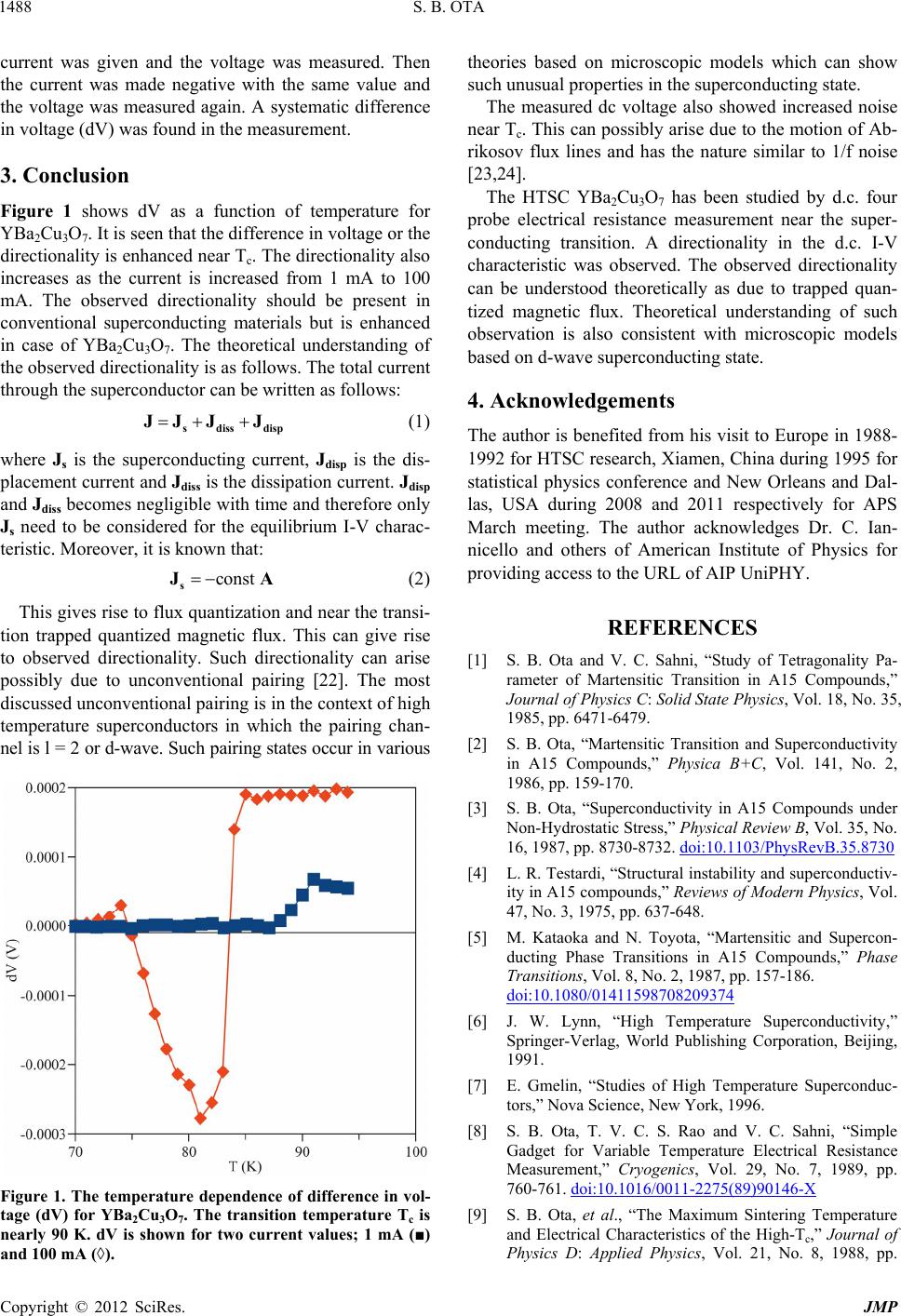 S. B. OTA 1488 current was given and the voltage was measured. Then the current was made negative with the same value and the voltage was measured again. A systematic difference in voltage (dV) was found in the measurement. 3. Conclusion Figure 1 shows dV as a function of temperature for YBa2Cu3O7. It is seen that the difference in voltage or the directionality is enhanced near Tc. The directionality also increases as the current is increased from 1 mA to 100 mA. The observed directionality should be present in conventional superconducting materials but is enhanced in case of YBa2Cu3O7. The theoretical understanding of the observed directionality is as follows. The total current through the superconductor can be written as follows: diss disp J J con st s JA s JJ (1) where Js is the superconducting current, Jdisp is the dis- placement current and Jdiss is the dissipation current. Jdisp and Jdiss becomes negligible with time and therefore only Js need to be considered for the equilibrium I-V charac- teristic. Moreover, it is known that: (2) This gives rise to flux quantization and near the transi- tion trapped quantized magnetic flux. This can give rise to observed directionality. Such directionality can arise possibly due to unconventional pairing [22]. The most discussed unconventional pairing is in the context of high temperature superconductors in which the pairing chan- nel is l = 2 or d-wave. Such pairing states occur in various Figure 1. The temperature dependence of difference in vol- tage (dV) for YBa2Cu3O7. The transition temperature Tc is nearly 90 K. dV is shown for two current values; 1 mA (■) and 100 mA (◊). theories based on microscopic models which can show such unusual properties in the superconducting state. The measured dc voltage also showed increased noise near Tc. This can possibly arise due to the motion of Ab- rikosov flux lines and has the nature similar to 1/f noise [23,24]. The HTSC YBa2Cu3O7 has been studied by d.c. four probe electrical resistance measurement near the super- conducting transition. A directionality in the d.c. I-V characteristic was observed. The observed directionality can be understood theoretically as due to trapped quan- tized magnetic flux. Theoretical understanding of such observation is also consistent with microscopic models based on d-wave superconducting state. 4. Acknowledgements The author is benefited from his visit to Europe in 1988- 1992 for HTSC research, Xiamen, China during 1995 for statistical physics conference and New Orleans and Dal- las, USA during 2008 and 2011 respectively for APS March meeting. The author acknowledges Dr. C. Ian- nicello and others of American Institute of Physics for providing access to the URL of AIP UniPHY. REFERENCES [1] S. B. Ota and V. C. Sahni, “Study of Tetragonality Pa- rameter of Martensitic Transition in A15 Compounds,” Journal of Physics C: Solid State Physics, Vol. 18, No. 35, 1985, pp. 6471-6479. [2] S. B. Ota, “Martensitic Transition and Superconductivity in A15 Compounds,” Physica B+C, Vol. 141, No. 2, 1986, pp. 159-170. [3] S. B. Ota, “Superconductivity in A15 Compounds under Non-Hydrostatic Stress,” Physical Review B, Vol. 35, No. 16, 1987, pp. 8730-8732. doi:10.1103/PhysRevB.35.8730 [4] L. R. Testardi, “Structural instability and superconductiv- ity in A15 compounds,” Reviews of Modern Physics, Vol. 47, No. 3, 1975, pp. 637-648. [5] M. Kataoka and N. Toyota, “Martensitic and Supercon- ducting Phase Transitions in A15 Compounds,” Phase Transitions, Vol. 8, No. 2, 1987, pp. 157-186. doi:10.1080/01411598708209374 [6] J. W. Lynn, “High Temperature Superconductivity,” Springer-Verlag, World Publishing Corporation, Beijing, 1991. [7] E. Gmelin, “Studies of High Temperature Superconduc- tors,” Nova Science, New York, 1996. [8] S. B. Ota, T. V. C. S. Rao and V. C. Sahni, “Simple Gadget for Variable Temperature Electrical Resistance Measurement,” Cryogenics, Vol. 29, No. 7, 1989, pp. 760-761. doi:10.1016/0011-2275(89)90146-X [9] S. B. Ota, et al., “The Maximum Sintering Temperature and Electrical Characteristics of the High-Tc,” Journal of Physics D: Applied Physics, Vol. 21, No. 8, 1988, pp. Copyright © 2012 SciRes. JMP  S. B. OTA Copyright © 2012 SciRes. JMP 1489 1308-1311. doi:10.1088/0022-3727/21/8/013 [10] S. B. Ota, et al., “Signature of Possible Vortex Lattice Melting in Magnetic Hysteresis of High Tc Bi2Sr2CaCu2O8+x,” Physica C, Vol. 157, No. 8, 1989, pp. 520-524. doi:10.1016/0921-4534(89)90280-3 [11] R. A. Rose, et al., “Scaling of the Vortex Pinning Force in Bi2Sr2CaCu2O8+y,” Physica C, Vol. 170, No. 1-2, 1990, pp. 51-55. doi:10.1016/0921-4534(90)90227-6 [12] S. B. Ota, G. P. Rapson and P. A. J. de Groot, “Irreversi- bility Temperature and Meissner Fraction in High Tem- perature Superconductors,” Physica B, Vol. 165-166, 1990, p. 1145. [13] S. B. Ota, “Specific Heat in the Mixed State of Super- conducting YBa2Cu3O7−x,” Physical Review B, Vol. 43, No. 1, 1991, pp. 1237-1240. doi:10.1103/PhysRevB.43.1237 [14] S. B. Ota, et al., “Anisotropic Magnetic Field Depend- ence of the Specific Heat in Single Crystal Like YBa2Cu3O7−x,” Physical Review B, Vol. 43, No.7, 1991, pp. 6147-6150. doi:10.1103/PhysRevB.43.6147 [15] S. B. Ota, K. K. Nanda and S. N. Behera, “Ginzburg- Landau Theory of Specific Heat Anomaly of High Tc Superconductors in Magnetic Field,” Physica B, Vol. 194-196, 1994, pp. 1387-1388. doi:10.1016/0921-4526(94)91193-2 [16] S. B. Ota, M. Bose, B. Sahoo and T. V. C. S. Rao, “Cur- rent Dependence of Superconducting Transition in Sin- tered Polycrystalline YBa2Cu3O7−x,” Physica C, Vol. 282- 287, 1997, p. 799. [17] P. A. J. de Groot, et al., “Growth and Magnetic Charac- terisation of Bi2Sr2CaCu2Oy Crystals,” Journal of Physics: Condensed Matter, Vol. 1, No. 33, 1989, p. 5817. doi:10.1088/0953-8984/1/33/028 [18] M. Oussena, P. A. J. de Groot, R. Gagnon and L. Taillefer, “Lock-In Oscillations in Magnetic Hysteresis Curves of Yba2Cu3O7−x Single Crystals,” Physical Review Letters, Vol. 72, No. 22, 1994, pp. 3606-3609. doi:10.1103/PhysRevLett.72.3606 [19] J. E. Sonier, “High Field μSR Studies of Superconducting and Magnetic Correlation in Cuprates above Tc,” Journal of Physics: Condensed Matter, Vol. 22, No. 20, 2010, Ar- ticle ID: 203202. doi:10.1088/0953-8984/22/20/203202 [20] S. B. Ota and E. Gmelin, “Improved Analysis of Isoperi- bol Heat Pulse Calorimetry,” Measurement Science and Technology, Vol. 3, No. 11, 1992, pp. 1047-1049. doi:10.1088/0957-0233/3/11/004 [21] S. B. Ota, “Origin of Incommensurate Structure in Sol- ids,” Indian Journal of Pure and Applied Physics, Vol. 32, 1994, pp. 568-574. [22] M. Sigrist and T. M. Rice, “Unusual Paramagnetic Phe- nomena in Granular High Temperature Superconduc- tors—A Consequence of d-Wave Pairing,” Reviews of Modern Physics, Vol. 67, No. 2, 1995, pp. 503-513. doi:10.1103/RevModPhys.67.503 [23] P. W. Anderson and Y. B. Kim, “Hard Superconductivity: Theory of the Motion of Abrikosov Flux Lines,” Reviews of Modern Physics, Vol. 36, No. 1, 1964, pp. 39-43. doi:10.1103/RevModPhys.36.39 [24] Y. Yeshurun, A. P. Malozemoff and A. Shaulov, “Mag- netic Relaxation in High Temperature Superconductors,” Reviews of Modern Physics, Vol. 68, No. 3, 1996, pp. 911-950. |