

Paper Menu >>
Journal Menu >>
 Journal of Modern Physics, 2012, 3, 1394-1397 http://dx.doi.org/10.4236/jmp.2012.310176 Published Online October 2012 (http://www.SciRP.org/journal/jmp) Analysis of Characteristic of Free Particles: Relativistic Concept Emmanuel I. Ugwu1, Daniel Ugadu Onah1, D. Oboma1, V. O. C. Eke2 1Departments of Industrial Physics, Ebonyi State University, Abakaliki, Nigeria 2Departments of Computer Science, Ebonyi State University, Abakaliki, Nigeria Email: [email protected] Received July 19, 2012; revised August 30, 2012; accepted September 10, 2012 ABSTRACT A linear Hamiltonian in spatial derivative that satisfies Klein-Gordon equation was used starting from energy momen- tum relation for free particle was solved in agreement with the matrices ˆ ˆ and bearing in mind their suitability in terms of anticommutation relations in parallel with the definition of algebraic matrices whose hermicity is fulfilled by † ˆˆˆ i† ˆˆ i and and in turn linked up to explicit representation of the Dirac matrices. The wave packets of plane Dirac wave obtained as a superposition of plane wave yielding a localized wave function was normalized consid- ering only positive energy of plane wave in which the expectation value with respect to the wave packet resulted from 2 cp gr v E was found to agree with the Ehrenfest theorem in relation to Schrodinger theorem as it relates to true velocity of single particle. A comparison was made between the classical concept with Heisenberg representation from where the combined effect of the positive and negative energy components was considered. Keywords: Hamiltonian; Klein-Gordon Equation; Wave Function; Dirac Matrices Wave Packet; Heisenberg Representation; Superposition; Energy; Group Velocity; Frequency 1. Introduction The of the wave particle plays important role in under- standing of the behavourial description of particle as re- gards the electronic structure, energy spectrum and wave characteristics [1]. With regard to this, many researchers probe into this using classical approach which was of course found to be insufficient in giving complete de- scription particle. However this is because relativistic effect which is of most important is in description of any physical system is excluded. Indeed relativistic effect plays a crucial role the description of electronic structure of not only small particle but also heavy particles [1]. Sequel to the evolution of Dirac theory that led to for- mulation Dirac equation, Dirac’s relativistic frame work where one electron spinorial solution is a two vector whose component are wave function has been used but was found incomplete in giving description of particle [2-4]. A survey of the current available analytical solu- tion using relativistic one electron atoms has been carried out.It has been made that reasonable description can only be given by making use of quantum electrodynamics [5]. In this work we intend to analyze the wave character- istics using relativistic approach by bringing together momentum relation, vectorial relation and Dirac wave in conjunction with Heisenberg representation observe in a real sense the feasibility of existence of single particle. 2. Analytical Procedures The analytical procedure is taken in three aspects via momentum relation and matrices of free particle, Dirac wave and Heisenberg representation. 2.1. Momentum Relation and Matrices of Free Particle We start with relativistic covariant wave equation of Schrodinger form is written as ˆ H t (1) for free particle [5,6]. This is a linear time derivative. Now we construct a Hamiltonian that is also linear in the spatial derivative that is of the form C opyright © 2012 SciRes. JMP 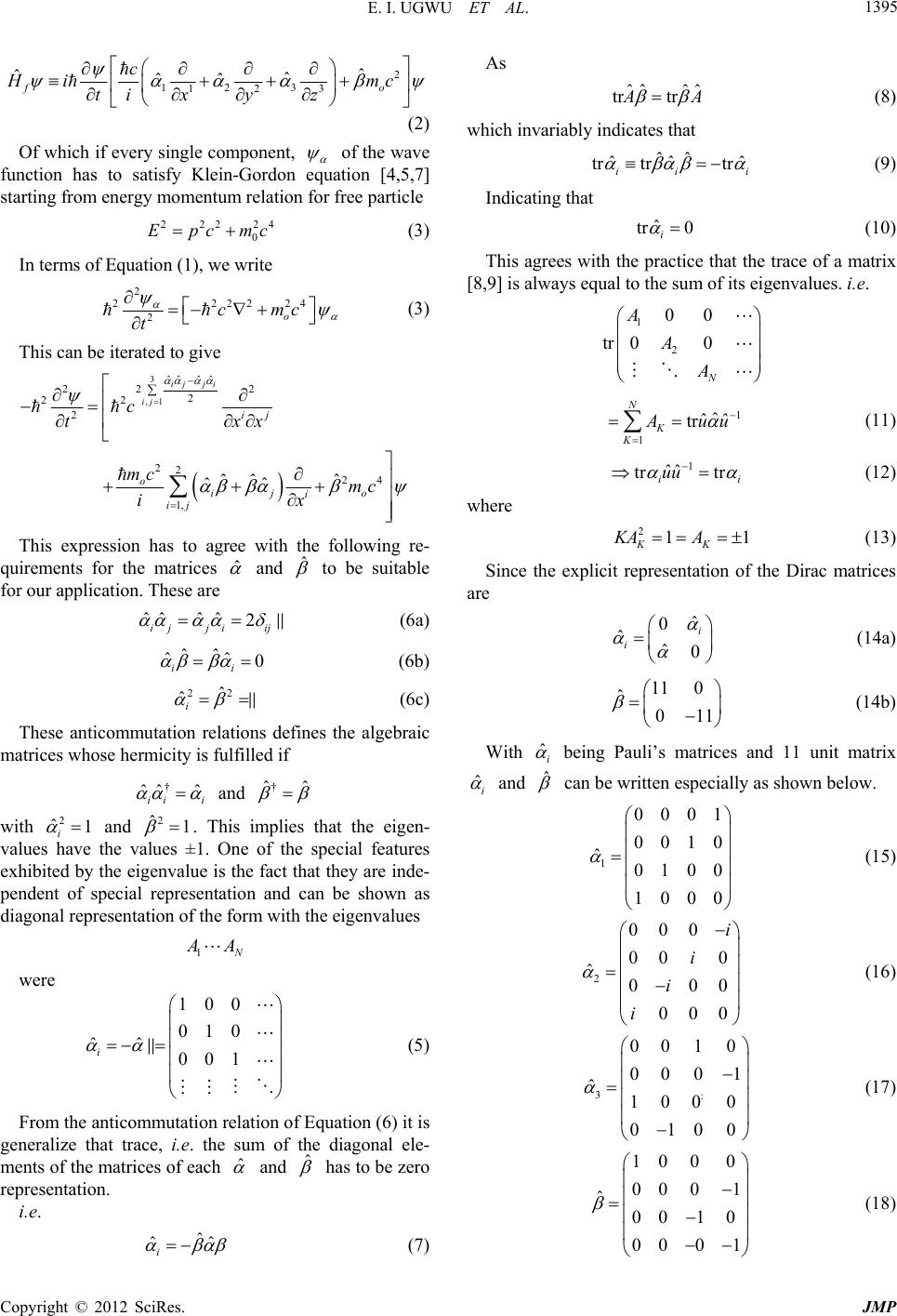 E. I. UGWU ET AL. 1395 2 3 ˆo mc 12 3 12 ˆˆˆˆ f c Hi ti xyz (2) Of which if every single component, of the wave function has to satisfy Klein-Gordon equation [4,5,7] starting from energy momentum relation for free particle 22224 0 Epcmc (3) In terms of Equation (1), we write 2 22 2 t 2224 o cmc (3) This can be iterated to give 3 ,1 ˆˆˆˆ 22 22 22 2 22 1, ˆˆ ˆˆ ij ji ij ij oij i ij c tx mc ix 24 ˆo x mc ˆ This expression has to agree with the following re- quirements for the matrices and ˆ to be suitable for our application. These are ˆˆ ij ˆˆ2 ji ij ˆˆˆ0 ii 22 ˆ ˆi ˆ (6a) ˆ (6b) (6c) These anticommutation relations defines the algebraic matrices whose hermicity is fulfilled if † ˆˆ ii i and † ˆˆ 1 with i and . This implies that the eigen- values have the values ±1. One of the special features exhibited by the eigenvalue is the fact that they are inde- pendent of special representation and can be shown as diagonal representation of the form with the eigenvalues 2 ˆ1 2 ˆ1 N A A 100 010 001 ˆ were ˆˆ i (5) From the anticommutation relation of Equation (6) it is generalize that trace, i.e. the sum of the diagonal ele- ments of the matrices of each and ˆ has to be zero representation. i.e. ˆ ˆˆ i ˆˆ ˆˆ tr tr (7) As A A ˆˆ ˆˆˆ tr trtr ii i (8) which invariably indicates that ˆ tr 0 i (9) Indicating that (10) This agrees with the practice that the trace of a matrix [8,9] is always equal to the sum of its eigenvalues. i.e. 1 2 00 tr 00 N A A A 1 1 ˆ ˆˆ tr N K K A uu 1 ˆˆ tr tr i uu (11) i 211 KK KA A (12) where ˆ 0 ˆˆ0 i i (13) Since the explicit representation of the Dirac matrices are 11 0 ˆ 011 ˆi (14a) (14b) being Pauli’s matrices and 11 unit matrix With ˆ ˆi and can be written especially as shown below. 1 0001 0010 ˆ0100 1000 2 000 00 0 ˆ000 000 i i i i 3: 00 1 0 000 1 ˆ100 0 0100 10 00 00 01 ˆ 001 0 0001 (15) (16) (17) (18) Copyright © 2012 SciRes. JMP 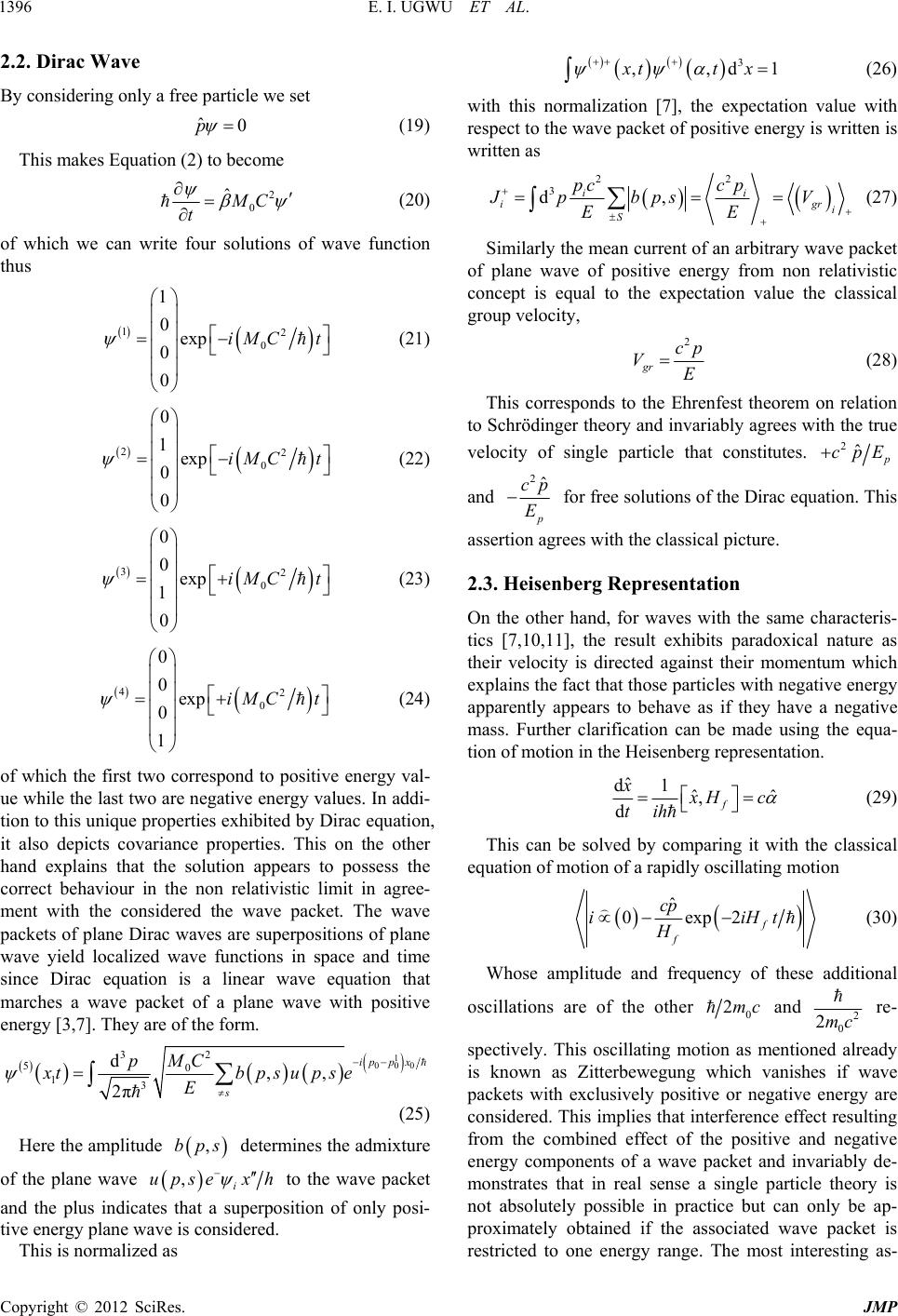 E. I. UGWU ET AL. 1396 2.2. Dirac Wave By considering only a free particle we set ˆ0 p (19) This makes Equation (2) to become 2 0 ˆMC t (20) of which we can write four solutions of wave function thus 2 0 1 iMC t 10exp 0 0 (21) 2 0 iMC t 21exp 0 0 0 (22) 2 0 iMC t 30exp 1 0 0 (23) 2 0 iMC t 40exp 0 1 0 (24) of which the first two correspond to positive energy val- ue while the last two are negative energy values. In addi- tion to this unique properties exhibited by Dirac equation, it also depicts covariance properties. This on the other hand explains that the solution appears to possess the correct behaviour in the non relativistic limit in agree- ment with the considered the wave packet. The wave packets of plane Dirac waves are superpositions of plane wave yield localized wave functions in space and time since Dirac equation is a linear wave equation that marches a wave packet of a plane wave with positive energy [3,7]. They are of the form. 1 000 2 3 50 d,, ipp x MC p xtbpsup s e ,bps 13 2πs E (25) Here the amplitude determines the admixture of the plane wave ,i upsexh 3 ,,d1xtt x to the wave packet and the plus indicates that a superposition of only posi- tive energy plane wave is considered. This is normalized as (26) with this normalization [7], the expectation value with respect to the wave packet of positive energy is written is written as 22 3 d, ii igr i S pcc p Jp bpsV EE (27) Similarly the mean current of an arbitrary wave packet of plane wave of positive energy from non relativistic concept is equal to the expectation value the classical group velocity, 2 gr cp VE (28) This corresponds to the Ehrenfest theorem on relation to Schrödinger theory and invariably agrees with the true velocity of single particle that constitutes. 2ˆ p cpE and 2ˆ p cp E for free solutions of the Dirac equation. This assertion agrees with the classical picture. 2.3. Heisenberg Representation On the other hand, for waves with the same characteris- tics [7,10,11], the result exhibits paradoxical nature as their velocity is directed against their momentum which explains the fact that those particles with negative energy apparently appears to behave as if they have a negative mass. Further clarification can be made using the equa- tion of motion in the Heisenberg representation. ˆ d1 ˆ ˆ, df x x Hc tih (29) This can be solved by comparing it with the classical equation of motion of a rapidly oscillating motion ˆ 0exp2 f f cp iiHt H (30) Whose amplitude and frequency of these additional oscillations are of the other 0 2mc and 2 0 2mc re- spectively. This oscillating motion as mentioned already is known as Zitterbewegung which vanishes if wave packets with exclusively positive or negative energy are considered. This implies that interference effect resulting from the combined effect of the positive and negative energy components of a wave packet and invariably de- monstrates that in real sense a single particle theory is not absolutely possible in practice but can only be ap- proximately obtained if the associated wave packet is restricted to one energy range. The most interesting as- Copyright © 2012 SciRes. JMP 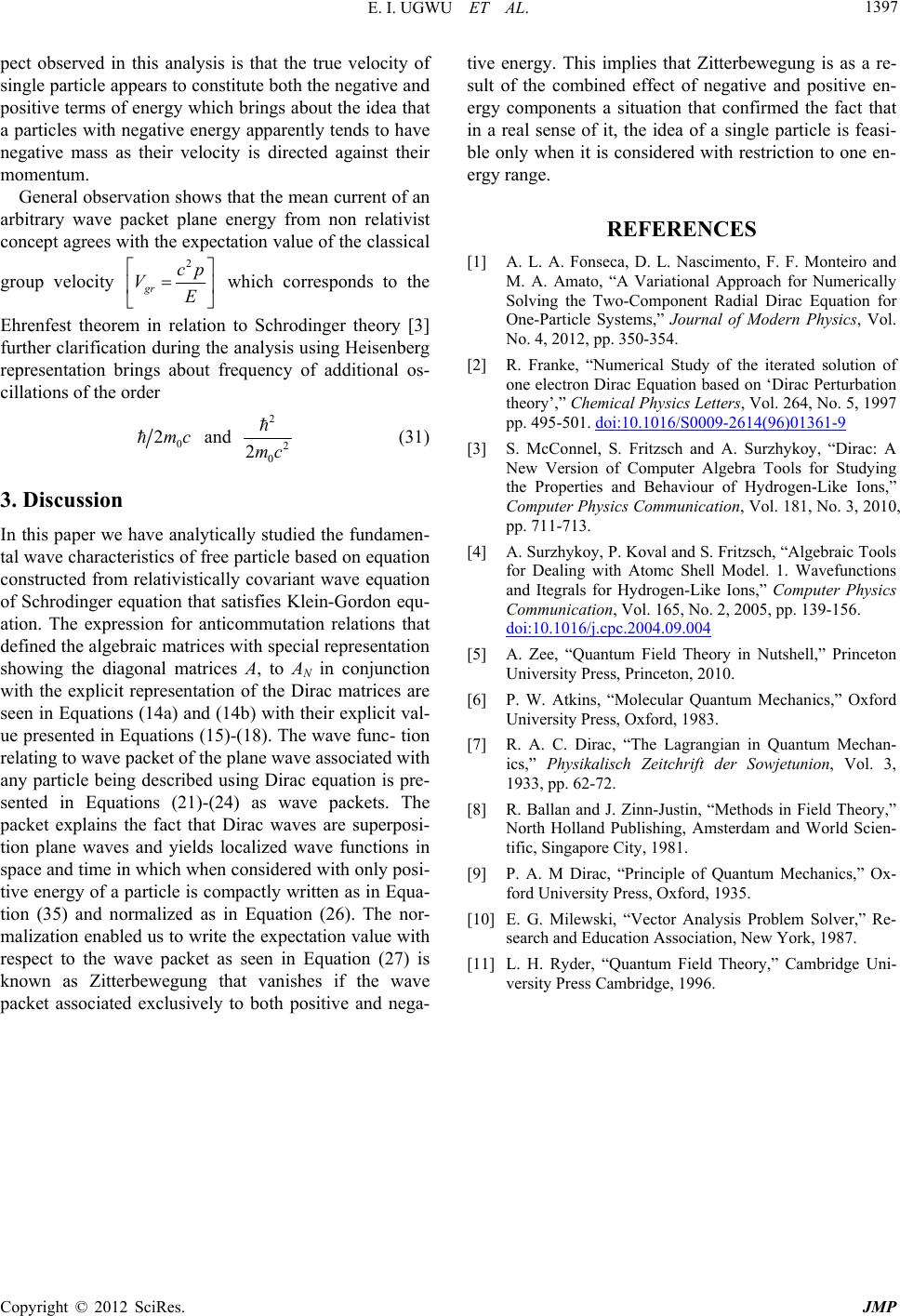 E. I. UGWU ET AL. Copyright © 2012 SciRes. JMP 1397 pect observed in this analysis is that the true velocity of single particle appears to constitute both the negative and positive terms of energy which brings about the idea that a particles with negative energy apparently tends to have negative mass as their velocity is directed against their momentum. General observation shows that the mean current of an arbitrary wave packet plane energy from non relativist concept agrees with the expectation value of the classical group velocity 2 gr cp VE which corresponds to the Ehrenfest theorem in relation to Schrodinger theory [3] further clarification during the analysis using Heisenberg representation brings about frequency of additional os- cillations of the order 0 2mc and 2 2 0 2mc (31) 3. Discussion In this paper we have analytically studied the fundamen- tal wave characteristics of free particle based on equation constructed from relativistically covariant wave equation of Schrodinger equation that satisfies Klein-Gordon equ- ation. The expression for anticommutation relations that defined the algebraic matrices with special representation showing the diagonal matrices A, to AN in conjunction with the explicit representation of the Dirac matrices are seen in Equations (14a) and (14b) with their explicit val- ue presented in Equations (15)-(18). The wave func- tion relating to wave packet of the plane wave associated with any particle being described using Dirac equation is pre- sented in Equations (21)-(24) as wave packets. The packet explains the fact that Dirac waves are superposi- tion plane waves and yields localized wave functions in space and time in which when considered with only posi- tive energy of a particle is compactly written as in Equa- tion (35) and normalized as in Equation (26). The nor- malization enabled us to write the expectation value with respect to the wave packet as seen in Equation (27) is known as Zitterbewegung that vanishes if the wave packet associated exclusively to both positive and nega- tive energy. This implies that Zitterbewegung is as a re- sult of the combined effect of negative and positive en- ergy components a situation that confirmed the fact that in a real sense of it, the idea of a single particle is feasi- ble only when it is considered with restriction to one en- ergy range. REFERENCES [1] A. L. A. Fonseca, D. L. Nascimento, F. F. Monteiro and M. A. Amato, “A Variational Approach for Numerically Solving the Two-Component Radial Dirac Equation for One-Particle Systems,” Journal of Modern Physics, Vol. No. 4, 2012, pp. 350-354. [2] R. Franke, “Numerical Study of the iterated solution of one electron Dirac Equation based on ‘Dirac Perturbation theory’,” Chemical Physics Letters, Vol. 264, No. 5, 1997 pp. 495-501. doi:10.1016/S0009-2614(96)01361-9 [3] S. McConnel, S. Fritzsch and A. Surzhykoy, “Dirac: A New Version of Computer Algebra Tools for Studying the Properties and Behaviour of Hydrogen-Like Ions,” Computer Physics Communication, Vol. 181, No. 3, 2010, pp. 711-713. [4] A. Surzhykoy, P. Koval and S. Fritzsch, “Algebraic Tools for Dealing with Atomc Shell Model. 1. Wavefunctions and Itegrals for Hydrogen-Like Ions,” Computer Physics Communication, Vol. 165, No. 2, 2005, pp. 139-156. doi:10.1016/j.cpc.2004.09.004 [5] A. Zee, “Quantum Field Theory in Nutshell,” Princeton University Press, Princeton, 2010. [6] P. W. Atkins, “Molecular Quantum Mechanics,” Oxford University Press, Oxford, 1983. [7] R. A. C. Dirac, “The Lagrangian in Quantum Mechan- ics,” Physikalisch Zeitchrift der Sowjetunion, Vol. 3, 1933, pp. 62-72. [8] R. Ballan and J. Zinn-Justin, “Methods in Field Theory,” North Holland Publishing, Amsterdam and World Scien- tific, Singapore City, 1981. [9] P. A. M Dirac, “Principle of Quantum Mechanics,” Ox- ford University Press, Oxford, 1935. [10] E. G. Milewski, “Vector Analysis Problem Solver,” Re- search and Education Association, New York, 1987. [11] L. H. Ryder, “Quantum Field Theory,” Cambridge Uni- versity Press Cambridge, 1996. |