

Paper Menu >>
Journal Menu >>
 Journal of Transportation Technologies, 2012, 2, 334-338 http://dx.doi.org/10.4236/jtts.2012.24036 Published Online October 2012 (http://www.SciRP.org/journal/jtts) Design and Stability Analysis of Fuzzy Switched PID Controller for Ship Track-Keeping* Baozhu Jia1,2, Hui Cao2, Jie Ma1 1State Key Laboratory of Ocean Engineering, Shanghai Jiao Tong University, Shanghai, China 2Marine Engineering College, Dalian Maritime University, Dalian, China Email: [email protected] Received July 25, 2012; revised August 23, 2012; accepted September 10, 2012 ABSTRACT The fuzzy switched PID controller which combines fuzzy PD and conventional PI controller is proposed for ship track-keeping autopilot In this paper. By using rudder angle, the whole voyage is divided into two operating regimes which named transient operating regime and steady operating regime respectively. The fuzzy PD controller is employed in transient operating regime for increasing response, reducing overshoot and shorting transition time. And conventional PI controller is used to improve the stable accuracy in steady operating regime. The global controller is achieved by fuzzy blending of all local controllers. Routh stability criterion is utilized to obtain the stability condition of closed-loop system. The simulation results show the effectiveness of proposed method. Keywords: Ship Control; Fuzzy Switched PID; Track-Keeping; Fuzzy Operating Regime; Stability Condition 1. Introduction Ship autopilot mainly used to keep the course at designed trajectory within minimum deviation. In terms of charac- teristics of nonlinear and underactuated of cargo ship, finding an effective autopilot control algorithm has been the significant topic in area of ship steering control. This has evoked interest into the field of autopilot in marine cargo ship controlling community recently. Fossen, et al. proposed adaptive controller to improve performance and reduce fuel consumption on both of course-keeping and course-changing maneuvers [1]. In [2], the problem is solved by the adaptive robust fuzzy method, which called state input-output theory is adopted. The work in [3] has proposed adjust ship course by using track error-driven control algorithm. Ship voyage involves several straight-line segmenta- tions. During straight-line voyage, the control require- ment mainly focuses on stable accuracy, which are called tack-keeping. Rudder angle changes frequently and the controller output is small. Most of time, autopilot oper- ating in the mode of track-keeping process, so we called is as steady operating regime in this paper. Whereas, when the ship changing into a new direction from origi- nal course, the control requirements mainly depends on response, overshoot and transition time, what are named course-changing process, the controller provides a larger control signal to achieve faster response. There are do- zens of course-changing points in whole voyage, what depends on the ocean environment and port of destina- tion as well. When course error decreasing, the controller outputs would gradually reduce according to control laws. The course-changing process is generally short-term and countable, so it can be called transient operating regime. The good control strategy could adaptively switch to the most matching control law based on operating regime according to switching rules. The fuzzy switching PID control algorithm combines Takagi-Sugeno PD controller with general PI controller to improve the control per- formance in terms of fast response and high stable accu- racy throughout the voyage. During track-keeping proc- ess, the so called TS-PD controller is employed to keep the stability accuracy, and when course-changing process, the general PD controller is used to improve the response speed. The TS-PD controller and general PI controller switched according to the operating regime switching rules. Fuzzy logic has been proved to be an universal ap- proximator for any real continuous function. It can be constructed in many different configurations. However, since Takagi-Sugeno fuzzy inference is nonlinear in na- ture, we utilize it to construct the supervisory rules. The global controller output is used to be antecedent variable of supervisory rules. The stability of fuzzy control sys- tems may not be easily analyzed. Lyapunov approach and variable structure or the phase-plane approach nor- mally be employed. Besides, it is difficult to find a common Lyapunov’s function for a fuzzy controller. In C opyright © 2012 SciRes. JTTs 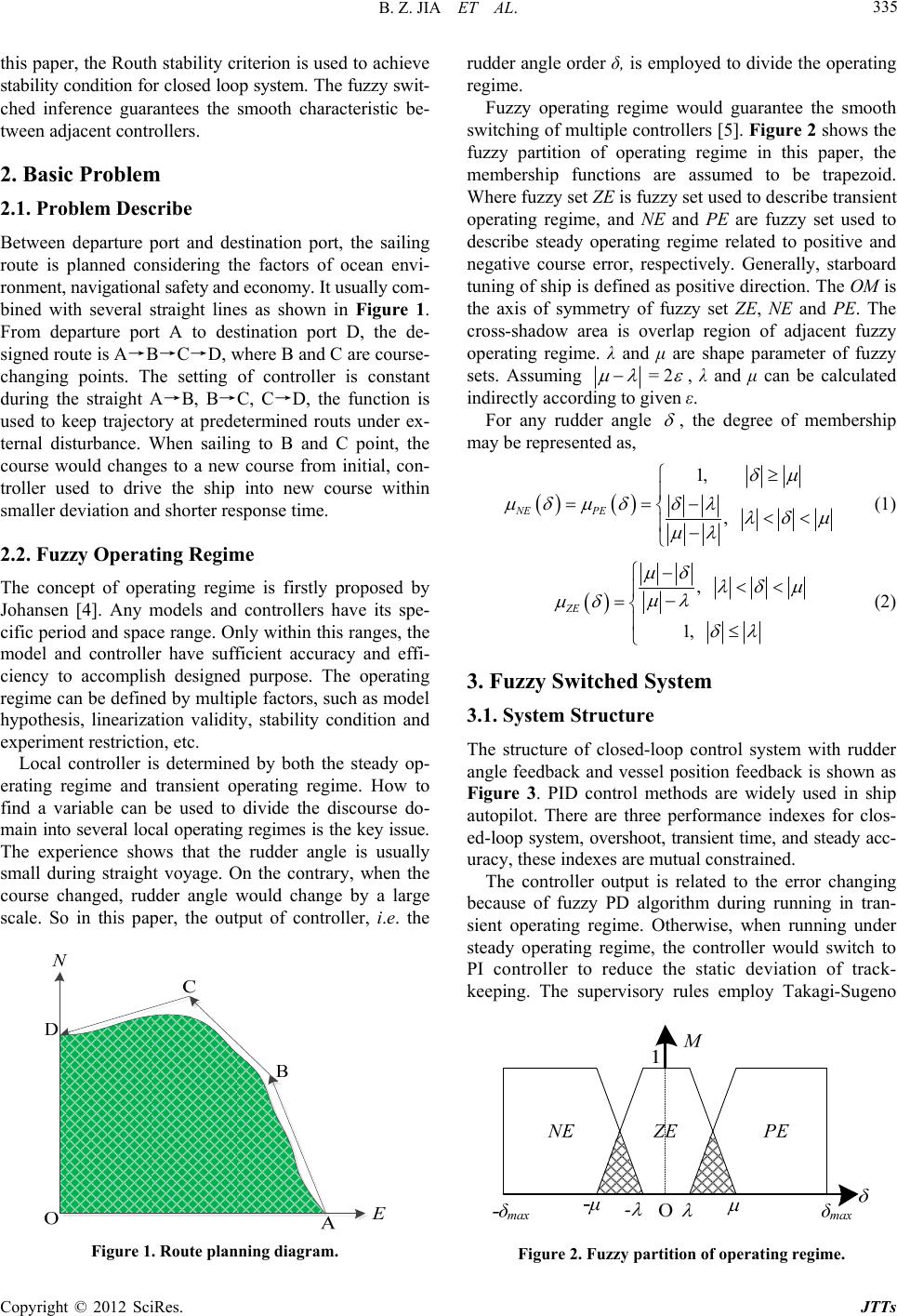 B. Z. JIA ET AL. 335 this paper, the Routh stability criterion is used to achieve stability condition for closed loop system. The fuzzy swit- ched inference guarantees the smooth characteristic be- tween adjacent controllers. 2. Basic Problem 2.1. Problem Describe Between departure port and destination port, the sailing route is planned considering the factors of ocean envi- ronment, navigational safety and economy. It usually com- bined with several straight lines as shown in Figure 1. From departure port A to destination port D, the de- signed route is A→B→C→D, where B and C are course- changing points. The setting of controller is constant during the straight A→B, B→C, C→D, the function is used to keep trajectory at predetermined routs under ex- ternal disturbance. When sailing to B and C point, the course would changes to a new course from initial, con- troller used to drive the ship into new course within smaller deviation and shorter response time. 2.2. Fuzzy Operating Regime The concept of operating regime is firstly proposed by Johansen [4]. Any models and controllers have its spe- cific period and space range. Only within this ranges, the model and controller have sufficient accuracy and effi- ciency to accomplish designed purpose. The operating regime can be defined by multiple factors, such as model hypothesis, linearization validity, stability condition and experiment restriction, etc. Local controller is determined by both the steady op- erating regime and transient operating regime. How to find a variable can be used to divide the discourse do- main into several local operating regimes is the key issue. The experience shows that the rudder angle is usually small during straight voyage. On the contrary, when the course changed, rudder angle would change by a large scale. So in this paper, the output of controller, i.e. the Figure 1. Route planning diagram. rudder angle order δ, is employed to divide the operating regime. Fuzzy operating regime would guarantee the smooth switching of multiple controllers [5]. Figure 2 shows the fuzzy partition of operating regime in this paper, the membership functions are assumed to be trapezoid. Where fuzzy set ZE is fuzzy set used to describe transient operating regime, and NE and PE are fuzzy set used to describe steady operating regime related to positive and negative course error, respectively. Generally, starboard tuning of ship is defined as positive direction. The OM is the axis of symmetry of fuzzy set ZE, NE and PE. The cross-shadow area is overlap region of adjacent fuzzy operating regime. λ and μ are shape parameter of fuzzy sets. Assuming = 2 , λ and μ can be calculated indirectly according to given ε. For any rudder angle , the degree of membership may be represented as, 1, , NE PE (1) , 1, ZE (2) 3. Fuzzy Switched System 3.1. System Structure The structure of closed-loop control system with rudder angle feedback and vessel position feedback is shown as Figure 3. PID control methods are widely used in ship autopilot. There are three performance indexes for clos- ed-loop system, overshoot, transient time, and steady acc- uracy, these indexes are mutual constrained. The controller output is related to the error changing because of fuzzy PD algorithm during running in tran- sient operating regime. Otherwise, when running under steady operating regime, the controller would switch to PI controller to reduce the static deviation of track- keeping. The supervisory rules employ Takagi-Sugeno - Figure 2. Fuzzy partition of operating regime. Copyright © 2012 SciRes. JTTs 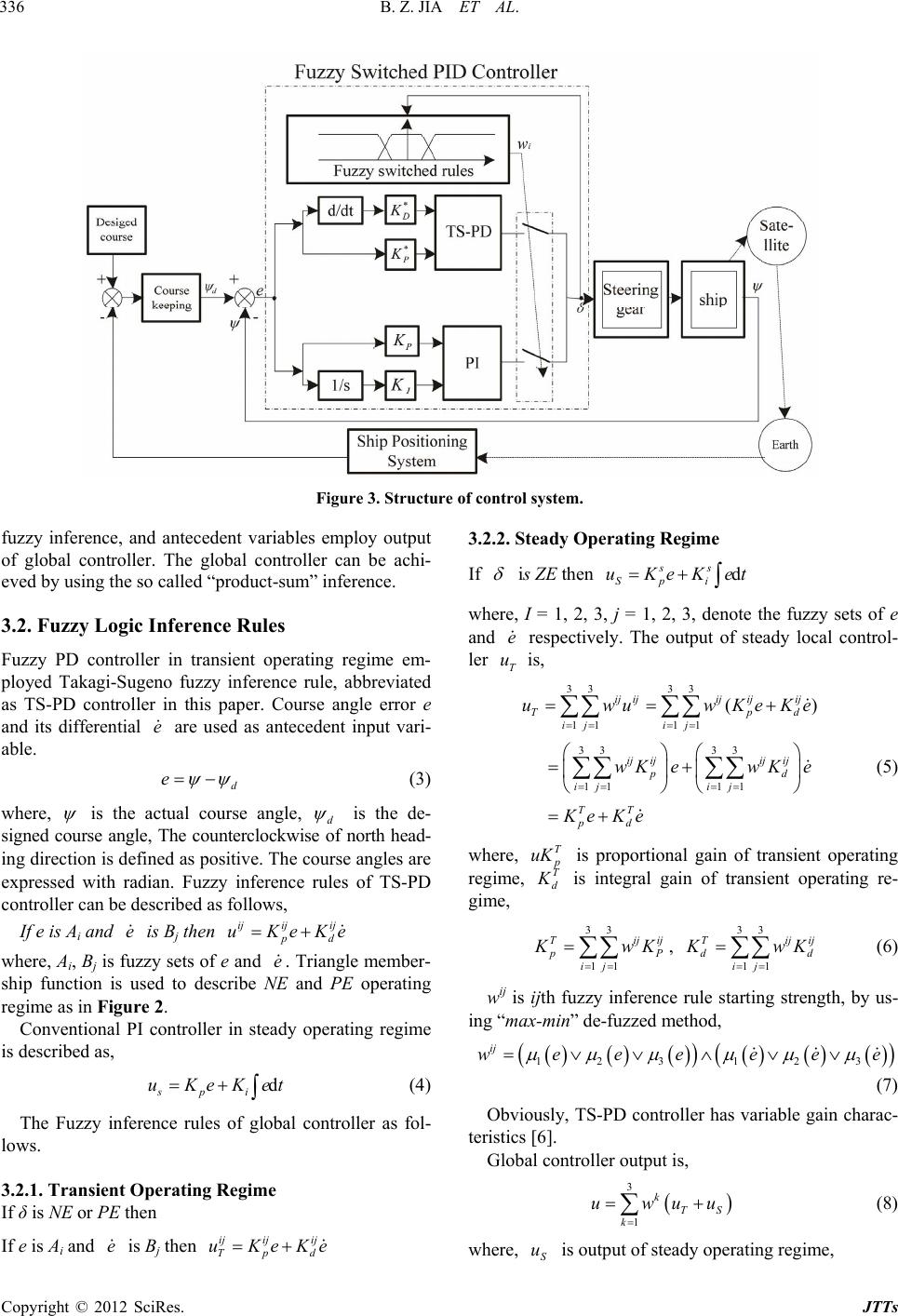 B. Z. JIA ET AL. Copyright © 2012 SciRes. JTTs 336 Figure 3. Structure of control system. uzzy inference, and antecedent variables employ output 3.2. Fuzzy Logic Inference Rules rating regime em- f of global controller. The global controller can be achi- eved by using the so called “product-sum” inference. Fuzzy PD controller in transient ope ployed Takagi-Sugeno fuzzy inference rule, abbreviated as TS-PD controller in this paper. Course angle error e and its differential e are used as antecedent input vari- able. d e (3) where, is the actual course angle, d of is the de- signed course angle, The counterclockwise north head- ing direction is defined as positive. The course angles are expressed with radian. Fuzzy inference rules of TS-PD controller can be described as follows, If e is A and e is B then ij ij i j ij p d K uKee wu and Triang member- troller in steady operating regime is t (4) The Fuzzy inference rules of global controller as fol- lo 3.2.1. Transi ent Operating Regime i je 3.2.2. Steady Operating Regime here, A, Bj is fzzy sets of ele i ship function is used to describe NE and PE operating regime as in Figure 2. Conventional PI con e . described as, d sp i uKeKe ij ijij Tp d uKeK If is ZE th n s uKee te the fuzzy sets of e ly. The output of steady local control- (5) where, d s Sp i Ket where, I = 1, 2, 3, j = 1, 2, 3, deno and e respective ler T u is, 33 33 () ij ijijijij Tpd uwuw KeKe 11 11 33 33 11 11 ij ij ij ijij ij pd ij ij TT pd wK ewK e Ke Ke T p uK , T d is proportional gain of transient operating regime K is integral gain of transient operating re- gime, 33 ijij ws. If δ is NE or PE then If e is A and e is B then 11 T p P ij K wK , 33 Tijij dd 11 ij K wK (6) wij is ijth fuzzy inferencrule starting stren ing “max-min” de-fuzzed mthod, e gth, by us- e 123 123 ij eee eee w (7) Obviously, TS-PD controller has variable gain charac- teristics [6]. (8) where, is output of steady operating regime, Global controller output is, 3 k S u 1 T k uwu S u  B. Z. JIA ET AL. 337 d SS Sp i uKeKe t (9) By using “max-min” de-fuzzed method, there is, k wNE NE PE (10) By combining (4) and (5), (11) where, 1 11 1 33 11 d d kT TS S pd pi k S pp kij ij ijS di ij uwKe KeKe Ket Ke wKe Ket 3 333 ki jij ww K 333 11 1 kij Sij P pp ki j K ww KK (12) 3 1 kS I i k K wK (13) 333 11 1 kij ij D d ki j K wwK (14) are nonlinear proportional gain, integral gain and differ- ential gain of global controller’s output respectively. The transfer function of equation (11 as, ) can be rewritten cPID Gs KKsKs (15) 3.3. Plant Models By considering only the closed loop sys error to ship heading, the Figure 3 can be simplified as model relating the rudder angle of tem from course Figure 4. The mathematical the ship to the heading was proposed by Norbin [7] 1k ttt (16) and τ are model parameters. Assuming zero initial conditions, (16) can be written as t where φ is ship heading of ship, δ is rudder angle, k 21Gsss k s (17) d/dt 1/s Ship e d Steering gear FS-PID Controller δ -1 u Figure 4. Closed loop system. The parameter K, τ1, τ2, τ3 is the function of ship speed u and length l 0 0 123 ,1,2,3 ii KKul lu i (18) The paramehip’s forward ve odel can be written as ters u and l are function of s locity and its length. Steer gear m EdEE E tktttkutt (19) kE is steering gear gain coefficient, τE is steer gea stant time coefficient. The transfer function of plant in- cl r con- uding steering gear can be written as 21 E K s (20) where, 1 Gs Us s s E K kk , is generalized controller amplifica- tion coefficient. For majority of cargo ships the rudder angle and the rudder rate are confined to be in the ranges 35deg max max 1 2deg7 deg 3 s s (21) It is uuired that rudder should move from 35˚ port to 35˚ starboard within 30 s. sually req 3.4. Stability Conditions By considering the closed-loop control system constr- ucted by controller (15) and generalized characteristic equation can be written as plant (20), its 432 10 EDE ssKKsKKs KK PI (22) According Routh stability criterio conditions can be written as f n, system stability ollows, 0 0 E 0 1 DE DE P DEPIP KK KK KK KKKKKK KK 10 0 P I KK KK where we assume that for a cargo ship, K0 = −3.86, τ10 = 5.66, τ20 = 0.38, τ30 = 0.89, l = 161 m. Also, we assume that the ship is traveling in the x direction at a velocity of 10 knots (about 7.8 m/s). In Equation (23), parameter k = −0.187, τ = 106.2. For pump-controlled hydraulic steer- (23) Copyright © 2012 SciRes. JTTs 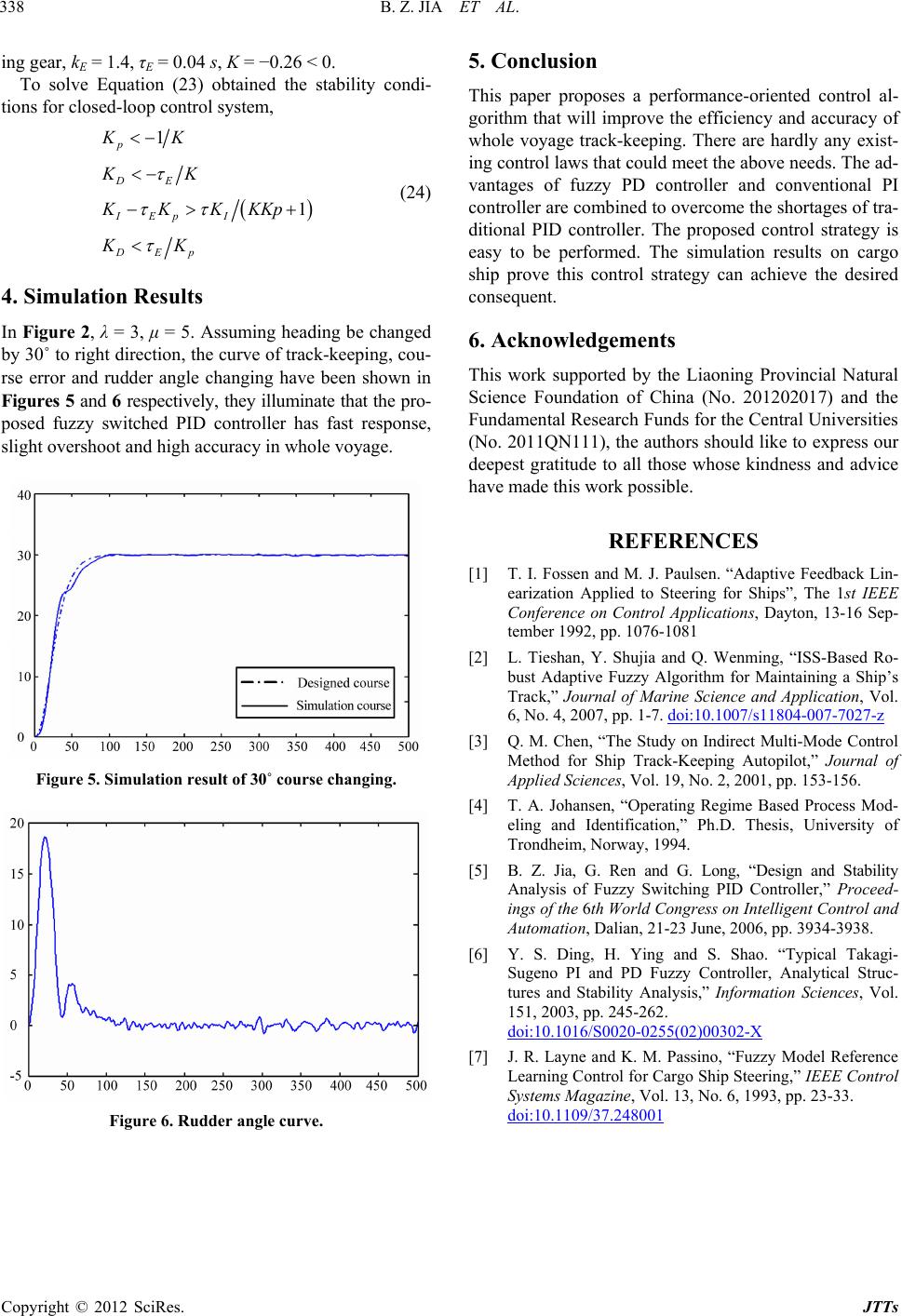 B. Z. JIA ET AL. Copyright © 2012 SciRes. JTTs 338 ing gear, kE = 1.4, τE = 0.04 s, K = −0.26 < 0. To solve Equation (23) obtained the stability condi- tions for closed-loop control system, 1 1 p DE IEp I DEp KK KK KKK KKp KK (24) response, sl 4. Simulation Results In Figure 2, λ = 3, μ = 5. Assuming heading be changed by 30˚ to right direction, the curve of track-keeping, cou- rse error and rudder angle changing have been shown in Figures 5 and 6 respectively, they illuminate that the pro- posed fuzzy switched PID controller has fast ight overshoot and high accuracy in whole voyage. Figure 5. Simulation result of 30˚ course changing. Figure 6. Rudder angle curve. 5. Conclusion This paper proposes a performance-oriented control al- gorithm that will improve the efficiency and accuracy of whole voyage track-keeping. There are hardly any exist- ing control laws that could meet the above needs. The ad- vantages of fuzzy PD controller and conventional PI controller are combined to overcome the shortages of tra- ditional PID controller. The proposed control strategy is easy to be performed. The simulation results on cargo ship prove this control strategy can achieve the desired consequent. 6. Acknowledgements incial Natural n of China (No. 201202017) and the ce on Control Applications, Dayton, 13-16 Sep- , pp. 1076-1081 Q. Wenming, “ISS-Based Ro- thm for Maintaining a Ship’s This work supported b Science Foundatio y the Liaoning Prov Fundamental Research Funds for the Central Universities (No. 2011QN111), the authors should like to express our deepest gratitude to all those whose kindness and advice have made this work possible. REFERENCES [1] T. I. Fossen and M. J. Paulsen. “Adaptive Feedback Lin- earization Applied to Steering for Ships”, The 1st IEEE Conferen tember 1992 [2] L. Tieshan, Y. Shujia and bust Adaptive Fuzzy Algori Track,” Journal of Marine Science and Application, Vol. 6, No. 4, 2007, pp. 1-7. doi:10.1007/s11804-007-7027-z [3] Q. M. Chen, “The Study on Indirect Multi-Mode Control Method for Ship Track-Keeping Autopilot,” Journal of Applied Sciences, Vol. 19, No. 2, 2001, pp. 153-156. [4] T. A. Johansen, “Operating Regime Based Process Mod- eling and Identification,” Ph.D. Thesis, University of Trondheim, Norway [5] B. Z. Jia, G. Ren and G. Long, “Design and Stability S. Shao. “Typical Takagi- , 1994. Analysis of Fuzzy Switching PID Controller,” Proceed- ings of the 6th World Congress on Intelligent Control and Automation, Dalian, 21-23 June, 2006, pp. 3934-3938. [6] Y. S. Ding, H. Ying and Sugeno PI and PD Fuzzy Controller, Analytical Struc- tures and Stability Analysis,” Information Sciences, Vol. 151, 2003, pp. 245-262. doi:10.1016/S0020-0255(02)00302-X [7] J. R. Layne and K. M. Passino, “Fuzzy Model Reference Learning Control for Cargo Ship Steering,” IEEE Control Systems Magazine, Vol. 13, No. 6, 1993, pp. 23-33. doi:10.1109/37.248001 |