

Paper Menu >>
Journal Menu >>
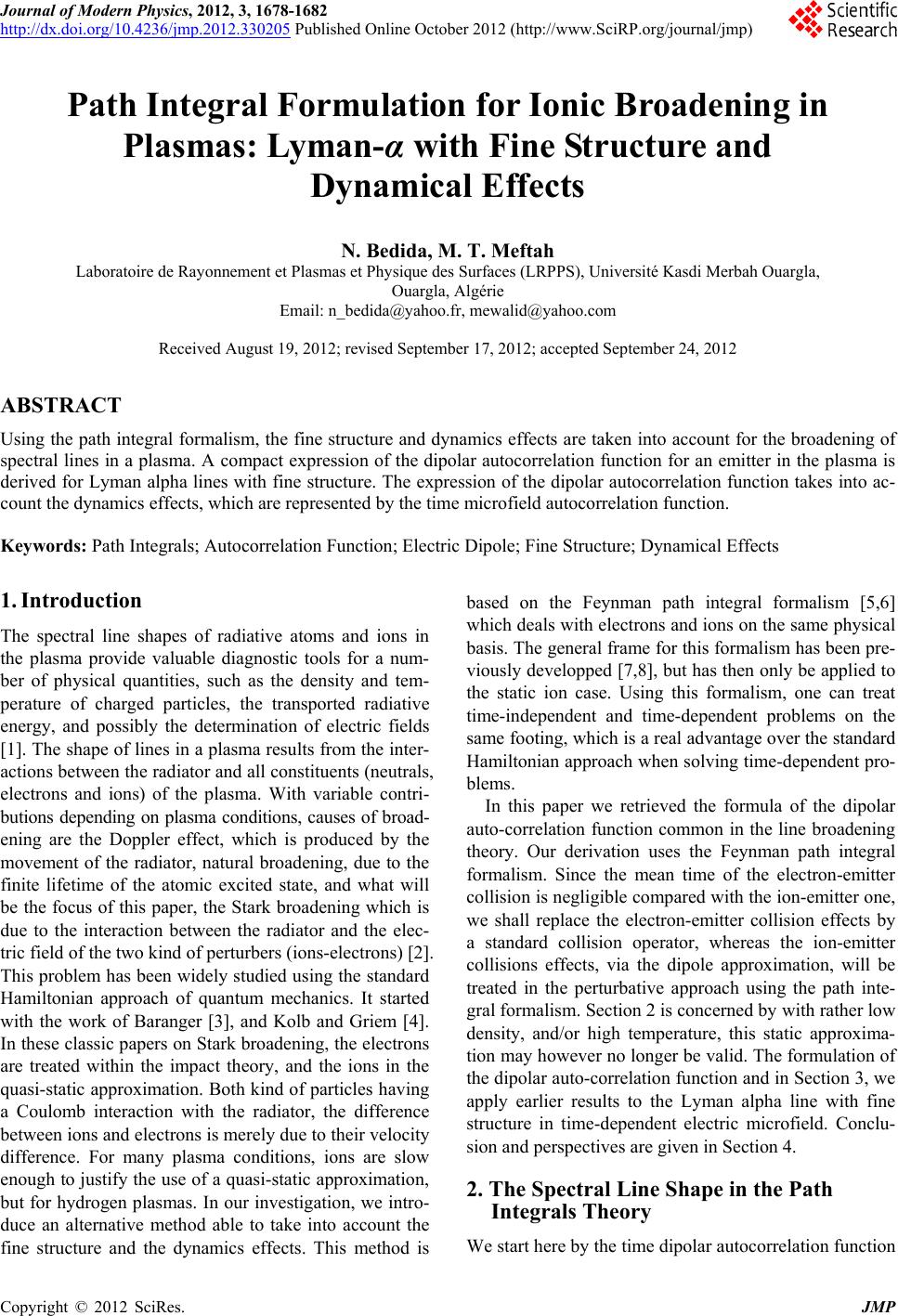 Journal of Modern Physics, 2012, 3, 1678-1682 http://dx.doi.org/10.4236/jmp.2012.330205 Published Online October 2012 (http://www.SciRP.org/journal/jmp) Path Integral Formulation for Ionic Broadening in Plasmas: Lyman-α with Fine Structure and Dynamical Effects N. Bedida, M. T. Meftah Laboratoire de Rayonnement et Plasmas et Physique des Surfaces (LRPPS), Université Kasdi Merbah Ouargla, Ouargla, Algérie Email: [email protected], [email protected] Received August 19, 2012; revised September 17, 2012; accepted September 24, 2012 ABSTRACT Using the path integral formalism, the fine structure and dynamics effects are taken into account for the broadening of spectral lines in a plasma. A compact expression of the dipolar autocorrelation function for an emitter in the plasma is derived for Lyman alpha lines with fine structure. The expression of the dipolar autocorrelation function takes into ac- count the dynamics effects, which are represented by the time microfield autocorrelation function. Keywords: Path Integrals; Autocorrelation Function; Electric Dipole; Fine Structure; Dynamical Effects 1. Introduction The spectral line shapes of radiative atoms and ions in the plasma provide valuable diagnostic tools for a num- ber of physical quantities, such as the density and tem- perature of charged particles, the transported radiative energy, and possibly the determination of electric fields [1]. The shape of lines in a plasma results from the inter- actions between the radiator and all constituents (neutrals, electrons and ions) of the plasma. With variable contri- butions depending on plasma conditions, causes of broad- ening are the Doppler effect, which is produced by the movement of the radiator, natural broadening, due to the finite lifetime of the atomic excited state, and what will be the focus of this paper, the Stark broadening which is due to the interaction between the radiator and the elec- tric field of the two kind of perturbers (ions-electrons) [2]. This problem has been widely studied using the standard Hamiltonian approach of quantum mechanics. It started with the work of Baranger [3], and Kolb and Griem [4]. In these classic papers on Stark broadening, the electrons are treated within the impact theory, and the ions in the quasi-static approximation. Both kind of particles having a Coulomb interaction with the radiator, the difference between ions and electrons is merely due to their velocity difference. For many plasma conditions, ions are slow enough to justify the use of a quasi-static approximation, but for hydrogen plasmas. In our investigation, we intro- duce an alternative method able to take into account the fine structure and the dynamics effects. This method is based on the Feynman path integral formalism [5,6] which deals with electrons and ions on the same physical basis. The general frame for this formalism has been pre- viously developped [7,8], but has then only be applied to the static ion case. Using this formalism, one can treat time-independent and time-dependent problems on the same footing, which is a real advantage over the standard Hamiltonian approach when solving time-dependent pro- blems. In this paper we retrieved the formula of the dipolar auto-correlation function common in the line broadening theory. Our derivation uses the Feynman path integral formalism. Since the mean time of the electron-emitter collision is negligible compared with the ion-emitter one, we shall replace the electron-emitter collision effects by a standard collision operator, whereas the ion-emitter collisions effects, via the dipole approximation, will be treated in the perturbative approach using the path inte- gral formalism. Section 2 is concerned by with rather low density, and/or high temperature, this static approxima- tion may however no longer be valid. The formulation of the dipolar auto-correlation function and in Section 3, we apply earlier results to the Lyman alpha line with fine structure in time-dependent electric microfield. Conclu- sion and perspectives are given in Section 4. 2. The Spectral Line Shape in the Path Integrals Theory We start here by the time dipolar autocorrelation function C opyright © 2012 SciRes. JMP 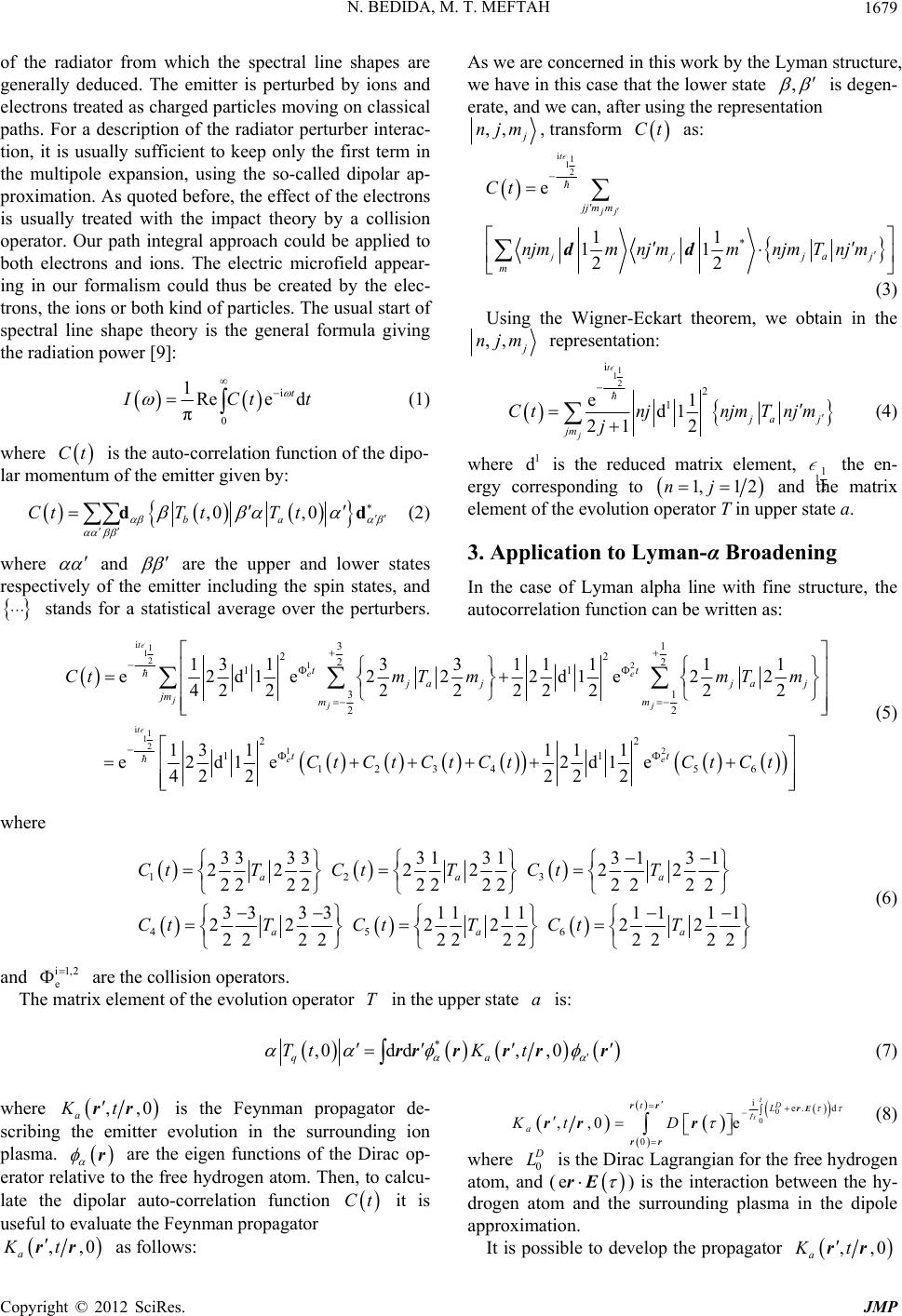 N. BEDIDA, M. T. MEFTAH 1679 of the radiator from which the spectral line shapes are generally deduced. The emitter is perturbed by ions and electrons treated as charged particles moving on classical paths. For a description of the radiator perturber interac- tion, it is usually sufficient to keep only the first term in the multipole expansion, using the so-called dipolar ap- proximation. As quoted before, the effect of the electrons is usually treated with the impact theory by a collision operator. Our path integral approach could be applied to both electrons and ions. The electric microfield appear- ing in our formalism could thus be created by the elec- trons, the ions or both kind of particles. The usual start of spectral line shape theory is the general formula giving the radiation power [9]: i 0 e d t 1Re π I Ct t Ct (1) where is the auto-correlation function of the dipo- lar momentum of the emitter given by: ,0 ,0 ba CtT tTt dd (2) where As we are concerned in this work by the Lyman structure, we have in this case that the lower state , is degen- erate, and we can, after using the representation and are the upper and lower states respectively of the emitter including the spin states, and Λ stands for a statistical average over the perturbers. ,, j njm , transform Ct as: i1 12 * e 11 11 22 t jj jj ћ jj mm ja j m Ct njmmnj mmnjmTnj m dd (3) Using the Wigner-Eckart theorem, we obtain in the ,, j njm representation: 1 12 i 2 1 e1 d1 21 2 t j ћ j aj jm CtnjnjmTnj m j 1 d (4) where is the reduced matrix element, 1 12 the en- ergy corresponding to 1,1 2nj and the matrix element of the evolution operator T in upper state a. 3. Application to Lyman-α Broadening In the case of Lyman alpha line with fine structure, the autocorrelation function can be written as: i1 121 2 2 31 22 22 ФФ 11 31 22 2 Ф 1 1234 56 1313 31111 1 e2d1e222d1e22 4222 22222 2 11 1 2d1e 22 2 t e e jj j e tt ћ ja jja j jm mm t CtmTmmTm t Ct Ct CtCt Ct i1 121 2 Ф 1 13 1 e2d1e 42 2 t et ћC (5) where 123 456 333331313 13 1 222222 222222222 22 2 3333111111 11 2222 22 2 22 222222 22 2 aa a aaa CtT CtTCtT CtTCtT CtT Ta (6) and are the collision operators. i1,2 e Ф The matrix element of the evolution operator in the upper state is: * ' ,0d d,,0 qa TtK t rrrr rr (7) where ,,0Kt rr r a is the Feynman propagator de- scribing the emitter evolution in the surrounding ion plasma. are the eigen functions of the Dirac op- erator relative to the free hydrogen atom. Then, to calcu- late the dipolar auto-correlation function Ct it is useful to evaluate the Feynman propagator ,,0 a Kt rr as follows: 0 0 i _e.d 0 ,,0 e tD tL a Kt D E rr r rr rrr η (8) where 0 D L is the Dirac Lagrangian for the free hydrogen atom, and ( e rE ) is the interaction between the hy- drogen atom and the surrounding plasma in the dipole approximation. It is possible to develop the propagator ,,0 a Kt rr Copyright © 2012 SciRes. JMP 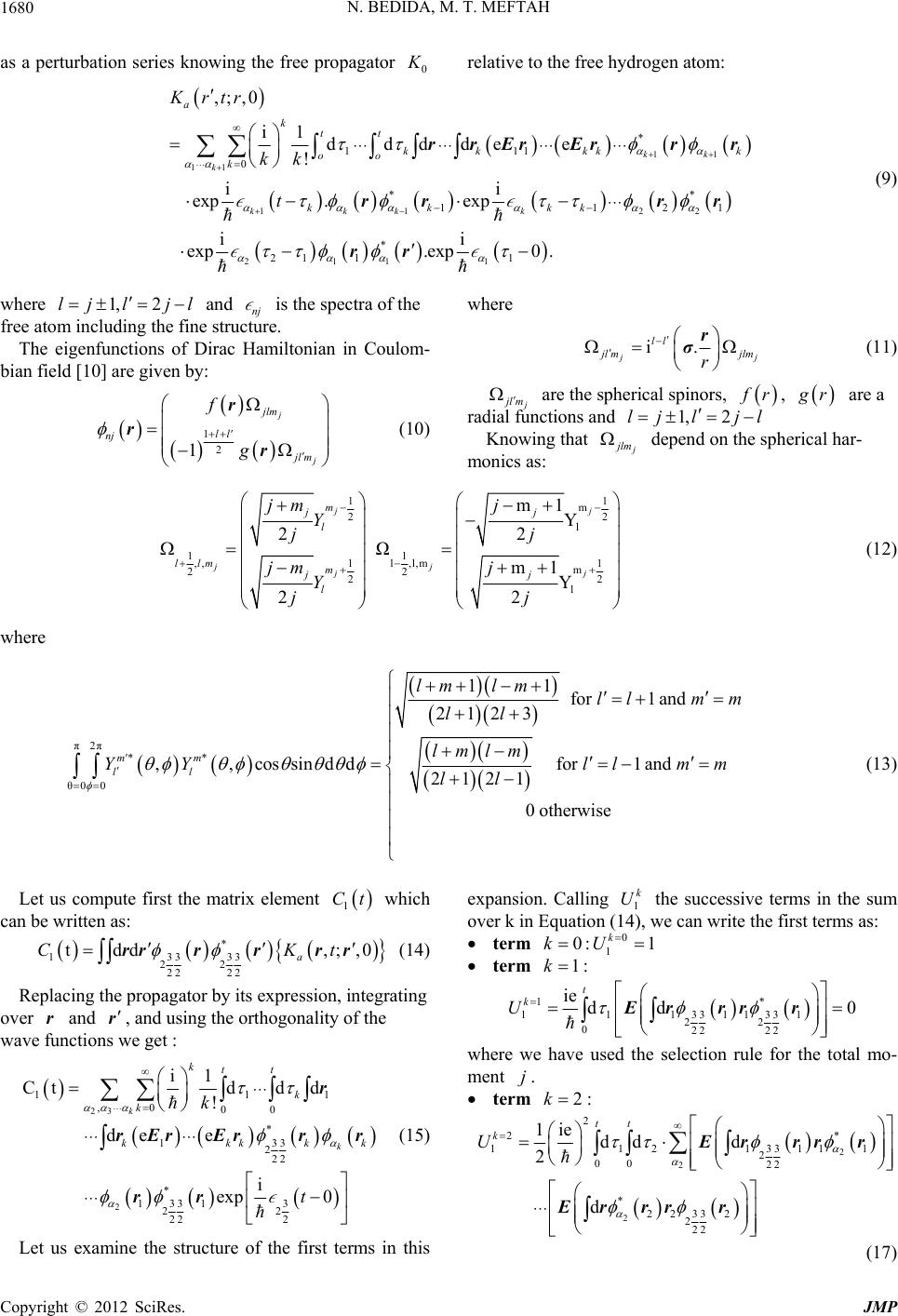 N. BEDIDA, M. T. MEFTAH 1680 as a perturbation series knowing the free propagator 0 K relative to the free hydrogen atom: 11 11 11 22 1 1 * 11 0 ** 1121 * 11 ,; ,0 ddddee ii exp exp ii exp.exp0 . kk k k k a k kk kkk k kkkk tt oo Krtr kk t ћћ ћћ Λ ΛΛ Λ ΛΛrrEr Errr rr rr rr 1, 2lj ljl 21 21 1 i1 ! . kk (9) where and nj is the spectra of the free atom including the fine structure. The eigenfunctions of Dirac Hamiltonian in Coulom- bian field [10] are given by: j jlm ll nj f g r r r 1 2 1j jl m (10) where i. j ll j j lm jlm r r σ (11) f r, g j j lm are the spherical spinors, r 1, 2lj l jl are a radial functions and Knowing that j lm j depend on the spherical har- monics as: 11 m 22 l 11 11 ,,l ,l,mm 22 22 l m1 Y 22 Ω m1 Y 22 jj jj jj jj llm jj j jj j jj m l m l jm Y jm Y (12) where π2π ** θ00 ,, cos 11 for1 and 2123 dfor1 and 2121 0otherwise mm ll lm lmllmm ll lmlm YY llmm ll sin d 1 Ct (13) Let us compute first the matrix element which can be written as: 3ar * 1333 22 22 22 tdd,;,0CKt rr rrr r r (14) Replacing the propagator by its expression, integrating over and , and using the orthogonality of the wave functions we get : 23 2 111 ,0 00 * 1 3 222 * 1331 22 22 2 i1 Ctd d ! de e i exp k k ktt k kkkkk ћk ћ Λ Λ ΛΛ Λ rEr Err rr k U 3 3 d 0 k t r r (15) Let us examine the structure of the first terms in this expansion. Calling 1 the successive terms in the sum over k in Equation (14), we can write the first terms as: term 0k :0 1 U1 k term 1k : 1* 11133 1133 1 22 022 22 ie dd 0 t k Uћ Er rr r j where we have used the selection rule for the total mo- ment . term 2k : 2 2 2 2 2* 112133111 2 00 22 * 22332 222 1ieddd 2 d tt k Uћ Errr r Er rrrΛ (17) Copyright © 2012 SciRes. JMP 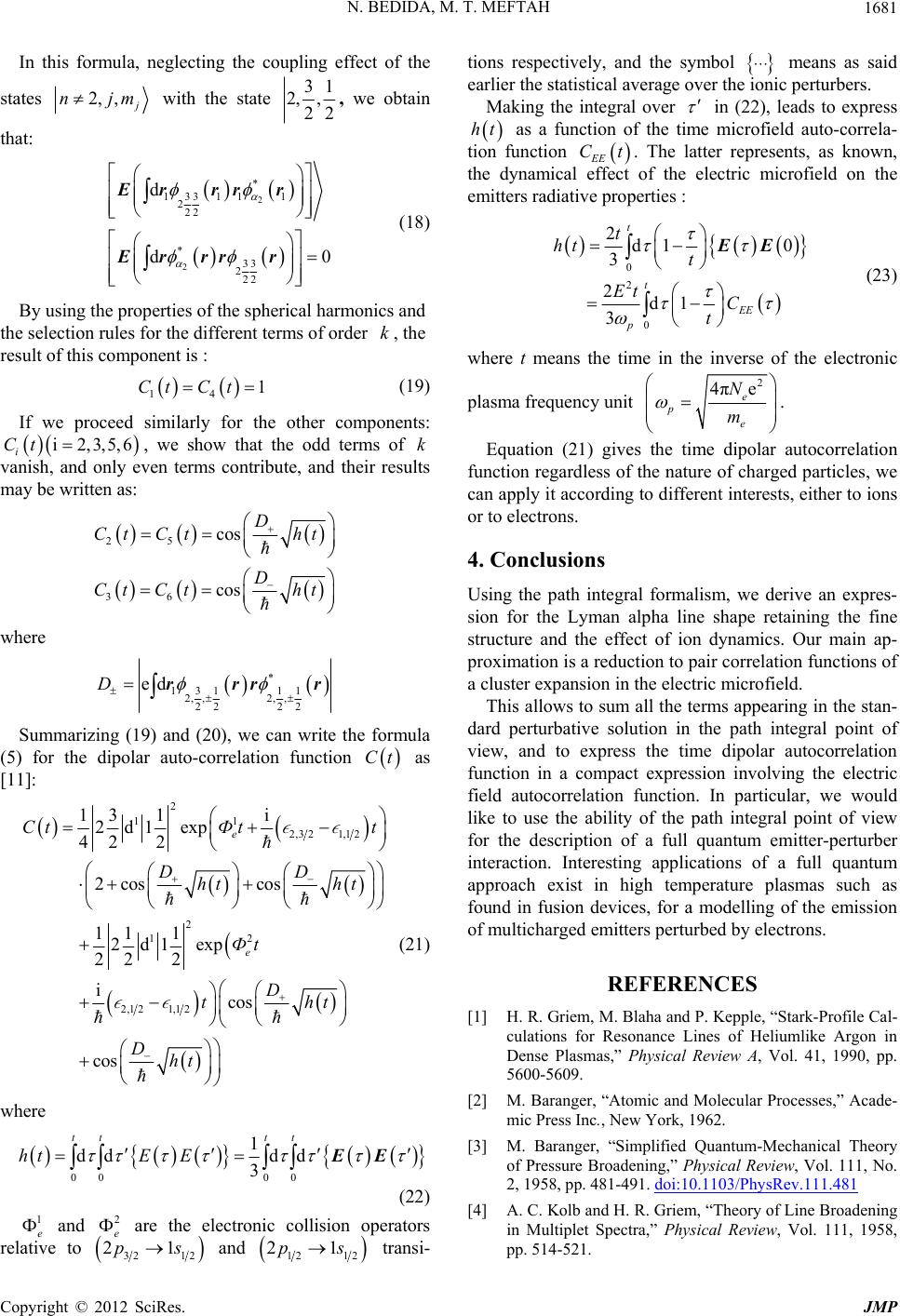 N. BEDIDA, M. T. MEFTAH 1681 In this formula, neglecting the coupling effect of the states 2,, j njm with the state 31 2, , 22 , we obtain that: 2 * 1 1 33 222 d0 r r r r k 2 13 3 1 222 * d Er r Er r (18) By using the properties of the spherical harmonics and the selection rules for the different terms of order , the result of this component is : 14 1C t i 2,3,5,6k Ct (19) If we proceed similarly for the other components: , we show that the odd terms of vanish, and only even terms contribute, and their results may be written as: i Ct 25 36 cos cos Ct Ct Ct Ct Dht ћ Dht ћ where * 11 2, , 22 rr 13 1 2, , 22 edDrr Summarizing (19) and (20), we can write the formula (5) for the dipolar auto-correlation function Ct as [11]: 2 11 2 12 2,1 21,12 13 1i 2d1 exp 42 2 2cos cos 11 1 2d1 exp 222 icos cos e e Ct Ф ћ ht Фt D ћћ Dht ћ 2,3 21,12 tt DD ht ћћ tht (21) where 00 00 1 dd dd 3 tt tt htE E EE 1 Ф2 Фe (22) e and are the electronic collision operators relative to 12 1ps 32 2 and 12 12 21ps transi- tions respectively, and the symbol Λ means as said earlier the statistical average over the ionic perturbers. Making the integral over in (22), leads to express ht as a function of the time microfield auto-correla- tion function Ct EE . The latter represents, as known, the dynamical effect of the electric microfield on the emitters radiative properties : 0 2 0 2d10 3 2d1 3 t t EE p t ht t Et C t EE (23) where t means the time in the inverse of the electronic 2 4πe e p e N m plasma frequency unit . Equation (21) gives the time dipolar autocorrelation function regardless of the nature of charged particles, we can apply it according to different interests, either to ions or to electrons. 4. Conclusions Using the path integral formalism, we derive an expres- sion for the Lyman alpha line shape retaining the fine structure and the effect of ion dynamics. Our main ap- proximation is a reduction to pair correlation functions of a cluster expansion in the electric microfield. This allows to sum all the terms appearing in the stan- dard perturbative solution in the path integral point of view, and to express the time dipolar autocorrelation function in a compact expression involving the electric field autocorrelation function. In particular, we would like to use the ability of the path integral point of view for the description of a full quantum emitter-perturber interaction. Interesting applications of a full quantum approach exist in high temperature plasmas such as found in fusion devices, for a modelling of the emission of multicharged emitters perturbed by electrons. REFERENCES [1] H. R. Griem, M. Blaha and P. Kepple, “Stark-Profile Cal- culations for Resonance Lines of Heliumlike Argon in Dense Plasmas,” Physical Review A, Vol. 41, 1990, pp. 5600-5609. [2] M. Baranger, “Atomic and Molecular Processes,” Acade- mic Press Inc., New York, 1962. [3] M. Baranger, “Simplified Quantum-Mechanical Theory of Pressure Broadening,” Physical Review, Vol. 111, No. 2, 1958, pp. 481-491. doi:10.1103/PhysRev.111.481 [4] A. C. Kolb and H. R. Griem, “Theory of Line Broadening in Multiplet Spectra,” Physical Review, Vol. 111, 1958, pp. 514-521. Copyright © 2012 SciRes. JMP  N. BEDIDA, M. T. MEFTAH Copyright © 2012 SciRes. JMP 1682 [5] R. Feynman and A. R. Hibbs, “Quantum Mechanics and Path Integrals,” McGraw- Hill, New York, 1965. [6] H. Kleinert, “Path Integrals in Quantum Mechanics Sta- tistics and Polymer Physics,” World Scientific, Singapore, 1990. [7] Is. Chihi, M. T. Meftah and H, Kleinert, “Path Integral Approach in the Plasma Radiation Theory,” Journal of Plasma Physics, Vol. 70, 2004, pp. 553-559. doi:10.1017/S0022377803002794 [8] H. Bouguettaia, Is. Chihi, K. Chenini, M. T. Meftah, F. Khelfaoui and R. Stamm, “Application of Path Integral Formalism in Spectral Line Broadening: Lyman-α in Hy- drogenic Plasma,” Journal of Quantitative Spectroscopy and Radiative Transfer, Vol. 94, No. 3-4, 2005, pp. 335- 346. doi:10.1016/j.jqsrt.2004.09.015 [9] H. R. Griem, “Spectral Line Broadening by Plasma,” McGraw-Hill, New York, 1964. [10] L. Landau and E. Lifchitz, “Théorie Quantique Relati- viste,” MIR, Moscou, 1972. [11] N. Bedida, M. T. Meftah, D. Boland and R. Stamm, “Path Integral Formalism for Spectral Line Shape in Plasmas,” Proceedings of the 19th International Conference on Spe- ctral Line Shapes, Valladolid, 15-20 June 2008, pp. 100- 101. |