

Paper Menu >>
Journal Menu >>
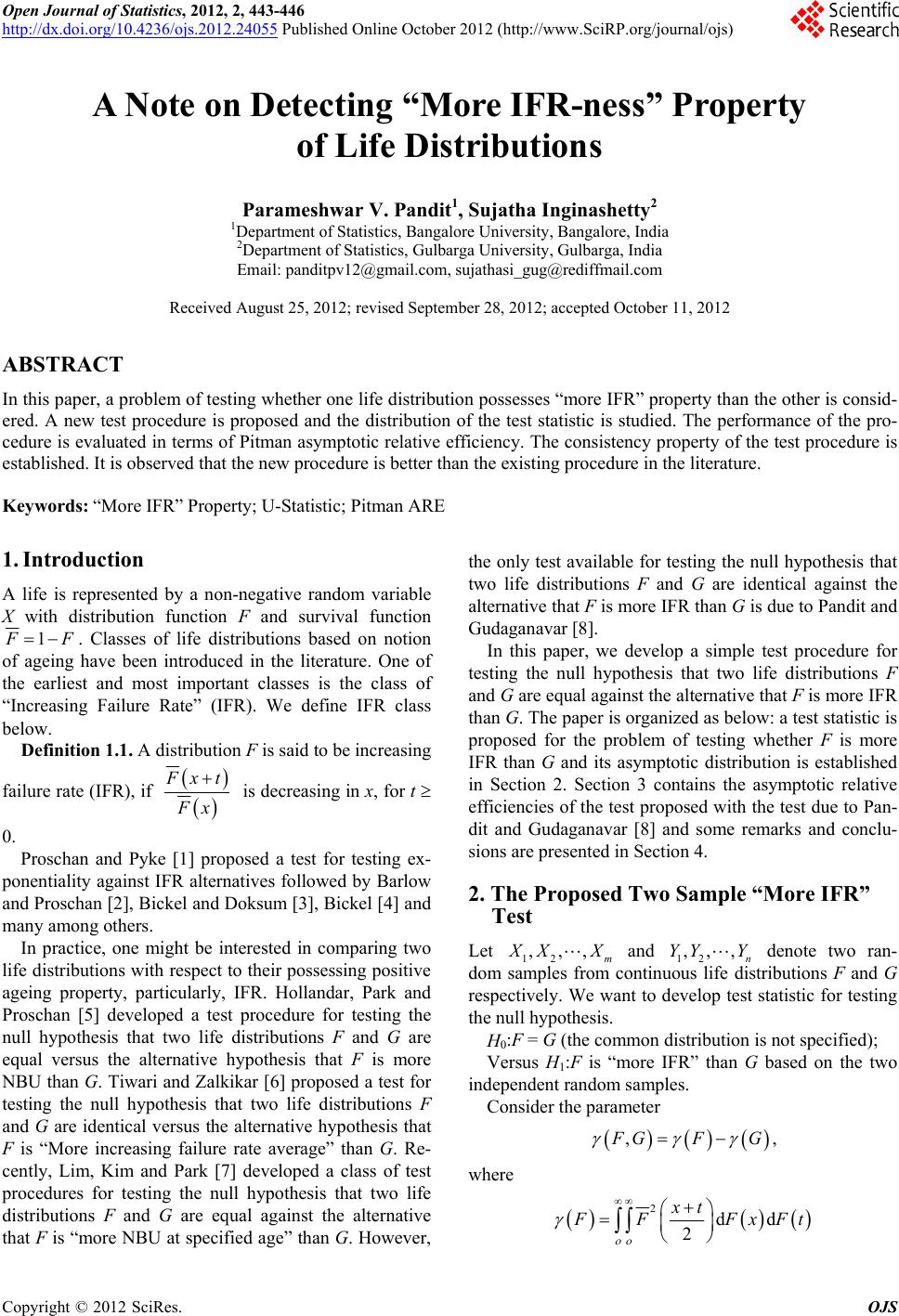 Open Journal of Statistics, 2012, 2, 443-446 http://dx.doi.org/10.4236/ojs.2012.24055 Published Online October 2012 (http://www.SciRP.org/journal/ojs) A Note on Detecting “More IFR-ness” Property of Life Distributions Parameshwar V. Pandit1, Sujatha Inginashetty2 1Department of Statistics, Bangalore University, Bangalore, India 2Department of Statistics, Gulbarga University, Gulbarga, India Email: [email protected], [email protected] Received August 25, 2012; revised September 28, 2012; accepted October 11, 2012 ABSTRACT In this paper, a problem of testing whether one life distribution possesses “more IFR” property than the other is consid- ered. A new test procedure is proposed and the distribution of the test statistic is studied. The performance of the pro- cedure is evaluated in terms of Pitman asymptotic relative efficiency. The consistency property of the test procedure is established. It is observed that the new procedure is better than the existing proced ure in the literature. Keywords: “More IFR” Property; U-Statistic; Pitman ARE 1. Introduction A life is represented by a non-negative random variable X with distribution function F and survival function F 1F . Classes of life distributions based on notion of ageing have been introduced in the literature. One of the earliest and most important classes is the class of “Increasing Failure Rate” (IFR). We define IFR class below. Definiti on 1.1. A distribution F is said to be increasing failure rate (IFR), if F xt x ,,, F is decreasing in x, for t 0. Proschan and Pyke [1] proposed a test for testing ex- ponentiality against IFR alternatives followed by Barlow and Proschan [2], Bickel and Doksum [3], Bickel [4] and many among others. In practice, one might be interested in comparing two life distributions with respect to their possessing positive ageing property, particularly, IFR. Hollandar, Park and Proschan [5] developed a test procedure for testing the null hypothesis that two life distributions F and G are equal versus the alternative hypothesis that F is more NBU than G. Tiwari and Za lkikar [6] propo sed a test for testing the null hypothesis that two life distributions F and G are identical versus the alternative hypothesis that F is “More increasing failure rate average” than G. Re- cently, Lim, Kim and Park [7] developed a class of test procedures for testing the null hypothesis that two life distributions F and G are equal against the alternative that F is “more NBU at specified age” than G. However, the only test available for testing the null hypothesis that two life distributions F and G are identical against the alternative that F is more IFR than G is due to Pandit and Gudaganavar [8]. In this paper, we develop a simple test procedure for testing the null hypothesis that two life distributions F and G are equal against the alternative that F is more IFR than G. The paper is organized as below: a test statistic is proposed for the problem of testing whether F is more IFR than G and its asymptotic distribution is established in Section 2. Section 3 contains the asymptotic relative efficiencies of the test proposed with the test due to Pan- dit and Gudaganavar [8] and some remarks and conclu- sions are presented in Section 4. 2. The Proposed Two Sample “More IFR” Test Let 12 m X XX,,,YY Y and 12 n denote two ran- dom samples from continuous life distributions F and G respectively. We want to develop test statistic for testing the null hypothesis. H0:F = G (the common distribution is not specified); Versus H1:F is “more IFR” than G based on the two independent random samples. Consider the parameter , F GFG , where 2dd 2 xt F FFxFt C opyright © 2012 SciRes. OJS 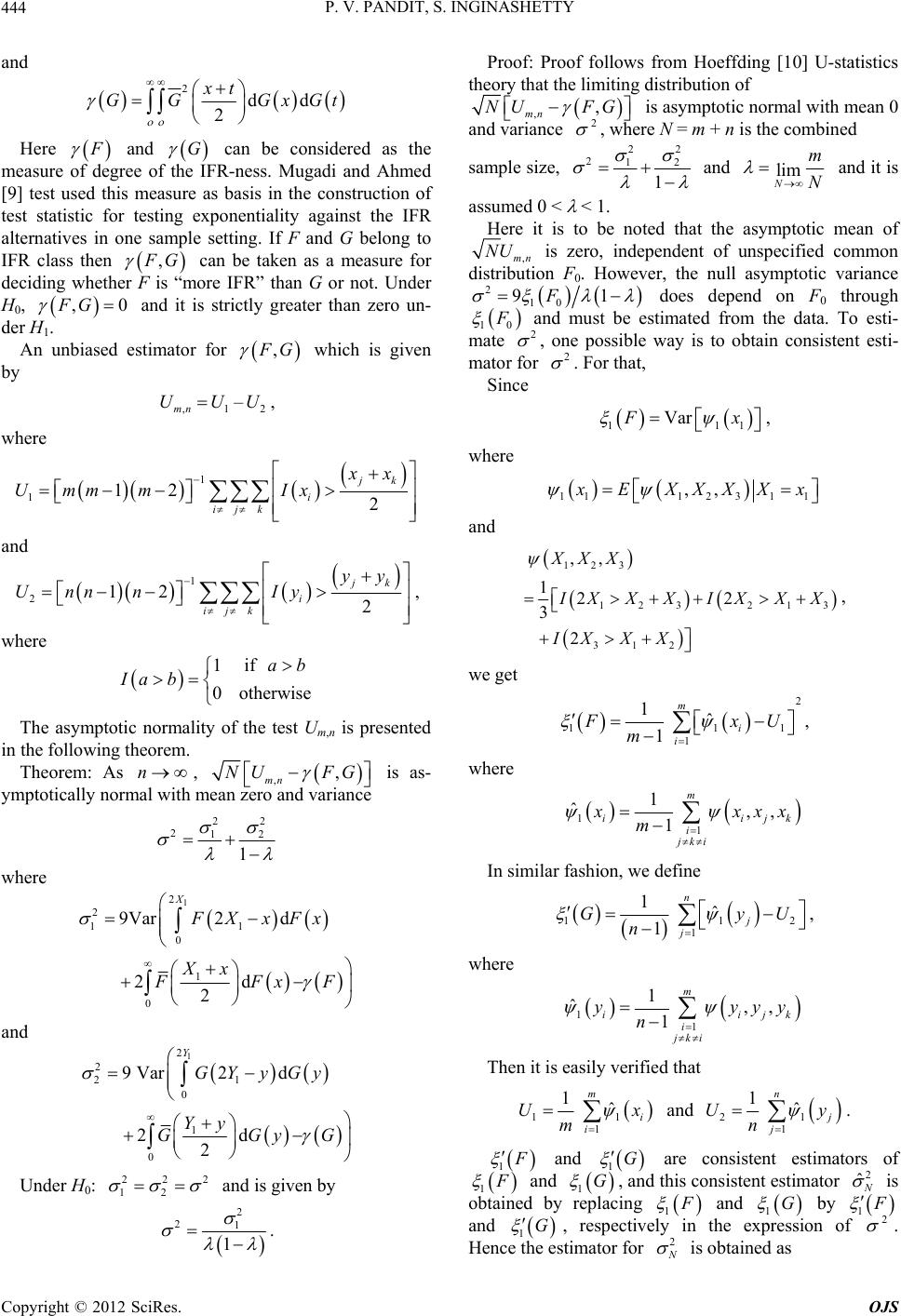 P. V. PANDIT, S. INGINASHETTY 444 and ddGxGt 2 2 xt GG Here F and can be considered as the measure of degree of the IFR-ness. Mugadi and Ahmed [9] test used this measure as basis in the construction of test statistic for testing exponentiality against the IFR alternatives in one sample setting. If F and G belong to IFR class then G , F G 0 , can be taken as a measure for deciding whether F is “more IFR” than G or not. Under H0, and it is strictly greater than zero un- der H1. ,FG An unbiased estimator for F G ,12 which is given by – mn UUU , where 1 112 i ijk2 jk x x x Um m mI and 1 212 i ijk Un n nIy 2 jk yy 1if 0otherwise ab , where Ia b The asymptotic normality of the test Um,n is presented in the following theorem. Theorem: As n, ,NU FG ,mn is as- ymptotically normal with mean zero and variance 22 12 1 2 where dxFx 1 2 2 11 0 1 0 9Var 2 2d 2 X FX Xx F Fx F and dyGy yG 1 2 2 21 0 1 0 9 Var2 2d 2 Y GY Yy GG Under H0: 222 12 and is given by 2 21 1 Proof: Proof follows from Hoeffding [10] U-statistics theory that the limiting distribution of . ,NU FG ,mn is asymptotic normal with mean 0 and variance 2 , where N = m + n is the combined sample size, 22 212 1 and lim N m N and it is assumed 0 < < 1. Here it is to be noted that the asymptotic mean of ,mn is zero, independent of unspecified common distribution F0. However, the null asymptotic variance NU 291F 10 does depend on F0 through 10 F 2 and must be estimated from the data. To esti- mate , one possible way is to obtain consistent esti- mator for 2 . For that, Since 111 Var F x , where 111 2 311 ,, x EXXXXx and 123 123 213 312 ,, 122 3 2 XXX IXXXIXX X IXXX , we get 2 111 1 1ˆ 1 m i i FxU m , where 11 1 ˆ,, 1 m iijk i jki x xx x m In similar fashion, we define 112 1 1ˆ 1 n j j GyU n , where 11 1 ˆ,, 1 m iijk i jki yyyy n Then it is easily verified that 11 1 1ˆ m i i Ux m and 21 1 1ˆ n j n j Uy. 1 1G are consistent estimators of F and 1 G 1, and this consistent estimator 2 ˆ N F and is obtained by replacing 1 F G and 1 by 1 F and G 2 1, respectively in the expression of . Hence the estimator for 2 N is obtained as Copyright © 2012 SciRes. OJS 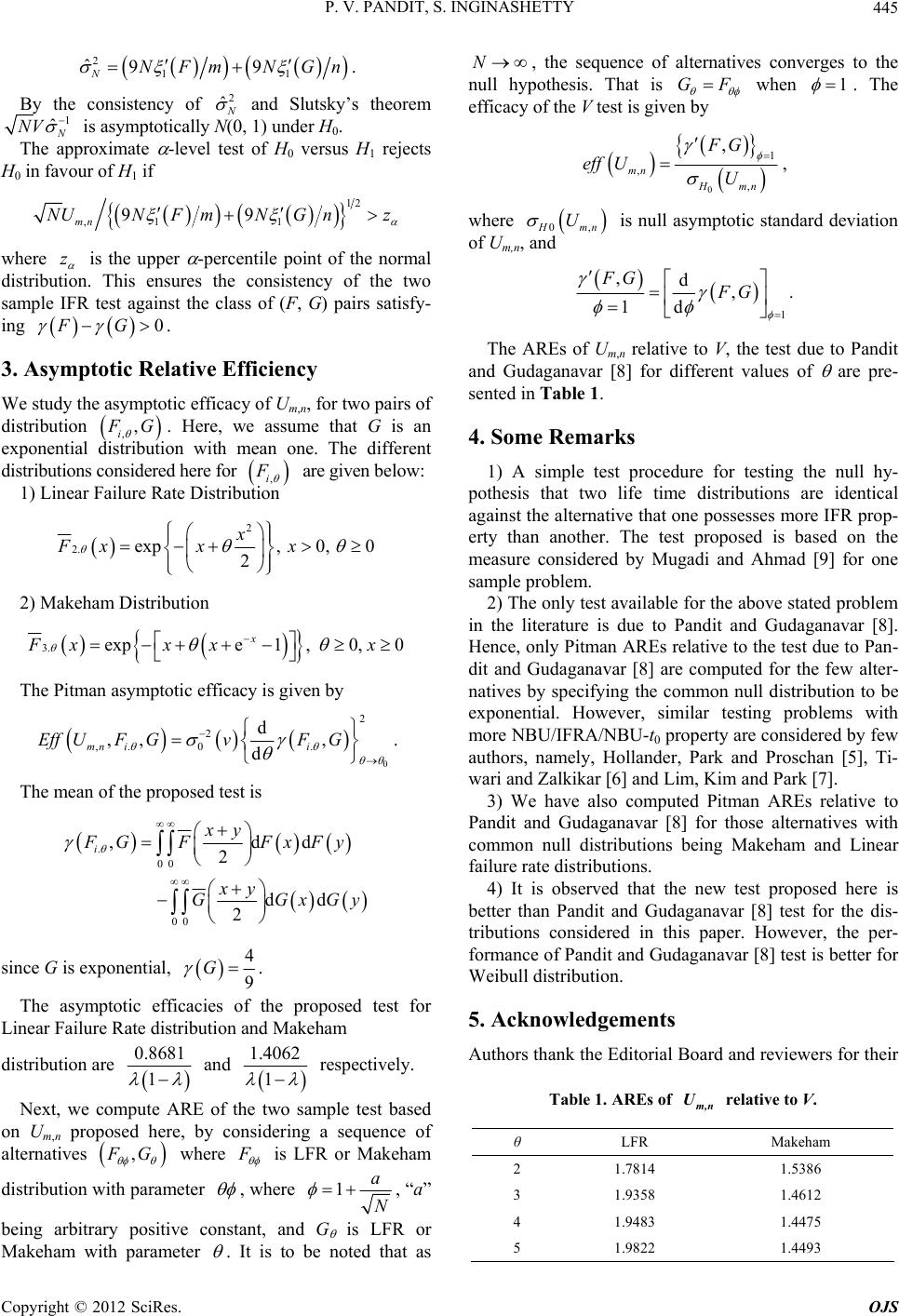 P. V. PANDIT, S. INGINASHETTY 445 11 99NGn 2 ˆ 2 ˆNNFm . By the consistency of N and Slutsky’s theorem 1 ˆ N NV is asymptotically N(0, 1) under H0. The approximate -level test of H0 versus H1 rejects H0 in favour of H1 if 12 1 n z ,1 99 mn NUNF mNG z where is the upper -percentile point of the normal distribution. This ensures the consistency of the two sample IFR test against the class of (F, G) pairs satisfy- ing . 0FG , 3. Asymptotic Relative Efficiency We study the asymptotic efficacy of Um,n, for two pairs of distribution ,i F G F . Here, we assume that G is an exponential distribution with mean one. The different distributions considered here for ,i are given below: 1) Linear Failure Rate Distribution 2 2. exp 2 x Fx x , 0, 0 x 2) Makeham Distribution 3. expe 1 x Fxx x , 0, 0x The Pitman asymptotic efficacy is given by 0 2 . , i F G 2 ,. 0d ,, d mn i Eff UFGv . The mean of the proposed test is d dd .00 00 ,d 2 2 i xy F GF xy FxFy GGxGy since G is exponential, 4 9 G . The asymptotic efficacies of the proposed test for Linear Failure Rate distribution and Makeham distributio n are 0.8681 1 and 1.4062 1 respectively. Next, we compute ARE of the two sample test based on Um,n proposed here, by considering a sequence of alternatives , F G where F is LFR or Makeham distribution with parameter , wh ere 1a N , “a” being arbitrary positive constant, and G is LFR or Makeham with parameter . It is to be noted that as , the sequence of alternatives converges to the null hypothesis. That is G N F 1 when . The efficacy of the V test is given by 0 1 , , , mn Hmn FG eff UU , ,0 H where mn U is null asymptotic standard deviation of Um,n, and 1 ,d, 1d FG FG . m,n U The AREs of Um,n relative to V, the test due to Pandit and Gudaganavar [8] for different values of are pre- sented in Table 1. 4. Some Remarks 1) A simple test procedure for testing the null hy- pothesis that two life time distributions are identical against the alternative th at one possesses more IFR prop- erty than another. The test proposed is based on the measure considered by Mugadi and Ahmad [9] for one sample problem. 2) The only test available for the above stated problem in the literature is due to Pandit and Gudaganavar [8]. Hence, only Pitman AREs relative to the test due to Pan- dit and Gudaganavar [8] are computed for the few alter- natives by specifying the common null distribution to be exponential. However, similar testing problems with more NBU/IFRA/NBU-t0 property are considered by few authors, namely, Hollander, Park and Proschan [5], Ti- wari and Zalkikar [6] and Lim, Kim and Park [7]. 3) We have also computed Pitman AREs relative to Pandit and Gudaganavar [8] for those alternatives with common null distributions being Makeham and Linear failure rate distributions. 4) It is observed that the new test proposed here is better than Pandit and Gudaganavar [8] test for the dis- tributions considered in this paper. However, the per- formance of Pandit and Gudaganavar [8] test is better for Weibull distribution. 5. Acknowledgements Authors thank the Editorial Board and reviewers for their Table 1. AREs of relative to V. θ LFR Makeham 2 1.7814 1.5386 3 1.9358 1.4612 4 1.9483 1.4475 5 1.9822 1.4493 Copyright © 2012 SciRes. OJS  P. V. PANDIT, S. INGINASHETTY Copyright © 2012 SciRes. OJS 446 valuable comments which lead to this revised version of the paper. REFERENCES [1] F. Proschan and R. Pyke, “Tests for Monotone Failure Rate,” Proceedings of the Fifth Berkeley Symposium on Mathematical Statistics and Probability, Vol. 3, 1967, pp. 293-312. [2] R. E. Barlow and F. Proschan, “A Note on Tests of Monotone Failure Rate Based on Incomplete Data,” The Annals of Mathematical Statistics, Vol. 40, No. 2, 1969, pp. 595-600. doi:10.1214/aoms/11776927 [3] P. J. Bickel and K. Doksum, “Test for Monotone Failure Rate Based on Normalized Spacings,” The Annals of Mathematical Statistics, Vol. 40, No. 4, 1969, pp. 1216- 1235. doi:10.1214/aoms/1177697498 [4] P. J. Bickel, “Tests of Monotone Failure Rate II,” The Annals of Mathematical Statistics, Vol. 40, No. 4, 1969, pp. 1250-1260. doi:10.1214/aoms/1177697498 [5] R. M. Hollander, D. H. Park and F. Proschan, “Testing Whether F Is ‘More NBU’ than Is G,” Microelectronics Reliability, Vol. 26, No. 1, 1986, pp. 39-44. doi:10.1016/0026-2714(86)90769-9 [6] R. C. Tiwari and J. N. Zalkikar, “Testing Whether F Is ‘More IFRA than G’,” Microelectronics Reliability, Vol. 28, No. 5, 1988, pp. 703-712. doi:10.1016/0026-2714(88)90006-6 [7] J. H. Lim, D. K. Kim and D. H. Park, “Tests for Detect- ing More NBU-ness at Specific Age,” Australian and New Zealand Journal of Statistics, Vol. 47, No. 3, 2005, pp. 329-337. [8] P. V. Pandit and N. V. Gudaganavar, “On Two-Sample Test for Detecting Differences in the IFR Property of Life Distributions,” African Journal of Mathematical and Com- puter Science Research, Vol. 2, No. 2, 2009, pp. 25-29. [9] A. R. Mugadi and I. A. Ahmad, “Classes of Statistics for Testing Exponentiality versus IFR or NBUE Altern ati ve s,” Calcutta Statistical Association Bulletin, Vol. 62, No. 245- 246, 2010, pp. 17-29. |