

Paper Menu >>
Journal Menu >>
 Open Journal of Statistics, 2012, 2, 420-423 http://dx.doi.org/10.4236/ojs.2012.24051 Published Online October 2012 (http://www.SciRP.org/journal/ojs) Maximum Likelihood Estimation for Generalized Pareto Distribution under Progressive Censoring with Binomial Removals Bander Al-Zahrani Department of Statistics, Faculty of Sciences, King Abdulaziz University, Jeddah, Saudi Arabia Email: [email protected] Received July 2, 2012; revised August 5, 2012; accepted August 17, 2012 ABSTRACT The paper deals with the estimation problem for the generalized Pareto distribution based on progressive type-II cen- soring with random removals. The number of components removed at each failure time is assumed to follow a binomial distribution. Maximum likelihood estimators and the asymptotic variance-covariance matrix of the estimates are ob- tained. Finally, a numerical example is given to illustrate the obtain ed results. Keywords: Pareto Distribution; Binomial Removal; Progressive Censoring; Maximum Likelihood Estimator 1. Introduction The generalized Pareto distribution is also known as the Lomax distribution with two parameters, or the Pareto of the second type. It can be considered as a mixture distri- bution. Suppose that a random variable X has an ex- ponential distribution with some parameter . Further, suppose that itself has a gamma distribution, and then the resulting unconditional distribution of X is called the Lomax distribution. This distribution has been extensively used for reliability modeling and life testing, for details see e.g. Balkema and de Haan [1]. It also has been used as an alternativ e to the expon ential d istributio n when the data are heavy tailed, see Bryson [2]. It has applications in economics, actuarial modeling, queuing problems and biological sciences, for more details we refer to Johnson et al. [3]. A random variable X is said to have the generalized Pareto distribution with two parameters, abbreviated as ,XGP ;,1, 0,,0.fxx x , if it has the probability density function (pdf) 1 (1) Here and are the shape and scale parameters, respectively. The survival function (sf) associated to (1) is given by ;,1, 0Fxx x (2) The hazard function is All standard (further probabilistic properties of this distribution are given, for example, in Arnold [4]). In life testing, the experimenter does not always ob- serve the failure times of all components placed on the test. In such cases, the censored sampling arises. Fur- thermore, there are some cases in which components are lost or removed from the test before failure. This would lead to progressive censoring. Progressive censoring schemes are very useful in clinical trials and life-testing experiments. Balakrishnan and Aggarwala [5] provided a wealth of information on inferences under progressive censoring sampling. The progressively type-II censored life test is described as follows. The experimenter puts n components on test at time zero. The first failure is ob- served at 1 X and then 1 of surviving components is randomly selected and removed. When the ith failure component is observed at i R X , i of surviving compo- nents are randomly selected and removed, R 2,3,, .im The experiment terminates when the mth failure component is observed at m X and m all removed. In this censoring scheme 12m are all prefixed. However, in some practical experiments, these numbers cannot be pre-fixed and they occur at random. Yuen and Tse [6], Tse and Yuen [7] and Tse et al. [8] considered the esti- mation problem for Weibull distribution under type-II progressive censoring with binomial removals. Shuo [9] studied the estimation problem for two-parameter Pareto distribution b ased on progressive censoring with unifor m removals. Wu [10] provided estimation for the two-pa- rameter Pareto distribution under progressive censoring 1i m i Rnm R ,,,RR R ;,1, 0.hxx x (3) C opyright © 2012 SciRes. OJS 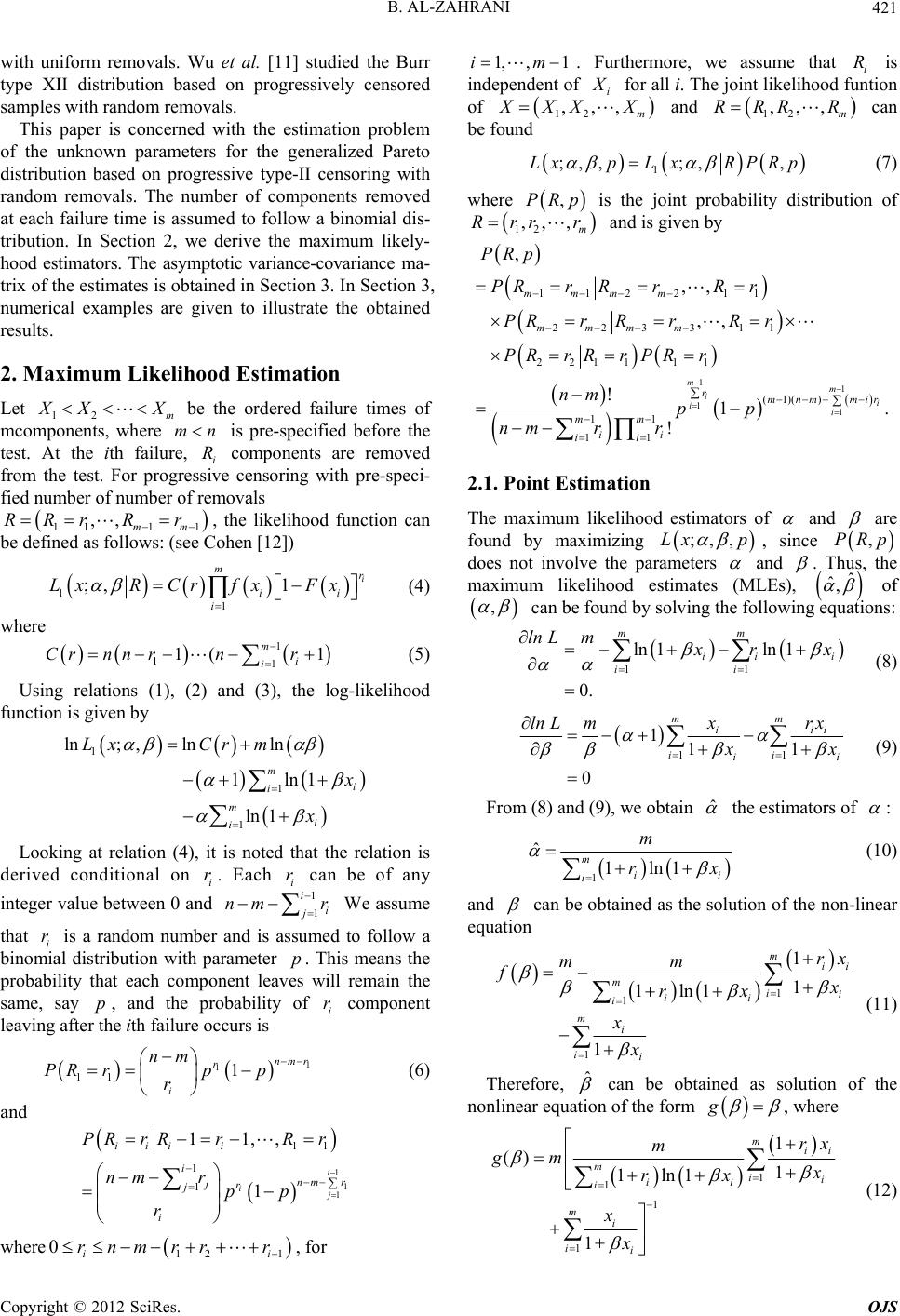 B. AL-ZAHRANI 421 with uniform removals. Wu et al. [11] studied the Burr type XII distribution based on progressively censored samples with random removals. This paper is concerned with the estimation problem of the unknown parameters for the generalized Pareto distribution based on progressive type-II censoring with random removals. The number of components removed at each failure time is assumed to follow a binomial dis- tribution. In Section 2, we derive the maximum likely- hood estimators. The asymptotic variance-covariance ma- trix of the estimates is obtained in Section 3. In Section 3, numerical examples are given to illustrate the obtained results. 2. Maximum Likelihood Estimation Let 12m X XX mnR ,,R r be the ordered failure times of mcomponents, where is pre-specified before the test. At the ith failure, i components are removed from the test. For progressive censoring with pre-speci- fied number of number of removals 1111mm , the likelihood function can be defined as follows: (see Cohen [12]) RRr 1 1;, m i i LxR Crfx 1i r i Fx 1 11 i m ir 1 ln 1ln1 1 i i m (4) where 11(Crnnrn (5) Using relations (1), (2) and (3), the log-likelihood function is given by 1 1 ln; ,ln ln i m i LxCr m x x ri1 1 i ji nm r rp pi r 1 11nmr p Looking at relation (4), it is noted that the relation is derived conditional on . Each r can be of any i integer value between 0 and We assume that i is a random number and is assumed to follow a binomial distribution with parameter . This means the probability that each component leaves will remain the same, say , and the probability of component leaving after the ith failure occurs is 11 r i nm PR rp r (6) and 1 1 1 11 ,, 1i j nm r R r pp 12ii r r 1, ,1im 1 1 11 i iii i jj i i r PR rRr nm r r R i . Furthermore, we assume that i is independent of X for all i. The joint likelihood funtion of 12 ,,, m X XX X 12 ,,, m RRRR and can be found where0, for 1 rnmr 1 ;,, ;,,LxpLxRPRp (7) , P Rp is the joint probability distribution of where 12 ,, , m Rrr r and is given by 11 11 112 2 11 223311 2211 11 (1)() 11 11 , ,, ,, !1. ! ii i mm i mmm m mmmm rmnmmir mm i ii i PRp PRrRrR r PRrRrR r PRrRr PRr nm pp nmr r 2.1. Point Estimation The maximum likelihood estimators of and are found by maximizing , L ;,,xp , since P Rp does not involve the parameters and . Thus, the maximum likelihood estimates (MLEs), ˆ ˆ, of , can be found by solving the following equations: 11 ln 1ln 1 0. m i iii m i ln Lm x rx (8) 11 111 0 ii mm iii ii x rx ln Lm x x ˆ (9) the esti mators of : From (8) and (9), we obtain 11ln1 ˆm ii i m rx (10) and can be obtained as the solution of the non-linear equation 1 1 1 1 1 1ln1 1 mii mii ii mi ii i rx mm f x rx x x ˆ (11) Therefore, can be obtained as solution of the nonlinear equation of the form g , where 1 1 1 1 1 () 1 1ln1 1 mii mii ii i mi ii rx m gm x rx x x (12) Copyright © 2012 SciRes. OJS 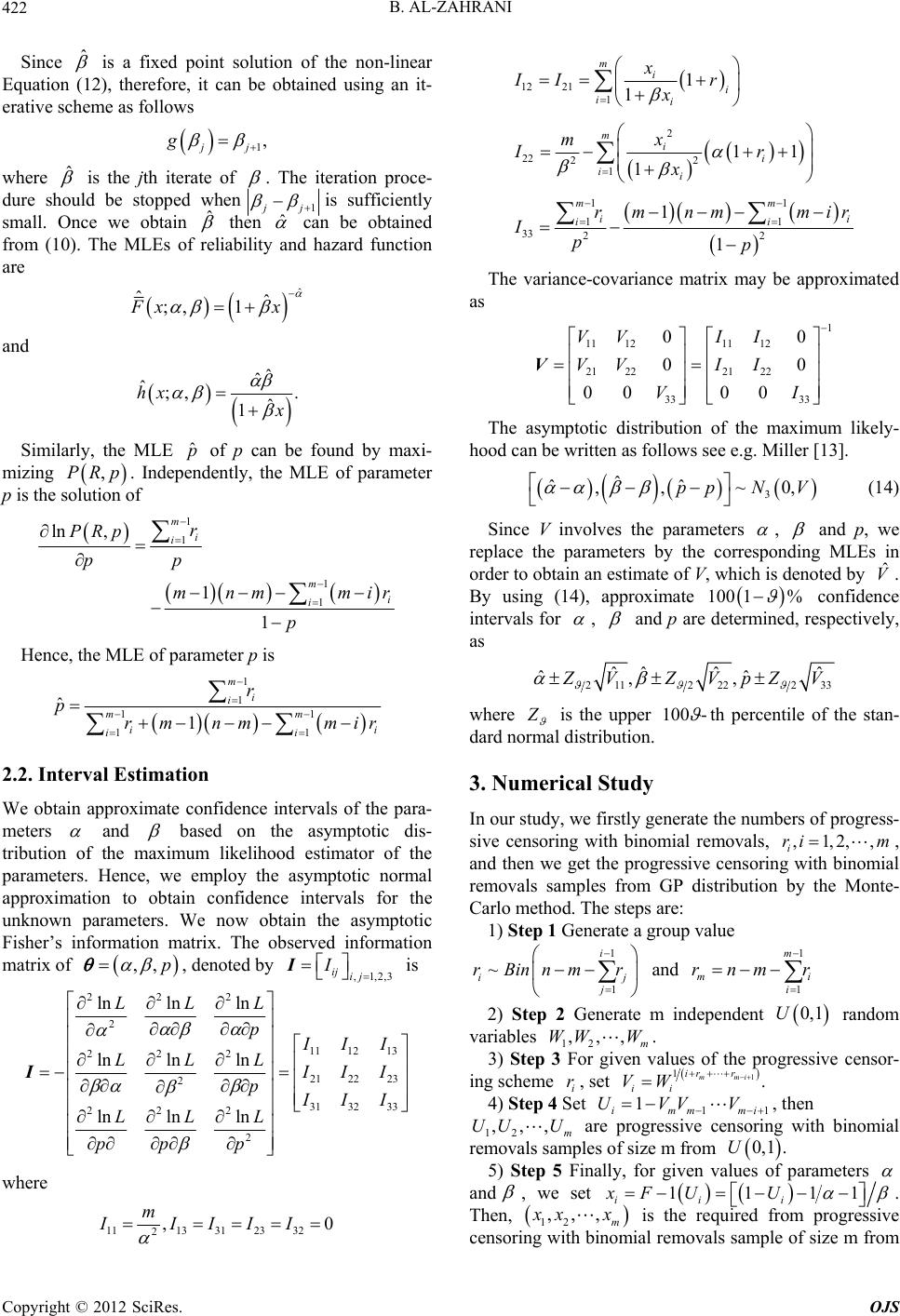 B. AL-ZAHRANI 422 ˆ Since is a fixed point solution of the non-linear Equation (12), therefore, it can be obtained using an it- erative scheme as follows 1, jj g ˆ where is the jth iterate of . The iteration proce- dure should be stopped when1jj is sufficiently small. Once we obtain ˆ then ˆ can be obtained from (10). The MLEs of reliability and hazard function are ˆ ˆ 1 ˆ;, F xx and ˆ;,hx ˆ. 1 ˆ ˆ x ˆ p , Similarly, the MLE of p can be found by maxi- mizing P Rp. Independently, the MLE of parameter p is the solution of 1 1 ln , 1 1 m i ir PRp pp mnm p 1 1 m i imir Hence, the MLE of parameter p is 1 1 1 1 ˆ1 m i i m i i r prmnm 1 1 m i i mir 2.2. Interval Estimation We obtain approximate confidence intervals of the para- meters and based on the asymptotic dis- tribution of the maximum likelihood estimator of the parameters. Hence, we employ the asymptotic normal approximation to obtain confidence intervals for the unknown parameters. We now obtain the asymptotic Fisher’s information matrix. The observed information matrix of ,,p ,1,2,3 ij ij I , denoted by is I 222 n lnLLL 2 11 12 13 222 21 2223 2 31 3233 222 2 ln l ln ln ln ln ln ln p I II LLL I II p I II LLL pp p I where 1113 31 2 m II 23 32 ,0III 12 211 1 1 m i ii i x Ir x I 1 2 22 22 11 1 m i i ii x m Ir x 11 11 33 22 1 1 mm ii ii rm nmmir Ipp 1 111211 12 212221 22 33 33 00 00 00 00 VVI I VVI I VI The variance-covariance matrix may be approximated as V The asymptotic distribution of the maximum likely- hood can be written as follows see e.g. Miller [13]. 3 ˆ ˆˆ ,, ~0,ppN V (14) Since V involves the parameters , and p, we replace the parameters by the corresponding MLEs in order to obtain an estimate of V, which is denoted by . By using (14), approximate 100 confidence intervals for ˆ V 1 % , and p are determined, respectively, as 211 222 233 ˆ ,ˆˆ ˆ , ˆ ˆVVZZpZV Z is the upper where 100 - th percentile of the stan- dard normal distribution. 3. Numerical Study In our study, we firstly generate the numbers of progress- sive censoring with binomial removals, i, and then we get the progressive censoring with binomial removals samples from GP distribution by the Monte- Carlo method. The steps are: 1, 2,,,ri m 1 1 ~i ij j rBinnm r 1) Step 1 Generate a grou p va lue and 1 1 m mi i rnm r 2) Step 2 Generate m independent 0, 1 ,,,WW W r U random variables . 12 m 3) Step 3 For given values of the progressive censor- ing scheme , set 1 1. mmi ir r ii VW 1UVVV i 4) Step 4 Set 11immmi ,,,UU U , then 12 m are progressive censoring with binomial removals samples of size m from 0,1 .U 5) Step 5 Finally, for given values of parameters and , we set 1111 ii xF UU i . Then, ,,, 12 m x xx is the required from progressive censoring with binomial removals sample of size m from Copyright © 2012 SciRes. OJS 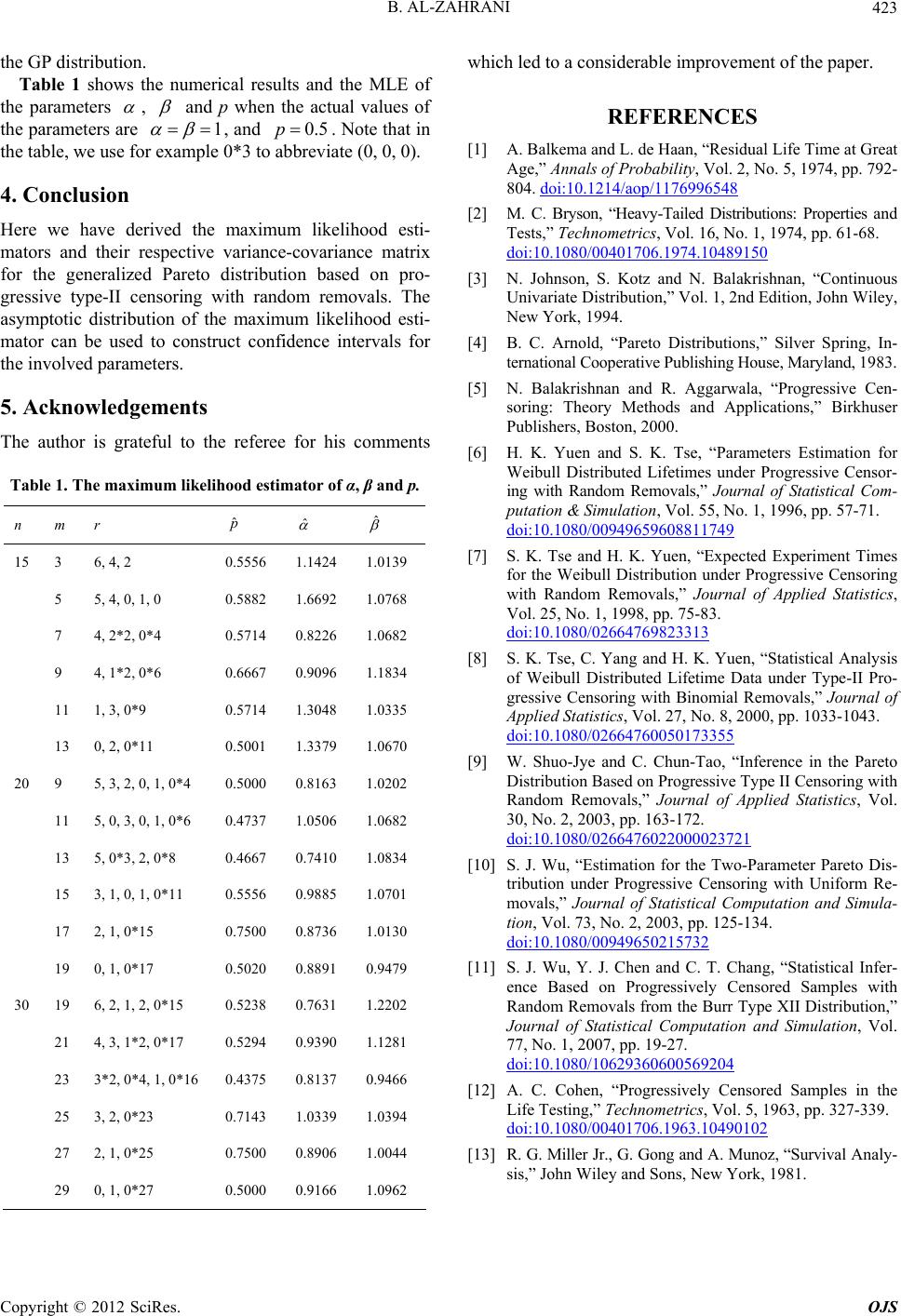 B. AL-ZAHRANI Copyright © 2012 SciRes. OJS 423 which led to a considerable improvement of the paper. the GP distribution. Table 1 shows the numerical results and the MLE of the parameters , and p when the actual values of the parameters are 1REFERENCES , and . Note that in the table, we use for example 0*3 to abbreviate (0, 0, 0). 0.5p ˆ [1] A. Balkema and L. de Haan, “Residual Life Time at Great Age,” Annals of Probability, Vol. 2, No. 5, 1974, pp. 792- 804. doi:10.1214/aop/1176996548 4. Conclusion [2] M. C. Bryson, “Heavy-Tailed Distributions: Properties and Tests,” Technometrics, Vol. 16, No. 1, 1974, pp. 61-68. doi:10.1080/00401706.1974.10489150 Here we have derived the maximum likelihood esti- mators and their respective variance-covariance matrix for the generalized Pareto distribution based on pro- gressive type-II censoring with random removals. The asymptotic distribution of the maximum likelihood esti- mator can be used to construct confidence intervals for the involved parameters. [3] N. Johnson, S. Kotz and N. Balakrishnan, “Continuous Univariate Distribution,” Vol. 1, 2nd Edition, John Wiley, New York, 1994. [4] B. C. Arnold, “Pareto Distributions,” Silver Spring, In- ter nat i ona l C o operat i v e Pub l i s hing Hous e , Mar yl and , 1983. [5] N. Balakrishnan and R. Aggarwala, “Progressive Cen- soring: Theory Methods and Applications,” Birkhuser Publishers, Boston, 2000. 5. Acknowledgements The author is grateful to the referee for his comments [6] H. K. Yuen and S. K. Tse, “Parameters Estimation for Weibull Distributed Lifetimes under Progressive Censor- ing with Random Removals,” Journal of Statistical Com- putation & Simulation, Vol. 55, No. 1, 1996, pp. 57-71. doi:10.1080/00949659608811749 Table 1. The maximum likelihood estimator of α, β and p. ˆ p ˆ n m r 15 3 6, 4, 2 0.5556 1.1424 1.0139 5 5, 4, 0, 1, 0 0.5882 1.6692 1.0768 7 4, 2*2, 0*4 0.5714 0.8226 1.0682 9 4, 1*2, 0*6 0.6667 0.9096 1.1834 11 1, 3, 0*9 0.5714 1.3048 1.0335 13 0, 2, 0*11 0.5001 1.3379 1.0670 20 9 5, 3, 2, 0, 1, 0*4 0.5000 0.8163 1.0202 11 5, 0, 3, 0, 1, 0*6 0.4737 1.0506 1.0682 13 5, 0*3, 2, 0*8 0.4667 0.7410 1.0834 15 3, 1, 0, 1, 0*11 0.5556 0.9885 1.0701 17 2, 1, 0*15 0.7500 0.8736 1.0130 19 0, 1, 0*17 0.5020 0.8891 0.9479 30 19 6, 2, 1, 2, 0*15 0.5238 0.7631 1.2202 21 4, 3, 1*2, 0*17 0.5294 0.9390 1.1281 23 3*2, 0*4, 1, 0*16 0.4375 0.8137 0.9466 25 3, 2, 0*23 0.7143 1.0339 1.0394 27 2, 1, 0*25 0.7500 0.8906 1.0044 29 0, 1, 0*27 0.5000 0.9166 1.0962 [7] S. K. Tse and H. K. Yuen, “Expected Experiment Times for the Weibull Distribution under Progressive Censoring with Random Removals,” Journal of Applied Statistics, Vol. 25, No. 1, 1998, pp. 75-83. doi:10.1080/02664769823313 [8] S. K. Tse, C. Yang and H. K. Yuen, “Statistical Analysis of Weibull Distributed Lifetime Data under Type-II Pro- gressive Censoring with Binomial Removals,” Journal of Applied Statistics, Vol. 27, No. 8, 2000, pp. 1033-1043. doi:10.1080/02664760050173355 [9] W. Shuo-Jye and C. Chun-Tao, “Inference in the Pareto Distribution Based on Progressive Type II Censoring with Random Removals,” Journal of Applied Statistics, Vol. 30, No. 2, 2003, pp. 163-172. doi:10.1080/0266476022000023721 [10] S. J. Wu, “Estimation for the Two-Parameter Pareto Dis- tribution under Progressive Censoring with Uniform Re- movals,” Journal of Statistical Computation and Simula- tion, Vol. 73, No. 2, 2003, pp. 125-134. doi:10.1080/00949650215732 [11] S. J. Wu, Y. J. Chen and C. T. Chang, “Statistical Infer- ence Based on Progressively Censored Samples with Random Removals from the Burr Type XII Distribution,” Journal of Statistical Computation and Simulation, Vol. 77, No. 1, 2007, pp. 19-27. doi:10.1080/10629360600569204 [12] A. C. Cohen, “Progressively Censored Samples in the Life Testing,” Technometrics, Vol. 5, 1963, pp. 327-339. doi:10.1080/00401706.1963.10490102 [13] R. G. Miller Jr., G. Gong and A. Munoz, “Survival A nal y- sis,” John Wiley and Sons, New York, 1981. |