

Paper Menu >>
Journal Menu >>
 Open Journal of Forestry 2012. Vol.2, No.4, 183-186 Published Online October 2012 in SciRes (http://www.SciRP.org/journal/ojf) http://dx.doi.org/10.4236/ojf.2012.24022 Copyright © 2012 SciRes. 183 Drought and Heat Triggers Sudden and Severe Dieback in a Dominant Mediterranean-Type Woodland Species George Matusick, Katinka X. Ruthrof, Giles St. J. Hardy Centre of Excellence for Climate Change Woodland and Forest Health, Murdoc h Uni ve rsity, Perth, Australia Email: [email protected] Received June 7th, 2012; revised July 10th, 2012; accepted July 25th, 2012 Ecosystems in Mediterranean climate regions are projected to undergo considerable changes as a result of shifting climate, including from extreme drought and heat events. A severe and sudden dieback event, occurring in regionally significant Eucalyptus gomphocephala woodland in Western Australia, coincided with extreme drought and heat conditions in early 2011. Using a combination of remote sensing and field- based approaches, we characterized the extent and severity of canopy dieback following the event, as well as highlighted potential predisposing site factors. An estimated 500 ha of woodland was severely affected between February and March 2011. Tree foliage rapidly discolored and died over this period. In the af- fected portion of the woodland, approximately 90% of trees greater than 20 cm DBH were impacted, while in the adjacent unaffected woodland 6% showed signs of damage. Tree density in the unaffected area had approximately 4.5 times more trees than the affected woodland. Precipitation drainage patterns are thought to explain the difference between affected and unaffected woodland. Dropping groundwater levels, a relatively shallow soil profile, and extreme drought and heat in 2010-2011 are thought to predis- pose water-shedding sites to drought-triggered canopy dieback during extended periods of dryness. Tracking forest health changes in response to severe disturbance is an important key to deciphering past and future vegetation change. Keywords: Eucalyptus Gomphocephala; Forest; Western Australia; Die-Off; Climate Change Introduction In Mediterranean climate regions, drought is one of the key selection pressures on forest distribution and growth (Damesin et al., 1998). Despite a range of adaptations to disturbance events, trees in Mediterranean ecosystems can be vulnerable to drought and heat-induced canopy dieback (Lloret et al., 2004) and associated declines in growth (Jump et al., 2006) and car- bon storage (Galiano et al., 2012). These forests will be further challenged if drought periods become more frequent, as pre- dicted by climate change projections (Giorgi & Li o ne l lo, 2008). The Mediterranean climate of the south-west of Western Australia (SWWA) is experiencing a sustained and substantial shift to drier and warmer conditions (Bates et al., 2008). Spe- cifically, the region has been experiencing a pronounced, long- term decline in rainfall since the mid 1970’s (Bates et al., 2008). Concurrently, the average temperatures have risen at a rate of 0.15˚C per decade over the same time period (Bates et al., 2008). Drier conditions in SWWA have corresponded with decreases in streamflow (Petrone, 2010) and groundwater levels as a result of reduced precipitation (Croton & Reed, 2007) and exploitation (Sommer & Froend, 2011). Eucalyptus gomphocepha la DC. is an endemic medium to tall tree with a highly restricted distribution along the Swan Coastal Plain in SWWA. It generally occurs in pure stands on coastal limestone derived soils and is one of the few eucalypts adapted to calcareous alkaline soils (Eldridge et al., 1994). Most E. gomphocephala-dominated woodlands have been cleared for urban and agricultural development (DEC, 2010). Indeed, only 33% of E. gomphocephala-dominated woodlands remain. Eucalyptus gomphocephala has experienced low levels of crown dieback throughout its range (Edwards, 2004). Addi- tionally, sudden and severe dieback leading to mortality has occurred (Fox & Curry, 1980; Cai et al., 2010). A variety of causal factors have been proposed for these tree health changes (Close et al., 2011; Curry, 1980), though extreme climate con- ditions have not been co ns id e red previously. Corresponding with the hottest period of 2010/2011 and in the midst of a record dry summer, E. gomphocephala tree crowns began suddenly collapsing in a regionally significant population. We hypothesize the extreme heat and dry condi- tions contributed to this observed dieback event. Understanding within-site patterns of crown mortality can identify potential site factors which predispose areas to dieback (Lloret et al., 2004), which may assist efforts to develop predictive tools. This research aims to estimate the incidence of damage, de- scribe the symptomology and severity of the dieback, as well as highlight potential site differences between affected and unaf- fected woodland. Materials and Methods The study site is located 37 km south of Perth, Western Aus- tralia (Figure 1) in the Rockingham Lakes Regional Park (32˚17'00.36''S, 115˚47'17.71''E). This area is significant for its geomorphic landforms because the distinct parallel sand ridges indicate the positions of former shorelines, providing a record of sea level changes over the past 7000 years. Lakes have formed in between the sand ridges, and these are also signifi- cant because they form part of an evolutionary time sequence and support unique vegetation communities (DEC, 2010). The 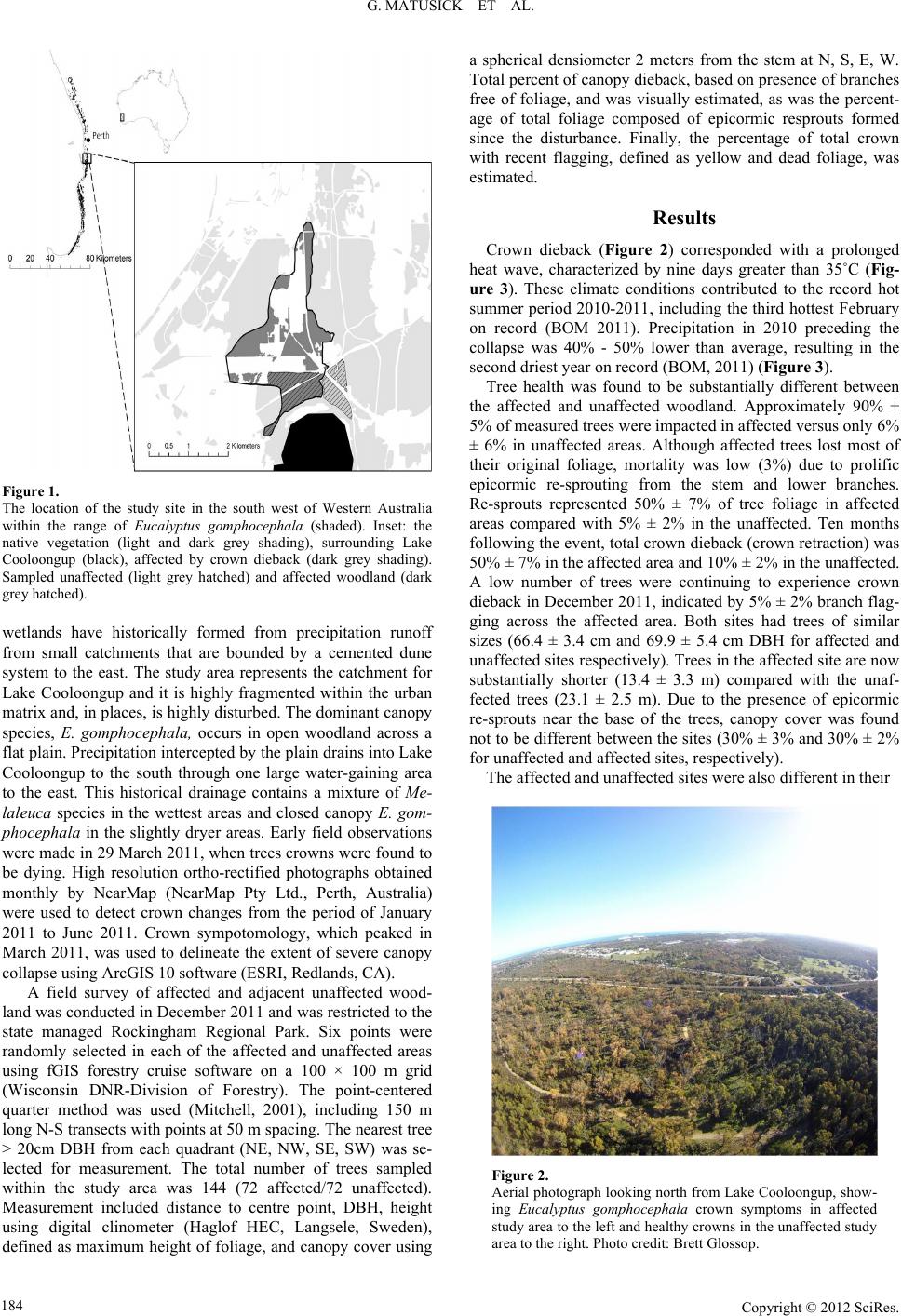 G. MATUSICK ET AL. Figure 1. The location of the study site in the south west of Western Australia within the range of Eucalyptus gomphocephala (shaded). Inset: the native vegetation (light and dark grey shading), surrounding Lake Cooloongup (black), affected by crown dieback (dark grey shading). Sampled unaffected (light grey hatched) and affected woodland (dark grey hatched). wetlands have historically formed from precipitation runoff from small catchments that are bounded by a cemented dune system to the east. The study area represents the catchment for Lake Cooloongup and it is highly fragmented within the urban matrix and, in places, is highly disturbed. The dominant canopy species, E. gomphocephala, occurs in open woodland across a flat plain. Precipitation intercepted by the plain drains into Lake Cooloongup to the south through one large water-gaining area to the east. This historical drainage contains a mixture of Me- laleuca species in the wettest areas and closed canopy E. gom- phocephala in the slightly dryer areas. Early field observations were made in 29 March 2011, when trees crowns were found to be dying. High resolution ortho-rectified photographs obtained monthly by NearMap (NearMap Pty Ltd., Perth, Australia) were used to detect crown changes from the period of January 2011 to June 2011. Crown sympotomology, which peaked in March 2011, was used to delineate the extent of severe canopy collapse using ArcGIS 10 software (ESRI, Redlands, CA). A field survey of affected and adjacent unaffected wood- land was conducted in December 2011 and was restricted to the state managed Rockingham Regional Park. Six points were randomly selected in each of the affected and unaffected areas using fGIS forestry cruise software on a 100 × 100 m grid (Wisconsin DNR-Division of Forestry). The point-centered quarter method was used (Mitchell, 2001), including 150 m long N-S transects with points at 50 m spacing. The nearest tree > 20cm DBH from each quadrant (NE, NW, SE, SW) was se- lected for measurement. The total number of trees sampled within the study area was 144 (72 affected/72 unaffected). Measurement included distance to centre point, DBH, height using digital clinometer (Haglof HEC, Langsele, Sweden), defined as maximum height of foliage, and canopy cover using a spherical densiometer 2 meters from the stem at N, S, E, W. Total percent of canopy dieback, based on presence of branches free of foliage, and was visually estimated, as was the percent- age of total foliage composed of epicormic resprouts formed since the disturbance. Finally, the percentage of total crown with recent flagging, defined as yellow and dead foliage, was estimated. Results Crown dieback (Figure 2) corresponded with a prolonged heat wave, characterized by nine days greater than 35˚C (Fig- ure 3). These climate conditions contributed to the record hot summer period 2010-2011, including the third hottest February on record (BOM 2011). Precipitation in 2010 preceding the collapse was 40% - 50% lower than average, resulting in the second driest year on record (BOM, 2011) (Figure 3). Tree health was found to be substantially different between the affected and unaffected woodland. Approximately 90% ± 5% of measured trees were impacted in affected versus only 6% ± 6% in unaffected areas. Although affected trees lost most of their original foliage, mortality was low (3%) due to prolific epicormic re-sprouting from the stem and lower branches. Re-sprouts represented 50% ± 7% of tree foliage in affected areas compared with 5% ± 2% in the unaffected. Ten months following the event, total crown dieback (crown retraction) was 50% ± 7% in the affected area and 10% ± 2% in the unaffected. A low number of trees were continuing to experience crown dieback in December 2011, indicated by 5% ± 2% branch flag- ging across the affected area. Both sites had trees of similar sizes (66.4 ± 3.4 cm and 69.9 ± 5.4 cm DBH for affected and unaffected sites respectively). Trees in the affected site are now substantially shorter (13.4 ± 3.3 m) compared with the unaf- fected trees (23.1 ± 2.5 m). Due to the presence of epicormic re-sprouts near the base of the trees, canopy cover was found not to be different between the sites (30% ± 3% and 30% ± 2% for unaffected and affected sites, respectively). The affected and unaffected sites were also different in their Figure 2. Aerial photograph looking north from Lake Cooloongup, show- ing Eucalyptus gomphocephala crown symptoms in affected study area to the left and healthy crowns in the unaffected study area to the right. Photo credit: Brett Glossop. Copyright © 2012 SciRes. 184 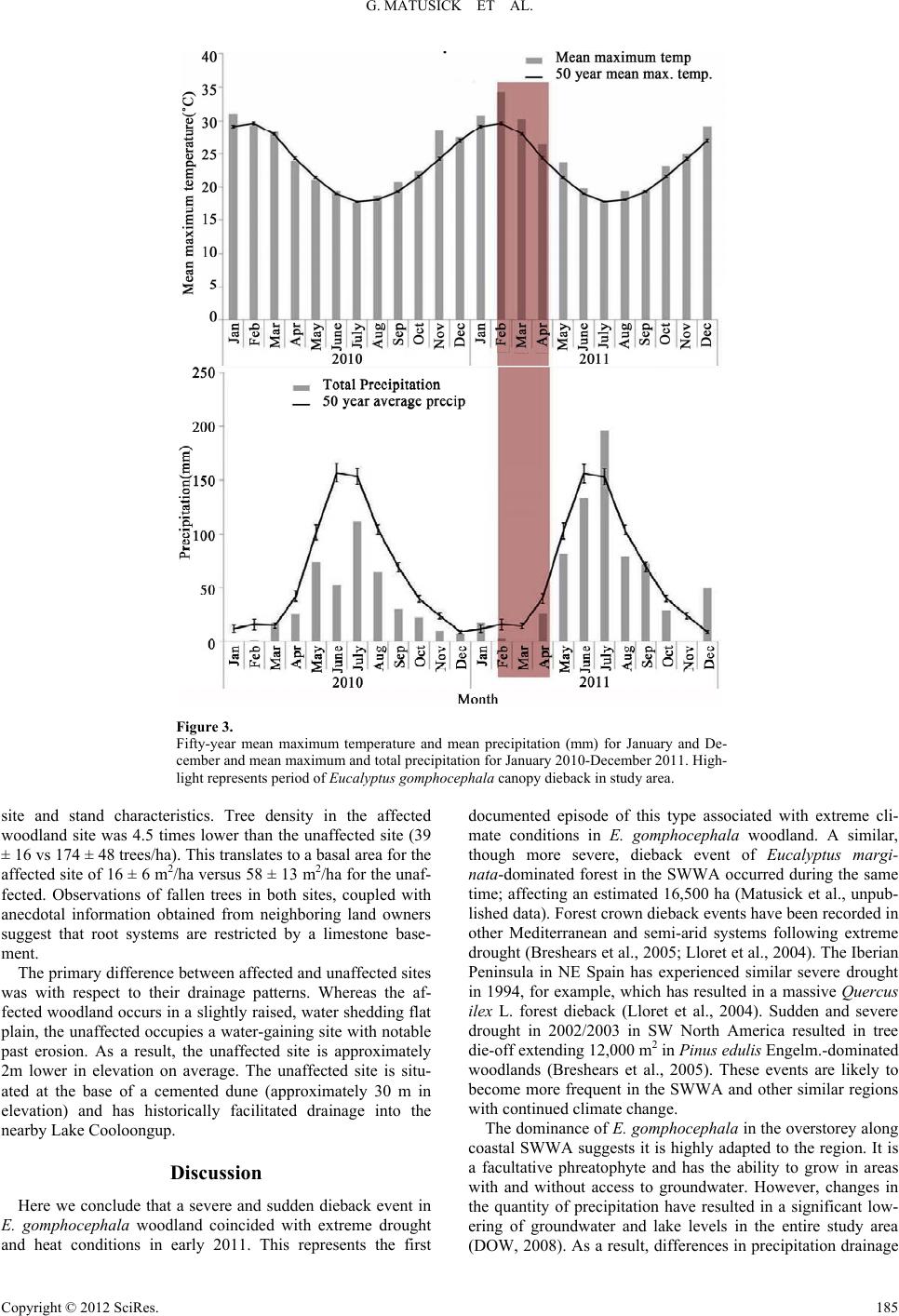 G. MATUSICK ET AL. Copyright © 2012 SciRes. 185 Figure 3. Fifty-year mean maximum temperature and mean precipitation (mm) for January and De- cember and mean maximum and total precipitation for January 2010-December 2011. High- light represents period of Eucalyptus gomphocephala canopy dieba ck in stu dy area. site and stand characteristics. Tree density in the affected woodland site was 4.5 times lower than the unaffected site (39 ± 16 vs 174 ± 48 trees/ha). This translates to a basal area for the affected site of 16 ± 6 m2/ha versus 58 ± 13 m2/ha for the unaf- fected. Observations of fallen trees in both sites, coupled with anecdotal information obtained from neighboring land owners suggest that root systems are restricted by a limestone base- ment. The primary difference between affected and unaffected sites was with respect to their drainage patterns. Whereas the af- fected woodland occurs in a slightly raised, water shedding flat plain, the unaffected occupies a water-gaining site with notable past erosion. As a result, the unaffected site is approximately 2m lower in elevation on average. The unaffected site is situ- ated at the base of a cemented dune (approximately 30 m in elevation) and has historically facilitated drainage into the nearby Lake Coolo on gu p . Discussion Here we conclude that a severe and sudden dieback event in E. gomphocephala woodland coincided with extreme drought and heat conditions in early 2011. This represents the first documented episode of this type associated with extreme cli- mate conditions in E. gomphocephala woodland. A similar, though more severe, dieback event of Eucalyptus margi- nata-dominated forest in the SWWA occurred during the same time; affecting an estimated 16,500 ha (Matusick et al., unpub- lished data). Forest crown dieback events have been recorded in other Mediterranean and semi-arid systems following extreme drought (Breshears et al., 2005; Lloret et al., 2004). The Iberian Peninsula in NE Spain has experienced similar severe drought in 1994, for example, which has resulted in a massive Quercus ilex L. forest dieback (Lloret et al., 2004). Sudden and severe drought in 2002/2003 in SW North America resulted in tree die-off extending 12,000 m2 in Pinus edulis Engelm.-dominated woodlands (Breshears et al., 2005). These events are likely to become more frequent in the SWWA and other similar regions with continued climate change. The dominance of E. gomphocephala in the overstorey along coastal SWWA suggests it is highly adapted to the region. It is a facultative phreatophyte and has the ability to grow in areas with and without access to groundwater. However, changes in the quantity of precipitation have resulted in a significant low- ering of groundwater and lake levels in the entire study area (DOW, 2008). As a result, differences in precipitation drainage 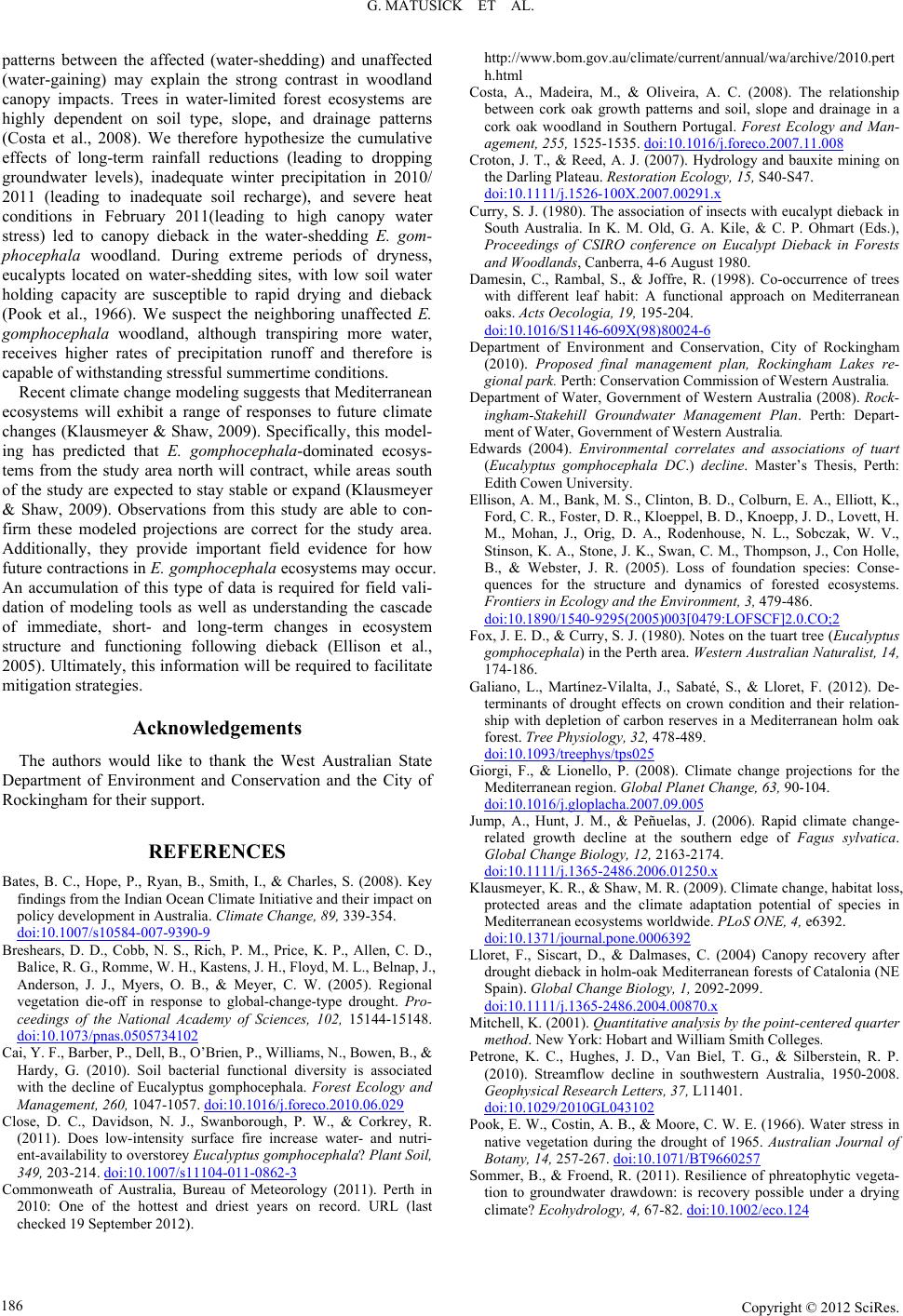 G. MATUSICK ET AL. patterns between the affected (water-shedding) and unaffected (water-gaining) may explain the strong contrast in woodland canopy impacts. Trees in water-limited forest ecosystems are highly dependent on soil type, slope, and drainage patterns (Costa et al., 2008). We therefore hypothesize the cumulative effects of long-term rainfall reductions (leading to dropping groundwater levels), inadequate winter precipitation in 2010/ 2011 (leading to inadequate soil recharge), and severe heat conditions in February 2011(leading to high canopy water stress) led to canopy dieback in the water-shedding E. gom- phocephala woodland. During extreme periods of dryness, eucalypts located on water-shedding sites, with low soil water holding capacity are susceptible to rapid drying and dieback (Pook et al., 1966). We suspect the neighboring unaffected E. gomphocephala woodland, although transpiring more water, receives higher rates of precipitation runoff and therefore is capable of withstanding stressful summertime conditions. Recent climate change modeling suggests that Mediterranean ecosystems will exhibit a range of responses to future climate changes (Klausmeyer & Shaw, 2009). Specifically, this model- ing has predicted that E. gomphocephala-dominated ecosys- tems from the study area north will contract, while areas south of the study are expected to stay stable or expand (Klausmeyer & Shaw, 2009). Observations from this study are able to con- firm these modeled projections are correct for the study area. Additionally, they provide important field evidence for how future contractions in E. gomphocephala ecosystems may occur. An accumulation of this type of data is required for field vali- dation of modeling tools as well as understanding the cascade of immediate, short- and long-term changes in ecosystem structure and functioning following dieback (Ellison et al., 2005). Ultimately, this information will be required to facilitate mitigation strategies. Acknowledgements The authors would like to thank the West Australian State Department of Environment and Conservation and the City of Rockingham for their support. REFERENCES Bates, B. C., Hope, P., Ryan, B., Smith, I., & Charles, S. (2008). Key findings from the Indian Ocean Climate Initiative and their impact on policy development in Australia. Climate Change, 89, 339-354. doi:10.1007/s10584-007-9390-9 Breshears, D. D., Cobb, N. S., Rich, P. M., Price, K. P., Allen, C. D., Balice, R. G., Romme, W. H., Kastens, J. H., Floyd, M. L., Belnap, J., Anderson, J. J., Myers, O. B., & Meyer, C. W. (2005). Regional vegetation die-off in response to global-change-type drought. Pro- ceedings of the National Academy of Sciences, 102, 15144-15148. doi:10.1073/pnas.0505734102 Cai, Y. F., Barber, P., Dell, B., O’Brien, P., Williams, N., Bowen, B., & Hardy, G. (2010). Soil bacterial functional diversity is associated with the decline of Eucalyptus gomphocephala. Forest Ecology and Management, 260, 1047- 1057. doi:10.1016/j.foreco.2010.06.029 Close, D. C., Davidson, N. J., Swanborough, P. W., & Corkrey, R. (2011). Does low-intensity surface fire increase water- and nutri- ent-availability to overstorey Eucalyptus gomphocephala? Plant Soil, 349, 203-214. doi:10.1007/s11104-011-0862-3 Commonweath of Australia, Bureau of Meteorology (2011). Perth in 2010: One of the hottest and driest years on record. URL (last checked 19 September 2012). http://www.bom.gov.au/climate/current/annual/wa/archive/2010.pert h.html Costa, A., Madeira, M., & Oliveira, A. C. (2008). The relationship between cork oak growth patterns and soil, slope and drainage in a cork oak woodland in Southern Portugal. Forest Ecology and Man- agement, 255, 1525-1535. doi:10.1016/j.foreco.2007.11.008 Croton, J. T., & Reed, A. J. (2007). Hydrology and bauxite mining on the Darling Plateau. Restoration Ecology, 15, S40-S47. doi:10.1111/j.1526-100X.2007.00291.x Curry, S. J. (1980). The association of insects with eucalypt dieback in South Australia. In K. M. Old, G. A. Kile, & C. P. Ohmart (Eds.), Proceedings of CSIRO conference on Eucalypt Dieback in Forests and Woodlands, Canberra, 4-6 August 1980. Damesin, C., Rambal, S., & Joffre, R. (1998). Co-occurrence of trees with different leaf habit: A functional approach on Mediterranean oaks. Acts Oecologia, 19, 195-204. doi:10.1016/S1146-609X(98)80024-6 Department of Environment and Conservation, City of Rockingham (2010). Proposed final management plan, Rockingham Lakes re- gional park. Perth: Conservation Commission of Western Australia. Department of Water, Government of Western Australia (2008). Rock- ingham-Stakehill Groundwater Management Plan. Perth: Depart- ment of Water, Government of Western Australia. Edwards (2004). Environmental correlates and associations of tuart (Eucalyptus gomphocephala DC.) decline. Master’s Thesis, Perth: Edith Cowen University. Ellison, A. M., Bank, M. S., Clinton, B. D., Colburn, E. A., Elliott, K., Ford, C. R., Foster, D. R., Kloeppel, B. D., Knoepp, J. D., Lov ett, H. M., Mohan, J., Orig, D. A., Rodenhouse, N. L., Sobczak, W. V., Stinson, K. A., St one, J. K., Swan, C. M., Thompso n, J., Con Holle, B., & Webster, J. R. (2005). Loss of foundation species: Conse- quences for the structure and dynamics of forested ecosystems. Frontiers in Ecology and the Environment, 3, 479-486. doi:10.1890/1540-9295(2005)003[0479:LOFSCF]2.0.CO;2 Fox, J. E. D., & Curry, S. J. (1980). Notes on the tuart tree (Eucalyptus gomphocephala) in the Perth area. Western Australian Naturalist, 14, 174-186. Galiano, L., Martínez-Vilalta, J., Sabaté, S., & Lloret, F. (2012). De- terminants of drought effects on crown condition and their relation- ship with depletion of carbon reserves in a Mediterranean holm oak forest. Tree Physiology, 32, 478-489. doi:10.1093/treephys/tps025 Giorgi, F., & Lionello, P. (2008). Climate change projections for the Mediterranean region. Global Planet Change, 63, 90-104. doi:10.1016/j.gloplacha.2007.09.005 Jump, A., Hunt, J. M., & Peñuelas, J. (2006). Rapid climate change- related growth decline at the southern edge of Fagus sylvatica. Global Change Biology, 12, 2163-2174. doi:10.1111/j.1365-2486.2006.01250.x Klausmeyer, K. R., & Shaw, M. R. (2009). Climate change, habitat loss, protected areas and the climate adaptation potential of species in Mediterranean ecosystems worldwide. PLoS ONE, 4, e6392. doi:10.1371/journal.pone.0006392 Lloret, F., Siscart, D., & Dalmases, C. (2004) Canopy recovery after drought dieback in holm-oak Mediterranean forests of Catalonia (NE Spain). Global Change Bio lo gy , 1, 2092-2099. doi:10.1111/j.1365-2486.2004.00870.x Mitchell, K. (2001). Quantitative analysis by the point-centered quarter method. New York: Hobart and Will iam Smith Colleges. Petrone, K. C., Hughes, J. D., Van Biel, T. G., & Silberstein, R. P. (2010). Streamflow decline in southwestern Australia, 1950-2008. Geophysical Research Letters, 37, L11401. doi:10.1029/2010GL043102 Pook, E. W., Costin, A. B., & Moore, C. W. E. (1966). Water stress in native vegetation during the drought of 1965. Australian Journal of Botany, 14, 257-26 7. doi:10.1071/BT9660257 Sommer, B., & Froend, R. (2011). Resilience of phreatophytic vegeta- tion to groundwater drawdown: is recovery possible under a drying climate? Ecohydrology, 4, 67-82. doi:10.1002/eco.124 Copyright © 2012 SciRes. 186 |