

Paper Menu >>
Journal Menu >>
 Open Journal of Synthesis Theory and Applications, 2012, 1, 23-30 http://dx.doi.org/10.4236/ojsta.2012.13005 Published Online October 2012 (http://www.SciRP.org/journal/ojsta) Antifunga l Pot en tia l of Transition Me tal Hexacyanoferrates against Fungal Diseases of Mushroom Charu Arora Chugh, Dipti Bharti Department of Chemistry, Lovely Professional University, Jalandhar, India Email: [email protected] Received July 9, 2012; revised August 12, 2012; accepted September 5, 2012 ABSTRACT Ferrocyanides of Co(II), Ni(II), Cu(II), Zn(II) and Cd(II) were synthesized and characterized by IR spectra, magnetic susceptibility, thermal gravimetric analysis, elemental analysis and X ray diffraction studies. Antimicrobial potential of these complexes have been evaluated. Antifungal screening of these complexes has been carried out against Mycogone perniciosa and Verticillium fungicola causing wet and dry bubble diseases of button mushroom respectively. Nickel ferrocyanide has been found to be most effective against Mycogone perniciosa with 60% inhibitory effect while cad- mium ferrocyanide has exhibited significant potential of 85% against Verticillium fungicola. Keywords: Verticilium Fungicola; Mycogone Perniciosa; Biocidal Potential; Transition Metal Hexacyanoferrates 1. Introduction Many of the transition metal ions in the living systems work as enzymes or carriers in macrocyclic ligand field environment. Therefore meaningful research in this di- rection might generate simple models for biologically occurring metallo enzymes and thus will help in devel- oping our understanding of biological systems. These ligands are also of theoretical interest as they are capable of furnishing an environment of controlled geometry and ligand field strength [1-5]. Synthesis of a number of poly- dentatemacrocyclic ligands and their metal complexes has been reported in literature [6].Transition metals have an important place within medicinal biochemistry. Re- view of literature has revealed significant progress in utilization of transition metal complexes as drugs to treat several human diseases like carcinomas, lymphomas, in- fection control etc. These complexes act as therapeutic and antimicrobial agents [7-13]. Transition metals exhibit different oxidation states and can interact with a number of negatively charged molecules. This activity of transi- tion metals has started the development of metal based drugs with promising pharmacological application and may offer unique therapeutic opportunities. To provide an update on recent advances in the medicinal use of transition metals, a Medline search has been carried out to identify the recent relevant literature [14,15]. These complexes may possess antimicrobial activity against pathogenic fungi being used as a test organism in the present study. It is well established that metal ferro- cyanides acts as adsorbent[16,17], ion-exchangers [18, 19] and photosensitizers [20].Transition metals such as zinc, copper, cobalt, manganese, iron have been reported to be essential for crops. They remain in soil in small quantity and known as micronutrient. If the deficiency of these elements is detected in soil these are recommended to be added to soil with fertilizer or in form of top dressing. Thus these metals act as micronutrient in trace quantity and hence application of metal complexes in combination with other ecofriendly chemicals/botanicals may be evalu- ated for antimicrobial potential. Mushrooms can provide more than just taste and tex- ture for our meals-they actually have a surprisingly high nutritional value also. White button mushrooms have a surprising amount of nutrients including niacin, ribofla- vin, folate, phosphorus, iron, panthothenic acid, zinc, po- tassium, copper, magnesium, vitamin B6, selenium and thiamin. In addition, white button mushroom extract has been found to reduce the size of some cancer tumors and slow down the production of some cancer cells. It is most prominently linked to reducing the risk of breast and prostate cancer. The yield of the crop is severely affected by fungal pathogens Mycogone perniciosa and Verticil- lium fungicola causing wet and dry bubble diseases of button mushroom respectively. During the last decade V. fungicola has become less sensitive to the only approved chemical (prochloraz) that is still effective to treat infec- tion. Moreover, it is expected that prochloraz will be banned from commercial mushroom growing. Therefore, alternative strategies to control the disease are urgently needed. Wet bubble caused by M. perniciosa is a disease that often occurs on mushroom farms. It can be of very C opyright © 2012 SciRes. OJSTA 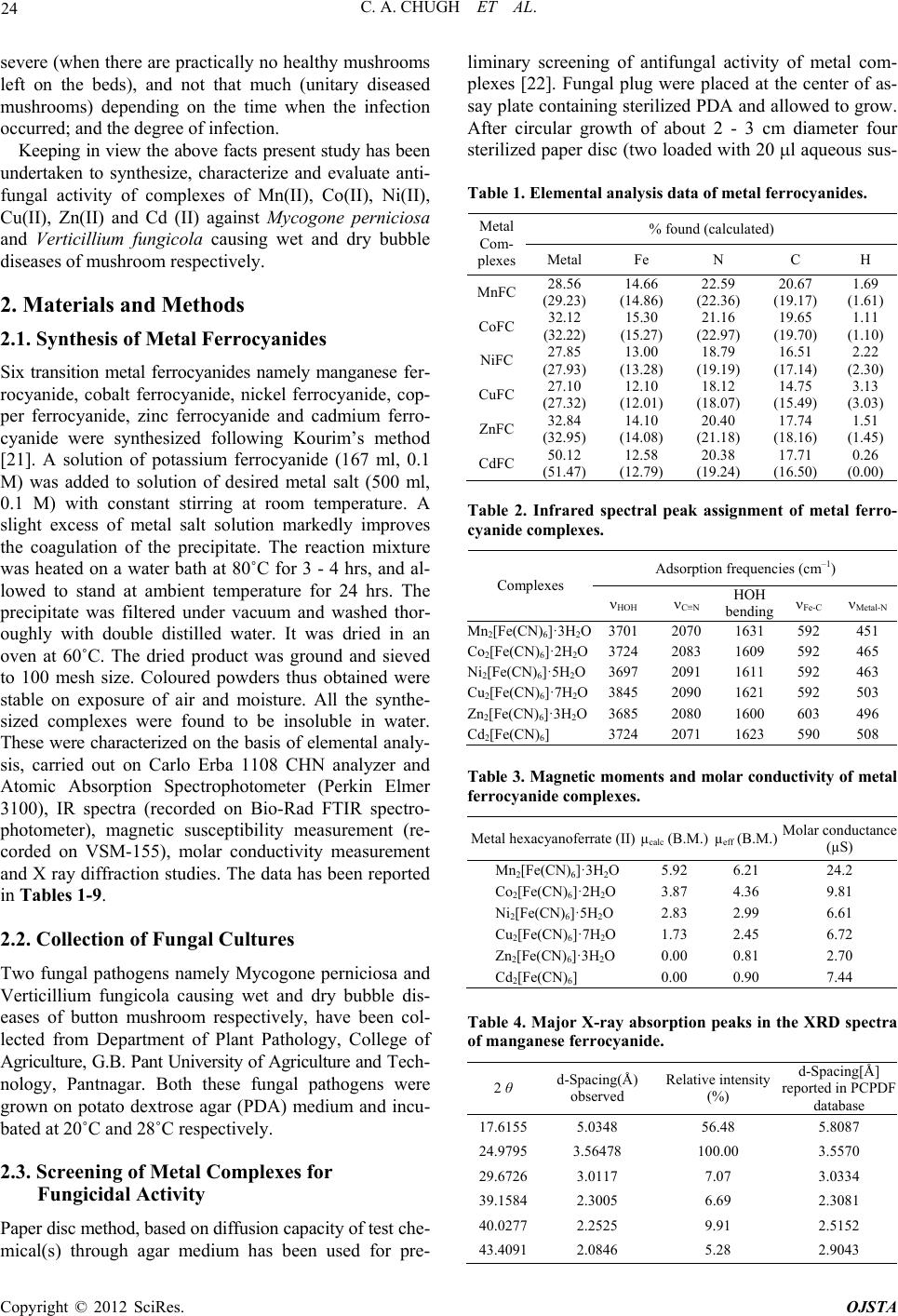 C. A. CHUGH ET AL. 24 severe (when there are practically no healthy mushrooms left on the beds), and not that much (unitary diseased mushrooms) depending on the time when the infection occurred; and the degree of infection. Keeping in view the above facts present study has been undertaken to synthesize, characterize and evaluate anti- fungal activity of complexes of Mn(II), Co(II), Ni(II), Cu(II), Zn(II) and Cd (II) against Mycogone perniciosa and Verticillium fungicola causing wet and dry bubble diseases of mushroom respectively. 2. Materials and Methods 2.1. Synthesis of Metal Ferrocyanides Six transition metal ferrocyanides namely manganese fer- rocyanide, cobalt ferrocyanide, nickel ferrocyanide, cop- per ferrocyanide, zinc ferrocyanide and cadmium ferro- cyanide were synthesized following Kourim’s method [21]. A solution of potassium ferrocyanide (167 ml, 0.1 M) was added to solution of desired metal salt (500 ml, 0.1 M) with constant stirring at room temperature. A slight excess of metal salt solution markedly improves the coagulation of the precipitate. The reaction mixture was heated on a water bath at 80˚C for 3 - 4 hrs, and al- lowed to stand at ambient temperature for 24 hrs. The precipitate was filtered under vacuum and washed thor- oughly with double distilled water. It was dried in an oven at 60˚C. The dried product was ground and sieved to 100 mesh size. Coloured powders thus obtained were stable on exposure of air and moisture. All the synthe- sized complexes were found to be insoluble in water. These were characterized on the basis of elemental analy- sis, carried out on Carlo Erba 1108 CHN analyzer and Atomic Absorption Spectrophotometer (Perkin Elmer 3100), IR spectra (recorded on Bio-Rad FTIR spectro- photometer), magnetic susceptibility measurement (re- corded on VSM-155), molar conductivity measurement and X ray diffraction studies. The data has been reported in Tables 1-9. 2.2. Collection of Fungal Cultures Two fungal pathogens namely Mycogone perniciosa and Verticillium fungicola causing wet and dry bubble dis- eases of button mushroom respectively, have been col- lected from Department of Plant Pathology, College of Agriculture, G.B. Pant University of Agriculture and Tech- nology, Pantnagar. Both these fungal pathogens were grown on potato dextrose agar (PDA) medium and incu- bated at 20˚C and 28˚C respectively. 2.3. Screening of Metal Complexes for Fungicidal Activity Paper disc method, based on diffusion capacity of test che- mical(s) through agar medium has been used for pre- liminary screening of antifungal activity of metal com- plexes [22]. Fungal plug were placed at the center of as- say plate containing sterilized PDA and allowed to grow. After circular growth of about 2 - 3 cm diameter four sterilized paper disc (two loaded with 20 l aqueous sus- Table 1. Elemental analysis data of metal ferrocyanides. % found (calculated) Metal Com- plexes Metal Fe N C H MnFC 28.56 (29.23) 14.66 (14.86) 22.59 (22.36) 20.67 (19.17) 1.69 (1.61) CoFC 32.12 (32.22) 15.30 (15.27) 21.16 (22.97) 19.65 (19.70) 1.11 (1.10) NiFC 27.85 (27.93) 13.00 (13.28) 18.79 (19.19) 16.51 (17.14) 2.22 (2.30) CuFC 27.10 (27.32) 12.10 (12.01) 18.12 (18.07) 14.75 (15.49) 3.13 (3.03) ZnFC 32.84 (32.95) 14.10 (14.08) 20.40 (21.18) 17.74 (18.16) 1.51 (1.45) CdFC 50.12 (51.47) 12.58 (12.79) 20.38 (19.24) 17.71 (16.50) 0.26 (0.00) Table 2. Infrared spectral peak assignment of metal ferro- cyanide complexes. Adsorption frequencies (cm–1) Complexes HOH C≡N HOH bending Fe-C Metal-N Mn2[Fe(CN)6]·3H2O3701 2070 1631 592 451 Co2[Fe(CN)6]·2H2O3724 2083 1609 592 465 Ni2[Fe(CN)6]·5H2O3697 2091 1611 592 463 Cu2[Fe(CN)6]·7H2O3845 2090 1621 592 503 Zn2[Fe(CN)6]·3H2O3685 2080 1600 603 496 Cd2[Fe(CN)6] 37242071 1623 590 508 Table 3. Magnetic moments and molar co nductivity of metal ferrocyanide complexe s. Metal hexacyanoferrate (II)µcalc (B.M.) µeff (B.M.) Molar conductance (µS) Mn2[Fe(CN)6]·3H2O 5.92 6.21 24.2 Co2[Fe(CN)6]·2H2O 3.87 4.36 9.81 Ni2[Fe(CN)6]·5H2O 2.83 2.99 6.61 Cu2[Fe(CN)6]·7H2O 1.73 2.45 6.72 Zn2[Fe(CN)6]·3H2O 0.00 0.81 2.70 Cd2[Fe(CN)6] 0.00 0.90 7.44 Table 4. Major X-ray absorption peaks in the XRD spectra of manganese ferrocyanide. 2 θ d-Spacing(Å) observed Relative intensity (%) d-Spacing[Å] reported in PCPDF database 17.61555.0348 56.48 5.8087 24.97953.56478 100.00 3.5570 29.67263.0117 7.07 3.0334 39.15842.3005 6.69 2.3081 40.02772.2525 9.91 2.5152 43.40912.0846 5.28 2.9043 Copyright © 2012 SciRes. OJSTA 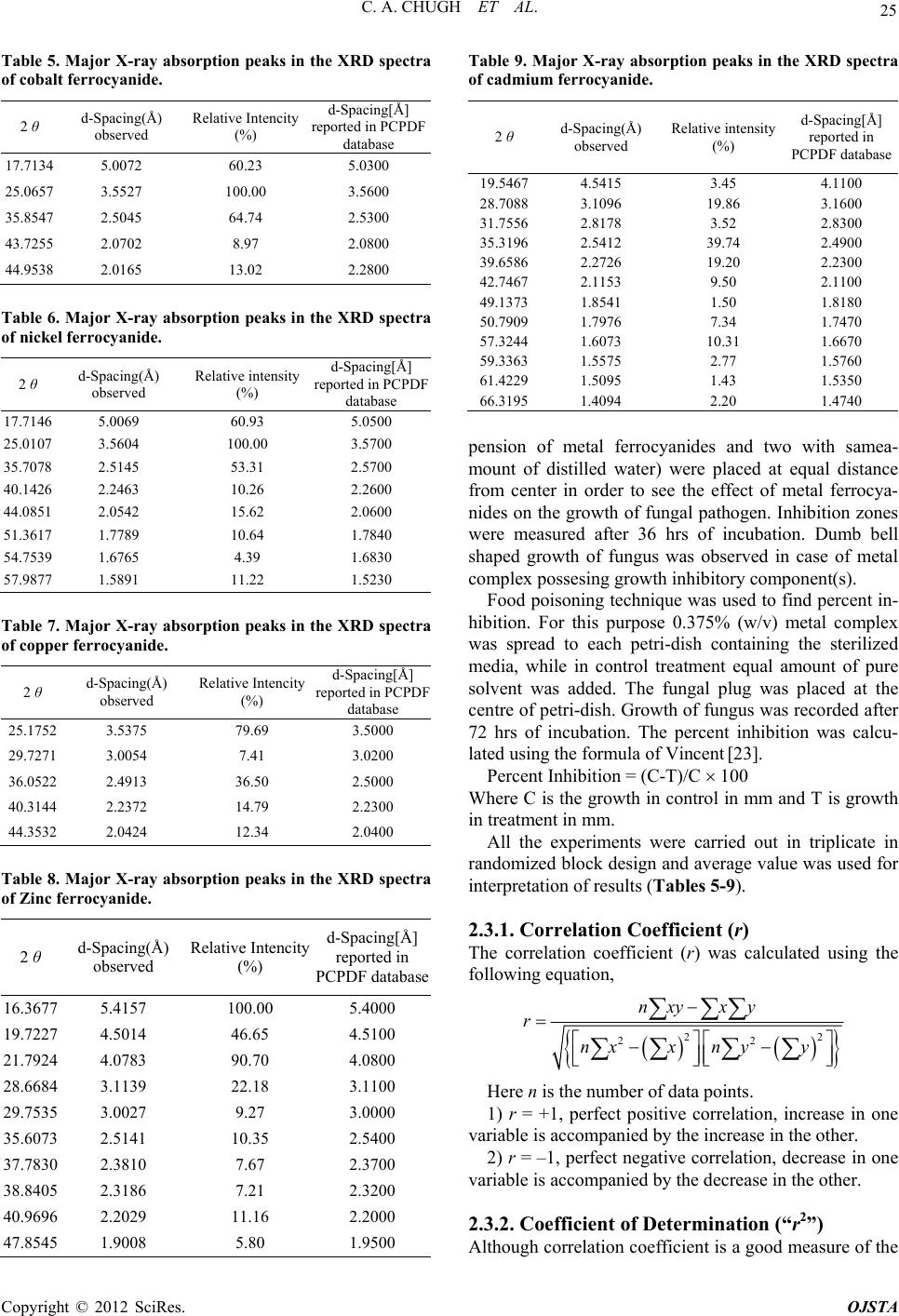 C. A. CHUGH ET AL. 25 Table 5. Major X-ray absorption peaks in the XRD spectra of cobalt ferrocya nide . 2 θ d-Spacing(Å) observed Relative Intencity (%) d-Spacing[Å] reported in PCPDF database 17.7134 5.0072 60.23 5.0300 25.0657 3.5527 100.00 3.5600 35.8547 2.5045 64.74 2.5300 43.7255 2.0702 8.97 2.0800 44.9538 2.0165 13.02 2.2800 Table 6. Major X-ray absorption peaks in the XRD spectra of nickel ferrocyanide. 2 θ d-Spacing(Å) observed Relative intensity (%) d-Spacing[Å] reported in PCPDF database 17.7146 5.0069 60.93 5.0500 25.0107 3.5604 100.00 3.5700 35.7078 2.5145 53.31 2.5700 40.1426 2.2463 10.26 2.2600 44.0851 2.0542 15.62 2.0600 51.3617 1.7789 10.64 1.7840 54.7539 1.6765 4.39 1.6830 57.9877 1.5891 11.22 1.5230 Table 7. Major X-ray absorption peaks in the XRD spectra of copper ferrocyanide. 2 θ d-Spacing(Å) observed Relative Intencity (%) d-Spacing[Å] reported in PCPDF database 25.1752 3.5375 79.69 3.5000 29.7271 3.0054 7.41 3.0200 36.0522 2.4913 36.50 2.5000 40.3144 2.2372 14.79 2.2300 44.3532 2.0424 12.34 2.0400 Table 8. Major X-ray absorption peaks in the XRD spectra of Zinc ferrocyanide. 2 θ d-Spacing(Å) observed Relative Intencity (%) d-Spacing[Å] reported in PCPDF database 16.3677 5.4157 100.00 5.4000 19.7227 4.5014 46.65 4.5100 21.7924 4.0783 90.70 4.0800 28.6684 3.1139 22.18 3.1100 29.7535 3.0027 9.27 3.0000 35.6073 2.5141 10.35 2.5400 37.7830 2.3810 7.67 2.3700 38.8405 2.3186 7.21 2.3200 40.9696 2.2029 11.16 2.2000 47.8545 1.9008 5.80 1.9500 Table 9. Major X-ray absorption peaks in the XRD spectra of cadmium ferrocyanide. 2 θ d-Spacing(Å) observed Relative intensity (%) d-Spacing[Å] reported in PCPDF database 19.54674.5415 3.45 4.1100 28.70883.1096 19.86 3.1600 31.75562.8178 3.52 2.8300 35.31962.5412 39.74 2.4900 39.65862.2726 19.20 2.2300 42.74672.1153 9.50 2.1100 49.13731.8541 1.50 1.8180 50.79091.7976 7.34 1.7470 57.32441.6073 10.31 1.6670 59.33631.5575 2.77 1.5760 61.42291.5095 1.43 1.5350 66.31951.4094 2.20 1.4740 pension of metal ferrocyanides and two with samea- mount of distilled water) were placed at equal distance from center in order to see the effect of metal ferrocya- nides on the growth of fungal pathogen. Inhibition zones were measured after 36 hrs of incubation. Dumb bell shaped growth of fungus was observed in case of metal complex possesing growth inhibitory component(s). Food poisoning technique was used to find percent in- hibition. For this purpose 0.375% (w/v) metal complex was spread to each petri-dish containing the sterilized media, while in control treatment equal amount of pure solvent was added. The fungal plug was placed at the centre of petri-dish. Growth of fungus was recorded after 72 hrs of incubation. The percent inhibition was calcu- lated using the formula of Vincent [23]. Percent Inhibition = (C-T)/C 100 Where C is the growth in control in mm and T is growth in treatment in mm. All the experiments were carried out in triplicate in randomized block design and average value was used for interpretation of results (Tables 5-9). 2.3.1. Correlation Coefficient (r) The correlation coefficient (r) was calculated using the following equation, 22 22 nxy xy r nxxnyy Here n is the number of data points. 1) r = +1, perfect positive correlation, increase in one variable is accompanied by the increase in the other. 2) r = –1, perfect negative correlation, decrease in one variable is accompanied by the decrease in the other. 2.3.2. Coefficient of Determination (“r2”) Although correlation coefficient is a good measure of the Copyright © 2012 SciRes. OJSTA 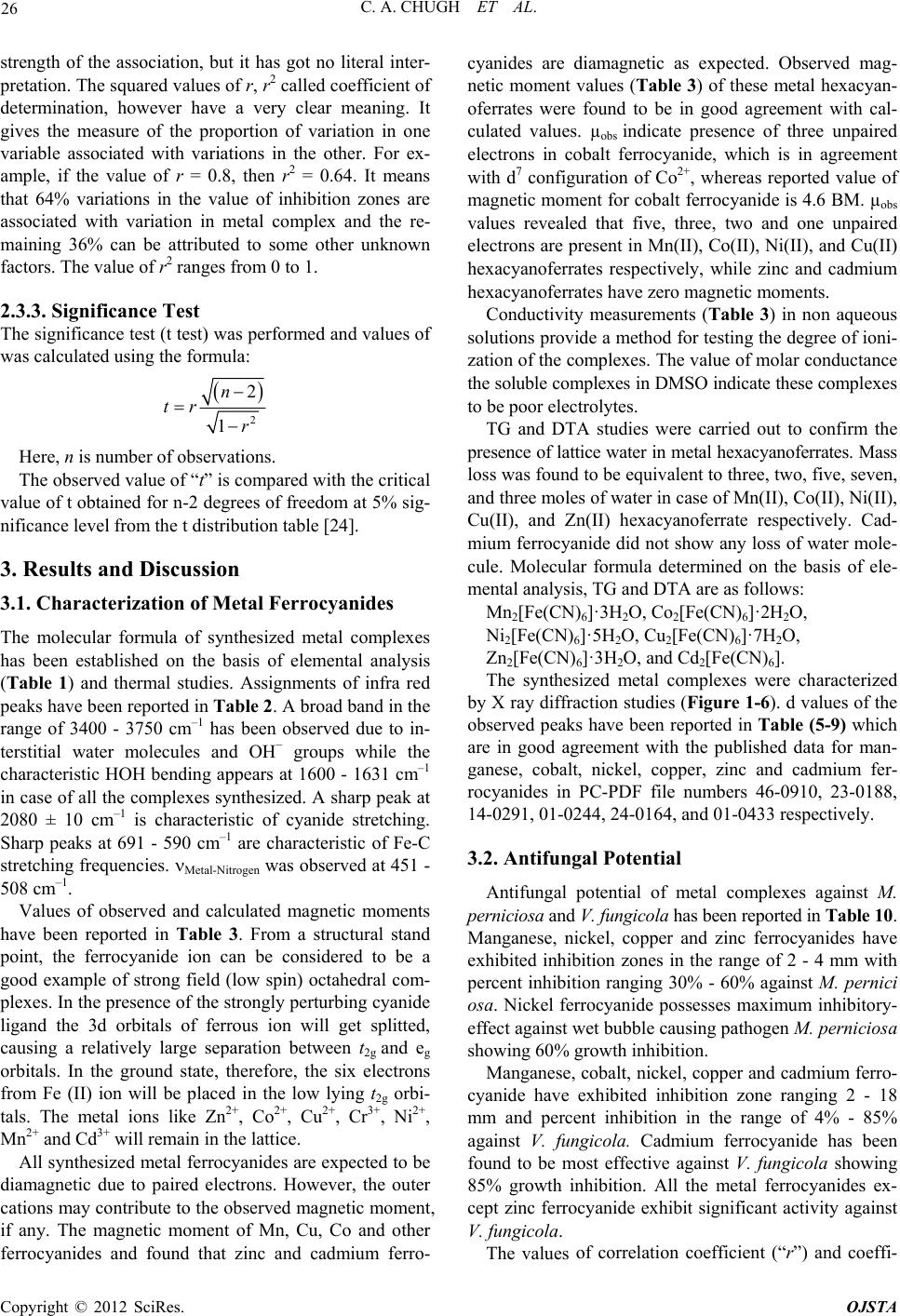 C. A. CHUGH ET AL. 26 strength of the association, but it has got no literal inter- pretation. The squared values of r, r2 called coefficient of determination, however have a very clear meaning. It gives the measure of the proportion of variation in one variable associated with variations in the other. For ex- ample, if the value of r = 0.8, then r2 = 0.64. It means that 64% variations in the value of inhibition zones are associated with variation in metal complex and the re- maining 36% can be attributed to some other unknown factors. The value of r2 ranges from 0 to 1. 2.3.3. Significance Test The significance test (t test) was performed and values of was calculated using the formula: 2 2 1 n tr r Here, n is number of observations. The observed value of “t” is compared with the critical value of t obtained for n-2 degrees of freedom at 5% sig- nificance level from the t distribution table [24]. 3. Results and Discussion 3.1. Characterization of Metal Ferrocyanides The molecular formula of synthesized metal complexes has been established on the basis of elemental analysis (Table 1) and thermal studies. Assignments of infra red peaks have been reported in Table 2. A broad band in the range of 3400 - 3750 cm–1 has been observed due to in- terstitial water molecules and OH− groups while the characteristic HOH bending appears at 1600 - 1631 cm–1 in case of all the complexes synthesized. A sharp peak at 2080 ± 10 cm–1 is characteristic of cyanide stretching. Sharp peaks at 691 - 590 cm–1 are characteristic of Fe-C stretching frequencies. Metal-Nitrogen was observed at 451 - 508 cm–1. Values of observed and calculated magnetic moments have been reported in Table 3. From a structural stand point, the ferrocyanide ion can be considered to be a good example of strong field (low spin) octahedral com- plexes. In the presence of the strongly perturbing cyanide ligand the 3d orbitals of ferrous ion will get splitted, causing a relatively large separation between t2g and eg orbitals. In the ground state, therefore, the six electrons from Fe (II) ion will be placed in the low lying t2g orbi- tals. The metal ions like Zn2+, Co2+, Cu2+, Cr3+, Ni2+, Mn2+ and Cd3+ will remain in the lattice. All synthesized metal ferrocyanides are expected to be diamagnetic due to paired electrons. However, the outer cations may contribute to the observed magnetic moment, if any. The magnetic moment of Mn, Cu, Co and other cyanides are diamagnetic as expected. Observed mag- netic moment values (Table 3) of these metal hexacyan- oferrates were found to be in good agreement with cal- culated values. µobs indicate presence of three unpaired electrons in cobalt ferrocyanide, which is in agreement with d7 configuration of Co2+, whereas reported value of magnetic moment for cobalt ferrocyanide is 4.6 BM. µobs values revealed that five, three, two and one unpaired electrons are present in Mn(II), Co(II), Ni(II), and Cu(II) hexacyanoferrates respectively, while zinc and cadmium hexacyanoferrates have zero magnetic moments. Conductivity measurements (Table 3) in non a ferrocyanides and found that zinc and cadmium ferro- queous so were carried out to confirm the pr haracterized by 3.2. Antifungal Potential etal complexes against M. pe per and cadmium ferro- cy of correlation coefficient (“r”) and coeffi- lutions provide a method for testing the degree of ioni- zation of the complexes. The value of molar conductance the soluble complexes in DMSO indicate these complexes to be poor electrolytes. TG and DTA studies esence of lattice water in metal hexacyanoferrates. Mass loss was found to be equivalent to three, two, five, seven, and three moles of water in case of Mn(II), Co(II), Ni(II), Cu(II), and Zn(II) hexacyanoferrate respectively. Cad- mium ferrocyanide did not show any loss of water mole- cule. Molecular formula determined on the basis of ele- mental analysis, TG and DTA are as follows: Mn2[Fe(CN)6]·3H2O, Co2[Fe(CN)6]·2H2O, Ni2[Fe(CN)6]·5H2O, Cu2[Fe(CN)6]·7H2O, Zn2[Fe(CN)6]·3 H2O, and Cd2[Fe(CN)6]. The synthesized metal complexes were c X ray diffraction studies (Figure 1-6). d values of the observed peaks have been reported in Table (5-9) which are in good agreement with the published data for man- ganese, cobalt, nickel, copper, zinc and cadmium fer- rocyanides in PC-PDF file numbers 46-0910, 23-0188, 14-0291, 01-0244, 24-0164, and 01-0433 respectively. Antifungal potential of m rniciosa and V. fungicola has been reported in Table 10. Manganese, nickel, copper and zinc ferrocyanides have exhibited inhibition zones in the range of 2 - 4 mm with percent inhibition ranging 30% - 60% against M. pernici osa. Nickel ferrocyanide possesses maximum inhibitory- effect against wet bubble causing pathogen M. perniciosa showing 60% growth inhibition. Manganese, cobalt, nickel, cop anide have exhibited inhibition zone ranging 2 - 18 mm and percent inhibition in the range of 4% - 85% against V. fungicola. Cadmium ferrocyanide has been found to be most effective against V. fungicola showing 85% growth inhibition. All the metal ferrocyanides ex- cept zinc ferrocyanide exhibit significant activity against V. fungicola. The values Copyright © 2012 SciRes. OJSTA 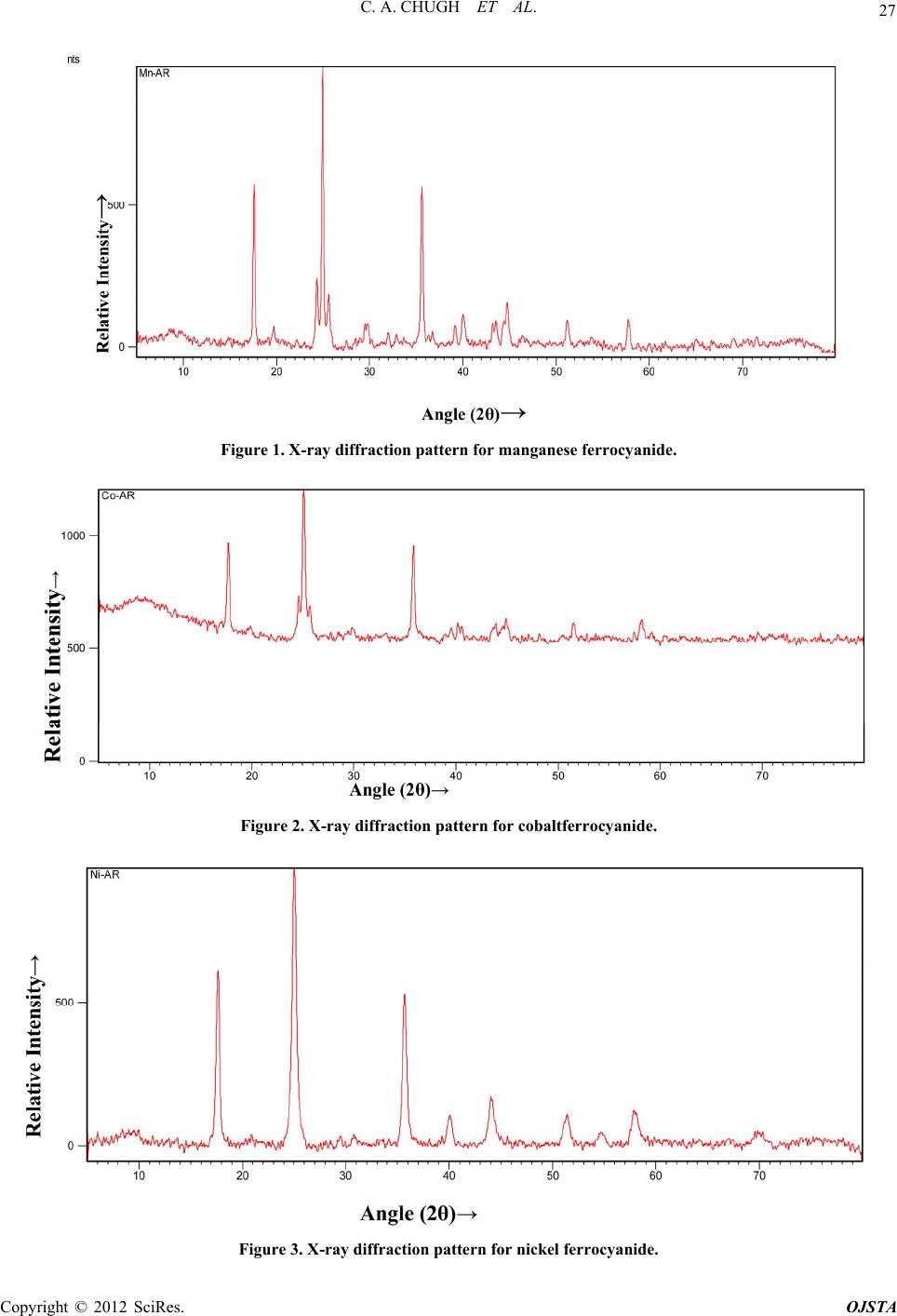 C. A. CHUGH ET AL. Copyright © 2012 SciRes. OJSTA 27 Figure 1. X-ray diffraction pattern for manganese ferrocyanide. Figure 2. X-ray diffraction pattern for cobaltferrocyanide. Figure 3. X-ray diffraction pattern for nickel ferrocyanide. 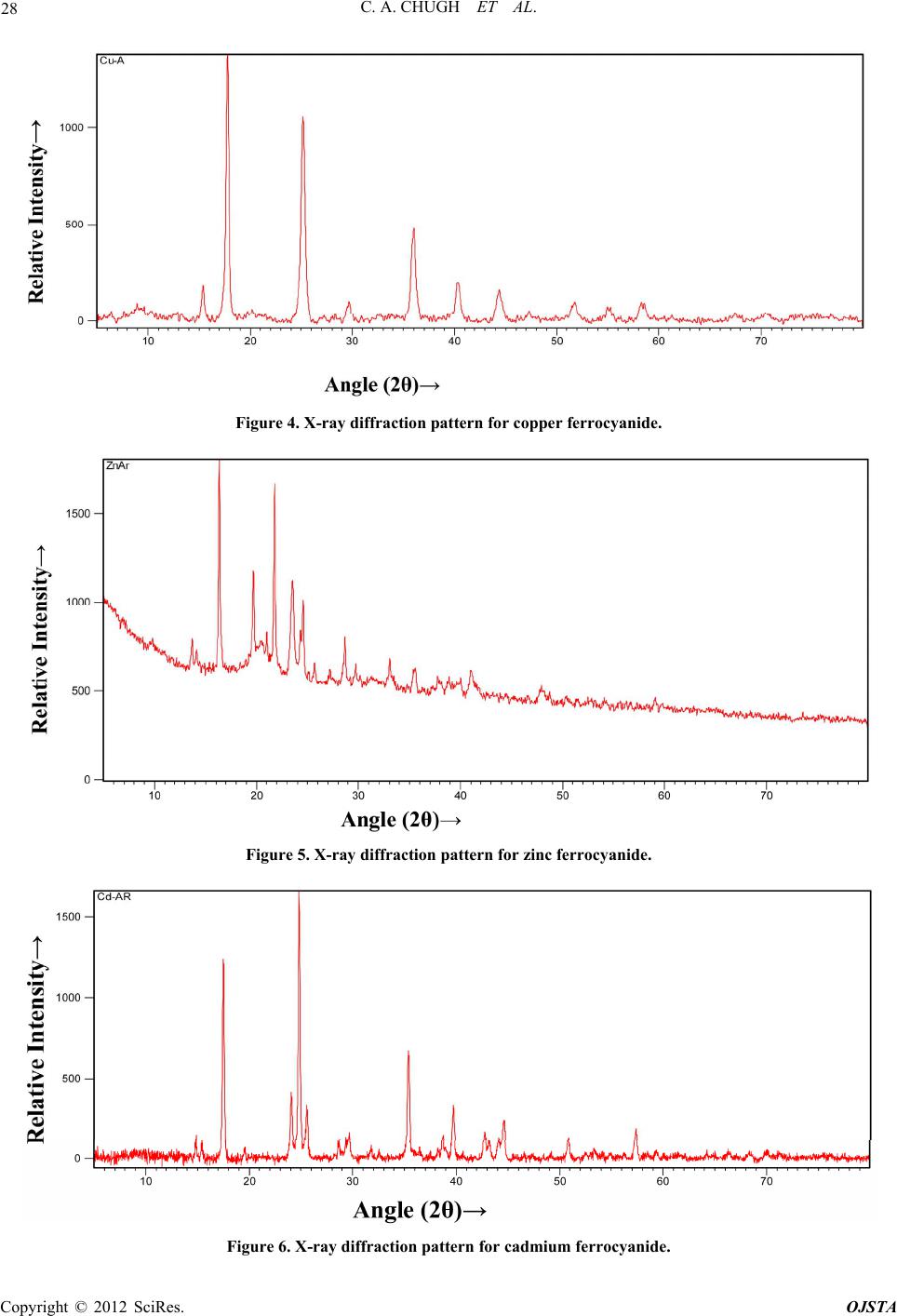 C. A. CHUGH ET AL. 28 Figure 4. X-ray diffraction pattern for copper ferrocyanide. Figure 5. X-ray diffraction pattern for zinc ferrocyanide. Figure 6. X-ray diffraction pattern for cadmium ferrocyanide. Copyright © 2012 SciRes. OJSTA 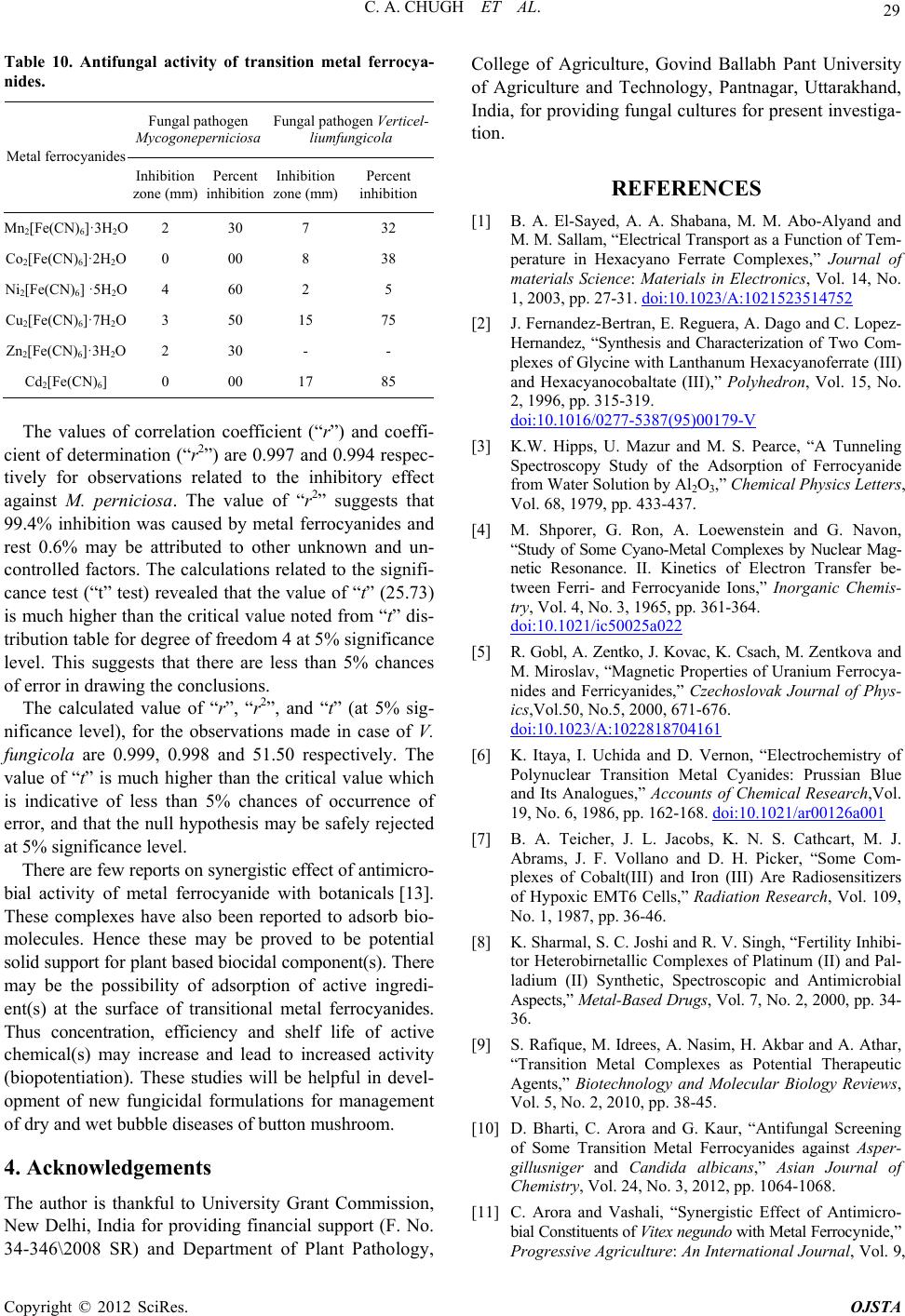 C. A. CHUGH ET AL. Copyright © 2012 SciRes. OJSTA 29 able 10. Antifungal activity o Fungal pathogen Mycogoneperniciosa Fungal pathogen Verticel- liumfungicola Tf transition metal ferrocya- nides. Metal ferrocyanides m) inhibition Inhib zone (mm) t inhibition Inhibition Percent zone (m ition Percen Mn2[Fe(CN)6]·3H2O 2 30 7 32 Co2[Fe(CN)6]·2H2O 0 00 8 38 Ni2[Fe(CN)6] ·5H2O 4 60 2 5 Cu2[Fe(CN)6]·7H2O 3 50 15 75 Zn2[Fe(CN)6]·3H2O 2 30 - - Cd2[Fe(CN)6] 0 00 17 85 The values of correlation fficient (“r”) and coeffi- ci 2 iversity Grant Commi ind Ballabh Pant University A. El-Sayed, A. A. Shabana, M. M. Abo-Alyand and M. M. Sallam, “Electrical Transport as a Function of Tem- perature in Hlexes,” Journal of materials Scieonics, Vol. 14, No. coe ent of determination (“r”) are 0.997 and 0.994 respec- tively for observations related to the inhibitory effect against M. perniciosa. The value of “r2” suggests that 99.4% inhibition was caused by metal ferrocyanides and rest 0.6% may be attributed to other unknown and un- controlled factors. The calculations related to the signifi- cance test (“t” test) revealed that the value of “t” (25.73) is much higher than the critical value noted from “t” dis- tribution table for degree of freedom 4 at 5% significance level. This suggests that there are less than 5% chances of error in drawing the conclusions. The calculated value of “r”, “r2”, and “t” (at 5% sig- nificance level), for the observations made in case of V. fungicola are 0.999, 0.998 and 51.50 respectively. The value of “t” is much higher than the critical value which is indicative of less than 5% chances of occurrence of error, and that the null hypothesis may be safely rejected at 5% significance level. There are few reports on synergistic effect of antimicro- bial activity of metal ferrocyanide with botanicals [13]. These complexes have also been reported to adsorb bio- molecules. Hence these may be proved to be potential solid support for plant based biocidal component(s). There may be the possibility of adsorption of active ingredi- ent(s) at the surface of transitional metal ferrocyanides. Thus concentration, efficiency and shelf life of active chemical(s) may increase and lead to increased activity (biopotentiation). These studies will be helpful in devel- opment of new fungicidal formulations for management of dry and wet bubble diseases of button mushroom. 4. Acknowledgements The author is thankful to Unssion, New Delhi, India for providing financial support (F. No. 34-346\2008 SR) and Department of Plant Pathology, of Agriculture and Technology, Pantnagar, Uttarakhand, India, for providing fungal cultures for present investiga- tion. REFERENCES [1] B. College of Agriculture, Gov exacyano Ferrate Comp nce: Materials in Electr 1, 2003, pp. 27-31. doi:10.1023/A:1021523514752 [2] J. Fernandez-Bertran, E. Reguera, A. Dago and C. Lopez- Hernandez, “Synthesis and Characterization of Two Com- plexes of Glycine with Lanthanum Hexacyanoferrate (III) and Hexacyanocobaltate (III),” Polyhedron, Vol. 15, No. 2, 1996, pp. 315-319. doi:10.1016/0277-5387(95)00179-V [3] K.W. Hipps, U. Mazur and M. S. Pearce, “A Tunneling Spectroscopy Study of the Adsorption of Ferrocyanide from Water Solution by Al2O3,” Chemical Physi Vol. 68, 1979, pp. 433-437. cs Letters, de Ions,” Inorganic Chemis- [4] M. Shporer, G. Ron, A. Loewenstein and G. Navon, “Study of Some Cyano-Metal Complexes by Nuclear Mag- netic Resonance. II. Kinetics of Electron Transfer be- tween Ferri- and Ferrocyani try, Vol. 4, No. 3, 1965, pp. 361-364. doi:10.1021/ic50025a022 [5] R. Gobl, A. Zentko, J. Kovac, K. Csach, M. Zentkova and M. Miroslav, “Magnetic Properties of Uranium Ferrocya- nides and Ferricyanides,” Czechoslovak ics,Vol. Journal of Phys- -676. 50, No.5, 2000, 671 doi:10.1023/A:1022818704161 [6] K. Itaya, I. Uchida and D. Vernon, “Electrochemistry of Polynuclear Transition Metal Cyanides: Prussian Blue and Its Analogues,” Accounts of C 19, No. 6, 1986, pp. 162-168. hemical Research,Vol. i:10.1021/ar00126a001do , rugs, Vol. 7, No. 2, 2000, pp. 34- 5, No. 2, 2010, pp. 38-45. , pp. 1064-1068. [7] B. A. Teicher, J. L. Jacobs, K. N. S. Cathcart, M. J. Abrams, J. F. Vollano and D. H. Picker, “Some Com- plexes of Cobalt(III) and Iron (III) Are Radiosensitizers of Hypoxic EMT6 Cells,” Radiation Research, Vol. 109 No. 1, 1987, pp. 36-46. [8] K. Sharmal, S. C. Joshi and R. V. Singh, “Fertility Inhibi- tor Heterobirnetallic Complexes of Platinum (II) and Pal- ladium (II) Synthetic, Spectroscopic and Antimicrobial Aspects,” Metal-Based D 36. [9] S. Rafique, M. Idrees, A. Nasim, H. Akbar and A. Athar, “Transition Metal Complexes as Potential Therapeutic Agents,” Biotechnology and Molecular Biology Reviews, Vol. [10] D. Bharti, C. Arora and G. Kaur, “Antifungal Screening of Some Transition Metal Ferrocyanides against Asper- gillusniger and Candida albicans,” Asian Journal of Chemistry, Vol. 24, No. 3, 2012 [11] C. Arora and Vashali, “Synergistic Effect of Antimicro- bial Constituents of Vitex negundo with Metal Ferrocynide,” Progressive Agriculture: An International Journal, Vol. 9, 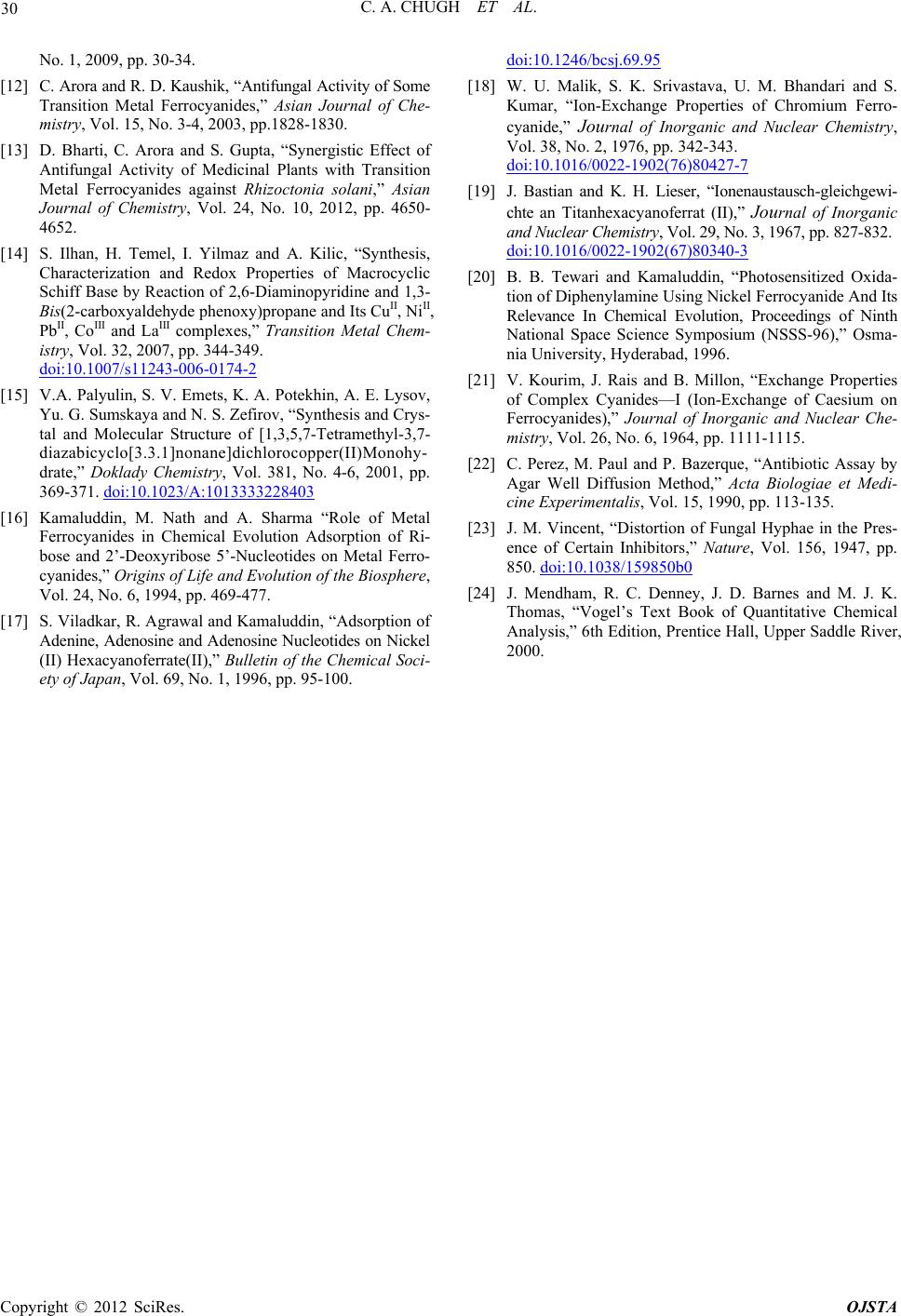 C. A. CHUGH ET AL. 30 No. 1, 2009, pp. 30-34. [12] C. Arora and R. D. Kaushik, “Antifungal Activity of Some Transition Metal Ferrocyanides,” Asian Journal of Che- mistry, Vol. 15, No. 3-4, 2003, pp.1828-1830. [13] D. Bharti, C. Arora and S. Gupta, “Synergistic Effect of pp. 4650- rboxyaldehyde phenoxy)propane and Its Cu, Ni Antifungal Activity of Medicinal Plants with Transition Metal Ferrocyanides against Rhizoctonia solani,” Asian Journal of Chemistry, Vol. 24, No. 10, 2012, 4652. [14] S. Ilhan, H. Temel, I. Yilmaz and A. Kilic, “Synthesis, Characterization and Redox Properties of Macrocyclic Schiff Base by Reaction of 2,6-Diaminopyridine and 1,3- Bis(2-ca II II, PbII, CoIII and LaIII complexes,” Transition Metal Chem- istry, Vol. 32, 2007, pp. 344-349. doi:10.1007/s11243-006-0174-2 [15] V.A. Palyulin, S. V. Emets, K. A. Potekhin, A. E. Lysov, Yu. G. Sumskaya and N. S. Zefirov, “Synthesis and Crys- tal and Molecular Structure of [1,3 diazabicyclo[3.3.1]nonane]dichl ,5,7-Tetramethy orocopper(II)Mon l-3,7- ohy- drate,” Doklady Chemistry, Vol. 381, No. 4-6, 2001, pp. 369-371. doi:10.1023/A:1013333228403 [16] Kamaluddin, M. Nath and A. Sharma “Role of Metal Ferrocyanides in Chemical Evolution Adsorption of Ri- bose and 2’-Deoxyribose 5’-Nucleotides on Metal Ferro- cyanides,” Origins of Life and Evolution of the Biosphere p. 95-100. , Vol. 24, No. 6, 1994, pp. 469-477. [17] S. Viladkar, R. Agrawal and Kamaluddin, “Adsorption of Adenine, Adenosine and Adenosine Nucleotides on Nickel (II) Hexacyanoferrate(II),” Bulletin of the Chemical Soci- ety of Japan, Vol. 69, No. 1, 1996, p doi:10.1246/bcsj.69.95 [18] W. U. Malik, S. K. Srivastava, U. M. Bhandari and S. Kumar, “Ion-Exchange Properties of Chromium cyanide,” Journal of In Ferro- organic and Nuclear Chemistry, Vol. 38, No. 2, 1976, pp. 342-343. doi:10.1016/0022-1902(76)80427-7 [19] J. Bastian and K. H. Lieser, “Ionenaustausch-gleichgewi- chte an Titanhexacyanoferrat (II),” Jo and Nuclear Chemistry, Vol. 29, No. 3 urnal of Inorganic , 1967, pp. 827-832. doi:10.1016/0022-1902(67)80340-3 [20] B. B. Tewari and Kamaluddin, “Photosensitized Oxida- tion of Diphenylamine Using Nickel Ferrocyanide And Its Relevance In Chemical Evolution, Proceedings of Ninth Nuclear Che- 35. National Space Science Symposium (NSSS-96),” Osma- nia University, Hyderabad, 1996. [21] V. Kourim, J. Rais and B. Millon, “Exchange Properties of Complex Cyanides—I (Ion-Exchange of Caesium on Ferrocyanides),” Journal of Inorganic and mistry, Vol. 26, No. 6, 1964, pp. 1111-1115. [22] C. Perez, M. Paul and P. Bazerque, “Antibiotic Assay by Agar Well Diffusion Method,” Acta Biologiae et Medi- cine Experimentalis, Vol. 15, 1990, pp. 113-1 [23] J. M. Vincent, “Distortion of Fungal Hyphae in the Pres- ence of Certain Inhibitors,” Nature, Vol. 156, 1947, pp. 850. doi:10.1038/159850b0 [24] J. Mendham, R. C. Denney, J. D. Barnes and M. J. K. Thomas, “Vogel’s Text Book of Quantitative Chemical Analysis,” 6th Edition, Prentice Hall, Upper Saddle River, 2000. Copyright © 2012 SciRes. OJSTA |