

Paper Menu >>
Journal Menu >>
 Pharmacology & Pharmacy, 2012, 3, 468-473 http://dx.doi.org/10.4236/pp.2012.34064 Published Online October 2012 (http://www.SciRP.org/journal/pp) 1 Preparation and in Vitro Drug Release Evaluation of Once-Daily Metformin Hydrochloride Sustained-Release Tablets Ling Zhao1, Yumeng Wei1*, Yong Mei2, Li Yang2, Yuan You2, Xufeng Yang2, Yanhong Jiang2 1Department of Pharmaceutics, School of Pharmacy, Luzhou Medical College, Luzhou, China; 2Chongqing Conquor Pharmaceutical Co., Chongqing, China. Email: *[email protected] Received June 24th, 2012; revised July 25th, 2012; accepted August 11th, 2012 ABSTRACT The objective of this study was to develop once-daily metformin hydrochloride sustained-release tablets (MHSRT) and evaluate their in vitro release behavior. MHSRT were prepared by the film coating method. The in vitro drug release rate of MHSRT and the commercial tablets Fortamet® made in the United States of America in water was fitted with zero order kinetic equation, and Ritger-Peppas kinetic equation in 0.1 M HCl and pH 6.8-phosphate buffer, respectively. The similarity factor f2 values of MHSRT in three different dissolution medium were 82, 80 and 74, respectively in comparison with imported Fortamet®, which were all greater than 50. The results of storage-stability showed that MHSRT were stable for at least 6 months under stress condition (40˚C ± 2˚C, RH 75% ± 5%). Therefore, in this study, MHSRT were successfully prepared using optimized formulation technologies that meet mass produce. The in vitro release behavior of MHSRT was almost similar to that of imported Fortamet®. Keywords: Sustained-Release Tablets; Metformin Hydrochloride; In Vitro Release Rate; Similarity Factor; Kinetic Model 1. Introduction Metformin hydrochloride (MH) is a biguanide oral anti- diabetic drug which is widely used to treat non-insulin dependent diabetes mellitus (type 2 diabets). Its mode of action is thought to be multifactoral and includes de- layed uptake of glucose from the intestinal tract, in- creased peripheral glucose utilisation mediated by in- creased insulin sensitivity and decreased hepatic and renal gluconeogenesis. In clinical treatment, there are many advantages of MH such as the tendency to weight reduc- tion and the ability to reduce blood glucose to normal level without significant hypoglycaemia [1]. However, because of its relative low bioavailability (40% - 60%) and short biological half-life (0.9 - 2.6 h) [2-5], the im- mediate release dosage forms of MH such as conven- tional tablets and capsules, have to be administered three times a day [3], which results in a significant fluctuation in the plasma drug concentration and poor patient com- pliance. In order to overcome these problems, sustained- release drug delivery systems of MH including sustained- release matrix tablets [2,6-8], sustained-release pellets [3,9], sustained-release microparticles [10], prolonged release microspheres [11], gastroretentive drug delivery preparation [12], pH-controlled peroral delivery formula- tion [13] have been developed in recent years. Though sustained release formulations of MH have been reported to prolong drug release, formulation and technologies used in these studies were complicated and costly, which influence industrial scale and market expansion. At present, MHSRT produced by Bristol-Myers Squibb Company (USA) capture a major market share in China. However, many patients in our developing country could not accept it due to its high cost. Therefore, development of sustained release dosage form of MH that is similar to imported drug is to save pharmacy cost and improve clinical outcomes. Therefore, in this study, MHSRT were prepared using optimized formulation technologies that meet mass pro- duce. The in vitro drug release behavior of MHSRT was studied in water, 0.1 M HCl and pH 6.8-phosphate buffer as release medium and compared with the commercial tablets Fortamet® made in the United States of America. 2. Materials and Methods 2.1. Materials Metformin hydrochloride (purity: 99.86%) was purchased *Corresponding autho r . Copyright © 2012 SciRes. PP 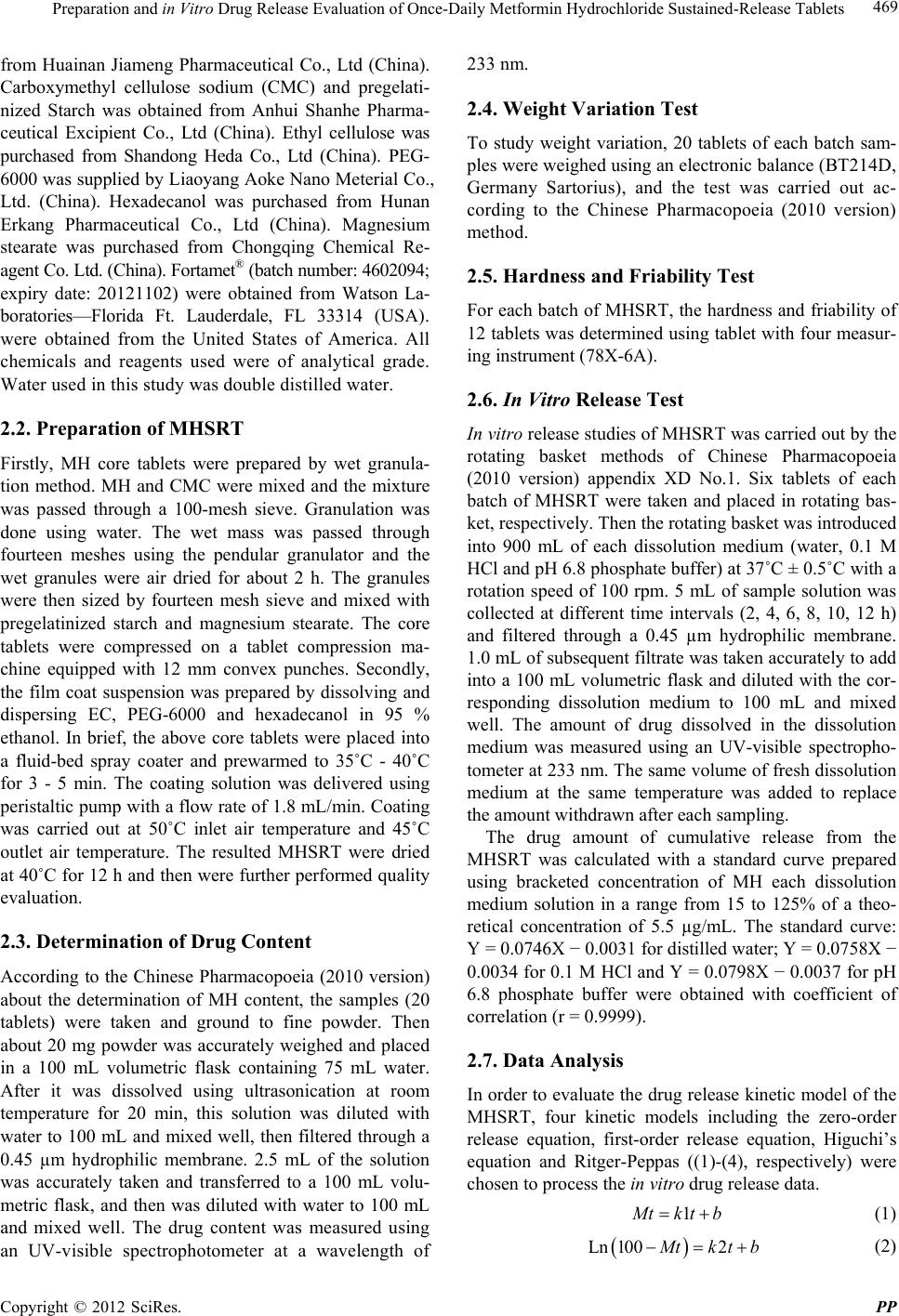 Preparation and in Vitro Drug Release Evaluation of Once-Daily Metformin Hydrochloride Sustained-Release Tablets 469 from Huainan Jiameng Pharmaceutical Co., Ltd (China). Carboxymethyl cellulose sodium (CMC) and pregelati- nized Starch was obtained from Anhui Shanhe Pharma- ceutical Excipient Co., Ltd (China). Ethyl cellulose was purchased from Shandong Heda Co., Ltd (China). PEG- 6000 was supplied by Liaoyang Aoke Nano Meterial Co., Ltd. (China). Hexadecanol was purchased from Hunan Erkang Pharmaceutical Co., Ltd (China). Magnesium stearate was purchased from Chongqing Chemical Re- agent Co. Ltd. (China). Fortamet® (batch number: 4602094; expiry date: 20121102) were obtained from Watson La- boratories—Florida Ft. Lauderdale, FL 33314 (USA). were obtained from the United States of America. All chemicals and reagents used were of analytical grade. Water used in this study was double distilled water. 2.2. Preparation of MHSRT Firstly, MH core tablets were prepared by wet granula- tion method. MH and CMC were mixed and the mixture was passed through a 100-mesh sieve. Granulation was done using water. The wet mass was passed through fourteen meshes using the pendular granulator and the wet granules were air dried for about 2 h. The granules were then sized by fourteen mesh sieve and mixed with pregelatinized starch and magnesium stearate. The core tablets were compressed on a tablet compression ma- chine equipped with 12 mm convex punches. Secondly, the film coat suspension was prepared by dissolving and dispersing EC, PEG-6000 and hexadecanol in 95 % ethanol. In brief, the above core tablets were placed into a fluid-bed spray coater and prewarmed to 35˚C - 40˚C for 3 - 5 min. The coating solution was delivered using peristaltic pump with a flow rate of 1.8 mL/min. Coating was carried out at 50˚C inlet air temperature and 45˚C outlet air temperature. The resulted MHSRT were dried at 40˚C for 12 h and then were further performed quality evaluation. 2.3. Determination of Drug Content According to the Chinese Pharmacopoeia (2010 version) about the determination of MH content, the samples (20 tablets) were taken and ground to fine powder. Then about 20 mg powder was accurately weighed and placed in a 100 mL volumetric flask containing 75 mL water. After it was dissolved using ultrasonication at room temperature for 20 min, this solution was diluted with water to 100 mL and mixed well, then filtered through a 0.45 µm hydrophilic membrane. 2.5 mL of the solution was accurately taken and transferred to a 100 mL volu- metric flask, and then was diluted with water to 100 mL and mixed well. The drug content was measured using an UV-visible spectrophotometer at a wavelength of 233 nm. 2.4. Weight Variation Test To study weight variation, 20 tablets of each batch sam- ples were weighed using an electronic balance (BT214D, Germany Sartorius), and the test was carried out ac- cording to the Chinese Pharmacopoeia (2010 version) method. 2.5. Hardness and Friability Test For each batch of MHSRT, the hardness and friability of 12 tablets was determined using tablet with four measur- ing instrument (78X-6A). 2.6. In Vitro Release Test In vitro release studies of MHSRT was carried out by the rotating basket methods of Chinese Pharmacopoeia (2010 version) appendix XD No.1. Six tablets of each batch of MHSRT were taken and placed in rotating bas- ket, respectively. Then the rotating basket was introduced into 900 mL of each dissolution medium (water, 0.1 M HCl and pH 6.8 phosphate buffer) at 37˚C ± 0.5˚C with a rotation speed of 100 rpm. 5 mL of sample solution was collected at different time intervals (2, 4, 6, 8, 10, 12 h) and filtered through a 0.45 µm hydrophilic membrane. 1.0 mL of subsequent filtrate was taken accurately to add into a 100 mL volumetric flask and diluted with the cor- responding dissolution medium to 100 mL and mixed well. The amount of drug dissolved in the dissolution medium was measured using an UV-visible spectropho- tometer at 233 nm. The same volume of fresh dissolution medium at the same temperature was added to replace the amount withdrawn after each sampling. The drug amount of cumulative release from the MHSRT was calculated with a standard curve prepared using bracketed concentration of MH each dissolution medium solution in a range from 15 to 125% of a theo- retical concentration of 5.5 µg/mL. The standard curve: Y = 0.0746X − 0.0031 for distilled water; Y = 0.0758X − 0.0034 for 0.1 M HCl and Y = 0.0798X − 0.0037 for pH 6.8 phosphate buffer were obtained with coefficient of correlation (r = 0.9999). 2.7. Data Analysis In order to evaluate the drug release kinetic model of the MHSRT, four kinetic models including the zero-order release equation, first-order release equation, Higuchi’s equation and Ritger-Peppas ((1)-(4), respectively) were chosen to process the in vitro drug release data. 1 M tktb (1) Ln 1002 M tktb (2) Copyright © 2012 SciRes. PP 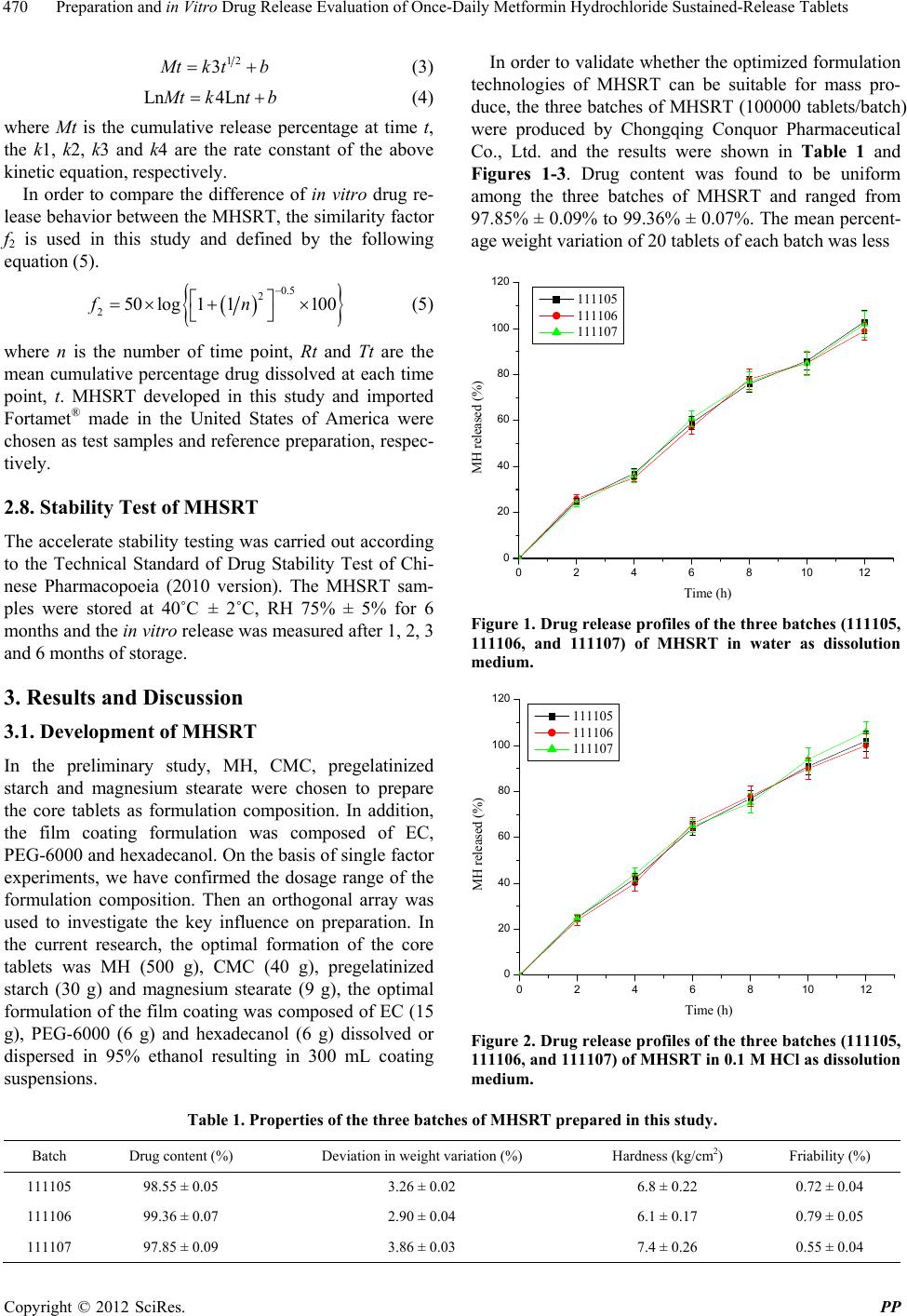 Preparation and in Vitr o Drug Release Evaluation of Once-Daily Metformin Hydrochloride Sustained-Release Tablets Copyright © 2012 SciRes. PP 470 In order to validate whether the optimized formulation technologies of MHSRT can be suitable for mass pro- duce, the three batches of MHSRT (100000 tablets/batch) were produced by Chongqing Conquor Pharmaceutical Co., Ltd. and the results were shown in Table 1 and Figures 1-3. Drug content was found to be uniform among the three batches of MHSRT and ranged from 97.85% ± 0.09% to 99.36% ± 0.07%. The mean percent- age weight variation of 20 tablets of each batch was less 12 3 M tkt b (3) Ln 4Ln M tk tb (4) where Mt is the cumulative release percentage at time t, the k1, k2, k3 and k4 are the rate constant of the above kinetic equation, respectively. In order to compare the difference of in vitro drug re- lease behavior between the MHSRT, the similarity factor f2 is used in this study and defined by the following equation (5). 0.5 2 250 log11100fn (5) 024681012 0 20 40 60 80 100 120 MH released (%) Time (h) 111105 111106 111107 where n is the number of time point, Rt and Tt are the mean cumulative percentage drug dissolved at each time point, t. MHSRT developed in this study and imported Fortamet® made in the United States of America were chosen as test samples and reference preparation, respec- tively. 2.8. Stability Test of MHSRT The accelerate stability testing was carried out according to the Technical Standard of Drug Stability Test of Chi- nese Pharmacopoeia (2010 version). The MHSRT sam- ples were stored at 40˚C ± 2˚C, RH 75% ± 5% for 6 months and the in vitro release was measured after 1, 2, 3 and 6 months of storage. Figure 1. Drug release profiles of the three batches (111105, 111106, and 111107) of MHSRT in water as dissolution medium. 3. Results and Discussion 024681012 0 20 40 60 80 100 120 MH released (%) Time (h) 111105 111106 111107 3.1. Development of MHSRT In the preliminary study, MH, CMC, pregelatinized starch and magnesium stearate were chosen to prepare the core tablets as formulation composition. In addition, the film coating formulation was composed of EC, PEG-6000 and hexadecanol. On the basis of single factor experiments, we have confirmed the dosage range of the formulation composition. Then an orthogonal array was used to investigate the key influence on preparation. In the current research, the optimal formation of the core tablets was MH (500 g), CMC (40 g), pregelatinized starch (30 g) and magnesium stearate (9 g), the optimal formulation of the film coating was composed of EC (15 g), PEG-6000 (6 g) and hexadecanol (6 g) dissolved or dispersed in 95% ethanol resulting in 300 mL coating suspensions. Figure 2. Drug release profiles of the three batches (111105, 111106, and 111107) of MHSRT in 0.1 M HCl as dissolution medium. Table 1. Properties of the three batches of MHSRT prepared in this study. Batch Drug content (%) Deviation in weight variation (%) Hardness (kg/cm2) Friability (%) 111105 98.55 ± 0.05 3.26 ± 0.02 6.8 ± 0.22 0.72 ± 0.04 111106 99.36 ± 0.07 2.90 ± 0.04 6.1 ± 0.17 0.79 ± 0.05 111107 97.85 ± 0.09 3.86 ± 0.03 7.4 ± 0.26 0.55 ± 0.04 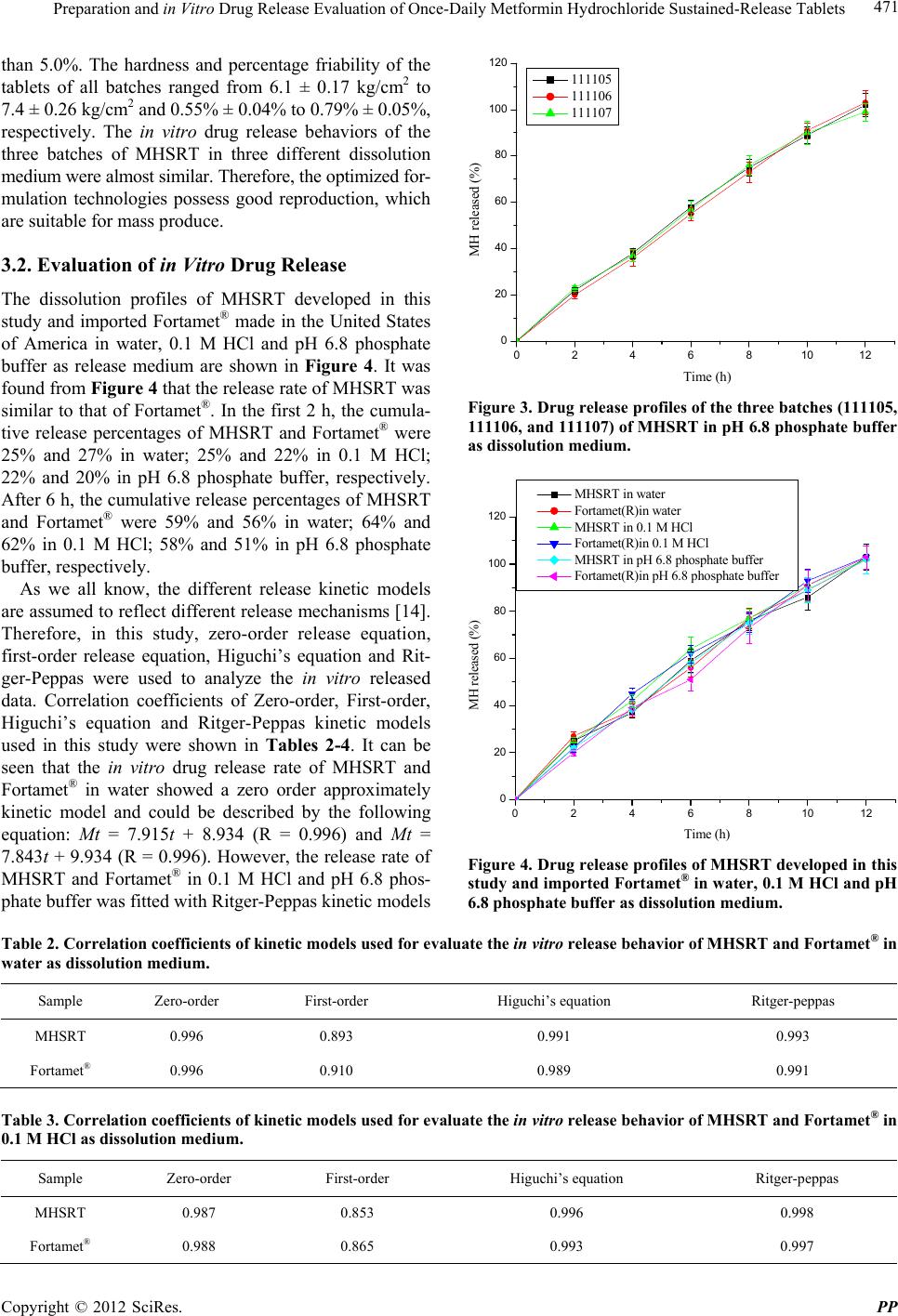 Preparation and in Vitro Drug Release Evaluation of Once-Daily Metformin Hydrochloride Sustained-Release Tablets 471 than 5.0%. The hardness and percentage friability of the tablets of all batches ranged from 6.1 ± 0.17 kg/cm2 to 7.4 ± 0.26 kg/cm2 and 0.55% ± 0.04% to 0.79% ± 0.05%, respectively. The in vitro drug release behaviors of the three batches of MHSRT in three different dissolution medium were almost similar. Therefore, the optimized for- mulation technologies possess good reproduction, which are suitable for mass produce. 3.2. Evaluation of in Vitro Drug Release The dissolution profiles of MHSRT developed in this study and imported Fortamet® made in the United States of America in water, 0.1 M HCl and pH 6.8 phosphate buffer as release medium are shown in Figure 4. It was found from Figure 4 that the release rate of MHSRT was similar to that of Fortamet®. In the first 2 h, the cumula- tive release percentages of MHSRT and Fortamet® were 25% and 27% in water; 25% and 22% in 0.1 M HCl; 22% and 20% in pH 6.8 phosphate buffer, respectively. After 6 h, the cumulative release percentages of MHSRT and Fortamet® were 59% and 56% in water; 64% and 62% in 0.1 M HCl; 58% and 51% in pH 6.8 phosphate buffer, respectively. As we all know, the different release kinetic models are assumed to reflect different release mechanisms [14]. Therefore, in this study, zero-order release equation, first-order release equation, Higuchi’s equation and Rit- ger-Peppas were used to analyze the in vitro released data. Correlation coefficients of Zero-order, First-order, Higuchi’s equation and Ritger-Peppas kinetic models used in this study were shown in Tables 2-4. It can be seen that the in vitro drug release rate of MHSRT and Fortamet® in water showed a zero order approximately kinetic model and could be described by the following equation: Mt = 7.915t + 8.934 (R = 0.996) and Mt = 7.843t + 9.934 (R = 0.996). However, the release rate of MHSRT and Fortamet® in 0.1 M HCl and pH 6.8 phos- phate buffer was fitted with Ritger-Peppas kinetic models 024681012 0 20 40 60 80 100 120 MH released (%) Time (h) 111105 111106 111107 Figure 3. Drug release profiles of the three batches (111105, 111106, and 111107) of MHSRT in pH 6.8 phosphate buffer as dissolution medium. 024681012 0 20 40 60 80 100 120 MH released (%) Time (h) MHSRT in water Fortamet(R)in water MHSRT in 0.1 M HCl Fortamet(R)in 0.1 M HCl MHSRT in pH 6.8 phosphate buffer Fortamet(R)in pH 6.8 phosphate buffer Figure 4. Drug release profiles of MHSRT develope d in this study and imported Fortamet® in water, 0. 1 M HCl and pH 6.8 phosphate buffer as dissolution medium. Table 2. Correlation coefficients of kinetic models used for evaluate the in vitro release behavior of MHSRT and Fortamet® in water as dissolution medium. Sample Zero-order First-order Higuchi’s equation Ritger-peppas MHSRT 0.996 0.893 0.991 0.993 Fortamet® 0.996 0.910 0.989 0.991 Table 3. Correlation coefficients of kinetic models used for evaluate the in vitro release behavior of MHSRT and Fortamet® in 0.1 M HCl as dissolution medium. Sample Zero-order First-order Higuchi’s equation Ritger-peppas MHSRT 0.987 0.853 0.996 0.998 Fortamet® 0.988 0.865 0.993 0.997 Copyright © 2012 SciRes. PP  Preparation and in Vitr o Drug Release Evaluation of Once-Daily Metformin Hydrochloride Sustained-Release Tablets 472 Table 4. Correlation coefficients of kinetic models used for evaluate the in vitro release behavior of MHSRT and Fortamet® in pH 6.8 phosphate buffer as dissolution medium. Sample Zero-order First-order Higuchi’s equation Ritger-peppas MHSRT 0.995 0.827 0.993 0.999 Fortamet® 0.994 0.834 0.982 0.996 and could be described by the following equation: LnMt = 0.801Lnt + 2.665 (R = 0.998) and LnMt = 0.857Lnt + 2.551 (R = 0.997); LnMt = 0.875Lnt + 2.471 (R = 0.999) and LnMt = 0.922Lnt + 2.354 (R = 0.996), respectively, which indicated that the drug release mechanisms of MHSRT and Fortamet® were similar in gastrointestinal tract. According the formulation composition MHSRT, it was obvious that drug diffusion and erosion were the main factor in controlling the drug release rate from MHSRT. This was also evidenced by the value of the release exponent n of 0.801 and 0.875, because when n ranged from 0.45 to 0.89, indicating that drug is released by the combination of diffusion and erosion mechanisms [15-16]. On the other hand, the similarity factor f2 value be- tween 50 and 100 shows that two release profiles are similar [17]. Therefore, in order to evaluate the in vitro release difference of MHSRT, when imported Fortamet® were chosen as reference, f2 value was calculated. It was found that the dissolution profile of only MHSRT pre- pared in this study was similar to that of Fortamet®, be- cause the f2 values in water, 0.1 M HCl and pH 6.8 phosphate buffer were 82, 80 and 74, respectively, which were all greater than 50. 3.3. Test for Stability It was known that the stability of preparation is an im- portant factor to estimate the quality of pharmaceutical formulation. Thus, the acceleration stability test was performed to study the stability of MHSRT. It can be seen from Figures 5-7 that good storage stability was ob- served and the in vitro release profiles had little change. And no significant difference in cumulative release per- centage of drug in water, 0.1 M HCl and pH 6.8 phos- phate buffer after 1, 2, 3 and 6 months was observed in comparison with MHSRT samples before storage (n = 3; P > 0.05). Therefore, MHSRT developed in this study were stable at least for 6 months under stress conditions. 4. Conclusion In this study, once-daily metformin hydrochloride sus- tained-release tables (MHSRT) were successfully devel- oped by the optimized formulation technologies that are suitable for mass produce at Chongqing Conquor Phar- maceutical Co., Ltd. The in vitro release behavior of MHSRT was almost similar to that of imported For- 024681012 0 20 40 60 80 100 120 MH released (%) Time (h) 0 month 1 month 2 month 3 month 6 month Figure 5. Drug release profiles of MHSRT develope d in this study in water before and after 1, 2, 3 and 6 months of storage under stress conditions (40˚C ± 2˚C, RH 75% ± 5%). 024681012 0 20 40 60 80 100 120 MH re l ease d (%) Time (h) 0 month 1 month 2 month 3 month 6 month Figure 6. Drug release profiles of MHSRT develope d in this study in 0.1 M HCl before and after 1, 2, 3 and 6 months of storage under stress conditions (40˚C ± 2˚C, RH 75% ± 5%). tamet®. Furthermore, MHSRT developed in this study were stable at least for 6 months under stress conditions. 5. Acknowledgements This research was supported of by the National Natural Science Foundation of China (81101678), the Key Pro- gram of the Scientific Research Foundation of the Edu- Copyright © 2012 SciRes. PP  Preparation and in Vitro Drug Release Evaluation of Once-Daily Metformin Hydrochloride Sustained-Release Tablets 473 024681012 0 20 40 60 80 100 120 MH released (%) Time (h) 0 month 1 month 2 month 3 month 6 month Figure 7. Drug release profiles of MHSRT develope d in this study in pH 6.8 phosphate buffer before and after 1, 2, 3 and 6 months of storage under stress conditions (40˚C ± 2˚C, RH 75% ± 5%). cation Department of Sichuan Province [09ZA049; 11ZZ024], the Scientific Research Foundation of the Health Bureau of Sichuan Province [100215; 100214]and the Key Program of the Scientific Research Foundation of Bureau of Science and Technology of luzhou Munici- pality [2011-S-32(1/4)]. REFERENCES [1] X.-X. Yin, Y.-D. Zhang, H.-T. Zhuo, J.-P. Shen, L.-M. Li and Q. Jun, “Pharmacokinetics and Relative Bioavailabil- ity of Metformin Hydrochloride Sustained Release Tab- lets in Healthy Chinese Volunteers,” Asian Journal of Drug Metabolism and Pharmacokinetics, Vol. 4, No. 2, 2004, pp.137-142. [2] G. Corti, M. Cirri, F. Maestrelli, N. Mennini and P. Mura, “Sustained-Release Matrix Tablets of Metformin Hydro- chloride in Combination with Triacetyl-Beta-Cyclodex- trin,” European Journal of Pharmaceutics and Biophar- maceutics, Vol. 68, No. 2, 2008, pp. 303-309. doi:10.1016/j.ejpb.2007.06.004 [3] L. D. Hu, Y. Liu, X. Tang and Q. Zhang, “Preparation and in Vitro/in Vivo Evaluation of Sustained-Release Met- formin Hydrochloride Pellets,” European Journal of P har - maceutics and Biopharmaceutics, Vol. 64, No. 2, 2006, pp. 185-192. doi:10.1016/j.ejpb.2006.04.004 [4] P. J. Pentikäinen, P. J. Neuvonen and A. Penttilä, “Phar- macokinetics of Metformin after Intravenous and Oral Administration to Man,” European Journal of Clinical Pharmacology, Vol. 16, No. 3, 1979, pp. 195-202. doi:10.1007/BF00562061 [5] G. T. Tucker, C. Casey, P. J. Phillips, H. Connor, J. D. Ward and H. F. Woods, “Metformin Kinetics in Healthy Subjects and in Patients with Diabetes Mellitus,” British Journal of Clinical Pharmacology, Vol. 12, No. 2, 1981, pp. 235-246. [6] P. K. Bhoyar and D. M. Biyani, “Formulation and in Vitro Evaluation of Sustained Release Dosage Form with Taste Masking of Metformin Hydrochloride,” Indian Journal of Pharmaceutical Sciences, Vol. 72, No. 2, 2010, pp. 184- 190. doi:10.4103/0250-474X.65031 [7] O. Defang, N. Shufang, L. Wei, G. Hong, L. Hui and P. Weisan, “In Vitro and in Vivo Evaluation of Two Ex- tended Release Preparations of Combination Metformin and Glipizide,” Drug Development and Industrial Phar- macy, Vol. 31, No. 7, 2005, pp. 677-685. doi:10.1080/03639040500216410 [8] A. Ghosh, A. Bose and U. Bhaumik, “Application of Response Surface Methodology in the Formulation of Sustained Release Matrix Tablets of Metformin Hydro- chloride,” Asian Journal of Chemistry, Vol. 20, No. 7, 2008, pp. 5541-5556. [9] J. Piao, J. E. Lee, K. Y. Weon, D. W. Kim, J. S. Lee, J. D. Park, Y. Nishiyama, I. Fukui and J. S. Kim, “Develop- ment of Novel Mucoadhesive Pellets of Metformin Hy- drochloride,” Archives of Pharmacal Research, Vol. 32, No. 3, 2009, pp. 391-397. doi:10.1007/s12272-009-1312-0 [10] P. Subhedar, J. B. Naik and D. N. Muley, “Effect of Polymer Concentration on Sustained Release Microparti- cles of Metformin Hydrochloride Prepared by Using Spray Dryer,” Polymer-Plastics Technology and Engineering, Vol. 49, No. 3, 2010, pp. 267-271. [11] H. F. Liu, X. Y. Su, X. Li, X. Zhao, L. Zang and W. S. Pan, “Development of Prolonged Release Microspheres of Metformin Hydrochloride Using Ion Exchange Res- ins,” Journal of Chinese Pharmaceutical Sciences, Vol. 15, No. 3, 2006, pp. 155-161. [12] S. P. Boldhane and B. S. Kuchekar, “Gastroretentive Drug Delivery of Metformin Hydrochloride: Formulation and in Vitro Evaluation Using 32 Full Factorial Design,” Current Drug Deliver, Vol. 6, No. 5, 2009, pp. 477-485. [13] G. Di Colo, S. Falchi and Y. Zambito, “In Vitro Evalua- tion of a System for pH-Controlled Peroral Delivery of Metformin,” Journal of Controlled Release, Vol. 80, No. 1-3, 2002, pp. 119-128. doi:10.1016/S0168-3659(02)00022-6 [14] P. C. Wu, M. J. Tsai, Y. B. Huang, J. S. Chang and Y. H. Tsai, “In Vitro and in Vivo Evaluation of Potassium Chlo- ride Sustained Release Formulation Prepared with Satu- rated Polyglycolyed Glycerides Matrices,” International Journal of Pharmaceutics, Vol. 243, No. 1-2, 2002, pp. 119-124. doi:10.1016/S0378-5173(02)00264-8 [15] J. E. Polli, G. S. Rekhi, L. L. Augsburger and V. P. Shah, “Methods to Compare Dissolution Profiles and a Ration- ale for Wide Dissolution Specifications for Metoprolol Tartrate Tablets,” Journal of Pharmaceutical Sciences, Vol. 86, No. 6, 1997, pp. 690-700. doi:10.1021/js960473x [16] S. G. Wang, L. Wang, Z. Z. Shao, X. P. Lu and X. Q. Hang, “Study on the Release Rate of Niacin in Different Media for the Compound Niacin Extended-Release and Simvastatin Tablets,” Chinese Journal of Pharmacology and Toxicology, Vol. 8, No. 10, 2011, pp. 581-584. [17] N. A. Peppas, “Analysis of Fickian and Non-Fickian Drug Release from Polymers,” Pharmaceutica Acta Helvetiae, Vol. 60, No. 4, 1985, pp. 110-111. Copyright © 2012 SciRes. PP |