

Paper Menu >>
Journal Menu >>
 Creative Education 2012. Vol.3, Special Issue, 946-950 Published Online October 2012 in SciRes (http://www.SciRP.org/journal/ce) http://dx.doi.org/10.4236/ce.2012.326144 Copyright © 2012 SciRes. 946 Investigation of Clinical Medical Teachers’ Opinion about Validity-Feasibility of Clinical Assessment Tools in Medical Sciences Universities in Tehran Jalil Kuhpayeh Zadeh1, Helen Dargahi2, Jila Shajari2, Rafei Ali3, Mahsa Narenjiha2, Soudabeh Afsharpour2, Darioush Mehdivarzi4 1Medical Education Research Center, Tehran Universities of Medical Sciences, Tehran, Iran 2Department of Medical Education, Tehran Universities of Medical Sciences, Tehran, Iran 3Department of Biostatistics, Tehran Universities of Medical Sciences, Tehran, Iran 4Department of Orthopedi c Surgery, Shahed Universities of Medical Sciences, Tehran, Iran Email: [email protected] Received August 1st, 2012; revised September 3 rd, 2012; accepted September 15th, 2012 The purpose of this study is investigation about validity and feasibility of clinical assessment methods in the point of view of clinical instructors. The descriptive study was done in Tehran city universities. Popu- lation study consisted of academic clinical experts. The instrument was a two-part questionnaire made by using Accreditation Council for Graduate Medical Education (ACGME) suggested questionnaire and valid scientific resources. Sampling was based-objected. Total of obtained questionnaires were 83 which were collected from universities Tehran University of Medical Sciences (39), Iran University of Medical Sciences (24) and Shahid Beheshti Medical University (20). Data analysis was conducted by SPSS16. Data indicated that the majority of the study population believed that MCQ (97.6%) is used in clinical set- ting. OSCE (92.8%) and Logbook (86.7%) are the next methods. Furthermore, Multi-Source Feedback (MSF) (8.4%) and Portfolio (6%) are not often used; whereas the most suitable and feasible medical stu- dents’ clinical assessment tools in variety of domains are completely different so that there are lots of suggested methods for efficient evaluation. Also, the most suitable and feasible methods were the same in 60% cases. Clearly, no single rating is able to provide the whole story about any doctor’s ability to prac- tice medicine, as this requires the demonstration of ongoing competence across a number of different general and specific areas. Keywords: Validity; Feasibility; Clinical Assessment Methods; Medical Sciences University; Tehran; Clinical Medical Teachers Introduction Assessment has a powerful positive steering effect on learn- ing and the curriculum (Tabish, 2010) and drives both how a subject is taught and what is taught (Sultana, 2006). Assess- ment and evaluation are crucial steps in educational process (Tabish, 2010) that play major role in the process of medical education, in the lives of medical students, and in society by certifying competent physicians who are able to take care of the public. The very foundation of medical curricula is built around assessment milestones for students. Assessment becomes a motivating force for them to learn (Shumway, 2003). Before making a choice of assessment method, some important ques- tions must be asked: what should be assessed? Why assess? And for an assessment instrument one must also ask: Is it valid? Is it reliable? Is it feasible? (Tabish, 2010) Since the 1950s, there has been rapid and extensive change in the way assess- ment is conducted in medical education. Several new methods of assessment have been developed and implemented over this time and they have focused on clinical skills (taking a history from a patient and performing a physical examination), com- munication skills, procedural skills, and professionalism. In 2005, Van der Vleuten and Schuwirth expanded on these fac- tors for purposes of assessment in medical education and added educational effect, feasibility, and acceptability to validity and reliability. Feasibility is the degree to which the assessment method selected is affordable and efficient for the testing pur- pose; assessments need to have reasonable costs. Acceptability is the extent to which stakeholders in the process endorse the measurement and the associated interpretation of scores (Nor- cini & McKinle, 2007). Mahara (1998) believes that clinical evaluation processes should focus on reflection, meaning mak- ing and student teacher partnerships. Evaluation tools are needed that to capture the unity and context dependent nature of clinical practice and support an empowering teacher-student relationship (Bourbonnais, 2008). Unfortunately, in the vast majority of medical schools, feedback to clinical clerks is neither direct nor timely. The primary method for evaluation of both junior and senior medical student performance on the wards is typically a subjective and is written by the faculty (Colletti, 2000). On the other hand, because of faculty time constraints, the increasing reliance on residents as teachers for medical students in the clinical setting at our institution has arisen largely (Johnson & Chen, 2006), and in many institutions, resi- dents and fellows anticipate to write evaluation process. In addition, particularly for junior rotations, many institutions complement the subjective written evaluation of clinical ward  J. K. ZADEH ET AL. performance with some form of cognitive evaluation (Colletti, 2000). Whereas for an assessment method to be acceptable, it needs to be valid, reliable, and practical and have a positive effect on a trainee’s learning (Brown & Doshi, 2006). Effective evaluation not only increases the students’ motivation but also helps instructors to determine the strength or weakness of their educational activities for improvement of their performance (Baral & Paudel, 2007). And poorly selected assessment methods can lead to passive or rote learning (to get through an examina- tion), which is associated with a rapid decay of knowledge and sometimes an inability to apply it in real situations (Brown & Doshi, 2006). Because of the importance of the topic research, we decided to assess the validity and feasibility of the medical student’s assessment tools in view of Iranian academic clinical experts. Methods & Material This survey was a descriptive study that was done in Tehran city universities. Population study consisted of academic clini- cal experts that were working as a faculty member. The study instrument was a two-part questionnaire. One of them was about demographic and institutional data and the other one was a thirteen-item table of medical students’ competencies in six domains included patient care, medical knowledge, prac- tice-based learning & improvement, interpersonal & communi- cation skills, professionalism, systems-based practice and also some clinical assessment tools that were used for medical student as usual. The questionnaire was made by using of ACGME suggested questionnaire and valid scientific resources. Ques- tionnaire was adopted with conditions of universities after translation and back translation. Also three pages were a brief of clinical assessment tools enclosed to questionnaire. Content validity of questionnaire was confirmed after doing a survey from experts and accomplishing preliminary study. Reliability of the results was assessed through calculating Cronbach alpha coefficient for internal consistency. Sampling was based-ob- jected, so that researcher found out some of key point persons via educational development centers (EDC) and then the others were introduced by them. Then after coordination and making appointment with clinical professors, researcher by self deliv- ered questionnaire with a short explanation about completion it and made another appointment to receive the questionnaire. Total of collected questionnaires were 83 that 39 of them were of Tehran University of medical science, 24 Iran University of medical science and 20 Shahid Beheshti University of medical science. Analysis of data was conducted with SPSS version 17. Clinical Assessment Tools Multi-Rater (360˚) Evaluation Multi-rater (360˚) evaluations provide multiple perspectives on various aspects of the resident’s performance. For residents, Multi-rater (360˚) assessment might entail evaluation by at- tending, other residents, medical students, nurses, ancillary staff, clerical/administrative support staff, and patients. Self-evalua- tion is an important part of the Multi-Rater (360˚) assessment (Joyce, 2006). Portfolio A learning portfolio is a collection of materials that repre- sents a resident’s efforts in multiple areas of the curriculum. The purpose of a learning portfolio is to improve ability. Key components of a learning portfolio include: Self-assessment and goal setting; Mentored observation and feedback; Works in progress with formative feedback; Self reflection on work; and Final materials documenting achievement (Joyce, 2006). Chart Stimulated Recall Oral Examination (CSR) In a chart stimulated recall (CSR) examination patient cases of the examinee (resident) are assessed in a standardized oral examination. A trained and experienced physician examiner questions the examinee about the care provided probing for reasons behind the work-up, diagnoses, interpretation of clini- cal findings, and treatment plans. The examiners rate the ex- aminee by a well established protocol and an accurate scoring procedure (Wilkinson & Wade, 2005). The Mini-Clinical Evaluation Exercise (Mini-CEX) The mini-clinical evaluation exercise (mCEX) is a method of clinical skills assessment. Faculty observe and evaluate a resi- dent during a focused new or follow-up patient encounter. The resident is evaluated along domains using a scale and then re- ceives feedback. The mCEX is performed on multiple occa- sions with different patients and different observers (Kogan et al., 2003). Assessment of Procedural Skills: DOPS Directly observed procedural skills (DOPS) is a method of assessment designed specifica lly by the RCP for the a ssessment of practical skills. An assessor observes a trainee undertaking a routine practical procedure and scores specific components of the procedure at the time of the procedure. Finally, they give the trainee an overall score on their performance (Wilkinson & Wade, 2005). Viva Voce (Oral Examination) “... assessment in which a student’s response to the assess- ment task is verbal, in the sense of being expressed or conveyed by speech instead of writing” (Pearce & Lee, 2007). Logbook The logbook is a convenient tool for recording procedural skills learned during training. The logbook will help trainees record: Understanding of the indications, limitations, contraindica- tions and complications of diagnostic and therapeutic pro- cedures; Performance of diagnostic and therapeutic procedures; Interpretation of diagnostic and therapeutic procedure re- sults (Wilkinson & Wade, 2005). Objective Structured Clinical Examination (OSCE) In an objective structured clinical examination (OSCE) one or more assessment tools are administered at 12 to 20 separate standardized patient encounter stations, each station lasting 10 - 15 minutes. Between stations candidates may complete patient Copyright © 2012 SciRes. 947 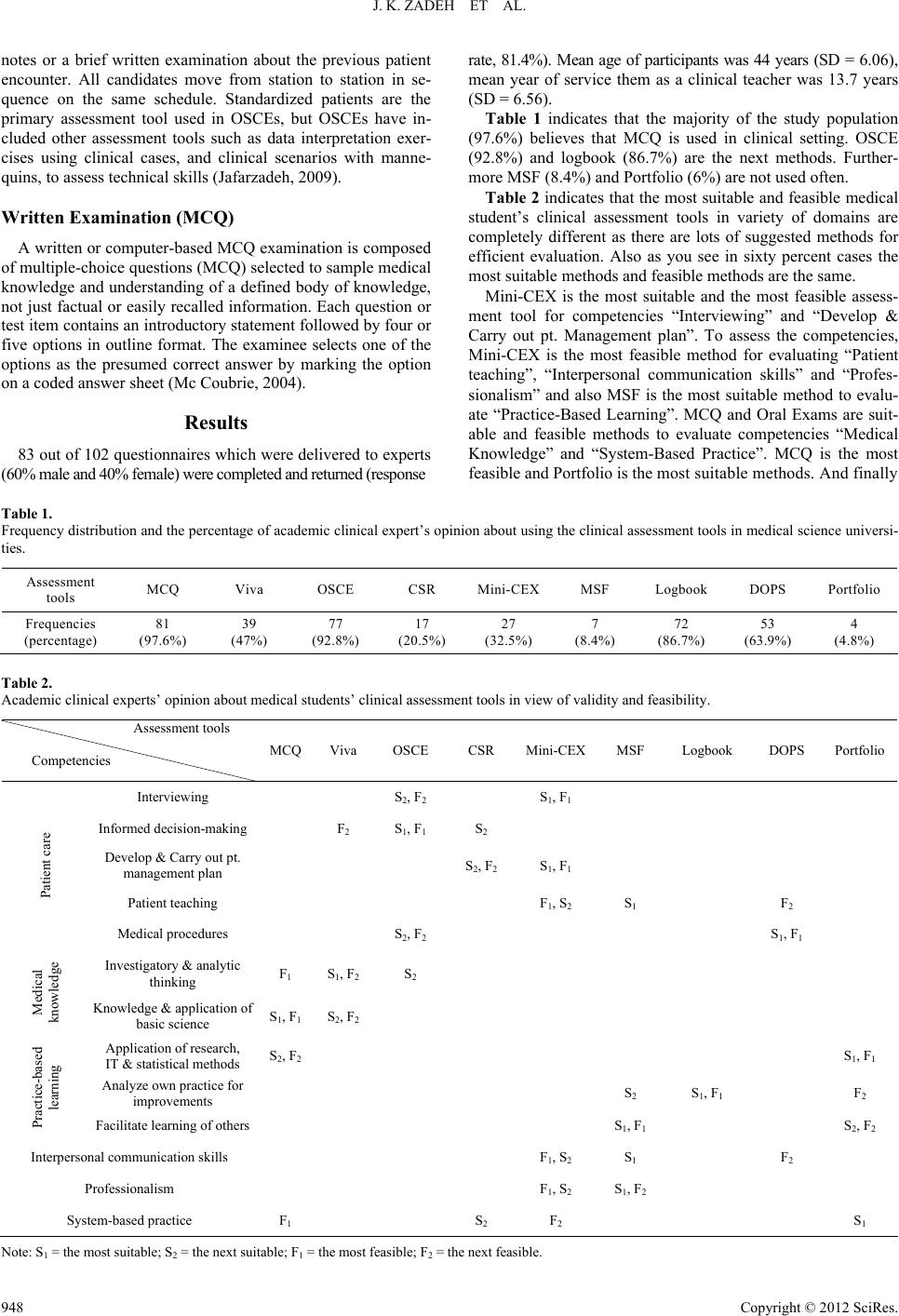 J. K. ZADEH ET AL. Copyright © 2012 SciRes. 948 notes or a brief written examinationabout the previous patient encounter. All candidates move from station to station in se- quence on the same schedule. Standardized patients are the primary assessmenttool used in OSCEs, but OSCEs have in- cluded other assessment tools such as data interpretationexer- cises using clinical cases, and clinical scenarios with manne- quins, to assess technical skills (Jafarzadeh, 2009). Written Examination (MCQ) A written or computer-based MCQ examination is composed of multiple-choice questions (MCQ) selected to sample medical knowledge and understanding of a defined body of knowledge, not just factual or easily recalled information. Each question or test item contains an introductory statement followed by four or five options in outline format. The examinee selects one of the options as the presumed correct answer by marking the option on a coded answer sheet (Mc Coubrie, 2004). Results 83 out of 102 questionnaires which were delivered to experts ( 60% male and 40% female) were completed and returned (response rate, 81.4%). Mean age of participants was 44 years (SD = 6.06 ), mean year of service them as a clinical teacher was 13.7 years (SD = 6.56). Table 1 indicates that the majority of the study population (97.6%) believes that MCQ is used in clinical setting. OSCE (92.8%) and logbook (86.7%) are the next methods. Further- more MSF (8.4%) and Portfolio (6%) are not used often. Table 2 indicates that the most suitable and feasible medical student’s clinical assessment tools in variety of domains are completely different as there are lots of suggested methods for efficient evaluation. Also as you see in sixty percent cases the most suitable methods and feasible methods are the same. Mini-CEX is the most suitable and the most feasible assess- ment tool for competencies “Interviewing” and “Develop & Carry out pt. Management plan”. To assess the competencies, Mini-CEX is the most feasible method for evaluating “Patient teaching”, “Interpersonal communication skills” and “Profes- sionalism” and also MSF is the most suitable method to evalu- ate “Practice-Based Learning”. MCQ and Oral Exams are suit- able and feasible methods to evaluate competencies “Medical Knowledge” and “System-Based Practice”. MCQ is the most feasible and Portfolio is the most suitable methods. And finally Table 1. Frequency distribution and the percentage of academic clinical expert’s opinion about using the clinical assessment tools in medical science universi- ties. Assessment tools MCQ Viva OSCE CSR Mini-CEXMSF Logbook DOPS Portfolio Frequencies (per c ent age) 81 (97.6%) 39 (47%) 77 (92.8%) 17 (20.5%) 27 (32.5%) 7 (8.4%) 72 (86.7%) 53 (63.9%) 4 (4.8%) Table 2. Academic clinical experts’ opinion about medical students’ clinical assessment tools in view of validity and feasib i lity. Assessment tools Competencies MCQ Viva OSCE CSR Mini-CEXMSF Logbook DOPS Portfolio Interviewing S2, F2 S 1, F1 Informed decision-making F2 S1, F1 S2 Develop & Carry out pt. management plan S 2, F2 S 1, F1 Patient teaching F1, S2 S1 F 2 Patient care Medical proc edures S2, F2 S 1, F1 Investigatory & analytic thinking F1 S1, F2 S2 Medical knowledge Knowledge & application of basic science S1, F1 S2, F2 Application of research, IT & statistical methods S2, F2 S 1, F1 Analyze own practice for improvements S 2 S1, F1 F 2 Practice-based learning Facilitate learning of others S1, F1 S 2, F2 Interpersona l communication skills F1, S2 S1 F 2 Professionalism F1, S2 S1, F2 System-based practice F1 S 2 F2 S 1 Note: S1 = the most suitable; S2 = the next suitable; F1 = the most feasible; F2 = the next feasible.  J. K. ZADEH ET AL. DOPS is the best method to assess competency “Medical pro- cedures” and OSCE is the next. Discussion The evaluation of clinical competence is a major responsibil- ity of medical educators (Tabish, 2010). Effective evaluation not only increases the students’ motivation but also helps in- structors to determine the strength or weakness of their educa- tional activities for improvement of their performance (Jafar- zadeh, 2009). In our study the majority of the study population (97.6%) believed that MCQ is used in clinical setting. Although MCQs are a valid method of competence testing, they do not guarantee competence as professional competence integrates knowledge, skills, attitudes and communication skills (Mc Coubrie, 2004). OSCE and logbook were the next methods that were used. Furthermore MSF and Portfolio are not used often. As we know a direct relationship between instructional objec- tives and tests must exist. Thus, tests should come directly from the objectives and focus on important and relevant content (Collins, 2006). One of the barriers to use portfolio and MSF (360˚) is that all raters must be trained in using these tools. In portfolio scoring is difficult and in MSF you may need a large number of evaluators to obtain a stable estimate of performance and this assessment can increase cost (Joyce, 2006). Data indi- cated that the most suitable and feasible medical student’s clinical assessment tools in sixty percent cases are the same, that it could be a acceptable result and it shows there are ap- propriate educational environments that you can improve clini- cal assessment methods to evaluate medical students. In July 2002, the Accreditation Council for Graduate Medi- cal Education (ACGME) began requiring residency programs to demonstrate resident competency in six areas: patient care, medical knowledge, practice—based learning and improvement, interpersonal and communication skills, professionalism, and systems—based practice (Tabish, 2010) and developed a “Toolbox” to suggest possible techniques for evaluating each competency (Cogbill & O’Sullivan, 2005) though validity and reliability suggested tools have not been demonstrated for most, and many tools may have limited feasibility because of time constraints and other reasons (Gigante & Swan, 2010). Previ- ous studies indicated that measuring both professional (Tabish, 2010) and medical (Ronald & Epstein, 2007) competences are extremely complex. Assessment techniques have limitations, and therefore multiple strategies are recommended (Tabish, 2010) and because of that the assessment tools are selected should be practical in residency program, so in this way adds valuable information about a resident’s performance, and as- sists in making promotion and graduation decisions (Joyce, 2006). For example a 360-degree evaluation can be used to assess interpersonal and communication skills, professional behaviors, and some aspects of patient care and systems-based practice or MCQ may not be the suitable method to determine how a resident will perform with a patient (Dannefer et al., 2005) but it can assess taxonomically higher-order cognitive processing if they construct appropriate. Also portfolio is often used to assess professional development (Michels, 2009). CSR is to evaluate the trainee’s clinical decision-making, reasoning and application of medical knowledge with real patients and DOPS is appropriate for competencies patient care, profession- alism, interpersonal skills, communication (Gigante & Swan, 2010) and anywhere practical skills are important (Brown & Doshi, 2006). The results of this study showed that Mini-CEX is the most suitable and the most feasible assessment tool for competencies “Interviewing” and “Develop & Carry out pt. Management plan”. Mini-CEX is the most feasible method, too and MSF is the most suitable method. Although Mini-CEX because of limitation to one patient and one assessor has limited genera- lisabi lity, it make s a snapshot view for raters (Brown & Doshi, 2006) and it is feasible to use in an inpatient and outpa- tient medicine clerkship for formative assessment (Kogan et al., 2003). Besides the main strength of mini-CEX is its ability to provide immediate feedback, related to the task, from a knowl- edgeable assessor (Singh & Sharma, 2010). It also can be seen Portfolio and Logbook are suitable and feasible methods to evaluate competency “Practice-Based learning”. MCQ and oral exams are suitable and feasible me- thods to evaluate competency “Medical Knowledge” and for “System-based practice” MCQ is the most feasible and Port- folio is the most suitable methods. And finally DOPS is the best method to assess competency “Medical procedures” and OSCE is the next. Conclusion The most suitable and feasible medical student’s clinical as- sessment tools in variety of domains are completely different as there are lots of suggested methods for efficient evaluation. All methods of assessment have strengths and intrinsic flaws. The use of multiple observations and several different assessment methods over time can partially compensate for flaws in any one method (Ronald & Epstein, 2007). A multi-method as- sessment might include direct observation of the student inter- acting with several patients at different points during the rota- tion, a multiple-choice examination with both “key features” and “script-concordance” items to assess clinical reasoning, an encounter with a standardized patient followed by an oral ex- amination to assess clinical skills in a standardized setting, written essays that would require literature searches and syn- thesis of the medical literature on the basic science or clinical aspects of one or more of the diseases the student encountered, and peer assessments to provide insights into interpersonal skills and work habits (Ronald & Epstein, 2007). Clearly, no single rating is able to provide the whole story about any doc- tor’s ability to practice medicine, as this requires the demon- stration of ongoing competence across a number of different general and specific areas (Brown & Doshi, 2006). Multiple assessment methods and multiple perspectives, however, pro- vide rich data that support a resident’s ability (or inability) to perform as a medical practitioner upon graduation and finally assessment results provide feedback to both the resident and faculty that the resident is making expected progress in achiev- ing the knowledge, skills, and attitudes outlined by the objec- tives (Joyce, 2006). Acknowledgements The authors would like to thank all of academic clinical ex- perts tha t participate in thi s study because of their worthy opinions and also Dr. Soltani Arabshahi, Dr. Mohamad Ali Mohagheghi, Dr. Shahram Yazdani, Dr. Amir Hosein Emami and Dr. Kurosh Vahidshahi because of their helpful leads. Copyright © 2012 SciRes. 949  J. K. ZADEH ET AL. REFERENCES Baral, N., & Paudel, B. H. (2007). An evaluation of training of teachers in medical education in four medical schools of Nepal. Nepal Medi- cal College Journal, 9, 157-161. Bourbonnais, F., Langford, S., & Giannantonio, L. (2008). Develop- ment of a clinical evaluation tool for baccalaureate nursing students. Nurse Educational Practice, 8, 62-71. doi:10.1016/j.nepr.2007.06.005 Brown, N., & Doshi, M. (2006). Assessing professional and clinical competence: The way forward. Advances in Psychiatric Treatment, 12, 81-91. Cogbill, K. K., O’Sullivan, P. S., & Clardy, J. (2005). Residents’ per- ception of effectiveness of twelve evaluation methods for measuring competency. Academic Psychiatry, 29, 76-81. doi:10.1176/appi.ap.29.1.76 Colletti, L. M. (2000). Difficulty with Negative Feedback: Face-to-face evaluation of junior medical student clinical performance results in grade inflation. The Journal of Surgical R esearch, 90, 82-87. doi:10.1006/jsre.2000.5848 Collins, J. (2006). Writing multiple choice questions for continuing medical education activities and self-assessment modules. Radio- graphcs, 26, 543-551. doi:10.1148/rg.262055145 Dannefer, E., Henson, L., Bierer, S., et al. (2005). Peer assessment of professional competence. Medical Education, 39, 713-722. doi:10.1111/j.1365-2929.2005.02193.x Gigante, J., & Swan, R. A. (2010). Simplified observation tool for residents in the outpatient clinic. Journal of Graduate Medical Edu- cation, 2, 108-110. doi:10.4300/JGME-D-09-00090.1 http://www.acgme.org/outcome/e-learn/redir_module3manual.asp Jafarzadeh, A. (2009). Designing the OSCE method for evaluation of practical immunology course of medical students: In comparison to written-MCQ and oral examination. Rawal Medical Journal, 34, 219-222. Johnson, N., & Chen, J. (2006). Medical student evaluation of teaching quality between obstetrics and gynecology residents and faculty as clinical preceptors in ambulatory gynecology. American Journal of Obstetrics & Gynecology, 195, 1479-1483. doi:10.1016/j.ajog.2006.05.038 Joyce, B. (2006). Developing an assessment system. Facilitator’s Guide. Accreditation Council for Graduate Medical Education, 1, 15-17. Kogan, J., Bellina, L., & Shea, J. (2003). Feasibility, reliability, and validity of the Mini-CEX in a medicine core clerkship. Academic Medicine, 78, 533-535. Mc Coubrie, P. (2004). Improving the fairness of multiple-choice ques- tions: A literature review. Medical Teaching, 26, 709-712. doi:10.1080/01421590400013495 Michels, N. R., Driessen, E. W., Muijtjens, A. M., Van Gaal, L. F., Bossaert, L. L., & De Winter, B. Y. (2009). Portfolio assessment during medical internships: How to obtain a reliable and feasible as- sessment procedure? Education Health, 22, 313. Norcini, J., & McKinle, D. (2007). Assessment methods in medical education. Teaching and Teacher Education, 23, 239-250. doi:10.1016/j.tate.2006.12.021 Pearce, G., & Lee, G. (2007). Marketing student perceptions of viva voce (oral examination) as an Assessment Method. ANZMAC 2007: Reputation, Responsibility, Relevance, 31, 8. Ronald, M., & Epstein, M. D. (2007). Assessment in medical education. The New England Journal of Medicine, 356, 387-396. doi:10.1056/NEJMra054784 Shumway, J. M., & Harden, R. M. ( 2003). AMEE education guide No. 25: The assessment of learning outcomes for the competent and re- flective physician. Medical Teaching, 25, 569-584. doi:10.1080/0142159032000151907 Singh, T., & Sharma, M. (2010). Mini-clinical examination (CEX) as a tool for formative assessment. The National Medical Journal of India, 23, 100-102. Sultana, C. (2006). The objective structured assessment of technical skills and the ACGME competencies. Obstetrics and Gynecology Clinics of North America, 33, 259-265. Tabish, A. (2010). Assessment methods in medical education. Intena- tional Journal of Health Sciences, 2, 3-7. Wilkinson, J., & Wade, W. (2005). New methods of performance as- sessment for trainees. RCPath Bulletin, 132, 12-15. Copyright © 2012 SciRes. 950 |