

Paper Menu >>
Journal Menu >>
 Creative Education 2012. Vol.3, Special Issue, 866-873 Published Online October 2012 in SciRes (http://www.SciRP.org/journal/ce) http://dx.doi.org/10.4236/ce.2012.326130 Copyright © 2012 SciRes. 866 Meaning Check Questions as an Active Learning Tool in the University Biology Laboratory Assists International Students Hye-Jin Kim Hawkes1,2, Aldo Armstron g H a wkes2,3, Kathryn Fay Tonissen1 1School of Biomolecular and Physical Sciences, Griffith University, Nathan, Australia 2State University of New York Korea, Incheon, Korea 3Sonic Language Solutions, Seoul, Korea Email: K.Toni s s [email protected] d u .au Received August 31st, 2012; revis e d S e p t e mber 28th, 2012; accepted October 9th, 2012 Greater participation by students is associated with better learning outcomes. Therefore active learning approaches in teaching have been encouraged for teachers to use in the classroom. In particular, student- centered learning is highly appreciated in a classroom where international students have to learn in Eng- lish while it is not their first language. Master of Science students at Griffith University, Australia, all in- ternational students, were exposed to an environment where Meaning Check Questions (MQ) were prac- ticed as an active learning approach. The MQs were incorporated into a biology laboratory course and required the students to answer short verbal questions relating to the course content, experimental proce- dures and scientific writing. The results show that these methods encouraged students to be more active in class and improved their confidence level and knowledge of the key concepts during the course, com- pared to students who did not experience the MQ learning approach. Students exposed to MQs during the course also showed a distinct improvement in their confidence towards scientific writing. Keywords: Student Centered Learning; Meaning Check Questions (MQ); Scientific Writing Skills; International Student; Biology Laboratory Introduction It is now well established that students learn more effectively when “student-centered learning” approaches are used in the University classroom (Biggs, 2003; Smith et al., 2005; Wood, 2003). In “student-centered” learning, “Learning takes place through the active behaviour of the student and not through what the teacher does” (Biggs, 2003). According to studies completed in the USA a large number of science and mathe- matics students withdrew from their programs largely due to lectures being perceived as boring and hard to relate to (Kardash & Wallace, 2001; Seymour & Hewitt, 1997; Strenta et al., 1994). A core message is therefore to ensure students are actively involved in their own learning by providing them tools or opportunities to interact in class (Chickering & Gamson, 1999; Smith et al., 2005; Walczyk & Ramsey, 2003). The chal- lenge is to design the course structure to include activities that motivate and encourage students to actively engage with the curriculum (Knight & Wood, 2005). A highly effective approach to encourage student involve- ment in the classroom is via Meaning Check Questions (MQs), also known as concept check questions (Workman, 2005). MQs are typically simple questions that require short answers. They are asked just prior to starting an activity and often right after instructions have been given. The typical amount of time given to these types of questions is between 2-5 minutes. MQs can focus on key parts of how and what to do for an activity or the crucial elements of a concept’s meaning. MQs are viable in many teaching situations and have been widely used as a tool for teaching languages (TEFL, 2007). MQs encourage students to think about the question they have been asked since they need to verbalise an answer. In contrast merely asking “Do you understand?” is all too often just answered with “yes”, even though students in reality do not understand. Similarly, students in science laboratory classes quite often follow verbal or written instructions without neces- sarily knowing why. Thus we considered that adapting MQs to a laboratory class setting would help to check a student’s con- ceptual understanding before doing an activity, resulting in more student interaction as well as less class time lost due to students not really knowing what to do. The goal is also for students to develop a deeper understanding of the important concepts through verbalising their answers. Vygotsky (1986) postulated that there is a strong relationship between thinking, talking and learning and more recently other teachers have promoted the idea of learning through the spoken word (Myhill, 2010). Active learning applies to all students, regardless of cultural background or discipline of study. However, according to some researchers there is a common perception amongst many teach- ers that Asian students rely on rote learning (Chan, 1999) and therefore prefer a teacher-focused approach. This view has been challenged by studies showing Asian students, including sci- ence students, can adapt to a more student-centred style of learning and in fact, prefer it (Kember, 2000; Wong, 2004). Thus, learning styles are more likely to be contextual rather than cultural (Wong, 2004). It is therefore important for teach- ers to adopt strategies that promote active student learning and be aware that despite initial reluctance, students from all cul- tures will respond similarly. Within science, a key issue is to teach scientific writing ef- fectively. Significant scientific research findings need to be  H.-J. K. HAWKES ET AL. clearly communicated through writing, which takes many forms including reports, journal articles and conference presentations. Improving students’ writing skills in science degree programs is necessary because writing is an important form of profes- sional communication and also improves critical thinking (Libarkin & Ording, 2012; Peat et al., 2002; Quitadamo & Kurtz, 2007). It is clear that a greater emphasis on developing effective communication is required among scientists and thus needs be part of their education (Ali et al., 2007; Libarkin & Ording, 2012; Quitadamo & Kurtz, 2007). However a survey at the University of Wisconsin-Madison found that 45% of biol- ogy students did not like writing despite 98% regarding writing as important for learning (Manske, 2010). International students who do not have English as their preferred language are even more overwhelmed when faced with a technical writing task (Jordan & Kedrowicz, 2011). Tools and activities must there- fore be utilised that inspire students to want to develop their writing expertise. We have shown previously (Lee et al., 2011) that the use of writing activities embedded into a laboratory class can assist students to gain confidence in their writing and we were therefore interested if oral MQs could complement this approach to encourage international students to write. In the study described herein oral MQs are implemented as a simple method to encourage non-native English speakers to adapt to a student-centered style of learning in a biology labo- ratory course, with the goals of developing a deeper under- standing of the concepts underpinning their laboratory experi- ments and improving their confidence at performing scientific writing tasks. Methodology Participants Student participants were in the course entitled “Biotechnol- ogy and Molecular Biology Laboratory”, which is taken by students in the second semester of the first year of the Master of Science program at Griffith University, Australia. This program is only available to international students who complete under- graduate studies overseas and then come to Australia to under- take a two-year program. This research project received ethics approval from the Griffith University Human Research Ethics Committee and students signed consent forms to allow the use of their responses for research purposes. Course Description Five students were enrolled in 2008. They were all interna- tional students and English was their 2nd language. The aim of the course was to conduct a project (a series of experiments) in the laboratory and to submit a written report. It is a 7-week, 8 hours/week (in 2 × 4 hour sessions) semi-intensive course. Ex- periments are completed in the first 5 weeks. Students also commence work on their written report with feedback through writing exercise (Lee et al., 2011). In the final 2 weeks students were given 2-hour workshops aimed at improving their written report. Assessment also includes 2 written quizzes (weeks 3 and 5) on the concepts underpinning their experimental work and includes problem-solving questions. A control group of 8 stu- dents was also used for this study. These students experienced the same course taught in the following year without MQs. Use of MQs to Learn Scientific Concepts Before, during and after each laboratory session students were asked oral MQs. This was to encourage students to pre- pare for the class and to check how much they had learnt. Another benefit is that the teacher receives frequent real-time feedback of what students know. A teacher would explain a technical procedure and then ask short questions to the students to probe their understanding. The number and type of MQs varied, with questions based on information from the laboratory manual. Example MQs are: “Why are we using NaOH in this step of the plasmid preparation procedure? What is the next step?” How does the T7 expression system work to induce pro- tein expression? Unless students understand what they are do- ing and why they are doing such an experiment, they can’t an- swer those MQs. The intention is to encourage students to think and to verbalise their answers. Then as needed, the teacher guides them towards the right answer. The MQ approach con- trasts to asking students one-on-one questions once the class has commenced, as is normal practice in laboratory courses. Students know they must answer the MQs before commencing laboratory work and therefore they come to class prepared. Implementing MQs only requires a few minutes yet it is a sim- ple and effective approach to involve students in the subject material. The time spent on MQs is soon saved as students are more efficient in the laboratory. At the end of a session MQ questions were asked such as, “Why were we doing this experiment? Why did you use this chemical and not that one?” The purpose is to ensure that stu- dents have cemented their understanding of the laboratory pro- cedures and why they were performing them. Writing Activities and the Use of MQs During the laboratory sessions the students also completed some writing activities similar to those reported for an under- graduate biology laboratory class (Lee et al., 2011). These writ- ing activities included simple written tasks that required analy- sis of their own experimental data on which they received for- mative feedback from teaching staff to assist them with their final report. Tasks varied in each session but included writing figure legends, describing results and deciding which informa- tion should go into the discussion section. The Masters students also had two 2-hour workshops devoted to developing and re- ceiving feedback on their written report drafts. The type of verbal MQs used to guide students in their scientific writing development included “What type of information do you need in this particular figure legend” and “With respect to your re- striction digests what analysis will you provide in your discus- sion”. Evaluation o f T eachi n g Stra tegi es Evaluation of the effectiveness of the MQs was conducted using five different evaluation methods: 1) Regular written surveys Anonymous surveys were conducted at weeks 3, 4 and 5. Students were asked open-ended questions such as to recall the MQs asked that day, whether MQs had helped with subject material comprehension and if MQs had helped them to per- form experiments correctly. They were also asked to specifi- cally describe how the MQs helped. Copyright © 2012 SciRes. 867  H.-J. K. HAWKES ET AL. 2) Interviews of students A teacher (external to the course) conducted interviews with the Masters students in the final session of experiments (week 5) without the presence of the teacher who utilised the MQs. Stu- dents were asked specific open-ended questions regarding their opinions on the effectiveness of using MQs during the labora- tory sessions and if improvements could be made. 3) Official university evaluation An anonymous voluntary survey was conducted, at the end of the course, according to University policy asking students to rate the effectiveness of the teaching strategies implemented in the course. Respondents were asked to mark one number on a Likert scale rating from 1 to 7, where 1 is regarded as poor and 7 as excellent. Open questions further encouraged feedback on course strengths, weaknesses and the teaching activities. 4) Analysis of quiz results The student results from both quizzes were compared to quiz marks obtained by the control group of students who did not experience MQs. The data were analysed using the GraphPad Prism software package and applying the student’s t-test. The grade point averages (GPA) of the students in each group were also compared and analysed using a t-test. The GPAs are cal- culated on the courses undertaken by the students in their first semester of the program. These courses are theory based and specialised to their discipline of study. Thus they are an indica- tor of a student’s academic capability prior to commencing the laboratory course. 5) Students’ attitudes towards scientific writing Surveys were also conducted at the start and end of the course regarding student attitudes towards scientific writing. The same surveys were given to the control group (in the fol- lowing year) who did not experience MQs. Participation was anonymous and voluntary. The closed items were designed to determine the student perceptions of their own scientific writing ability and their confidence at performing certain writing tasks, such as writing a figure legend and deciding what information should go into discussion versus results sections of a report. Students were asked to circle one number on a Likert scale rating from 1 to 5. The data were analysed using the SPSS software package and applying the Mann-Whitney two-group test, which tests whether there is a difference between two pop- ulation medians. Open-ended questions sampled student opin- ions on the course teaching strategies used. Results MQ Approach and Student Acceptance To determine if students adapted to the use of MQs in class, surveys were undertaken on a regular basis (Table 1). The re- sults show that students retained the information probed by MQs earlier in the course. Students also reported that the MQ approach helped them to understand more about the project. Initially, when students were asked MQ questions, further ex- planation was given for wrong answers only. Survey results indicated that students wanted a brief summary or further ex- planation even after MQs were answered correctly to ensure they understood the concepts accurately and in sufficient depth. This feedback was taken into consideration and from week 3 a summary of all questions and the day’s laboratory activities were included as part of the session. In week 4, all students were satisfied with the improved approach (Table 1) with no further recommendation or dissatisfaction. The students’ re- quest to provide more explanation shows that they were com- fortable in providing an honest evaluation if they thought something needed improvement. The students also stated that the MQ approach helped them to better understand the labora- tory experiments with quotes such as “My understanding has improved and I know what I am doing”. In addition the quote “It is interactive and informative” shows that getting involved in their own learning is perceived as a benefit. A teacher familiar with the content, but external to the course interviewed the students after the experimental phase had con- cluded. Opinions were solicited regarding the use of MQs dur- ing the laboratory sessions (Table 2). Quotes such as “Im- proved understanding of the lab” and “Consolidated knowledge about lab work” revealed students regarded the MQs as benefi- cial. There were no recommendations for further improvement. The final official University evaluation consisted of an anony - mous survey with both open and closed questions that sought students’ opinions of the effectiveness of teaching strategies (Table 3). They indicate overwhelming support for this teach- ing style, with all questions scoring an average greater than 6 out of 7, placing the course in the top 5% out of the 350 courses taught within the faculty in this semester. The following are representative comments made by students: “MQs really helped me...!!”, “MQs as well as the feedback given were very good” and “The MQs are done well and should be continued”. Use of MQs Enhance Student Learning In their surveys and interviews the students also stated that the MQs helped them prepare for the laboratory quizzes (which test understanding of the laboratory course techniques and data analysis). The marks from both quizzes were shown to be sta- tistically significantly higher, when compared to a control group of 8 students who completed the same course in the sub- sequent year when MQs were not utilised (Figure 1). All other learning techniques were identical between the two groups. An analysis of the grade point average (GPA) was not significantly different between the two groups of students (5.1 (with MQs) compared to 5.0 (without MQs)), indicating that their academic ability was comparable (as detailed in the methods). The Quiz results show that the students’ understanding and knowledge did match their belief that the MQs had assisted them to better understand the experiments they were perform- ing. The quizzes contained some questions that assessed their ability to utilise their knowledge and understanding of the core concepts to solve problems, rather than to merely recall infor- mation. Thus, questions were in a different format to MQs, which typically were shorter simple questions. The quiz results suggest that MQs were encouraging a deeper learning approach and that students could apply their knowledge to a wider scope of situations. MQs Enhan ce Student Attitudes and Confidence towards Writing Tasks One goal of the course was to instruct students in scientific writing. As such we wanted to determine if the students found the teaching strategies helpful. The anonymous surveys at the commencement and end of the course asked students how they rated their confidence and ability to write. The results are shown in Figure 2. Copyright © 2012 SciRes. 868  H.-J. K. HAWKES ET AL. Copyright © 2012 SciRes. 869 Table 1. Biotechnology laboratory student surveys (MQ approach). Survey Questions Yes (%) Student Responses Did you understand what “Meaning Check Questions” are when the teacher explained them to you? Wk 3 80% Wk 4 How the insulin assay and expression system works, why we run a pr ot ein gel. Regarding the protei n expression. About the last stage of the experiment especially analytical procedures. Protein expression. Regarding protein expression system and activity assay etc. What MQs have you been asked today? Wk 5 Introduction of fragments into pETThio vector and summary of whole project. About the entire project. Which enzymes would you use for exp eriment; expression vector. The work don e in the la b to day and yesterday. MQs were about the entire process that was c arried out during the p ast 4 weeks. Wk 3 80% Yes. It is a good way to check your knowledge about the subject. Along with the MQs, the demonstrator should also explain the entire activity. Wk 4 100%Yes, it helped me a lot. Do you think M Q has helped you in the course today? Wk 5 100%Yes, it expl ained the gaps in part o f t he exper i ment. Wk 3 It helps us rea li ze our weakness and improve on them as well as prepa ri ng questions as it en- courages us to read ahead of time. H elped me to u n d erstand the activity better. I th ink the explanatio n given by her is sufficient enough for me to present my s elf in the MQ. M y understan ding has improved alon g with the tec h nique. I ge t to know what exactly I am doing and why I am doing that. Wk 4 It consolidat es what I a l r eady know and emphasizes import ant things. I think it helps me for quiz (test). It helps to know how c ertain questions should be answered. Improved my understanding. It has improved my understanding and has made me think about this project. If yes, how d id you bene f i t from this MQ approac h? Wk 5 M y understan ding has improved and I know what I am doing. It is interactive a nd in formative. It made answers clearer. This MQ is a link for the missing clues of th e lab. H elped to im p r o ve my und erstandin g. Wk 3 The demonstrator should also expla in a bit more. Wk 4 All g ood. Everything is perfect. If any, please mention what we can do better to ass ist you to l earn. Wk 5 All g ood. Previously, students asked for a summary of MQs. Did the teacher summarise the answers to all MQs? Wk 4 Wk 5 100% 100% Yes, she was giving expl anation as well as the summary. Yes, she was giving expl anation as well as the summary. Students showed a statistically significant improvement in their rating of their scientific writing ability (Panel A) and in their confidence at being able to decide if information should be included in the results or discussion section (Panel C). While the results also show an improved trend in their confidence at writing figure legends (Panel B) there was no statistical sig- nificance. This is likely due to a couple of reasons. First, writ- ing a figure legend follows relatively simple rules and second, they were Masters students with some prior experience. In con- trast, writing a coherent results and discussion section requires higher order analytical and critical thinking, which can only be obtained by practice and appropriate training. Of particular interest is that this course was also conducted in the same format in 2009, without the MQ approach. Identical survey questions were asked before and after the course and there was no statistically significant improvement in the student rating of either their scientific writing ability, figure legend writing or ability to decide which information went into results vs. discussion sessions (data not shown). The students in 2009 also stated in the open ended questions that they had problems learning the scientific language needed for writing reports, whereas the students in 2008 had very positive things to say about how the teaching strategies (including MQs) helped to improve their scientific knowledge and writing skills. In the 2008 survey 100% of students responded that they better un- derstood the purposes of the experiments after MQs and writing activities. In contrast only 50% of students in 2009 responded that they understood better the experiments after the writing 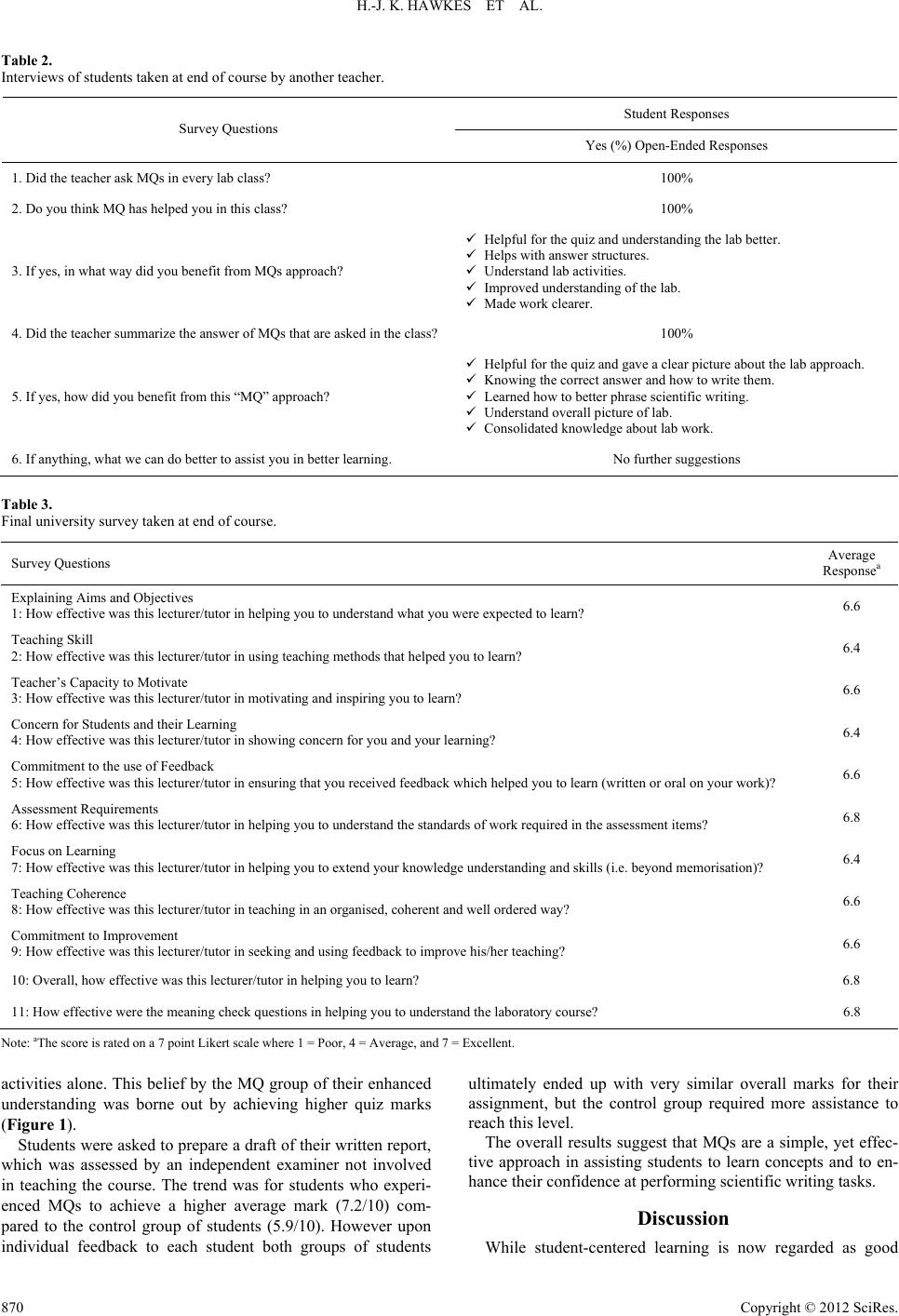 H.-J. K. HAWKES ET AL. Table 2. Interviews of students taken at end of course by another teacher. Student Responses Survey Questions Yes (%) Ope n-Ended Responses 1. Did the teacher ask MQs in every lab class? 100% 2. Do you think MQ has helped you in this class? 100% 3. If yes, i n what way did you benefit from MQs approach? Helpful for the quiz a n d u nderstanding the lab better. Helps with answer structures. Unde r stand lab activities. Improved understanding of the lab . Made work clearer. 4. Did the teacher summarize the answer of MQs that are asked in the class? 100% 5. If yes, h ow did you bene f it from th is “MQ” approach? H elpful for the quiz and g ave a clear picture about the lab approach. Knowing the correct answer and how to write them. Learned how to bett er phrase scien tific writing. U n d erstand overall picture of lab. Consolidated knowledge about lab work. 6. If anything, what we can do better to assist yo u in better learning. No further suggestions Table 3. Final university survey taken at end of course . Survey Questions Average Responsea Explaining Aims and Objectives 1: How effective was this lecturer/tutor in helping you to understand what you were expected to learn? 6.6 Teaching Skill 2: How effective was this lecturer/tutor in using teaching methods that helped you to learn? 6.4 Teacher’s Capacity to Motivate 3: How effective was this lecturer/tutor in motivatin g and inspiring yo u to learn? 6.6 Concern for Students and their Le arning 4: How effective was this lecturer /tutor in showing concern for you and your l earning? 6.4 Commitment to the use of Feedback 5: How effective was this lecturer/tutor in ensuring that you received feedback which helped you to lea rn (written or oral on your work)? 6.6 Assessment Requirements 6: How effective was this lecturer/tutor in helping you to understand the standards of work required in the assessment items? 6.8 Focus on Learning 7: How effective was this lecture r/ tutor in helping yo u t o extend y o ur knowledge understanding and skills (i.e . beyond memorisation)? 6.4 Teaching Coherence 8: How effective was this lecturer/tutor in teaching in an organised, coherent and well ordered way? 6.6 Commitment to Improvement 9: How effective was this lecturer /tutor in seeking and u sing feedback to improve his/he r teaching ? 6.6 10: Overall, how effective was this le cturer/tutor in helping you to l earn? 6.8 11: How effective were the meaning check questions in helping you t o understand the laboratory course? 6.8 Note: aT he score is ra ted on a 7 point Likert scale where 1 = Poor, 4 = Avera ge, and 7 = Excellent. activities alone. This belief by the MQ group of their enhanced understanding was borne out by achieving higher quiz marks (Figure 1). Students were asked to prepare a draft of their written report, which was assessed by an independent examiner not involved in teaching the course. The trend was for students who experi- enced MQs to achieve a higher average mark (7.2/10) com- pared to the control group of students (5.9/10). However upon individual feedback to each student both groups of students ultimately ended up with very similar overall marks for their assignment, but the control group required more assistance to reach this level. The overall results suggest that MQs are a simple, yet effec- tive approach in assisting students to learn concepts and to en- hance their confidence at performing scientific writing tasks. Discussion While student-centered learning is now regarded as good Copyright © 2012 SciRes. 870 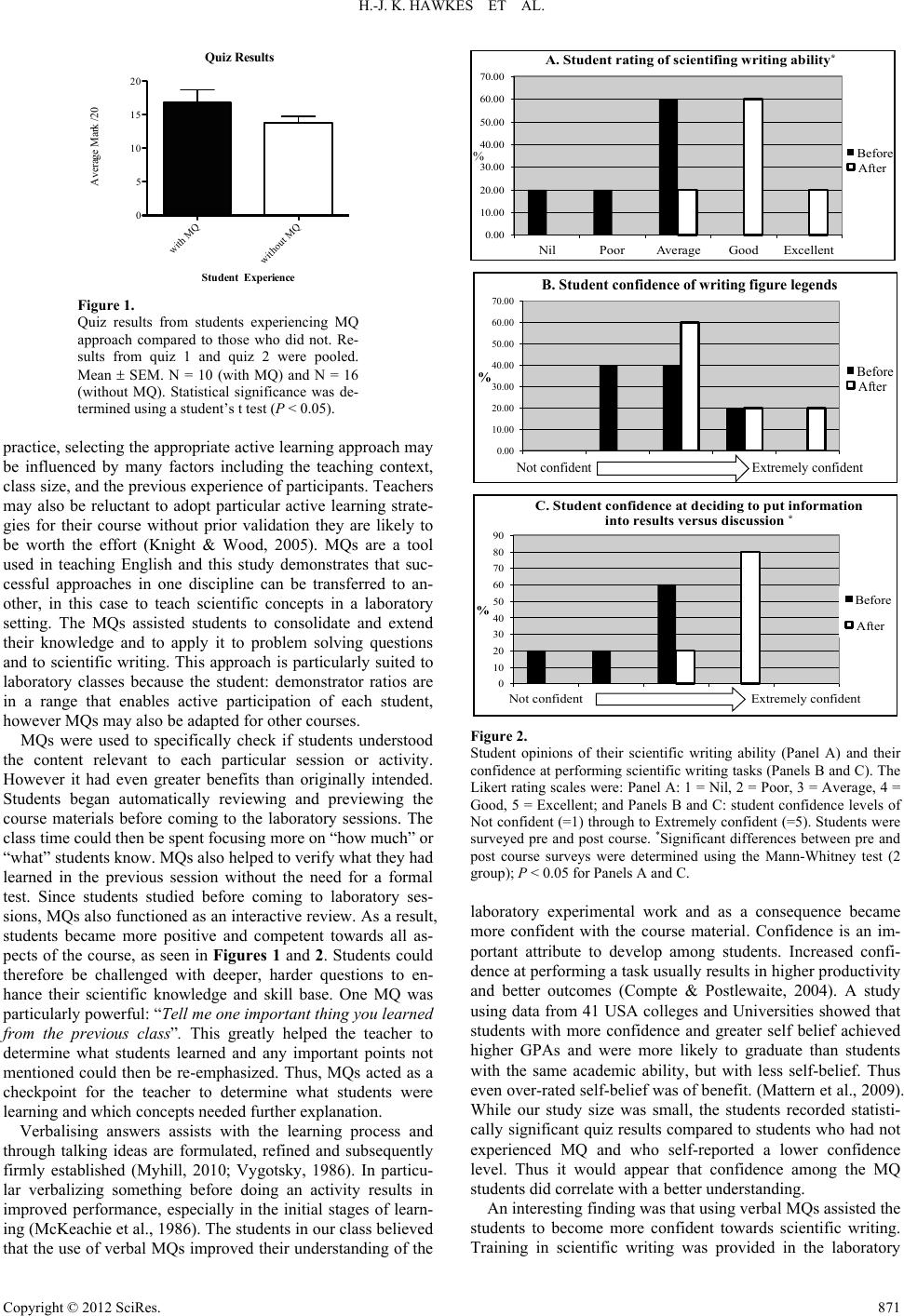 H.-J. K. HAWKES ET AL. Q u i z R es u l ts with MQ without MQ 0 5 10 15 20 Student Experience Average Mark /20 Figure 1. Quiz results from students experiencing MQ approach compared to those who did not. Re- sults from quiz 1 and quiz 2 were pooled. Mean SEM. N = 10 (with MQ) and N = 16 (without MQ). Statistical significance was de- termined using a student’s t test (P < 0.0 5). practice, selecting the appropriate active learning approach may be influenced by many factors including the teaching context, class size, and the previous experience of participants. Teachers may also be reluctant to adopt particular active learning strate- gies for their course without prior validation they are likely to be worth the effort (Knight & Wood, 2005). MQs are a tool used in teaching English and this study demonstrates that suc- cessful approaches in one discipline can be transferred to an- other, in this case to teach scientific concepts in a laboratory setting. The MQs assisted students to consolidate and extend their knowledge and to apply it to problem solving questions and to scientific writing. This approach is particularly suited to laboratory classes because the student: demonstrator ratios are in a range that enables active participation of each student, however MQs may also be adapted for other courses. MQs were used to specifically check if students understood the content relevant to each particular session or activity. However it had even greater benefits than originally intended. Students began automatically reviewing and previewing the course materials before coming to the laboratory sessions. The class time could then be spent focusing more on “how much” or “what” students know. MQs also helped to verify what they had learned in the previous session without the need for a formal test. Since students studied before coming to laboratory ses- sions, MQs also functioned as an interactive review. As a result, students became more positive and competent towards all as- pects of the course, as seen in Figures 1 and 2. Students could therefore be challenged with deeper, harder questions to en- hance their scientific knowledge and skill base. One MQ was particularly powerful: “Tell me one important thing you learned from the previous class”. This greatly helped the teacher to determine what students learned and any important points not mentioned could then be re-emphasized. Thus, MQs acted as a checkpoint for the teacher to determine what students were learning and which concepts needed further explanation. Verbalising answers assists with the learning process and through talking ideas are formulated, refined and subsequently firmly established (Myhill, 2010; Vygotsky, 1986). In particu- lar verbalizing something before doing an activity results in improved performance, especially in the initial stages of learn- ing (McKeachie et al., 1986). The students in our class believed that the use of verbal MQs improved their understanding of the 0.00 10.00 20.00 30.00 40.00 50.00 60.00 70.00 Nil Poor Average Good Excellent % A. Student rating of scientifing writing ability * Before After 0.00 10.00 20.00 30.00 40.00 50.00 60.00 70.00 Not confident Extremely confident % B. Student confidence of writing figure legends Before After 0 10 20 30 40 50 60 70 80 90 Not conf ident Extreme l y co nfident % C. Student confidence at deciding to put information into results versus discussion * Before After Figure 2. Student opinions of their scientific writing ability (Panel A) and their confidence at performing scientific writing tasks (Panels B and C). The Likert rating scales were: Panel A: 1 = Nil, 2 = Poor, 3 = Average, 4 = Good, 5 = Excellent; and Panels B and C: student confidence levels of Not confident (=1) through to Extremely confident (=5). Students were surveyed pre and post course. *Significant differences between pre and post course surveys were determined using the Mann-Whitney test (2 group); P < 0.05 for Panels A and C. laboratory experimental work and as a consequence became more confident with the course material. Confidence is an im- portant attribute to develop among students. Increased confi- dence at performing a task usually results in higher productivity and better outcomes (Compte & Postlewaite, 2004). A study using data from 41 USA colleges and Universities showed that students with more confidence and greater self belief achieved higher GPAs and were more likely to graduate than students with the same academic ability, but with less self-belief. Thus even over-rated self-belief was of benefit. (Mattern et al., 2009). While our study size was small, the students recorded statisti- cally significant quiz results compared to students who had not experienced MQ and who self-reported a lower confidence level. Thus it would appear that confidence among the MQ students did correlate with a better understanding. An interesting finding was that using verbal MQs assisted the students to become more confident towards scientific writing. Training in scientific writing was provided in the laboratory Copyright © 2012 SciRes. 871 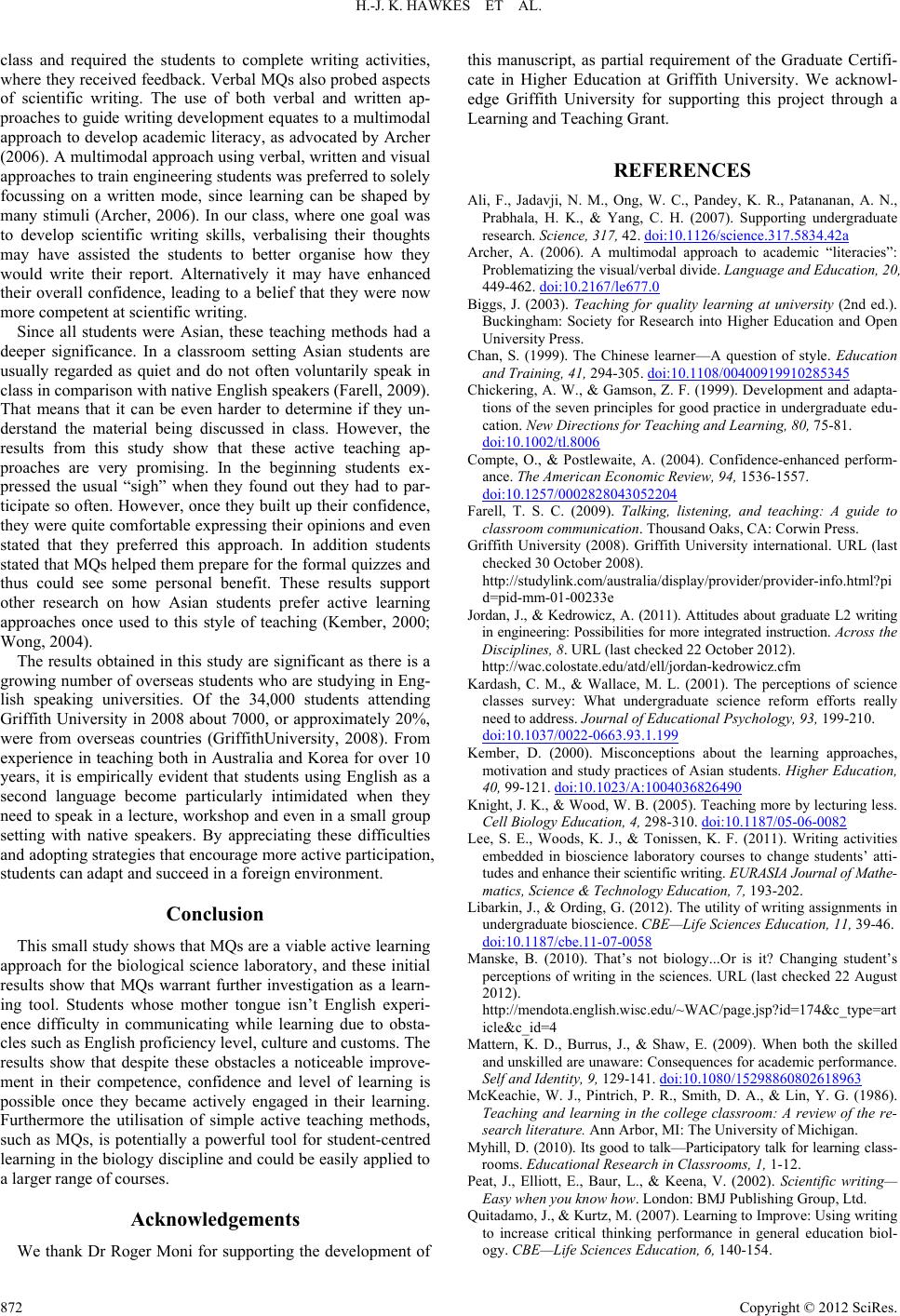 H.-J. K. HAWKES ET AL. class and required the students to complete writing activities, where they received feedback. Verbal MQs also probed aspects of scientific writing. The use of both verbal and written ap- proaches to guide writing development equates to a multimodal approach to develop academic literacy, as advocated by Archer (2006). A multimodal approach using verbal, written and visual approaches to train engineering students was preferred to solely focussing on a written mode, since learning can be shaped by many stimuli (Archer, 2006). In our class, where one goal was to develop scientific writing skills, verbalising their thoughts may have assisted the students to better organise how they would write their report. Alternatively it may have enhanced their overall confidence, leading to a belief that they were now more competent at scientific writing. Since all students were Asian, these teaching methods had a deeper significance. In a classroom setting Asian students are usually regarded as quiet and do not often voluntarily speak in class in comparison with native English speakers (Farell, 2009). That means that it can be even harder to determine if they un- derstand the material being discussed in class. However, the results from this study show that these active teaching ap- proaches are very promising. In the beginning students ex- pressed the usual “sigh” when they found out they had to par- ticipate so often. However, once they built up their confidence, they were quite comfortable expressing their opinions and even stated that they preferred this approach. In addition students stated that MQs helped them prepare for the formal quizzes and thus could see some personal benefit. These results support other research on how Asian students prefer active learning approaches once used to this style of teaching (Kember, 2000; Wong, 2004). The results obtained in this study are significant as there is a growing number of overseas students who are studying in Eng- lish speaking universities. Of the 34,000 students attending Griffith University in 2008 about 7000, or approximately 20%, were from overseas countries (GriffithUniversity, 2008). From experience in teaching both in Australia and Korea for over 10 years, it is empirically evident that students using English as a second language become particularly intimidated when they need to speak in a lecture, workshop and even in a small group setting with native speakers. By appreciating these difficulties and adopting strategies that encourage more active participation, students can adapt and succeed in a foreign environment. Conclusion This small study shows that MQs are a viable active learning approach for the biological science laboratory, and these initial results show that MQs warrant further investigation as a learn- ing tool. Students whose mother tongue isn’t English experi- ence difficulty in communicating while learning due to obsta- cles such as English proficiency level, culture and customs. The results show that despite these obstacles a noticeable improve- ment in their competence, confidence and level of learning is possible once they became actively engaged in their learning. Furthermore the utilisation of simple active teaching methods, such as MQs, is potentially a powerful tool for student-centred learning in the biology discipline and could be easily applied to a larger range of courses. Acknowledgements We thank Dr Roger Moni for supporting the development of this manuscript, as partial requirement of the Graduate Certifi- cate in Higher Education at Griffith University. We acknowl- edge Griffith University for supporting this project through a Learning and Teaching Grant. REFERENCES Ali, F., Jadavji, N. M., Ong, W. C., Pandey, K. R., Patananan, A. N., Prabhala, H. K., & Yang, C. H. (2007). Supporting undergraduate research. Science, 317, 42. doi:10.1126/science.317.5834.42a Archer, A. (2006). A multimodal approach to academic “literacies”: Problematizing t he v isual/verbal divide . Language and Educati on , 20, 449-462. doi:10.2167/le677.0 Biggs, J. (2003). Teaching for quality learning at university (2nd ed.). Buckingham: Society for Research into Higher Education and Open University Press. Chan, S. (1999). The Chinese learner—A question of style. Education and Training, 41, 294-305. doi:10.1108/00400919910285345 Chickering, A. W., & Gamson, Z. F. (1999). Development and adapta- tions of the seven principles for good practice in undergraduate edu- cation. New Directions for Teaching and Learning, 80, 75-81. doi:10.1002/tl.8006 Compte, O., & Postlewaite, A. (2004). Confidence-enhanced perform- ance. The American Economic Review, 94, 1536-1557. doi:10.1257/0002828043052204 Farell, T. S. C. (2009). Talking, listening, and teaching: A guide to classroom communication. Thousand Oaks, CA: Corwin Press. Griffith University (2008). Griffith University international. URL (last checked 30 October 2008). http://studylink.com/australia/display/provider/provider-info.html?pi d=pid-mm-01-00233e Jordan, J., & Kedrowicz, A. (2011). Attitudes about graduate L2 writing in engineering: Possibil ities for more integrated instructio n. Across the Disciplines, 8. URL (last checked 22 October 2012). http://wac.colostate.edu/atd/ell/jordan-kedrowicz.cfm Kardash, C. M., & Wallace, M. L. (2001). The perceptions of science classes survey: What undergraduate science reform efforts really need to address. Journal of Educational Psychology, 93, 199-210. doi:10.1037/0022-0663.93.1.199 Kember, D. (2000). Misconceptions about the learning approaches, motivation and study practices of Asian students. Higher Education, 40, 99-121. doi:10.1023/A:1004036826490 Knight, J. K., & Wood, W. B. (2005). Teaching more by lecturing less. Cell Biology Education, 4, 298-310. doi:10.1187/05-06-0082 Lee, S. E., Woods, K. J., & Tonissen, K. F. (2011). Writing activities embedded in bioscience laboratory courses to change students’ atti- tu des and enhance their scientific writing. EURASIA Journal of Mathe- matics, Science & Technology Education, 7, 193-202. Libarkin, J., & Ording, G. (2012). The utility of writing assignments in undergraduate bioscience. CBE—Life Sciences Education, 11, 39-46. doi:10.1187/cbe.11-07-0058 Manske, B. (2010). That’s not biology...Or is it? Changing student’s perceptions of writing in the sciences. URL (last checked 22 August 2012). http://mendota.english.wisc.edu/~WAC/page.jsp?id=174&c_type=art icle&c_id=4 Mattern, K. D., Burrus, J., & Shaw, E. (2009). When both the skilled and unskilled are unaware: Consequences for academic performance. Self and Identity, 9, 129-141. doi:10.1080/15298860802618963 McKeachie, W. J., Pintrich, P. R., Smith, D. A., & Lin, Y. G. (1986). Teaching and learning in the college classroom: A review of the re- search literature. Ann Arbor , MI: The University of Michigan. Myhill, D. (2010). Its good to talk—Participatory talk for learning class- rooms. Educational Research in Classrooms, 1, 1-12. Peat, J., Elliott, E., Baur, L., & Keena, V. (2002). Scientific writing— Easy when you know how. London: BMJ Publishing Group, Ltd. Quitadamo, J., & Kurtz, M. (2007). Learning to Improve: Using writing to increase critical thinking performance in general education biol- ogy. CBE—Life Sciences Education, 6, 140-154. Copyright © 2012 SciRes. 872  H.-J. K. HAWKES ET AL. Copyright © 2012 SciRes. 873 doi:10.1187/cbe.06-11-0203 Seymour, E., & Hewitt, N. M. (1997). Talking about leaving: Why undergraduates leave the sci en ce s . Boulder, CO: Westview Press. Smith, A. C., Stewart, R., Shields, P., Hayes-Klosteridis, J., Robinson, P., & Yuan, R. (2005). Introductory biology courses: A framework to support active learning in large enrollment introductory science courses. Cell Biology Education, 4, 143-156. doi:10.1187/cbe.04-08-0048 Strenta, A. C. I., Elliott, R., Adair, R., Matier, M., & Scott, J. (1994). Choosing and leaving science in highly selective institutions. Re- search in Higher Education, 35, 513- 547. doi:10.1007/BF02497086 TEFL. (2007). Is this a concept check question? URL (last checked 22 August 2012). http://www.tefllogue.com/training/is-this-a-concept-check-question.h tml Vygotsky, L. S. (1986). Thought and language (A. Kozulin, Trans.). Cambridge, MA: MIT Press. Walczyk, J. J., & Ramsey, L. L. (2003). Use of learner-centered in- struction in college science and mathematics classrooms. Journal of research in science teaching, 40, 566-584. doi:10.1002/tea.10098 Wong, J. K. (2004). Are the learning styles of Asian international stu- dents culturally or contextually based? International Education Journal, 4, 154-166. Wood, W. B. (2003). Inquiry-based undergraduate teaching in the life sciences at large research universities: A perspective on the Boyer Commission Report. CBE—Life Sciences Education, 2, 112-116. doi:10.1187/cbe.03-02-0004 Workman, G. (2005). Concept questions and time lines. Cambridge: Chadburn Publishing. |