

Paper Menu >>
Journal Menu >>
 Creative Education 2012. Vol.3, Special Issue, 802-806 Published Online October 2012 in SciRes (http://www.SciRP.org/journal/ce) http://dx.doi.org/10.4236/ce.2012.326119 Copyright © 2012 SciRes. 802 Post-Registration IPL: Becoming a Paediatric Practitioner “Virtually” —NHS Education for Scotland & University of Nottingham AHP Paediatric E-Learning Pilot Report Sarah Westwat e r- Wo od1, Jane Reid1, Pauline Berine2, Grahame Pope3 1Division of Physiother a py Education, University of Nottingham, Nottingham, UK 2AHP National Lead for Children and Young People, Sco ttish Government, Edinbu rgh, Scotland 3Education Projects Manager (AHP), NHS Education for Scotland, Edinburgh, Scotland Email: Sara h . Westwate[email protected] Received September 10th, 2012; re vised October 8th, 2012; October 24th, 2012 Educational solutions for allied health professionals (AHP’s) need to stimulate problem-solving skills al- though AHP’s seldom have the opportunity to develop these skills in a paediatric environment prior to registration. Computer aided learning (CAL) has become an established educational option with a grow- ing body of literature detailing positive CAL introduction within HC education across many disciplines. NHS Education for Scotland (NES) scoping exercise identified a paucity of paediatric education at a pre and post registration levels for all Allied Health Professionals (AHP’s), except speech and language therapists. The question considered was would a reusable CAL (ReTool) be a useful tool in developing inter-professional learning for AHP’s in paediatrics with potential to become a core part of induction for new and aspirant paediatric AHP’s allowing flexibility in access (location & time). A pilot was completed with a group of AHP’s (N12). ReTool was evaluated positively by users for usability (88.9% rated very easy or easy). Working with children and young people requires the ability to work as part of a multi- gency team and an ability to learn from one another therefore individuals were asked to comment on the IPL opportunity of the project. They rated ReTool positively in facilitating joint working and decision making for IPL (N10). Keywords: Inter-Professional Learning; Reusable Computer Aided Learning Introduction An NHS Education for Scotland (NES) scoping exercise identified a paucity of paediatric education at a pre-registration level for Allied Health Professionals (AHPs), with the excep- tion of speech and language therapists (NES, 2009). It also found that at a post-registration level, AHPs had varied access to education and a stakeholder consultation recognised the need for a core learning resource that could be included at induction. The small numbers and geographical distribution of clinicians makes the delivery of inter-professional learning challenging and the vulnerability of the patient group is problematic in de- livering relevant learning opportunities. NES and the Physio- therapy Division at University of Nottingham (UoN) entered into a collaborative venture to identify whether a contextualised Reusable e-Tool (ReTool) developed for undergraduate (UG) physiotherapy education in paediatrics could be used as part of a “virtual” paediatric induction programme for multi profes- sional AHPs. The development and implementation of the Re- Tool is published elsewhere (Westwater-Wood & Dennick, 2011). The ReTool utilises a series of virtual case studies with em- bedded multimedia and when evaluated with UG physiotherapy students it was rated very highly for problem solving and clini- cal reasoning skills (Westwater-Wood & Dennick, 2011). Four separate learning tasks are delivered at weekly intervals to stimulate clinical reasoning and problem solving in small group discussion. It was proposed that ReTool may address some of the issues identified for AHPs new to paediatrics with the po- tential to become an integral part of the educational framework for AHP paediatric induction in Scotland. Methodology In recruiting AHPs to the pilot it was important to reflect the different settings that AHPs worked in across Scotland. There- fore initial contact was made by NES AHP Education Projects Manager to Paediatric AHP managers & AHP Directors across urban and rural settings in Scotland via a circular e-mail. They were asked if they would be willing for a member of their staff to participate in the pilot and then to identify potential partici- pants who would then be contacted by NES to give them more information and to ascertain willingness to participate. This method identified 15 AHPs willing to participate in the pilot however due to timing of the pilot and other pressures 3 opted not to be involved. Twelve AHPs were recruited which included physiothera- pists, occupational therapists, speech and language therapists and dieticians from 4 of the territorial health boards across NHS Scotland. Participants included AHPs working in 2 children’s hospitals, community paediatrics and there were 2 remote and rural practitioners. It was postulated that it would be beneficial to have a mixture of AHPs who were new to paediatrics and also those who were more experienced, with the notion to op- 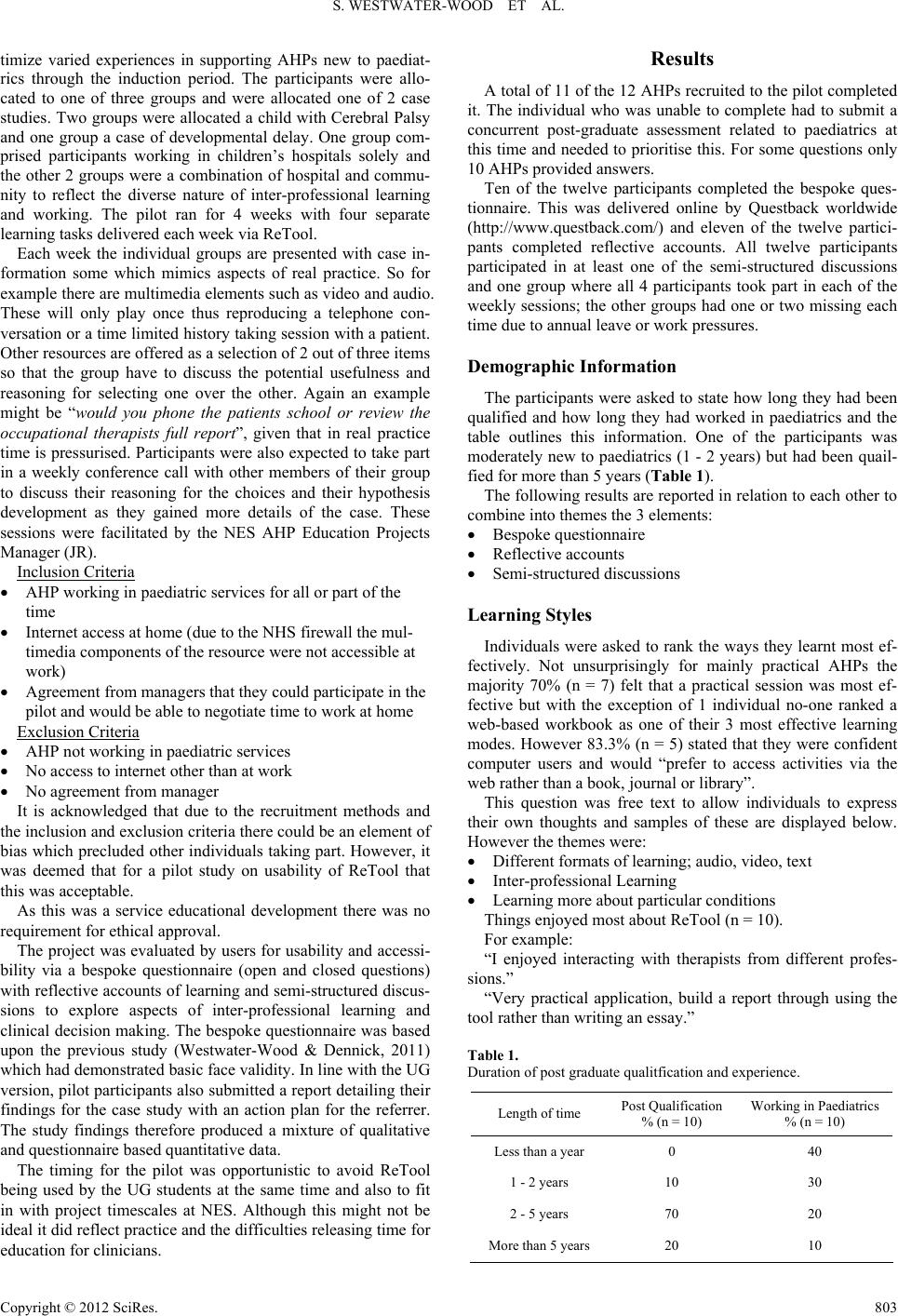 S. WESTWATER-WOOD ET AL. timize varied experiences in supporting AHPs new to paediat- rics through the induction period. The participants were allo- cated to one of three groups and were allocated one of 2 case studies. Two groups were allocated a child with Cerebral Palsy and one group a case of developmental delay. One group com- prised participants working in children’s hospitals solely and the other 2 groups were a combination of hospital and commu- nity to reflect the diverse nature of inter-professional learning and working. The pilot ran for 4 weeks with four separate learning tasks delivered each week via ReTool. Each week the individual groups are presented with case in- formation some which mimics aspects of real practice. So for example there are multimedia elements such as video and audio. These will only play once thus reproducing a telephone con- versation or a time limited hi story taking se ssion with a patient . Other resources are offered as a selection of 2 out of three items so that the group have to discuss the potential usefulness and reasoning for selecting one over the other. Again an example might be “would you phone the patients school or review the occupational therapists full report”, given that in real practice time is pressurised. Participants were also expected to take part in a weekly conference call with other members of their group to discuss their reasoning for the choices and their hypothesis development as they gained more details of the case. These sessions were facilitated by the NES AHP Education Projects Manager (JR). Inclusion Criteria AHP working in paediatric services for all or part of the time Internet access at home (due to the NHS firewall the mul- timedia components of the resource were not accessible at work) Agreement from managers that they could participate in the pilot and would be able to negotiate time to work at home Exclusion Criteria AHP not working in paediatric services No access to internet other than at work No agreement from manager It is acknowledged that due to the recruitment methods and the inclusion and exclusion criteria there could be an element of bias which precluded other individuals taking part. However, it was deemed that for a pilot study on usability of ReTool that this was acceptable. As this was a service educational development there was no requirement for ethical approval. The project was evaluated by users for usability and accessi- bility via a bespoke questionnaire (open and closed questions) with reflective accounts of learning and semi-structured discus- sions to explore aspects of inter-professional learning and clinical decision making. The bespoke questionnaire was based upon the previous study (Westwater-Wood & Dennick, 2011) which had demonstrated basic face validity. In line with the UG version, pilot participants also submitted a report detailing their findings for the case study with an action plan for the referrer. The study findings therefore produced a mixture of qualitative and questionnaire based quantitative data. The timing for the pilot was opportunistic to avoid ReTool being used by the UG students at the same time and also to fit in with project timescales at NES. Although this might not be ideal it did reflect practice and the difficulties releasing time for education for clinicians. Results A total of 11 of the 12 AHPs recruited to the pilot completed it. The individual who was unable to complete had to submit a concurrent post-graduate assessment related to paediatrics at this time and needed to prioritise this. For some questions only 10 AHPs provided answers. Ten of the twelve participants completed the bespoke ques- tionnaire. This was delivered online by Questback worldwide (http://www.questback.com/) and eleven of the twelve partici- pants completed reflective accounts. All twelve participants participated in at least one of the semi-structured discussions and one group where all 4 participants took part in each of the weekly sessions; the other groups had one or two missing each time due to annual leave or work pressures. Demograp hic Informatio n The participants were asked to state how long they had been qualified and how long they had worked in paediatrics and the table outlines this information. One of the participants was moderately new to paediatrics (1 - 2 years) but had been quail- fied for more than 5 years (Table 1). The following results are reported in relation to each other to combine into themes the 3 elements: Bespoke questionnaire Reflective accounts Semi-structured discussions Learning Styles Individuals were asked to rank the ways they learnt most e f- fectively. Not unsurprisingly for mainly practical AHPs the majority 70% (n = 7) felt that a practical session was most ef- fective but with the exception of 1 individual no-one ranked a web-based workbook as one of their 3 most effective learning modes. However 83.3% (n = 5) stated that they were confident computer users and would “prefer to access activities via the web rather than a book, journal or library”. This question was free text to allow individuals to express their own thoughts and samples of these are displayed below. However the themes were: Different formats of learning; audio, video, text Inter-professional Learning Learning more about particular conditions Things enjoyed most about ReTool (n = 10). For example: “I enjoyed interacting with therapists from different profes- sions.” “Very practical application, build a report through using the tool rather than writing an essa y. ” Table 1. Duration of post graduate qualitfication and experience. Length of time Post Qualificatio n % (n = 10) Working in Paedia trics % (n = 10) Less than a year 0 40 1 - 2 years 10 30 2 - 5 years 70 20 More than 5 years 20 10 Copyright © 2012 SciRes. 803 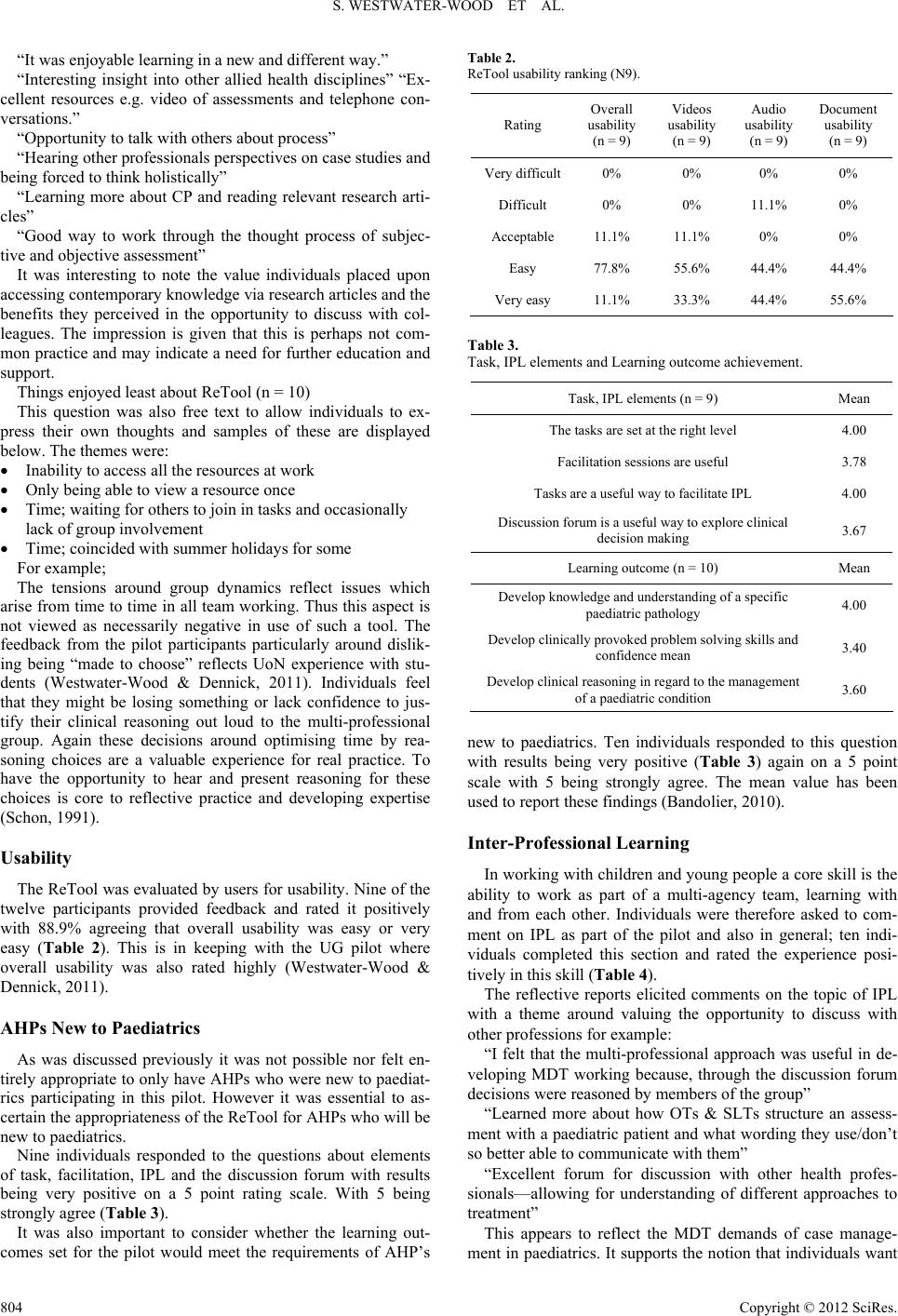 S. WESTWATER-WOOD ET AL. “It was enjoyable learning in a new and different way.” “Interesting insight into other allied health disciplines” “Ex- cellent resources e.g. video of assessments and telephone con- versations.” “Opportunity to talk with others about process” “Hearing other professionals perspectives on case studies and being forced to think holistically” “Learning more about CP and reading relevant research arti- cles” “Good way to work through the thought process of subjec- tive and objective assessment” It was interesting to note the value individuals placed upon accessing contemporary knowledge via research articles and the benefits they perceived in the opportunity to discuss with col- leagues. The impression is given that this is perhaps not com- mon practice and may indicate a need for further education and support. Things enjoyed least about ReTool (n = 10) This question was also free text to allow individuals to ex- press their own thoughts and samples of these are displayed below. The themes were: Inability to access all the resources at work Only being able to view a resource once Time; waiting for others to join in tasks and occasionally lack of group involvement Time; coincided with summer holidays for some For example; The tensions around group dynamics reflect issues which arise from time to time in all team working. Thus this aspect is not viewed as necessarily negative in use of such a tool. The feedback from the pilot participants particularly around dislik- ing being “made to choose” reflects UoN experience with stu- dents (Westwater-Wood & Dennick, 2011). Individuals feel that they might be losing something or lack confidence to jus- tify their clinical reasoning out loud to the multi-professional group. Again these decisions around optimising time by rea- soning choices are a valuable experience for real practice. To have the opportunity to hear and present reasoning for these choices is core to reflective practice and developing expertise (Schon, 1991). Usability The ReT ool was evalua ted by users fo r usability . Nine of the twelve participants provided feedback and rated it positively with 88.9% agreeing that overall usability was easy or very easy (Table 2). This is in keeping with the UG pilot where overall usability was also rated highly (Westwater-Wood & Dennick, 2011). AHPs New to Paediatrics As was discussed previously it was not possible nor felt en- tirely appropriate to only have AHPs who were new to paediat- rics participating in this pilot. However it was essential to as- certain the appropriateness of the ReTool for AHPs who will be new to paediatrics. Nine individuals responded to the questions about elements of task, facilitation, IPL and the discussion forum with results being very positive on a 5 point rating scale. With 5 being strongly agree (Table 3). It was also important to consider whether the learning out- comes set for the pilot would meet the requirements of AHP’s Table 2. ReTool usa bi lity ranking (N9). Rating Overall usability (n = 9) Videos usability (n = 9) Audio usability (n = 9) Document usability (n = 9) Very difficult0% 0% 0% 0% Difficult 0% 0% 11.1% 0% Acceptable 11.1% 11.1% 0% 0% Easy 77.8% 55.6% 44.4% 44.4% Very easy 11.1% 33.3% 44.4% 55.6% Table 3. Task, IPL elements and L earning outcome achievement. Task, IPL elements (n = 9) Mean The tasks are set at the right level 4.00 Facilitation sessions are useful 3.78 Tasks are a useful way to fac i lit ate IPL 4.00 Discussion forum is a useful wa y to explore clinical decision making 3.67 Learning o u tcome (n = 10 ) Mean Develop kn owledge and understanding of a specific paediatric pathology 4.00 Develop cl in ically prov ok ed proble m solving skills and confiden ce me an 3.40 Develop cl in ical reas o ning in rega rd to the m anagement of a paediatric condition 3.60 new to paediatrics. Ten individuals responded to this question with results being very positive (Table 3) again on a 5 point scale with 5 being strongly agree. The mean value has been used to report these findings (Bandolier, 2010). Inter-Professional Learning In working with children and young people a core skill is the ability to work as part of a multi-agency team, learning with and from each other. Individuals were therefore asked to com- ment on IPL as part of the pilot and also in general; ten indi- viduals completed this section and rated the experience posi- tively in this skill (Table 4). The reflective reports elicited comments on the topic of IPL with a theme around valuing the opportunity to discuss with other professions for example: “I felt that the multi-professional approach was useful in de- veloping MDT working because, through the discussion forum decisions were reasoned by members of the group” “Learned more about how OTs & SLTs structure an assess- ment with a paediatric patient and what wording they use/don’t so better able to communicate with them” “Excellent forum for discussion with other health profes- sionals—allowing for understanding of different approaches to treatment” This appears to reflect the MDT demands of case manage- ment in paediatrics. It supports the notion that individuals want Copyright © 2012 SciRes. 804 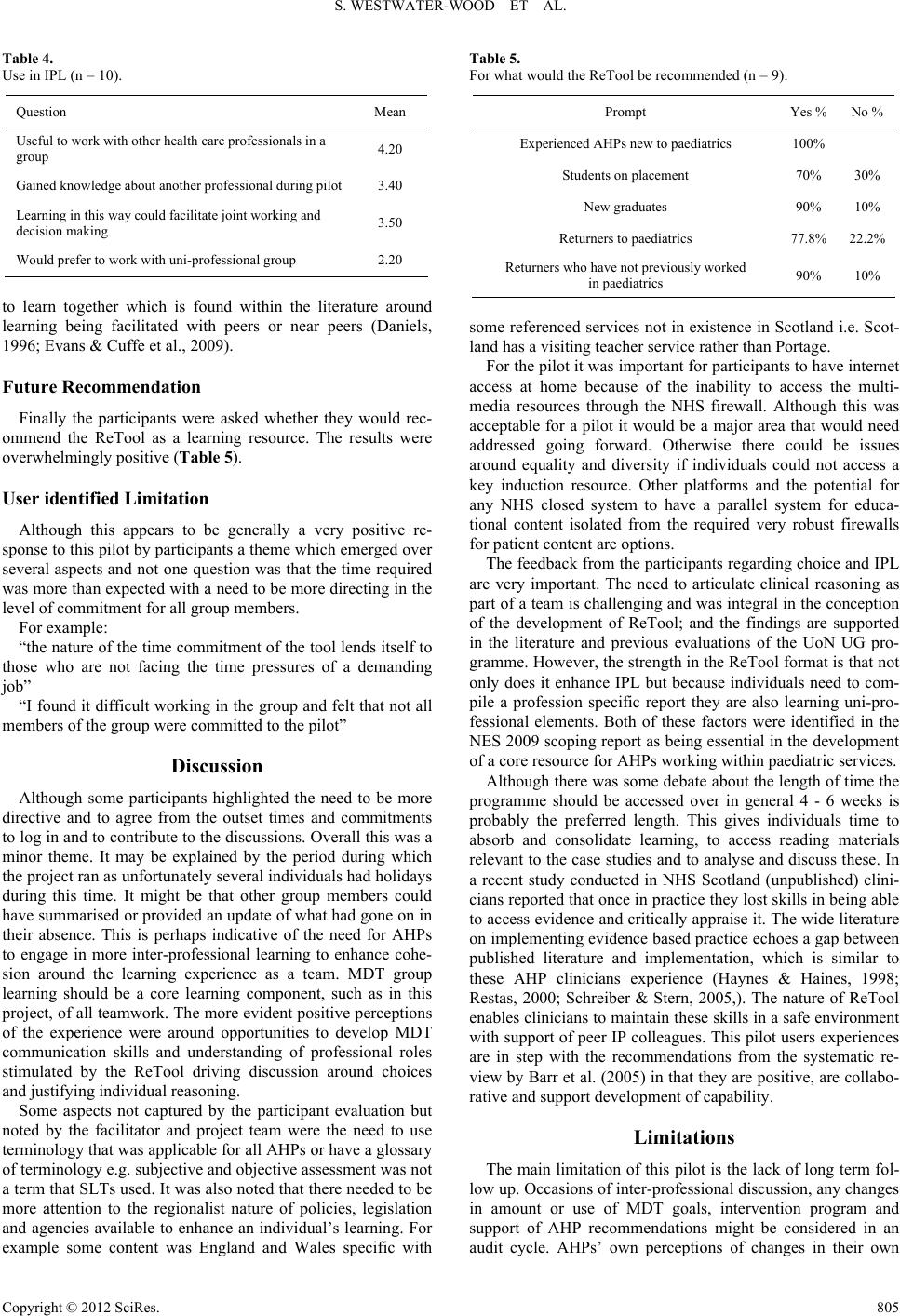 S. WESTWATER-WOOD ET AL. Table 4. Use in IPL (n = 10). Question Mean Useful to work with oth er health care professional s in a group 4.20 Gained knowl edge about another p r ofessional during pilot 3.40 Learning in this wa y could facilita te joint working and decision making 3.50 Would prefer to work with uni-professional group 2.20 to learn together which is found within the literature around learning being facilitated with peers or near peers (Daniels, 1996; Evans & Cuffe et al., 2009). Future Recommendation Finally the participants were asked whether they would rec- ommend the ReTool as a learning resource. The results were overwhelmingly positiv e (Table 5). User identified Limitation Although this appears to be generally a very positive re- sponse to this pilot by participants a theme which emerged over several aspects and not one question was that the time required was more than expected with a need to be more directing in the level of commitment for all group members. For example: “the nature of the time commitment of the tool lends itself to those who are not facing the time pressures of a demanding job” “I found it difficult working in the group and felt that not all members of the group were committed to the pilot” Discussion Although some participants highlighted the need to be more directive and to agree from the outset times and commitments to log in and to contribute to the discussions. Overall this was a minor theme. It may be explained by the period during which the project ran as unfortunately several individuals had holidays during this time. It might be that other group members could have summarised or provided an update of what had gone on in their absence. This is perhaps indicative of the need for AHPs to engage in more inter-professional learning to enhance cohe- sion around the learning experience as a team. MDT group learning should be a core learning component, such as in this project, of all teamwork. The more evident positive perceptions of the experience were around opportunities to develop MDT communication skills and understanding of professional roles stimulated by the ReTool driving discussion around choices and justifying individual reasoning. Some aspects not captured by the participant evaluation but noted by the facilitator and project team were the need to use terminology that was applicable for all AHPs or have a glossary of terminology e.g. subjective and objective assessment was not a term that SLTs used. It was also noted that there needed to be more attention to the regionalist nature of policies, legislation and agencies available to enhance an individual’s learning. For example some content was England and Wales specific with Table 5. For what would the ReTool be recommended (n = 9). Prompt Yes %No % Experienced AHPs new to pae diatrics 100% Students on pla c eme nt 70% 30% New graduates 90% 10% Returners to paediatrics 77.8%22.2% Returners w ho have not previously worked in paediatrics 90% 10% some referenced services not in existence in Scotland i.e. Scot- land has a visiting teacher service rather than Portage. For the pilot it was important for participants to have internet access at home because of the inability to access the multi- media resources through the NHS firewall. Although this was acceptable for a pilot it would be a major area that would need addressed going forward. Otherwise there could be issues around equality and diversity if individuals could not access a key induction resource. Other platforms and the potential for any NHS closed system to have a parallel system for educa- tional content isolated from the required very robust firewalls for patient content are options. The feedback from the participants regarding choice and IPL are very important. The need to articulate clinical reasoning as part of a team is challenging and was integral in the conception of the development of ReTool; and the findings are supported in the literature and previous evaluations of the UoN UG pro- gramme. However, the strength in the ReTool format is that not only does it enhance IPL but because individuals need to com- pile a profession specific report they are also learning uni-pro- fessional elements. Both of these factors were identified in the NES 2009 scoping report as being essential in the development of a core resource for AHPs working within paediatric services. Although there was some debate about the length of time the programme should be accessed over in general 4 - 6 weeks is probably the preferred length. This gives individuals time to absorb and consolidate learning, to access reading materials relevant to the case studies and to analyse and discuss these. In a recent study conducted in NHS Scotland (unpublished) clini- cians reported that once in practice they lost skills in being able to access evidence and critically appraise it. The wide literature on implementing evidence based practice echoes a gap between published literature and implementation, which is similar to these AHP clinicians experience (Haynes & Haines, 1998; Restas, 2000; Schreiber & Stern, 2005,). The nature of ReTool enables clinicians to maintain these skills in a safe environment with support of peer IP colleagues. This pilot users experiences are in step with the recommendations from the systematic re- view by Barr et al. (2005) in that they are positive, are collabo- rative and support development of capability. Limitations The main limitation of this pilot is the lack of long term fol- low up. Occasions of inter-professional discussion, any changes in amount or use of MDT goals, intervention program and support of AHP recommendations might be considered in an audit cycle. AHPs’ own perceptions of changes in their own Copyright © 2012 SciRes. 805  S. WESTWATER-WOOD ET AL. Copyright © 2012 SciRes. 806 clinical practice would also be appropriate to consider in any further investigat io n. Conclusion The collaboration between UoN and NHS Education Scot- land has been very positive. The contextualised e-tool program ReTool was successfully implemented and evaluated for the needs of inter-professional professional development in the field of paediatrics. Clinical reasoning and solution options from different AHPs were shared within multi professional groups and demonstrated the low desire for paediatric AHPs to work in uni-professional groups but to be aware of the balance in the size of larger groups and the dynamics therein. The Re- Tool should be incorporated into the induction component of the education framework for AHPs working with children and young people. To achieve this, the issues identified around glossary, referencing and learning relating to the needs of AHPs in Scotland and the barrier of the NHS firewall need to be con- sidered. In addition to meeting the learning needs of individ- ual’s access to ReTool will also provide evidence for individu- als to meet the requirements of the NHS Knowledge and Skills framework (Department of Health, 2004). REFERENCES Bandolier: Evidence Based Thinking about Healthcare (2010). Mean, median, mode. URL (last checked 22 Sept e mber 2010). http://www.medicine.ox.ac.uk/bandolier/booth/glossary/mean Barr, H., Koppel, I., Reeves, S., Hammick, M., & Freeth, D. (2005) Effective inter-professional education: Argument, assumption and evidence. Oxford: Blackwell. doi:10.1002/9780470776445 Daniels, H. (Ed.) (1996). An introduction to Vygotsky. London: Rout- ledge. Department of Health (2004). The NHS Knowledge and Skills Frame- work (NHS KSF) and the development review pr ocess. http://www.dh.gov.uk/en/Publicationsandstatistics/Publications/Publi cationsPolicyAndGuidance/DH_4090843 Evans, D. J., & Cuffe, T. (2009) Near-peer teaching in anatomy: An approach for deeper learning. Anatomical Sciences Education, 2, 227-233. Haynes, B., & Haines, A. (1998). Barriers and bridges to ev idence based clinical practice. British Medical Journal, 317, 273-276. Restas, A. (2000). Barriers to using research evidence in nursing prac- tice. Journal of Advanced Nursing, 31, 599-606. doi:10.1046/j.1365-2648.2000.01315.x Schon, D. A. (1991). The reflective practitioner: How professionals think in action. Aldershot: Ashgate Pub li shi ng Ltd. Schreiber, J., & Stern, P. (2005). A review of the literature on evi- dence-based practice in physical therapy. The Internet Journal of Al- lied Health Sciences and Practice, 3, 1-10. URL (last checked 20 August 2012). http://ijahsp.nova.edu/articles/vol3num4/schreiber.pdf NHS Education for Scotland (2009). Allied health professionals educa- tional scoping exercise — I n it i a l f i n d in g s . http://www.knowledge.scot.nhs.uk/child-services/communities-of-pr actice/ahp-cyp-network/the-children's-chapter/references.aspx Westwater-Wood, S., & Dennick, R. (2011). A reusable e-learning tool for paediatric physiotherapy education: A preliminary report. Inter- national Journal of Medical Education, 2, 80-86. doi:10.5116/ijme.4e5c.942c |