

Paper Menu >>
Journal Menu >>
 Journal of Surface Engineered Materials and Advanced Technology, 2012, 2, 271-277 http://dx.doi.org/10.4236/jsemat.2012.24041 Published Online October 2012 (http://www.SciRP.org/journal/jsemat) 271 Preparation of Perfluorinated Surfactant Activates for Antifouling Paints A. Bacha1, R. Méghabar2 1Chemistry Laboratory, Faculty of Sciences and Technology, University of Djelfa, Djelfa, Algeria; 2Laboratory of Polymer Chemis- try, University of Es-Senia, Oran, Algeria. Email: [email protected] Received July 8th, 2012; revised August 15th, 2012; accepted August 26th, 2012 ABSTRACT Antifouling paints are the most reliable way to prevent biofouling of submerged surfaces. The high toxicity of organotin paints, prompted us to look for ideas to develop paints that do not present environmental risks. In this work, we prepare a painting by a modification of acrylic acid monomer containing a free carboxyl group. The biocide that is selected is the perfluorinated chain with eight carbons. Chemical modifications of the resins are made through a radical reaction. The magnitudes of changes are monitored by proton nuclear magnetic resonance NMR, gel permeation chromatography (GPC) and the light scattering (LS) at a fixed angle 90°. The glass transition temperature of the surfactant is obtained by the differential scanning calorimetry (DSC). The antifouling properties of the paint are followed by exposure of panels to the marine environment by visual observation. Keywords: Surfactant; Antifouling; Glass Transition Temperature; Aluminum Panels; Differential Scanning Calorimetry; Critical Micelle Concentration (CMC) 1. Introduction The paintings with fluorine atoms are used in many applications and this is due to their unique properties like low surface tension, non-adhesive nature and antifouling properties along. Fluorine is difficult to polarize. This is especially advantageous for their applications in surface coatings. Hence fluoropolymers can hinder water reach- ing the metallic surface in tow ways: fluorinated poly- mers are not wetted by water and secondly the molecular absorption of water into these polymers is relatively small [1]. During recent years, the most successful antifouling marine paints are those consisting of trior- ganotin-based. They are hydrolysable polymers containing triorganotin ester groups that are released by a reaction with seawater. However, the high toxicity of these compound has been shown [2-4]. These environmental concerns lead to develop new antifouling paints, environ- mental friendly and effective over the long term. Our work concerns the synthesis of products (perfluorinated surfactants) that can enter into the formulation of anti- fouling paints by an economic way. Perfluorinated surfactants are classified as biocides [5]. In particular salts with perfluorinated chain with at least eight carbons are effective biocides [6]. The most com- mon way to present these compound is the radical telo- merization [7]. The synthesis involves a single step (Figure 1). The product is a surfactant with a hydrophobic carbon chain and a hydrophilic portion represented by a function in the same loaded organic molecule [8-9]. This property provides a potentially effective antibacterial effect [9]. This article describes the synthesis, characterization and biocidal potential of this new surfactant molecule. 2. Experimentation 2.1. Materials The perfluorinated acrylic surfactant (PAS) was synthe- sized in the physics laboratory materials, Faculty of Sci- ence and Technology (University of Djelfa (Algeria)), this synthesis is described in detail in Section 2.3. The product used is compared with tributyltin (TBT) nonfluorinated synthesized in the laboratory of polymer chemistry at the University of Oran Es-Senia (Algeria) [10]. The product was vacuum distilled before use and stored at 0˚C to avoid thermal polymerization. Azoiso- butyronitrile (AIBN) and perfluorinated thiol were used Figure 1. Telomerization of acrylic acid (R ≡ C8F17C2H4-) Copyright © 2012 SciRes. JSEMAT 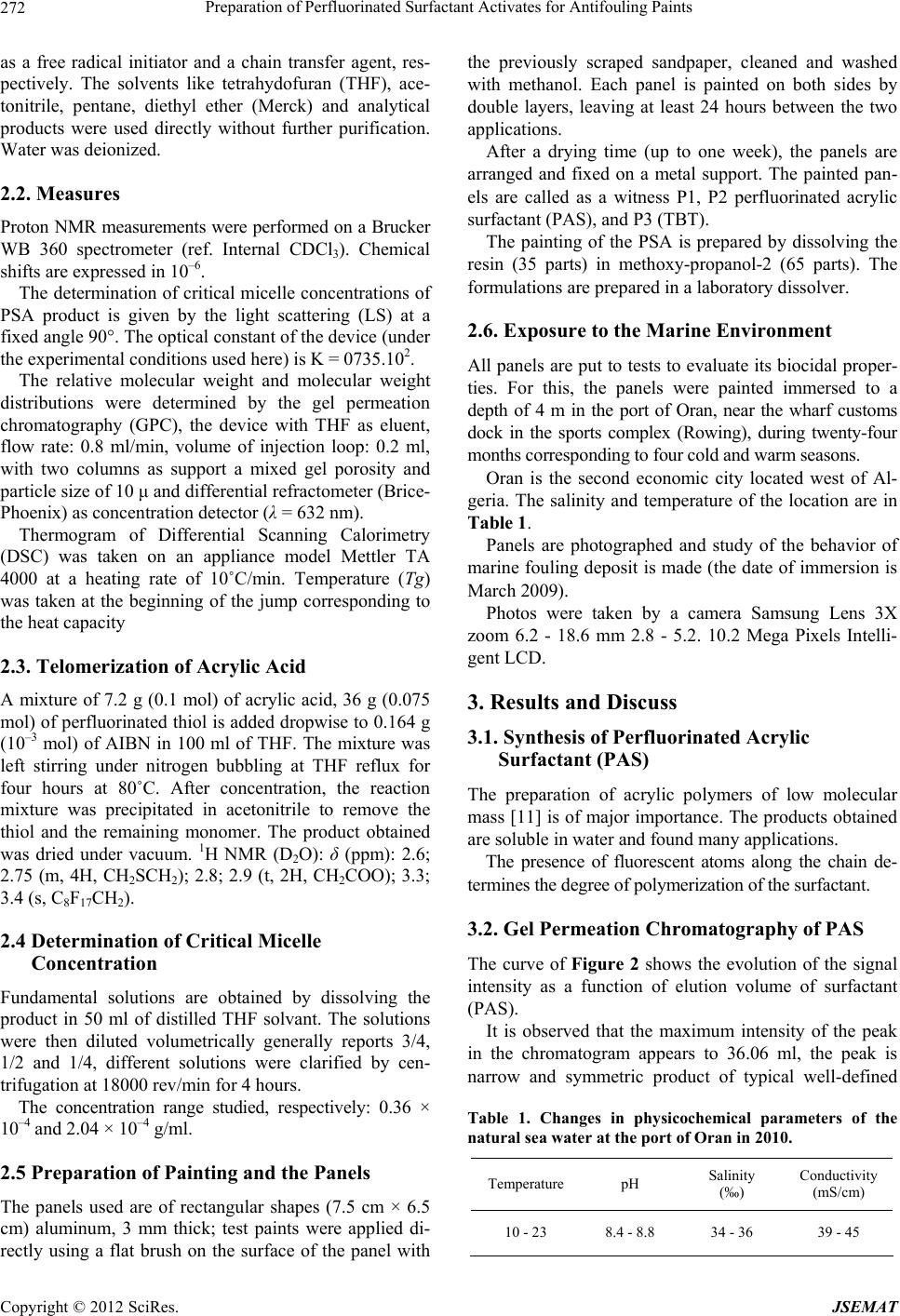 Preparation of Perfluorinated Surfactant Activates for Antifouling Paints 272 as a free radical initiator and a chain transfer agent, res- pectively. The solvents like tetrahydofuran (THF), ace- tonitrile, pentane, diethyl ether (Merck) and analytical products were used directly without further purification. Water was deionized. 2.2. Measures Proton NMR measurements were performed on a Brucker WB 360 spectrometer (ref. Internal CDCl3). Chemical shifts are expressed in 10–6. The determination of critical micelle concentrations of PSA product is given by the light scattering (LS) at a fixed angle 90°. The optical constant of the device (under the experimental conditions used here) is K = 0735.102. The relative molecular weight and molecular weight distributions were determined by the gel permeation chromatography (GPC), the device with THF as eluent, flow rate: 0.8 ml/min, volume of injection loop: 0.2 ml, with two columns as support a mixed gel porosity and particle size of 10 μ and differential refractometer (Brice- Phoenix) as concentration detector (λ = 632 nm). Thermogram of Differential Scanning Calorimetry (DSC) was taken on an appliance model Mettler TA 4000 at a heating rate of 10˚C/min. Temperature (Tg) was taken at the beginning of the jump corresponding to the heat capacity 2.3. Telomerization of Acrylic Acid A mixture of 7.2 g (0.1 mol) of acrylic acid, 36 g (0.075 mol) of perfluorinated thiol is added dropwise to 0.164 g (10–3 mol) of AIBN in 100 ml of THF. The mixture was left stirring under nitrogen bubbling at THF reflux for four hours at 80˚C. After concentration, the reaction mixture was precipitated in acetonitrile to remove the thiol and the remaining monomer. The product obtained was dried under vacuum. 1H NMR (D2O): δ (ppm): 2.6; 2.75 (m, 4H, CH2SCH2); 2.8; 2.9 (t, 2H, CH2COO); 3.3; 3.4 (s, C8F17CH2). 2.4 Determination of Critical Micelle Concentration Fundamental solutions are obtained by dissolving the product in 50 ml of distilled THF solvant. The solutions were then diluted volumetrically generally reports 3/4, 1/2 and 1/4, different solutions were clarified by cen- trifugation at 18000 rev/min for 4 hours. The concentration range studied, respectively: 0.36 × 10⁻⁴ and 2.04 × 10⁻⁴ g/ml. 2.5 Preparation of Painting and the Panels The panels used are of rectangular shapes (7.5 cm × 6.5 cm) aluminum, 3 mm thick; test paints were applied di- rectly using a flat brush on the surface of the panel with the previously scraped sandpaper, cleaned and washed with methanol. Each panel is painted on both sides by double layers, leaving at least 24 hours between the two applications. After a drying time (up to one week), the panels are arranged and fixed on a metal support. The painted pan- els are called as a witness P1, P2 perfluorinated acrylic surfactant (PAS), and P3 (TBT). The painting of the PSA is prepared by dissolving the resin (35 parts) in methoxy-propanol-2 (65 parts). The formulations are prepared in a laboratory dissolver. 2.6. Exposure to the Marine Environment All panels are put to tests to evaluate its biocidal proper- ties. For this, the panels were painted immersed to a depth of 4 m in the port of Oran, near the wharf customs dock in the sports complex (Rowing), during twenty-four months corresponding to four cold and warm seasons. Oran is the second economic city located west of Al- geria. The salinity and temperature of the location are in Table 1. Panels are photographed and study of the behavior of marine fouling deposit is made (the date of immersion is March 2009). Photos were taken by a camera Samsung Lens 3X zoom 6.2 - 18.6 mm 2.8 - 5.2. 10.2 Mega Pixels Intelli- gent LCD. 3. Results and Discuss 3.1. Synthesis of Perfluorinated Acrylic Surfactant (PAS) The preparation of acrylic polymers of low molecular mass [11] is of major importance. The products obtained are soluble in water and found many applications. The presence of fluorescent atoms along the chain de- termines the degree of polymerization of the surfactant. 3.2. Gel Permeation Chromatography of PAS The curve of Figure 2 shows the evolution of the signal intensity as a function of elution volume of surfactant (PAS). It is observed that the maximum intensity of the peak in the chromatogram appears to 36.06 ml, the peak is narrow and symmetric product of typical well-defined Table 1. Changes in physicochemical parameters of the natural sea water at the port of Oran in 2010. Temperature pH Salinity (‰) Conductivity (mS/cm) 10 - 23 8.4 - 8.8 34 - 36 39 - 45 Copyright © 2012 SciRes. JSEMAT 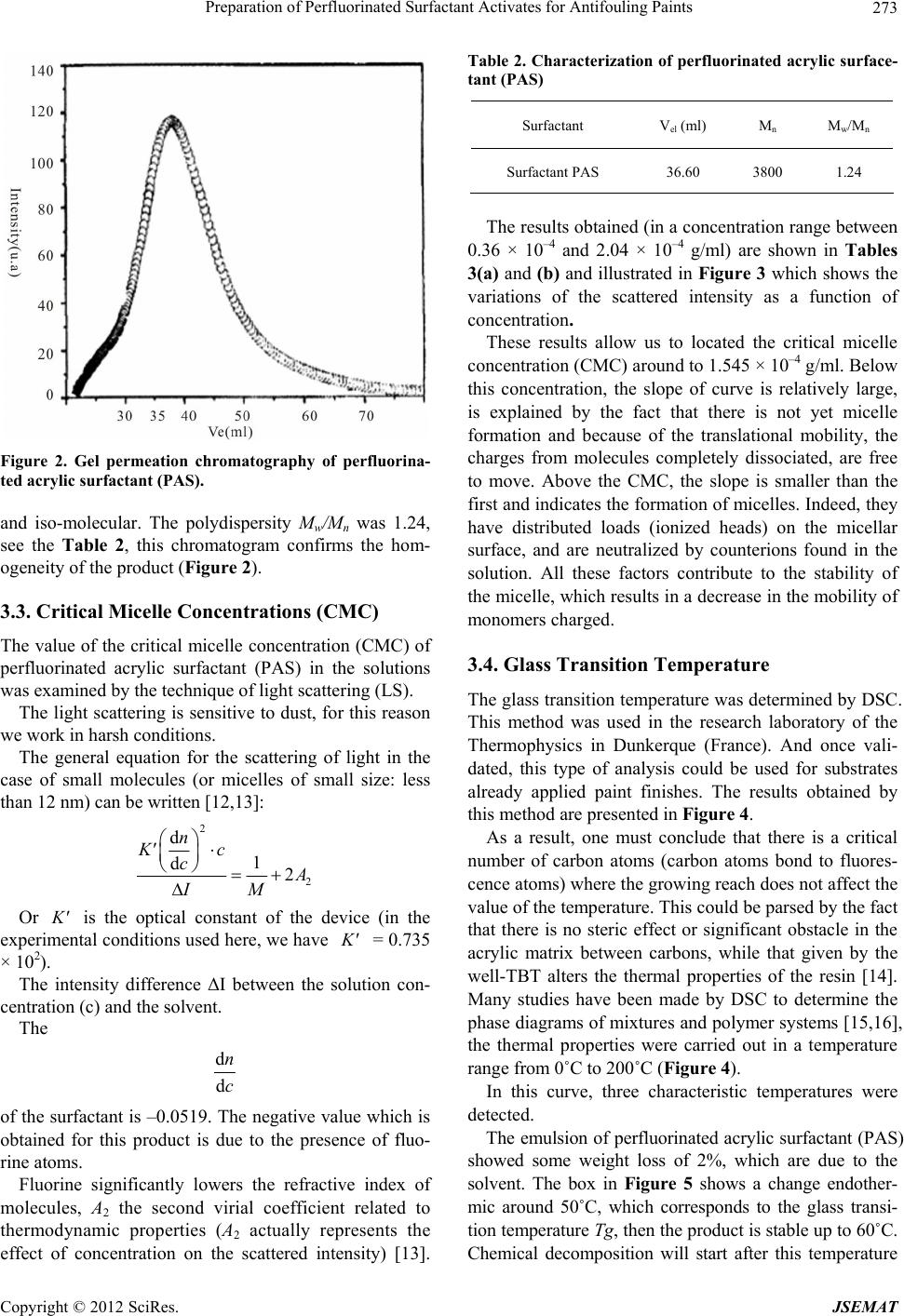 Preparation of Perfluorinated Surfactant Activates for Antifouling Paints 273 Figure 2. Gel permeation chromatography of perfluorina- ted acrylic surfactant (PAS). and iso-molecular. The polydispersity Mw/Mn was 1.24, see the Table 2, this chromatogram confirms the hom- ogeneity of the product (Figure 2). 3.3. Critical Micelle Concentrations (CMC) The value of the critical micelle concentration (CMC) of perfluorinated acrylic surfactant (PAS) in the solutions was examined by the technique of light scattering (LS). The light scattering is sensitive to dust, for this reason we work in harsh conditions. The general equation for the scattering of light in the case of small molecules (or micelles of small size: less than 12 nm) can be written [12,13]: 2 2 d 1 d2 n Kc c A I M Or is the optical constant of the device (in the experimental conditions used here, we have K K = 0.735 × 10²). The intensity difference ΔI between the solution con- centration (c) and the solvent. The d d n c of the surfactant is –0.0519. The negative value which is obtained for this product is due to the presence of fluo- rine atoms. Fluorine significantly lowers the refractive index of molecules, A2 the second virial coefficient related to thermodynamic properties (A2 actually represents the effect of concentration on the scattered intensity) [13]. Table 2. Characterization of perfluorinated acrylic surface- tant (PAS) Surfactant Vel (ml) Mn M w/Mn Surfactant PAS 36.60 3800 1.24 The results obtained (in a concentration range between 0.36 × 10⁻⁴ and 2.04 × 10⁻⁴ g/ml) are shown in Tables 3(a) and (b) and illustrated in Figure 3 which shows the variations of the scattered intensity as a function of concentration . These results allow us to located the critical micelle concentration (CMC) around to 1.545 × 10⁻⁴ g/ml. Below this concentration, the slope of curve is relatively large, is explained by the fact that there is not yet micelle formation and because of the translational mobility, the charges from molecules completely dissociated, are free to move. Above the CMC, the slope is smaller than the first and indicates the formation of micelles. Indeed, they have distributed loads (ionized heads) on the micellar surface, and are neutralized by counterions found in the solution. All these factors contribute to the stability of the micelle, which results in a decrease in the mobility of monomers charged. 3.4. Glass Transition Temperature The glass transition temperature was determined by DSC. This method was used in the research laboratory of the Thermophysics in Dunkerque (France). And once vali- dated, this type of analysis could be used for substrates already applied paint finishes. The results obtained by this method are presented in Figure 4. As a result, one must conclude that there is a critical number of carbon atoms (carbon atoms bond to fluores- cence atoms) where the growing reach does not affect the value of the temperature. This could be parsed by the fact that there is no steric effect or significant obstacle in the acrylic matrix between carbons, while that given by the well-TBT alters the thermal properties of the resin [14]. Many studies have been made by DSC to determine the phase diagrams of mixtures and polymer systems [15,16], the thermal properties were carried out in a temperature range from 0˚C to 200˚C (Figure 4). In this curve, three characteristic temperatures were detected. The emulsion of perfluorinated acrylic surfactant (PAS) showed some weight loss of 2%, which are due to the solvent. The box in Figure 5 shows a change endother- mic around 50˚C, which corresponds to the glass transi- tion temperature Tg, then the product is stable up to 60˚C. Chemical decomposition will start after this temperature Copyright © 2012 SciRes. JSEMAT 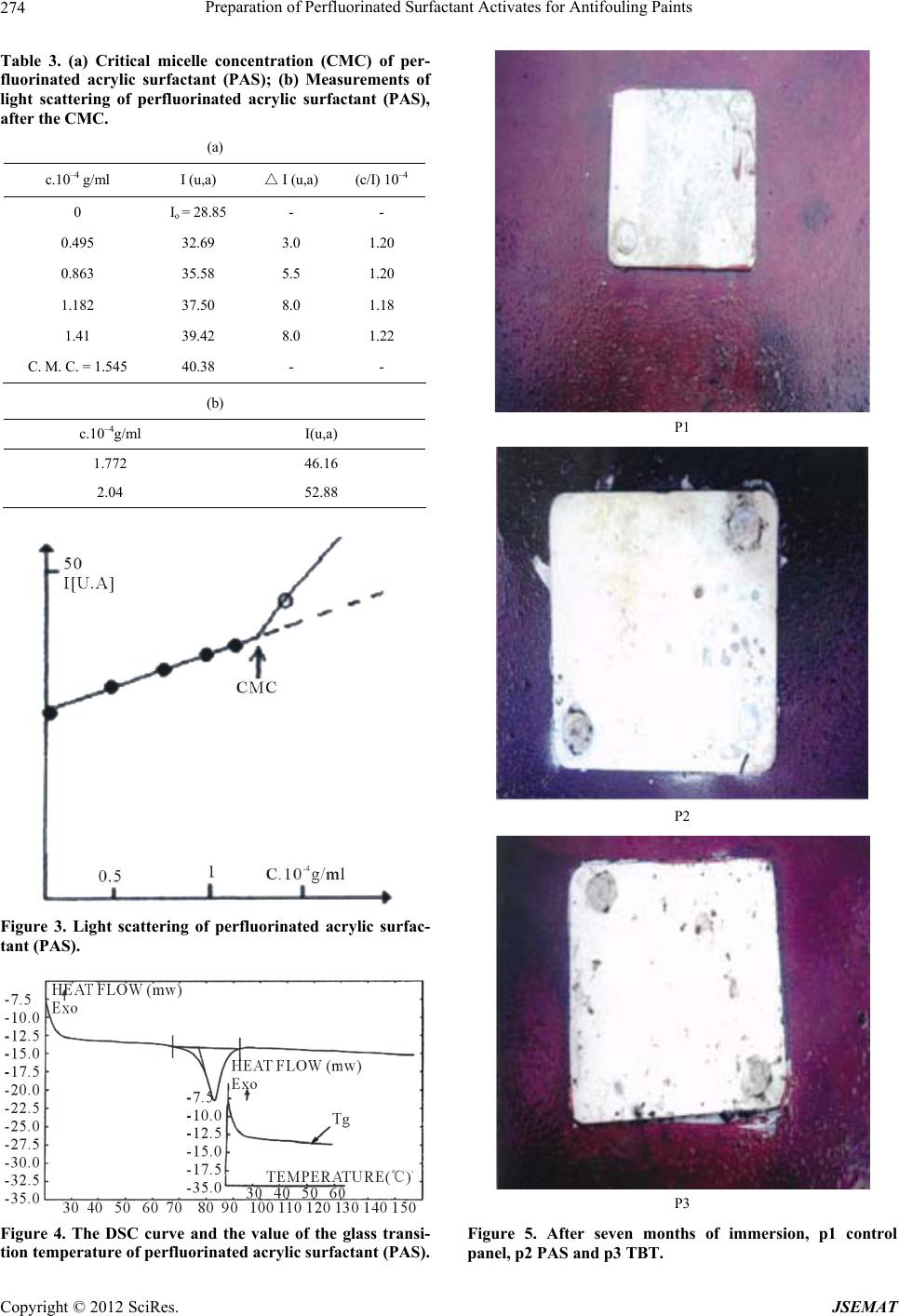 Preparation of Perfluorinated Surfactant Activates for Antifouling Paints 274 Table 3. (a) Critical micelle concentration (CMC) of per- fluorinated acrylic surfactant (PAS); (b) Measurements of light scattering of perfluorinated acrylic surfactant (PAS), after the CMC. (a) c.10–4 g/ml I (u,a) △ I (u,a) (c/I) 10–4 0 Io = 28.85 - - 0.495 32.69 3.0 1.20 0.863 35.58 5.5 1.20 1.182 37.50 8.0 1.18 1.41 39.42 8.0 1.22 C. M. C. = 1.545 40.38 - - (b) c.10–4g/ml I(u,a) 1.772 46.16 2.04 52.88 Figure 3. Light scattering of perfluorinated acrylic surfac- tant (PAS). Figure 4. The DSC curve and the value of the glass transi- tion temperature of perfluorinated acrylic surfactant (PAS). P1 P2 P3 Figure 5. After seven months of immersion, p1 control panel, p2 PAS and p3 TBT. Copyright © 2012 SciRes. JSEMAT 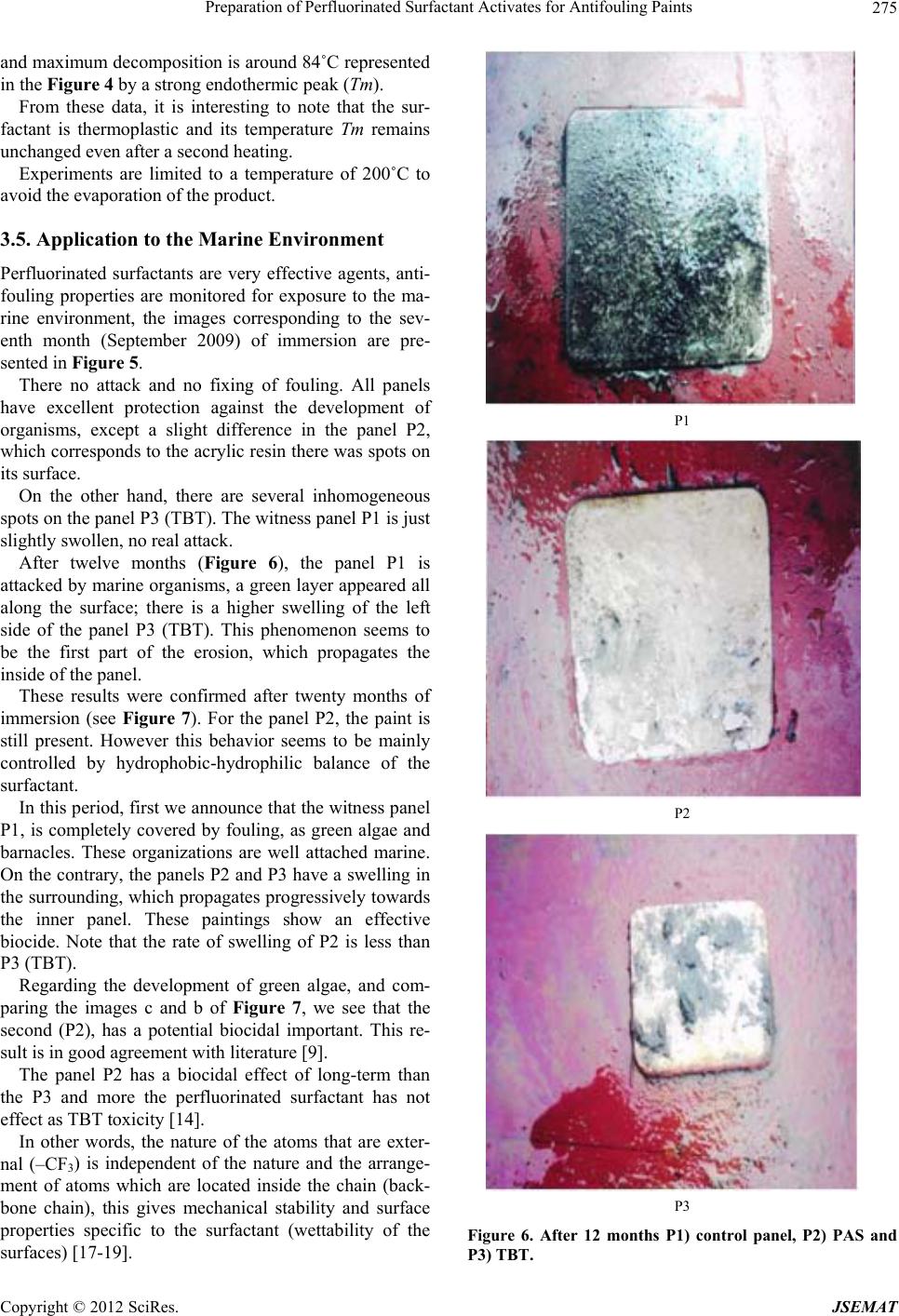 Preparation of Perfluorinated Surfactant Activates for Antifouling Paints 275 and maximum decomposition is around 84˚C represented in the Figure 4 by a strong endothermic peak (Tm). From these data, it is interesting to note that the sur- factant is thermoplastic and its temperature Tm remains unchanged even after a second heating. Experiments are limited to a temperature of 200˚C to avoid the evaporation of the product. 3.5. Application to the Marine Environment Perfluorinated surfactants are very effective agents, anti- fouling properties are monitored for exposure to the ma- rine environment, the images corresponding to the sev- enth month (September 2009) of immersion are pre- sented in Figure 5. There no attack and no fixing of fouling. All panels have excellent protection against the development of organisms, except a slight difference in the panel P2, which corresponds to the acrylic resin there was spots on its surface. On the other hand, there are several inhomogeneous spots on the panel P3 (TBT). The witness panel P1 is just slightly swollen, no real attack. After twelve months (Figure 6), the panel P1 is attacked by marine organisms, a green layer appeared all along the surface; there is a higher swelling of the left side of the panel P3 (TBT). This phenomenon seems to be the first part of the erosion, which propagates the inside of the panel. These results were confirmed after twenty months of immersion (see Figure 7). For the panel P2, the paint is still present. However this behavior seems to be mainly controlled by hydrophobic-hydrophilic balance of the surfactant. In this period, first we announce that the witness panel P1, is completely covered by fouling, as green algae and barnacles. These organizations are well attached marine. On the contrary, the panels P2 and P3 have a swelling in the surrounding, which propagates progressively towards the inner panel. These paintings show an effective biocide. Note that the rate of swelling of P2 is less than P3 (TBT). Regarding the development of green algae, and com- paring the images c and b of Figure 7, we see that the second (P2), has a potential biocidal important. This re- sult is in good agreement with literature [9]. The panel P2 has a biocidal effect of long-term than the P3 and more the perfluorinated surfactant has not effect as TBT toxicity [14]. In other words, the nature of the atoms that are exter- nal (–CF3) is independent of the nature and the arrange- ment of atoms which are located inside the chain (back- bone chain), this gives mechanical stability and surface properties specific to the surfactant (wettability of the surfaces) [17-19]. P1 P2 P3 Figure 6. After 12 months P1) control panel, P2) PAS and P3) TBT. Copyright © 2012 SciRes. JSEMAT 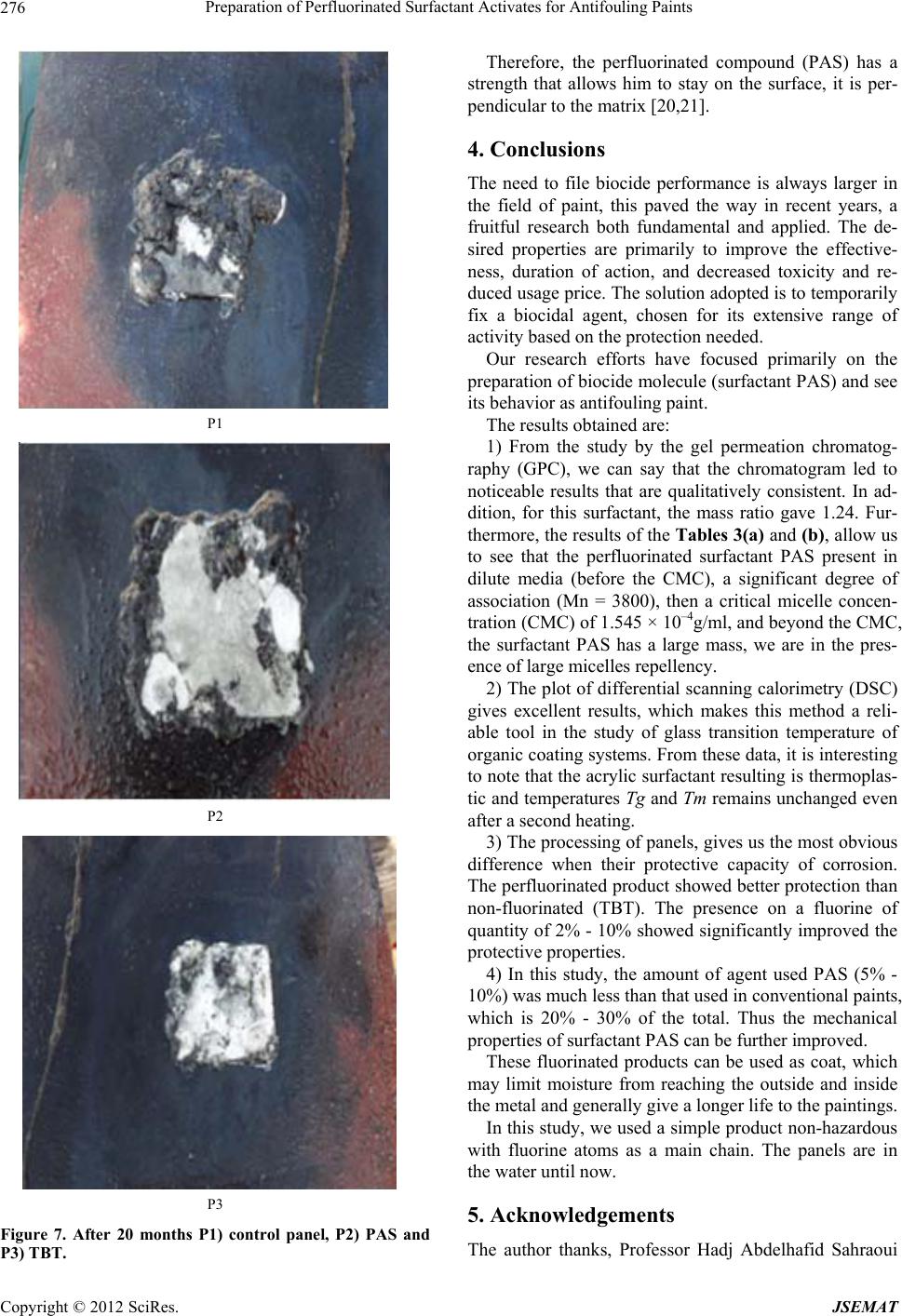 Preparation of Perfluorinated Surfactant Activates for Antifouling Paints 276 P1 P2 P3 Figure 7. After 20 months P1) control panel, P2) PAS and P3) TBT. Therefore, the perfluorinated compound (PAS) has a strength that allows him to stay on the surface, it is per- pendicular to the matrix [20,21]. 4. Conclusions The need to file biocide performance is always larger in the field of paint, this paved the way in recent years, a fruitful research both fundamental and applied. The de- sired properties are primarily to improve the effective- ness, duration of action, and decreased toxicity and re- duced usage price. The solution adopted is to temporarily fix a biocidal agent, chosen for its extensive range of activity based on the protection needed. Our research efforts have focused primarily on the preparation of biocide molecule (surfactant PAS) and see its behavior as antifouling paint. The results obtained are: 1) From the study by the gel permeation chromatog- raphy (GPC), we can say that the chromatogram led to noticeable results that are qualitatively consistent. In ad- dition, for this surfactant, the mass ratio gave 1.24. Fur- thermore, the results of the Tables 3(a) and (b), allow us to see that the perfluorinated surfactant PAS present in dilute media (before the CMC), a significant degree of association (Mn = 3800), then a critical micelle concen- tration (CMC) of 1.545 × 10⁻⁴g/ml, and beyond the CMC, the surfactant PAS has a large mass, we are in the pres- ence of large micelles repellency. 2) The plot of differential scanning calorimetry (DSC) gives excellent results, which makes this method a reli- able tool in the study of glass transition temperature of organic coating systems. From these data, it is interesting to note that the acrylic surfactant resulting is thermoplas- tic and temperatures Tg and Tm remains unchanged even after a second heating. 3) The processing of panels, gives us the most obvious difference when their protective capacity of corrosion. The perfluorinated product showed better protection than non-fluorinated (TBT). The presence on a fluorine of quantity of 2% - 10% showed significantly improved the protective properties. 4) In this study, the amount of agent used PAS (5% - 10%) was much less than that used in conventional paints, which is 20% - 30% of the total. Thus the mechanical properties of surfactant PAS can be further improved. These fluorinated products can be used as coat, which may limit moisture from reaching the outside and inside the metal and generally give a longer life to the paintings. In this study, we used a simple product non-hazardous with fluorine atoms as a main chain. The panels are in the water until now. 5. Acknowledgements The author thanks, Professor Hadj Abdelhafid Sahraoui Copyright © 2012 SciRes. JSEMAT 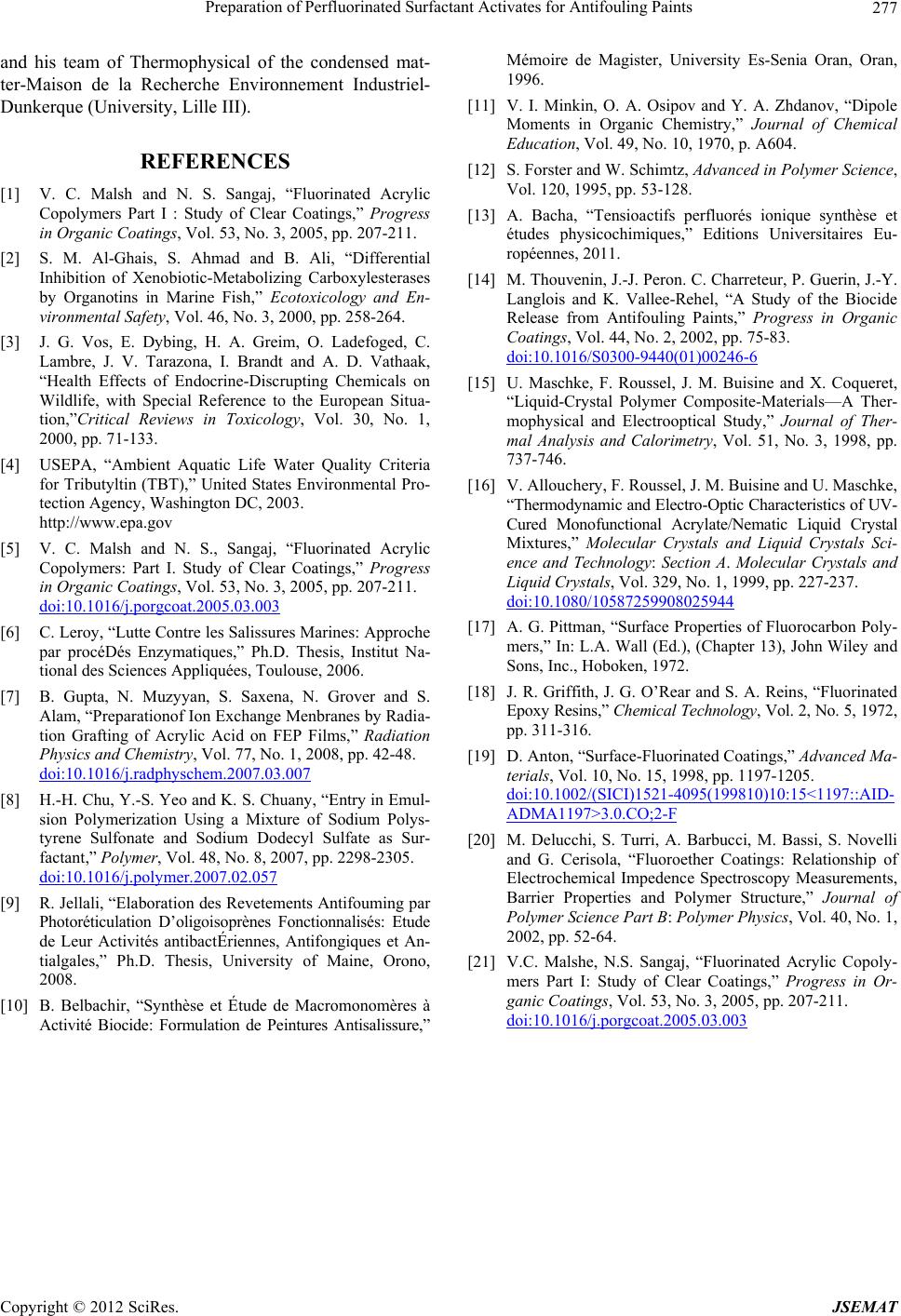 Preparation of Perfluorinated Surfactant Activates for Antifouling Paints Copyright © 2012 SciRes. JSEMAT 277 and his team of Thermophysical of the condensed mat- ter-Maison de la Recherche Environnement Industriel- Dunkerque (University, Lille III). REFERENCES [1] V. C. Malsh and N. S. Sangaj, “Fluorinated Acrylic Copolymers Part I : Study of Clear Coatings,” Progress in Organic Coatings, Vol. 53, No. 3, 2005, pp. 207-211. [2] S. M. Al-Ghais, S. Ahmad and B. Ali, “Differential Inhibition of Xenobiotic-Metabolizing Carboxylesterases by Organotins in Marine Fish,” Ecotoxicology and En- vironmental Safety, Vol. 46, No. 3, 2000, pp. 258-264. [3] J. G. Vos, E. Dybing, H. A. Greim, O. Ladefoged, C. Lambre, J. V. Tarazona, I. Brandt and A. D. Vathaak, “Health Effects of Endocrine-Discrupting Chemicals on Wildlife, with Special Reference to the European Situa- tion,”Critical Reviews in Toxicology, Vol. 30, No. 1, 2000, pp. 71-133. [4] USEPA, “Ambient Aquatic Life Water Quality Criteria for Tributyltin (TBT),” United States Environmental Pro- tection Agency, Washington DC, 2003. http://www.epa.gov [5] V. C. Malsh and N. S., Sangaj, “Fluorinated Acrylic Copolymers: Part I. Study of Clear Coatings,” Progress in Organic Coatings, Vol. 53, No. 3, 2005, pp. 207-211. doi:10.1016/j.porgcoat.2005.03.003 [6] C. Leroy, “Lutte Contre les Salissures Marines: Approche par procéDés Enzymatiques,” Ph.D. Thesis, Institut Na- tional des Sciences Appliquées, Toulouse, 2006. [7] B. Gupta, N. Muzyyan, S. Saxena, N. Grover and S. Alam, “Preparationof Ion Exchange Menbranes by Radia- tion Grafting of Acrylic Acid on FEP Films,” Radiation Physics and Chemistry, Vol. 77, No. 1, 2008, pp. 42-48. doi:10.1016/j.radphyschem.2007.03.007 [8] H.-H. Chu, Y.-S. Yeo and K. S. Chuany, “Entry in Emul- sion Polymerization Using a Mixture of Sodium Polys- tyrene Sulfonate and Sodium Dodecyl Sulfate as Sur- factant,” Polymer, Vol. 48, No. 8, 2007, pp. 2298-2305. doi:10.1016/j.polymer.2007.02.057 [9] R. Jellali, “Elaboration des Revetements Antifouming par Photoréticulation D’oligoisoprènes Fonctionnalisés: Etude de Leur Activités antibactÉriennes, Antifongiques et An- tialgales,” Ph.D. Thesis, University of Maine, Orono, 2008. [10] B. Belbachir, “Synthèse et Étude de Macromonomères à Activité Biocide: Formulation de Peintures Antisalissure,” Mémoire de Magister, University Es-Senia Oran, Oran, 1996. [11] V. I. Minkin, O. A. Osipov and Y. A. Zhdanov, “Dipole Moments in Organic Chemistry,” Journal of Chemical Education, Vol. 49, No. 10, 1970, p. A604. [12] S. Forster and W. Schimtz, Advanced in Polymer Science, Vol. 120, 1995, pp. 53-128. [13] A. Bacha, “Tensioactifs perfluorés ionique synthèse et études physicochimiques,” Editions Universitaires Eu- ropéennes, 2011. [14] M. Thouvenin, J.-J. Peron. C. Charreteur, P. Guerin, J.-Y. Langlois and K. Vallee-Rehel, “A Study of the Biocide Release from Antifouling Paints,” Progress in Organic Coatings, Vol. 44, No. 2, 2002, pp. 75-83. doi:10.1016/S0300-9440(01)00246-6 [15] U. Maschke, F. Roussel, J. M. Buisine and X. Coqueret, “Liquid-Crystal Polymer Composite-Materials—A Ther- mophysical and Electrooptical Study,” Journal of Ther- mal Analysis and Calorimetry, Vol. 51, No. 3, 1998, pp. 737-746. [16] V. Allouchery, F. Roussel, J. M. Buisine and U. Maschke, “Thermodynamic and Electro-Optic Characteristics of UV- Cured Monofunctional Acrylate/Nematic Liquid Crystal Mixtures,” Molecular Crystals and Liquid Crystals Sci- ence and Technology: Section A. Molecular Crystals and Liquid Crystals, Vol. 329, No. 1, 1999, pp. 227-237. doi:10.1080/10587259908025944 [17] A. G. Pittman, “Surface Properties of Fluorocarbon Poly- mers,” In: L.A. Wall (Ed.), (Chapter 13), John Wiley and Sons, Inc., Hoboken, 1972. [18] J. R. Griffith, J. G. O’Rear and S. A. Reins, “Fluorinated Epoxy Resins,” Chemical Technology, Vol. 2, No. 5, 1972, pp. 311-316. [19] D. Anton, “Surface-Fluorinated Coatings,” Advanced Ma- terials, Vol. 10, No. 15, 1998, pp. 1197-1205. doi:10.1002/(SICI)1521-4095(199810)10:15<1197::AID- ADMA1197>3.0.CO;2-F [20] M. Delucchi, S. Turri, A. Barbucci, M. Bassi, S. Novelli and G. Cerisola, “Fluoroether Coatings: Relationship of Electrochemical Impedence Spectroscopy Measurements, Barrier Properties and Polymer Structure,” Journal of Polymer Science Part B: Polymer Physics, Vol. 40, No. 1, 2002, pp. 52-64. [21] V.C. Malshe, N.S. Sangaj, “Fluorinated Acrylic Copoly- mers Part I: Study of Clear Coatings,” Progress in Or- ganic Coatings, Vol. 53, No. 3, 2005, pp. 207-211. doi:10.1016/j.porgcoat.2005.03.003 |