

Paper Menu >>
Journal Menu >>
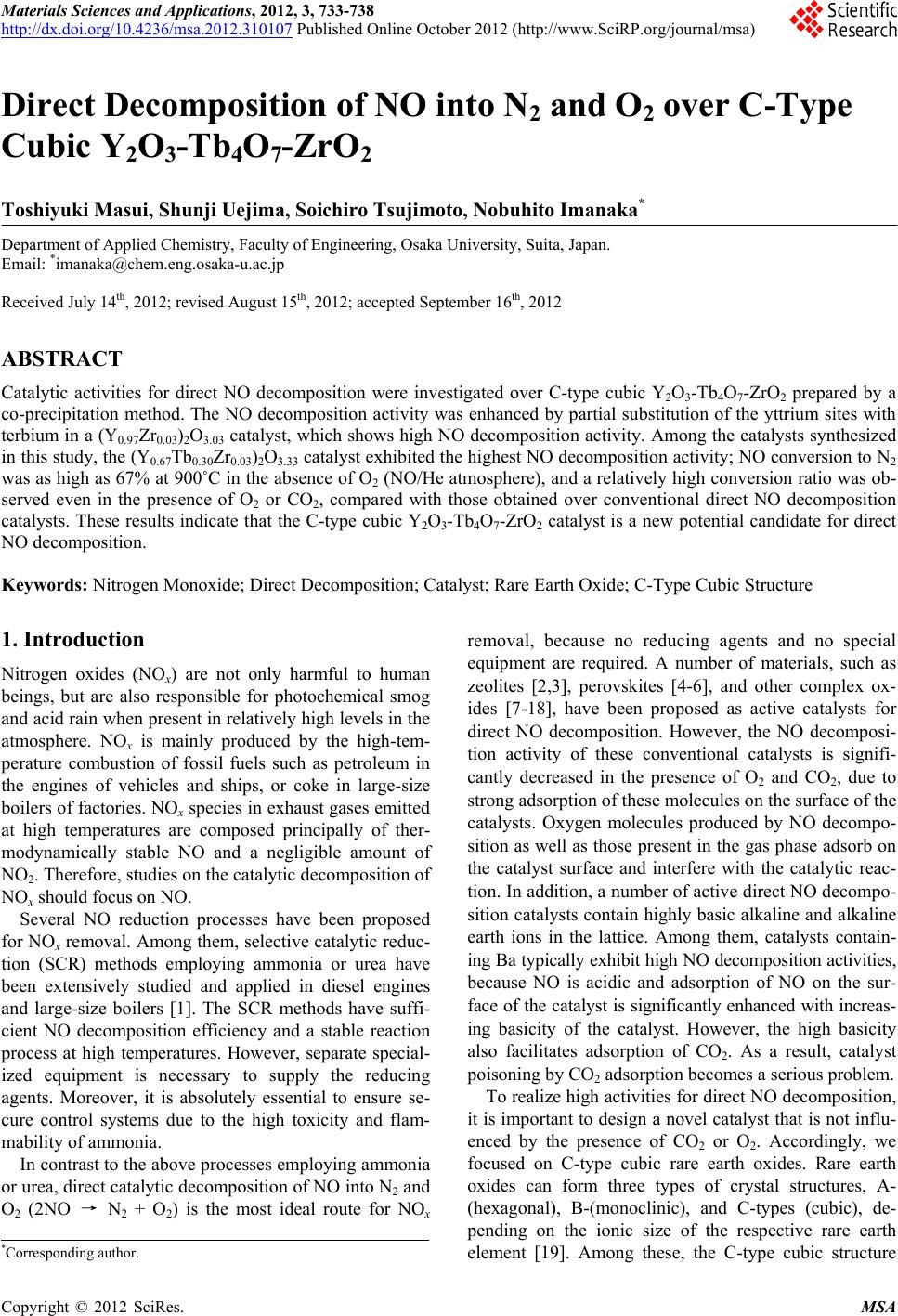 Materials Sciences and Applications, 2012, 3, 733-738 http://dx.doi.org/10.4236/msa.2012.310107 Published Online October 2012 (http://www.SciRP.org/journal/msa) Direct Decomposition of NO into N2 and O2 over C-Type Cubic Y2O3-Tb4O7-ZrO2 Toshiyuki Masui, Shunji Uejima, Soichiro Tsujimoto, Nobuhito Imanaka* Department of Applied Chemistry, Faculty of Engineering, Osaka University, Suita, Japan. Email: *[email protected] Received July 14th, 2012; revised August 15th, 2012; accepted September 16th, 2012 ABSTRACT Catalytic activities for direct NO decomposition were investigated over C-type cubic Y2O3-Tb4O7-ZrO2 prepared by a co-precipitation method. The NO decomposition activity was enhanced by partial substitution of the yttrium sites with terbium in a (Y0.97Zr0.03)2O3.03 catalyst, which shows high NO decomposition activity. Among the catalysts synthesized in this study, the (Y0.67Tb0.30Zr0.03)2O3.33 catalyst exhibited the highest NO decomposition activity; NO conversion to N2 was as high as 67% at 900˚C in the absence of O2 (NO/He atmosphere), and a relatively high conversion ratio was ob- served even in the presence of O2 or CO2, compared with those obtained over conventional direct NO decomposition catalysts. These results indicate that the C-type cubic Y2O3-Tb4O7-ZrO2 catalyst is a new potential candidate for direct NO decomposition. Keywords: Nitrogen Monoxide; Direct Decomposition; Catalyst; Rare Earth Oxide; C-Type Cubic Structure 1. Introduction Nitrogen oxides (NOx) are not only harmful to human beings, but are also responsible for photochemical smog and acid rain when present in relatively high levels in the atmosphere. NOx is mainly produced by the high-tem- perature combustion of fossil fuels such as petroleum in the engines of vehicles and ships, or coke in large-size boilers of factories. NOx species in exhaust gases emitted at high temperatures are composed principally of ther- modynamically stable NO and a negligible amount of NO2. Therefore, studies on the catalytic decomposition of NOx should focus on NO. Several NO reduction processes have been proposed for NOx removal. Among them, selective catalytic reduc- tion (SCR) methods employing ammonia or urea have been extensively studied and applied in diesel engines and large-size boilers [1]. The SCR methods have suffi- cient NO decomposition efficiency and a stable reaction process at high temperatures. However, separate special- ized equipment is necessary to supply the reducing agents. Moreover, it is absolutely essential to ensure se- cure control systems due to the high toxicity and flam- mability of ammonia. In contrast to the above processes employing ammonia or urea, direct catalytic decomposition of NO into N2 and O2 (2NO → N 2 + O2) is the most ideal route for NOx removal, because no reducing agents and no special equipment are required. A number of materials, such as zeolites [2,3], perovskites [4-6], and other complex ox- ides [7-18], have been proposed as active catalysts for direct NO decomposition. However, the NO decomposi- tion activity of these conventional catalysts is signifi- cantly decreased in the presence of O2 and CO2, due to strong adsorption of these molecules on the surface of the catalysts. Oxygen molecules produced by NO decompo- sition as well as those present in the gas phase adsorb on the catalyst surface and interfere with the catalytic reac- tion. In addition, a number of active direct NO decompo- sition catalysts contain highly basic alkaline and alkaline earth ions in the lattice. Among them, catalysts contain- ing Ba typically exhibit high NO decomposition activities, because NO is acidic and adsorption of NO on the sur- face of the catalyst is significantly enhanced with increas- ing basicity of the catalyst. However, the high basicity also facilitates adsorption of CO2. As a result, catalyst poisoning by CO2 adsorption becomes a serious problem. To realize high activities for direct NO decomposition, it is important to design a novel catalyst that is not influ- enced by the presence of CO2 or O2. Accordingly, we focused on C-type cubic rare earth oxides. Rare earth oxides can form three types of crystal structures, A- (hexagonal), B-(monoclinic), and C-types (cubic), de- pending on the ionic size of the respective rare earth element [19]. Among these, the C-type cubic structure *Corresponding author. Copyright © 2012 SciRes. MSA 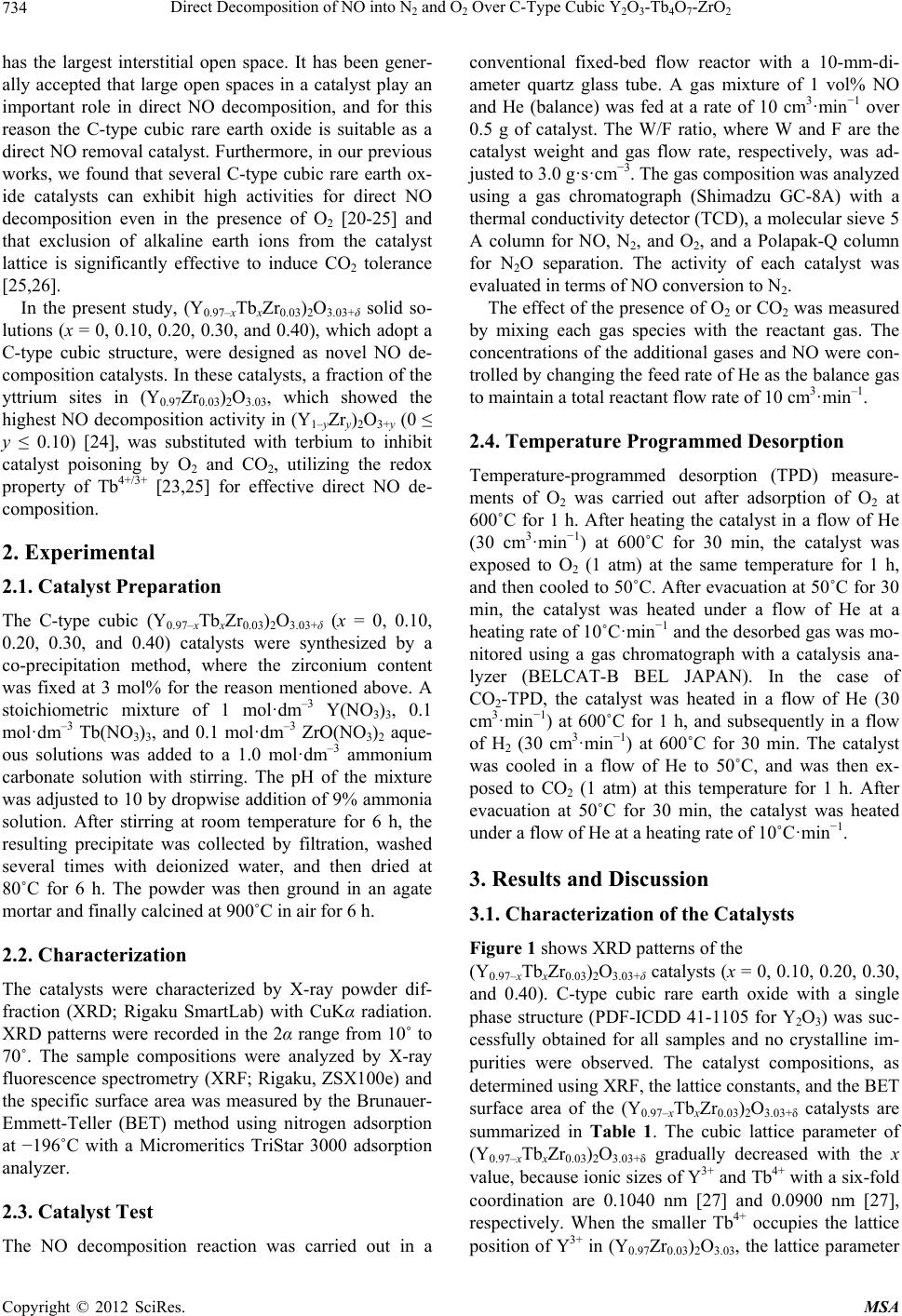 Direct Decomposition of NO into N2 and O2 Over C-Type Cubic Y2O3-Tb4O7-ZrO2 734 has the largest interstitial open space. It has been gener- ally accepted that large open spaces in a catalyst play an important role in direct NO decomposition, and for this reason the C-type cubic rare earth oxide is suitable as a direct NO removal catalyst. Furthermore, in our previous works, we found that several C-type cubic rare earth ox- ide catalysts can exhibit high activities for direct NO decomposition even in the presence of O2 [20-25] and that exclusion of alkaline earth ions from the catalyst lattice is significantly effective to induce CO2 tolerance [25,26]. In the present study, (Y0.97–xTbxZr0.03)2O3.03+δ solid so- lutions (x = 0, 0.10, 0.20, 0.30, and 0.40), which adopt a C-type cubic structure, were designed as novel NO de- composition catalysts. In these catalysts, a fraction of the yttrium sites in (Y0.97Zr0.03)2O3.03, which showed the highest NO decomposition activity in (Y1–yZr y)2O3+y (0 ≤ y ≤ 0.10) [24], was substituted with terbium to inhibit catalyst poisoning by O2 and CO2, utilizing the redox property of Tb4+/3+ [23,25] for effective direct NO de- composition. 2. Experimental 2.1. Catalyst Preparation The C-type cubic (Y0.97–xTbxZr0.03)2O3.03+δ (x = 0, 0.10, 0.20, 0.30, and 0.40) catalysts were synthesized by a co-precipitation method, where the zirconium content was fixed at 3 mol% for the reason mentioned above. A stoichiometric mixture of 1 mol·dm–3 Y(NO3)3, 0.1 mol· dm–3 Tb(NO3)3, and 0.1 mol·dm–3 ZrO(NO3)2 aque- ous solutions was added to a 1.0 mol·dm–3 ammonium carbonate solution with stirring. The pH of the mixture was adjusted to 10 by dropwise addition of 9% ammonia solution. After stirring at room temperature for 6 h, the resulting precipitate was collected by filtration, washed several times with deionized water, and then dried at 80˚C for 6 h. The powder was then ground in an agate mortar and finally calcined at 900˚C in air for 6 h. 2.2. Characterization The catalysts were characterized by X-ray powder dif- fraction (XRD; Rigaku SmartLab) with CuKα radiation. XRD patterns were recorded in the 2α range from 10˚ to 70˚. The sample compositions were analyzed by X-ray fluorescence spectrometry (XRF; Rigaku, ZSX100e) and the specific surface area was measured by the Brunauer- Emmett-Teller (BET) method using nitrogen adsorption at −196˚C with a Micromeritics TriStar 3000 adsorption analyzer. 2.3. Catalyst Test The NO decomposition reaction was carried out in a conventional fixed-bed flow reactor with a 10-mm-di- ameter quartz glass tube. A gas mixture of 1 vol% NO and He (balance) was fed at a rate of 10 cm3·min−1 over 0.5 g of catalyst. The W/F ratio, where W and F are the catalyst weight and gas flow rate, respectively, was ad- justed to 3.0 g·s·cm−3. The gas composition was analyzed using a gas chromatograph (Shimadzu GC-8A) with a thermal conductivity detector (TCD), a molecular sieve 5 A column for NO, N2, and O2, and a Polapak-Q column for N2O separation. The activity of each catalyst was evaluated in terms of NO conversion to N2. The effect of the presence of O2 or CO2 was measured by mixing each gas species with the reactant gas. The concentrations of the additional gases and NO were con- trolled by changing the feed rate of He as the balance gas to maintain a total reactant flow rate of 10 cm3·min–1. 2.4. Temperature Programmed Desorption Temperature-programmed desorption (TPD) measure- ments of O2 was carried out after adsorption of O2 at 600˚C for 1 h. After heating the catalyst in a flow of He (30 cm3·min−1) at 600˚C for 30 min, the catalyst was exposed to O2 (1 atm) at the same temperature for 1 h, and then cooled to 50˚C. After evacuation at 50˚C for 30 min, the catalyst was heated under a flow of He at a heating rate of 10˚C·min−1 and the desorbed gas was mo- nitored using a gas chromatograph with a catalysis ana- lyzer (BELCAT-B BEL JAPAN). In the case of CO2-TPD, the catalyst was heated in a flow of He (30 cm3·min−1) at 600˚C for 1 h, and subsequently in a flow of H2 (30 cm3·min−1) at 600˚C for 30 min. The catalyst was cooled in a flow of He to 50˚C, and was then ex- posed to CO2 (1 atm) at this temperature for 1 h. After evacuation at 50˚C for 30 min, the catalyst was heated under a flow of He at a heating rate of 10˚C·min−1. 3. Results and Discussion 3.1. Characterization of the Catalysts Figure 1 shows XRD patterns of the (Y0.97–xTbxZr0.03)2O3.03+δ catalysts (x = 0, 0.10, 0.20, 0.30, and 0.40). C-type cubic rare earth oxide with a single phase structure (PDF-ICDD 41-1105 for Y2O3) was suc- cessfully obtained for all samples and no crystalline im- purities were observed. The catalyst compositions, as determined using XRF, the lattice constants, and the BET surface area of the (Y0.97–xTbxZr0.03)2O3.03+δ catalysts are summarized in Table 1. The cubic lattice parameter of (Y0.97–xTbxZr0.03)2O3.03+δ gradually decreased with the x value, because ionic sizes of Y3+ and Tb4+ with a six-fold coordination are 0.1040 nm [27] and 0.0900 nm [27], respectively. When the smaller Tb4+ occupies the lattice position of Y3+ in (Y0.97Zr0.03)2O3.03, the lattice parameter Copyright © 2012 SciRes. MSA 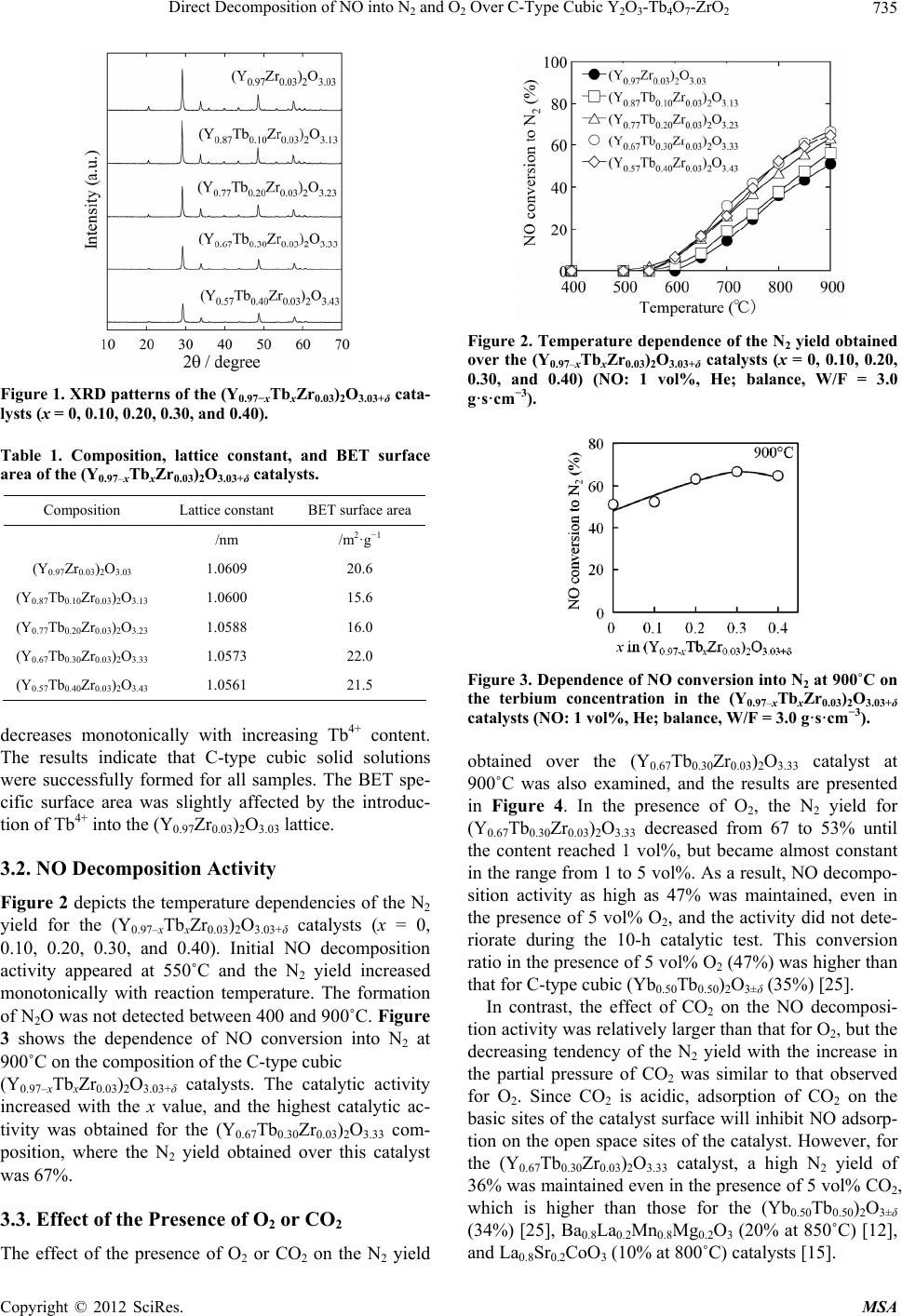 Direct Decomposition of NO into N2 and O2 Over C-Type Cubic Y2O3-Tb4O7-ZrO2 735 Figure 1. XRD patterns of the (Y0.97−xTbxZr0.03)2O3.03+δ cata- lysts (x = 0, 0.10, 0.20, 0.30, and 0.40). Table 1. Composition, lattice constant, and BET surface area of the (Y0.97–xTbxZr0.03)2O3.03+δ catalysts. Composition Lattice constant BET surface area /nm /m2·g−1 (Y0.97Zr0.03)2O3.03 1.0609 20.6 (Y0.87Tb0.10Zr0.03)2O3.13 1.0600 15.6 (Y0.77Tb0.20Zr0.03)2O3.23 1.0588 16.0 (Y0.67Tb0.30Zr0.03)2O3.33 1.0573 22.0 (Y0.57Tb0.40Zr0.03)2O3.43 1.0561 21.5 decreases monotonically with increasing Tb4+ content. The results indicate that C-type cubic solid solutions were successfully formed for all samples. The BET spe- cific surface area was slightly affected by the introduc- tion of Tb4+ into the (Y0.97Zr0.03)2O3.03 lattice. 3.2. NO Decomposition Activity Figure 2 depicts the temperature dependencies of the N2 yield for the (Y0.97–xTbxZr0.03)2O3.03+δ catalysts (x = 0, 0.10, 0.20, 0.30, and 0.40). Initial NO decomposition activity appeared at 550˚C and the N2 yield increased monotonically with reaction temperature. The formation of N2O was not detected between 400 and 900˚C. Figure 3 shows the dependence of NO conversion into N2 at 900˚C on the composition of the C-type cubic (Y0.97–xTbxZr0.03)2O3.03+δ catalysts. The catalytic activity increased with the x value, and the highest catalytic ac- tivity was obtained for the (Y0.67Tb0.30Zr0.03)2O3.33 com- position, where the N2 yield obtained over this catalyst was 67%. 3.3. Effect of the Presence of O2 or CO2 The effect of the presence of O2 or CO2 on the N2 yield Figure 2. Temperature dependence of the N2 yield obtained over the (Y0.97–xTbxZr0.03)2O3.03+δ catalysts (x = 0, 0.10, 0.20, 0.30, and 0.40) (NO: 1 vol%, He; balance, W/F = 3.0 g·s·cm−3). Figure 3. Dependence of NO conversion into N2 at 900˚C on the terbium concentration in the (Y0.97–xTbxZr0.03)2O3.03+δ catalysts (NO: 1 vol%, He; balance, W/F = 3.0 g·s·cm−3). obtained over the (Y0.67Tb0.30Zr0.03)2O3.33 catalyst at 900˚C was also examined, and the results are presented in Figure 4. In the presence of O2, the N2 yield for (Y0.67Tb0.30Zr0.03)2O3.33 decreased from 67 to 53% until the content reached 1 vol%, but became almost constant in the range from 1 to 5 vol%. As a result, NO decompo- sition activity as high as 47% was maintained, even in the presence of 5 vol% O2, and the activity did not dete- riorate during the 10-h catalytic test. This conversion ratio in the presence of 5 vol% O2 (47%) was higher than that for C-type cubic (Yb0.50Tb0.50)2O3±δ (35%) [25]. In contrast, the effect of CO2 on the NO decomposi- tion activity was relatively larger than that for O2, but the decreasing tendency of the N2 yield with the increase in the partial pressure of CO2 was similar to that observed for O2. Since CO2 is acidic, adsorption of CO2 on the basic sites of the catalyst surface will inhibit NO adsorp- tion on the open space sites of the catalyst. However, for the (Y0.67Tb0.30Zr0.03)2O3.33 catalyst, a high N2 yield of 36% was maintained even in the presence of 5 vol% CO2, which is higher than those for the (Yb0.50Tb0.50)2O3±δ (34%) [25], Ba0.8La0.2Mn0.8Mg0.2O3 (20% at 850˚C) [12], and La0.8Sr0.2CoO 3 (10% at 800˚C) catalysts [15]. Copyright © 2012 SciRes. MSA 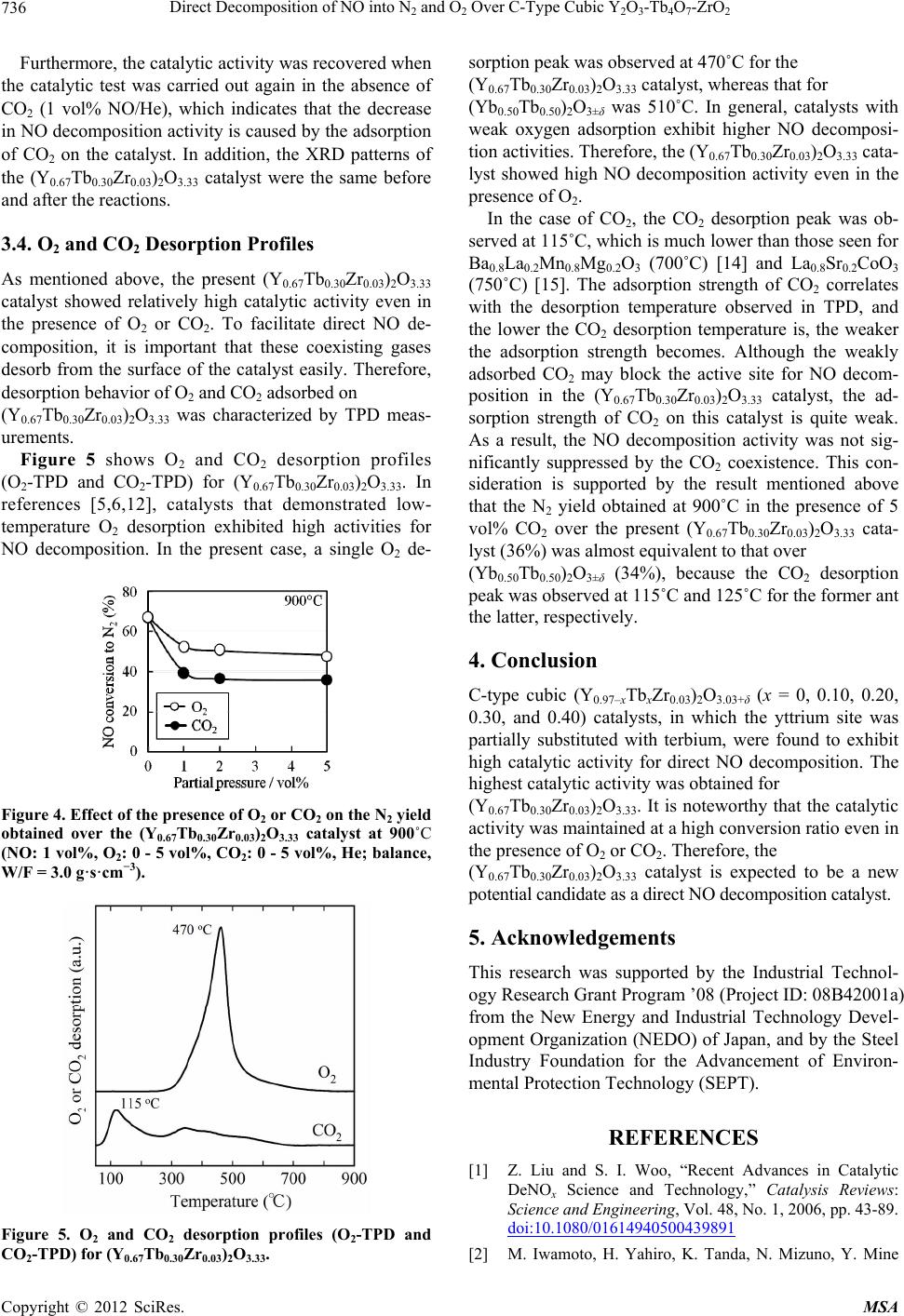 Direct Decomposition of NO into N2 and O2 Over C-Type Cubic Y2O3-Tb4O7-ZrO2 736 Furthermore, the catalytic activity was recovered when the catalytic test was carried out again in the absence of CO2 (1 vol% NO/He), which indicates that the decrease in NO decomposition activity is caused by the adsorption of CO2 on the catalyst. In addition, the XRD patterns of the (Y0.67Tb0.30Zr0.03)2O3.33 catalyst were the same before and after the reactions. 3.4. O2 and CO2 Desorption Profiles As mentioned above, the present (Y0.67Tb0.30Zr0.03)2O3.33 catalyst showed relatively high catalytic activity even in the presence of O2 or CO2. To facilitate direct NO de- composition, it is important that these coexisting gases desorb from the surface of the catalyst easily. Therefore, desorption behavior of O2 and CO2 adsorbed on (Y0.67Tb0.30Zr0.03)2O3.33 was characterized by TPD meas- urements. Figure 5 shows O2 and CO2 desorption profiles (O2-TPD and CO2-TPD) for (Y0.67Tb0.30Zr0.03)2O3.33. In references [5,6,12], catalysts that demonstrated low- temperature O2 desorption exhibited high activities for NO decomposition. In the present case, a single O2 de- Figure 4. Effect of the presence of O2 or CO2 on the N2 yield obtained over the (Y0.67Tb0.30Zr0.03)2O3.33 catalyst at 900˚C (NO: 1 vol%, O2: 0 - 5 vol%, CO2: 0 - 5 vol%, He; balance, W/F = 3.0 g·s·cm−3). Figure 5. O2 and CO2 desorption profiles (O2-TPD and CO2-TPD) for (Y0.67Tb0.30Zr0.03)2O3.33. sorption peak was observed at 470˚C for the (Y0.67Tb0.30Zr0.03)2O3.33 catalyst, whereas that for (Yb0.50Tb0.50)2O3±δ was 510˚C. In general, catalysts with weak oxygen adsorption exhibit higher NO decomposi- tion activities. Therefore, the (Y0.67Tb0.30Zr0.03)2O3.33 cata- lyst showed high NO decomposition activity even in the presence of O2. In the case of CO2, the CO2 desorption peak was ob- served at 115˚C, which is much lower than those seen for Ba0.8La0.2Mn0.8Mg0.2O3 (700˚C) [14] and La0.8Sr0.2CoO3 (750˚C) [15]. The adsorption strength of CO2 correlates with the desorption temperature observed in TPD, and the lower the CO2 desorption temperature is, the weaker the adsorption strength becomes. Although the weakly adsorbed CO2 may block the active site for NO decom- position in the (Y0.67Tb0.30Zr0.03)2O3.33 catalyst, the ad- sorption strength of CO2 on this catalyst is quite weak. As a result, the NO decomposition activity was not sig- nificantly suppressed by the CO2 coexistence. This con- sideration is supported by the result mentioned above that the N2 yield obtained at 900˚C in the presence of 5 vol% CO2 over the present (Y0.67Tb0.30Zr0.03)2O3.33 cata- lyst (36%) was almost equivalent to that over (Yb0.50Tb0.50)2O3±δ (34%), because the CO2 desorption peak was observed at 115˚C and 125˚C for the former ant the latter, respectively. 4. Conclusion C-type cubic (Y0.97–xTbxZr0.03)2O3.03+δ (x = 0, 0.10, 0.20, 0.30, and 0.40) catalysts, in which the yttrium site was partially substituted with terbium, were found to exhibit high catalytic activity for direct NO decomposition. The highest catalytic activity was obtained for (Y0.67Tb0.30Zr0.03)2O3.33. It is noteworthy that the catalytic activity was maintained at a high conversion ratio even in the presence of O2 or CO2. Therefore, the (Y0.67Tb0.30Zr0.03)2O3.33 catalyst is expected to be a new potential candidate as a direct NO decomposition catalyst. 5. Acknowledgements This research was supported by the Industrial Technol- ogy Research Grant Program ’08 (Project ID: 08B42001a) from the New Energy and Industrial Technology Devel- opment Organization (NEDO) of Japan, and by the Steel Industry Foundation for the Advancement of Environ- mental Protection Technology (SEPT). REFERENCES [1] Z. Liu and S. I. Woo, “Recent Advances in Catalytic DeNOx Science and Technology,” Catalysis Reviews: Science and Engineering, Vol. 48, No. 1, 2006, pp. 43-89. doi:10.1080/01614940500439891 [2] M. Iwamoto, H. Yahiro, K. Tanda, N. Mizuno, Y. Mine Copyright © 2012 SciRes. MSA  Direct Decomposition of NO into N2 and O2 Over C-Type Cubic Y2O3-Tb4O7-ZrO2 737 and S. Kagawa, “Removal of Nitrogen Monoxide through a Novel Catalytic Process. 1. Decomposition on Exces- sively Copper Ion Exchanged ZSM-5 Zeolites,” The Journal of Physical Chemistry, Vol. 95, No. 9, 1991, pp. 3727-3730. doi:10.1021/j100162a053 [3] B. L. Trout, A. K. Chakraborty and A. T. Bell, “Analysis of the Thermochemistry of NOx Decomposition over CuZSM-5 Based on Quantum Chemical and Statistical Mechanical Calculations,” The Journal of Physical Che- mistry, Vol. 100, No. 44, 1996, pp. 17582-17592. doi:10.1021/jp961470b [4] Y. Teraoka, T. Harada and S. Kagawa, “Reaction Mecha- nism of Direct Decomposition of Nitric Oxide over Co- and Mn-Based Perovskite-Type Oxides,” Journal of the Chemical Society, Faraday Transactions, Vol. 94, No. 13, 1998, pp. 1887-1891. doi:10.1039/a800872h [5] T. Ishihara, M. Ando, K. Sada, K. Takiishi, K. Yamada, H. Nishiguchi and Y. Takita, “Direct Decomposition of NO into N2 and O2 over La(Ba)Mn(In)O3 Perovskite Ox- ide,” Journal of Catalysis, Vol. 220, No. 1, 2003, pp. 104-114. doi:10.1016/S0021-9517(03)00265-3 [6] H. Iwakuni, Y. Shinmyou, H. Yano, H. Matsumoto and T. Ishihara, “Direct Decomposition of NO into N2 and O2 on BaMnO3-Based Perovskite Oxides,” Applied Catalysis B: Environmental, Vol. 74, No. 3-4, 2007, pp. 299-306. doi:10.1016/j.apcatb.2007.02.020 [7] M. Haneda, Y. Kintaichi, N. Bion and H. Hamada, “Al- kali Metal-Doped Cobalt Oxide Catalysts for NO De- composition,” Applied Catalysis B: Environmental, Vol. 46, No. 3, 2003, pp. 473-482. doi:10.1016/S0926-3373(03)00287-X [8] S. Xie, G. Mestl, M. P. Rosynek and J. H. Lunsford, “Decomposition of Nitric Oxide over Barium Oxide Supported on Magnesium Oxide. 1. Catalytic Results and in Situ Raman Spectroscopic Evidence for a Barium-Nitro Intermediate,” Journal of the American Chemical Society, Vol. 119, No. 42, 1997, pp. 10186-10191. doi:10.1021/ja970809k [9] Z. Liu, J. Hao, L. Fu and T. Zhu, “Study of Ag/La0.6Ce0.4CoO3 Catalysts for Direct Decomposition and Reduction of Nitrogen Oxides with Propene in the Presence of Oxygen,” Applied Catalysis B: Environmen- tal, Vol. 44, No. 4, 2003, pp. 355-370. doi:10.1016/S0926-3373(03)00103-6 [10] Y. Teraoka, K. Torigoshi, H. Yamaguchi, T. Ikeda and S. Kagawa, “Direct Decomposition of Nitric Oxide over Stannate Pyrochlore Oxides: Relationship between Solid- State Chemistry and Catalytic Activity,” Journal of Mo- lecular Catalysis A: Chemical, Vol. 155, No. 1-2, 2000, pp. 73-80. doi:10.1016/S1381-1169(99)00320-9 [11] S. Iwamoto, R. Takahashi and M. Inoue, “Direct Decom- position of Nitric Oxide over Ba Catalysts Supported on CeO2-Based Mixed Oxides,” Applied Catalysis B: Envi- ronmental, Vol. 70, No. 1-4, 2007, pp. 146-150. doi:10.1016/j.apcatb.2006.01.016 [12] H. Iwakuni, Y. Shinmyou, H. Matsumoto and T. Ishihara, “Direct Decomposition of NO into N2 and O2 on SrFe0.7Mg0.3O3 Perovskite Oxide,” Bulletin of the Chem- ical Society of Japan, Vol. 80, No. 10, 2007, pp. 2039- 2046. doi:10.1246/bcsj.80.2039 [13] T. Ishihara, Y. Shinmyou, K. Goto, N. Nishiyama, H. Iwakuni and H. Matsumoto, “NO Decomposition on Rud- dlesden-Popper-Type Oxide, Sr3Fe2O7, Doped with Ba and Zr,” Chemistry Letters, Vol. 37, No. 3, 2008, pp. 318- 319. doi:10.1246/cl.2008.318 [14] H. Iwakuni, Y. Shinmyou, H. Yano, K. Goto, H. Matsu- moto and T. Ishihara, “Effects of Added CO2 and H2 on the Direct Decomposition of NO over BaMnO3-Based Perovskite Oxide,” Bulletin of the Chemical Society of Japan, Vol. 81, No. 9, 2008, pp. 1175-1182. doi:10.1246/bcsj.81.1175 [15] Y. Teraoka, K. Torigoshi and S. Kagawa, “Inhibition of NO Decomposition Activity of Perovskite-Type Oxides by Coexisting Carbon Dioxide,” Bulletin of the Chemical Society of Japan, Vol. 74, No. 6, 2001, pp. 1161-1162. doi:10.1246/bcsj.74.1161 [16] K. Goto, H. Matsumoto and T. Ishihara, “Direct Decom- position of NO on Ba/Ba-Y-O Catalyst,” Topics in Ca- talysis, Vol. 52, No. 13-20, 2009, pp. 1776-1780. doi:10.1007/s11244-009-9337-7 [17] T. Ishihara and K. Goto, “Direct Decomposition of NO over BaO/Y2O3 Catalyst,” Catalysis Today, Vol. 164, No. 1, 2011, pp. 484-488. doi:10.1016/j.cattod.2010.12.005 [18] K. Goto and T. Ishihara, “Direct Decomposition of NO into N2 and O2 over Ba3Y3.4Sc0.6O9,” Applied Catalysis A: General, Vol. 409-410, No. 1, 2011, pp. 66-73. doi:10.1016/j.apcata.2011.09.027 [19] G. Adachi and N. Imanaka, “The Binary Rare Earth Ox- ides,” Chemical Reviews, Vol. 98, No. 4, 1998, pp. 1479- 1514. doi:10.1021/cr940055h [20] N. Imanaka, T. Masui and H. Masaki, “Direct Decompo- sition of Nitric Oxide over C-Type Cubic (Gd1–x–yYxBay)2O3–y Solid Solutions,” Advanced Materi- als, Vol. 19, No. 21, 2007, pp. 3660-3663. doi:10.1002/adma.200602323 [21] H. Masaki, T. Masui and N. Imanaka, “Direct Decompo- sition of Nitric Oxide into Nitrogen and Oxygen over C-Type Cubic Y2O3-ZrO2 Solid Solutions,” Journal of Alloys and Compounds, Vol. 451, No. 1-2, 2008, pp. 406- 409. doi:10.1016/j.jallcom.2007.04.158 [22] N. Imanaka and T. Masui, “Advanced Materials for En- vironmental Catalysts,” The Chemical Record, Vol. 9, No. 1, 2009, pp. 40-50. doi:10.1002/tcr.20167 [23] S. Tsujimoto, K. Mima, T. Masui and N. Imanaka, “Di- rect Decomposition of NO on C-Type Cubic Rare Earth Oxides Based on Y2O3,” Chemistry Letters, Vol. 39, No. 5, 2010, pp. 456-457. doi:10.1246/cl.2010.456 [24] S. Tsujimoto, X. Wang, T. Masui and N. Imanaka, “Di- rect Decomposition of NO into N2 and O2 on C-type Cu- bic Y2O3-ZrO2 and Y2O3-ZrO2-BaO,” Bulletin of the Chemical Society of Japan, Vol. 84, No. 7, 2011, pp. 807-811. doi:10.1246/bcsj.20100360 [25] S. Tsujimoto, C. Nishimura, T. Masui and N. Imanaka, “Coexisting Gas-Resistant C-type Cubic Yb2O3-Tb4O7 Catalysts for Direct NO Decomposition,” Chemistry Let- ters, Vol. 40, No. 7, 2011, pp. 708-710. doi:10.1246/cl.2011.708 [26] N. Imanaka and T. Masui, “Advances in Direct NOx De- Copyright © 2012 SciRes. MSA  Direct Decomposition of NO into N2 and O2 Over C-Type Cubic Y2O3-Tb4O7-ZrO2 Copyright © 2012 SciRes. MSA 738 composition Catalysts,” Applied Catalysis A: General, Vol. 431-432, No. 1, 2012, pp. 1-8. doi:10.1016/j.apcata.2012.02.047 [27] R. D. Shannon, “Revised Effective Ionic Radii and Sys- tematic Studies of Interatomic Distances in Halides and Chalcogenides,” Acta Crystallographica Section A, Vol. 32, No. 5, 1976, pp. 751-767. doi:10.1107/S0567739476001551 |