

Paper Menu >>
Journal Menu >>
 Surgical Science, 2012, 3, 469-472 http://dx.doi.org/10.4236/ss.2012.310093 Published Online October 2012 (http://www.SciRP.org/journal/ss) Does Chemo-Radiation Therapy Influence Outcomes in Unresectable Locally Advanced State IV Rectal Cancer? Joaquin J. Estrada, Vivek Chaudhry, Jose R. Cintron, Leela M. Prasad, Herand Abcarian Division of Colon and Rectal Surgery, John H. Stroger Jr. Hospital of Cook County, Chicago, USA Email: [email protected] Received August 15, 2012; revised September 20, 2012; accepted September 30, 2012 ABSTRACT Introduction: The median survival for patients with stage IV rectal cancer is approximately 20 months. Therapy should focus not only on improving survival but also on quality of life. The aim of our study was to determine if ch emoradia- tion (C-RT) would improve palliation for metastatic un resectable locally advanced disease compared to patients receiv- ing palliative chemotherapy alone (C) for stage IV cancer. Methods: Retrospective review of a prospectively main- tained database at a single institution was carried out under IRB approval. From January 2004 to December 2008, 43 patients presenting with unresectable stage IV rectal cancer were identified with a median follow-up of 12 months. Pa- tients with evidence of locally advanced disease or bulky disease received infusional 5-FU ± bevacizumab and 3D con- formed mega voltage photon therapy (5400 cGy). Patients without evidence of bulky disease received either FOLFOX or FOLFIRI ± bevacizumab. Data on demographics, investigations, treatment, complications, metastasis, number of blood transfusions, days of hospitalization, and surgical intervention were analyzed using SPSS statistical software. p < 0.05 was considered statistically significant. Results: There were 25 and 18 patients in the C and C-RT groups respec- tively. There was no difference in mean age, sex or overall survival. Three patient (12%) in the C group developed hy- dronephrosis compared to 8 patients (44%) in the C-RT group (p < 0.05). Six patients (24%) developed bowel obstruc- tions requiring an ostomy in the C group compared to 9 patient (50%) in the C-RT group (p = 0.07). In the C arm, 80% of patients required multiple h ospitalizations for symptoms consistent with progression of d isease compared to 61% of patients in the C-RT arm (p < 0.01). Conclusion: Chemoradiation in patients with locally advanced unresectable stage IV cancer has not been extensively investigated. At our institution , patients treated with C-RT for bulky stage IV rectal cancer required fewer hospitalizations when compared to those treated with chemotherapy alone. Keywords: Chemo-Radiation; Cancer 1. Introduction Despite well delineated screening protocols, colon and rectal cancer remains the 3rd most commonly diagnosed malignancy in the United States [1]. Approximately 140,000 patients we re diagnosed with a colorectal cancer in 2010 [1,2] and over 39,000 of them had rectal cancer [2-4]. Current treatment strategies for rectal cancer are based on clinical staging. The majority of patients pre- sent with resectable disease [5] and treatment algorithms may include surgery alone for proximal rectal cancer vs. multimodality approach (chemotherapy, radiation ther- apy and surgical resection) for mid-distal rectal cancer. R0 resections are necessary for favorable long-term outcomes [6-8]. In patients diagnosed with locally ad- vanced or unresectable metastatic disease R0 resection is frequently not possible. As a result, survival rates are dismal. Historically, the median survival for stage VI rectal cancer has been 7 - 12 months [9]. However, with advancement in chemotherapy regiments and the addi- tion of mono-clonal antibodies the survival has been ex- tended to approximately 20 months [4]. Unfortunately, with this advanced state of disease pa- tients frequently require multiple hospitalizations for the management of gastro-intestinal bleeding, intractable pain, ureteral obstruction, urinary tract infection, dehydration (from poor oral intake as well as chemotherapy induced diarrhea) and intestinal obstruction. For the patients with unresectable disease, multiple palliative treatment strate- gies exist which include chemotherapy, chemo-radiation therapy, palliative surgery, fecal diversion, and endo- scopic stenting [2]. In addition to improving overall sur- vival, therapy for this patients’ population should focus on improving the quality of life. The aim of this study is to determine whether providing chemo-radiation to pa- tients with stage IV rectal cancer will decrease the inci- dence of cancer related morbidities. C opyright © 2012 SciRes. SS 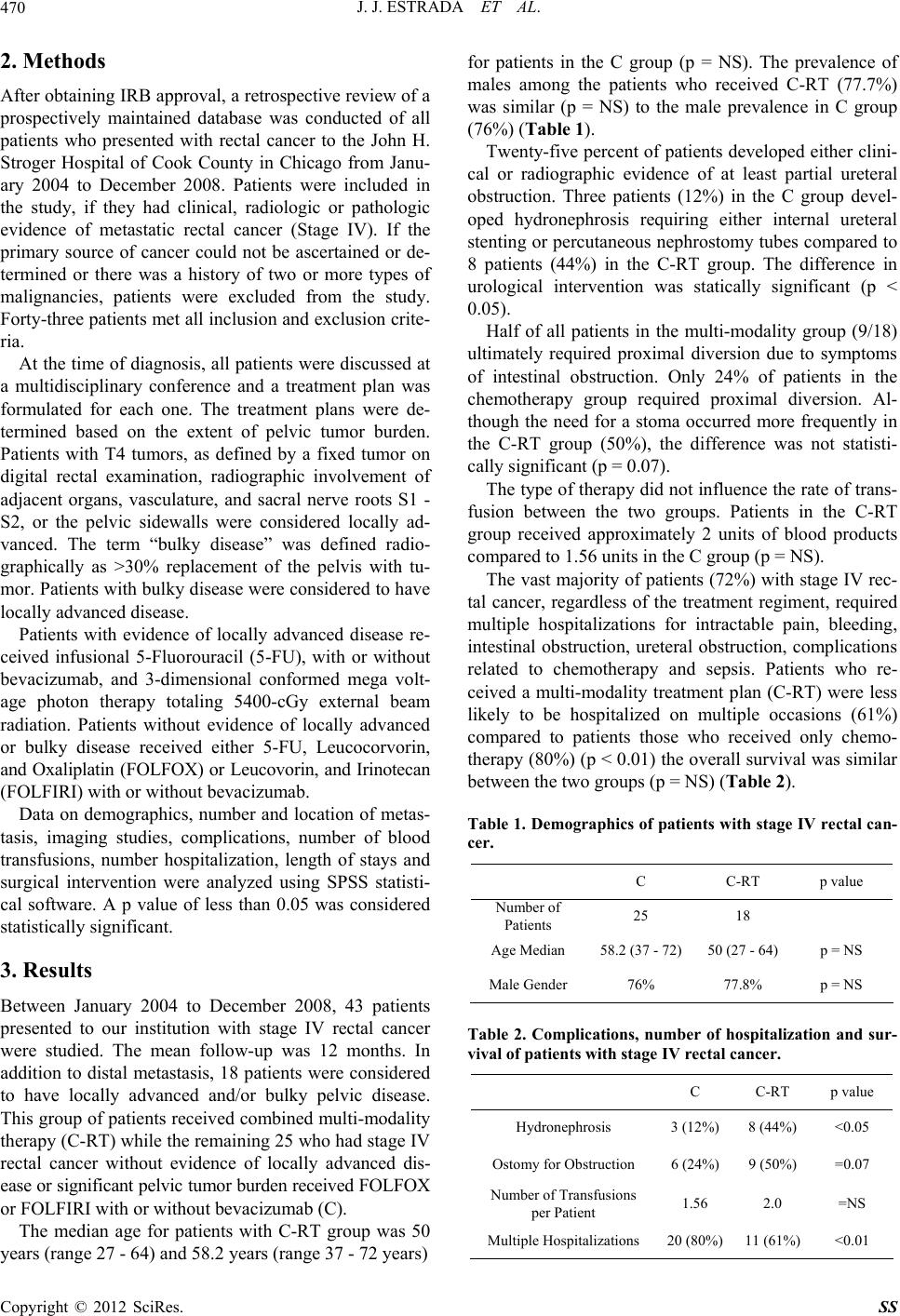 J. J. ESTRADA ET AL. 470 2. Methods After obtaining IRB approval, a retrospective review of a prospectively maintained database was conducted of all patients who presented with rectal cancer to the John H. Stroger Hospital of Cook County in Chicago from Janu- ary 2004 to December 2008. Patients were included in the study, if they had clinical, radiologic or pathologic evidence of metastatic rectal cancer (Stage IV). If the primary source of cancer could not be ascertained or de- termined or there was a history of two or more types of malignancies, patients were excluded from the study. Forty-three patients met all inclusion and exclusion crite- ria. At the time of diagnosis, all patients were discussed at a multidisciplinary conference and a treatment plan was formulated for each one. The treatment plans were de- termined based on the extent of pelvic tumor burden. Patients with T4 tumors, as defined by a fixed tumor on digital rectal examination, radiographic involvement of adjacent organs, vasculature, and sacral nerve roots S1 - S2, or the pelvic sidewalls were considered locally ad- vanced. The term “bulky disease” was defined radio- graphically as >30% replacement of the pelvis with tu- mor. Patients with bulky d isease were considered to hav e locally advanced disease. Patients with evidence of locally advanced disease re- ceived infusional 5-Fluorouracil (5-FU), with or without bevacizumab, and 3-dimensional conformed mega volt- age photon therapy totaling 5400-cGy external beam radiation. Patients without evidence of locally advanced or bulky disease received either 5-FU, Leucocorvorin, and Oxaliplatin (FOLFOX) or Leucovorin, and Irinotecan (FOLFIRI) with or without bevacizumab. Data on demographics, number and location of metas- tasis, imaging studies, complications, number of blood transfusions, number hospitalization, length of stays and surgical intervention were analyzed using SPSS statisti- cal software. A p value of less than 0.05 was considered statistically significant. 3. Results Between January 2004 to December 2008, 43 patients presented to our institution with stage IV rectal cancer were studied. The mean follow-up was 12 months. In addition to distal metastasis, 18 patients were considered to have locally advanced and/or bulky pelvic disease. This group of patients received combined multi-modality therapy (C-RT) while the remain ing 25 who had stage IV rectal cancer without evidence of locally advanced dis- ease or significant pelvic tumor burden received FOLFOX or FOLFIRI w i t h o r without bevacizumab (C). The median age for patients with C-RT group was 50 years (range 27 - 64) and 58.2 years (range 37 - 72 years) for patients in the C group (p = NS). The prevalence of males among the patients who received C-RT (77.7%) was similar (p = NS) to the male prevalence in C group (76%) (Table 1). Twenty-five percent of patients developed either clini- cal or radiographic evidence of at least partial ureteral obstruction. Three patients (12%) in the C group devel- oped hydronephrosis requiring either internal ureteral stenting or percutaneous nephrostomy tubes compared to 8 patients (44%) in the C-RT group. The difference in urological intervention was statically significant (p < 0.05). Half of all patients in the multi-modality group (9/18) ultimately required proximal diversion due to symptoms of intestinal obstruction. Only 24% of patients in the chemotherapy group required proximal diversion. Al- though the need for a stoma occurred more frequently in the C-RT group (50%), the difference was not statisti- cally significant (p = 0.07). The type of therapy did not influence the rate of trans- fusion between the two groups. Patients in the C-RT group received approximately 2 units of blood products compared to 1.56 units in the C group (p = NS). The vast majority of patients (72%) with stage IV rec- tal cancer, regardless of the treatment regiment, required multiple hospitalizations for intractable pain, bleeding, intestinal obstruction, ureteral obstruction, complications related to chemotherapy and sepsis. Patients who re- ceived a multi-modality treatment plan (C-RT) were less likely to be hospitalized on multiple occasions (61%) compared to patients those who received only chemo- therapy (80%) (p < 0.01) the overall surv ival was similar between the two groups (p = NS) (Table 2). Table 1. Demographics of patients with stage IV rectal can- cer. C C-RT p value Number of Patients 25 18 Age Median 58.2 (37 - 72) 50 (27 - 64) p = NS Male Gender 76% 77.8% p = NS Table 2. Complications, number of hospitalization and sur- vival of patients with stage IV rectal cancer. C C-RT p value Hydronephrosis 3 (12%) 8 (44%) <0.05 Ostomy for Obstruction 6 (24%) 9 (50%) =0.07 Number of Transfusions per Patient 1.56 2.0 =NS Multiple Hospitalizations 20 (80%) 11 (61%) <0.01 Copyright © 2012 SciRes. SS  J. J. ESTRADA ET AL. 471 4. Discussion The management of rectal cancer has dramatically changed of the last 30 years. The use of neo-adjuvant therapy and total mesorectal excision has significantly improved the overall survival for patients diagnosed with rectal cancer [10-13]. The treatment algorithms for pa- tients with potentially curable disease have been well established and effective. Despite maximal treatment, the overall survival for patients with stage IV disease re- mains poor. Furthermore, many patients spend a signifi- cant number of their last days hospitalized for the man- agement of complications related to their disease. The optimal treatment strategies for these patients remain controversial. While many studies have focused on de- termining which treatment maximizes the overall sur- vival, few have focused on the implication of a recom- mended treatment on the patients quality life. It has been well documented [11,14-17] that radiation therapy improves palliation in patients with unresectable rectal cancer with regards to pain and bleeding. But pa- tients may still require frequent hospitalization for the management of other complications. In our series, 72% of all patients required multiple impatient hospital visits. Fewer patients required multiple hospitalizations when they received a combination of chemotherapy and radia- tion rather than chemotherapy alone 61% vs. 80% (p < 0.01). This finding was somewhat surprising because the patients who received multi-modality therapy tended to have a significant tumor burden in the pelvis. This is clearly evidenced by the fact that more patients in the C-RT required proximal fecal diversion ureteral instru- mentation, and blood transfusions. However, despite these findings, patients required fewer inpatient hospital visits. One potential reason for the fewer observed inpatient hospitalizations could be explained by the greater length of stay (LOS) for the C-RT group. The mean LOS was almost twice as long for the patients in the C-RT group (17.3 vs. 8.9 days). However, three patients with ex- tremely advanced disease dramatically influenced the LOS. The mean LOS for these three patients was 78 days. When these three patients are excluded, the LOS for the C-RT group is 5.2 days. While hospice services were suggested for the patients with the most advance disease, these three patients elected to pursue a more aggressive treatment strategy. Although, formal qu ality of life surveys were not used in this study, one may infer that less hosp ital visits could translate into an improved quality of life. Larger pro- spective randomized studies are needed to investigate and validate this finding . 5. Conclusion Chemo-radiation for patients with locally advanced un- resectable stage IV rectal cancer is not a well established protocol. In our series patients treated with C-RT for bulky stage IV rectal cancer required fewer hospitaliza- tions when compared to stage IV rectal cancer patients treated with chemotherapy alone. In the properly selected patient, fewer hospital visits may improve the quality of life of patients with unresectable stage IV rectal cancer. REFERENCES [1] American Cancer Society, “Colorectal Cancer Facts & Figures 2011-2013,” American Cancer Society, Atlanta, 2011. [2] S. M. Ronnekleiv-Kelly and G. D. Kennedy, “Manage- ment of Stage IV Rectal Cancer: Palliative Options,” World Journal of Gastroenterology, Vol. 17, No. 7, 2011, pp. 835-847. doi:10.3748/wjg.v17.i7.835 [3] A. Jemal, R. Siegel, E. Ward, Y. Hao, J. Xu and M. J. Thun, “Cancer Statistics, 2009,” CA: A Cancer Journal for Clinicians, Vol. 59, No. 4, 2009, pp. 225-249. doi:10.3322/caac.20006 [4] R. Stangl, A. Altendorf-Hofmann, R. M. Charnley and J. Scheele, “Factors Influencing the Natural History of Co- lorectal Liver Metastases,” Lancet, Vol. 343, No. 8910, 1994, pp. 1405-1410. doi:10.1016/S0140-6736(94)92529-1 [5] R. J. Heald and R. D. H. Ryall, “Recurrence and Survival after Total Mesorectal Excision for Rectal Cancer,” Lan- cet, Vol. 327, No. 8496, 1986, pp. 1479-1482. doi:10.1016/S0140-6736(86)91510-2 [6] J. K. MacFarlane, R. D. H. Ryall and R. J. Heald, “Me- sorectal Excision for Rectal Cancer,” Lancet, Vol. 341, No. 8843, 1993, pp. 457-460. doi:10.1016/0140-6736(93)90207-W [7] Swedish Rectal Cancer Trial, “Improved Survival with Preoperative Radiotherapy in Resectable Rectal Cancer,” The New England Journal of Medicine, Vol. 336, No. 14, 1997, pp. 980-987. doi:10.1056/NEJM199704033361402 [8] C. Camma, M. Giunta, F. Fiorica, et al., “Preoperative Radiotherapy for Resectable Rectal Cancer: A Meta-Ana- lysis,” Journal of American Medical Association, Vol. 284, No. 8, 2000, pp. 1008-1015. doi:10.1001/jama.284.8.1008 [9] A. DeGramont, J. F. Bosset, C. Milan, P. Rougier, O. Bouché, P. L. Etienne, F. Morvan, C. Louvet, T. Guillot, E. François and L. Bedenne, “Randomized Trial Com- paring Monthly Low-Dose Leucovorin and Fluorouracil Bolus with Bimonthly High-Dose Leucovorin and Fluo- rouracil Bolus Plus Continuous Infusion for Advanced Colorectal Cancer: A French Intergroup Study,” Journal of Clinical Oncology, Vol. 15, No. 2, 1997, pp. 808-815. [10] T. Kramer, R. Share, K. Kiel, et al., “Intraoperative Ra- diation Therapy of Colorectal Cancer,” In: M. Abe, Ed., Intraoperative Radiation Therapy, Pergamon Press, New York, 1991, pp. 308-310. [11] I. D. Nagtegaal, C. A. Marijnen, E. K. Kranenbarg, et al., “Circumferential Margin Involvement Is Still an Impor- tant Predictor of Local Recurrence in Rectal Carcinoma: Copyright © 2012 SciRes. SS  J. J. ESTRADA ET AL. Copyright © 2012 SciRes. SS 472 Not One Millimeter But Two Millimeters Is the Limit,” American Journal of Surgical Pathology, Vol. 26, No. 3, 2002, pp. 350-357. doi:10.1097/00000478-200203000-00009 [12] A. Wibe, P. R. Rendedal, E. Svensson, et al., “Prognostic Significance of the Circumferential Resection Margin Following Total Mesorectal Excision for Rectal Cancer,” British Journal of Surgery, Vol. 89, No. 3, 2002, pp. 327- 334. doi:10.1046/j.0007-1323.2001.02024.x [13] J. F. Bosset, L. Collette, G. Calais, et al., “Chemotherapy with Preoperative Radiotherapy in Rectal Cancer,” The New England Journal of Medicine, Vol. 355, No. 11, 2006, pp. 1114-1123. doi:10.1056/NEJMoa060829 [14] R. K. Wong, V. Tandan, S. De Silva, A. Figueredo, “Pre- Operative Radiotherapy and Curative Surgery for the Ma- nagement of Localized Rectal Carcinoma, ” Cochrane Da- tabase Systematic Reviews, Vol. 2, No. 2, 2007, Article ID: CD 002102. [15] C. G. Willett and L. L. Gunderson, “Palliative Treatment of Rectal Cancer: Is Radiotherapy Alone a Good Op- tion?” Journal of Gastrointestinal Surgery, Vol. 8, No. 3, 2004, pp. 277-279. doi:10.1016/j.gassur.2003.11.015 [16] S. H. Bae, W. Park, D. H. Choi, H. Nam, W. K. Kang, Y. S. Park, J. O. Park, H. K. Chun, W. Y. Lee, S. H. Yun and H. C. Kim, “Palliative Radiotherapy in Patients with a Symptomatic Pelvic Mass of Metastatic Colorectal Can- cer,” Radiation Oncolo gy, Vol. 6, No. 52, 2011, pp. 1-8. doi:10.1186/1748-717X-6-52 [17] A. Suppiah, J. E. Hartley and J. R. Monson, “Advances in Radiotherapy in Operable Rectal Cancer,” Digestive Sur- gery, Vol. 26, No. 3, 2009, pp. 187-199. doi:10.1159/000219931 |