

Paper Menu >>
Journal Menu >>
 Vol.3, No.6, 816-821 (2012) Agricultural Sciences http://dx.doi.org/10.4236/as.2012.36099 Required amounts of medium and fertilizer for potted culture of zucchini Hiromi Ikeura*, Takahiko Tokuda, Yasuyoshi Hayata School of Agriculture, Meiji University, Kanagawa, Japan; *Corresponding Author: [email protected] Received 23 July 2012; revised 29 August 2012; accepted 13 September 2012 ABSTRACT In Japan, zucchini culture has yet to get under- way, and the current costs of zucchini can be attributed to damage from soil-borne disease and the unstable yields due to seasonal change of female flowers. Eradication of these problems will lead to st able supply and a conse quent price reduction of zucchini fruits. We previously clari- fied the efficacy of potted culture as a new cul- ture method for zucchini, but potted culture can be burdensome as the weak water and nutrient retention capacity of the medium warrants its regular replacement. To solve this problem, in this study, we investigated the blend ratio for mixing rice husk charcoal with peat and the amount of fertilizer required for potted culture of zucchini. Results revealed no significant differ- ences in the length of the largest leaf, total number of flowers, number of female flowers, and the ratio of female flowers to total flowers with different blend ratios of rice husk charcoal to peat. However, the number of harvested fruits increased with higher ratios of rice husk char- coal to peat and was highest at 80:20. The length of the largest leaf increased with increased amount s of fertilizer, with the best response was at 200 g. No significant differences were noted between the ratio of female flowers to total flowers in any treatments. In addition, the num- ber of harvested fruits was highest with 160 g and 200 g of fertilizer. Taken together, the opti- mal blend ratio of rice husk charcoal to peat is 80:20, and the optimal amount of fertilizer with this ratio is 160 g. Keywords: Zucchini; Rice Husk Charco al; Peat; Potted Culture; Fertilizer 1. INTRODUCTION In Japan, large-scale zucchini culture has yet to get underway, and the current costs of zucchini makes wide- spread distribution prohibitive. The high cost of zucchini can be attributed to damage from soil-borne disease and the unstable yields due to seasonal change of female flowers. Eradication of these problems will lead to stable supply and a consequent price reduction of zucchini fruits, which will open the door for zucchini business prospects. Generally, zucchini is produced open culture, but the culture methods and cultivars are not established due to difference environmental condition in some areas. Espe- cially, planting density in zucchini culture is important to prevent soil-borne disease. In fact, interstrain used in zucchini culture was from 50 cm to 100 cm, and different by producers or areas. There are many reports about study to demonstrate optimum interstrain and cultivar in zucchini culture [1]. We previously clarified the efficacy of potted culture as a new culture method for zucchini [2]. However, pot- ted culture can be burdensome as the weak water and nutrient retention capacity of the medium warrants its regular replacement. To solve this problem, we consid- ered using rice husk charcoal and peat moss as a medium as both are organic materials with a high cation exchange capacity and are often used as a medium in soilless cul- ture [3-9]. Rice husk charcoal and peat moss have been studied for recycling and the subsequent reclamation of solid and organic residues produced in agriculture, fam- ing, forestry, and industry, and they are also being suc- cessfully used as container media for ornamental plant production [9,10]. In addition, these organic materials are available for compost after use and are easily applied in the field [10,11]. In particular, rice husk charcoal is made from burning rice husks, which are generated from har- vested rice, the principal food in Japan and Thailand [12]. In addition, rice husks are typically utilized as a medium for ornamental crops (e.g., Chrysanthemum morifolium) and as soil cover for protecting rice in nurseries by cov- ering with oil paper. Such uses are common because rice husk charcoal is affordable, has high cation exchange and aeration properties, has good moisture retentiveness due to its porosity, and mixes well with other substances [4,13,14]. Moreover, Inden and Torres (2004) [14] re- Copyright © 2012 SciRes. OPEN ACCESS  H. Ikeura et al. / Agricultural Sciences 3 (2012) 816-821 817 ported an increase in yield and total soluble solid content in tomato when using coconut coir or perlite plus car- bonized rice hulls as a growth substrate. Islam (2008) [15] described focusing on good aeration and lightweight properties and thereby found rise husk charcoal to be a suitable medium for soilless culture. Peat moss, which has high moisture and nutrient retentiveness as well as a high buffering ability, is particularly utilized as a growth medium for strawberry culture [5,16]. In this study, we investigated the effects of different ratios of rice husk charcoal to peat moss as a medium as well as the optimal amount of fertilizer required for zuc- chini potted culture. 2. MATERIALS AND METHODS 2.1. Culture Conditions Zucchini seeds “Diner” (Takii Co. Ltd., Kyoto, Japan) were planted in a plastic tray containing propagation medium (Coop Chemical Co. Ltd., Tokyo, Japan) and vermiculite (Showa vermiculite Co. Ltd., Kanagawa, Japan) (1:1). A hydroponic fertilizer (Otsuka house No. 1 and No. 2) diluted 2-fold in tap water (as a standard concentration) was added for propagation. Interstrain and interrow spaces after settled planting were 60 cm and 80 cm, respectively. Agrisheet was laid out in a greenhouse as the pots should not have contact with regular soil. Rice husk charcoal and peat were purchased from Berry’s life Co. (Kagawa, Japan) and Nichias Co. (Tokyo, Japan). Irrigation after settled planting was conducted at 3 L·pot−1 at 7 am daily. 2.2. Blend Ratio of Rice Husk Charcoal to Peat Culture was conducted in a greenhouse at Meiji Uni- versity from July 6, 2008 to October 28, 2008. Zucchini seeds were planted in 12-cm plastic pots (height 10 cm) containing propagation medium, and seedlings were cul- tured until developing 7 leaves. The plants were then settled in 30.5-cm plastic pots (height 30.5 cm; medium volume, 15 L; Kaneko Seed Co. Ltd., Gunma, Japan) on July 28, 2008. The following four blend ratios of rice husk charcoal to peat were set: 80:20, 60:40, 40:60, and 20:80. Eighty grams of delayed release fertilizer, Ecolong 424 (N:P:K = 14:12:13, JCAM AGRI. Co., Ltd., Tokyo, Japan), and 210 g of compost (Fujimi group, Sizuoka, Japan) were added, and the pH of each medium was adjusted to the same level (pH 6.5) by adding 7 g of magnesium lime (Aiko Sekkai Co., Tochigi, Japan) for 80:20 and 60:40 and 120 g of magnesium lime for 40:60 and 20:80. After adding each medium, fertilizer, compost, and water were mixed in a soil mixer and drained. All experiments were replicated 3 times, with 10 plants per replicate. 2.3. Amount of Fertilizer Culture was conducted from August 11, 2009 to De- cember 15, 2009 under the same conditions with differ- ent blend ratios of rice husk charcoal to peat. Plants were settled in 30.5-cm plastic pots on August 29, 2009. The following four amounts of fertilizer were set: 80 g, 120 g, 160 g, and 200 g. Based in the results of the above ex- periments, the most appropriate ratio of medium was mixed to a volume of 15 L. Other applied fertilizers were 210 g of compost and 7 g of magnesium lime. All ex- periments were replicated 3 times, with 10 plants per replicate. Growth, Pollination, and Harvest The length of the largest leaf, the total number of flowers, and the number of female flowers were meas- ured once every 7 days to establish the female flower to total flower ratio. Pollination was conducted at 8 - 9 am, and fruits were harvested at a size with a market value (16 - 19 cm). 2.4. Statistical Analysis Data are presented as mean and standard error values, and statistical differences between treatments were tested using the Tukey-Kramer test at P < 0.05. 3. RESULTS AND DISCUSSION The effect of different ratios of rice husk charcoal to peat on zucchini growth is shown in Table 1. There was no significant difference in the length of the largest leaf, total number of flowers, number of female flowers, or the ratio of female flowers to the total number of flowers. The number of harvested fruits per pot was 2.8 with 20:80, 2.7 with 40:60, 4.2 with 60:40, and 4.8 with 80:20, respectively; an obvious increasing trend with increasing rice husk charcoal (Figure 1). Endo et al. (2006) [16] demonstrated the effects of root zone substrates consist- ing of coir and peat mixture on the growth and yield of strawberry and indicated that the marketable yield of strawberries increased with decreasing peat ratios. Islam (2008) [15] described that rice husk charcoal gave simi- lar and/or better crop performance and yield of tomatoes than rock wool under high-temperature stress conditions (30˚C and 35˚C versus 25˚C), which showed that rice husk charcoal can be used successfully as a growing me- dium amendment for producing greenhouse tomato as well as other nursery crops. Promchot and Boonprakob (2007) [12] reported that rice husk charcoal was better than agar for embryo culture of nectarines and that it may be a substitute for vermiculite. Thus, rice husk Copyright © 2012 SciRes. OPEN ACCESS 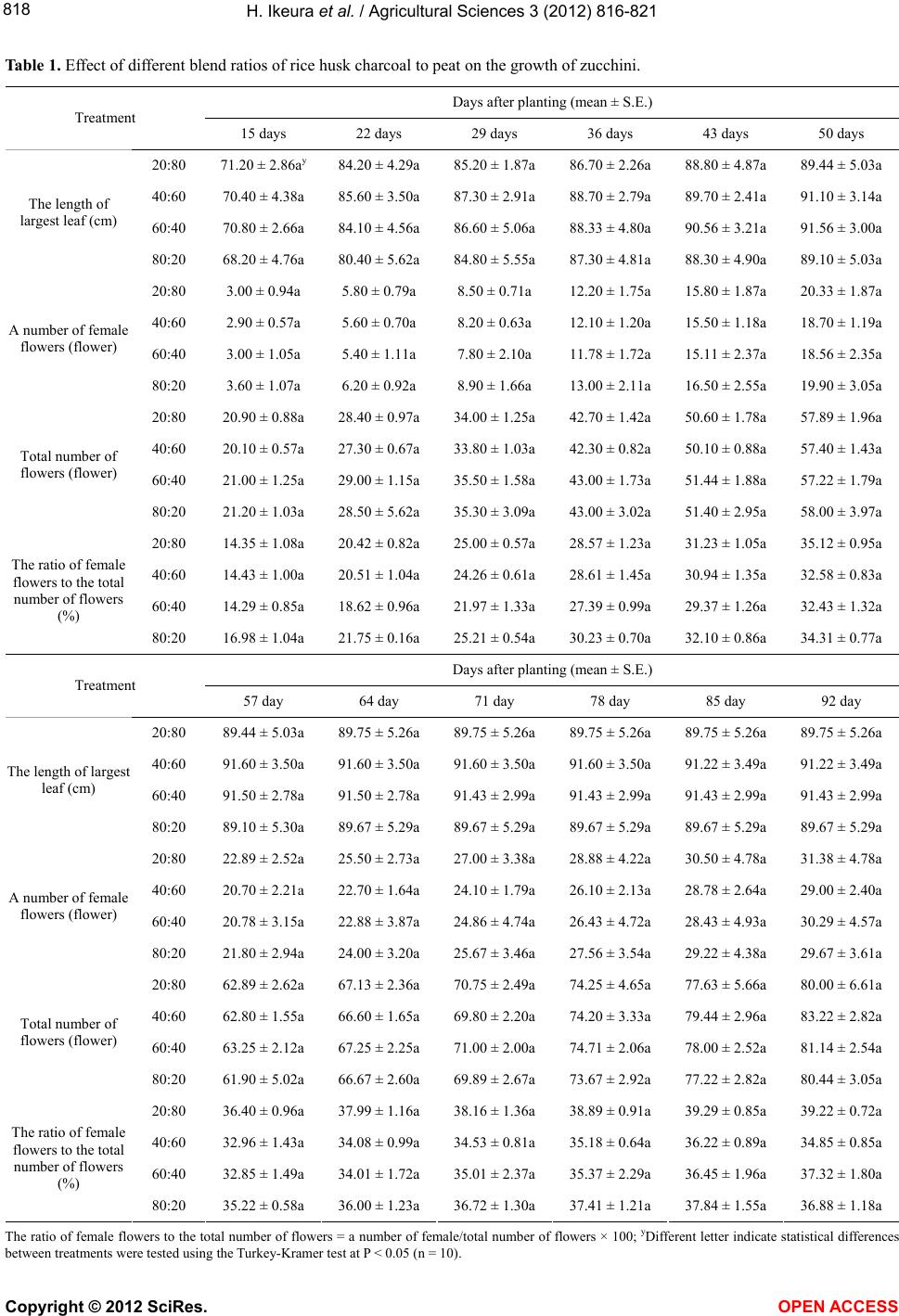 H. Ikeura et al. / Agricultural Sciences 3 (2012) 816-821 Copyright © 2012 SciRes. OPEN ACCESS 818 Table 1. Effect of different blend ratios of rice husk charcoal to peat on the growth of zucchini. Days after planting (mean ± S.E.) Treatment 15 days 22 days 29 days 36 days 43 days 50 days 20:80 71.20 ± 2.86ay 84.20 ± 4.29a 85.20 ± 1.87a 86.70 ± 2.26a 88.80 ± 4.87a 89.44 ± 5.03a 40:60 70.40 ± 4.38a 85.60 ± 3.50a 87.30 ± 2.91a 88.70 ± 2.79a 89.70 ± 2.41a 91.10 ± 3.14a 60:40 70.80 ± 2.66a 84.10 ± 4.56a 86.60 ± 5.06a 88.33 ± 4.80a 90.56 ± 3.21a 91.56 ± 3.00a The length of largest leaf (cm) 80:20 68.20 ± 4.76a 80.40 ± 5.62a 84.80 ± 5.55a 87.30 ± 4.81a 88.30 ± 4.90a 89.10 ± 5.03a 20:80 3.00 ± 0.94a 5.80 ± 0.79a 8.50 ± 0.71a 12.20 ± 1.75a 15.80 ± 1.87a 20.33 ± 1.87a 40:60 2.90 ± 0.57a 5.60 ± 0.70a 8.20 ± 0.63a 12.10 ± 1.20a 15.50 ± 1.18a 18.70 ± 1.19a 60:40 3.00 ± 1.05a 5.40 ± 1.11a 7.80 ± 2.10a 11.78 ± 1.72a 15.11 ± 2.37a 18.56 ± 2.35a A number of female flowers (flower) 80:20 3.60 ± 1.07a 6.20 ± 0.92a 8.90 ± 1.66a 13.00 ± 2.11a 16.50 ± 2.55a 19.90 ± 3.05a 20:80 20.90 ± 0.88a 28.40 ± 0.97a 34.00 ± 1.25a 42.70 ± 1.42a 50.60 ± 1.78a 57.89 ± 1.96a 40:60 20.10 ± 0.57a 27.30 ± 0.67a 33.80 ± 1.03a 42.30 ± 0.82a 50.10 ± 0.88a 57.40 ± 1.43a 60:40 21.00 ± 1.25a 29.00 ± 1.15a 35.50 ± 1.58a 43.00 ± 1.73a 51.44 ± 1.88a 57.22 ± 1.79a Total number of flowers (flower) 80:20 21.20 ± 1.03a 28.50 ± 5.62a 35.30 ± 3.09a 43.00 ± 3.02a 51.40 ± 2.95a 58.00 ± 3.97a 20:80 14.35 ± 1.08a 20.42 ± 0.82a 25.00 ± 0.57a 28.57 ± 1.23a 31.23 ± 1.05a 35.12 ± 0.95a 40:60 14.43 ± 1.00a 20.51 ± 1.04a 24.26 ± 0.61a 28.61 ± 1.45a 30.94 ± 1.35a 32.58 ± 0.83a 60:40 14.29 ± 0.85a 18.62 ± 0.96a 21.97 ± 1.33a 27.39 ± 0.99a 29.37 ± 1.26a 32.43 ± 1.32a The ratio of female flowers to the total number of flowers (%) 80:20 16.98 ± 1.04a 21.75 ± 0.16a 25.21 ± 0.54a 30.23 ± 0.70a 32.10 ± 0.86a 34.31 ± 0.77a Days after planting (mean ± S.E.) Treatment 57 day 64 day 71 day 78 day 85 day 92 day 20:80 89.44 ± 5.03a 89.75 ± 5.26a 89.75 ± 5.26a 89.75 ± 5.26a 89.75 ± 5.26a 89.75 ± 5.26a 40:60 91.60 ± 3.50a 91.60 ± 3.50a 91.60 ± 3.50a 91.60 ± 3.50a 91.22 ± 3.49a 91.22 ± 3.49a 60:40 91.50 ± 2.78a 91.50 ± 2.78a 91.43 ± 2.99a 91.43 ± 2.99a 91.43 ± 2.99a 91.43 ± 2.99a The length of largest leaf (cm) 80:20 89.10 ± 5.30a 89.67 ± 5.29a 89.67 ± 5.29a 89.67 ± 5.29a 89.67 ± 5.29a 89.67 ± 5.29a 20:80 22.89 ± 2.52a 25.50 ± 2.73a 27.00 ± 3.38a 28.88 ± 4.22a 30.50 ± 4.78a 31.38 ± 4.78a 40:60 20.70 ± 2.21a 22.70 ± 1.64a 24.10 ± 1.79a 26.10 ± 2.13a 28.78 ± 2.64a 29.00 ± 2.40a 60:40 20.78 ± 3.15a 22.88 ± 3.87a 24.86 ± 4.74a 26.43 ± 4.72a 28.43 ± 4.93a 30.29 ± 4.57a A number of female flowers (flower) 80:20 21.80 ± 2.94a 24.00 ± 3.20a 25.67 ± 3.46a 27.56 ± 3.54a 29.22 ± 4.38a 29.67 ± 3.61a 20:80 62.89 ± 2.62a 67.13 ± 2.36a 70.75 ± 2.49a 74.25 ± 4.65a 77.63 ± 5.66a 80.00 ± 6.61a 40:60 62.80 ± 1.55a 66.60 ± 1.65a 69.80 ± 2.20a 74.20 ± 3.33a 79.44 ± 2.96a 83.22 ± 2.82a 60:40 63.25 ± 2.12a 67.25 ± 2.25a 71.00 ± 2.00a 74.71 ± 2.06a 78.00 ± 2.52a 81.14 ± 2.54a Total number of flowers (flower) 80:20 61.90 ± 5.02a 66.67 ± 2.60a 69.89 ± 2.67a 73.67 ± 2.92a 77.22 ± 2.82a 80.44 ± 3.05a 20:80 36.40 ± 0.96a 37.99 ± 1.16a 38.16 ± 1.36a 38.89 ± 0.91a 39.29 ± 0.85a 39.22 ± 0.72a 40:60 32.96 ± 1.43a 34.08 ± 0.99a 34.53 ± 0.81a 35.18 ± 0.64a 36.22 ± 0.89a 34.85 ± 0.85a 60:40 32.85 ± 1.49a 34.01 ± 1.72a 35.01 ± 2.37a 35.37 ± 2.29a 36.45 ± 1.96a 37.32 ± 1.80a The ratio of female flowers to the total number of flowers (%) 80:20 35.22 ± 0.58a 36.00 ± 1.23a 36.72 ± 1.30a 37.41 ± 1.21a 37.84 ± 1.55a 36.88 ± 1.18a The ratio of female flowers to the total number of flowers = a number of female/total number of flowers × 100; yDifferent letter indicate statistical differences etween treatments were tested using the Turkey-Kramer test at P < 0.05 (n = 10). b 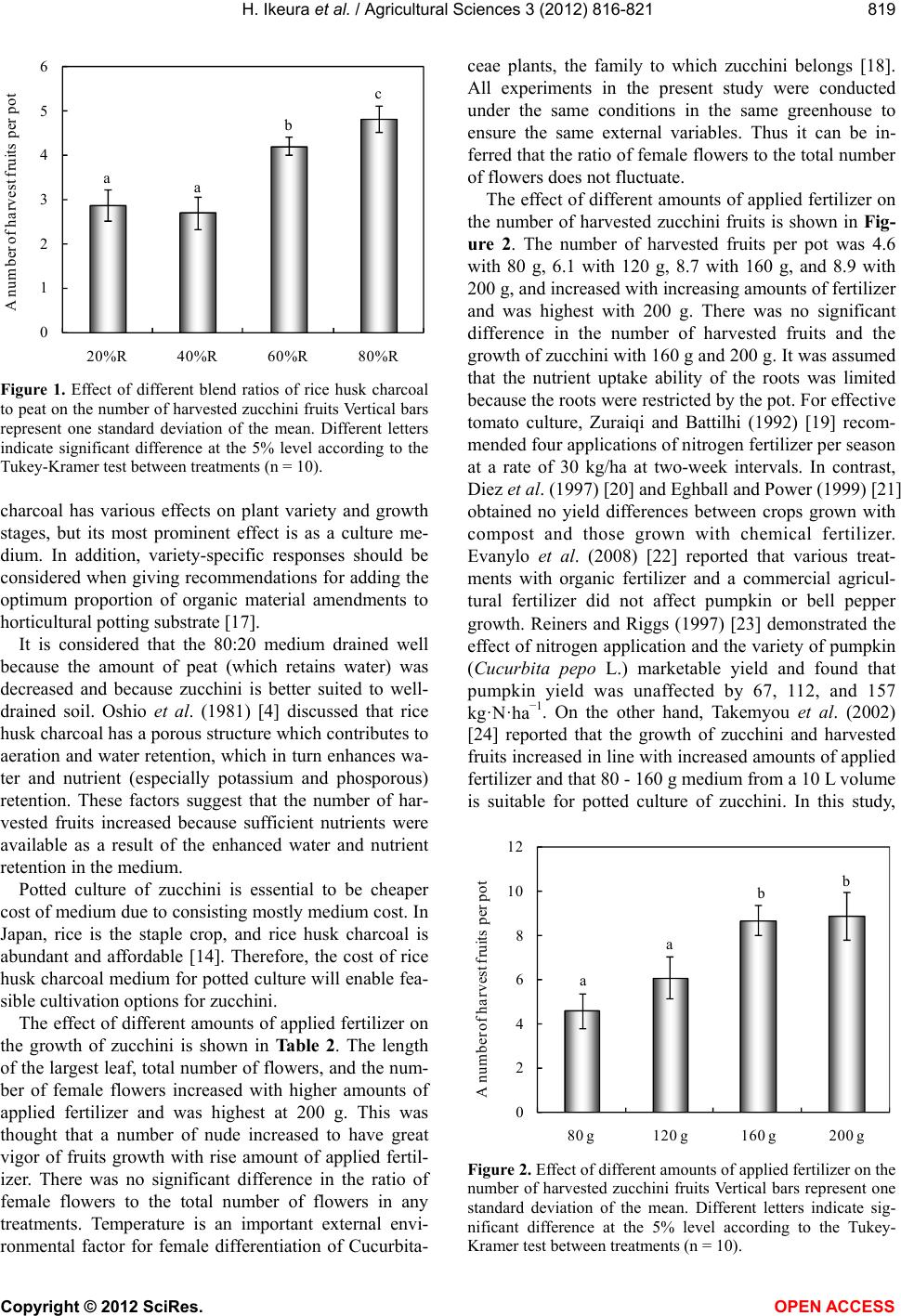 H. Ikeura et al. / Agricultural Sciences 3 (2012) 816-821 819 aa b c 0 1 2 3 4 5 6 20%R 40%R 60%R 80%R A number of harvest fruits per pot Figure 1. Effect of different blend ratios of rice husk charcoal to peat on the number of harvested zucchini fruits Vertical bars represent one standard deviation of the mean. Different letters indicate significant difference at the 5% level according to the Tukey-Kramer test between treatments (n = 10). charcoal has various effects on plant variety and growth stages, but its most prominent effect is as a culture me- dium. In addition, variety-specific responses should be considered when giving recommendations for adding the optimum proportion of organic material amendments to horticultural potting substrate [17]. It is considered that the 80:20 medium drained well because the amount of peat (which retains water) was decreased and because zucchini is better suited to well- drained soil. Oshio et al. (1981) [4] discussed that rice husk charcoal has a porous structure which contributes to aeration and water retention, which in turn enhances wa- ter and nutrient (especially potassium and phosporous) retention. These factors suggest that the number of har- vested fruits increased because sufficient nutrients were available as a result of the enhanced water and nutrient retention in the medium. Potted culture of zucchini is essential to be cheaper cost of medium due to consisting mostly medium cost. In Japan, rice is the staple crop, and rice husk charcoal is abundant and affordable [14]. Therefore, the cost of rice husk charcoal medium for potted culture will enable fea- sible cultivation options for zucchini. The effect of different amounts of applied fertilizer on the growth of zucchini is shown in Ta b l e 2 . The length of the largest leaf, total number of flowers, and the num- ber of female flowers increased with higher amounts of applied fertilizer and was highest at 200 g. This was thought that a number of nude increased to have great vigor of fruits growth with rise amount of applied fertil- izer. There was no significant difference in the ratio of female flowers to the total number of flowers in any treatments. Temperature is an important external envi- ronmental factor for female differentiation of Cucurbita- ceae plants, the family to which zucchini belongs [18]. All experiments in the present study were conducted under the same conditions in the same greenhouse to ensure the same external variables. Thus it can be in- ferred that the ratio of female flowers to the total number of flowers does not fluctuate. The effect of different amounts of applied fertilizer on the number of harvested zucchini fruits is shown in Fig- ure 2. The number of harvested fruits per pot was 4.6 with 80 g, 6.1 with 120 g, 8.7 with 160 g, and 8.9 with 200 g, and increased with increasing amounts of fertilizer and was highest with 200 g. There was no significant difference in the number of harvested fruits and the growth of zucchini with 160 g and 200 g. It was assumed that the nutrient uptake ability of the roots was limited because the roots were restricted by the pot. For effective tomato culture, Zuraiqi and Battilhi (1992) [19] recom- mended four applications of nitrogen fertilizer per season at a rate of 30 kg/ha at two-week intervals. In contrast, Diez et al. (1997) [20] and Eghball and Power (1999) [21] obtained no yield differences between crops grown with compost and those grown with chemical fertilizer. Evanylo et al. (2008) [22] reported that various treat- ments with organic fertilizer and a commercial agricul- tural fertilizer did not affect pumpkin or bell pepper growth. Reiners and Riggs (1997) [23] demonstrated the effect of nitrogen application and the variety of pumpkin (Cucurbita pepo L.) marketable yield and found that pumpkin yield was unaffected by 67, 112, and 157 kg·N·ha−1. On the other hand, Takemyou et al. (2002) [24] reported that the growth of zucchini and harvested fruits increased in line with increased amounts of applied fertilizer and that 80 - 160 g medium from a 10 L volume is suitable for potted culture of zucchini. In this study, a a bb 0 2 4 6 8 10 12 80 g 120 g160 g200 g A number of harvest fruits per pot Figure 2. Effect of different amounts of applied fertilizer on the number of harvested zucchini fruits Vertical bars represent one standard deviation of the mean. Different letters indicate sig- nificant difference at the 5% level according to the Tukey- ramer test between treatments (n = 10). K Copyright © 2012 SciRes. OPEN ACCESS 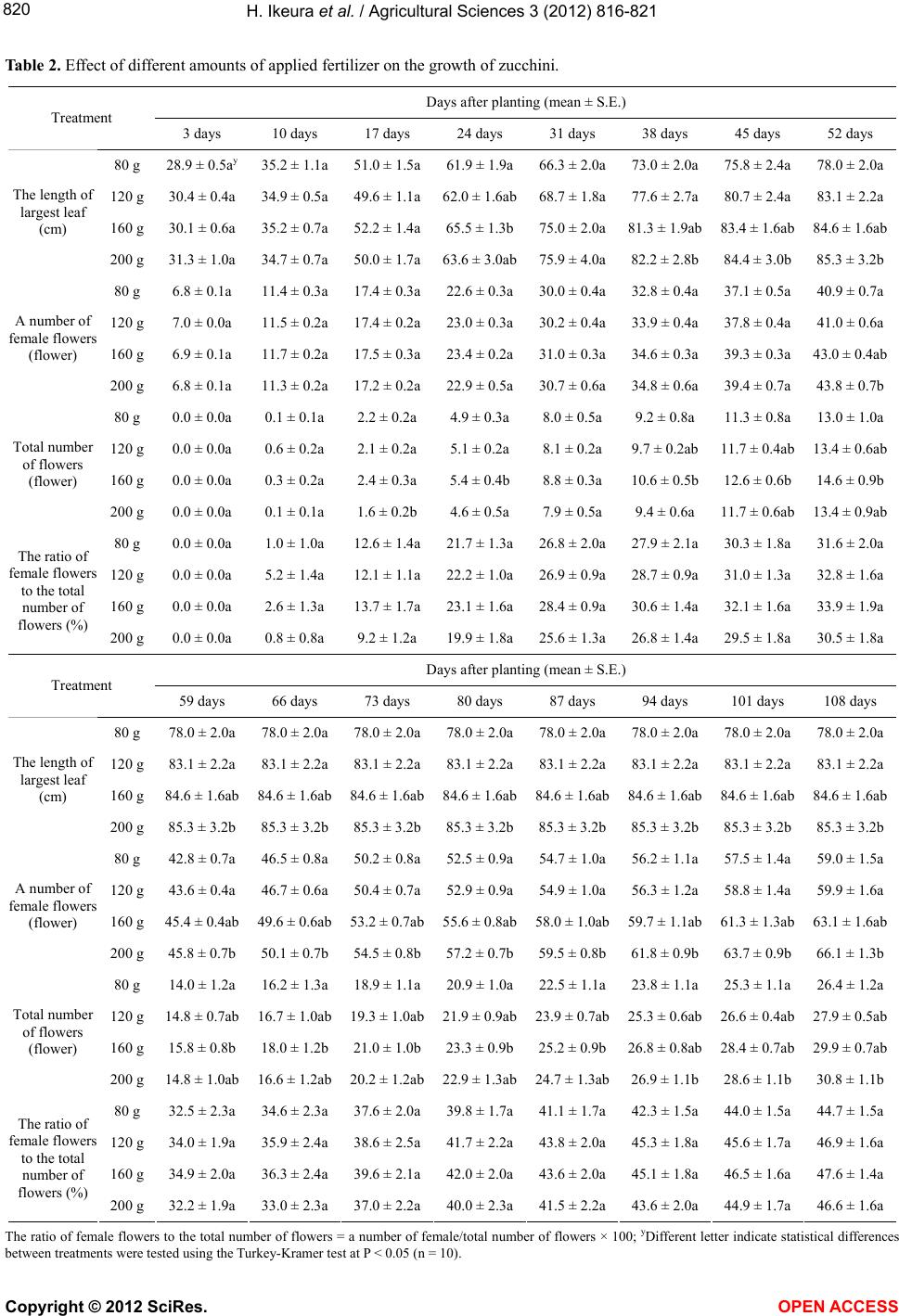 H. Ikeura et al. / Agricultural Sciences 3 (2012) 816-821 820 Table 2. Effect of different amounts of applied fertilizer on the growth of zucchini. Days after planting (mean ± S.E.) Treatment 3 days 10 days 17 days 24 days 31 days 38 days 45 days 52 days 80 g 28.9 ± 0.5ay35.2 ± 1.1a 51.0 ± 1.5a61.9 ± 1.9a66.3 ± 2.0a73.0 ± 2.0a 75.8 ± 2.4a 78.0 ± 2.0a 120 g 30.4 ± 0.4a34.9 ± 0.5a 49.6 ± 1.1a62.0 ± 1.6ab68.7 ± 1.8a77.6 ± 2.7a 80.7 ± 2.4a 83.1 ± 2.2a 160 g 30.1 ± 0.6a35.2 ± 0.7a 52.2 ± 1.4a65.5 ± 1.3b75.0 ± 2.0a81.3 ± 1.9ab 83.4 ± 1.6ab 84.6 ± 1.6ab The length of largest leaf (cm) 200 g 31.3 ± 1.0a34.7 ± 0.7a 50.0 ± 1.7a63.6 ± 3.0ab75.9 ± 4.0a82.2 ± 2.8b 84.4 ± 3.0b 85.3 ± 3.2b 80 g 6.8 ± 0.1a 11.4 ± 0.3a 17.4 ± 0.3a22.6 ± 0.3a30.0 ± 0.4a32.8 ± 0.4a 37.1 ± 0.5a 40.9 ± 0.7a 120 g 7.0 ± 0.0a 11.5 ± 0.2a 17.4 ± 0.2a23.0 ± 0.3a30.2 ± 0.4a33.9 ± 0.4a 37.8 ± 0.4a 41.0 ± 0.6a 160 g 6.9 ± 0.1a 11.7 ± 0.2a 17.5 ± 0.3a23.4 ± 0.2a31.0 ± 0.3a34.6 ± 0.3a 39.3 ± 0.3a 43.0 ± 0.4ab A number of female flowers (flower) 200 g 6.8 ± 0.1a 11.3 ± 0.2a 17.2 ± 0.2a22.9 ± 0.5a30.7 ± 0.6a34.8 ± 0.6a 39.4 ± 0.7a 43.8 ± 0.7b 80 g 0.0 ± 0.0a 0.1 ± 0.1a 2.2 ± 0.2a 4.9 ± 0.3a 8.0 ± 0.5a 9.2 ± 0.8a 11.3 ± 0.8a 13.0 ± 1.0a 120 g 0.0 ± 0.0a 0.6 ± 0.2a 2.1 ± 0.2a 5.1 ± 0.2a 8.1 ± 0.2a 9.7 ± 0.2ab 11.7 ± 0.4ab 13.4 ± 0.6ab 160 g 0.0 ± 0.0a 0.3 ± 0.2a 2.4 ± 0.3a 5.4 ± 0.4b 8.8 ± 0.3a 10.6 ± 0.5b 12.6 ± 0.6b 14.6 ± 0.9b Total number of flowers (flower) 200 g 0.0 ± 0.0a 0.1 ± 0.1a 1.6 ± 0.2b 4.6 ± 0.5a 7.9 ± 0.5a 9.4 ± 0.6a 11.7 ± 0.6ab 13.4 ± 0.9ab 80 g 0.0 ± 0.0a 1.0 ± 1.0a 12.6 ± 1.4a21.7 ± 1.3a26.8 ± 2.0a27.9 ± 2.1a 30.3 ± 1.8a 31.6 ± 2.0a 120 g 0.0 ± 0.0a 5.2 ± 1.4a 12.1 ± 1.1a22.2 ± 1.0a26.9 ± 0.9a28.7 ± 0.9a 31.0 ± 1.3a 32.8 ± 1.6a 160 g 0.0 ± 0.0a 2.6 ± 1.3a 13.7 ± 1.7a23.1 ± 1.6a28.4 ± 0.9a30.6 ± 1.4a 32.1 ± 1.6a 33.9 ± 1.9a The ratio of female flowers to the total number of flowers (%) 200 g 0.0 ± 0.0a 0.8 ± 0.8a 9.2 ± 1.2a 19.9 ± 1.8a25.6 ± 1.3a26.8 ± 1.4a 29.5 ± 1.8a 30.5 ± 1.8a Days after planting (mean ± S.E.) Treatment 59 days 66 days 73 days 80 days 87 days 94 days 101 days 108 days 80 g 78.0 ± 2.0a78.0 ± 2.0a 78.0 ± 2.0a78.0 ± 2.0a78.0 ± 2.0a78.0 ± 2.0a 78.0 ± 2.0a 78.0 ± 2.0a 120 g 83.1 ± 2.2a83.1 ± 2.2a 83.1 ± 2.2a83.1 ± 2.2a83.1 ± 2.2a83.1 ± 2.2a 83.1 ± 2.2a 83.1 ± 2.2a 160 g 84.6 ± 1.6ab84.6 ± 1.6ab 84.6 ± 1.6ab84.6 ± 1.6ab84.6 ± 1.6ab84.6 ± 1.6ab 84.6 ± 1.6ab 84.6 ± 1.6ab The length of largest leaf (cm) 200 g 85.3 ± 3.2b85.3 ± 3.2b 85.3 ± 3.2b85.3 ± 3.2b85.3 ± 3.2b85.3 ± 3.2b 85.3 ± 3.2b 85.3 ± 3.2b 80 g 42.8 ± 0.7a46.5 ± 0.8a 50.2 ± 0.8a52.5 ± 0.9a54.7 ± 1.0a56.2 ± 1.1a 57.5 ± 1.4a 59.0 ± 1.5a 120 g 43.6 ± 0.4a46.7 ± 0.6a 50.4 ± 0.7a52.9 ± 0.9a54.9 ± 1.0a56.3 ± 1.2a 58.8 ± 1.4a 59.9 ± 1.6a 160 g 45.4 ± 0.4ab49.6 ± 0.6ab 53.2 ± 0.7ab55.6 ± 0.8ab58.0 ± 1.0ab59.7 ± 1.1ab 61.3 ± 1.3ab 63.1 ± 1.6ab A number of female flowers (flower) 200 g 45.8 ± 0.7b50.1 ± 0.7b 54.5 ± 0.8b57.2 ± 0.7b59.5 ± 0.8b61.8 ± 0.9b 63.7 ± 0.9b 66.1 ± 1.3b 80 g 14.0 ± 1.2a16.2 ± 1.3a 18.9 ± 1.1a20.9 ± 1.0a22.5 ± 1.1a23.8 ± 1.1a 25.3 ± 1.1a 26.4 ± 1.2a 120 g 14.8 ± 0.7ab16.7 ± 1.0ab 19.3 ± 1.0ab21.9 ± 0.9ab23.9 ± 0.7ab25.3 ± 0.6ab 26.6 ± 0.4ab 27.9 ± 0.5ab 160 g 15.8 ± 0.8b18.0 ± 1.2b 21.0 ± 1.0b23.3 ± 0.9b25.2 ± 0.9b26.8 ± 0.8ab 28.4 ± 0.7ab 29.9 ± 0.7ab Total number of flowers (flower) 200 g 14.8 ± 1.0ab16.6 ± 1.2ab 20.2 ± 1.2ab22.9 ± 1.3ab24.7 ± 1.3ab26.9 ± 1.1b 28.6 ± 1.1b 30.8 ± 1.1b 80 g 32.5 ± 2.3a34.6 ± 2.3a 37.6 ± 2.0a39.8 ± 1.7a41.1 ± 1.7a42.3 ± 1.5a 44.0 ± 1.5a 44.7 ± 1.5a 120 g 34.0 ± 1.9a35.9 ± 2.4a 38.6 ± 2.5a41.7 ± 2.2a43.8 ± 2.0a45.3 ± 1.8a 45.6 ± 1.7a 46.9 ± 1.6a 160 g 34.9 ± 2.0a36.3 ± 2.4a 39.6 ± 2.1a42.0 ± 2.0a43.6 ± 2.0a45.1 ± 1.8a 46.5 ± 1.6a 47.6 ± 1.4a The ratio of female flowers to the total number of flowers (%) 200 g 32.2 ± 1.9a33.0 ± 2.3a 37.0 ± 2.2a40.0 ± 2.3a41.5 ± 2.2a43.6 ± 2.0a 44.9 ± 1.7a 46.6 ± 1.6a The ratio of female flowers to the total number of flowers = a number of female/total number of flowers × 100; yDifferent letter indicate statistical differences etween treatments were tested using the Turkey-Kramer test at P < 0.05 (n = 10). b Copyright © 2012 SciRes. OPEN ACCESS 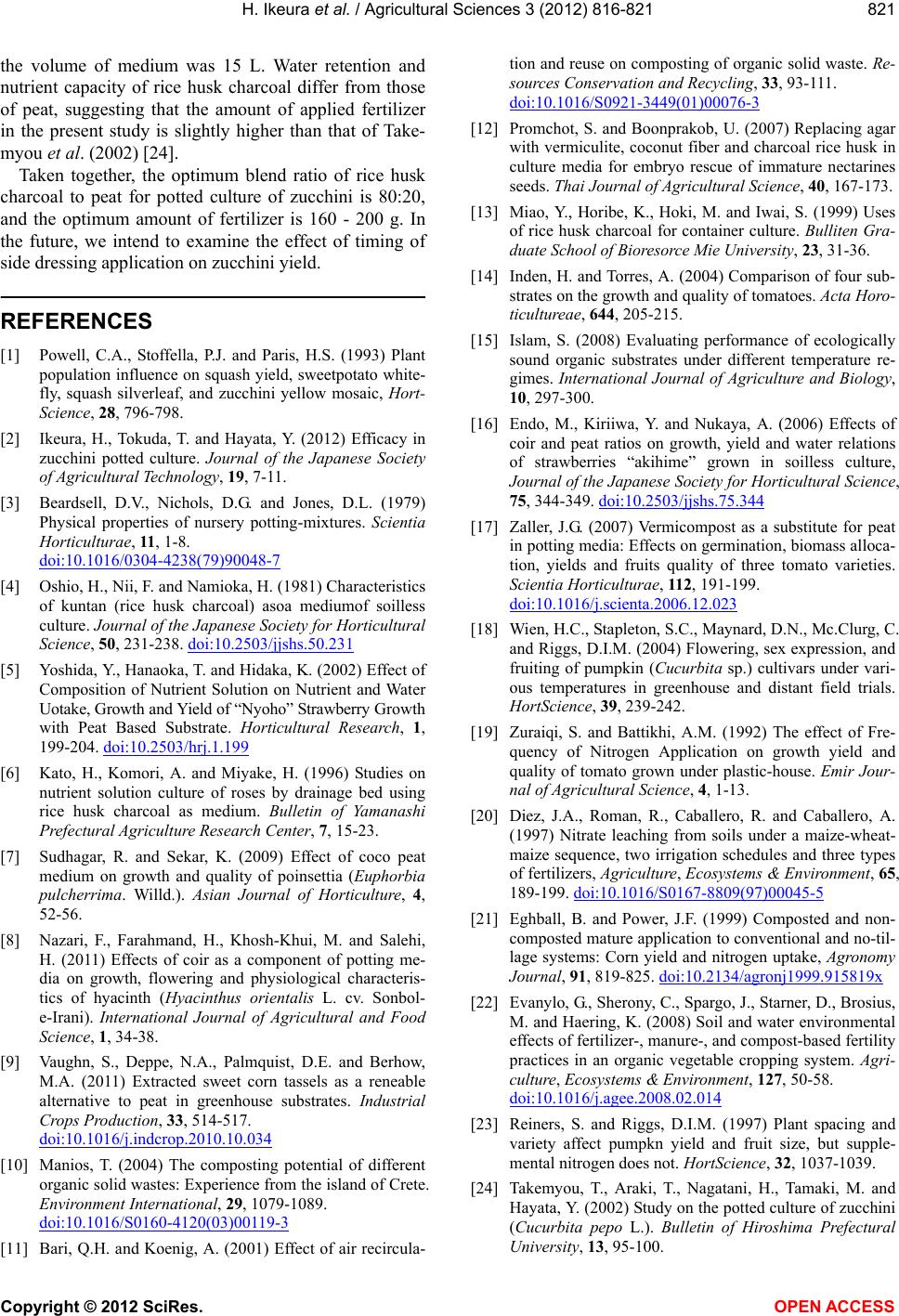 H. Ikeura et al. / Agricultural Sciences 3 (2012) 816-821 821 the volume of medium was 15 L. Water retention and nutrient capacity of rice husk charcoal differ from those of peat, suggesting that the amount of applied fertilizer in the present study is slightly higher than that of Take- myou et al. (2002) [24]. Taken together, the optimum blend ratio of rice husk charcoal to peat for potted culture of zucchini is 80:20, and the optimum amount of fertilizer is 160 - 200 g. In the future, we intend to examine the effect of timing of side dressing application on zucchini yield. REFERENCES [1] Powell, C.A., Stoffella, P.J. and Paris, H.S. (1993) Plant population influence on squash yield, sweetpotato white- fly, squash silverleaf, and zucchini yellow mosaic, Hort- Science, 28, 796-798. [2] Ikeura, H., Tokuda, T. and Hayata, Y. (2012) Efficacy in zucchini potted culture. Journal of the Japanese Society of Agricu ltural Technolo gy, 19, 7-11. [3] Beardsell, D.V., Nichols, D.G. and Jones, D.L. (1979) Physical properties of nursery potting-mixtures. Scientia Horticulturae, 11, 1-8. doi:10.1016/0304-4238(79)90048-7 [4] Oshio, H., Nii, F. and Namioka, H. (1981) Characteristics of kuntan (rice husk charcoal) asoa mediumof soilless culture. Journal of the Japanese Society for Horticultural Science, 50, 231-238. doi:10.2503/jjshs.50.231 [5] Yoshida, Y., Hanaoka, T. and Hidaka, K. (2002) Effect of Composition of Nutrient Solution on Nutrient and Water Uotake, Growth and Yield of “Nyoho” Strawberry Growth with Peat Based Substrate. Horticultural Research, 1, 199-204. doi:10.2503/hrj.1.199 [6] Kato, H., Komori, A. and Miyake, H. (1996) Studies on nutrient solution culture of roses by drainage bed using rice husk charcoal as medium. Bulletin of Yamanashi Prefectural Agriculture Resear ch Center, 7, 15-23. [7] Sudhagar, R. and Sekar, K. (2009) Effect of coco peat medium on growth and quality of poinsettia (Euphorbia pulcherrima. Willd.). Asian Journal of Horticulture, 4, 52-56. [8] Nazari, F., Farahmand, H., Khosh-Khui, M. and Salehi, H. (2011) Effects of coir as a component of potting me- dia on growth, flowering and physiological characteris- tics of hyacinth (Hyacinthus orientalis L. cv. Sonbol- e-Irani). International Journal of Agricultural and Food Science, 1, 34-38. [9] Vaughn, S., Deppe, N.A., Palmquist, D.E. and Berhow, M.A. (2011) Extracted sweet corn tassels as a reneable alternative to peat in greenhouse substrates. Industrial Crops Production, 33, 514-517. doi:10.1016/j.indcrop.2010.10.034 [10] Manios, T. (2004) The composting potential of different organic solid wastes: Experience from the island of Crete. Environment International, 29, 1079-1089. doi:10.1016/S0160-4120(03)00119-3 [11] Bari, Q.H. and Koenig, A. (2001) Effect of air recircula- tion and reuse on composting of organic solid waste. Re- sources Conservation and Recycling, 33, 93-111. doi:10.1016/S0921-3449(01)00076-3 [12] Promchot, S. and Boonprakob, U. (2007) Replacing agar with vermiculite, coconut fiber and charcoal rice husk in culture media for embryo rescue of immature nectarines seeds. Thai Journal of Agricultural Science, 40, 167-173. [13] Miao, Y., Horibe, K., Hoki, M. and Iwai, S. (1999) Uses of rice husk charcoal for container culture. Bulliten Gra- duate School of Bioresorce Mie University, 23, 31-36. [14] Inden, H. and Torres, A. (2004) Comparison of four sub- strates on the growth and quality of tomatoes. Acta Horo- ticultureae, 644, 205-215. [15] Islam, S. (2008) Evaluating performance of ecologically sound organic substrates under different temperature re- gimes. International Journal of Agriculture and Biology, 10, 297-300. [16] Endo, M., Kiriiwa, Y. and Nukaya, A. (2006) Effects of coir and peat ratios on growth, yield and water relations of strawberries “akihime” grown in soilless culture, Journal of the Japanese Society for Horticultural Science, 75, 344-349. doi:10.2503/jjshs.75.344 [17] Zaller, J.G. (2007) Vermicompost as a substitute for peat in potting media: Effects on germination, biomass alloca- tion, yields and fruits quality of three tomato varieties. Scientia Horticulturae, 112, 191-199. doi:10.1016/j.scienta.2006.12.023 [18] Wien, H.C., Stapleton, S.C., Maynard, D.N., Mc.Clurg, C. and Riggs, D.I.M. (2004) Flowering, sex expression, and fruiting of pumpkin (Cucurbita sp.) cultivars under vari- ous temperatures in greenhouse and distant field trials. HortScience, 39, 239-242. [19] Zuraiqi, S. and Battikhi, A.M. (1992) The effect of Fre- quency of Nitrogen Application on growth yield and quality of tomato grown under plastic-house. Emir Jour- nal of Agricultural Science, 4, 1-13. [20] Diez, J.A., Roman, R., Caballero, R. and Caballero, A. (1997) Nitrate leaching from soils under a maize-wheat- maize sequence, two irrigation schedules and three types of fertilizers, Agriculture, Ecosystems & Environment, 65, 189-199. doi:10.1016/S0167-8809(97)00045-5 [21] Eghball, B. and Power, J.F. (1999) Composted and non- composted mature application to conventional and no-til- lage systems: Corn yield and nitrogen uptake, Agronomy Journal, 91, 819-825. doi:10.2134/agronj1999.915819x [22] Evanylo, G., Sherony, C., Spargo, J., Starner, D., Brosius, M. and Haering, K. (2008) Soil and water environmental effects of fertilizer-, manure-, and compost-based fertility practices in an organic vegetable cropping system. Agri- culture, Ecosystems & Environment, 127, 50-58. doi:10.1016/j.agee.2008.02.014 [23] Reiners, S. and Riggs, D.I.M. (1997) Plant spacing and variety affect pumpkn yield and fruit size, but supple- mental nitrogen does not. HortScience, 32, 1037-1039. [24] Takemyou, T., Araki, T., Nagatani, H., Tamaki, M. and Hayata, Y. (2002) Study on the potted culture of zucchini (Cucurbita pepo L.). Bulletin of Hiroshima Prefectural University, 13, 95-100. Copyright © 2012 SciRes. OPEN ACCESS |