

Paper Menu >>
Journal Menu >>
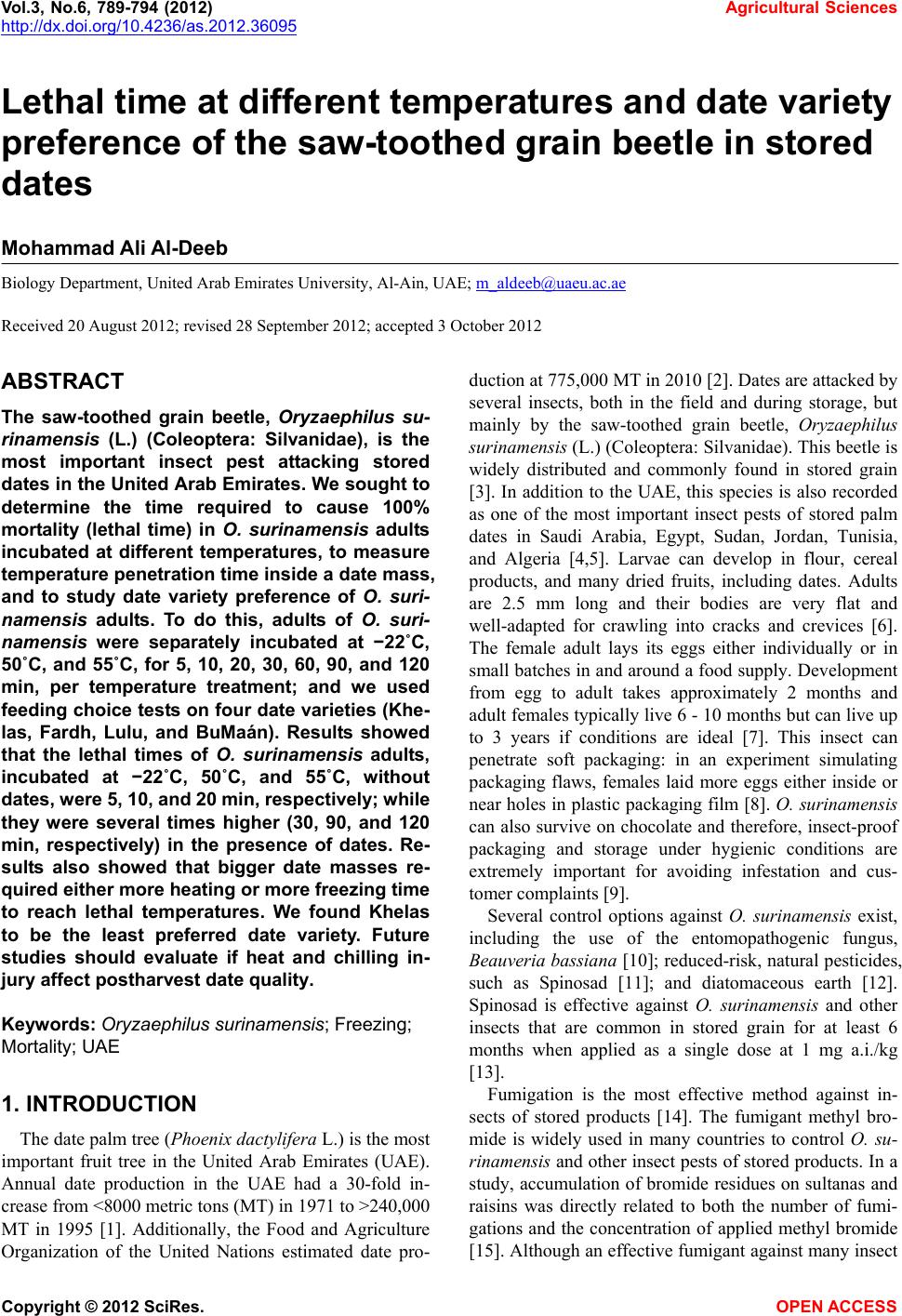 Vol.3, No.6, 789-794 (2012) Agricultural Sciences http://dx.doi.org/10.4236/as.2012.36095 Lethal time at different temperatures and date variety preference of the saw-toothed grain beetle in stored dates Mohammad Ali Al-Deeb Biology Department, United Arab Emirates University, Al-Ain, UAE; [email protected] Received 20 August 2012; revised 28 September 2012; accepted 3 October 2012 ABSTRACT The saw-toothed grain beetle, Oryzaephilus su- rinamensis (L.) (Coleoptera: Silvanidae), is the most important insect pest attacking stored dates in the United Arab Emirates. We sought to determine the time required to cause 100% mortality (lethal time) in O. surinamensis adults incubated at different temperatures, to measure temperature penetration time inside a date mass, and to study date variety preference of O. suri- namensis adults. To do this, adults of O. suri- namensis were separately incubated at −22˚C, 50˚C, and 55˚C, for 5, 10, 20, 30, 60, 90, and 120 min, per temperature treatment; and we used feeding choice tests on four date varieties (Khe- las, Fardh, Lulu, and BuMaán). Results showed that the lethal times of O. surinamensis adults, incubated at −22˚C, 50˚C, and 55˚C, without dates, were 5, 10, and 20 min, respectively; while they were several times higher (30, 90, and 120 min, respectively) in the presence of dates. Re- sults also showed that bigger date masses re- quired either more heating or more freezing time to reach lethal temperatures. We found Khelas to be the least preferred date variety. Future studies should evaluate if heat and chilling in- jury affect postharvest date quality. Keywords: Oryzaephilus surinamens is; Freezing; Mortality; UAE 1. INTRODUCTION The date palm tree (Pho enix da ctylifera L.) is the most important fruit tree in the United Arab Emirates (UAE). Annual date production in the UAE had a 30-fold in- crease from <8000 metric tons (MT) in 1971 to >240,000 MT in 1995 [1]. Additionally, the Food and Agriculture Organization of the United Nations estimated date pro- duction at 775,000 MT in 2010 [2]. Dates are attacked by several insects, both in the field and during storage, but mainly by the saw-toothed grain beetle, Oryzaephilus surinamensis (L.) (Coleoptera: Silvanidae). This beetle is widely distributed and commonly found in stored grain [3]. In addition to the UAE, this species is also recorded as one of the most important insect pests of stored palm dates in Saudi Arabia, Egypt, Sudan, Jordan, Tunisia, and Algeria [4,5]. Larvae can develop in flour, cereal products, and many dried fruits, including dates. Adults are 2.5 mm long and their bodies are very flat and well-adapted for crawling into cracks and crevices [6]. The female adult lays its eggs either individually or in small batches in and around a food supply. Development from egg to adult takes approximately 2 months and adult females typically live 6 - 10 months but can live up to 3 years if conditions are ideal [7]. This insect can penetrate soft packaging: in an experiment simulating packaging flaws, females laid more eggs either inside or near holes in plastic packaging film [8]. O. surinamensis can also survive on chocolate and therefore, insect-proof packaging and storage under hygienic conditions are extremely important for avoiding infestation and cus- tomer complaints [9]. Several control options against O. surinamensis exist, including the use of the entomopathogenic fungus, Beauveria bassiana [10]; reduced-risk, natural pesticides, such as Spinosad [11]; and diatomaceous earth [12]. Spinosad is effective against O. surinamensis and other insects that are common in stored grain for at least 6 months when applied as a single dose at 1 mg a.i./kg [13]. Fumigation is the most effective method against in- sects of stored products [14]. The fumigant methyl bro- mide is widely used in many countries to control O. su- rinamensis and other insect pests of stored products. In a study, accumulation of bromide residues on sultanas and raisins was directly related to both the number of fumi- gations and the concentration of applied methyl bromide [15]. Although an effective fumigant against many insect Copyright © 2012 SciRes. OPEN ACCESS 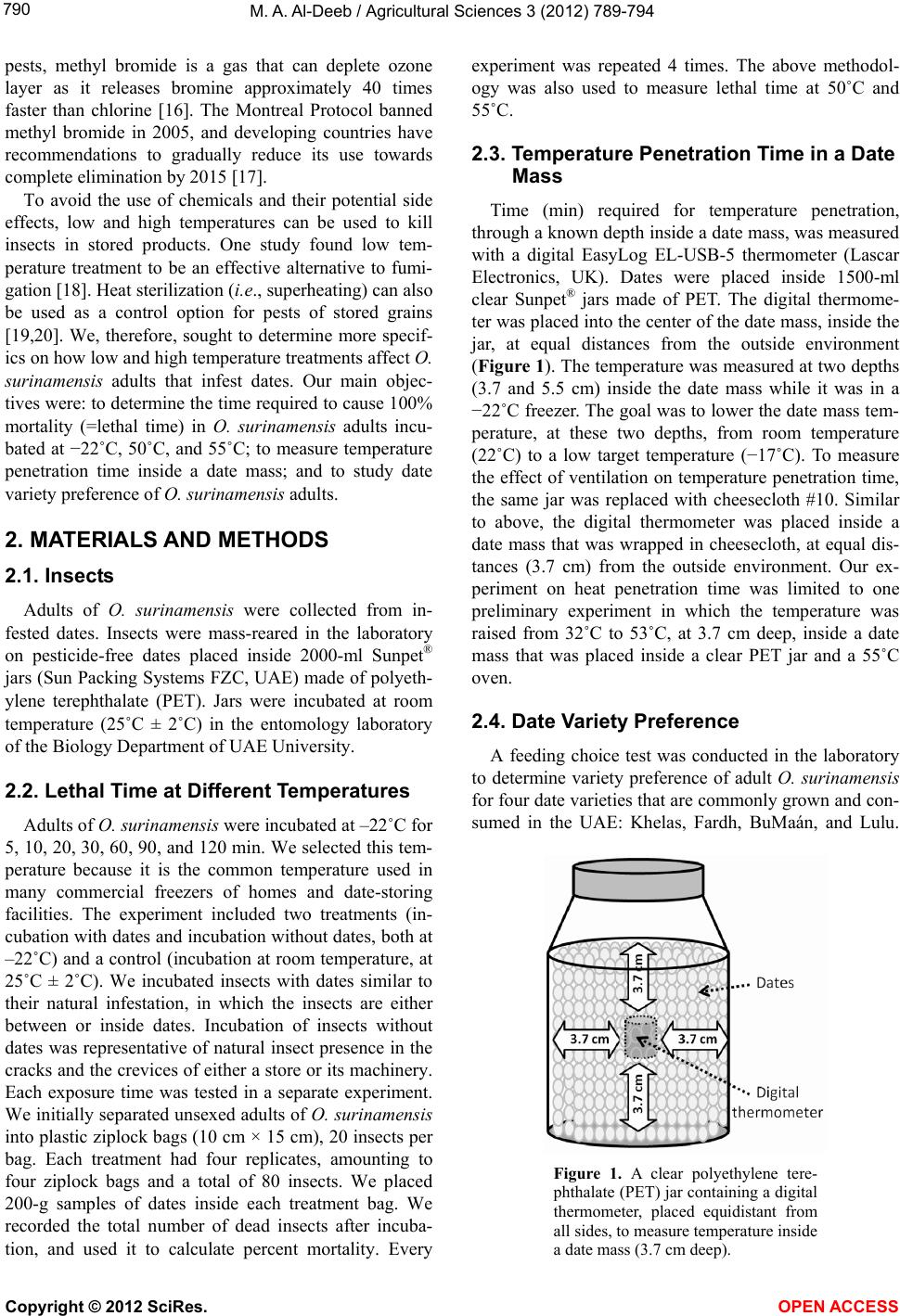 M. A. Al-Deeb / Agricultural Sciences 3 (2012 ) 789-794 790 pests, methyl bromide is a gas that can deplete ozone layer as it releases bromine approximately 40 times faster than chlorine [16]. The Montreal Protocol banned methyl bromide in 2005, and developing countries have recommendations to gradually reduce its use towards complete elimination by 2015 [17]. To avoid the use of chemicals and their potential side effects, low and high temperatures can be used to kill insects in stored products. One study found low tem- perature treatment to be an effective alternative to fumi- gation [18]. Heat sterilization (i.e., superheating) can also be used as a control option for pests of stored grains [19,20]. We, therefore, sought to determine more specif- ics on how low and high temperature treatments affect O. surinamensis adults that infest dates. Our main objec- tives were: to determine the time required to cause 100% mortality (=lethal time) in O. surinamensis adults incu- bated at −22˚C, 50˚C, and 55˚C; to measure temperature penetration time inside a date mass; and to study date variety preference of O. surinamensis adults. 2. MATERIALS AND METHODS 2.1. Insects Adults of O. surinamensis were collected from in- fested dates. Insects were mass-reared in the laboratory on pesticide-free dates placed inside 2000-ml Sunpet® jars (Sun Packing Systems FZC, UAE) made of polyeth- ylene terephthalate (PET). Jars were incubated at room temperature (25˚C ± 2˚C) in the entomology laboratory of the Biology Department of UAE University. 2.2. Lethal Time at Different Temperatures Adults of O. surinamensis were incubated at –22˚C for 5, 10, 20, 30, 60, 90, and 120 min. We selected this tem- perature because it is the common temperature used in many commercial freezers of homes and date-storing facilities. The experiment included two treatments (in- cubation with dates and incubation without dates, both at –22˚C) and a control (incubation at room temperature, at 25˚C ± 2˚C). We incubated insects with dates similar to their natural infestation, in which the insects are either between or inside dates. Incubation of insects without dates was representative of natural insect presence in the cracks and the crevices of either a store or its machinery. Each exposure time was tested in a separate experiment. We initially separated unsexed adults of O. surinamensis into plastic ziplock bags (10 cm × 15 cm), 20 insects per bag. Each treatment had four replicates, amounting to four ziplock bags and a total of 80 insects. We placed 200-g samples of dates inside each treatment bag. We recorded the total number of dead insects after incuba- tion, and used it to calculate percent mortality. Every experiment was repeated 4 times. The above methodol- ogy was also used to measure lethal time at 50˚C and 55˚C. 2.3. Temperature Penetration Time in a Date Mass Time (min) required for temperature penetration, through a known depth inside a date mass, was measured with a digital EasyLog EL-USB-5 thermometer (Lascar Electronics, UK). Dates were placed inside 1500-ml clear Sunpet® jars made of PET. The digital thermome- ter was placed into the center of the date mass, inside the jar, at equal distances from the outside environment (Figure 1). The temperature was measured at two depths (3.7 and 5.5 cm) inside the date mass while it was in a −22˚C freezer. The goal was to lower the date mass tem- perature, at these two depths, from room temperature (22˚C) to a low target temperature (−17˚C). To measure the effect of ventilation on temperature penetration time, the same jar was replaced with cheesecloth #10. Similar to above, the digital thermometer was placed inside a date mass that was wrapped in cheesecloth, at equal dis- tances (3.7 cm) from the outside environment. Our ex- periment on heat penetration time was limited to one preliminary experiment in which the temperature was raised from 32˚C to 53˚C, at 3.7 cm deep, inside a date mass that was placed inside a clear PET jar and a 55˚C oven. 2.4. Date Variety Preference A feeding choice test was conducted in the laboratory to determine variety preference of adult O. surinamensis for four date varieties that are commonly grown and con- sumed in the UAE: Khelas, Fardh, BuMaán, and Lulu. Figure 1. A clear polyethylene tere- phthalate (PET) jar containing a digital thermometer, placed equidistant from all sides, to measure temperature inside a date mass (3.7 cm deep). Copyright © 2012 SciRes. OPEN ACCESS  M. A. Al-Deeb / Agricultural Sciences 3 (2012 ) 789-794 791 They were selected for their high market value and pref- erence by customers, who especially like the Khelas va- riety. The feeding choice arena consisted of a square plastic container (27 × 27 × 9.5 cm), covered by a lid that was fitted tightly to prevent insect escape. We wrapped 100-g samples of dates, from each of the four varieties, within single layers of cheesecloth. Wrapped dates were placed at one of the four corners of the container. To provide equal selection opportunity for the four varieties, they were placed at equal distances from the insect re- lease point. This was achieved by marking the two di- agonals of the square container on its bottom, using a black marker and a ruler, so that the line intercept was the central release point. Two hundred unsexed adults of O. surinamensis, initially placed inside a 15-ml blue plastic cap tube (Sterilin, UK), were released into the arena by inverting the tube at the center of the container. The lid was attached and the arena was placed inside a dark room that was maintained at 25˚C ± 2˚C. We used a complete randomized design with date variety as the fixed effect. 2.5. Statistical Analysis We used arithmetic means to compare the lethal times at −22˚C, 50˚C, and 55˚C. For the feeding choice ex- periment, we tested for differences in O. surinamensis adult numbers with an analysis of variance (ANOVA) [21], with date variety as the classification variable. ANOVA was performed with a SAS PROC GLM and Fisher least significant difference, with significance set at P < 0.05. 3. RESULTS 3.1. Lethal Time at Different Temperatures The lethal time of O. surinamensis adults, incubated at −22˚C, was 20 min without dates but 120 min with dates (Figure 2). The lethal time of O. surinamensis adults at 50˚C was 90 min and 10 min, with and without dates, respectively; and, at 55˚C, 30 min and 5 min, with and without dates, respectively (Figure 2). 3.2. Temperature Penetration Time in a Date Mass An average of 713 min was needed to decrease the temperature from 22˚C to −17˚C, 3.7 cm inside a date mass that was placed inside a clear plastic jar and a −22˚C freezer. Under the same temperatures, this time increased to an average of 978 min when inside a bigger date mass, 5.5 cm deep (Figure 3). The use of cheese- cloth instead of the clear PET jar, however, decreased the time to an average of 343 min, under the same tempera- tures (Figure 4). Finally, an average of 350 min was Figure 2. The effect of incubating Oryza- ephilus surinamensis adults, either with or without dates, on the time (min) required to cause 100% mortality at −22˚C, 50˚C, and 55˚C. Figure 3. Effect of date mass depth on the time (min) required to decrease tempera- ture from 22˚C to −17˚C, as measured in- side a date mass placed into a −22˚C freezer. Figure 4. Effect of container ventilation (clear polyethylene terephthalate [PET] jar vs. cheesecloth) on the time (min) required to decrease temperature from 22˚C to −17˚C, as measured inside a date mass placed inside a −22˚C freezer. needed to raise the temperature from 32˚C to 53˚C, 3.7 cm inside a date mass that was placed inside a clear PET jar and a 55˚C oven. 3.3. Date Variety Preference We found significant differences among the number of O. surinamensis adults that infested the four date varie- Copyright © 2012 SciRes. OPEN ACCESS  M. A. Al-Deeb / Agricultural Sciences 3 (2012 ) 789-794 792 ties (F = 5.30; df = 3; P = 0.0265; Figure 5). Khelas was the least infested variety (19.1 ± 1.8), followed by Bu- Maán (23.5 ± 2.8), Lulu (27.9 ± 2.1), and Fardh (29.6 ± 1.1), which had the highest number on insects. Khelas had significantly less insects, as compared to Lulu and Fardh (t = −3.05063, df = 3, P = 0.0158; and t = −3.62405, df = 3, P = 0.0067, respectively), but was not significantly different from BuMaán (t = −1.53678, df = 3, P = 0.1629). Fardh, Lulu, and BuMaán were not sig- nifycantly different from each other. 4. DISCUSSION 4.1. Lethal Times at Different Temperatures Extreme temperatures may become rapid, non-che- mical alternatives to fumigation and chemical controls of insects in stored products. Our study showed that O. su- rinamensis adults can be killed by exposing them to −22˚C for 20 min in the absence of dates, and for a longer time (120 min) in the presence of dates. Similarly, lethal time increased from 10 to 90 min at 50˚C, and from 5 to 30 min at 55˚C, in the absence and the pres- ence of dates, respectively. A longer lethal time when incubating insects with dates most likely occurs because dates provide protection to insects from rapidly changing temperatures inside freezers and ovens. Some insects may seek shelter in the small spaces between dates and others may hide either under the fruit cap (perianth) or inside the dates. Fur- thermore, since date temperature changes more gradually than ambient surroundings, hiding insects have more time to live. This latter explanation applies more to in- sects that hide inside uncapped dates than those hiding between dates. At 50˚C and 55˚C, heat transfer occurs both by convection from air to dates and by conduction through contact between outside warmer dates and nearby dates that are less warm. Furthermore, the pres- ence of a pit (seed) inside the date provides some level of thermal insulation, which can delay both heat transfer, Figure 5. Effect of date variety on the number (mean ± standard error) of Oryza- ephilus surinamensis adults attracted to dates during a feeding choice test. between dates, and mortality for hiding insects inside the date. This possible delay of heat transfer occurs because the pit has a wood-like structure due to its cellulose, hemicellulose, and lignin components [22]. According to our results, approximately 12 hrs are needed to decrease the temperature of dates from 22˚C to −17˚C, 3.7 cm inside a date mass placed inside a clear PET jar and a −22˚C freezer. The freezing time was ap- proximately 16 hrs when using a bigger date mass (5.5 cm deep), resulting in a 33.3% time increase. The most important step to ensure successful cold treatment is to keep both the packaging small enough and freezer time long enough to ensure that a product com- pletely freezes. Our study also shows that freezing time can be shortened by placing dates inside ventilated con- tainers (e.g., cheesecloth). By providing ventilation, freezing time drops from an average of 713 to 343 min. This 50% reduction in treatment time could considerably decrease treatment cost. In fact, more time and cost re- ductions could be achieved if dates were also placed loosely in single layers (one date deep) on screen trays during cold treatment so that cold air effectively chills every date from all sides to reach the target lethal tem- perature in a short time. Our results show that the heating of dates to kill in- sects also require treatment for several hours. Date qual- ity in terms of either moisture loss or color change, is less compromised with freezing. In fact, freezing is a common food storage method that also helps retain food vitamin content, color, flavor, and texture. One of our preliminary experiments, however, showed that approxi- mately 6 hrs were needed to raise the temperature from 32˚C to 53˚C, 3.7 cm deep inside a date mass that was placed inside a clear PET jar and a 55˚C oven. Such a long heating time (with even longer times for larger date masses) may affect date quality, especially by darkening the color. One study [23] found slight date color changes and water losses, after using solar heat to control insects on stored dates in Saudi Arabia. Most published research on heat treated insect control methods are done on bulk grains, where extended heating time does not affect grain quality. In contrast, dates are mostly eaten fresh, without processing; therefore, temperatures that successfully dis- infest grain may negatively lower stored date quality. Additional studies on the impact of heat treatments on date fruit quality are needed to help identify the degree of damage in the different date varieties. Nevertheless, heat could be effectively used to disinfest machinery plants, materials, and structures. Since O. surinamensis adults die within a few minutes of either cold or heat treatments (according to our results), heating and freez- ing are non-chemical approaches that could be easily used in date processing factories as alternatives to fumi- gation. Flour mills and food processing plants in the Copyright © 2012 SciRes. OPEN ACCESS  M. A. Al-Deeb / Agricultural Sciences 3 (2012 ) 789-794 793 United States and Canada already routinely incorporate heat disinfestation into their pest control strategies by using temperatures of 55˚C - 60˚C for 24 hr [24]. 4.2. Date Variety Preference Khelas was significantly less infested than other date varieties, indicating less preference by O. surinamensis. It was followed by BuMaán, Lulu, and Fardh, which were not significantly different from each other. These results show that Khelas is not highly preferred when other varieties, such as Fardh, Lulu, and BuMaán, are available. One possible explanation is that Khelas fruits are very soft and become sticky during storage from their production of a thick sugar solution. O. surinamensis individuals cannot move freely within the date mass of these sticky dates, can get stuck on the dates and date container walls, and may eventually die. Other varieties, such as Fardh, are neither soft nor become sticky during long storage, possibly explaining preference by O. suri- namensis. 5. CONCLUSIONS Our results showed that the lethal times of O. surina- mensis adults incubated at −22˚C, 50˚C, and 55˚C, were but a few minutes (5, 10, and 20 min, respectively) with- out dates, yet several times higher (30, 90, and 120 min, respectively) with dates. The results also showed that bigger date masses took longer time to reach lethal tem- peratures. To save time, energy, money, and postharvest date quality, we recommend dates be frozen unpackaged, in single layers, one date deep, and on screen trays so that air can reach every date to chill it to its targeted tem- perature. Consequently, this process will efficiently kill O. surinamensis adults, and do so more safely than other methods. Future studies, however, should evaluate if heat and/or chilling injury from certain exposure times re- duces date quality. In the choice test, Khelas was the least preferred date variety as compared to Fardh, Lulu, and BuMaán, yet insects still infested all of them. Future studies should include more varieties and investigate resistance. REFERENCES [1] Date Palm Culture in UAE (2009) Plant Tissue Culture Laboratory. UAE University, Al Ain. http://datepalm.uaeu.ac.ae/subpages/datepalmcultural.htm l [2] FAOSTAT (2012) FAO Statistics. Countries by commod- ity. http://faostat.fao.org/site/339/default.aspx [3] Calvin, D. (2001) Saw-toothed and Merchant Grain Bee- tle. Cooperative Extension Service. Department of Ento- mology, Pennsylvania State University, Altoona, SG-12. [4] Al-Hafeedh, E.M. (2003) Date palm trees and dates in Iraq and countries of the Gulf Cooperation Council. Al-Yakoot Publication and Distribution, Amman. [5] Najeeb, M.A. (2001) Pests and diseases of date palm. Ministry of Agriculture and Water. Extension Directorate. Kingdom of Saudi Arabia. [6] Mason, L.J. (2003) Grain insect fact sheet. Cooperative Extension Service. Department of Entomology, Purdue University, West Lafayette. [7] Kilpatrick, A.L., Zungoli, P.A. and Benson, E.P. (2004) Saw-toothed grain beetle. Cooperative Extension Service. Department of Entomology, Clemson University, Clem- son. [8] Mowery, S.V., Mullen, M.A., Campbell, J.F. and Broce, A.B. (2002) Mechanisms underlying saw-toothed grain beetle (Oryzaephilus surinamensis [L.]) (Coleoptera: Sil- vanidae) infestation of consumer food packaging materi- als. Journal of Economic Entomology, 95, 1333-1336. doi:10.1603/0022-0493-95.6.1333 [9] Khamrunissa, B., Reddy, P.V., Leelaja, B.C., Rajashekar, Y. and Rajendran, S. (2006) Studies on insect infestation in chocolates. Journal of Stored Products Research, 43, 118-122. doi:10.1016/j.jspr.2006.02.001 [10] Throne, J.E. and Lord, J.C. (2004) Control of saw- toothed grain beetles (Coleoptera: Silvanidae) in stored oats by using an entomopathogenic fungus in conjunction with seed resistance. Journal of Economic Entomology, 97, 1765-1771. doi:10.1603/0022-0493-97.5.1765 [11] Fang, L., Subramanyam, B. and Arthur, F.H. (2002) Ef- fectiveness of spinosad on four classes of wheat against five stored-product insects. Journal of Economic Ento- mology, 95, 640-650. doi:10.1603/0022-0493-95.3.640 [12] Arthur, F.H. (2000) Immediate and delayed mortality of Oryzaephilus surinamensis (L.) exposed on wheat treated with diatomaceous earth: Effects of temperature, relative humidity, and exposure interval. Journal of Stored Prod- ucts Research, 37, 13-21. [13] Subramanyam, B., Toews, M.D., Ileleji, K.E., Maier, D. M., Thompson, G.D. and Pitts. T.J. (2006) Evaluation of spinosad as a grain protectant on three Kansas farms. Crop Protection, 26, 1021-1030. doi:10.1016/j.cropro.2006.09.011 [14] Lelieveld, H. (2005) Improving Hygiene in the Food Industry. GBR, Woodhead Publishing, Cambridge. [15] Hilton, S.J. and Banks, H.J. (1997) Methyl bromide sorp- tion and residues on sultanas and raisins. Journal of Stored Products Research, 33, 231-249. doi:10.1016/S0022-474X(97)00003-9 [16] Morrissey, W.A. (2004) Stratospheric ozone depletion and regulation of methyl bromide. CRS Report for Con- gress. RS20863. http://www.ncseonline.org/nle/crsreports/04dec/RS20863. pdf [17] UNEP (2004) Montreal protocol talks to consider exemp- tions from methyl bromide ban. Press Release, UNEP/211. http://www.un.org/News/Press/docs/2004/unep211.doc.ht m. Copyright © 2012 SciRes. OPEN ACCESS  M. A. Al-Deeb / Agricultural Sciences 3 (2012 ) 789-794 Copyright © 2012 SciRes. OPEN ACCESS 794 [18] Donahaye, E.J., Navarro, S. and Rindner, M. (1995) Low temperature as an alternative to fumigation for disinfect- ing dried fruit from three insect pests. Journal of Stored Products Research, 31, 63-70. doi:10.1016/0022-474X(94)00037-T [19] Sheppard, K.O. (1984) Heat sterilization (superheating) as a control for stored-grain pests in a food plant. In: F. J. Baur (Ed.), Insect Management for Food Storage and Processing. American Association of Cereal Chemists, St. Paul, 193-200. [20] Wright, E.J., Sinclair, E.A. and Annis, P.C. (2002) Labo- ratory determination of the requirements for control of Trogoderma variabile (Coleoptera: Dermestidae) by heat. Journal of Stored Products Research, 38, 147-155. doi:10.1016/S0022-474X(01)00011-X [21] SAS (2001) SAS users guide: Statistics. 8th Edition, Sta- tistical Analysis System Institute, Cary. [22] Barreveld, W.H. (1993) Date palm products. FAO Agri- cultural Services Bulletin No. 101. http://www.fao.org/docrep/t0681e/t0681e00.htm#con [23] Assiry, A.M. (2005) Penetration curves of solar heat into date fruits as a mean to control insects. King Saud Uni- versity. http://faculty.ksu.edu.sa/Assiry/Documents/18_alhussein_ assiri.pdf [24] CSIRO (2009) Heat treatment. http://www.csiro.au/resources/graininheatdisinfestation.ht ml |