

Paper Menu >>
Journal Menu >>
 Vol.3, No.6, 848-853 (2012) Agricultural Sciences http://dx.doi.org/10.4236/as.2012.36103 Seed protein, oil, fatty acids, and minerals concentration as affected by foliar K-glyphosate applications in soybean cultivars* Manju Pande1#, Mudlagiri B. Goli1, Tyneiseca Epps1, Nacer Bellaloui2 1Department of Natural Sciences and Environmental Health, Mississippi Valley State University, Itta Bena, USA; #Corresponding Author: [email protected] 2Crop Genetics Research Unit, USDA-ARS, Stoneville, USA Received 4 July 2012; revised 22 August 2012; accepted 10 September 2012 ABSTRACT Previous studies showed that glyphosate (Gly) may chelate cation nutrients, including potas- sium (K), which might affect the nutritional status of soybean seed. The objective of this study was to evaluate seed composition (protein, oil, fatty acids, and minerals) as influenced by foliar applications of K + Gly. A greenhouse ex- periment was conducted at Mississippi Valley State University, using two glyphosate-resistant soybean cultivars DK 4968 and Pioneer 95Y70 grown in a randomized complete block design. The treatments were foliar applications of K alone, Gly alone, K + Gly combined, and non- treated control (C). A single application of po- tassium (1.75% as K2SO4) was applied, and Gly was applied at a rate of 0.75 ae/ha at V5 stage. Leaf samples were harvested one week after treatment (1WAT) and 3WAT. Mature seeds were collected at harvest maturity (R8). The results showed that K, nitrogen (N), and phosphorus (P) concentrations increased in leaves in K alone and K + Gly treatme nts at 1WAT, but significantly increased at 3WAT in all treatments. The con- centration of iron (Fe) and zinc (Zn) showed a decre ase in l eaf con cen tra tion in Gly and K + Gly treatments compared to C. Boron (B) concentra- tion increased in Gly treatment. Seed protein percentage was higher in all treatments in cul- tivar DK 4968, and the increase was about 4.0% in K treatment, 6.9% in Gly treatment, and 3.5% in K + Gly treatment compared to C. The oppo- site trend was observed in oil concentration, especially in Gly treatment where the percen t age decrease was 11.2% compared to C. Stearic fatty acid was significantly higher in K + Gly treat- ment compared to K treatment for DK 4968. A higher percentage increase in linolenic acid was observed in DK 4968 in K treatment (an increase of 24.5%) and in K + Gly treatment (an increase of 29.5%) compared to C. In Pioneer 95Y70, the decrease in oil was 2.7% in K treatme nt and 2.3% in K + Gly treatment compared to C. Stearic acid in Pioneer 95Y70 was significantly higher in Gly treatment, an increase of 8.3%, compared to C. Our research demonstrated that foliar applica- tion of K and Gly altered mineral concentration in leaves and shifted seed composition towards protein and stearic concentration. Further re- search under field conditions is needed before final conclusions are made. Keywords: Fatty Acids; Glyphosate; Nu trition; Oil; Potassium; Protein; Seed Composition; Soybean 1. INTRODUCTION Soybean is a source of protein, desirable amino acids, and fatty acids. Recent research showed that soy protein contains balanced amino acids and phytoestrogen such as isoflavones, which have positive health benefits [1]. Soy products have also been used to prevent and treat bone resorption, inhibiting ovarian and colon cancer and other chronic diseases [2-6]. Compared with casein, dietary soy has been found to slow the progression of chronic renal injury in animals [7]). Potassium (K) is one of the three major essential nu- trients required by plants. Plants need large quantities of potassium, and K is removed by most crops more than any other nutrients, indicating the need to apply an ade- quate amount of K fertilizer [8]. Since K is involved in enzyme activation, sugar transport, chlorophyll produc- *Mention of trade names or commercial products in this publication is solely for the purpose of providing specific information and does not imply recommendation or endorsement by the US Department of Ag- riculture. Copyright © 2012 SciRes. OPEN ACCESS 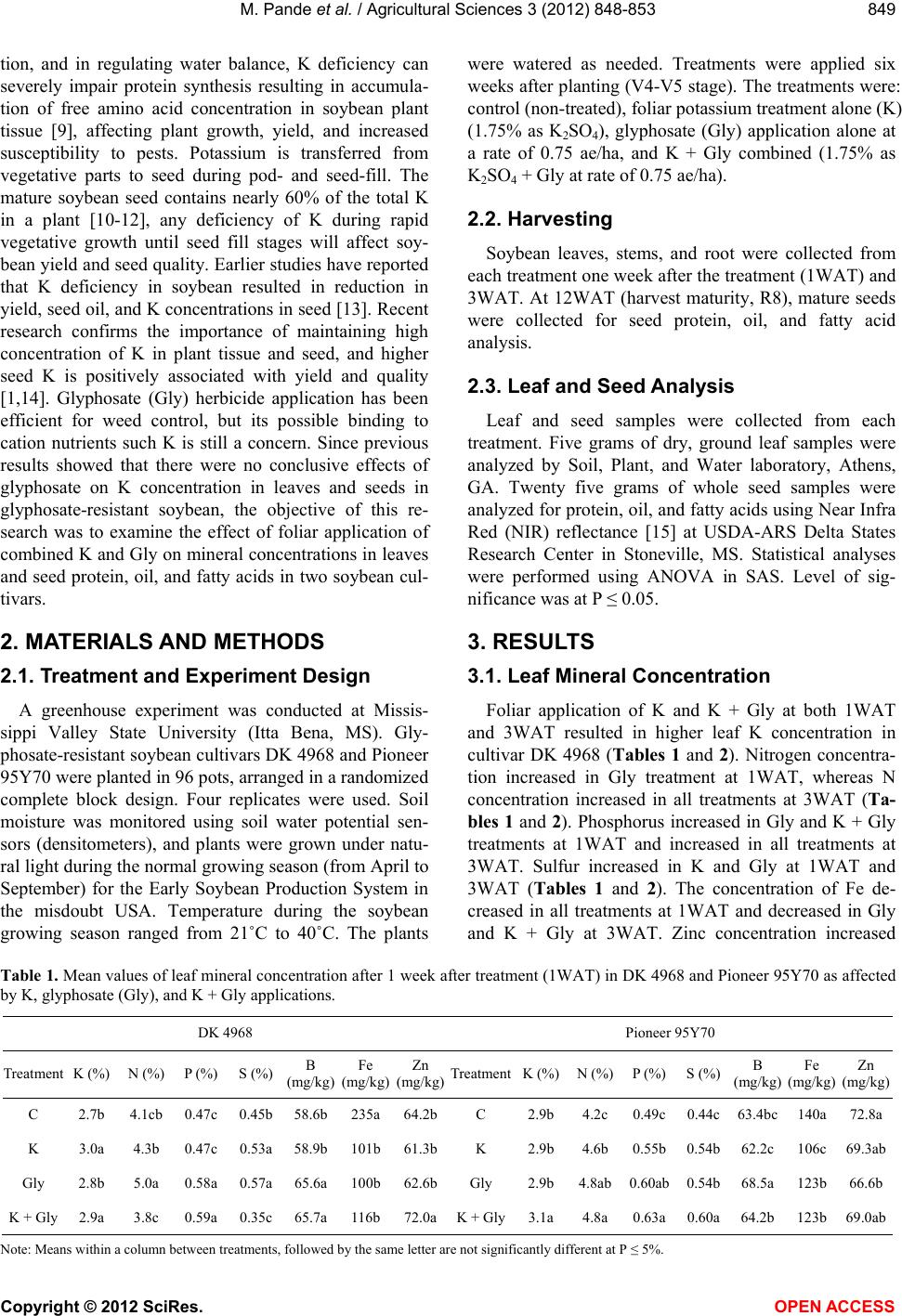 M. Pande et al. / Agricultural Sciences 3 (2012) 848-853 849 tion, and in regulating water balance, K deficiency can severely impair protein synthesis resulting in accumula- tion of free amino acid concentration in soybean plant tissue [9], affecting plant growth, yield, and increased susceptibility to pests. Potassium is transferred from vegetative parts to seed during pod- and seed-fill. The mature soybean seed contains nearly 60% of the total K in a plant [10-12], any deficiency of K during rapid vegetative growth until seed fill stages will affect soy- bean yield and seed quality. Earlier studies have reported that K deficiency in soybean resulted in reduction in yield, seed oil, and K concentrations in seed [13]. Recent research confirms the importance of maintaining high concentration of K in plant tissue and seed, and higher seed K is positively associated with yield and quality [1,14]. Glyphosate (Gly) herbicide application has been efficient for weed control, but its possible binding to cation nutrients such K is still a concern. Since previous results showed that there were no conclusive effects of glyphosate on K concentration in leaves and seeds in glyphosate-resistant soybean, the objective of this re- search was to examine the effect of foliar application of combined K and Gly on mineral concentrations in leaves and seed protein, oil, and fatty acids in two soybean cul- tivars. 2. MATERIALS AND METHODS 2.1. Treatment and Experiment Design A greenhouse experiment was conducted at Missis- sippi Valley State University (Itta Bena, MS). Gly- phosate-resistant soybean cultivars DK 4968 and Pioneer 95Y70 were planted in 96 pots, arranged in a randomized complete block design. Four replicates were used. Soil moisture was monitored using soil water potential sen- sors (densitometers), and plants were grown under natu- ral light during the normal growing season (from April to September) for the Early Soybean Production System in the misdoubt USA. Temperature during the soybean growing season ranged from 21˚C to 40˚C. The plants were watered as needed. Treatments were applied six weeks after planting (V4-V5 stage). The treatments were: control (non-treated), foliar potassium treatment alone (K) (1.75% as K2SO4), glyphosate (Gly) application alone at a rate of 0.75 ae/ha, and K + Gly combined (1.75% as K2SO4 + Gly at rate of 0.75 ae/ha). 2.2. Harvesting Soybean leaves, stems, and root were collected from each treatment one week after the treatment (1WAT) and 3WAT. At 12WAT (harvest maturity, R8), mature seeds were collected for seed protein, oil, and fatty acid analysis. 2.3. Leaf and Seed Analysis Leaf and seed samples were collected from each treatment. Five grams of dry, ground leaf samples were analyzed by Soil, Plant, and Water laboratory, Athens, GA. Twenty five grams of whole seed samples were analyzed for protein, oil, and fatty acids using Near Infra Red (NIR) reflectance [15] at USDA-ARS Delta States Research Center in Stoneville, MS. Statistical analyses were performed using ANOVA in SAS. Level of sig- nificance was at P ≤ 0.05. 3. RESULTS 3.1. Leaf Mineral Concentration Foliar application of K and K + Gly at both 1WAT and 3WAT resulted in higher leaf K concentration in cultivar DK 4968 (Tables 1 and 2). Nitrogen concentra- tion increased in Gly treatment at 1WAT, whereas N concentration increased in all treatments at 3WAT (Ta- bles 1 and 2). Phosphorus increased in Gly and K + Gly treatments at 1WAT and increased in all treatments at 3WAT. Sulfur increased in K and Gly at 1WAT and 3WAT (Tables 1 and 2). The concentration of Fe de- creased in all treatments at 1WAT and decreased in Gly and K + Gly at 3WAT. Zinc concentration increased Table 1. Mean values of leaf mineral concentration after 1 week after treatment (1WAT) in DK 4968 and Pioneer 95Y70 as affected by K, glyphosate (Gly), and K + Gly applications. DK 4968 Pioneer 95Y70 Treatment K (%) N (%) P (%) S (%) B (mg/kg) Fe (mg/kg) Zn (mg/kg) TreatmentK (%)N (%)P (%)S (%) B (mg/kg) Fe (mg/kg) Zn (mg/kg) C 2.7b 4.1cb 0.47c 0.45b 58.6b 235a64.2bC 2.9b4.2c0.49c0.44c 63.4bc 140a72.8a K 3.0a 4.3b 0.47c 0.53a 58.9b 101b61.3bK 2.9b4.6b0.55b0.54b 62.2c 106c69.3ab Gly 2.8b 5.0a 0.58a 0.57a 65.6a 100b62.6bGly 2.9b4.8ab0.60ab0.54b 68.5a 123b66.6b K + Gly 2.9a 3.8c 0.59a 0.35c 65.7a 116b72.0aK + Gly3.1a4.8a0.63a0.60a 64.2b 123b69.0ab Note: Means within a column between treatments, followed by the same letter are not significantly different at P ≤ 5%. Copyright © 2012 SciRes. OPEN ACCESS 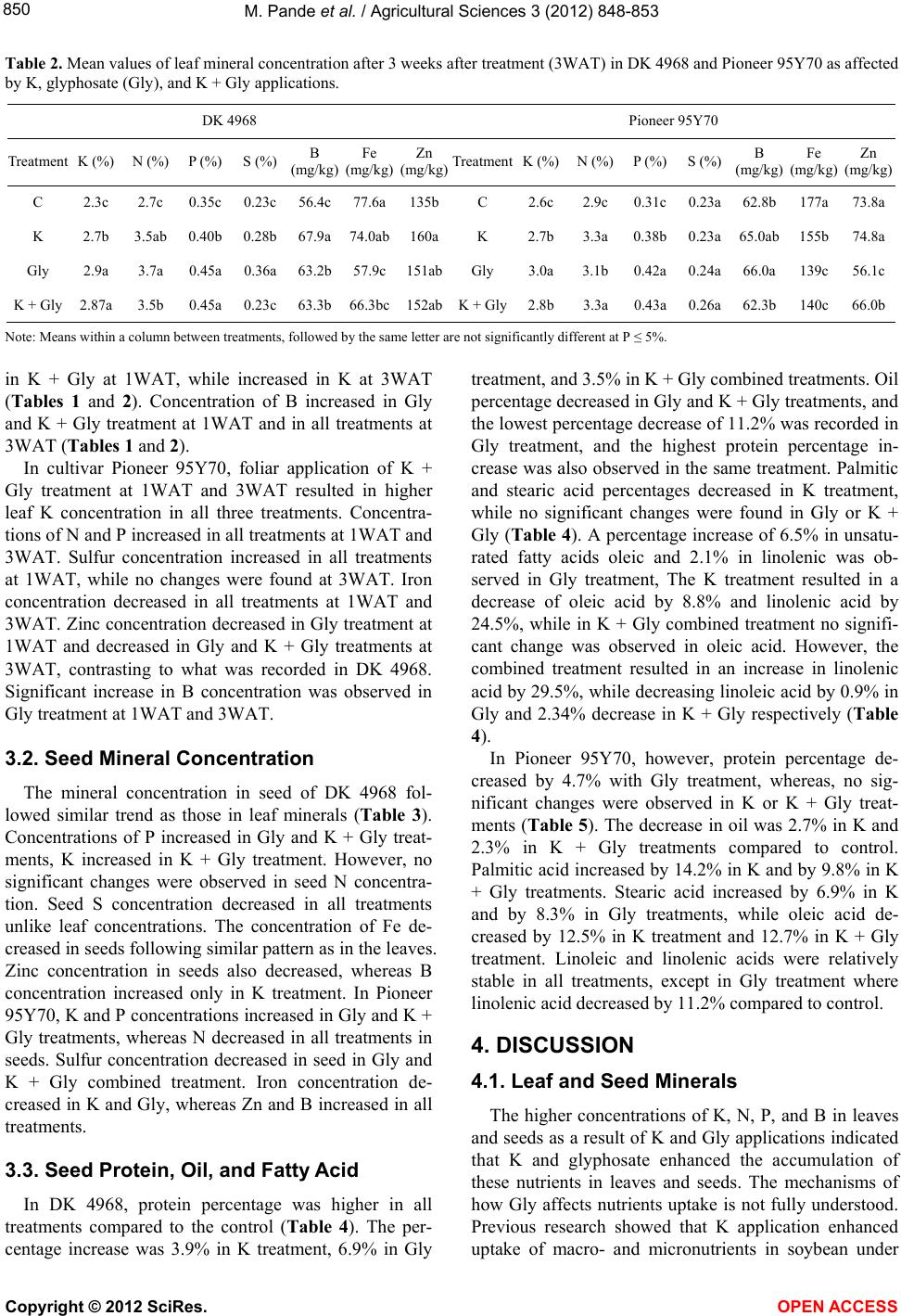 M. Pande et al. / Agricultural Sciences 3 (2012) 848-853 850 Table 2. Mean values of leaf mineral concentration after 3 weeks after treatment (3WAT) in DK 4968 and Pioneer 95Y70 as affected by K, glyphosate (Gly), and K + Gly applications. DK 4968 Pioneer 95Y70 Treatment K (%) N (%) P (%) S (%) B (mg/kg) Fe (mg/kg) Zn (mg/kg) TreatmentK (%)N (%)P (%)S (%) B (mg/kg) Fe (mg/kg) Zn (mg/kg) C 2.3c 2.7c 0.35c 0.23c 56.4c 77.6a135bC 2.6c 2.9c 0.31c0.23a 62.8b 177a73.8a K 2.7b 3.5ab 0.40b 0.28b 67.9a 74.0ab160aK 2.7b3.3a 0.38b0.23a 65.0ab 155b74.8a Gly 2.9a 3.7a 0.45a 0.36a 63.2b 57.9c151abGly 3.0a 3.1b0.42a0.24a 66.0a 139c56.1c K + Gly 2.87a 3.5b 0.45a 0.23c 63.3b 66.3bc152abK + Gly2.8b3.3a 0.43a0.26a 62.3b 140c66.0b Note: Means within a column between treatments, followed by the same letter are not significantly different at P ≤ 5%. in K + Gly at 1WAT, while increased in K at 3WAT (Tables 1 and 2). Concentration of B increased in Gly and K + Gly treatment at 1WAT and in all treatments at 3WAT (Tables 1 and 2). In cultivar Pioneer 95Y70, foliar application of K + Gly treatment at 1WAT and 3WAT resulted in higher leaf K concentration in all three treatments. Concentra- tions of N and P increased in all treatments at 1WAT and 3WAT. Sulfur concentration increased in all treatments at 1WAT, while no changes were found at 3WAT. Iron concentration decreased in all treatments at 1WAT and 3WAT. Zinc concentration decreased in Gly treatment at 1WAT and decreased in Gly and K + Gly treatments at 3WAT, contrasting to what was recorded in DK 4968. Significant increase in B concentration was observed in Gly treatment at 1WAT and 3WAT. 3.2. Seed Mineral Concentration The mineral concentration in seed of DK 4968 fol- lowed similar trend as those in leaf minerals (Table 3). Concentrations of P increased in Gly and K + Gly treat- ments, K increased in K + Gly treatment. However, no significant changes were observed in seed N concentra- tion. Seed S concentration decreased in all treatments unlike leaf concentrations. The concentration of Fe de- creased in seeds following similar pattern as in the leaves. Zinc concentration in seeds also decreased, whereas B concentration increased only in K treatment. In Pioneer 95Y70, K and P concentrations increased in Gly and K + Gly treatments, whereas N decreased in all treatments in seeds. Sulfur concentration decreased in seed in Gly and K + Gly combined treatment. Iron concentration de- creased in K and Gly, whereas Zn and B increased in all treatments. 3.3. Seed Protein, Oil, and Fatty Acid In DK 4968, protein percentage was higher in all treatments compared to the control (Table 4). The per- centage increase was 3.9% in K treatment, 6.9% in Gly treatment, and 3.5% in K + Gly combined treatments. Oil percentage decreased in Gly and K + Gly treatments, and the lowest percentage decrease of 11.2% was recorded in Gly treatment, and the highest protein percentage in- crease was also observed in the same treatment. Palmitic and stearic acid percentages decreased in K treatment, while no significant changes were found in Gly or K + Gly (Tabl e 4). A percentage increase of 6.5% in unsatu- rated fatty acids oleic and 2.1% in linolenic was ob- served in Gly treatment, The K treatment resulted in a decrease of oleic acid by 8.8% and linolenic acid by 24.5%, while in K + Gly combined treatment no signifi- cant change was observed in oleic acid. However, the combined treatment resulted in an increase in linolenic acid by 29.5%, while decreasing linoleic acid by 0.9% in Gly and 2.34% decrease in K + Gly respectively (Table 4). In Pioneer 95Y70, however, protein percentage de- creased by 4.7% with Gly treatment, whereas, no sig- nificant changes were observed in K or K + Gly treat- ments (Table 5 ). The decrease in oil was 2.7% in K and 2.3% in K + Gly treatments compared to control. Palmitic acid increased by 14.2% in K and by 9.8% in K + Gly treatments. Stearic acid increased by 6.9% in K and by 8.3% in Gly treatments, while oleic acid de- creased by 12.5% in K treatment and 12.7% in K + Gly treatment. Linoleic and linolenic acids were relatively stable in all treatments, except in Gly treatment where linolenic acid decreased by 11.2% compared to control. 4. DISCUSSION 4.1. Leaf and Seed Minerals The higher concentrations of K, N, P, and B in leaves and seeds as a result of K and Gly applications indicated that K and glyphosate enhanced the accumulation of these nutrients in leaves and seeds. The mechanisms of how Gly affects nutrients uptake is not fully understood. Previous research showed that K application enhanced uptake of macro- and micronutrients in soybean under Copyright © 2012 SciRes. OPEN ACCESS 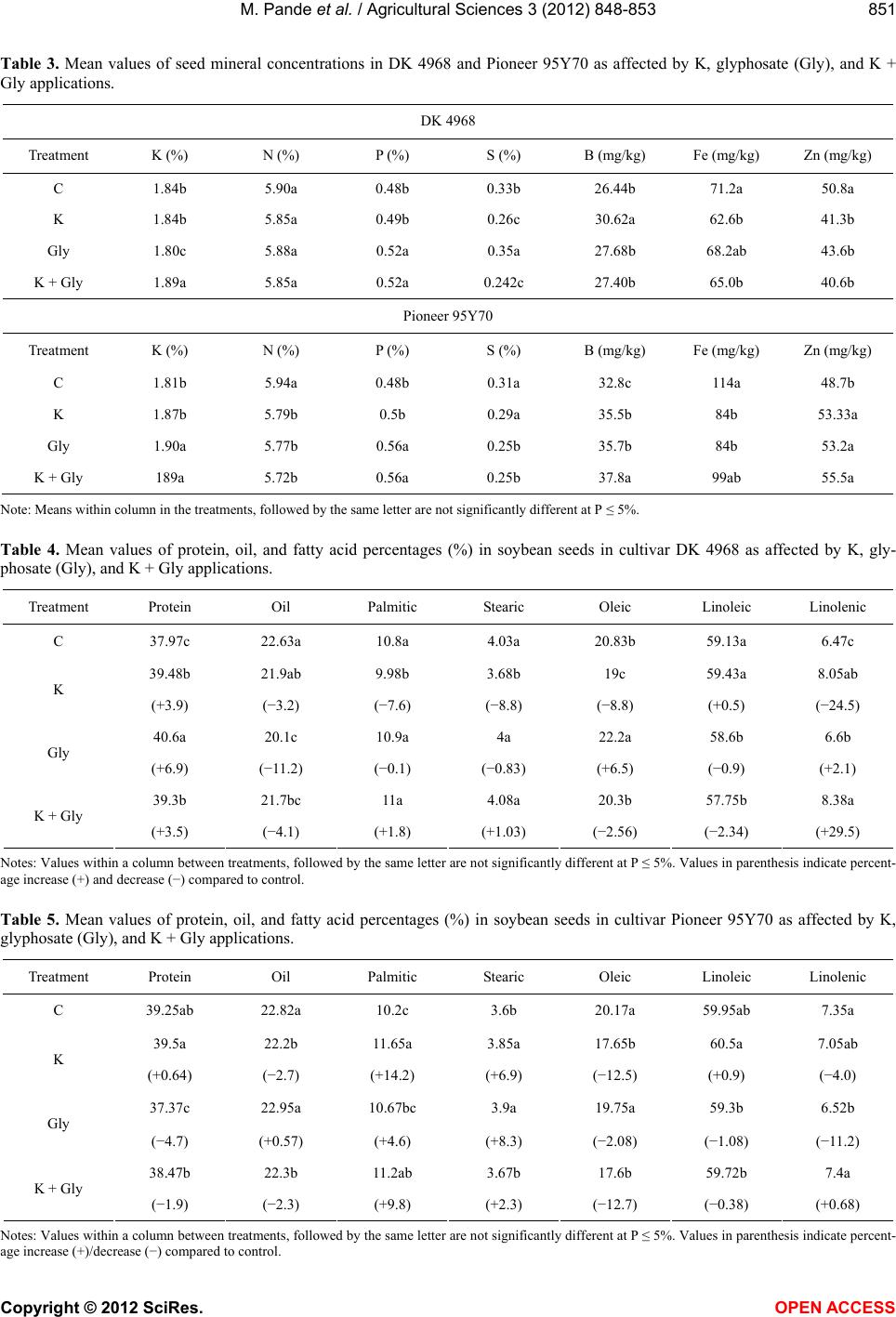 M. Pande et al. / Agricultural Sciences 3 (2012) 848-853 851 Table 3. Mean values of seed mineral concentrations in DK 4968 and Pioneer 95Y70 as affected by K, glyphosate (Gly), and K + Gly applications. DK 4968 Treatment K (%) N (%) P (%) S (%) B (mg/kg) Fe (mg/kg) Zn (mg/kg) C 1.84b 5.90a 0.48b 0.33b 26.44b 71.2a 50.8a K 1.84b 5.85a 0.49b 0.26c 30.62a 62.6b 41.3b Gly 1.80c 5.88a 0.52a 0.35a 27.68b 68.2ab 43.6b K + Gly 1.89a 5.85a 0.52a 0.242c 27.40b 65.0b 40.6b Pioneer 95Y70 Treatment K (%) N (%) P (%) S (%) B (mg/kg) Fe (mg/kg) Zn (mg/kg) C 1.81b 5.94a 0.48b 0.31a 32.8c 114a 48.7b K 1.87b 5.79b 0.5b 0.29a 35.5b 84b 53.33a Gly 1.90a 5.77b 0.56a 0.25b 35.7b 84b 53.2a K + Gly 189a 5.72b 0.56a 0.25b 37.8a 99ab 55.5a Note: Means within column in the treatments, followed by the same letter are not significantly different at P ≤ 5%. Table 4. Mean values of protein, oil, and fatty acid percentages (%) in soybean seeds in cultivar DK 4968 as affected by K, gly- phosate (Gly), and K + Gly applications. Treatment Protein Oil Palmitic Stearic Oleic Linoleic Linolenic C 37.97c 22.63a 10.8a 4.03a 20.83b 59.13a 6.47c 39.48b 21.9ab 9.98b 3.68b 19c 59.43a 8.05ab K (+3.9) (−3.2) (−7.6) (−8.8) (−8.8) (+0.5) (−24.5) 40.6a 20.1c 10.9a 4a 22.2a 58.6b 6.6b Gly (+6.9) (−11.2) (−0.1) (−0.83) (+6.5) (−0.9) (+2.1) 39.3b 21.7bc 11a 4.08a 20.3b 57.75b 8.38a K + Gly (+3.5) (−4.1) (+1.8) (+1.03) (−2.56) (−2.34) (+29.5) Notes: Values within a column between treatments, followed by the same letter are not significantly different at P ≤ 5%. Values in parenthesis indicate percent- age increase (+) and decrease (−) compared to control. Table 5. Mean values of protein, oil, and fatty acid percentages (%) in soybean seeds in cultivar Pioneer 95Y70 as affected by K, glyphosate (Gly), and K + Gly applications. Treatment Protein Oil Palmitic Stearic Oleic Linoleic Linolenic C 39.25ab 22.82a 10.2c 3.6b 20.17a 59.95ab 7.35a 39.5a 22.2b 11.65a 3.85a 17.65b 60.5a 7.05ab K (+0.64) (−2.7) (+14.2) (+6.9) (−12.5) (+0.9) (−4.0) 37.37c 22.95a 10.67bc 3.9a 19.75a 59.3b 6.52b Gly (−4.7) (+0.57) (+4.6) (+8.3) (−2.08) (−1.08) (−11.2) 38.47b 22.3b 11.2ab 3.67b 17.6b 59.72b 7.4a K + Gly (−1.9) (−2.3) (+9.8) (+2.3) (−12.7) (−0.38) (+0.68) Notes: Values within a column between treatments, followed by the same letter are not significantly different at P ≤ 5%. Values in parenthesis indicate percent- ge increase (+)/decrease (−) compared to control. a Copyright © 2012 SciRes. OPEN ACCESS  M. Pande et al. / Agricultural Sciences 3 (2012) 848-853 852 soybean-wheat-maize rotation conditions [12]. The in- crease of N in leaves and seed could be due to the close relationship between K and nitrogen assimilation, espe- cially nitrate reductase activity, the limiting step in ni- trogen assimilation. Potassium application resulted in increased chlorophyll content, nitrate reductase activity in soybean, whereas the application of Gly at 0.84, 1.68, 2.52 + 2.52, and 0.84 + 0.84 kg ae/ha reduced foliar ni- trogen by 26% - 42% [16]. Reports on N acquisition and mobilization from vegetative tissue to seed, which de- termine seed protein, are still conflicting [17], although the role of K, B and Zn in protein synthesis have been well established [18]. For example, it was found that K application at anthesis to K-deprived plants enhanced the photosynthetic capacity, leading to alteration in seed protein and oil [13]. Our study showed consistent higher concentrations of K, N, P, and B in Gly and K + Gly treatments. Application of Gly and K + Gly decreased micronu- trients Fe and Zn concentrations in leaf and seeds of DK 4968, which is supported by previous research [12,19, 20]. However, Zn increased in cultivar Pioneer 57Y90, suggesting complex genotype × environment interaction. It was confirmed that Gly application significantly de- creased Fe in plant tissues of glyphosate-resistant soy- bean. Earlier studies on glyphosate-sensitive sunflower showed that the application of Gly influenced uptake and translocation of micronutrients, including Fe, Mn, and Zn. It was explained that the reduction of Fe uptake may be due to Fe-Gly complexes. Working on target and non- target plants and sunflower, other researchers [21] showed that Gly in the rhizosphere can inhibit acquisition of micronutrients that are associated with plant disease re- sistant mechanism. Iron deficiency has been increasingly observed in crops with frequent Gly applications, and Gly application negatively influenced plant growth and micronutrient levels in plants, even in glyphosate-re- sistant soybeans [20]. 4.2. Seed Protein, Oil, and Fatty Acids Foliar application of K and Gly treatments resulted in higher protein percentages in all treatments in DK 4968, while oil percentage decreased. However, in Pioneer 95Y70, protein decreased with Gly treatment. The dif- ferent response of cultivars to K and Gly treatments could be due to genotype differences. The different pro- tein /oil ratio in the two cultivars may be due to genotype x environment interactions which are reported to be sig- nificant for seed yield, protein, and oil [22]. The inverse relationship between protein and oil (r = −0.87) was pre- viously reported [23,24]. The higher protein might be due to increased N, K, P, and B concentrations in leaf and seeds. The role of K, B, and Zn in protein synthesis and nitrogen metabolism was reported in other species [18]. Conflicting reports exists on whether or not N acquisition by plants and N and C mobilization from vegetative tissue to seed determine seed protein [17], although a close association exists between soil nutrient levels and protein, oil, and unsatu- rated fatty acids [24]. The increase of protein by Gly treatments, as previously suggested [25], could be due to altered patterns of nitrogen repartitioning at seed fill in these treatments. Since increased N, P, K, and B concen- trations were observed in both leaves and seed, higher uptake and translocation of these minerals from leaves to seed may have occurred, influencing seed protein levels. Higher percentage of palmitic with K and K + Gly and higher percentage of stearic acid in K and Gly treatment in Pioneer 95Y70 was observed, while oleic acid per- centage decreased. This observation was in contrast with previous reports [24,25], where an increased percentage of oleic acid and decreased percentage of linoleic acid were observed. These researchers further reported that saturated fatty acids, palmitic, and stearic percentages were relatively constant. The higher stearic acid and lower oleic acid reported in our study could be due to possible effect of these chemicals (K and Gly treatments) on the activity of fatty acid desaturases. The relative sta- bility of saturated fatty acids by K treatment was re- ported by others [24,25]. The increase in linolenic acid in DK 4968 by combined treatment (K + Gly) is inconsis- tent with previous research, indicating that saturated and unsaturated fatty acids response to K and Gly could be due to genotype differences and genotypes × environ- ment interactions. The inconsistency in the results in the literature emphasizes the need for further research in the area of glyphosate application and mineral nutrition. 5. ACKNOWLEDGEMENTS We would like to thank Ms. Sandra Mosley for technical assistance and lab analysis. This research was funded by USDA/Faculty Student Research grant at MVSU. The US Department of Agriculture (USDA) prohibits discrimination in all its programs and activities on the basis of race, color, national origin, age, disability, and where applicable, sex, marital status, familial status, parental status, religion, sexual orienta- tion, genetic information, political beliefs, reprisal, or because all or part of an individual’s income is derived from any public assistance program. (Not all prohibited bases apply to all programs.) Persons with disabilities who require alternative means for communication of pro- gram information (Braille, large print, audiotape, etc.) should contact USDA’s TARGET Center at (202) 720 - 2600 (voice and TDD). To file a complaint of discrimination, write to USDA, Director, Office of Civil Rights, 1400 Independence Avenue, S.W., Washington, D.C. 20250 - 9410, or call (800) 795 - 3272 (voice) or (202) 720 - 6382 (TDD). USDA is an equal opportunity provider and employer.5 Note: If product is small and cannot accommodate full version, short Copyright © 2012 SciRes. OPEN ACCESS  M. Pande et al. / Agricultural Sciences 3 (2012) 848-853 853 version of EEO Statement is acceptable: “USDA is an equal opportu- nity provider and employer”. REFERENCES [1] Vyn, T.J., Yin, X., Bruulsema, T.W., Jackson, C.C., Ra- jcan, I. and Brouder, S.M. (2002) Potassium placement: What’s new for soybeans and corn in conservation tillage systems? Journal of Agricultural Food Chemistry, 50, 3501-3506. doi:10.1021/jf0200671 [2] Chang, E.T., Lee, V.S., Canchola, A.J., Clarke, C.A., Purdie, D.M., Reynolds, P., Anton-Culver, H., Bernstein, L., Deapen, D., Peel, D., Pinder, R., Ross, R.K., Stram, D.O., West, D.W., Wright, W., Ziogas, A. and Horn-Ross, P.L. (2007) Diet and risk of ovarian cancer in the Califor- nia teachers study cohort. American Journal of Epidemi- ology, 165, 801-813. doi:10.1093/aje/kwk065 [3] Hasler, C.M. (1998) Scientific status summary on func- tional foods: Their role in disease prevention and Health promotion. Food Technology, 52, 57-62. [4] Messina, M. (1995) Modern applications for ancient bean: Soybeans and the prevention and treatment of chronic disease. Journal of Nutrition, 125, 567S-569S. [5] Messina, M., Gardner, C. and Barnes, S. (2002) Gaining insight into the health effects of soy but a long way still to go: Commentary on the 4th International Symposium on the Role of Soy in Preventing and Treating Chronic Dis- ease. Journal of Nutrition, 132, 547S-551S. [6] Caragay, A.B. (1992) Cancer-preventive foods and ing- redients. Fo od Technolog y, 4, 65-68. [7] Fair, D.E., Ogborn, M.R., Weiler, H.A., Bankovic-Calic, N., Nitschmann, E.P., Fitzpatrick-Wong, S.C. and Aukema, H.M. (2004) Dietary soy protein attenuates renal disease progression after 1 and 3 weeks in Han: SPRD-cy wean- ling rats. The American Society for Nutritional Sciences, 134, 1504-1507. [8] Dev, G. (1995) Potassium: An essential nutrient. Use of Potassium in Punjab Agriculture. Potash and Phosphate Institute of Canada, India Programe, Gurgaon, 113. [9] Myers, S.W., Gratton, C., Wolkowski, R.P., Hogg, D.B. and Wedberg, J.L. (2005) Effect of soil potassium avai- lability on soybean aphid (Hemiptera: Aphididae) popu- lation dynamics and soybean yield. Journal of Economic Entomology, 98, 113-120. doi:10.1603/0022-0493-98.1.113 [10] Hoeft, R.G., Nafziger, E.D., Johnson, R.R. and Aldrich, R. (2000). Modern corn and soybean production. MCSP Publications, Savoy, 353. [11] Tiwari, S.P., Joshi, O.P. and Billore, S.D. (2001) Rea- lisable yield potential of soybean varieties at farm level in India. In: Souvenier, “Harnessing the Soy Potential of Soybean for Health and Wealth” India Soy Forum SOPA, India, 108-112. [12] Tiwari, S.P., Joshi, O.P., Vyas, A.K. and Billore, S.D. (2001) Potassium nutrition in yield and quality. 307-320. www.ipipotash.org [13] Sale, P.W.G. and Campell, L.C. (1986) Yield and compo- sition of soybean seed as a function of potassium supply. Plant and Soil, 96, 317-325. doi:10.1007/BF02375136 [14] Annadurai, K., Seshadri, P. and Palaniappan, S. (1994) Influence of Potassium levels on yield and oil content in sunflower-soybean sequence. Journal of Potassium Re- search, 10, 124-129. [15] Bellaloui, N., Reddy, K.N., Zablotowicz, R.M. and Mengistu, A. (2006) Simulated glyphosate drift influences nitrite assimilation and nitrogen fixation in glyphosate-re- sistant soybean. Journal of Agricultural and Food Chem- istry, 54, 3357-3364. doi:10.1021/jf053198l [16] Anuradha, K. and Sharma, P.S. (1995) Effect of moisture stress and applied potassium on yield and biochemical parameters of soybean in vertisols. Journal of Oilseeds Research, 12, 275-278. [17] Burton, J.W. (1985) Breeding soybean for improved pro- tein quantity and quality. In: Shibles, R. Ed., World Soy- bean Research Conference III: Proceedings, Westview Press, Co., Boulder, 361-367 [18] Ruiz, J.M. and Romero, L. (2002) Relationship between potassium fertilization and nitrate assimilation in leaves and fruits of cucumber (Cucumis sativus) plants. Annals of Applied Biology, 140, 241-245. doi:10.1111/j.1744-7348.2002.tb00177.x [19] Panthee, D.R., Pantalone, V.R., Sams, C.E., Saxton, A.M., West, D.R. and Rayford, W.E. (2004) Genomic re- gions governing soybean seed nitrogen accumulation. Journal of the American Oil Chemists’ Society, 81, 77-81. doi:10.1007/s11746-004-0860-4 [20] Bott, S., Tesfamariam, T., Candan, H., Cakmak, I., Rom- held, V. and Neumann, G. (2008) Glyphosate induced impairment of plant growth and micronutrient status in glyphosate-resistant soybean (Glycine max L.) Plant Soil, 312, 185-194. doi:10.1007/s11104-008-9760-8 [21] Neumann, G., Kohls, S., Landsberg, E., Souza, S.K.O., Yamada, T. and Romheld, V. (2006) Relevance of gly- phosate transfer to nontarget plants via the rizhosphere. Journal of Plant Diseases and Protection, 20, 963-969. [22] Wilcox, J.R. and Shibles, R.M. (2001) Interrelationships among seed quality attributes in soybean. Crop Science, 41, 11-14. doi:10.2135/cropsci2001.41111x [23] Dornbos, D.L. and Mullen, R.E. (1992) Soybean seed protein and oil contents and fatty-acid composition ad- justments by drought and temperature. Journal of the American Oil Chemists’ Society, 69, 228-231. doi:10.1007/BF02635891 [24] Bellaloui, N., Hanks J.E., Fisher, D.K. and Mengistu, A. (2009) Soybean seed composition is influenced by wi- thin—field variability in soil nutrients. Crop manage- ment, 56, 2765-2772. doi:10.1021/jf703615m [25] Bellaloui, N., Zablotowicz, R.M., Reddy, K.N. and Abel, C.A. (2008) Nitrogen metabolism and seed composition as influenced by glyphosate application in Glyphosate re- sistant soybean. Journal of Agriculture and Food Chem- istry, 56, 2765-2772. Copyright © 2012 SciRes. OPEN ACCESS |