

Paper Menu >>
Journal Menu >>
 Vol.1, No.2, 5-10 (2012) Modern Chemotherapy http://dx.doi.org/10.4236/mc.2012.12002 Raltitrexed + irinotecan as second-line chemotherapy in elderly patients with advanced colorectal cancer Barbara Vandendriessche1*, Filip Geurs2*, Ingeborg Hilderson3* 1Regionaal Ziekenhuis SINT MARIA, Halle, Belgium; *Corresponding Author: [email protected] 2ZH Sint Maria, Brussel, Belgium; *Corresponding Author: [email protected] 3Medical Oncology Department, REG ZH Sint Maria, Halle, Belgium; *Corresponding Author: [email protected] Received 7 August 2012; revised 14 September 2012; accepted 8 October 2012 ABSTRACT Aims and Background: Irinotecan is a standard option for relapsed/refractory advanced colo- rectal cancer. Combination with raltitrexed and irinotecan at lower than MTD doses should preserve disease stabilisation while decreasing toxicity. Patients and Methods: From January 2004 to April 2009, we analyzed, retrospectively, our data on irinotecan + raltitrexed, fixed doses, as a second-line chemotherapy in elderly pa- tients (>70 years) with advanced colorectal can- cer after failure of oxaliplatin based chemothera- py twenty-three patients were evaluated. Iri- notecan 350 mg + raltitrexed 2.6 mg were given every 3 weeks. Tumo r measurements were ob- tained after every third course of therapy. Toxic- ity was assessed weekly using the National Cancer Institute Common Toxicity Criteria, ver- sion 2. Results: The median number of treatment courses received per patient was 4 (range, 1 - 8). All patients were assessable for toxicity and 21 for response. The most frequently observed severetoxicities were diarrhea (grade 2, 13%) No cases of significant neutropenia occurred. Ob- jective partial responses were observed in 3 pa- tients (13%). An additional 10 patients (43%) had stable disease as their best response. To date, 12 patients have progressed with a median time- to-progression of 4.3 months and a median sur- vival of 8.3 months. Conclusions: A three weekly irinotecan + raltitrexed administration can indu- ce tumor control in elderly patients with advanc- ed colorectalcancer that has progressed during or shortly after oxaliplatin-based chemotherapy. The diarrhea by irinotecan, seems mitigated by coadministration of a smaller dose of raltitrexed Keywords: Colorectal; Elderly; Irinotecan; Second-Line; Unresectable 1. INTRODUCTION Irinotecan (CPT-11), a DNA topoisomerase I inhibitor, has demonstrated antitumor activity as a single agent in the second-line treatment of advanced colorectal cancer (ACC) [1,2]. In Europe, the drug was developed as a 3-weekly regimen (350 mg/m2 every 3 weeks), whereas in the USA, a weekly regimen (100 - 125 mg/m2/week for 4 consecutive weeks out of 6) wasevaluated 3 - 5. In patients with 5-fluorouracil (5-FU)-refractory disease, these phase II trials demonstrated objective response rates of 12% to 15% and median survivals of 8 to 9 months. However, the major toxicities encountered with these regimens were grade 3 for diarrhea, neutropenia, nausea and vomiting, and alopecia. Several randomized studies have studied the optimal regimen for single-agent CPT-11. In the first study, CPT-11 was administered weekly (125 mg/m2), once every 2 weeks (250 mg/m2) or once every 3 weeks (350 mg/m2), or as a continuous in- fusion (10 mg/m2/day, 14-day continuous infusion every 3 weeks). It was concluded that the 3-week and 2-week regimens showed better tolerance and induced higher response rates than the weekly regimen 6. In another stu- dy, CPT-11 schedules of weekly (125 mg/m2) and of once every 3 weeks (350 mg/m2) demonstrated similar effi- cacy and quality of life. However, the 3-week regimen was associated with a significantly lower incidence of se- vere diarrhea 7. By adding raltitrexed to 3 weekly iri- notecan, diarrhea and neutropenia were decreased. By lowering the dose to the lowest one active for both drugs, we hoped to avoid the neutropenia associated with three weekly irinotecan, whilst maintaining an easy outpatient regimen conceived for elderly patients risk. Due to the physiological reduction of functional organ reserve and the presence of comorbid conditions, elderly patients are often excluded from clinical trials. These subjects fre- quently suffer from tumor-related symptoms and need some kind of palliative treatment. In clinical practice, they often receive inadequate and untested treatments [9, 10]. The aforementioned trials did not obtain exhaustive Copyright © 2012 SciRes. OPEN ACCESS  B. Vandendriessche et al. / Modern Chemotherapy 1 (2012) 5-10 6 information on the CPT-11 activity and tolerability in this subset of patients. From January 2004 to April 2011, we retrospectively collected our data on elderly patients with ACC responding to defined selection criteria and treated with irinotecan + raltitexed as second-line treatment fol- lowing 5-FU/oxaliplatin-based therapy. 2. PATIENTS AND METHODS 2.1. Patient Selection Patients with the following inclusion criteria were considered for retrospective analysis: histologically con- firmed ACC; age 70 years; performance status PS) 2 (Eastern Cooperative Oncology Group); at least one bidi- mensionally measurable lesion; disease progression dur- ing or within 6 months of 5-FU/oxaliplatin-based che- motherapy for advanced disease; radiotherapy acceptable if it was completed 3 weeks before the start of CPT-11 chemotherapy and not including the only site of measure able disease; adequate hematologic reserve and hepatic and renal function, documented by WBC 3000 mm3, abso- lute neutrophil count 1500 mm3, hemoglobin level 9.0 g/dL, platelets 100,000 mm3, serum bilirubin 1.5 mg/dL, AST (SGOT) 3x and 5x upper level of institutional nor- mal if liver metastases were present), and serum crea- tinine 2.0 mg/dL. Patients with metastatic involvement of the CNS, a psychiatric disorder that could interfere with treatment compliance, significant concurrent infection or concurrent or previous malignancy, or significant cardiac disease were excluded. 2.2. Staging, Response and Toxicity Evaluation Retrospectively analyzed patients were assessed ac- cording to usual clinical practice including a complete medical history and a general physical examination. Tu- mor staging was assessed by a two-view chest X-ray, upper abdomen ultrasound and, when appropriate, diag- nostic scans (i.e., computed tomography, magnetic reso- nance imaging, or bone scan). Complete blood cell counts with platelet and differential counts were obtained weekly during chemotherapy. Serum chemistries were repeated at least once every course. Physical examination, tumour marker levels (CEA and Ca 19.9) and radiologic tumour parameter assessment were obtained every 3 cy- cles of treatment. The World Health Organization (WHO) criteria were used for the definition of response, response duration, time to progression (TTP), and survival1. 1) Decreased tumour marker levels were considered useful for monitoring therapy in patients whose CEA and CA 19-9 had been elevated at baseline, but were not used to evaluate the response. All adverse reactions were recorded before each chemotherapy course. Toxicities were scored according to the standard National Cancer Institute common toxicity criteria, version. 2) The worst experi- enced grade was recorded for each patient and type of toxicity. 2.3. Statistical Methods Duration of response was calculated from the first documentation of response to disease progression or last examination. TTP was determined by the interval from the beginning of therapy to the date when disease pro- gression was first documented. Survival was measured from the date of registration to the date of death. Patients dying before completion of restaging were defined as “progressed” on the date of death. Overall survival from the date of the beginning of 5- FU/oxaliplatin-based first-line chemotherapy was also calculated. 3. TREATMENT The analysis was conducted in one centre. Patients re- ceived irinotecan 350 mg (1 h infusion ) + raltitrexed 2.5 mg (15 min infusion ) on days 1 repeated every 3 weeks. Corticosteroids and granisetrons were delivered before each chemotherapy infusion to prevent emesis. Primary prophylaxis with Granulocyte Colony-Stimulating Factor (GCSF) was not allowed. On days 1 the minimum re- quirements for chemotherapy administration were a neu- trophil count of 1500 mm3, a platelet count of 100,000 mm3, a hemoglobin level 9.0 g/dL, and no sign of organ toxicity (excluding alopecia). For the patients who experienced hemoglobin levels <10 g/dL, the recombinant human erythropoietin was admitted. Loperamide, 2 mg orally every 2 hr, was rec- ommended in the event of delayed diarrhoea and discon- tinued 12 h after the last liquid stool. If diarrhoea was not under control after 48 hr, other supportive measures, in- cluding hospitalization for iv rehydration, were prescribed. In case of appearance of grade 3 - 4 diarrhoea, a 20% dose reduction was chosen for the subsequent courses. Treatment was administered until evidence of disease progression, unacceptable toxicity or patient refusal. 4. RESULTS 4.1. Patient Demographics Twenty-three patients treated in the involved institution were analyzed. Their characteristics are shown in Table 1. The median age of patients was 75 years (range, 70 - 89), and 10 patients (43%) were 75 years old or older. Patients generally had widespread disease, with the most frequent distant sites including liver, lung, and peritoneum. Six patients (26%) had received prior radiotherapy. Copyright © 2012 SciRes. OPEN ACCESS 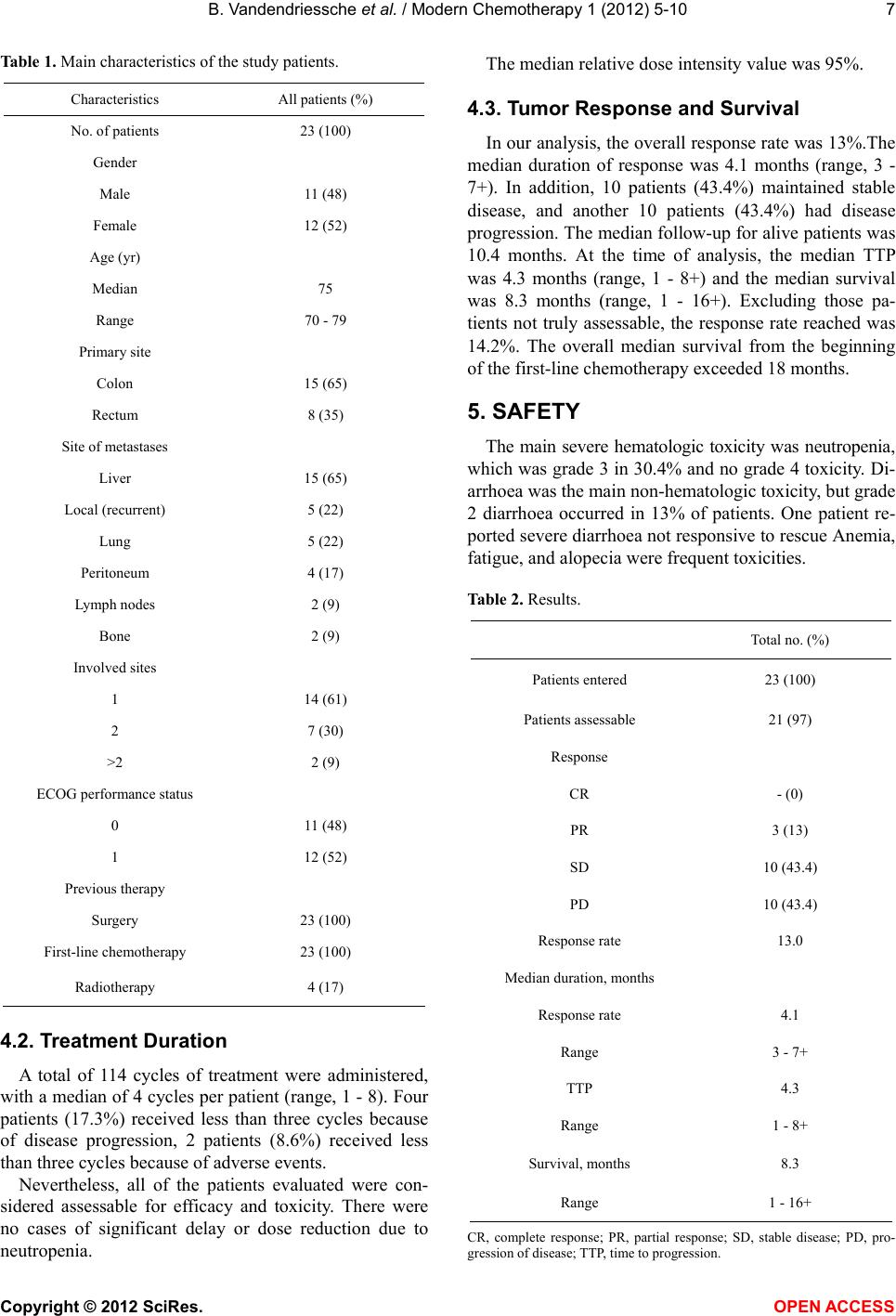 B. Vandendriessche et al. / Modern Chemotherapy 1 (2012) 5-10 7 T able 1. Main characteristics of the study patients. Characteristics All patients (%) No. of patients 23 (100) Gender Male 11 (48) Female 12 (52) Age (yr) Median 75 Range 70 - 79 Primary site Colon 15 (65) Rectum 8 (35) Site of metastases Liver 15 (65) Local (recurrent) 5 (22) Lung 5 (22) Peritoneum 4 (17) Lymph nodes 2 (9) Bone 2 (9) Involved sites 1 14 (61) 2 7 (30) >2 2 (9) ECOG performance status 0 11 (48) 1 12 (52) Previous therapy Surgery 23 (100) First-line chemotherapy 23 (100) Radiotherapy 4 (17) 4.2. Treatment Duration A total of 114 cycles of treatment were administered, with a median of 4 cycles per patient (range, 1 - 8). Four patients (17.3%) received less than three cycles because of disease progression, 2 patients (8.6%) received less than three cycles because of adverse events. Nevertheless, all of the patients evaluated were con- sidered assessable for efficacy and toxicity. There were no cases of significant delay or dose reduction due to neutropenia. The median relative dose intensity value was 95%. 4.3. Tumor Response and Survival In our analysis, the overall response rate was 13%.The median duration of response was 4.1 months (range, 3 - 7+). In addition, 10 patients (43.4%) maintained stable disease, and another 10 patients (43.4%) had disease progression. The median follow-up for alive patients was 10.4 months. At the time of analysis, the median TTP was 4.3 months (range, 1 - 8+) and the median survival was 8.3 months (range, 1 - 16+). Excluding those pa- tients not truly assessable, the response rate reached was 14.2%. The overall median survival from the beginning of the first-line chemotherapy exceeded 18 months. 5. SAFETY The main severe hematologic toxicity was neutropenia, which was grade 3 in 30.4% and no grade 4 toxicity. Di- arrhoea was the main non-hematologic toxicity, but grade 2 diarrhoea occurred in 13% of patients. One patient re- ported severe diarrhoea not responsive to rescue Anemia, fatigue, and alopecia were frequent toxicities. Table 2. Results. Total no. (%) Patients entered 23 (100) Patients assessable 21 (97) Response CR - (0) PR 3 (13) SD 10 (43.4) PD 10 (43.4) Response rate 13.0 Median duration, months Response rate 4.1 Range 3 - 7+ TTP 4.3 Range 1 - 8+ Survival, months 8.3 Range 1 - 16+ CR, complete response; PR, partial response; SD, stable disease; PD, pro- gression of disease; TTP, time to progresion. s Copyright © 2012 SciRes. OPEN ACCESS 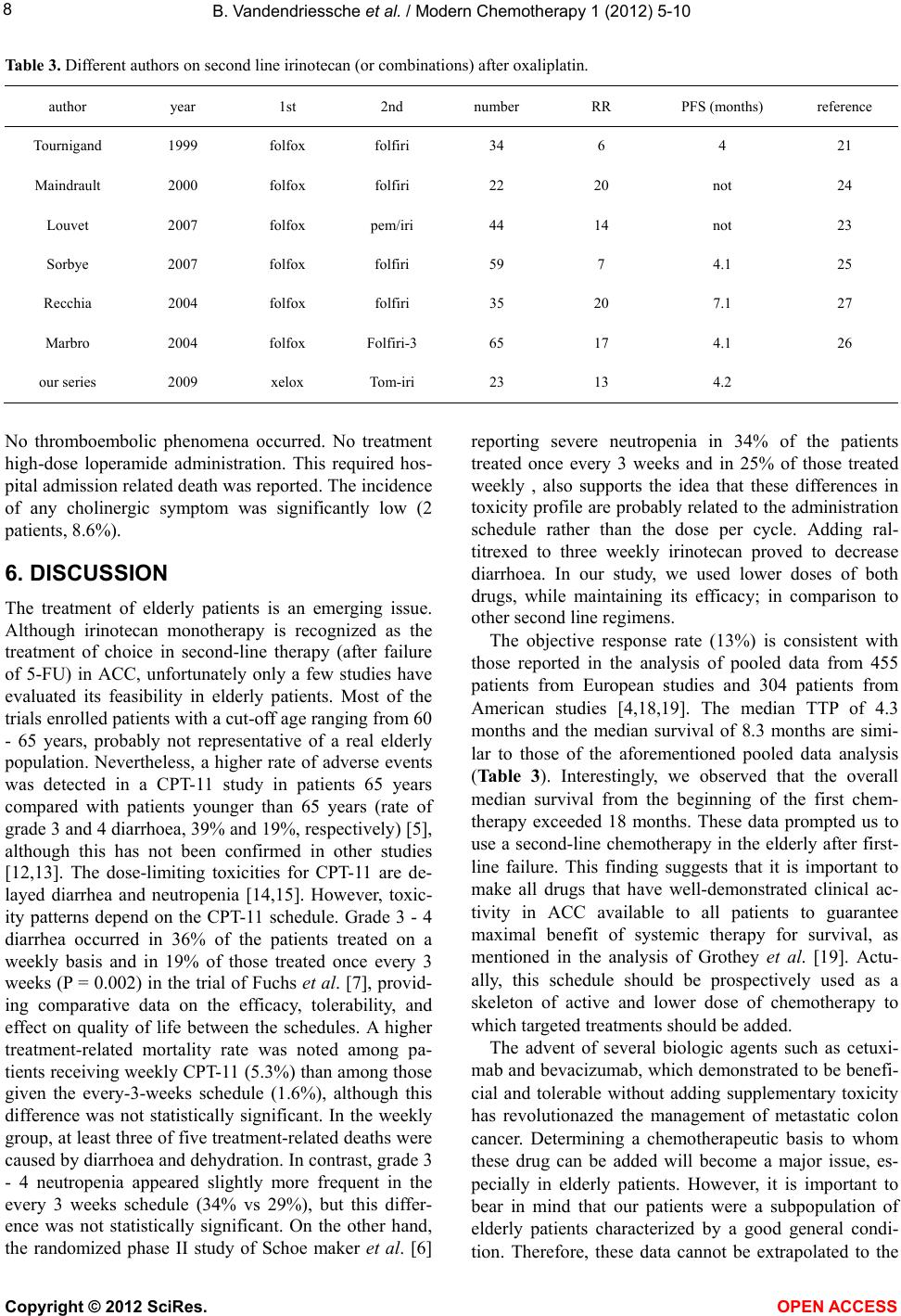 B. Vandendriessche et al. / Modern Chemotherapy 1 (2012) 5-10 Copyright © 2012 SciRes. OPEN ACCESS 8 Table 3. Different authors on second line irinotecan (or combinations) after oxaliplatin. author year 1st 2nd number RR PFS (months) reference Tournigand 1999 folfox folfiri 34 6 4 21 Maindrault 2000 folfox folfiri 22 20 not 24 Louvet 2007 folfox pem/iri 44 14 not 23 Sorbye 2007 folfox folfiri 59 7 4.1 25 Recchia 2004 folfox folfiri 35 20 7.1 27 Marbro 2004 folfox Folfiri-3 65 17 4.1 26 our series 2009 xelox Tom-iri 23 13 4.2 No thromboembolic phenomena occurred. No treatment high-dose loperamide administration. This required hos- pital admission related death was reported. The incidence of any cholinergic symptom was significantly low (2 patients, 8.6%). 6. DISCUSSION The treatment of elderly patients is an emerging issue. Although irinotecan monotherapy is recognized as the treatment of choice in second-line therapy (after failure of 5-FU) in ACC, unfortunately only a few studies have evaluated its feasibility in elderly patients. Most of the trials enrolled patients with a cut-off age ranging from 60 - 65 years, probably not representative of a real elderly population. Nevertheless, a higher rate of adverse events was detected in a CPT-11 study in patients 65 years compared with patients younger than 65 years (rate of grade 3 and 4 diarrhoea, 39% and 19%, respectively) [5], although this has not been confirmed in other studies [12,13]. The dose-limiting toxicities for CPT-11 are de- layed diarrhea and neutropenia [14,15]. However, toxic- ity patterns depend on the CPT-11 schedule. Grade 3 - 4 diarrhea occurred in 36% of the patients treated on a weekly basis and in 19% of those treated once every 3 weeks (P = 0.002) in the trial of Fuchs et al. [7], provid- ing comparative data on the efficacy, tolerability, and effect on quality of life between the schedules. A higher treatment-related mortality rate was noted among pa- tients receiving weekly CPT-11 (5.3%) than among those given the every-3-weeks schedule (1.6%), although this difference was not statistically significant. In the weekly group, at least three of five treatment-related deaths were caused by diarrhoea and dehydration. In contrast, grade 3 - 4 neutropenia appeared slightly more frequent in the every 3 weeks schedule (34% vs 29%), but this differ- ence was not statistically significant. On the other hand, the randomized phase II study of Schoe maker et al. [6] reporting severe neutropenia in 34% of the patients treated once every 3 weeks and in 25% of those treated weekly , also supports the idea that these differences in toxicity profile are probably related to the administration schedule rather than the dose per cycle. Adding ral- titrexed to three weekly irinotecan proved to decrease diarrhoea. In our study, we used lower doses of both drugs, while maintaining its efficacy; in comparison to other second line regimens. The objective response rate (13%) is consistent with those reported in the analysis of pooled data from 455 patients from European studies and 304 patients from American studies [4,18,19]. The median TTP of 4.3 months and the median survival of 8.3 months are simi- lar to those of the aforementioned pooled data analysis (Table 3). Interestingly, we observed that the overall median survival from the beginning of the first chem- therapy exceeded 18 months. These data prompted us to use a second-line chemotherapy in the elderly after first- line failure. This finding suggests that it is important to make all drugs that have well-demonstrated clinical ac- tivity in ACC available to all patients to guarantee maximal benefit of systemic therapy for survival, as mentioned in the analysis of Grothey et al. [19]. Actu- ally, this schedule should be prospectively used as a skeleton of active and lower dose of chemotherapy to which targeted treatments should be added. The advent of several biologic agents such as cetuxi- mab and bevacizumab, which demonstrated to be benefi- cial and tolerable without adding supplementary toxicity has revolutionazed the management of metastatic colon cancer. Determining a chemotherapeutic basis to whom these drug can be added will become a major issue, es- pecially in elderly patients. However, it is important to bear in mind that our patients were a subpopulation of elderly patients characterized by a good general condi- tion. Therefore, these data cannot be extrapolated to the  B. Vandendriessche et al. / Modern Chemotherapy 1 (2012) 5-10 9 elderly population in general, but must be confirmed by randomized prospective studies. REFERENCES [1] Cunningham, D., Pyrhönen, S., James, R.D., Punt, C.J.A., Hickish, T.F., Heikkila, R., Johannesenm, T.B., Stark- hammar, H., Thopam, C.A., Awad, L., Jacques, C. and Herait, P. (1998) Randomised trial of irinotecan plus supportive care versus supportive care alone after fluor- ouracil failure for patients with metastatic colorectal can- cer. Lancet, 352, 1413-1418. [2] Rougier, P, Van Cutsem, E., Bajetta, E., Niederle, N., Possinger, K., Labianca, R., Navarro, M., Morant, R., Bleiberg, H., Wils, J., Awad, L., Herait, P. and Jacques, C. (1998) Randomised trial of irinotecan versus fluorouracil by continuous infusion after fluorouracil failure in pa- tients with metastatic colorectal cancer. Lancet, 352, 1407-1412. [3] Armand, J.P., Ducreux, M., Mahjoubi, M., Abigerges, D., Bugat, R., Chabot, G., Herait, P., De Forni, M. and Rougier, P. (1995) CPT-11 (irinotecan) in the treatment of colorectal cancer. European Journal of Cancer, 31A, 1283-1287. [4] Pitot, H.C., Wender, D.B., O’Connell, M.J., Schroeder, G., Goldberg, R.M., Rubin, J., Mailliard, J.A., Knost, J.A., Ghosh, C., Kirschling, R.J., Levitt, R. and Windschitl, H.E. (1997) Phase II trial ofirinotecan in patients with metastatic colorectal carcinoma. Journal of Clinical On- cology, 15, 2910-2919. [5] Rothenberg, M.L., Cox, J.V., De Vore, R.F., Hainsworth, J.D., Pazdur, R., Rivkin, S.E., Macdonald, J.S., Geyer, C.E., Sandbach, J., Wolf, D.L., Mohrland, J.S., Elfring, G.L., Miller, L.L. and Von Hoff, D.D. (1999) A multicen- ter, phase II trial of weekly irinotecan (CPT-11) inpatients with previously treated colorectal carcinoma. Cancer, 85, 786-795. [6] Schoemaker, N.E., Kuppens, I.E.L.M., Moiseyenko, V., Glimelius, B., Kjaer, M., Starkhammer, H., Richel, D.J., Smaaland, R., Bertelsen, K., Poulsen, J.P., Voznyi, E., Norum, J., Fennelly, D., Tveit, K.M., Garin, A., Gruia, G., Mourier, A., Sibaud, D., Lefebvre, P., Beijnen, J.H., Schellens, J.H. and Bokkel-Huinink, W.W. (2004) A ran- domisedphase II multicentre trial of irinotecan (CPT-11) using four different schedules in patients with metastatic colorectalcancer. British Journal of Cancer, 91, 1434- 1441. [7] Fuchs, C.S., Moore, M.R., Harker, G., Villa, L., Rinaldi, D. and Hecht, J.R. (2003) Phase III comparison of two irinotecan dosing regimensin second-line therapy of me- tastatic colorectal cancer. Journal of Clinical Oncology, 21, 807-814. [8] Hwang, J.J., Eisenberg, S.G. and Marshall, J.L. (2003) Improving the toxicity of irinotecan/5-FU/leucovorin: A 21-day schedule. Oncology, 17, 37-43. [9] Fentiman, I.S., Tirelli, U., Monfardini, S., Schneider, M., Festen, J., Cognetti, F. and Aapro, M.S. (1990) Cancer in the elderly: why so badly treated. Lancet, 28, 1020-1022. [10] Monfardini, S. and Yancik, R. (1993) Cancer in the eld- erly: Meeting the challenge of an aging population. Jour- nal of the National Cancer Institute, 85, 532-538. [11] Miller, A.B., Hoogstraten, B., Staquet, M. and Winkler, A. (1981) Reporting results of cancer treatment. Cancer, 47, 207-214. [12] Rougier, P., Mitry, E., Cunningham, D., Roth, A., Cla- vero-Fabri, M.C., Magherini, E., Mery-Mignard, D., Awad, L. and Douillard, J.Y. (2003) Is age a prognostic factor of toxicity and efficacy in patients(pts) with metastatic co- lorectal cancer (MCRC) receiving irinotecan in combina- tion with 5FU/folinic acid (FA). American Society of Clinical Oncology, 22. [13] Chau, I., Norman, A.R., Cunningham, D., Waters, J.S., Topham, C., Middleton, G., Hill, M., Ross, P.J., Katopo- dis, R., Stewart, G. and Oates, J.R. (2004) Elderly patients with fluoropyrimidine andthymidylate synthase inhibitor- resistant advanced colorectal cancer derive similar benefit without excessive toxicity when treated with irinotecan monotherapy. British Journal of Cancer, 91, 1453-1458. [14] Rothenberg, M.L., Kuhn, J.G., Burris, H.A., Nelson, J., Eckardt, J.R., Tristan-Morales, M., Hilsenbeck, S.G., Weiss, G.R., Smith, L.S. and Rodriguez, G.I. (1993) Phase I and pharmacokinetic trial of weekly CPT-11. Journal of Clinical Oncology, 11, 2194-2204. [15] Abigerges, D., Chabot, G.G., Armand, J.P., Herait, P., Gouyette, A. and Gandia, D. (1995) Phase I and pharma- cologic studies of the camptothecin analog irinotecan administered every 3 weeks in cancer patients. Journal of Clinical Oncology, 13, 210-221. [16] Benavides, M., Garcia-Alfonso, P., Cobo, M., Munoz- Martin, A., Gil-Calle, S., Carabantes, F., Villar, E., Graupera, J., Balcells, M. and Perez-Manga, G. (2004) Weekly irinotecan (CPT-11) in 5-FU heavily pretreated and poor-performance-status patients with advanced co- lorectal cancer. Medical Oncology, 21, 255-262. [17] Karaoglu, A., Yalcin, S., Tekuzman, G., Kars, A., Celik, I., Guler, N., Ozisik, Y., Turker, A., Barista, I. and Gullu, I. (2003) Weekly irinotecan in patients with metastatic co- lorectal cancer failing 5-fluorouracil-based chemotherapy: Efficacy and prognostic factors. Tu mori , 89, 141-145. [18] Rougier, P. and Mitry, E. (2000) Colorectal cancer che- motherapy: Irinotecan. Seminars in Oncology, 27, 138- 143. [19] Grothey, A., Sargent, D., Goldberg, R.M. and Schmoll, H.J. (2004) Survival of patients with advanced colorectal cancer improves with the availability of fluorouracil- leucovorin, irinotecan, and oxaliplatin in the course of treatment. Journal of Clinical Oncology, 22, 1209-1214. [20] Rosati, G. and Cordio, S. (2006) Single agent irinotecan as second line weekly chemotherapy in elderly patients with advanced colorectal cancer. Tu mori , 92,290-294. [21] Tournigand, C., André, T., Achille, E., Lledo, G., Flesh, M., Mery-Mignard, D., et al. (2004) Folfiri followed by FOLFOX6 or the reverse sequence in advanced colorectal cancer: A randomized GERCOR study. Journal of Clini- cal Oncology, 22, 229-237. [22] Louvet, C., André, T., Gamelin, E., Hebbar, M., Mabro, Copyright © 2012 SciRes. OPEN ACCESS  B. Vandendriessche et al. / Modern Chemotherapy 1 (2012) 5-10 Copyright © 2012 SciRes. OPEN ACCESS 10 M., Bennamoun, M., Rassam, H. and De Gramont. (2010) Phase II study of biweekly pemetrexed plus irinotecan as second-line therapy for metastatic colorectal cancer. American Journal of Clinical Oncology. [23] Mabro, M., Artru, P., André, T., Flesch, M., Maindrault- Goebel, F., Landi, B., Lledo, G., Plantade, A., Louvet, C. and De Gramont, A. (2006) A phase II study of FOLFIRI-3 (double infusion of irinotecan combined with LV5FU) after FOLFOX in advanced colorectal cancer patients. British Journal of Cancer, 94, 1287-1292. [24] Sorbye, H., Berglund, A., MagneTveits, K., Ogreid, D., Hoff Wandere, E., et al. (2007) Secondary treatment and predictive factors for second-line chemotherapy after first-line oxaliplatin-based therapy in metastatic colorec- tal cancer. Acta Oncologica, 46, 982-988. [25] Mabro, M., Artru, P., Andre, T., Flesch, M., Maindrault- Goebel, F., Landi, B., Lledo, G., Plantade, A., Louvet, C. and Gramont, A. (2006) A phase II study of FOLFIRI-3 (double infusion of irinotecan combined with LV5FU) after FOLFOX in advanced colorectal cancer patients. British Journal of Cancer, 94, 1287-1292. [26] Recchia, F., Nuzzo, A., Lalli, A., Di Lullo, L., De Filippis, S., Saggio, G., Di Blasio, A. and Rea, S. (2003) Multi- center phase II study of CPT-11 fractionated over two days with bimonthly leucovorin and 5-fluorouracil in pa- tients with metastatic colorectal cancer. Anti-Cancer Re- search, 23, 2903-2908. |