

Paper Menu >>
Journal Menu >>
 Modern Economy, 2012, 3, 671-674 http://dx.doi.org/10.4236/me.2012.35086 Published Online September 2012 (http://www.SciRP.org/journal/me) A Local Currency in a Dollarized Economy Sokchea Lim1,2 1Department of Economics, Southern Illinois University Carbondale, Carbondale, USA 2Cambodian Institute for Cooperation and Peace, Phnom Penh, Cambodia Email: [email protected] Received July 3, 2012; revised August 2, 2012; accepted August 10, 2012 ABSTRACT The paper uses a dual-currency search theoretic approach to demonstrate that it is possible to induce the acceptance of a local currency in a dollarized economy. In the model, we assume that a foreign currency is in full circulation and the government policy tool is the convertibility of the local currency to the foreign currency. We show that the economy can achieve equilibria where two monies are in circulation if the government can raise a sufficiently high probability of exchange between the two currencies. Keywords: Dual-Currency Search Theoretic Approach; Dollarized Economy 1. Introduction Curtis and Waller [1] explore the coexistence of two cur- rencies, domestic as a legal tender and foreign as an ille- gal one. Assume that the legal currency is always accepted, the government uses several enforcement policies to drive the illegal currency out of circulation. Dutu [2] constructs a one-country search-theoretic model of two monies with different rates of return and bargaining powers. The results show that the weakening of the domestic currency’s bar- gaining power can invite strong foreign currency while its lower rate of return drives out the foreign one. Lotz and Recheteau [3] use the search-theoretic approach to determine how the government can replace an old currency with a new one. Different from the above papers, we in- troduce the convertibility between the two monies in the model. We want to show that the government can induce the acceptance of a local currency in an economy in which a foreign currency is fully accepted. The purpose of the paper is to determine under which conditions a local currency can be accepted in a dollar- ized economy where a foreign currency is in full circula- tion. The policy tool of the government is to link the lo- cal currency to the fully established foreign currency by easing the convertibility between the two. Using search- theoretical approach of money, we show that the econ- omy can achieve equilibria where two monies are in cir- culation if the government can raise a sufficiently high probability of exchange between the two currencies. 2. The Simple Model The model is related to the dual-currency search-theoretic model of Kiyotaki and Wright [4]. In this model, the dou- ble coincidence of wants between a given pair of agents is ruled out; hence, there exist two fiat monies which play an important role as media of exchange. The economy is populated by a continuum of infinitely-lived agents with total population normalized to unity. Time is continuous. There are also a large number of consumption goods which are indivisible and non-storable, and they come in units of size one. Each agent is specialized in both consump- tion and production. All agents are assumed to be homoge- nous in their preferences. An agent gets zero utility (U = 0) from consuming her own production good or not con- suming any goods and she gets a positive utility (U > 0) from consuming a good that she likes. A type j consumer consumes good j and produces good j + 1 (modulo N), for j = 1, 2, ···, N and N 3. So, the probability that, for a given agent, a would-be trading partner can produce her desired good is x = 1/N (a single coincidence of wants). The assumption is essential to rule out the double coin- cidence of wants. For simplicity, it is assumed that there is no labor cost of production of goods. Once consuming, an agent can enter the production process and produce an- other unit of consumption goods to trade in the next period. There are two currencies in the model, local and for- eign currencies which are denoted by subscripts of L and F, respectively. Both monies are indivisible, costlessly stor- able and cannot be produced by any private agents. An agent stores only one unit of one type of money at a time. At the beginning of period 0, a fraction of M agents is chosen at random and endowed with one unit of money each. Since there are two currencies in this economy, mL denotes a fraction of private agents who are endowed with C opyright © 2012 SciRes. ME 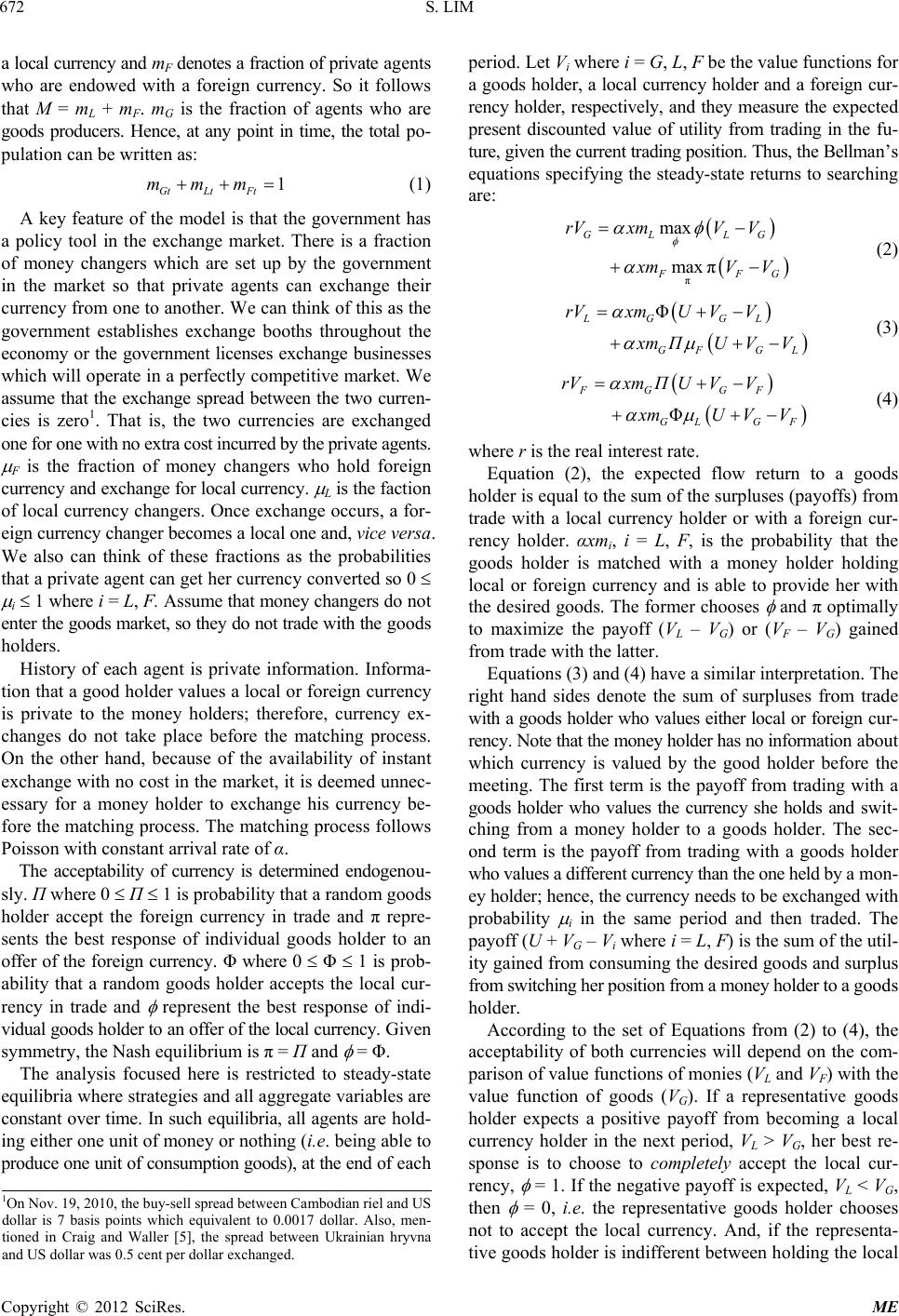 S. LIM 672 a local currency and mF denotes a fraction of private agents who are endowed with a foreign currency. So it follows that M = mL + mF. mG is the fraction of agents who are goods producers. Hence, at any point in time, the total po- pulation can be written as: 1 Lt Ft mmm π max max π GL LG Gt (1) A key feature of the model is that the government has a policy tool in the exchange market. There is a fraction of money changers which are set up by the government in the market so that private agents can exchange their currency from one to another. We can think of this as the government establishes exchange booths throughout the economy or the government licenses exchange businesses which will operate in a perfectly competitive market. We assume that the exchange spread between the two curren- cies is zero1. That is, the two currencies are exchanged one for one with no extra cost incurred by the private agents. F is the fraction of money changers who hold foreign currency and exchange for local currency. L is the faction of local currency changers. Once exchange occurs, a for- eign currency changer becomes a local one and, vice versa. We also can think of these fractions as the probabilities that a private agent can get her currency converted so 0 i 1 where i = L, F. Assume that money changers do not enter the goods market, so they do not trade with the goods holders. History of each agent is private information. Informa- tion that a good holder values a local or foreign currency is private to the money holders; therefore, currency ex- changes do not take place before the matching process. On the other hand, because of the availability of instant exchange with no cost in the market, it is deemed unnec- essary for a money holder to exchange his currency be- fore the matching process. The matching process follows Poisson with constant arrival rate of α. The acceptability of currency is determined endogenou- sly. Π where 0 Π 1 is probability that a random goods holder accept the foreign currency in trade and π repre- sents the best response of individual goods holder to an offer of the foreign currency. Φ where 0 Φ 1 is prob- ability that a random goods holder accepts the local cur- rency in trade and represent the best response of indi- vidual goods holder to an offer of the local currency. Given symmetry, the Nash equilibrium is π = Π and = Φ. The analysis focused here is restricted to steady-state equilibria where strategies and all aggregate variables are constant over time. In such equilibria, all agents are hold- ing either one unit of money or nothing (i.e. being able to produce one unit of consumption goods), at the end of each period. Let Vi where i = G, L, F be the value functions for a goods holder, a local currency holder and a foreign cur- rency holder, respectively, and they measure the expected present discounted value of utility from trading in the fu- ture, given the current trading position. Thus, the Bellman’s equations specifying the steady-state returns to searching are: F FG rVxmV V x mVV (2) Φ LG GL GF GL rVxmU VV xm ΠUV V (3) Φ FG GF GLG F rVxm ΠUV V x mUVV (4) where r is the real interest rate. Equation (2), the expected flow return to a goods holder is equal to the sum of the surpluses (payoffs) from trade with a local currency holder or with a foreign cur- rency holder. αxmi, i = L, F, is the probability that the goods holder is matched with a money holder holding local or foreign currency and is able to provide her with the desired goods. The former chooses and π optimally to maximize the payoff (VL – VG) or (VF – VG) gained from trade with the latter. Equations (3) and (4) have a similar interpretation. The right hand sides denote the sum of surpluses from trade with a goods holder who values either local or foreign cur- rency. Note that the money holder has no information about which currency is valued by the good holder before the meeting. The first term is the payoff from trading with a goods holder who values the currency she holds and swit- ching from a money holder to a goods holder. The sec- ond term is the payoff from trading with a goods holder who values a different currency than the one held by a mon- ey holder; hence, the currency needs to be exchanged with probability i in the same period and then traded. The payoff (U + VG – Vi where i = L, F) is the sum of the util- ity gained from consuming the desired goods and surplus from switching her position from a money holder to a goods holder. According to the set of Equations from (2) to (4), the acceptability of both currencies will depend on the com- parison of value functions of monies (VL and VF) with the value function of goods (VG). If a representative goods holder expects a positive payoff from becoming a local currency holder in the next period, VL > VG, her best re- sponse is to choose to completely accept the local cur- rency, = 1. If the negative payoff is expected, VL < VG, then = 0, i.e. the representative goods holder chooses not to accept the local currency. And, if the representa- tive goods holder is indifferent between holding the local 1On Nov. 19, 2010, the buy-sell spread between Cambodian riel and US dollar is 7 basis points which equivalent to 0.0017 dollar. Also, men- tioned in Craig and Waller [5], the spread between Ukrainian hryvna and US dollar was 0.5 cent per dollar exchanged. Copyright © 2012 SciRes. ME 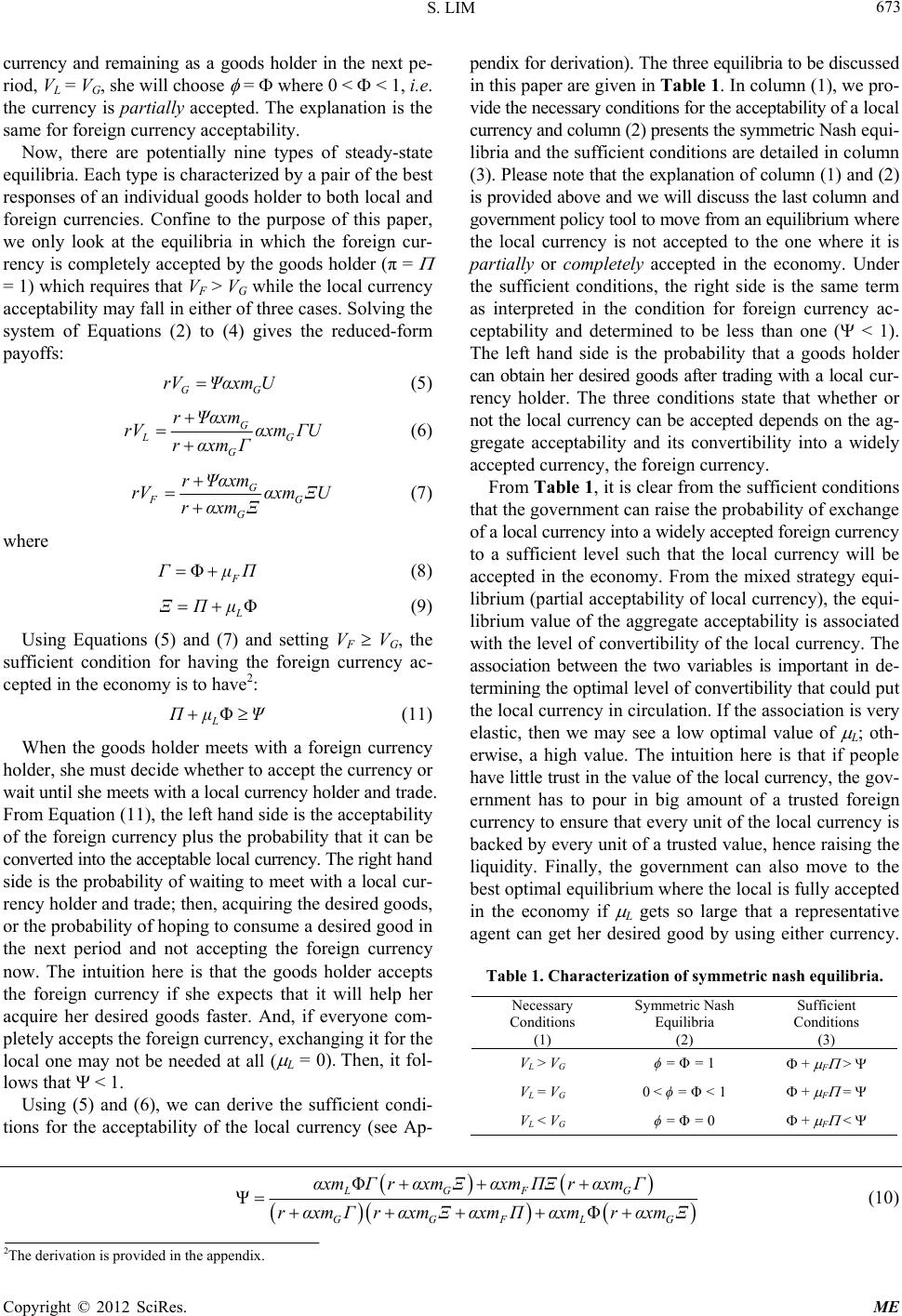 S. LIM Copyright © 2012 SciRes. ME 673 GG Ψα currency and remaining as a goods holder in the next pe- riod, VL = VG, she will choose = where 0 < < 1, i.e. the currency is partially accepted. The explanation is the same for foreign currency acceptability. Now, there are potentially nine types of steady-state equilibria. Each type is characterized by a pair of the best responses of an individual goods holder to both local and foreign currencies. Confine to the purpose of this paper, we only look at the equilibria in which the foreign cur- rency is completely accepted by the goods holder (π = = 1) which requires that VF > VG while the local currency acceptability may fall in either of three cases. Solving the system of Equations (2) to (4) gives the reduced-form payoffs: rV x mU (5) G G G xm αxm ΓU Γ L rΨα rV rαxm (6) G G G xm αxm ΞU Ξ ΦF ΓμΠ Φ L ΞΠ F rΨα rV rαxm (7) where (8) μ Φ L Πμ Ψ (9) Using Equations (5) and (7) and setting VF VG, the sufficient condition for having the foreign currency ac- cepted in the economy is to have2: (11) When the goods holder meets with a foreign currency holder, she must decide whether to accept the currency or wait until she meets with a local currency holder and trade. From Equation (11), the left hand side is the acceptability of the foreign currency plus the probability that it can be converted into the acceptable local currency. The right hand side is the probability of waiting to meet with a local cur- rency holder and trade; then, acquiring the desired goods, or the probability of hoping to consume a desired good in the next period and not accepting the foreign currency now. The intuition here is that the goods holder accepts the foreign currency if she expects that it will help her acquire her desired goods faster. And, if everyone com- pletely accepts the foreign currency, exchanging it for the local one may not be needed at all ( L = 0).Then, it fol- lows that < 1. Using (5) and (6), we can derive the sufficient condi- tions for the acceptability of the local currency (see Ap- pendix for derivation). The three equilibria to be discussed in this paper are given in Table 1. In column (1), we pro- vide the necessary conditions for the acceptability of a local currency and column (2) presents the symmetric Nash equi- libria and the sufficient conditions are detailed in column (3). Please note that the explanation of column (1) and (2) is provided above and we will discuss the last column and government policy tool to move from an equilibrium where the local currency is not accepted to the one where it is partially or completely accepted in the economy. Under the sufficient conditions, the right side is the same term as interpreted in the condition for foreign currency ac- ceptability and determined to be less than one ( < 1). The left hand side is the probability that a goods holder can obtain her desired goods after trading with a local cur- rency holder. The three conditions state that whether or not the local currency can be accepted depends on the ag- gregate acceptability and its convertibility into a widely accepted currency, the foreign currency. From Table 1, it is clear from the sufficient conditions that the government can raise the probability of exchange of a local currency into a widely accepted foreign currency to a sufficient level such that the local currency will be accepted in the economy. From the mixed strategy equi- librium (partial acceptability of local currency), the equi- librium value of the aggregate acceptability is associated with the level of convertibility of the local currency. The association between the two variables is important in de- termining the optimal level of convertibility that could put the local currency in circulation. If the association is very elastic, then we may see a low optimal value of L; oth- erwise, a high value. The intuition here is that if people have little trust in the value of the local currency, the gov- ernment has to pour in big amount of a trusted foreign currency to ensure that every unit of the local currency is backed by every unit of a trusted value, hence raising the liquidity. Finally, the government can also move to the best optimal equilibrium where the local is fully accepted in the economy if L gets so large that a representative agent can get her desired good by using either currency. Table 1. Characterization of symmetric nash equilibria. Necessary Conditions (1) Symmetric Nash Equilibria (2) Sufficient Conditions (3) VL > VG ϕ = Φ = 1 + F > VL = VG 0 < ϕ = Φ < 1 + F = VL < VG ϕ = Φ = 0 + F < Φ Ψ Φ LGF G GGFLG αxm Γrαxm Ξαxm ΠΞ rαxm Γ rαxm Γrαxm Ξαxm Παxmr αxm Ξ (10) 2The derivation is provided in the appendix. 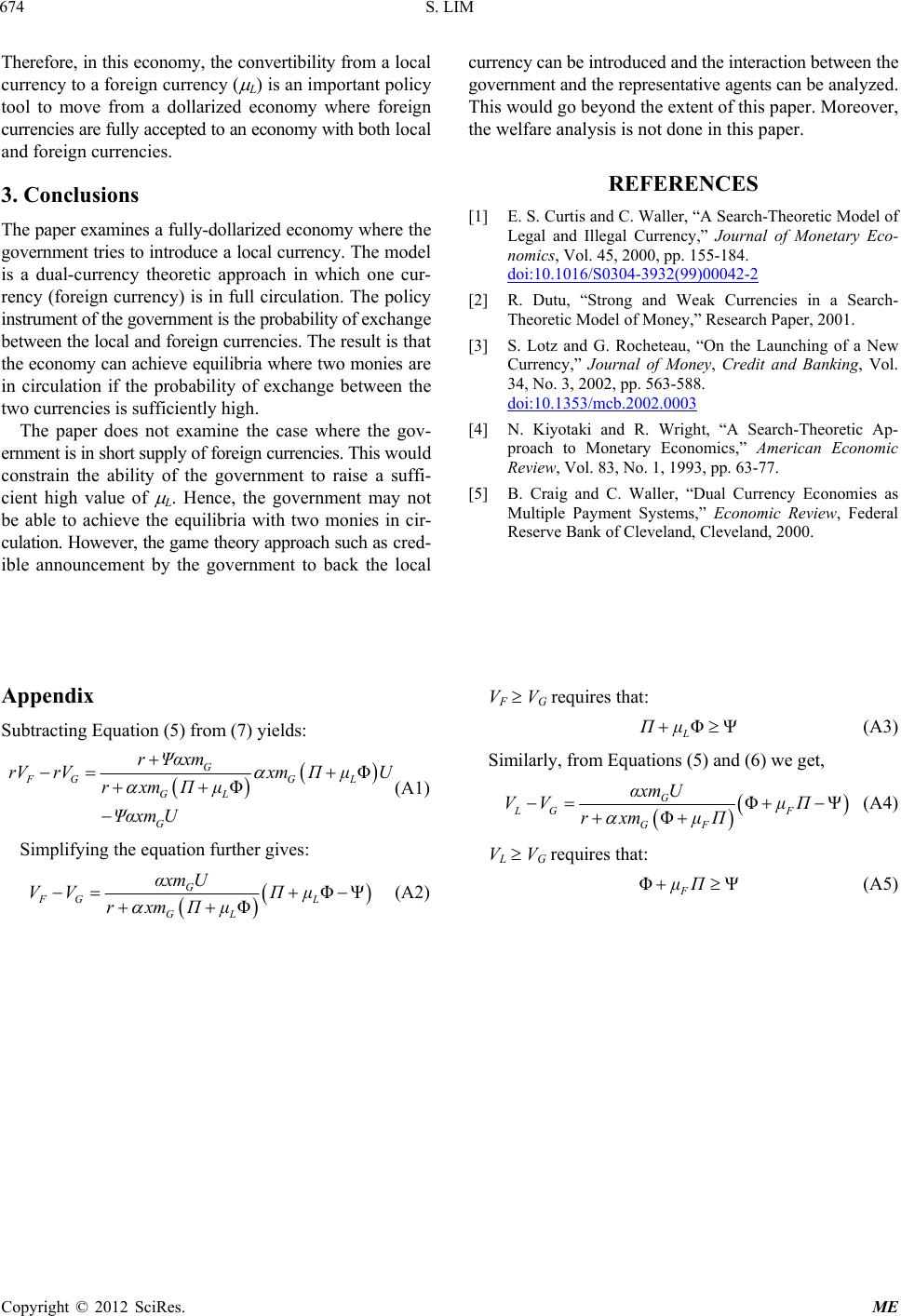 S. LIM 674 Therefore, in this economy, the convertibility from a local currency to a foreign currency ( L) is an important policy tool to move from a dollarized economy where foreign currencies are fully accepted to an economy with both local and foreign currencies. 3. Conclusions The paper examines a fully-dollarized economy where the government tries to introduce a local currency. The model is a dual-currency theoretic approach in which one cur- rency (foreign currency) is in full circulation. The policy instrument of the government is the probability of exchange between the local and foreign currencies. The result is that the economy can achieve equilibria where two monies are in circulation if the probability of exchange between the two currencies is sufficiently high. The paper does not examine the case where the gov- ernment is in short supply of foreign currencies. This would constrain the ability of the government to raise a suffi- cient high value of L. Hence, the government may not be able to achieve the equilibria with two monies in cir- culation. However, the game theory approach such as cred- ible announcement by the government to back the local currency can be introduced and the interaction between the government and the representative agents can be analyzed. This would go beyond the extent of this paper. Moreover, the welfare analysis is not done in this paper. REFERENCES [1] E. S. Curtis and C. Waller, “A Search-Theoretic Model of Legal and Illegal Currency,” Journal of Monetary Eco- nomics, Vol. 45, 2000, pp. 155-184. doi:10.1016/S0304-3932(99)00042-2 [2] R. Dutu, “Strong and Weak Currencies in a Search- Theoretic Model of Money,” Research Paper, 2001. [3] S. Lotz and G. Rocheteau, “On the Launching of a New Currency,” Journal of Money, Credit and Banking, Vol. 34, No. 3, 2002, pp. 563-588. doi:10.1353/mcb.2002.0003 [4] N. Kiyotaki and R. Wright, “A Search-Theoretic Ap- proach to Monetary Economics,” American Economic Review, Vol. 83, No. 1, 1993, pp. 63-77. [5] B. Craig and C. Waller, “Dual Currency Economies as Multiple Payment Systems,” Economic Review, Federal Reserve Bank of Cleveland, Cleveland, 2000. Appendix Subtracting Equation (5) from (7) yields: Φ Φ G FGG L GL G rΨαxm rVrVxm ΠμU rxmΠμ Ψαxm U (A1) Simplifying the equation further gives: ΦΨ Φ G FG L GL αxm U VV Πμ rxmΠμ ΦΨ L Πμ (A2) VF VG requires that: (A3) Similarly, from Equations (5) and (6) we get, ΦΨ Φ G LG F GF αxm U VV μΠ rxmμΠ ΦΨ F μΠ (A4) VL VG requires that: (A5) Copyright © 2012 SciRes. ME |