

Paper Menu >>
Journal Menu >>
 Modern Economy, 2012, 3, 542-552 http://dx.doi.org/10.4236/me.2012.35071 Published Online September 2012 (http://www.SciRP.org/journal/me) Financial Innovation, Macroeconomic Volatility and the Great Moderation Lorenzo Bencivelli, Andrea Zaghini Bank of Italy, Research Department—Servizio Studi di Congiuntura e Politica Monetaria, Rome, Italy Email: [email protected], [email protected] Received April 23, 2012; revised May 29, 2012; accepted June 7, 2012 ABSTRACT In the paper we propose an assessment of the role of financial innovation in shaping US macroeconomic dynamics. We extend an existing model by Christiano, Eichenbaum and Evans which studied the transmission of monetary policy im- pulses to business and corporate sector financing variables just before the Great Moderation period. By investigating the properties of the model over a longer time span we show that in the later period a change in the monetary policy trans- mission mechanism is likely to have occurred. In particular, we argue that the role of financial innovation has signify- cantly altered the transmission of shocks. Keywords: Great Moderation; Monetary Policy; Financial Innovation 1. Introduction The Great Moderation period in the US has been broadly investigated but it is still a matter of lively discussions. The stylized facts are very simple and clear: the volatility and the persistence of many macroeconomic variables (first of all GDP and inflation) declined significantly s in c e early 1980s. However, the reasons behind this change in business cycle dynamics are still unclear. The economic literature has provided three competing bu t non mutually excluding hypotheses: the “good luck” hypothesis (the economy was hit from less severe shocks), the “good pol - icy” hypothesis (improved monetary policy management), the “changes in the structure” hypothesis (modifications in the functioning of the economy which have altered the transmi ssi o n of monetary an d other kind of shocks). Recently a new branch of the literature has suggested that financial innovation may have played and important role in influencing the business cycle dynamics of the US economy. In particular, changes in firms’ and consumers’ behaviour, induced by significant financial improvements , have allowed private sector agents to better cushion them- selves from th e impac t of in ter est-rate fluctu ation s. Wi t h in this new framework, our paper analyses the role played by net funds raised by the business sector. We build on an existing model proposed by Christiano, Eichenbaum and Evans in 1996 by extending their sample in order to include the whole Great Moderation period. Their model worked well in identifying monetary policy shocks and describing the interaction among real and financial vari- ables over a period which includes only few years of the Great Moderation era. By adding data till 2006 and by adequately splitting the sample we show: 1) that the mod el is not able to describe the dynamics of US economy over the enlarged period; 2) that the transmission of monetary policy shocks in an early and a late sub-sample differs significantly. In particular, the role of financial variables seems to have changed. Even not including data from the most recent financial crisis, in the second part of the sa m- ple financial variab les emerge as the channel through which the shocks pass to the real sector of the economy. The paper is structured as follows. Section 2 proposes a survey of the literature p aying particular attention to the most recent contributions about the role of financial in- novation; Section 3 introdu ces th e model by Christiano et al. [1], Section 4 deals with the estimation results over the two sub-samples; Section 5 provides a robustness analy- sis; Section 6 concludes. 2. The Economic Literature Starting from the late 1990s, a large body of the empiri- cal literature has examined the Great Moderation era in the US. A survey of the early contributions can be al- ready found in Stock and Watson [2]1. More recently, this lively literature has witnessed a acceleration due to the employment of new econometric techniques. As al- ready mentioned, there are three main explanations of the declined volatility of US macroeconomic times series: 1See Bernanke and Mihov [3], Kim and Nelson [4], McConnel and Perez-Quiros [5], Clarida et al. [6], Blanchard and Simon [7] among the earl y studies. C opyright © 2012 SciRes. ME  L. BENCIVELLI, A. ZAGHINI 543 the “good luck”, the “good policy” and the “structural changes” hypotheses. The “good luck” hypothesis is based on the assumption that macroeconomic shocks are drawn from a t i m e - v a r y in g distribution. Over the Great Moderation years the US economy was simply hit by less severe shocks and in particular by smaller common international shocks (Stock and Watson [8]; Si ms and Zha [9]). The “good policy” explanation of the declined vola- tile- ity is that the FED ch anged its monetary policy con- duct improving its ability to tackle exogenous distur- bances. By systematically responding more decisively to fluctuations in economic conditions, a credible monetary policy has since the early 1980s stabilized inflationary expectations via commitment to a nominal anchor (Lubik and Schorfheide [10]; Boivin and Giannoni [11]). Finally, the “structural changes” hypothesis holds that various innovations induced by technological progress or financial innovations, might have altered the transmis- sion mechanism of shocks as well as monetary policy impulses allowing the private sector to better withstand the impact of business cycle fluctuations (Giannone et al. [12]; Galì and Gambetti [13]). Without the pretence of being exhaustive, we report in Table 1 a classification of the empirical contributions on the Great Moderation with respect to the main empirical method employed and the hypothesis backed by the results. One of the first and still br oadly used methodology by empirical works is the sub-sampling. The properties of the US economy are investigated separately over two dis- tinct periods. Even if the econometric techniques are of- ten different (e.g., IRFs are estimated with VAR/FAVAR or derived from small scale models) the idea is to use the business cycle dynamics over a pre-Moderation sample to test the changes of th e Great Moderation period. There is a relatively large consensus on the break having oc- curred in 1984. The early sample usually starts in mid- late 1950s and ends in late 1983 or in any of the four quarters of 1984. As for the closing date of the Great Moderation period, the latest available data is commonly employed. However, at least as inflation dynamics are concerned, based on a review of econometric estimates of trend inflation and surveys on inflation expectations, Mishkin [14] argues that the process of disinflation and the re-anchoring of long-term inflation expectations was completed by the end of the 1990s2. Recently more so- phisticated econometric instruments were employed to assess the causes of the Great Moderation. In particular (structural) time-varying coefficient VAR and time vary- ing regimes modelling are widely used. As for the motivations of the declined macroeconomic volatility, from Table 1 we can see that early work s t e n d e d to support the “good luck” hypothesis while later studies point to the “good policy explanation” of the Great Mod- eration. Whereas, apart from the pioneering work of Kim and Nelson [26], the contribution pointing to a structural change in the economic framework are the most recent, regardless of the econometric technique employed. Among the contributions which suggest that the struc- tural changes witnessed by the US economy are the main cause of the Great Moderation, there are several studies backing the hypothesis that the change in the financial system is the mo st important one. In particular, this branch of the literature looks at several possible links between the working of financial markets and the real economic activity. On the on e h and, th e financial accelerator and the pro- cyclicality of the premia on credit are seen as the main theoretical tools to assess the process through which the financial system is supposed to transmit and amplify economic fluctuations3. On the other hand, financial in- novation has been proposed as a possible source of mod- eration of business cycles. Changes in the way financial market operates have induced structural adjustments in firms’ and consumers’ behaviour, which in turn let the private sector better cushioning itself from the impact of interest-rate fluctuations and macroeconomic shocks. In particular, the coincidence of the Great Moderation in macroeconomic variables with an in crease in the volatile- ity of many financial variables (financial immoderation) Table 1. Empirical literature. Good luck Good policy Structural changes Sub-samples De Blas [16] Clarida et al. [6] Lubik Schorfheide [10] Boivin Giannoni [11 ] Boivin et al. [17] Canova Gambetti [18] Gilchrist et al. [19] Time-varying coefficients Stock Watson [8] Prim iceri [5] Justiniano Primiceri [20] Cecchetti et al. [21] Canova Gambetti [22] Galì Gambetti [13] Time-varying regimes McConnell Perez [5] Sims Zha [9] Korenok Radchenko [23] Kim et al. [24] Galvao Marcellino [25] Kim Nelson [4] 2For the welfare implication of the declined inflation rate over the Great Moderation period in the US se e Calza and Zaghini [15]. 3About the financial accel erator transm ission mechanism see, for instance, Gertler and Lown [26]. Copyright © 2012 SciRes. ME  L. BENCIVELLI, A. ZAGHINI 544 has pushed the profession looking for possible explana- tions of the phenomenon. The link proposed goes indeed through the financial innovation. The underlying intuition is that transformations occurred in the financial market (financial innovation) have turned to opportunities for f i rm s and households to smooth their investment and consump- tion plans, with the result that economic agents exploited more the financial instruments (financial immoderation), but the fluctuations in th e main macroeconomi c aggreg at es have moderated considerably (macroeconomic modera- tion). For instance, a change usually suggested by the literature to support the fin ancial innovation hypothesis is the democratization of the market (Dynan et al. [27]), i.e. the agents participation to the market trading without intervention of institutional intermediaries brought about by newly developed technologies4. Of particular interest is the empirical approach fol- lowed by Jermann and Quadrini [28], Gilchrist et al. [19] and Fuentes-Albero [29]. They start from the well known DSGE model for the US economy proposed by Smets and Wouters [30] and introduce some financial market frictions to account for spillovers from the financial sys- tem to the real activity. Following the line of research pioneered by Kiyotaki and Moore [31] and Bernanke et al. [32] which show that frictions in the credit market introduce a transmission mechanism which magnifies business fluctuations, they try to prove that the process of convergence toward a better functioning and almost frictionless financial market can yield more moderate fluctuations in the real variables, i.e. be the cause of the Great Moderation5. According to Gilchrist et al. [21], the in troduction of a financial accelerator mechanism à la Bernanke et al. [1] in the Smets and Wouters [34] framework , under the hypothesis that markets are imperfect, drives a wedge between expected return on capital and expected return demanded by the households (the lender). The authors show that over the period 1973-2008 this mechanism affects significantly business cycle fluctuations. In par- ticular, an increase in external finance premium causes significant and protracted decline in investment spending and in output. Furthermore, Gilchrist et al. find that the financial stress is partly responsible for the sharp drop in output and investments spending in the mid Seventies. Conversely, the financial easing of the late Nineties pro- vided a significant impetus to investments. Looking at Flow-of-Funds data Jermann and Quadrini [28] document the increase in volatility of firms financial flows. Specifically, the flows of debt and equity finance- ing in the business sector displayed much greater vari- ability from the second half of the 1980s. Because debt financing is negatively correlated to equity financing, t hes e findings suggest that firms have become more flexible in the choice of the financial structure. In their model the driving forces of business cycles are productivity and c re di t shocks. The former is the standard productivity shock as in the typical real business cycle model. The latter is a shock that affects the enforcement of debt contracts, and therefore, the borrowing ability of firms (credit shock). Because of financial frictions, credit shocks are transmit- ted to the real sector of the economy through the effect they have on the production and investment decisions of firms. They show that credit shocks do contribute non- negligibly to the volatility of the major macroeconomic variables in the first sample period (1952-1983). In addi- tion, they find that financial innovations can account for a large decline in real macroeconomic volatility and they can easily account for the full increase in the volatility of the financial structure of firms in the second sample pe- riod (1984-2006 ). The paper by Fuentes-Albero [29] tries to reconcile the two empirical facts of the great moderation of macro- economic variables and the great immoderation of finan- cial variables on the path traced by Jermann and Quadrini [28] and Gilchrist et al. [19]. The goal being that of quan - tifying the relative role played by financial factors in shaping macroeconomic volatilities. The baseline model is again the one by Smets and Wouter [30] enriched with a financial accelerator mechanism (financial frictions). Differently from Gilchrist et al. [19] the author allows for two different financial shocks, one accounting for the balance sheet channel, the other for the information channel. The main empirical finding is a redu ction in the average level of financial rigidities in the second sample (1984-2006). In particular, the estimated reduction in the size of the financial accelerator has two effects. On the one hand, it allows the model to account for 30% of the slowdown in the volatility o f investment and th e nominal interest rate. On the other hand, a smaller level of finan- cial rigidity changes the propagation mechanism of fi- nancial shocks to the economy. 3. A Benchmark Model In order to assess whether a change has occurred in the monetary policy transmission mechanism which is con- sistent with the Great Moderation timing and, in particu- lar, if it can be related to some changes in th e way private sector reacts to unexpected shocks, we build on the 1996 4Other transformations often quoted are the higher efficiency and speed of the spreading of information; the quick expansion of the market for high risk debt that has enlarged the participation to the market; the p hasing out of the Regulation Q, which imposed a ceiling on the inter- est rate on deposits, with the consequence that when market rates were to rise above this level, funds were no longer available for the lenders, reducin g the amount of re so urces for borrowers. 5For a different view on the role of the US financial structure see Den Haan and Sterk [33] who challenge the empirical evidence aboutfi na nc ia l innovation as a possible explanatory factor of the Great Moderation. Copyright © 2012 SciRes. ME  L. BENCIVELLI, A. ZAGHINI 545 work by Christiano, Eichenbaum and Evans (CEE hence- forth). The CEE paper is a very good starting point for two reasons: 1) it provides an empirical framework whi ch worked well in identifying FED monetary policy impulses; 2) it assesses the implication of a monetary policy shock on business sector variables. In our empirical approach we mostly focus on the analysis of the impulse response functions (IRFs) derived from their model over different periods. We compare the IRFs over different time spans because there are several behavioural patterns that are almost unanimously acknowledged to closely describe the macroeconomic implications of a monetary policy shock. As put by Christiano et al. [34], every model which deals with the FED monetary policy ought to reproduce these well measured and well accepted effects of US monetary policy shocks. Thus if we find over a given period that the IRFs describe different patterns with re- spect to standard behaviours, this would suggest that the model is no more able to describe the short- to medium- run dynamics of the US economy. In turn this would suggest a structural change in the fundamental working of the US economy or more simply in a different reaction of the economy to a monetary policy shock. In the work of 1996, Christiano and co-authors use two measures of monetary policy shocks (orthogonalized shock to Fed funds rate and orthogonalized shocks to non- borrowed reserves) in conjunction with Flow-of-Funds data to assess the impact of monetary policy on the bor- rowing and lending activities of different sectors of the economy. Our first step is to check whether the implica- tions of the CEE model for the business (and corporate) sector are still valid over an enlarged sample which in- cludes the whole Great Moderation period. The CEE benchmark model is made of six variables which enter the VAR in the following order over the pe- riod 1960:Q1-1992:Q4: GDP, GDP deflator, a commodi ty price index (PCOM), non-borrowed reserves (NBRD), the Fed Funds rate (FFR), total reserves (TR). When the Fed Funds rate is specified as the monetary policy in- strument, the ordering of the variables in the model and the Cholesky decomposition approach imply that the reac- tion function of the FED is such that when deciding ab ou t the optimal interest rate, not o nly the GDP in the curren t quarter but also the price levels and the commo dity price index can b e observed. The first part of the CEE work is entirely devoted to the assessment of the business cycle properties of the 6-variable VAR. In additio n, the authors verify the v alid- ity of the model by adding one at time a variable whose reaction to monetary policy has to be tested. The results of the empir ical investig ation are in line with the exp e ct ed textbook macroeconomic behaviours: a contractionary shock is associated with a decline in GDP, employment, retail sales, nonfinacial corporate profits and with an in- crease in unemployment and inventories. The GDP price deflator declines after two years. In order to look at different sectors of the economy, in the second part of their work, the authors, following the same methodology, add a seventh variable taken from the FoF accounts to the benchmark VAR. Their main result is that after a contractionary monetary policy shock net funds raised by the business sector rise for one year (2 to 4 quarters). One possible explanation put forward by the authors is that it is difficult for firms to quickly alter their nomin al exp end itur es. Und er these circu mst ances , if a contractionary monetary policy shock leads to a fall in firms’ receipts at the beginning of a recession and a fall in net cash flow, say because of a fall in sales and a rise in inventories, then we would expect their net de- mand for funds to rise. According to this scenario, the observed eventual decline in net funds raised by firms reflects their ability to gradually reduce their nominal expenditures. As a first step of our empirical investigation, we rep li- cate the CEE model over the original time span (1960- 1992) with the current data availability. Given the sig- nificant data revisions occurred after the publication of the paper (especially for the Flow-of-Funds data) it is worth checking whether the main conclusions are still valid. We use an increase in the Fed Funds rate as the contractionary monetary policy shock. Consistently with the original results, the shock determines a decline in GDP which reaches the maximum intensity after 7-8 lags, a decrease in the price index, which becomes significant after 2 years, a decline in non-borrowed reserves and a negligible effect at impact on total reserves6. We also check the response of net funds raised by the business sector (BNET) and by the corporate sector (CNET) to a monetary policy shock. They are i n line with t he origin- nal model: a rise in th e Fed Fund s rate leads to an inc r e a se in BNET and CNET which is significant for the first 4 quarters. Again the interpretation suggested by Chris- tiano and co-authors is still valid after the data revision. The following step is to run the VAR model over the entire sample 1960-2006. Figure 1 shows that while the response of non-borrowed reserves and total reserves seems to unfold in the expected way, it turns out that a contrac- tionary monetary policy shock has no effect on prices, in addition the negative reaction of GDP appear to be per- manent. These two responses clearly suggest that the model is not able to capture the dynamics of US econ- omy over the whole period, in turn this is most likely due to the effect of the Great Moderation. Our point is that with original data till 1992 the model was still function- ing reasonably well since just a limited number of years within the Great Moderation was covered by the sample. 6Impulse response functions available upon request. Note that the variable for non- b orrowed reserves (NBRD) enters the VAR with a negative sign. We did so for consistency with CEE variables’ defini- tion. Copyright © 2012 SciRes. ME 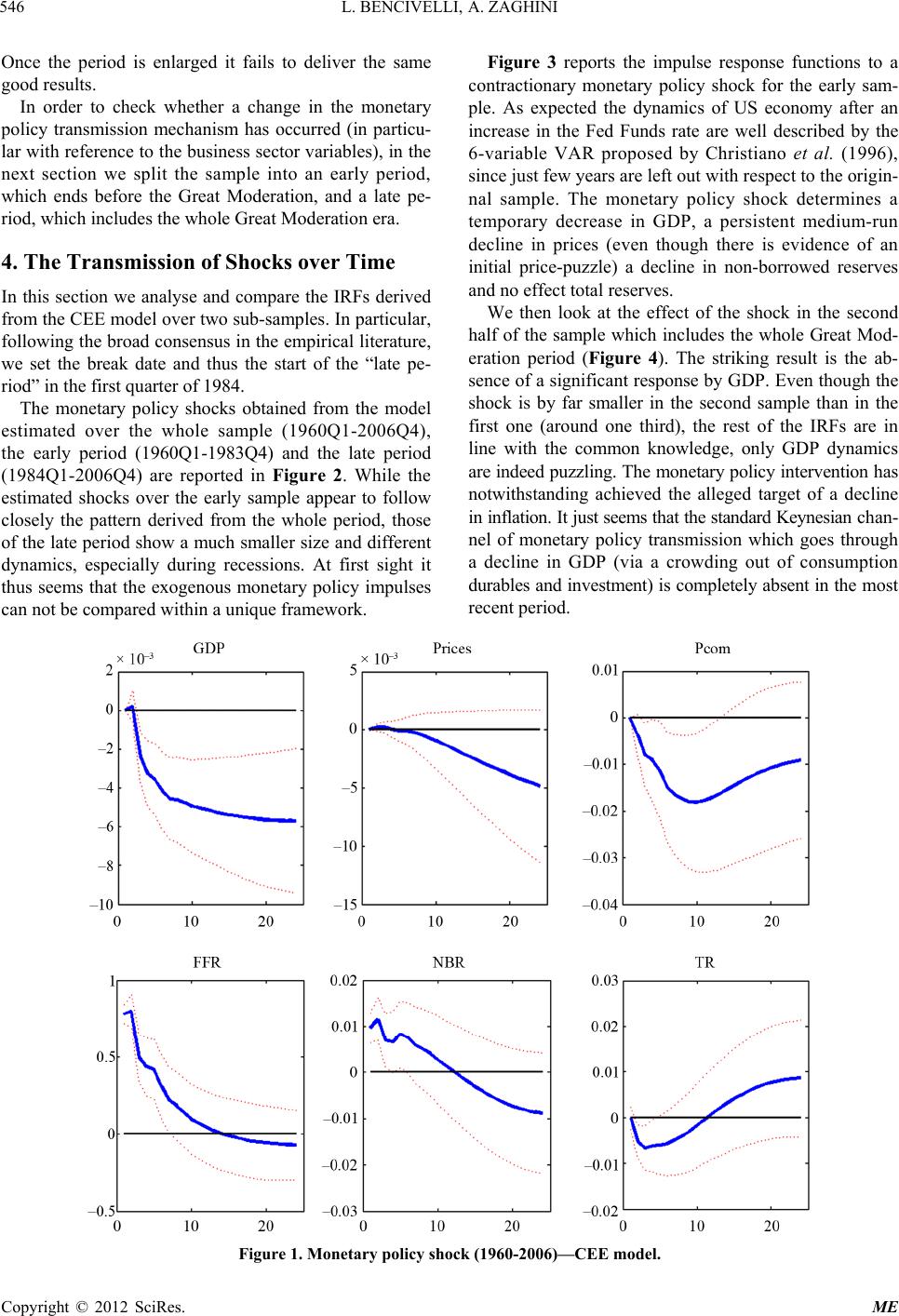 L. BENCIVELLI, A. ZAGHINI ME 546 Figure 3 reports the impulse response functions to a contractionary monetary policy shock for the early sam- ple. As expected the dynamics of US economy after an increase in the Fed Funds rate are well described by the 6-variable VAR proposed by Christiano et al. (1996), since just few years are left out with respect to the origin- nal sample. The monetary policy shock determines a temporary decrease in GDP, a persistent medium-run decline in prices (even though there is evidence of an initial price-puzzle) a decline in non-borrowed reserves and no effect total reserves. Once the period is enlarged it fails to deliver the same good results. In order to check whether a change in the monetary policy transmission mechanism has occurred (in particu- lar with reference to the business sector variables), in the next section we split the sample into an early period, which ends before the Great Moderation, and a late pe- riod, which includes the whole Great Moderation era. 4. The Transmission of Shocks over Time In this section we analyse and compare the IRFs derived from the CEE model over two sub-samples. In particular, following the broad consen sus in the empirical literature, we set the break date and thus the start of the “late pe- riod” in the first quarter of 1984. We then look at the effect of the shock in the second half of the sample which includes the whole Great Mod- eration period (Figure 4). The striking result is the ab- sence of a significant response by GDP. Even though the shock is by far smaller in the second sample than in the first one (around one third), the rest of the IRFs are in line with the common knowledge, only GDP dynamics are indeed puzzling. The monetary policy intervention ha s notwithstanding achieved the alleged target of a decline in infl ation. It ju st seems that th e standard Keyn esian ch a n- nel of monetary policy transmission which goes through a decline in GDP (via a crowding out of consumption durables and investment) is completely absent in the mos t recent period. The monetary policy shocks obtained from the model estimated over the whole sample (1960Q1-2006Q4), the early period (1960Q1-1983Q4) and the late period (1984Q1-2006Q4) are reported in Figure 2. While the estimated shocks over the early sample appear to follow closely the pattern derived from the whole period, those of the late period show a much smaller size and different dynamics, especially during recessions. At first sight it thus seems that the exogenous monetary policy impulses can not be compared wit hin a unique f ramework. Figure 1. Monetary policy shock (1960-2006)—CEE model. Copyright © 2012 SciRes. 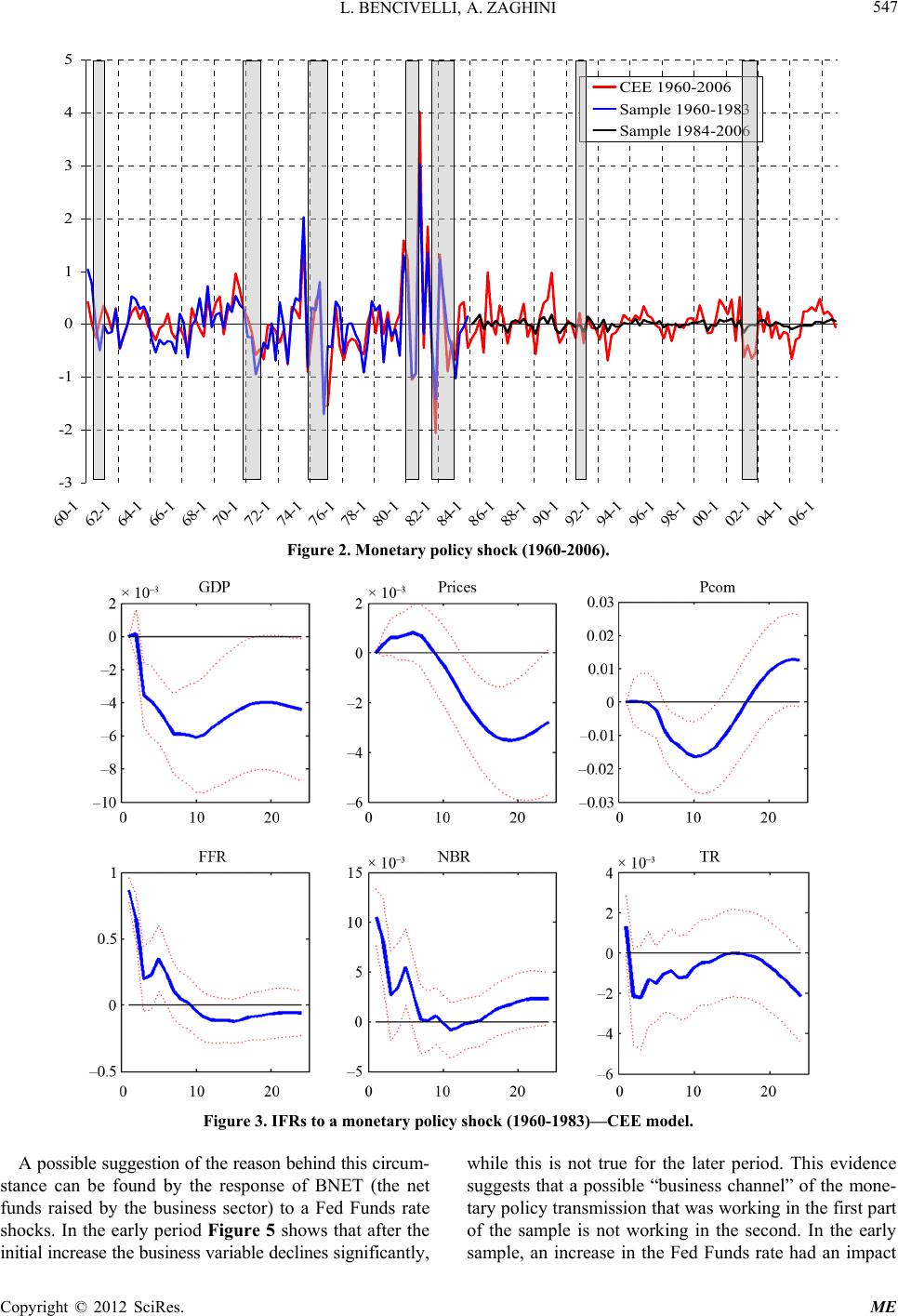 L. BENCIVELLI, A. ZAGHINI 547 -3 -2 -1 0 1 2 3 4 5 60-1 62-1 64-1 66-1 68-1 70-1 72-1 74-1 76-1 78-1 80-1 82-1 84-1 86-1 88-1 90-1 92-1 94-1 96-1 98-1 00-1 02-1 04-1 06-1 CEE 1960-2006 Sample 1960-1983 Sample 1984-2006 Figure 2. Monetary policy shock (1960-2006). Figure 3. IFRs to a monetary policy shock (1960-1983)—CEE model. A possible suggestion of the reason behind this circu m- stance can be found by the response of BNET (the net funds raised by the business sector) to a Fed Funds rate shocks. In the early period Figure 5 shows that after the initial increase th e business variable declines significa n tl y, while this is not true for the later period. This evidence suggests that a possible “business channel” of the mone- tary policy transmission that was working in the first part of the sample is not working in the second. In the early sample, an increase in the Fed Funds rate had an impact Copyright © 2012 SciRes. ME 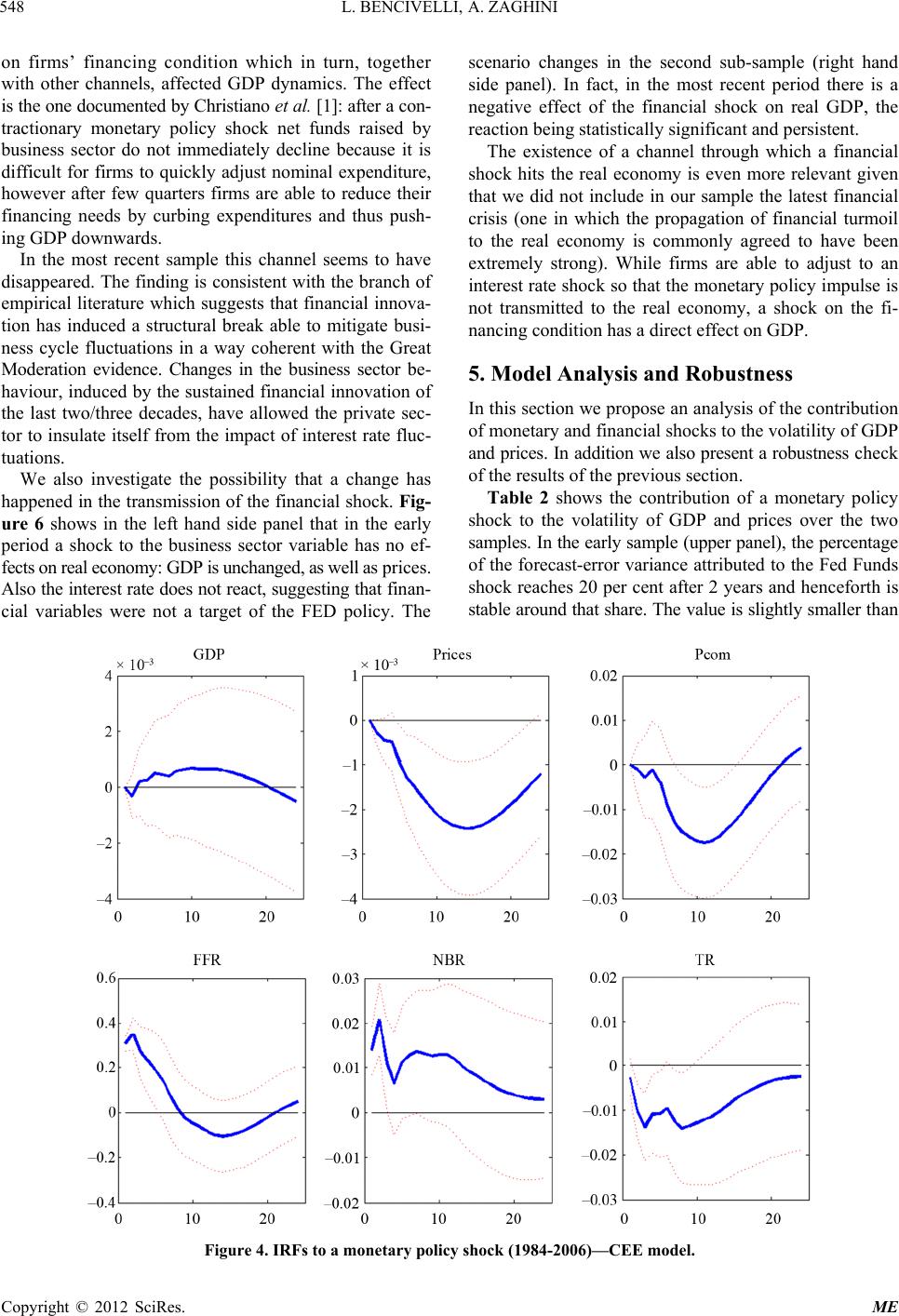 L. BENCIVELLI, A. ZAGHINI 548 on firms’ financing condition which in turn, together with other channels, affected GDP dynamics. The effect is the one documented by Christiano et al. [1]: after a con- tractionary monetary policy shock net funds raised by business sector do not immediately decline because it is difficult for firms to quickly adjust nominal expenditure, however after few quarters firms are able to reduce their financing needs by curbing expenditures and thus push- ing GDP downwards. In the most recent sample this channel seems to have disappeared. The finding is consistent with the bran ch of empirical literature which suggests that financial innova- tion has induced a structural break able to mitigate busi- ness cycle fluctuations in a way coherent with the Great Moderation evidence. Changes in the business sector be- haviour, induced by the sustained financial innovation of the last two/three decades, have allowed the private sec- tor to insulate itself from the impact of interest rate fluc- tuations. We also investigate the possibility that a change has happened in the transmission of the financial shock. Fig- ure 6 shows in the left hand side panel that in the early period a shock to the business sector variable has no ef- fects on real economy: GDP is unchanged, as well as prices. Also the interest rate does not react, suggesting that finan- cial variables were not a target of the FED policy. The scenario changes in the second sub-sample (right hand side panel). In fact, in the most recent period there is a negative effect of the financial shock on real GDP, the reaction being statistically significant and persistent. The existence of a channel through which a financial shock hits the real economy is even more relevant given that we did not include in our sample the latest financial crisis (one in which the propagation of financial turmoil to the real economy is commonly agreed to have been extremely strong). While firms are able to adjust to an interest rate shock so th at the monetary policy impulse is not transmitted to the real economy, a shock on the fi- nancing conditi on has a direct effect on GDP . 5. Model Analysis and Robustness In this section we propose an analysis of the con tribution of monetary and financial shock s to the volatilit y of GDP and prices. In addition we also present a robustness ch eck of the results of the previous section . Table 2 shows the contribution of a monetary policy shock to the volatility of GDP and prices over the two samples. In the early sample (upper panel), the percentage of the forecast-error variance attributed to the Fed Funds shock reaches 20 per cent after 2 years and henceforth is stable around that share. The value is slightly smaller tha n Figure 4. IRFs to a monetary policy shock (1984-2006)—CEE model. Copyright © 2012 SciRes. ME 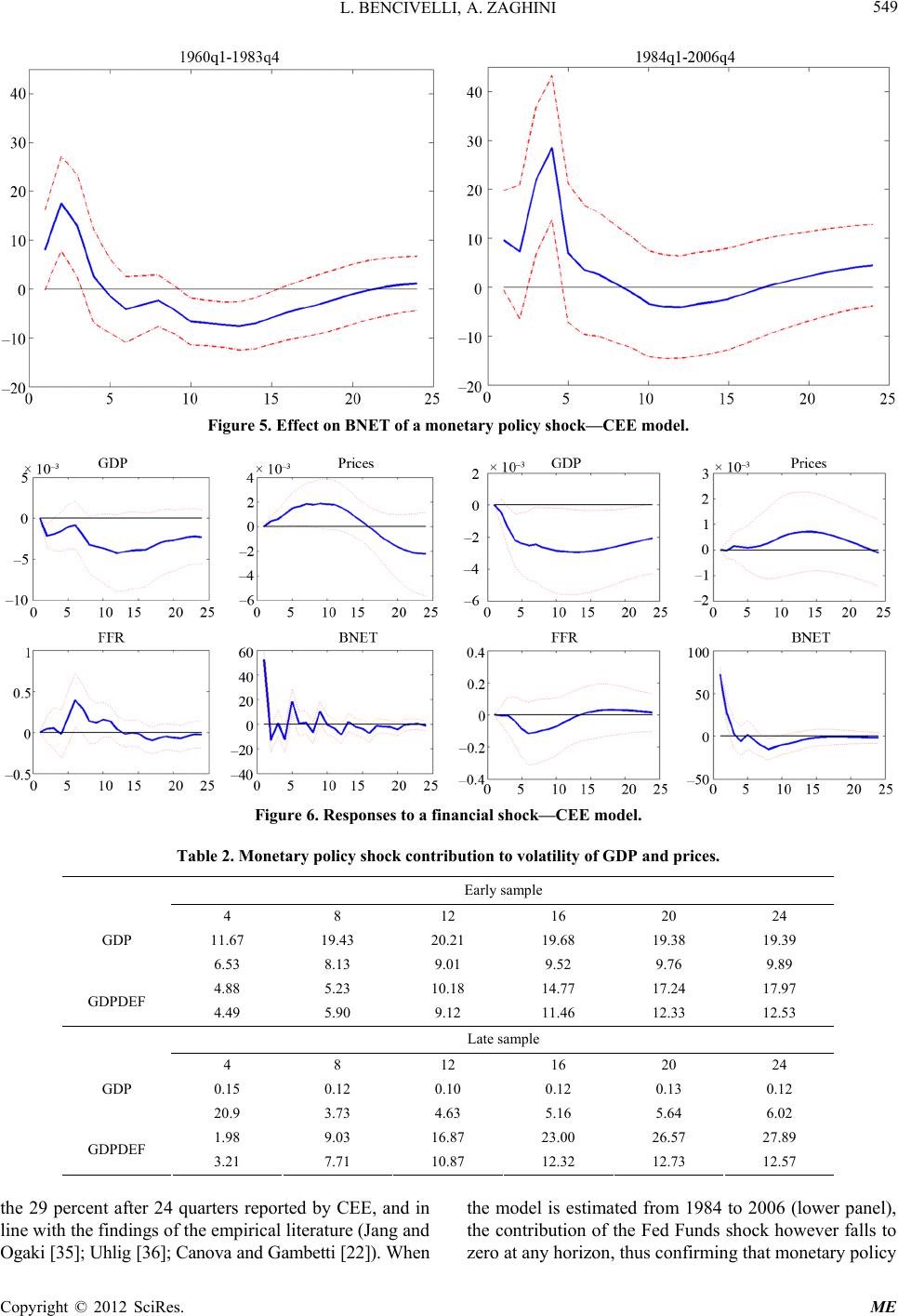 L. BENCIVELLI, A. ZAGHINI 549 Figure 5. Effect on BNET of a monetary policy shock—CEE model. Figure 6. Responses to a financial shock—CEE model. Table 2. Monetary policy shock contribution to volatility of GDP and pr ic es. Early sample 4 8 12 16 20 24 11.67 19.43 20.21 19.68 19.38 19.39 GDP 6.53 8.13 9.01 9.52 9.76 9.89 4.88 5.23 10.18 14.77 17.24 17.97 GDPDEF 4.49 5.90 9.12 11.46 12.33 12.53 Late sample 4 8 12 16 20 24 0.15 0.12 0.10 0.12 0.13 0.12 GDP 20.9 3.73 4.63 5.16 5.64 6.02 1.98 9.03 16.87 23.00 26.57 27.89 GDPDEF 3.21 7.71 10.87 12.32 12.73 12.57 the 29 percent after 24 quarters reported by CEE, and in line with the findings of the empirical literature (Jang and Ogaki [35]; Uhlig [36]; Canova and Gambetti [22]). When the model is estimated from 1984 to 2006 (lower panel), the contribution of the Fed Funds shock however falls to zero at any horizon, thus confirming that monetary policy Copyright © 2012 SciRes. ME 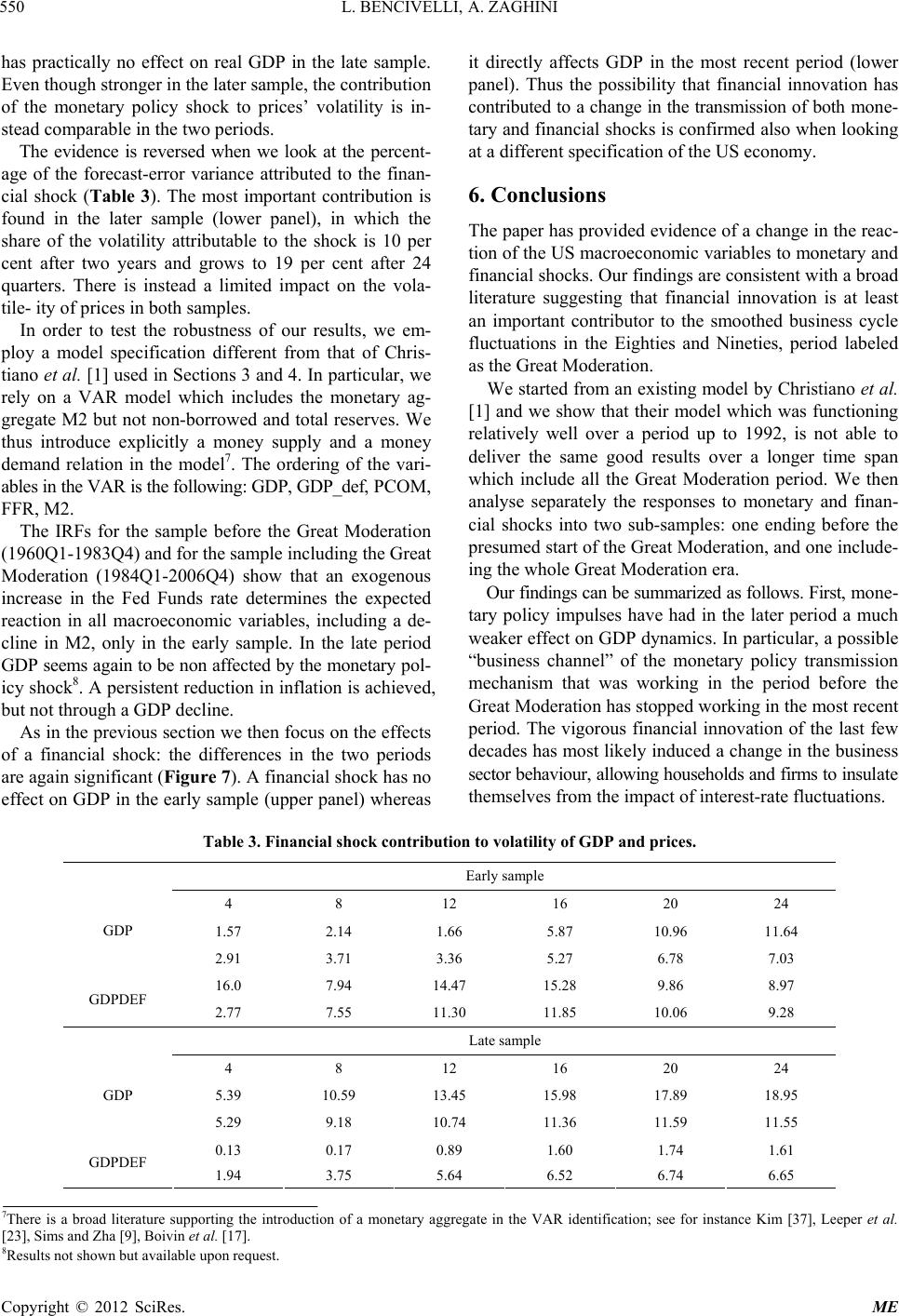 L. BENCIVELLI, A. ZAGHINI 550 has practically no effect on real GDP in the late sample. Even though stronger in the later sample, the contribution of the monetary policy shock to prices’ volatility is in- stead comparable in the two periods. The evidence is reversed when we look at the percent- age of the forecast-error variance attributed to the finan- cial shock (Table 3). The most important contribution is found in the later sample (lower panel), in which the share of the volatility attributable to the shock is 10 per cent after two years and grows to 19 per cent after 24 quarters. There is instead a limited impact on the vola- tile- ity of prices in both samples. In order to test the robustness of our results, we em- ploy a model specification different from that of Chris- tiano et al. [1] used in Sections 3 and 4. In particular, we rely on a VAR model which includes the monetary ag- gregate M2 but not non-borrowed and total reserves. We thus introduce explicitly a money supply and a money demand relation in the model7. The ordering of the vari- ables in the VAR is th e fo llo w ing : GDP, GDP_d ef, PC OM, FFR, M2. The IRFs for the sample before the Great Moderation (1960Q1-1983Q4) and for the sample including the Great Moderation (1984Q1-2006Q4) show that an exogenous increase in the Fed Funds rate determines the expected reaction in all macroeconomic variables, including a de- cline in M2, only in the early sample. In the late period GDP seems again to be non affected by the monetary pol - icy shock8. A persistent reduction in inflation is achiev ed, but not through a GDP decline. As in the previous section we then focus on the effects of a financial shock: the differences in the two periods are again significant (Figure 7). A financial shock has no effect on GDP in the early sample (upper panel) whereas it directly affects GDP in the most recent period (lower panel). Thus the possibility that financial innovation has contributed to a change in the transmission of both mo ne- tary and financial shocks is confirmed also when looking at a different specification of the US economy. 6. Conclusions The paper has provided evidence of a change in the reac- tion of the US macroeconomic variables to monetary and financial shocks. Our findings are consistent with a broad literature suggesting that financial innovation is at least an important contributor to the smoothed business cycle fluctuations in the Eighties and Nineties, period labeled as the Great Moderation. We started from an existing model by Christiano et al. [1] and we show that their model which was functioning relatively well over a period up to 1992, is not able to deliver the same good results over a longer time span which include all the Great Moderation period. We then analyse separately the responses to monetary and finan- cial shocks into two sub-samples: one ending before the presumed start of the Great Moderation, and one include- ing the whole Great Moderation era. Our findings can be summarized as fo llows. First, m o n e - tary policy impulses have had in the later period a much weaker effect on GDP dynamics. In particular, a possible “business channel” of the monetary policy transmission mechanism that was working in the period before the Great Moderation has stopped working in the most recent period. The vigorous financial innovation of the last few decades has most likely induced a change in the business sector behaviour, allowing households and firms to insula te themselves from the impact of interest-rate fluctuations. Table 3. Financial shock contribution to volatility of GDP and prices. Early sample 4 8 12 16 20 24 1.57 2.14 1.66 5.87 10.96 11.64 GDP 2.91 3.71 3.36 5.27 6.78 7.03 16.0 7.94 14.47 15.28 9.86 8.97 GDPDEF 2.77 7.55 11.30 11.85 10.06 9.28 Late sample 4 8 12 16 20 24 5.39 10.59 13.45 15.98 17.89 18.95 GDP 5.29 9.18 10.74 11.36 11.59 11.55 0.13 0.17 0.89 1.60 1.74 1.61 GDPDEF 1.94 3.75 5.64 6.52 6.74 6.65 7There is a broad literature supporting the introduction of a monetary aggregate in the VAR identification; see for instance Kim [37], Leeper et al. [23], Sims and Zha [9], Boivin et al. [17]. 8Results not shown but available u pon request. Copyright © 2012 SciRes. ME 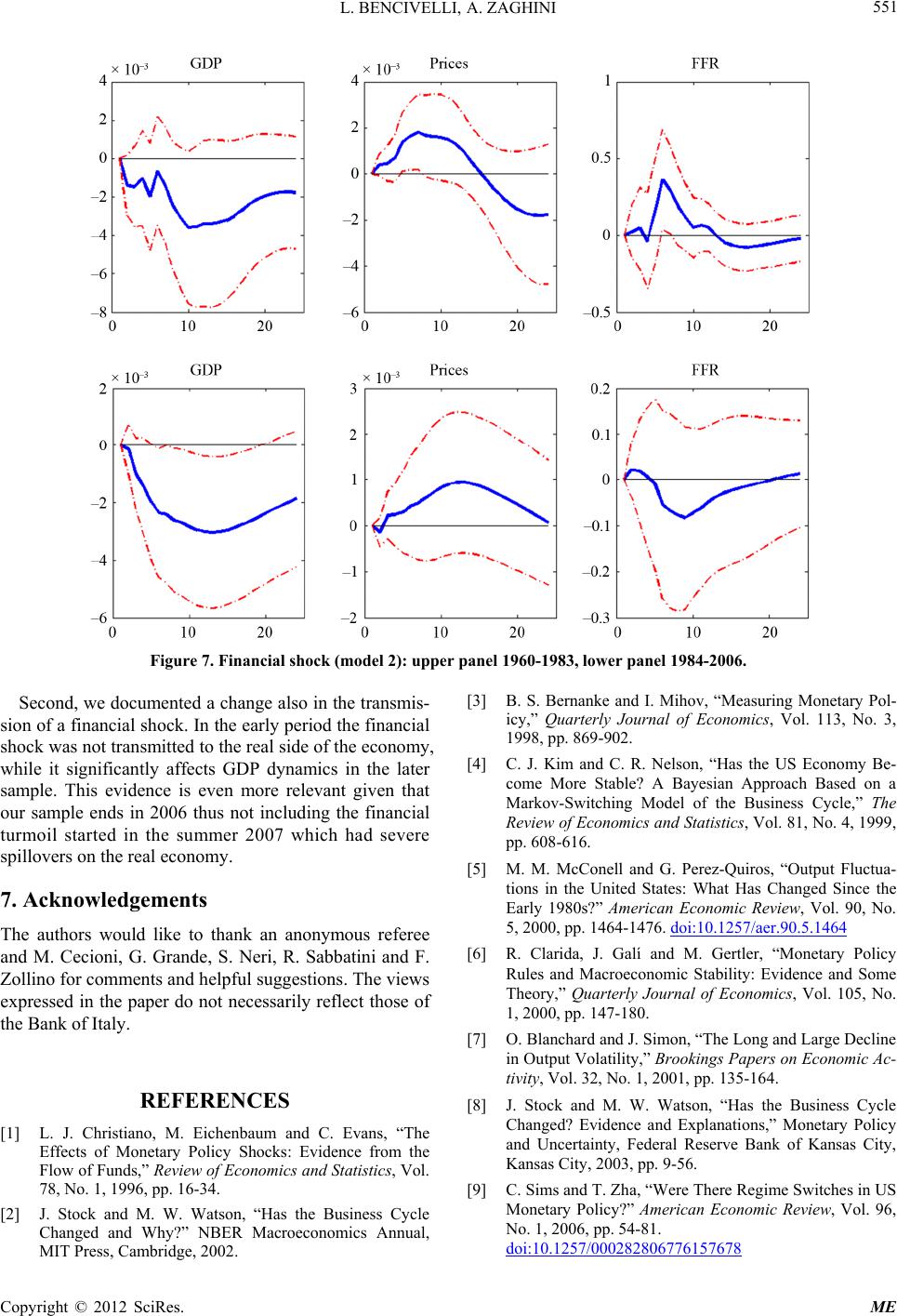 L. BENCIVELLI, A. ZAGHINI 551 Figure 7. Financial shock (model 2): upper panel 1960-1983, lower panel 1984-2006. Second, we documented a change also in the transmis- sion of a financial shock. In the early period the financial shock was not transmitted to the real side of th e economy, while it significantly affects GDP dynamics in the later sample. This evidence is even more relevant given that our sample ends in 2006 thus not including the financial turmoil started in the summer 2007 which had severe spillovers on the real economy. 7. Acknowledgements The authors would like to thank an anonymous referee and M. Cecioni, G. Grande, S. Neri, R. Sabbatini and F. Zollino for comments an d helpfu l sugg estions. The v iews expressed in the paper do not necessarily reflect those of the Bank of Italy. REFERENCES [1] L. J. Christiano, M. Eichenbaum and C. Evans, “The Effects of Monetary Policy Shocks: Evidence from the Flow of Funds,” Review of Economics and Statistics, Vol. 78, No. 1, 1996, pp. 16-34. [2] J. Stock and M. W. Watson, “Has the Business Cycle Changed and Why?” NBER Macroeconomics Annual, MIT Press, Cambridge, 2002. [3] B. S. Bernanke and I. Mihov, “Measuring Monetary Pol- icy,” Quarterly Journal of Economics, Vol. 113, No. 3, 1998, pp. 869-902. [4] C. J. Kim and C. R. Nelson, “Has the US Economy Be- come More Stable? A Bayesian Approach Based on a Markov-Switching Model of the Business Cycle,” The Review of Economics and Statistics, Vol. 81, No. 4, 1999, pp. 608-616. [5] M. M. McConell and G. Perez-Quiros, “Output Fluctua- tions in the United States: What Has Changed Since the Early 1980s?” American Economic Review, Vol. 90, No. 5, 2000, pp. 1464-1476. doi:10.1257/aer.90.5.1464 [6] R. Clarida, J. Galí and M. Gertler, “Monetary Policy Rules and Macroeconomic Stability: Evidence and Some Theory,” Quarterly Journal of Economics, Vol. 105, No. 1, 2000, pp. 147-180. [7] O. Blanchard and J. Simon, “The Long and Large Decline in Output Volatility,” Brookings Papers on Economic Ac- tivity, Vol. 32, No. 1, 2001, pp. 135-164. [8] J. Stock and M. W. Watson, “Has the Business Cycle Changed? Evidence and Explanations,” Monetary Policy and Uncertainty, Federal Reserve Bank of Kansas City, Kansas City, 2003, pp. 9-56. [9] C. Sims and T. Zha, “Were There Regime Switches in US Monetary Policy?” American Economic Review, Vol. 96, No. 1, 2006, pp. 54-81. doi:10.1257/000282806776157678 Copyright © 2012 SciRes. ME 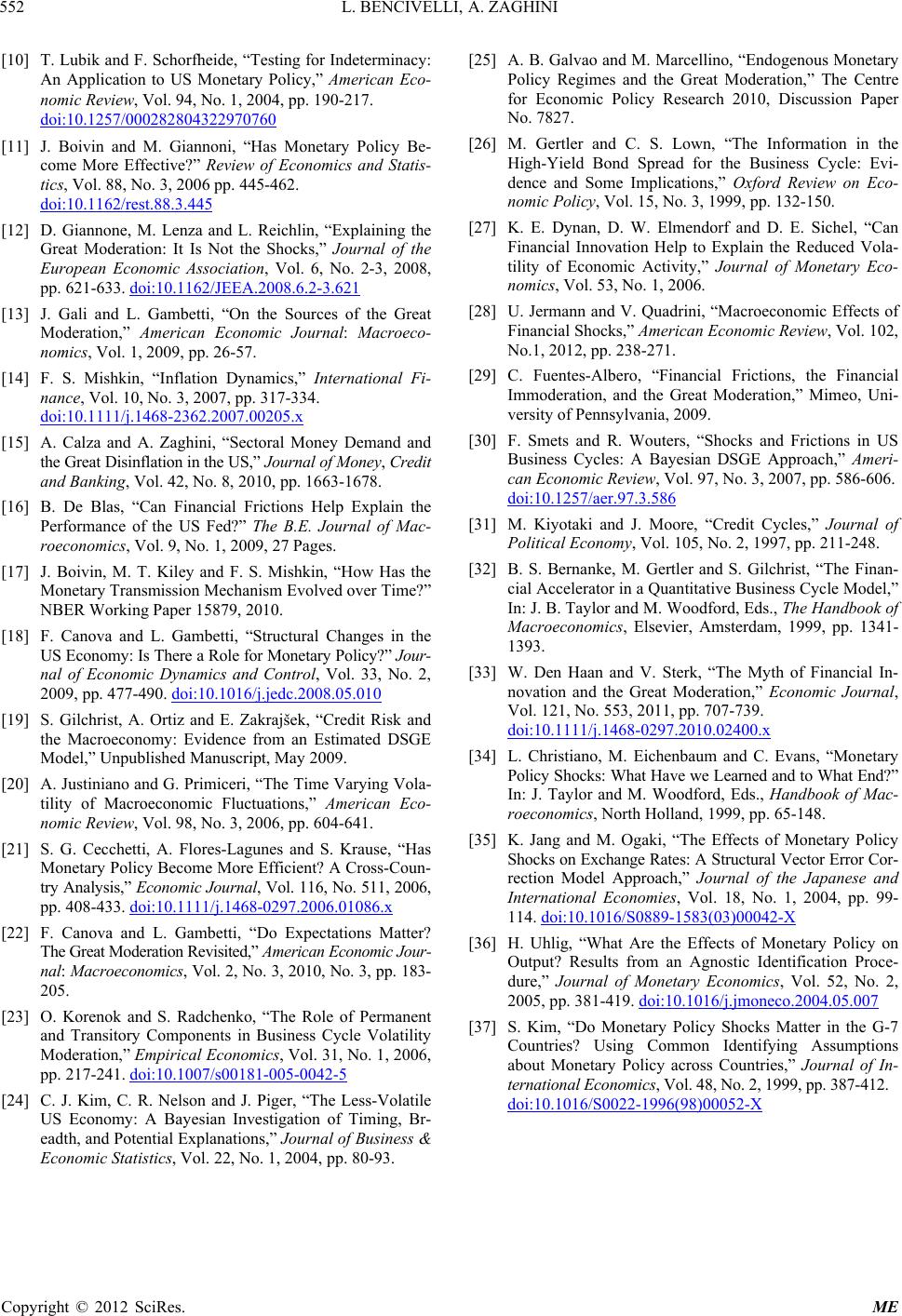 L. BENCIVELLI, A. ZAGHINI 552 [10] T. Lubik and F. Schorfheide, “Testing for Indeterminacy: An Application to US Monetary Policy,” American Eco- nomic Review, Vol. 94, No. 1, 2004, pp. 190-217. doi:10.1257/000282804322970760 [11] J. Boivin and M. Giannoni, “Has Monetary Policy Be- come More Effective?” Review of Economics and Statis- tics, Vol. 88, No. 3, 2006 pp. 445-462. doi:10.1162/rest.88.3.445 [12] D. Giannone, M. Lenza and L. Reichlin, “Explaining the Great Moderation: It Is Not the Shocks,” Journal of the European Economic Association, Vol. 6, No. 2-3, 2008, pp. 621-633. doi:10.1162/JEEA.2008.6.2-3.621 [13] J. Gali and L. Gambetti, “On the Sources of the Great Moderation,” American Economic Journal: Macroeco- nomics, Vol. 1, 2009, pp. 26-57. [14] F. S. Mishkin, “Inflation Dynamics,” International Fi- nance, Vol. 10, No. 3, 2007, pp. 317-334. doi:10.1111/j.1468-2362.2007.00205.x [15] A. Calza and A. Zaghini, “Sectoral Money Demand and the Great Disinflation in the US,” Journal of Money, Credit and Banking, Vol. 42, No. 8, 2010, pp. 1663-1678. [16] B. De Blas, “Can Financial Frictions Help Explain the Performance of the US Fed?” The B.E. Journal of Mac- roeconomics, Vol. 9, No. 1, 2009, 27 Pages. [17] J. Boivin, M. T. Kiley and F. S. Mishkin, “How Has the Monetary Transmission Mechanism Evolved over Time?” NBER Working Paper 15879, 2010. [18] F. Canova and L. Gambetti, “Structural Changes in the US Economy: Is There a Role for Monetary Policy? ” Jour- nal of Economic Dynamics and Control, Vol. 33, No. 2, 2009, pp. 477-490. doi:10.1016/j.jedc.2008.05.010 [19] S. Gilchrist, A. Ortiz and E. Zakrajšek, “Credit Risk and the Macroeconomy: Evidence from an Estimated DSGE Model,” Unpublished Manuscript, May 2009. [20] A. Justiniano and G. Primiceri, “The Time Varying Vola- tility of Macroeconomic Fluctuations,” American Eco- nomic Review, Vol. 98, No. 3, 2006, pp. 604-641. [21] S. G. Cecchetti, A. Flores-Lagunes and S. Krause, “Has Monetary Policy Become More Efficient? A Cross-Coun- try Analysis,” Economic Journal, Vol. 116, No. 511, 2006, pp. 408-433. doi:10.1111/j.1468-0297.2006.01086.x [22] F. Canova and L. Gambetti, “Do Expectations Matter? The Great Modera tion Revisited,” American Economic Jour- nal: Macroeconomics, Vol. 2, No. 3, 2010, No. 3, pp. 183- 205. [23] O. Korenok and S. Radchenko, “The Role of Permanent and Transitory Components in Business Cycle Volatility Moderation,” Empirical Economics, Vol. 31, No. 1, 2006, pp. 217-241. doi:10.1007/s00181-005-0042-5 [24] C. J. Kim, C. R. Nelson and J. Piger, “The Less-Volatile US Economy: A Bayesian Investigation of Timing, Br- eadth, and Potential Explanations,” Journal of Business & Economic Statistics, Vol. 22, No. 1, 2004, pp. 80-93. [25] A. B. Galvao and M. Marcellino, “Endogenous Monetary Policy Regimes and the Great Moderation,” The Centre for Economic Policy Research 2010, Discussion Paper No. 7827. [26] M. Gertler and C. S. Lown, “The Information in the High-Yield Bond Spread for the Business Cycle: Evi- dence and Some Implications,” Oxford Review on Eco- nomic Policy, Vol. 15, No. 3, 1999, pp. 132-150. [27] K. E. Dynan, D. W. Elmendorf and D. E. Sichel, “Can Financial Innovation Help to Explain the Reduced Vola- tility of Economic Activity,” Journal of Monetary Eco- nomics, Vol. 53, No. 1, 2006. [28] U. Jermann and V. Quadrini, “Macroeconomic Effects of Financial Shocks,” American Economic Review, Vol. 102, No.1, 2012, pp. 238-271. [29] C. Fuentes-Albero, “Financial Frictions, the Financial Immoderation, and the Great Moderation,” Mimeo, Uni- versity of Pennsylvania, 2009. [30] F. Smets and R. Wouters, “Shocks and Frictions in US Business Cycles: A Bayesian DSGE Approach,” Ameri- can Economic Review, Vol. 97, No. 3, 2007, pp. 586-606. doi:10.1257/aer.97.3.586 [31] M. Kiyotaki and J. Moore, “Credit Cycles,” Journal of Political Economy, Vol. 105, No. 2, 1997, pp. 211-248. [32] B. S. Bernanke, M. Gertler and S. Gilchrist, “The Finan- cial Accelerator in a Quantitative Business Cycle Model,” In: J. B. Taylor and M. Woodford, Eds., The Handbook of Macroeconomics, Elsevier, Amsterdam, 1999, pp. 1341- 1393. [33] W. Den Haan and V. Sterk, “The Myth of Financial In- novation and the Great Moderation,” Economic Journal, Vol. 121, No. 553, 2011, pp. 707-739. doi:10.1111/j.1468-0297.2010.02400.x [34] L. Christiano, M. Eichenbaum and C. Evans, “Monetary Policy Shocks: What Ha ve we Learned and to What End?” In: J. Taylor and M. Woodford, Eds., Handbook of Mac- roeconomics, North Holland, 1999, pp. 65-148. [35] K. Jang and M. Ogaki, “The Effects of Monetary Policy Shocks on Exchange Rate s: A Str uctural Vector Error Cor - rection Model Approach,” Journal of the Japanese and International Economies, Vol. 18, No. 1, 2004, pp. 99- 114. doi:10.1016/S0889-1583(03)00042-X [36] H. Uhlig, “What Are the Effects of Monetary Policy on Output? Results from an Agnostic Identification Proce- dure,” Journal of Monetary Economics, Vol. 52, No. 2, 2005, pp. 381-419. doi:10.1016/j.jmoneco.2004.05.007 [37] S. Kim, “Do Monetary Policy Shocks Matter in the G-7 Countries? Using Common Identifying Assumptions about Monetary Policy across Countries,” Journal of In- ternational Economics, Vol. 48, No. 2, 1999, pp. 387-412. doi:10.1016/S0022-1996(98)00052-X Copyright © 2012 SciRes. ME |