

Paper Menu >>
Journal Menu >>
 Open Journal of Applied Sciences, 2012, 2, 163-167 doi:10.4236/ojapps.2012.23023 Published Online September 2012 (http://www.SciRP.org/journal/ojapps) Phase Behavior of Sphere-Forming Triblock Copolymers in Films Hong-Ge Tan1*, Qing-Gong Song1, Xin-Huan Yang2, Ya-Jing Deng1 1College of Science, Civil Aviation University of China, Tianjin, China 2College of Science, Hebei University of Technology, Tianjin, China Email: *[email protected] Received July 8, 2012; revised August 5, 2012; accepted August 16, 2012 ABSTRACT The self-assembly of sphere-forming triblock copolymers confined between two thin homogeneous surfaces is investi- gated based on mean-field dynamic density functional theory. The morphologies deviating from the bulk sphere-form- ing phase are revealed, including cylinders oriented perpendicular to the surface, cylinders oriented parallel to the sur- face, perforated lamellae and lamellae by varying film thickness and surface field strength. The phase diagram of sur- face reconstruction is also constructed. By comparing the present phase diagram with the other relevant phase diagram for the cylinder-forming triblock copolymer film, the difference between the sphere-forming and the cylinder-forming triblock copolymer thin film is discussed. Keywords: Triblock Copolymer; Mean-Field Dynamic Density Functional Theory; Thin Film 1. Introduction Block copolymer molecules are composed of two or more chemically distinct blocks of monomer units. Since the blocks are joined covalently, they can form micro- scopic phase separation and are thus forced to form rich ordered microstructures. Those ordered microstructures could be useful in nanotechnology application. For bulk block copolymers, these microdomains have been ob- tained by controlling the molecules weight, molecules architecture and interaction parameter between different segments (blocks). When a block copolymer melt is con- fined in the film, two additional factors have to be con- sidered. One is the surface energy, the other is the film thickness. In order to obtain controllable patterns on a nanometer scale, films of block copolymers have re- ceived considerable attention. The self-assembly of dib- lock copolymers confined in films has been studied ex- tensively both theoretically and experimentally [1-4]. Under confinement, diblock copolymers can not only change the orientation, but also alternate between differ- ent morphologies deviating from the bulk structure. In contrast to confined diblock copolymers, phase be- havior of confined triblock copolymers is more compli- cated [5-9]. Stcoker et al. studied surface reconstruction of the lamellar morphology in triblock copolymers by the experiment [5]. Rehse et al. studied the microstructure near the surface in lamellar ABC triblock copolymers and observed the distorted lamellar [6]. Knoll et al. in- vestigated the thin film of the cylinder-forming triblock copolymers and compared the experimental and theo- retical result [7]. Horvat et al. simulated the phase be- havior of the cylinder-forming triblock copolymer film [8]. They obtained the morphologies deviating from the bulk and phase diagram of the surface reconstruction by changing the film thickness and surface field. So far, the sphere-forming triblock copolymer film has received much less attention and most of the work in this aspect focused on the packing and packing transition of the spherical domain in the film [9]. A fundamental under- standing of morphology reconstruction due to the con- finement and the surface field is lacking. In this paper, we employ a mean-field dynamic density functional the- ory (DDFT) to study confined triblock copolymers with spherical bulk phase. This model has been used exten- sively in many aspects. Huinink et al. employed this model to study asymmetric diblock copolymers with cy- lindrical bulk phase confined in the films [3]. Horvat et al. used this model to study the asymmetric triblock co- polymer film with cylinder-forming bulk phase [8]. The paper is arranged as follows: in Section 2 we simply in- troduce the method and parameters. In Section 3, we fo- cus on the morphologies of sphere-forming triblock co- polymer films by tuning the surface field and film thick- ness. Also, the corresponding discussion is given in this section. Finally, the conclusions are presented in Section 4. *Corresponding author. Copyright © 2012 SciRes. OJAppS 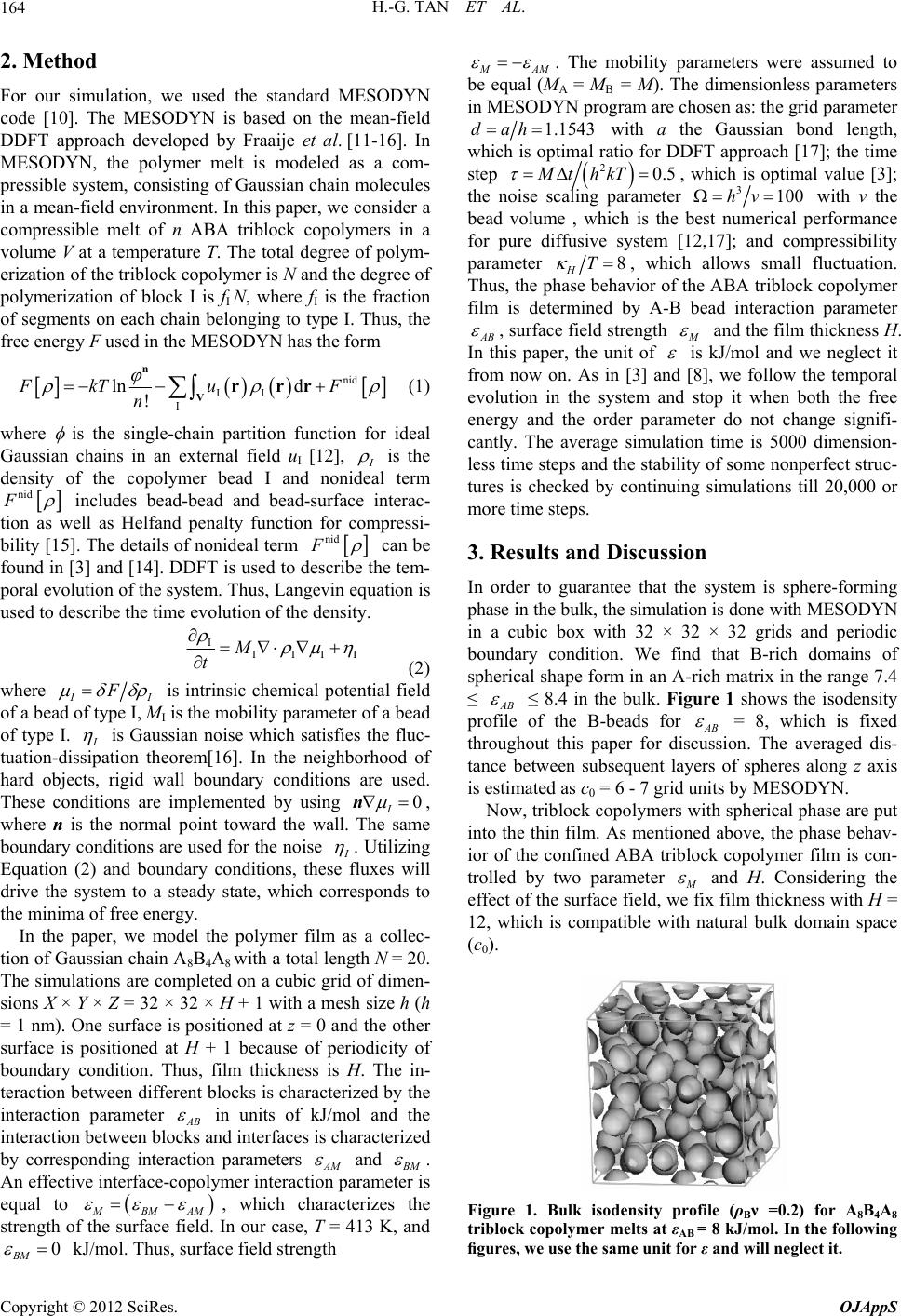 H.-G. TAN ET AL. 164 2. Method For our simulation, we used the standard MESODYN code [10]. The MESODYN is based on the mean-field DDFT approach developed by Fraaije et al. [11-16]. In MESODYN, the polymer melt is modeled as a com- pressible system, consisting of Gaussian chain molecules in a mean-field environment. In this paper, we consider a compressible melt of n ABA triblock copolymers in a volume V at a temperature T. The total degree of polym- erization of the triblock copolymer is N and the degree of polymerization of block I is fI N, where fI is the fraction of segments on each chain belonging to type I. Thus, the free energy F used in the MESODYN has the form nid II I ln d ! FkT uF n n Vrrr (1) where is the single-chain partition function for ideal Gaussian chains in an external field uІ [12], I is the density of the copolymer bead І and nonideal term nid F includes bead-bead and bead-surface interac- tion as well as Helfand penalty function for compressi- bility [15]. The details of nonideal term nid F can be found in [3] and [14]. DDFT is used to describe the tem- poral evolution of the system. Thus, Langevin equation is used to describe the time evolution of the density. I III M t I (2) where I I F is intrinsic chemical potential field of a bead of type I, MІ is the mobility parameter of a bead of type I. I is Gaussian noise which satisfies the fluc- tuation-dissipation theorem[16]. In the neighborhood of hard objects, rigid wall boundary conditions are used. These conditions are implemented by using 0 I n, where n is the normal point toward the wall. The same boundary conditions are used for the noise I . Utilizing Equation (2) and boundary conditions, these fluxes will drive the system to a steady state, which corresponds to the minima of free energy. In the paper, we model the polymer film as a collec- tion of Gaussian chain A8B4A8 with a total length N = 20. The simulations are completed on a cubic grid of dimen- sions X × Y × Z = 32 × 32 × H + 1 with a mesh size h (h = 1 nm). One surface is positioned at z = 0 and the other surface is positioned at H + 1 because of periodicity of boundary condition. Thus, film thickness is H. The in- teraction between different blocks is characterized by the interaction parameter AB in units of kJ/mol and the interaction between blocks and interfaces is characterized by corresponding interaction parameters AM and B M . An effective interface-copolymer interaction parameter is equal to M , which characterizes the strength of the surface field. In our case, T = 413 K, and MB MA 0 BM kJ/mol. Thus, surface field strength M AM . The mobility parameters were assumed to be equal (MA = MB = M). The dimensionless parameters in MESODYN program are chosen as: the grid parameter 1.1543dah with a the Gaussian bond length, which is optimal ratio for DDFT approach [17]; the time step 20.5Mt hkT , which is optimal value [3]; the noise scaling parameter 3100hv with v the bead volume , which is the best numerical performance for pure diffusive system [12,17]; and compressibility parameter 8 HT , which allows small fluctuation. Thus, the phase behavior of the ABA triblock copolymer film is determined by A-B bead interaction parameter AB , surface field strength M and the film thickness H. In this paper, the unit of is kJ/mol and we neglect it from now on. As in [3] and [8], we follow the temporal evolution in the system and stop it when both the free energy and the order parameter do not change signifi- cantly. The average simulation time is 5000 dimension- less time steps and the stability of some nonperfect struc- tures is checked by continuing simulations till 20,000 or more time steps. 3. Results and Discussion In order to guarantee that the system is sphere-forming phase in the bulk, the simulation is done with MESODYN in a cubic box with 32 × 32 × 32 grids and periodic boundary condition. We find that B-rich domains of spherical shape form in an A-rich matrix in the range 7.4 ≤ AB ≤ 8.4 in the bulk. Figure 1 shows the isodensity profile of the B-beads for AB = 8, which is fixed throughout this paper for discussion. The averaged dis- tance between subsequent layers of spheres along z axis is estimated as c0 = 6 - 7 grid units by MESODYN. Now, triblock copolymers with spherical phase are put into the thin film. As mentioned above, the phase behav- ior of the confined ABA triblock copolymer film is con- trolled by two parameter M and H. Considering the effect of the surface field, we fix film thickness with H = 12, which is compatible with natural bulk domain space (c0). Figure 1. Bulk isodensity profile (ρBν =0.2) for A8B4A8 triblock copolymer melts at εAB = 8 kJ/mol. In the following figures, we use the same unit for ε and will neglect it. Copyright © 2012 SciRes. OJAppS 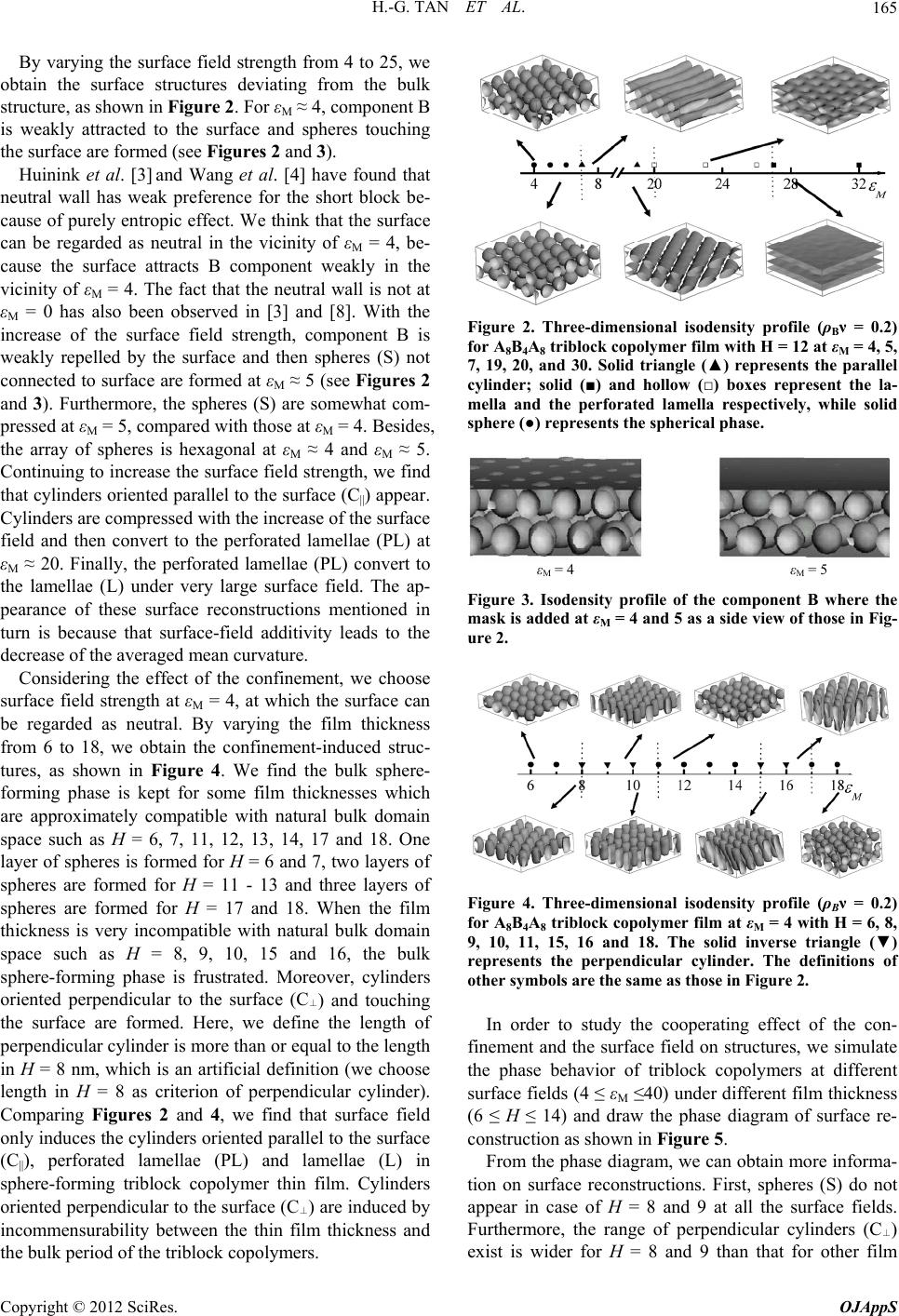 H.-G. TAN ET AL. 165 By varying the surface field strength from 4 to 25, we obtain the surface structures deviating from the bulk structure, as shown in Figure 2. For εM ≈ 4, component B is weakly attracted to the surface and spheres touching the surface are formed (see Figures 2 and 3). Huinink et al. [3] and Wang et al. [4] have found that neutral wall has weak preference for the short block be- cause of purely entropic effect. We think that the surface can be regarded as neutral in the vicinity of εM = 4, be- cause the surface attracts B component weakly in the vicinity of εM = 4. The fact that the neutral wall is not at εM = 0 has also been observed in [3] and [8]. With the increase of the surface field strength, component B is weakly repelled by the surface and then spheres (S) not connected to surface are formed at εM ≈ 5 (see Figures 2 and 3). Furthermore, the spheres (S) are somewhat com- pressed at εM = 5, compared with those at εM = 4. Besides, the array of spheres is hexagonal at εM ≈ 4 and εM ≈ 5. Continuing to increase the surface field strength, we find that cylinders oriented parallel to the surface (C||) appear. Cylinders are compressed with the increase of the surface field and then convert to the perforated lamellae (PL) at εM ≈ 20. Finally, the perforated lamellae (PL) convert to the lamellae (L) under very large surface field. The ap- pearance of these surface reconstructions mentioned in turn is because that surface-field additivity leads to the decrease of the averaged mean curvature. Considering the effect of the confinement, we choose surface field strength at εM = 4, at which the surface can be regarded as neutral. By varying the film thickness from 6 to 18, we obtain the confinement-induced struc- tures, as shown in Figure 4. We find the bulk sphere- forming phase is kept for some film thicknesses which are approximately compatible with natural bulk domain space such as H = 6, 7, 11, 12, 13, 14, 17 and 18. One layer of spheres is formed for H = 6 and 7, two layers of spheres are formed for H = 11 - 13 and three layers of spheres are formed for H = 17 and 18. When the film thickness is very incompatible with natural bulk domain space such as H = 8, 9, 10, 15 and 16, the bulk sphere-forming phase is frustrated. Moreover, cylinders oriented perpendicular to the surface (C⊥) and touching the surface are formed. Here, we define the length of perpendicular cylinder is more than or equal to the length in H = 8 nm, which is an artificial definition (we choose length in H = 8 as criterion of perpendicular cylinder). Comparing Figures 2 and 4, we find that surface field only induces the cylinders oriented parallel to the surface (C||), perforated lamellae (PL) and lamellae (L) in sphere-forming triblock copolymer thin film. Cylinders oriented perpendicular to the surface (C⊥) are induced by incommensurability between the thin film thickness and the bulk period of the triblock copolymers. Figure 2. Three-dimensional isodensity profile (ρBν = 0.2) for A8B4A8 triblock copolymer film with H = 12 at εM = 4, 5, 7, 19, 20, and 30. Solid triangle (▲) represents the parallel cylinder; solid (■) and hollow (□) boxes represent the la- mella and the perforated lamella respectively, while solid sphere (●) represents the spherical phase. εM = 4 εM = 5 Figure 3. Isodensity profile of the component B where the mask is added at εM = 4 and 5 as a side view of those in Fig- ure 2. Figure 4. Three-dimensional isodensity profile (ρBν = 0.2) for A8B4A8 triblock copolymer film at εM = 4 with H = 6, 8, 9, 10, 11, 15, 16 and 18. The solid inverse triangle (▼) represents the perpendicular cylinder. The definitions of other symbols are the same as those in Figure 2. In order to study the cooperating effect of the con- finement and the surface field on structures, we simulate the phase behavior of triblock copolymers at different surface fields (4 ≤ εM ≤40) under different film thickness (6 ≤ H ≤ 14) and draw the phase diagram of surface re- construction as shown in Figure 5. From the phase diagram, we can obtain more informa- tion on surface reconstructions. First, spheres (S) do not appear in case of H = 8 and 9 at all the surface fields. Furthermore, the range of perpendicular cylinders (C⊥) exist is wider for H = 8 and 9 than that for other film Copyright © 2012 SciRes. OJAppS 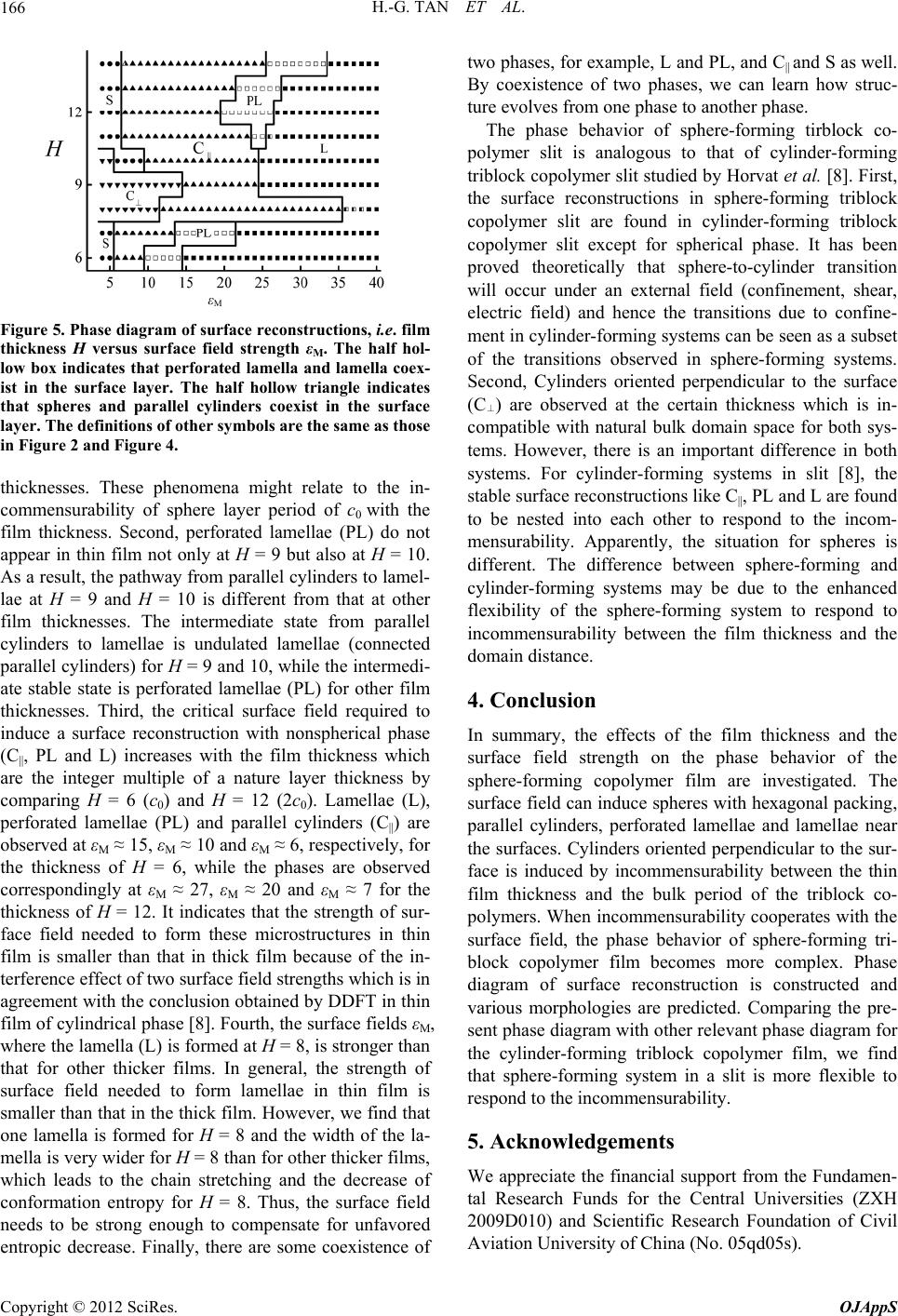 H.-G. TAN ET AL. 166 εM Figure 5. Phase diagram of surface reconstructions, i.e. film thickness H versus surface field strength εM. The half hol- low box indicates that perforated lamella and lamella coex- ist in the surface layer. The half hollow triangle indicates that spheres and parallel cylinders coexist in the surface layer. The definitions of other symbols are the same as those in Figure 2 and Figure 4. thicknesses. These phenomena might relate to the in- commensurability of sphere layer period of c0 with the film thickness. Second, perforated lamellae (PL) do not appear in thin film not only at H = 9 but also at H = 10. As a result, the pathway from parallel cylinders to lamel- lae at H = 9 and H = 10 is different from that at other film thicknesses. The intermediate state from parallel cylinders to lamellae is undulated lamellae (connected parallel cylinders) for H = 9 and 10, while the intermedi- ate stable state is perforated lamellae (PL) for other film thicknesses. Third, the critical surface field required to induce a surface reconstruction with nonspherical phase (C||, PL and L) increases with the film thickness which are the integer multiple of a nature layer thickness by comparing H = 6 (c0) and H = 12 (2c0). Lamellae (L), perforated lamellae (PL) and parallel cylinders (C||) are observed at εM ≈ 15, εM ≈ 10 and εM ≈ 6, respectively, for the thickness of H = 6, while the phases are observed correspondingly at εM ≈ 27, εM ≈ 20 and εM ≈ 7 for the thickness of H = 12. It indicates that the strength of sur- face field needed to form these microstructures in thin film is smaller than that in thick film because of the in- terference effect of two surface field strengths which is in agreement with the conclusion obtained by DDFT in thin film of cylindrical phase [8]. Fourth, the surface fields εM, where the lamella (L) is formed at H = 8, is stronger than that for other thicker films. In general, the strength of surface field needed to form lamellae in thin film is smaller than that in the thick film. However, we find that one lamella is formed for H = 8 and the width of the la- mella is very wider for H = 8 than for other thicker films, which leads to the chain stretching and the decrease of conformation entropy for H = 8. Thus, the surface field needs to be strong enough to compensate for unfavored entropic decrease. Finally, there are some coexistence of two phases, for example, L and PL, and C|| and S as well. By coexistence of two phases, we can learn how struc- ture evolves from one phase to another phase. The phase behavior of sphere-forming tirblock co- polymer slit is analogous to that of cylinder-forming triblock copolymer slit studied by Horvat et al. [8]. First, the surface reconstructions in sphere-forming triblock copolymer slit are found in cylinder-forming triblock copolymer slit except for spherical phase. It has been proved theoretically that sphere-to-cylinder transition will occur under an external field (confinement, shear, electric field) and hence the transitions due to confine- ment in cylinder-forming systems can be seen as a subset of the transitions observed in sphere-forming systems. Second, Cylinders oriented perpendicular to the surface (C⊥) are observed at the certain thickness which is in- compatible with natural bulk domain space for both sys- tems. However, there is an important difference in both systems. For cylinder-forming systems in slit [8], the stable surface reconstructions like C||, PL and L are found to be nested into each other to respond to the incom- mensurability. Apparently, the situation for spheres is different. The difference between sphere-forming and cylinder-forming systems may be due to the enhanced flexibility of the sphere-forming system to respond to incommensurability between the film thickness and the domain distance. 4. Conclusion In summary, the effects of the film thickness and the surface field strength on the phase behavior of the sphere-forming copolymer film are investigated. The surface field can induce spheres with hexagonal packing, parallel cylinders, perforated lamellae and lamellae near the surfaces. Cylinders oriented perpendicular to the sur- face is induced by incommensurability between the thin film thickness and the bulk period of the triblock co- polymers. When incommensurability cooperates with the surface field, the phase behavior of sphere-forming tri- block copolymer film becomes more complex. Phase diagram of surface reconstruction is constructed and various morphologies are predicted. Comparing the pre- sent phase diagram with other relevant phase diagram for the cylinder-forming triblock copolymer film, we find that sphere-forming system in a slit is more flexible to respond to the incommensurability. 5. Acknowledgements We appreciate the financial support from the Fundamen- tal Research Funds for the Central Universities (ZXH 2009D010) and Scientific Research Foundation of Civil Aviation University of China (No. 05qd05s). Copyright © 2012 SciRes. OJAppS  H.-G. TAN ET AL. Copyright © 2012 SciRes. OJAppS 167 REFERENCES [1] Y. Liu, W. Zhao, X. Zheng, A. King, A. Singh, M. H. Rafailovich, J. Sokolov, K. H. Dai, E. J. S. Kramer, A. Schwarz, O. Gebizlioglu and S. K. Sinha, “Surface-In- duced Ordering in a Asymmetric Block Copolymers,” Macromolecules, Vol. 27, No. 14, 1994, pp. 4000-4010. doi:10.1021/ma00092a047 [2] M. A. van Dijk and R. van den Berg, “Ordering Phe- nomena in Thin Block Copolymer Films Studied Using Atomic Force Microscopy,” Macromolecules, Vol. 28, No. 20, 1995, pp. 6773-6778. doi:10.1021/ma00124a011 [3] H. P. Huinink, J. C. M. Brokken-Zijp, M. A. van Dijk and G. J. A. Sevink, “Surface-Induced Transition in Thin Films of Asymmetric Diblock Copolymers,” Macromole- cules, Vol. 34, No. 15, 2001, pp. 5325-5330. doi:10.1021/ma000015h [4] Q. Wang, P. F. Nealey and J. J. de Pablo, “Monte Carlo Simulations of Asymmetric Diblock Copolymer Thin Films Confined between Two Homogeneous Surfaces,” Macromolecules, Vol. 34, No. 10, 2001, pp. 3458-3470. doi:10.1021/ma0018751 [5] W. Stocker, J. Beckmann, R. Stadler and J. P. Rabe, “Surface Reconstruction of the Lamellar Morphology in a Symmetric Poly (Styrene-Block-Butadiene-Block-Methyl Methacrylate) Triblock Copolymer: A Tapping Mode Scanning Force Microscope Study,” Macromolecules, Vol. 29, No. 23, 1996, pp. 7502-7505. doi:10.1021/ma9604000 [6] N. Rehse, A. Knoll, R. Magerle and G. Krausch, “Surface Reconstructions of Lamellar ABC Triblock Copolymer Mesostructures,” Macromolecules, Vol. 36, No. 9, 2003, pp. 3261-3271. doi:10.1021/ma021134v [7] A. Knoll, A. Horvat, K. S. Lyakhova, G. Krausch, G. J. A. Sevink, A. V. Zvelindovsky and R. Magerle, “Phase Be- havior in Thin Films of Cylinder-Forming Block Co- polymers” Physical Review Letters, Vol. 89, No. 3, 2002, pp. 035501/1-4. doi:10.1103/PhysRevLett.89.035501 [8] A. Horvat, K. S. Lyakhova, G. J. A. Sevink, A. V. Zvelindovsky and R. Magerle, “Phase Behavior in Thin Films of Cylinder-forming ABA Block Copolymers: Meso- scale Modelling,” Journal of Chemical Physics, Vol. 120, No. 2, 2004, pp. 1117-1126. doi:10.1063/1.1627325 [9] C. B. Tang, J. Bang, G. E. Stein, G. H. Fredrickson, C. J. Hawker, E. J. Kramer, M. Sprung and J. Wang, “Square Packing and Structural Arrangement of ABC Triblock Copolymer Spheres in Thin Films,” Macromolecules, Vol. 41, No 12, 2008, pp. 4328-4339. doi:10.1021/ma800207n [10] Available from Accelrys Inc., San Diego. [11] J. G. E. M. Fraaije, “Dynamic Density Functional Theory for Microphase Separation Kinetics of Block Copolymer Melts,” Journal of Chemical Physics, Vol. 99, No. 11, 1993, pp. 9202-9212. doi:10.1063/1.465536 [12] J. G. E. M. Fraaije, B. A. C. van Vlimmeren, N. M. Maurits, M. Postma, O. A. Evers, C. Hoffmann, P. Al- tevogt and G. Goldbeck-Wood, “The Dynamic Mean- Field Density Functional Method and Its Application to the Mesoscopic Dynamics of Quenched Block Copoly- mer Melts,” Journal of Chemical Physics, Vol. 106, No. 10, 1997, pp. 4260-4269. doi:10.1063/1.473129 [13] B. A. C. van Vlimmeren, N. M. Maurits, A. V. Zvelin- dovsky, G. J. A. Sevink and J. G. E. M. Fraaije, “Simula- tion of 3D Mesoscale Structure Formation in Concen- trated Aqueous Solution of the Triblock Polymer Surfac- tants (Ethylene Oxide)13(Propylene Oxide)30(Ethylene Oxi- de)13 and (Propylene Oxide)19(Ethylene Oxide)33 (Propy- lene Oxide)19. Application of Dynamic Mean-Field Den- sity Functional Theory,” Macromolecules, Vol. 32, No. 3, 1999, pp. 646-656. doi:10.1021/ma980947+ [14] G. J. A. Sevink, A. V. Zvelindovsky, B. A. C. van Vlim- meren, N. M. Maurits and J. G. E. M. Fraaije, “Dynamic of Surface Directed Mesophase Formation in Block Co- polymer Melts,” Journal of Chemical Physics, Vol. 110, No. 4, 1999, pp. 2250-2256. doi:10.1063/1.477837 [15] N. M. Maurits, B. A. C. van Vlimmeren and J. G. E. M. Fraaije, “Mesoscopic Phase Separation Dynamics of Com- pressible Copolymer Melts,” Physical Review E, Vol. 56, No. 1, 1997, pp. 816-825. doi:10.1103/PhysRevE.56.816 [16] B. A. C. van Vlimmeren and J. G. E. M. Fraaije, “Calcu- lation of Noise Distribution in Mesoscopic Dynamics Models for Phase Separation of Multicomponent Com- plex Fluids,” Computer Physics Communications, Vol. 99, No. 1, 1996, pp. 21-28. doi:10.1016/S0010-4655(96)00125-7 [17] N. M. Maurits, P. Altevogt and O. A. Evers, “Simple Numerical Quadrature Rules for Gaussian Chain Polymer Density Functional Calculations in 3D and Implementa- tion Platforms,” Computational and Theoretical Polymer Science, Vol. 6, No. 1-2, 1996, pp. 1-8. |