

Paper Menu >>
Journal Menu >>
 Open Journal of Applied Sciences, 2012, 2, 146-152 doi:10.4236/ojapps.2012.23021 Published Online September 2012 (http :/ /www.SciRP.org/journal/ojapps) A Comparative Study on Biosorption of Cr(VI) by Fusarium solani under Different Growth Conditions Mousumi Sen Department of Applied Chemistry, Amity School of Engineering & Technology, New Delhi, India Email: mousum[email protected] Received May 24, 2012; revised June 25, 2012; accepted July 4, 2012 ABSTRACT Biosorption of Cr(VI) from aqueous solution was studied in a batch bioreactor using the resting cells of Fusarium so- lani isolated from soil. The specific Cr(VI) removal decreased with increase in pH from 2.0 to 6.0 and increased with increase in initial Cr(VI) concentration, upto 500 mg·l–1. By increasing biomass concentration from 2.0 - 5.0 g·l–1, the specific metal removal remained almost constant. The maximum specific Cr(VI) removal was 60 mg·g–1 achieved at 500 mg·l–1 initial Cr(VI) concentration and by using resting cells (36 h old). The Langmuir adsorption isotherm con- stants, Qo and b were observed to be 57.1 mg·g–1 and 0.06 l·mg–1 respectively. These results were compared with the Cr(VI) removal obtained in earlier studies conducted by the present authors using non living and growing cells of F. solani. Keywords: Biosorption; Cr(VI); Fusarium solan i; Resting Cells 1. Introduction Chromium(VI) is one of the toxic heavy metals that are present as chromate 2 4 CrO hromate and dic 2 27 Cr O waste water [1] of many industries such as dye, electroplating, metal cleaning, leather, tanneries metal plating, metal cleaning and processing, manufac- ture of anticorrosive agents, wood preservation, wood processing, alloy preparation, pigment manufacture, lea- ther tanning, manufacturing of dyes, printing, etc. [2-4]. The persistant nature of Cr(VI) makes it accumulate in the food chain which with time reach harmful levels in living beings resulting in serious health hazards. There- fore, removal of Cr(VI) from waste water prior to its discharge into natural water systems, adjoining land- masses, sewer systems, etc. requires serious and immedi- ate attention. The conventional treatment techniques used for removal of Cr(VI) from wastewaters are expensive, result in the production of harmful by-products and are not efficient when initial Cr(VI) concentration is in the range of 10 - 100 mg Cr(VI) l–1 [5]. Bioremediation in- volves potential application of microorganisms in re- moval of heavy metals and has been recognized as a po- tential alternative to the conventional methods for treat- ment of contaminated wastewaters [6]. Several research- ers reported removal of Cr(VI) from aqueous solution using growing, resting and non-living cells of different microorganisms [7-19]. in aqueous However, most of the work to remove Cr(VI) have been carried out using non-living fungal cells which have advantages over growing and resting cells due to the ab- sence of both toxicity limitations and requirements for growth media and nutrients. The metal ion uptake by the growing as well as the resting cells, though is a function of cell age, composition of growth media and pH of the solution, the cells can be maintained biologically active to remove Cr(VI) from aqueous solution by maintaining the suitable cell energetic biochemical reaction condi- tions, whereas biochemical reactions are no longer con- tinued in case of non-living biomass as the cells are dried. Further, resting cells have the advantage over growing cells in that the former require very low maintenance energy to remain biologically active. The earlier studies were conducted by the present authors on biosorption of Cr(VI) by using F. solani isolated from soil under dif- ferent growth conditions i.e., resting cells [20] growing cells [21,22] as well as non living biomass [23]. Signifi- cant Cr(VI) removal was observed using growing cells in batch and continuous modes of operations and using non living biomass in batch bioreactor. The present study has been conducted to evaluate the potential of the resting cells of the F. solani for Cr(VI) removal from aqueous solution with an aim to develop suitable operational strategy for treatment of Cr(VI) con- taminated wastewaters. The effects of pH, initial Cr(VI) concentration, biomass concentration and age of the cul- ture on Cr(VI) removal from aqueous a solutions were studied using synthetic Cr(VI) solution in batch bioreac- Copyright © 2012 SciRes. OJAppS 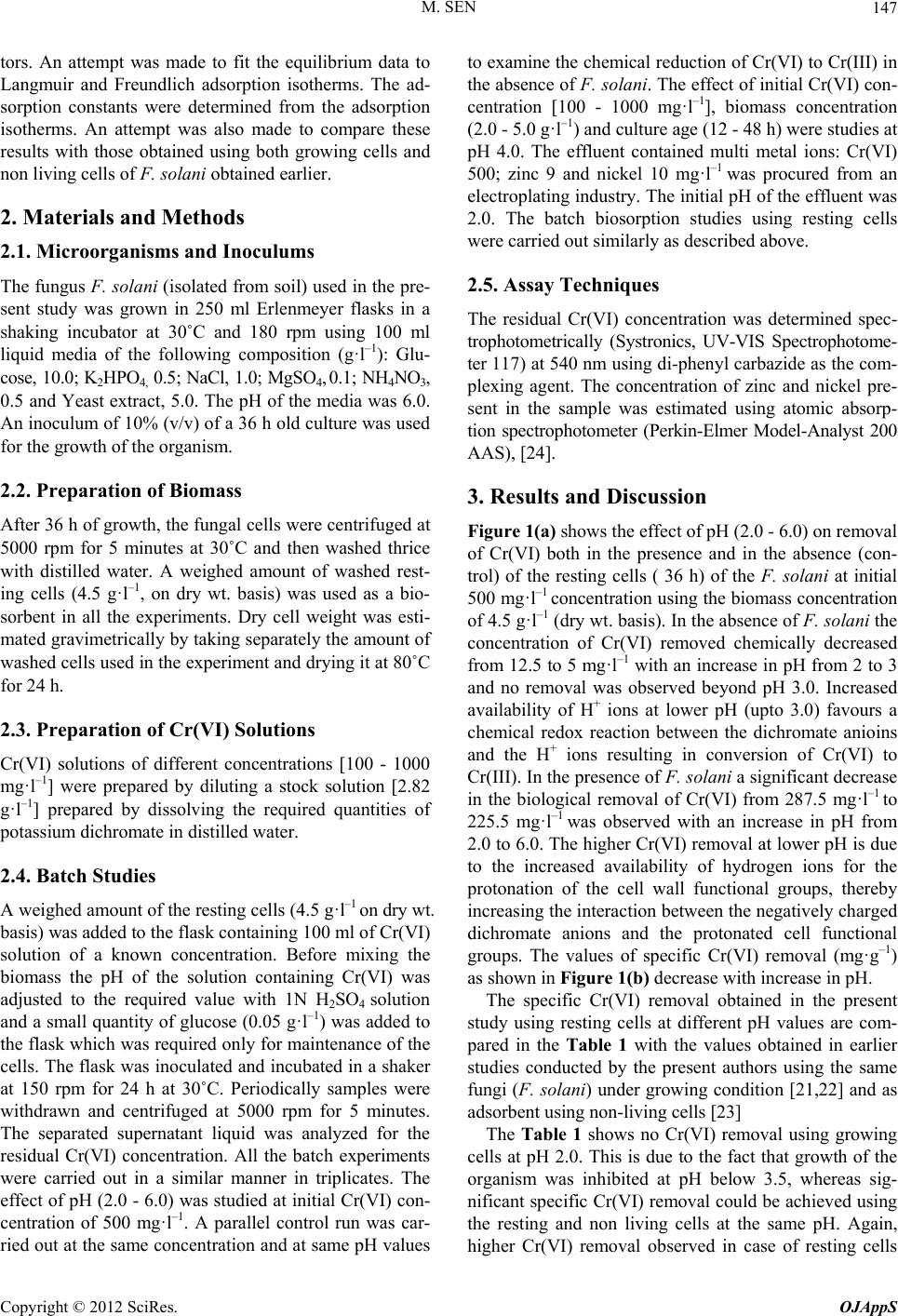 M. SEN 147 tors. An attempt was made to fit the equilibrium data to Langmuir and Freundlich adsorption isotherms. The ad- sorption constants were determined from the adsorption isotherms. An attempt was also made to compare these results with those obtained using both growing cells and non living cells of F. solani obtained earlier. 2. Materials and Methods 2.1. Microorganisms and Inoculums The fungus F. solani (isolated from soil) used in the pre- sent study was grown in 250 ml Erlenmeyer flasks in a shaking incubator at 30˚C and 180 rpm using 100 ml liquid media of the following composition (g·l–1): Glu- cose, 10.0; K2HPO4, 0.5; NaCl, 1.0; MgSO4, 0.1; NH4NO3, 0.5 and Yeast extract, 5.0. The pH of the media was 6.0. An inoculum of 10% (v/v) of a 36 h old culture was used for the growth of the organism. 2.2. Preparation of Biomass After 36 h of growth, the fungal cells were centrifuged at 5000 rpm for 5 minutes at 30˚C and then washed thrice with distilled water. A weighed amount of washed rest- ing cells (4.5 g·l–1, on dry wt. basis) was used as a bio- sorbent in all the experiments. Dry cell weight was esti- mated gravimetrically by taking separately the amount of washed cells used in the experiment and drying it at 80˚C for 24 h. 2.3. Preparation of Cr(VI) Solutions Cr(VI) solutions of different concentrations [100 - 1000 mg·l–1] were prepared by diluting a stock solution [2.82 g·l–1] prepared by dissolving the required quantities of potassium dichromate in distilled water. 2.4. Batch Studies A weighed amount of the resting cells (4.5 g·l–1 on dry wt. basis) was added to the flask containing 100 ml of Cr(VI) solution of a known concentration. Before mixing the biomass the pH of the solution containing Cr(VI) was adjusted to the required value with 1N H2SO4 solution and a small quantity of glucose (0.05 g·l–1) was added to the flask which was required only for maintenance of the cells. The flask was inoculated and incubated in a shaker at 150 rpm for 24 h at 30˚C. Periodically samples were withdrawn and centrifuged at 5000 rpm for 5 minutes. The separated supernatant liquid was analyzed for the residual Cr(VI) concentration. All the batch experiments were carried out in a similar manner in triplicates. The effect of pH (2.0 - 6.0) was studied at initial Cr(VI) con- centration of 500 mg·l–1. A parallel control run was car- ried out at the same concentration and at same pH values to examine the chemical reduction of Cr(VI) to Cr(III) in the absence of F. solani. The effect of initial Cr(VI) con- centration [100 - 1000 mg·l–1], biomass concentration (2.0 - 5.0 g·l–1) and culture age (12 - 48 h) were studies at pH 4.0. The effluent contained multi metal ions: Cr(VI) 500; zinc 9 and nickel 10 mg·l–1 was procured from an electroplating industry. The initial pH of the effluent was 2.0. The batch biosorption studies using resting cells were carried out similarly as described above. 2.5. Assay Techniques The residual Cr(VI) concentration was determined spec- trophotometrically (Systronics, UV-VIS Spectrophotome- ter 117) at 540 nm using di-phenyl carb azide as the com- plexing agent. The concentration of zinc and nickel pre- sent in the sample was estimated using atomic absorp- tion spectrophotometer (Perkin-Elmer Model-Analyst 200 AAS), [24]. 3. Results and Discussion Figure 1(a) shows the effect of pH (2.0 - 6.0) on removal of Cr(VI) both in the presence and in the absence (con- trol) of the resting cells ( 36 h) of the F. solani at initial 500 mg·l–1 concentration using the biomass concentration of 4.5 g·l–1 (dry wt. basis). In the absence of F. solani the concentration of Cr(VI) removed chemically decreased from 12.5 to 5 mg·l–1 with an increase in pH from 2 to 3 and no removal was observed beyond pH 3.0. Increased availability of H+ ions at lower pH (upto 3.0) favours a chemical redox reaction between the dichromate anioins and the H+ ions resulting in conversion of Cr(VI) to Cr(III). In the presence of F. solan i a significant decrease in the biological removal of Cr(VI) from 287.5 mg·l–1 to 225.5 mg·l–1 was observed with an increase in pH from 2.0 to 6.0. The higher Cr(VI) removal at lower pH is due to the increased availability of hydrogen ions for the protonation of the cell wall functional groups, thereby increasing the interaction between the negatively charged dichromate anions and the protonated cell functional groups. The values of specific Cr(VI) removal (mg·g–1) as shown in Figure 1(b) decrease with increase in pH. The specific Cr(VI) removal obtained in the present study using resting cells at different pH values are com- pared in the Table 1 with the values obtained in earlier studies conducted by the present authors using the same fungi (F. solani) under growing condition [2 1,22] and as adsorbent usi n g no n -living cells [23] The Table 1 shows no Cr(VI) removal using growing cells at pH 2.0. This is due to the fact that growth of the organism was inhibited at pH below 3.5, whereas sig- nificant specific Cr(VI) removal could be achieved using the resting and non living cells at the same pH. Again, higher Cr(VI) removal observed in case of resting cells Copyright © 2012 SciRes. OJAppS 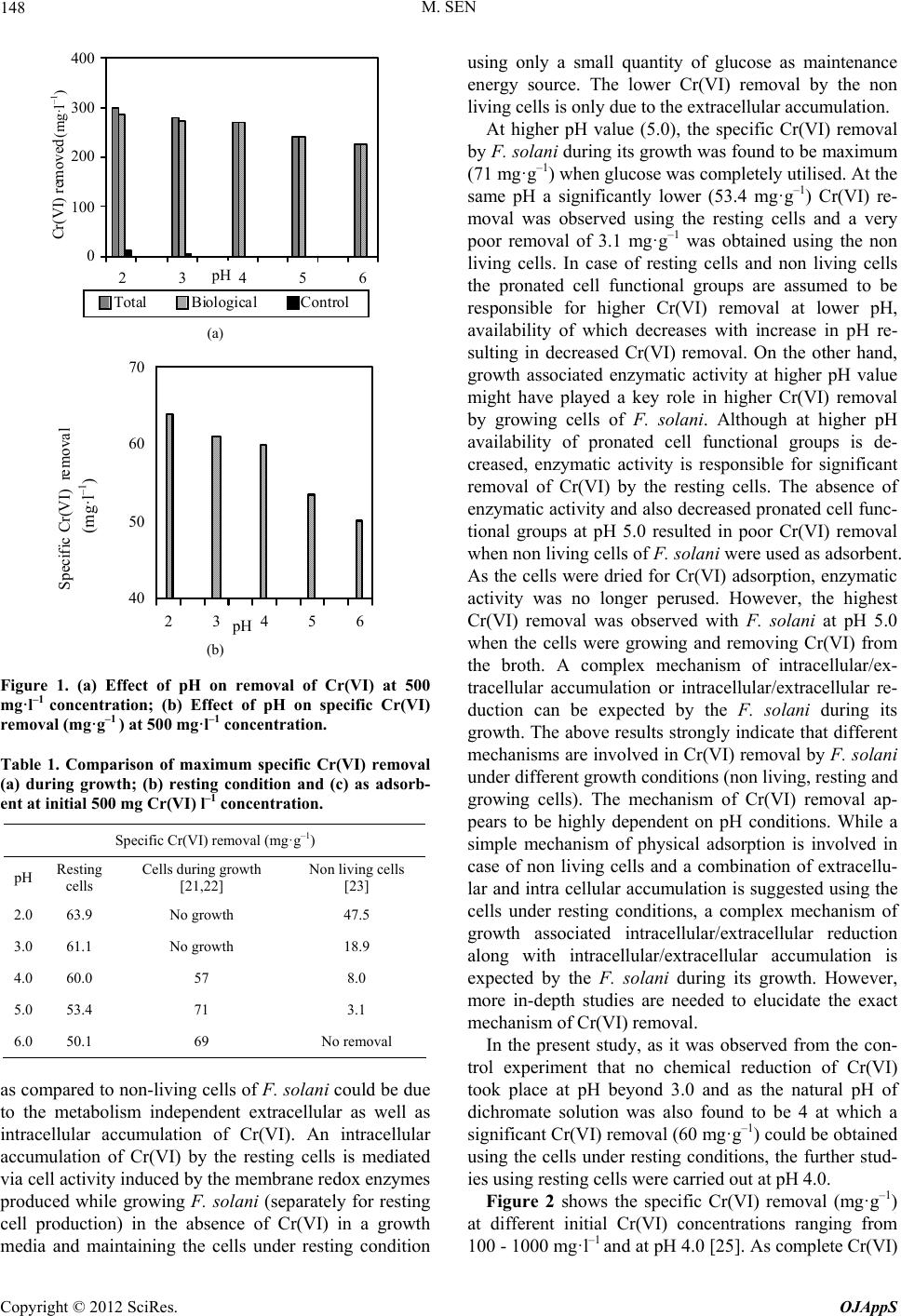 M. SEN 148 0 100 200 300 400 23456 pH C r (V I ) r e move d (mg l -1) Total Biological Control (mg·l –1 ) (a) 40 50 60 70 23456 p H Specific Cr(VI) remova l (mg g-1 ) (mg·l –1 ) (b) Figure 1. (a) Effect of pH on removal of Cr(VI) at 500 mg·l–1 concentration; (b) Effect of pH on specific Cr(VI) removal (mg·g–1 ) at 500 mg·l–1 concen tr a ti on. Table 1. Comparison of maximum specific Cr(VI) removal (a) during growth; (b) resting condition and (c) as adsorb- ent at initial 500 mg Cr(VI) l–1 conce ntration. Specific Cr(VI) removal (mg·g–1) pH Resting cells Cells during growth [21,22] Non living cells [23] 2.0 63.9 No growth 47.5 3.0 61.1 No growth 18.9 4.0 60.0 57 8.0 5.0 53.4 71 3.1 6.0 50.1 69 No removal as compared to non-living cells of F. solani could be due to the metabolism independent extracellular as well as intracellular accumulation of Cr(VI). An intracellular accumulation of Cr(VI) by the resting cells is mediated via cell activity induced by the membrane redox enzymes produced while growing F. solani (separately for resting cell production) in the absence of Cr(VI) in a growth media and maintaining the cells under resting condition using only a small quantity of glucose as maintenance energy source. The lower Cr(VI) removal by the non living cells is only due to the extracellular accumulation. At higher pH value (5.0), the specific Cr(VI) removal by F. solani during its growth was found to be maximum (71 mg·g–1) when glucose was completely utilised. At the same pH a significantly lower (53.4 mg·g–1) Cr(VI) re- moval was observed using the resting cells and a very poor removal of 3.1 mg·g–1 was obtained using the non living cells. In case of resting cells and non living cells the pronated cell functional groups are assumed to be responsible for higher Cr(VI) removal at lower pH, availability of which decreases with increase in pH re- sulting in decreased Cr(VI) removal. On the other hand, growth associated enzymatic activity at higher pH value might have played a key role in higher Cr(VI) removal by growing cells of F. solani. Although at higher pH availability of pronated cell functional groups is de- creased, enzymatic activity is responsible for significant removal of Cr(VI) by the resting cells. The absence of enzymatic activity and also decreased pronated cell func- tional groups at pH 5.0 resulted in poor Cr(VI) removal when non living cells of F. solani were used as adsorbent. As the cells were dried for Cr(VI) adsorption, enzymatic activity was no longer perused. However, the highest Cr(VI) removal was observed with F. solani at pH 5.0 when the cells were growing and removing Cr(VI) from the broth. A complex mechanism of intracellular/ex- tracellular accumulation or intracellular/extracellular re- duction can be expected by the F. solani during its growth. The above results strongly indicate that different mechanisms are involved in Cr(VI) removal by F. solani under different growth conditions (non living, resting and growing cells). The mechanism of Cr(VI) removal ap- pears to be highly dependent on pH conditions. While a simple mechanism of physical adsorption is involved in case of non living cells and a combination of extracellu- lar and intra cellular accumulation is suggested using the cells under resting conditions, a complex mechanism of growth associated intracellular/extracellular reduction along with intracellular/extracellular accumulation is expected by the F. solani during its growth. However, more in-depth studies are needed to elucidate the exact mechanism of Cr(VI) removal. In the present study, as it was observed from the con- trol experiment that no chemical reduction of Cr(VI) took place at pH beyond 3.0 and as the natural pH of dichromate solution was also found to be 4 at which a significant Cr(VI) removal (60 mg·g–1) could be obtained using the cells under resting conditions, the further stud- ies using resting cells were carried out at pH 4.0. Figure 2 shows the specific Cr(VI) removal (mg·g–1) at different initial Cr(VI) concentrations ranging from 100 - 1000 mg·l–1 and at pH 4.0 [25]. As complete Cr(VI) Copyright © 2012 SciRes. OJAppS 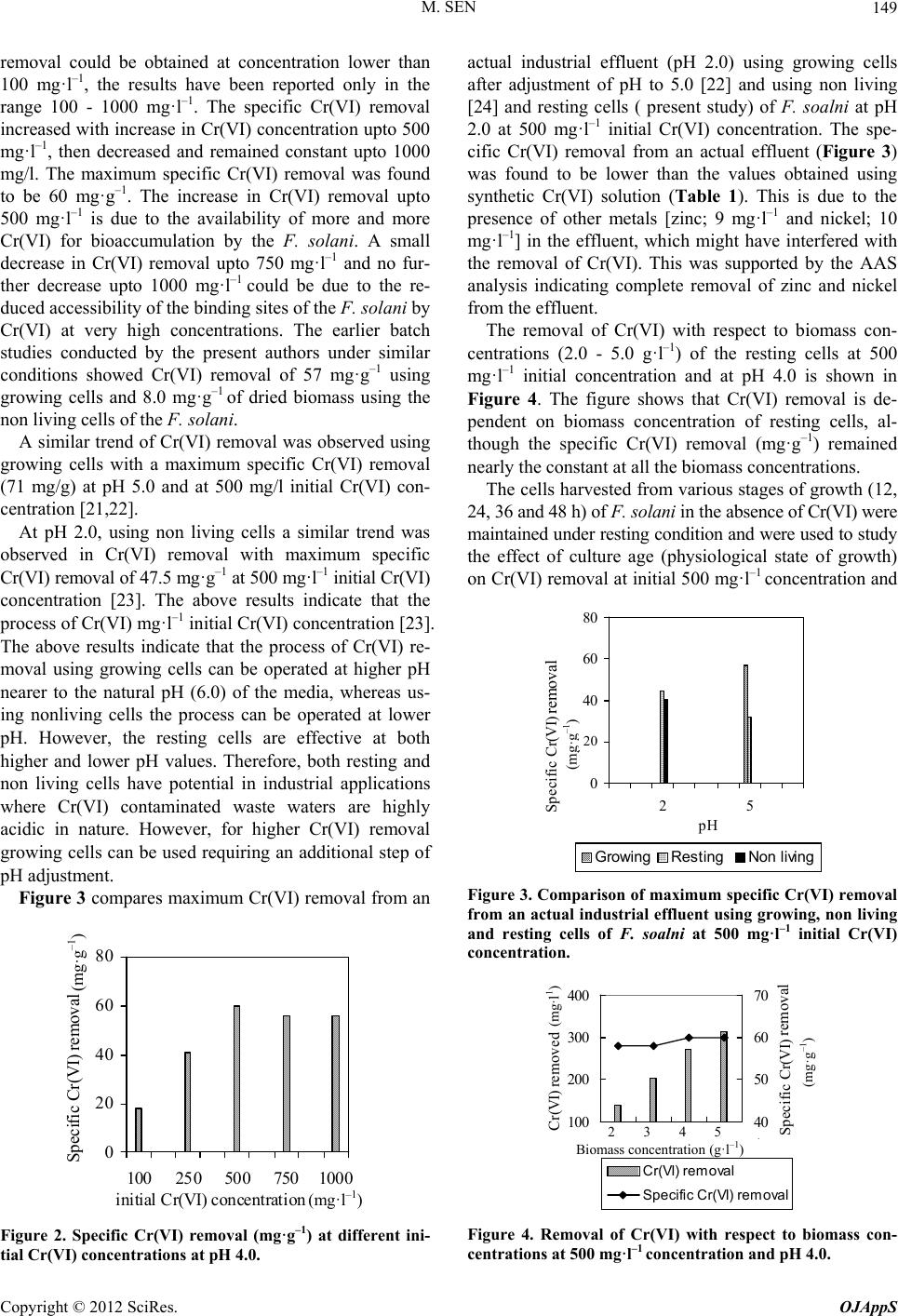 M. SEN 149 removal could be obtained at concentration lower than 100 mg·l–1, the results have been reported only in the range 100 - 1000 mg·l–1. The specific Cr(VI) removal increased with increase in Cr(VI) concen tration upto 500 mg·l–1, then decreased and remained constant upto 1000 mg/l. The maximum specific Cr(VI) removal was found to be 60 mg·g –1. The increase in Cr(VI) removal upto 500 mg·l–1 is due to the availability of more and more Cr(VI) for bioaccumulation by the F. solani. A small decrease in Cr(VI) removal upto 750 mg·l–1 and no fur- ther decrease upto 1000 mg·l–1 could be due to the re- duced accessibility of the binding sites of the F. solani by Cr(VI) at very high concentrations. The earlier batch studies conducted by the present authors under similar conditions showed Cr(VI) removal of 57 mg·g–1 using growing cells and 8.0 mg·g–1 of dried biomass using the non living cells of the F. solani. A similar trend of Cr(VI) removal was observed using growing cells with a maximum specific Cr(VI) removal (71 mg/g) at pH 5.0 and at 500 mg/l initial Cr(VI) con- centration [21,22]. At pH 2.0, using non living cells a similar trend was observed in Cr(VI) removal with maximum specific Cr(VI) removal of 47.5 mg·g–1 at 500 mg·l–1 initial Cr(VI) concentration [23]. The above results indicate that the process of Cr(VI) mg·l–1 initial Cr(VI) concentration [23]. The above results indicate that the process of Cr(VI) re- moval using growing cells can be operated at higher pH nearer to the natural pH (6.0) of the media, whereas us- ing nonliving cells the process can be operated at lower pH. However, the resting cells are effective at both higher and lower pH values. Therefore, both resting and non living cells have potential in industrial applications where Cr(VI) contaminated waste waters are highly acidic in nature. However, for higher Cr(VI) removal growing cells can be used requiring an additional step of pH adjustment. Figure 3 comp ar es max imu m Cr (VI ) re mova l fr om an 0 20 40 60 80 100250500750 1000 initial Cr(V I) concentr ation (mg l -1) Specific Cr(VI) r emoval (mg g - (mg·g –1 ) (mg·l –1 ) Figure 2. Specific Cr(VI) removal (mg·g–1) at different ini- actual industrial effluent (pH 2.0) tial Cr(VI) concentrations at pH 4.0. using growing cells Cr(VI) with respect to biomass con- ce 12, 24 after adjustment of pH to 5.0 [22] and using non living [24] and resting cells ( present study) of F. soalni at pH 2.0 at 500 mg·l–1 initial Cr(VI) concentration. The spe- cific Cr(VI) removal from an actual effluent (Figure 3) was found to be lower than the values obtained using synthetic Cr(VI) solution (Table 1). This is due to the presence of other metals [zinc; 9 mg·l–1 and nickel; 10 mg·l–1] in the effluent, which might have interfered with the removal of Cr(VI). This was supported by the AAS analysis indicating complete removal of zinc and nickel from the effluent. The removal of ntrations (2.0 - 5.0 g·l–1) of the resting cells at 500 mg·l–1 initial concentration and at pH 4.0 is shown in Figure 4. The figure shows that Cr(VI) removal is de- pendent on biomass concentration of resting cells, al- though the specific Cr(VI) removal (mg·g–1) remained nearly the constant at all the biomass concentrations. The cells harvested from various stages of growth ( , 36 and 48 h) of F. solani in the absence of Cr(VI) were maintained under resting condition and were used to study the effect of culture age (physiological state of growth) on Cr(VI) removal at initial 500 mg·l–1 concentration and 0 20 40 60 80 25 pH Specific Cr(VI) remova (mg g -1 ) Growing Resting Non living (mg·g –1 ) 20 removal Figure 3. Comparison of maximum specific Cr(VI) removal from an actual industrial effluent using growing, non living and resting cells of F. soalni at 500 mg·l–1 initial Cr(VI) concentration. 100 200 300 400 2345 Biomass concentr ation (g l -1) Cr(VI) removed (mg l -1 ) 40 50 60 70 Specific Cr(VI) remova l (mg g -1 ) Cr( VI ) removal Spec ific Cr(VI) remova l (mg·g –1 ) (mg·l 1 ) Biomass concentration (g ·l –1 ) 2 3 4 5 removal Figure 4. Removal of Cr(VI) with respect to biomass con- centrations at 500 mg·l–1 concentration and pH 4.0. Copyright © 2012 SciRes. OJAppS 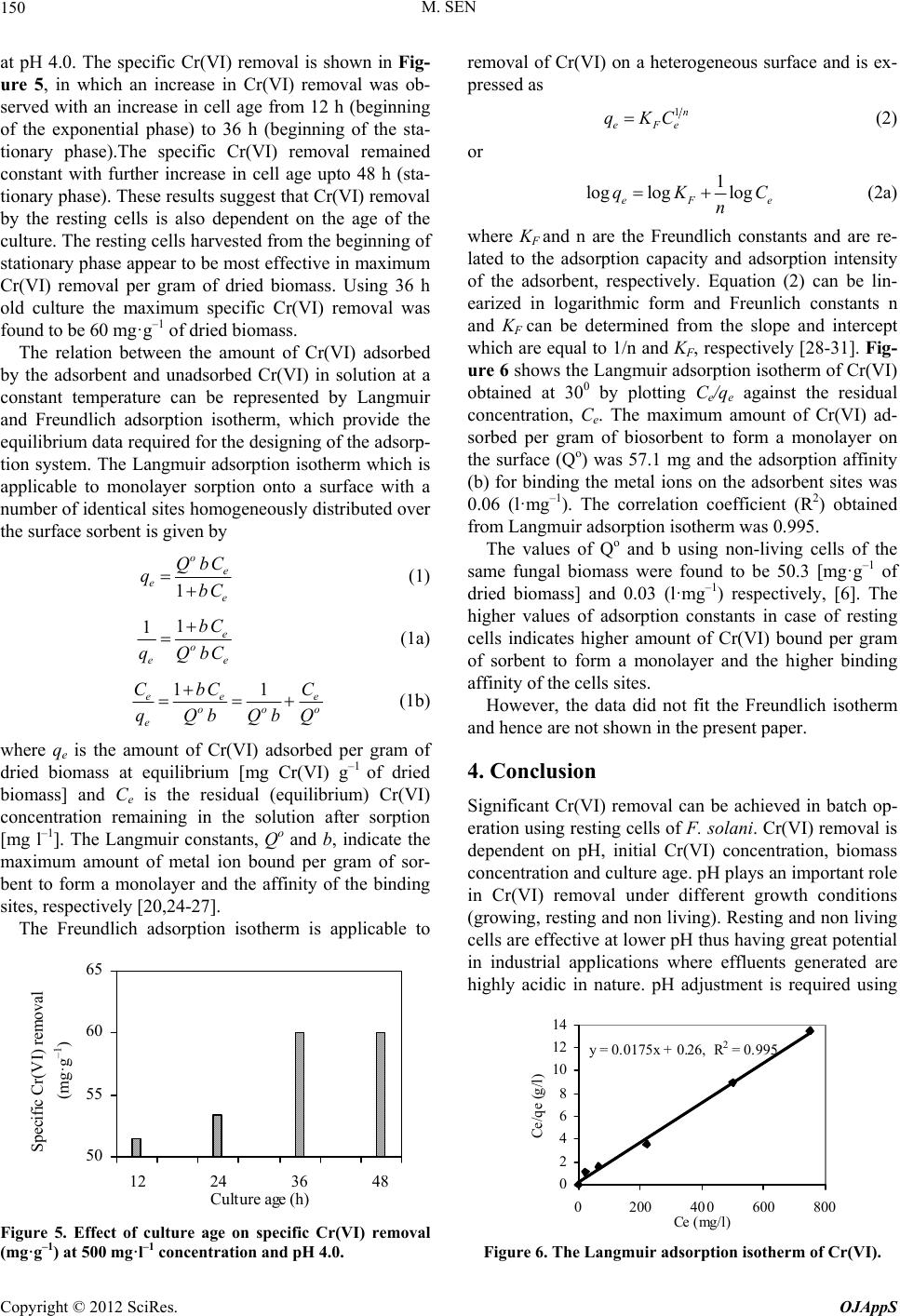 M. SEN 150 at pH 4.0. The specific Cr(VI) removal is shown in Fig- r(VI) adsorbed by ure 5, in which an increase in Cr(VI) removal was ob- served with an increase in cell age from 12 h (beginning of the exponential phase) to 36 h (beginning of the sta- tionary phase).The specific Cr(VI) removal remained constant with further increase in cell age upto 48 h (sta- tionary phase). These results suggest that Cr(VI) removal by the resting cells is also dependent on the age of the culture. The resting cells harvested from the beginning of stationary phase appear to be most effective in maximum Cr(VI) removal per gram of dried biomass. Using 36 h old culture the maximum specific Cr(VI) removal was found to be 60 mg·g–1 of dried biomass. The relation between the amount of C the adsorbent and unadsorbed Cr(VI) in solution at a constant temperature can be represented by Langmuir and Freundlich adsorption isotherm, which provide the equilibrium data required for the designing of the adsorp- tion system. The Langmuir adsorption isotherm which is applicable to monolayer sorption onto a surface with a number of identical sites homogeneously distributed over the surface sorbent is given by 1 o QbC e ee qbC (1) 1 1e o e bC qQbC e (1a) 11 ee oo e CbC C qQbQbQ e o (1b) where qe is the amount of Cr(VI) adsorbed per gram of sotherm is applicable to dried biomass at equilibrium [mg Cr(VI) g–1 of dried biomass] and Ce is the residual (equilibrium) Cr(VI) concentration remaining in the solution after sorption [mg l–1]. The Langmuir constants, Qo and b, indicate the maximum amount of metal ion bound per gram of sor- bent to form a monolayer and the affinity of the binding sites, respectively [20,24-27]. The Freundlich adsorption i 50 55 60 65 12 24 36 48 Culture age (h) Specific Cr(VI) removal (mg g -1) (mg·g –1 ) Figure 5. Effect of culture age on specific Cr(VI) removal and is ex- (mg·g–1) at 500 mg·l–1 concentration and pH 4.0. removal of Cr(VI) on a heterogeneous surface pressed as 1n eFe qKC (2) or 1 log loglog eF qK n e C (2a) where KF and n are the Freundlich constants and are re- lls of the sa not fit the Freundlich isotherm an 4. Conclusion removal can be achieved in batch op- lated to the adsorption capacity and adsorption intensity of the adsorbent, respectively. Equation (2) can be lin- earized in logarithmic form and Freunlich constants n and KF can be determined from the slope and intercept which are equal to 1/n and KF, respectively [28-31]. Fig- ure 6 shows the Langmuir adsorption isotherm of Cr(VI) obtained at 300 by plotting Ce/qe against the residual concentration, Ce. The maximum amount of Cr(VI) ad- sorbed per gram of biosorbent to form a monolayer on the surface (Qo) was 57.1 mg and the adsorption affinity (b) for binding the metal ions on the adsorbent sites was 0.06 (l·mg–1). The correlation coefficient (R2) obtained from Langmuir adsorption isotherm was 0.995. The values of Qo and b using non-living ce me fungal biomass were found to be 50.3 [mg·g–1 of dried biomass] and 0.03 (l·mg–1) respectively, [6]. The higher values of adsorption constants in case of resting cells indicates higher amount of Cr(VI) bound per gram of sorbent to form a monolayer and the higher binding affinity of the cells sites. However, the data did d hence are not shown in the present paper. Significant Cr(VI) eration using resting cells of F. solani. Cr(VI) removal is dependent on pH, initial Cr(VI) concentration, biomass concentration and cu lture age. pH plays an impo rtant role in Cr(VI) removal under different growth conditions (growing, resting and non living). Resting and non living cells are effective at lower pH thus having great potential in industrial applications where effluents generated are highly acidic in nature. pH adjustment is required using y = 0.0175x + 0.26, R2 = 0.9 95 0 2 4 6 8 10 12 14 0200 400 600 800 Ce (mg/l) Ce/qe (g/l) Figure 6. The Langmuir adsorption isotherm of Cr(VI). Copyright © 2012 SciRes. OJAppS  M. SEN 151 ce - [1] L. E. Germaiating and Cyanide atment Technolog ors lls under growing condition. The equilibrium adsorp tion data fitted well with Langmuir adsorption isotherm indicating the favorab le monolayer adsorption on th e cell surface. The findings from this comparative study pro- vide useful basis for development of suitable operational strategies for treatment of Cr(VI) contaminated waste- waters. REFERENCES n and E. Patterson, “Pl Wastes,” Journal of the Water Pollution Control Federa- tion, Vol. 46, 1974, pp. 1301-1315. [2] J. W. Patterson, “Waste Water Trey,” Ann Arbor Science Publishers Inc., Ann Arbor, 1977. [3] K. Komari, P. Wang, K.Toda and H. Ohyake, “Fact Affecting Chromate Reduction in Enterobactor cloacae strain HOI,” Applied Microbiology and Biotechnology, Vol. 31, No. 5-6, 1989, pp. 567-570. doi:10.1007/BF00270796 [4] M. Faisal and S. Hassan, “Microbial Conversion of Cr(VI ) ion of in Biosorption re- ag, Z. Ozer, Z. Aksu, T. Kustal and A. into Cr(III) in Industrial Effluent,” African Journal of Biotechnology, Vol. 3, No. 11, 2004, pp. 610-617. [5] Z. Aksu and D. Akpinar, “Competitive Biosorpt Phenol and Chromium(VI) from Binary Mixture onto Dried Anaerobic Activate Sludge,” Biochemical Engi- neering, Vol. 7, No. 3, 2001, pp. 183-193. [6] B. Volesky, “Biosorption and Biosorbents of Heavy Metals,” CRC press Inc., Boca Raton, 1990. [7] S. Llovera, R. Bonet, M. D. Simon-Pujol and F. Cong gado, “Effect of Culture Medium Ions on Chromate Re- duction by Resting Cells of Agrobacterium radiobacter,” Applied Microbiology and Biotechnology, Vol. 39, No. 3, 1993, pp. 424-426. [8] M. Nourbaksh, Y. S Caglar, “A Comparative Study of Various Biosorbent for Removal of Chromium(VI) Ions from Industrial Waste Waters,” Process Biochemistry, Vol. 29, No. 1, 1994, pp. 1-5. doi:10.1016/0032-9592(94)80052-9 [9] J. Campos, M. Martinez-Pacheco and C. Cervant es, “Hexa- valent Chromium Reduction by a Chromate Resistant Ba- cillus Sp. Strain,” Antonie Van Leeuwenhoek, Vol. 68, No. 3, 1995, pp. 203-208. doi:10.1007/BF00871816 [10] P. Pattanapipitpaisal, N. L. Brown and L. E. Macaskie, “Chromate Reduction by Microbacterium liquefaciens Immobilized in Polyvinyl Alcohol,” Biotechnology Let- ters, Vol. 23, No. 1, 2001, pp. 41-43. doi:10.1023/A:1026750810580 [11] B. Barkhordar and M. Ghiasseddin, “Comparision of E. Abraham, “Biosorption of Cr(VI) Langmuir and Freundlich Equilibriums in Cr, Cu and Ni Adsorption by Sargassum,” Iranian Journal of Environ- mental Health Science & Engineering, Vol. 1, No. 2, 2004, pp. 58-64. [12] B. R. Sudha and T. from Aqueous Solution by Rhizopus nigrificans,” Biore- source Technology, Vol. 79, No. 1, 2001, pp. 73-81. doi:10.1016/S0960-8524(00)00107-3 [13] G. W. Stratten, “Review,” In: E. Hodson, ed., Environ- ter, A. Patmalnieks and A. Rapoport, “Interrela- mental Toxicology, Elsiever, Amsterdam, 1987, pp. 85- 94. [14] O. Mu tions of the Yeast Candida utilis and Cr(VI): Metal Re- duction and Its Distribution in the Cell and Medium,” Process Biochemistry, Vol. 36, No. 10, 2001, pp. 963-970. doi:10.1016/S0032-9592(01)00136-4 [15] T. Srinath, T. Verma, P. W. Ramteka and S. K. Garg, “Chromium(VI) Biosorption and Bioaccumulation by Chromate Resistant Bacteria,” Chemophere, Vol. 48, No. 4, 2002, pp. 427-435. doi:10.1016/S0045-6535(02)00089-9 [16] K. S. Selvaraj, S. Manonmai and S. Pattabhi, “Removal of Hexavalent Chromium Using Distillery Sludge,” Biore- source Technology, Vol. 89, No. 2, 2003, pp. 207-211. doi:10.1016/S0960-8524(03)00062-2 [17] S. S. Middleton, R. B. Latmani, M. R. Mackey, M. H. Ellisman, B. M. Tebo and C. S. Criddle, “Cometabolism of Cr(VI) by Shewanella Oncendensis MR-1 Produced Cell Associated Reduced Chromium and Inhibit Growth,” Wiley InterScience, 2003. doi:10.1002/bit [18] A. Y. Dursan, G. Ulsu, Y. Cuci and Z. Aksu, “Bioac- cumulation of Cupper (II), Lead (II) and Chromium (VI) by Growing Aspergillus niger,” Process Biochemistry, Vol. 38, No. 10, 2003, pp. 1647-1651. doi:10.1016/S0032-9592(02)00075-4 [19] J. M. Panacastro, F. Martinez-Jeronimo, F. Esparza-Gar- cia and R. O. Canizares-Villanueva, “Heavy Metals Re- moval by the Micro Algae Sceneunus in Crassatulus in Continuous Cultures,” Bioresource Technology, Vol. 94, No. 2, 2004, pp. 219-222. doi:10.1016/j.biortech.2003.12.005 [20] M. Sen and M. G. Dastidar, “Biosorption of Cr(VI) by and P. K. Roychoudhury, “Bio- . Dastidar and P. K. Roychoudhury, “Com- Resting Cells of Aspergillus sp.” Iranian Journal of En- vironmental Health Science & Engineering, Vol. 4, No. 1, 2006, pp. 9-12. [21] M. Sen, M. G. Dastidar logical Removal of Cr(VI) Using an Isolated Fungal Strain Wate r and Wa ste wat er Perspectives of Developing Countries (WAPDEC),” Water Association, 2005, pp. 1163-1169. [22] M. Sen, M. G parative Studies of Batch and Continuous Biological Treatment of Cr(VI) Using Fusarium solani,” Enzyme and Microbial Technology, Vol. 41, No. 102, 2007, pp. 51-56. doi:10.1016/j.enzmictec.2006.11.021 [23] M. Sen, M. G. Dastidar, P. K. Roychoudhury, “Biosorp- tion of Cr(VI) Using Fungal Strain of Fusarium sp. American Society of Civil Engineers (ASCE),” Practice Periodical of Hazardous, Toxic, and Radioactive Waste Management, Vol. 9, No. 3, 2005, pp.147-151. doi:10.1061/(ASCE)1090-025X(2005)9:3(147) [24] V. G. Vogel, “Standards Methods for the Examination of (VI) by Resting Cells of Fusarium solani,” Iranian Journal of Water and Wastewater,” 17th Edition, American Public Health Association (APHA), Washing DC, 1989. [25] M. Sen and M. G. Dastidar, “Biosorption of Cr Copyright © 2012 SciRes. OJAppS  M. SEN Copyright © 2012 SciRes. OJAppS 152 ing Non-Living Fungal Biomass,” d and Chromium from Aqueous Solution b um(VI) from Aqueous Solutions by Green Al- 4(01)00138-5 Environmental Health Science & Engineering, Vol. 8, No. 2, 2011, pp. 153-158. [26] M. Sen and M. G. Dastidar, “Adsorption-Desorption Studies on Cr(VI) Us Asian Journal of Chemistry, Vol. 22, No. 3, 2010, pp. 2331-2338. [27] A. Khanafari, S. Eshghdoost and A. Mashinchian, “Re- moval of Leay Bacillus Circulans,” Iranian Journal of Environmental Health Science & Engineering, Vol. 5, No. 3, 2008, pp. 195-200. [28] V. K. Gupta, A. K. Shrivastava and N. Jain, “Biosorption of Chromi gae spirogyra Species,” Water Research, Vol. 35, No. 17, 2001, pp. 4079-4085. doi:10.1016/S0043-135 , K. Eller, J. Klima of Hexava- Selective Biosorption of [29] M. Pillicsanmer, T. Pumpel, R. Poder and F. Schinner, “Biosorption of Chromium to Fungi,” Biometals, Vol.8, No. 2, 1995, pp. 117-121. [30] A. I. Rapport and O. A. Muter, “Biosorption lent Chromium by Yeasts,” Process Biochemistry, Vol. 36, No. 10, 2001, pp.963-970. [31] Y. Sag and T. Kutsal, “The Chromium(VI) and Copper(II) Ions from Binary Metals Mixtures by Rhizopus arrhizus,” Process Biochemistry, Vol. 9, No. 3, 1995, pp. 147-151. |