

Paper Menu >>
Journal Menu >>
 Journal of Financial Risk Management 2012. Vol.1, No.3, 52-55 Published Online September 2012 in SciRes (http://www.SciRP.org/journal/jfrm) http://dx.doi.org/10.4236/jfrm.2012.13009 Copyright © 2012 SciRes. 52 Research on the Effects of Fund Performance on Fund Manager Turnover* Tiaoyan Hui, Ze Yuan Department of Industrial Engineering, School of Economics and Management, Xidian University, Xi’ an, China Email: [email protected], [email protected] Received July 8th, 2012; revised August 10th, 2012; accepted August 19th, 2012 We take the equity funds and hybrid funds in china as a sample, base on fund performance in the second half of the year 2009, and make an empirical analysis on the effects of fund performance, interaction be- tween fund performance and the character of fund manager on his turnover in 2010 year by method of Logistic Regression Analysis using SPSS17.0. We find that fund return rate and excess return rate have a significant negative impact on fund manager turnover, while risk-adjusted fund performance and the ca- pability of market-timing and stock-selection have no significant effect on fund manager turnover. For some characters of fund manager, such as fund manager age and securities working time will mitigate the negative relationship between the fund performance and the fund manager turnover. Keywords: Fund manager; Performance; Turnover; Interaction Introduction Fund manager, who is responsible for the investment deci- sion, plays a pivotal role in the fund performance. Today, under the fierce ranking competition, fund managers changed fre- quently in our country. There are respectively 66, 132, 147, 180, 226 fund managers turnover from 2006 to 2010 year. It’s obvi- ous that the funds in China ushers are in the trend of large-scale personnel adjustment after years of rapid development and the fund manager’s average tenure is merely 1.5 years. The fund manager turnover rate continues to be high, then, what is the reason leading to fund manager frequent turnover? Whether the fund manager turnover is effective or not? We do this research on the effects of fund performance, interaction between fund performance and characteristics of fund manager on fund man- ager turnover. Literature Review The academic literature has devoted considerable attention to the effectiveness of fund performance on subsequent fund man- ager turnover. Morck, Shleifer and Vishny (1989) find that a manager is prone to be replaced when his performance is below the average level. However, if the performance of overall Indus- try is bad, the possibility of replacement is to be relatively low. We can see that a company will assess a manager based on the relative performance, and then decide his position and replace- ment. Khorana (1996) documents an inverse relation between the probability of managerial replacement and fund performance. The possibility to be replaced of the fund managers whose rank is lagged is 4 times that of the front. Hu, Hall and Harvey’s (2000) analysis of 307 manager changes separates promotions from demotions, they find that there is a negative relationship between performance and the likelihood of being replaced or demoted, while the probability of a manager being promoted is positively correlated with his current and past performance. Wermers, Wu & Zechner (2005) research on the American closed-end fund manager replacement issues from 1985 to 2002 and demonstrate that fund performance can also make significant explanations for closed-end fund manager replacement, a fund underperforms its peer group prior to manager replacement, but improves after- wards. They also find that the discount income lagged two years and the possibility of fund managers replacement are negatively correlated, however, the discount income lagged one year does not have the explanatory power, which shows that discount change not only reflects the information of fund manager capa- bility, but also the anticipation of the fund manager replacement (Wermers, Wu, & Zechner, 2005). In China, Jialiu Lu and Maobin Wang who take the replace- ment issues of closed-end fund from 1998 to 2004 as a sample find that the fund companies have a good internal governance mechanism on the replacing of fund manager with bad per- formance. The relative performance of fund managers and their investment capability can significantly explain their demotion but cannot interpret their promotion. At the same time, the change in fund discount rate cannot explain fund manager replacement. Fund performance cannot be well improved by replacing fund manager (Lu & Wang, 2007). Bao (2008) concludes that the fund performance is the crucial factor of the replacement of fund manager. Replacing fund manager becomes a relatively effective measure for improving performance when the fund performance is poor ( Bao, 2008). Lintao Zhang’s research (2011) also indi- cates that the fund performance can well explain the demotion of fund manager but not promotion (Zhang & Deng, 2011). Empirical Analysis Data Resource *Supported by the National Science Fund of China (NO: 70802047) and Ministry of Education Humanities and Social Sciences Research (NO: 09XJA790008) The sample consists of all equity and hybrid funds of china in 2009. Based on the fund performance in the second half of 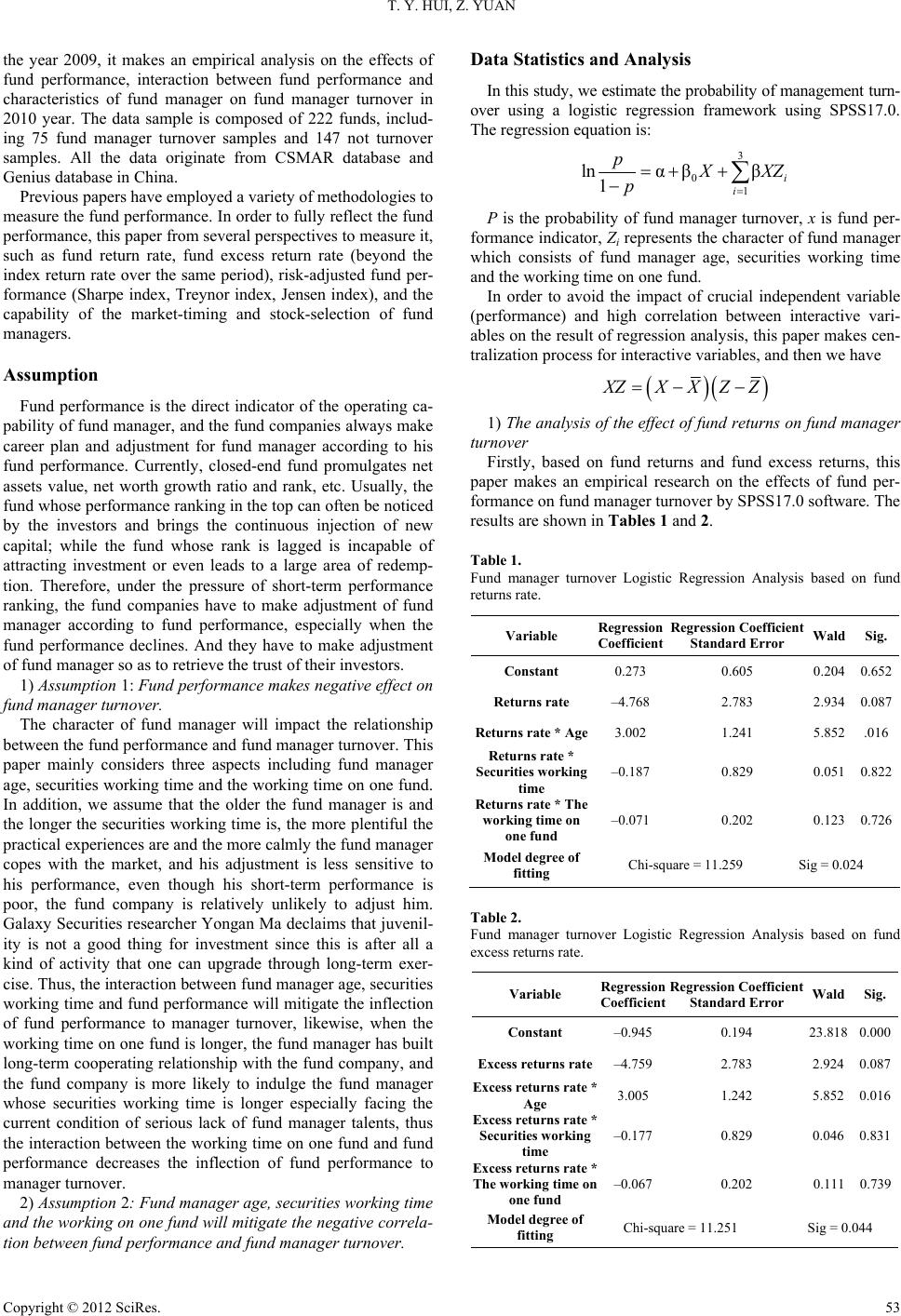 T. Y. HUI, Z. YUAN the year 2009, it makes an empirical analysis on the effects of fund performance, interaction between fund performance and characteristics of fund manager on fund manager turnover in 2010 year. The data sample is composed of 222 funds, includ- ing 75 fund manager turnover samples and 147 not turnover samples. All the data originate from CSMAR database and Genius database in China. Previous papers have employed a variety of methodologies to measure the fund performance. In order to fully reflect the fund performance, this paper from several perspectives to measure it, such as fund return rate, fund excess return rate (beyond the index return rate over the same period), risk-adjusted fund per- formance (Sharpe index, Treynor index, Jensen index), and the capability of the market-timing and stock-selection of fund managers. Assumption Fund performance is the direct indicator of the operating ca- pability of fund manager, and the fund companies always make career plan and adjustment for fund manager according to his fund performance. Currently, closed-end fund promulgates net assets value, net worth growth ratio and rank, etc. Usually, the fund whose performance ranking in the top can often be noticed by the investors and brings the continuous injection of new capital; while the fund whose rank is lagged is incapable of attracting investment or even leads to a large area of redemp- tion. Therefore, under the pressure of short-term performance ranking, the fund companies have to make adjustment of fund manager according to fund performance, especially when the fund performance declines. And they have to make adjustment of fund manager so as to retrieve the trust of their investors. 1) Assumption 1: Fund performance makes negative effect on fund manager turnover. The character of fund manager will impact the relationship between the fund performance and fund manager turnover. This paper mainly considers three aspects including fund manager age, securities working time and the working time on one fund. In addition, we assume that the older the fund manager is and the longer the securities working time is, the more plentiful the practical experiences are and the more calmly the fund manager copes with the market, and his adjustment is less sensitive to his performance, even though his short-term performance is poor, the fund company is relatively unlikely to adjust him. Galaxy Securities researcher Yongan Ma declaims that juvenil- ity is not a good thing for investment since this is after all a kind of activity that one can upgrade through long-term exer- cise. Thus, the interaction between fund manager age, securities working time and fund performance will mitigate the inflection of fund performance to manager turnover, likewise, when the working time on one fund is longer, the fund manager has built long-term cooperating relationship with the fund company, and the fund company is more likely to indulge the fund manager whose securities working time is longer especially facing the current condition of serious lack of fund manager talents, thus the interaction between the working time on one fund and fund performance decreases the inflection of fund performance to manager turnover. 2) Assumption 2: Fund manager age, securities working time and the working on one fund will mitigate the negative correla- tion between fund performance and fund manager turnover. Data Statistics and Analysis In this study, we estimate the probability of management turn- over using a logistic regression framework using SPSS17.0. The regression equation is: 3 0 1 ln αβ β 1i i p X XZ p P is the probability of fund manager turnover, x is fund per- formance indicator, Zi represents the character of fund manager which consists of fund manager age, securities working time and the working time on one fund. In order to avoid the impact of crucial independent variable (performance) and high correlation between interactive vari- ables on the result of regression analysis, this paper makes cen- tralization process for interactive variables, and then we have X ZXXZZ 1) The analysis of the effect of fund returns on fund manager turnover Firstly, based on fund returns and fund excess returns, this paper makes an empirical research on the effects of fund per- formance on fund manager turnover by SPSS17.0 software. The results are shown in Tables 1 and 2. Table 1. Fund manager turnover Logistic Regression Analysis based on fund returns rate. Variable Regression Coefficient Regression C oefficient Standard Error Wald Sig. Constant 0.273 0.605 0.2040.652 Returns rate –4.768 2.783 2.9340.087 Returns rate * Age3.002 1.241 5.852.016 Returns rate * Securities working time –0.187 0.829 0.0510.822 Returns rate * The working time on one fund –0.071 0.202 0.1230.726 Model degree of fitting Chi-square = 11.259 Sig = 0.024 Table 2. Fund manager turnover Logistic Regression Analysis based on fund excess returns rate. Variable Regression Coefficient Regression Coefficient Standard Error WaldSig. Constant –0.945 0.194 23.818 0.000 Excess returns rate–4.759 2.783 2.924 0.087 Excess returns rate * Age 3.005 1.242 5.852 0.016 Excess returns rate * Securities working time –0.177 0.829 0.046 0.831 Excess returns rate * The working time on one fund –0.067 0.202 0.111 0.739 Model degree of fitting Chi-square = 11.251 Sig = 0.044 Copyright © 2012 SciRes. 53 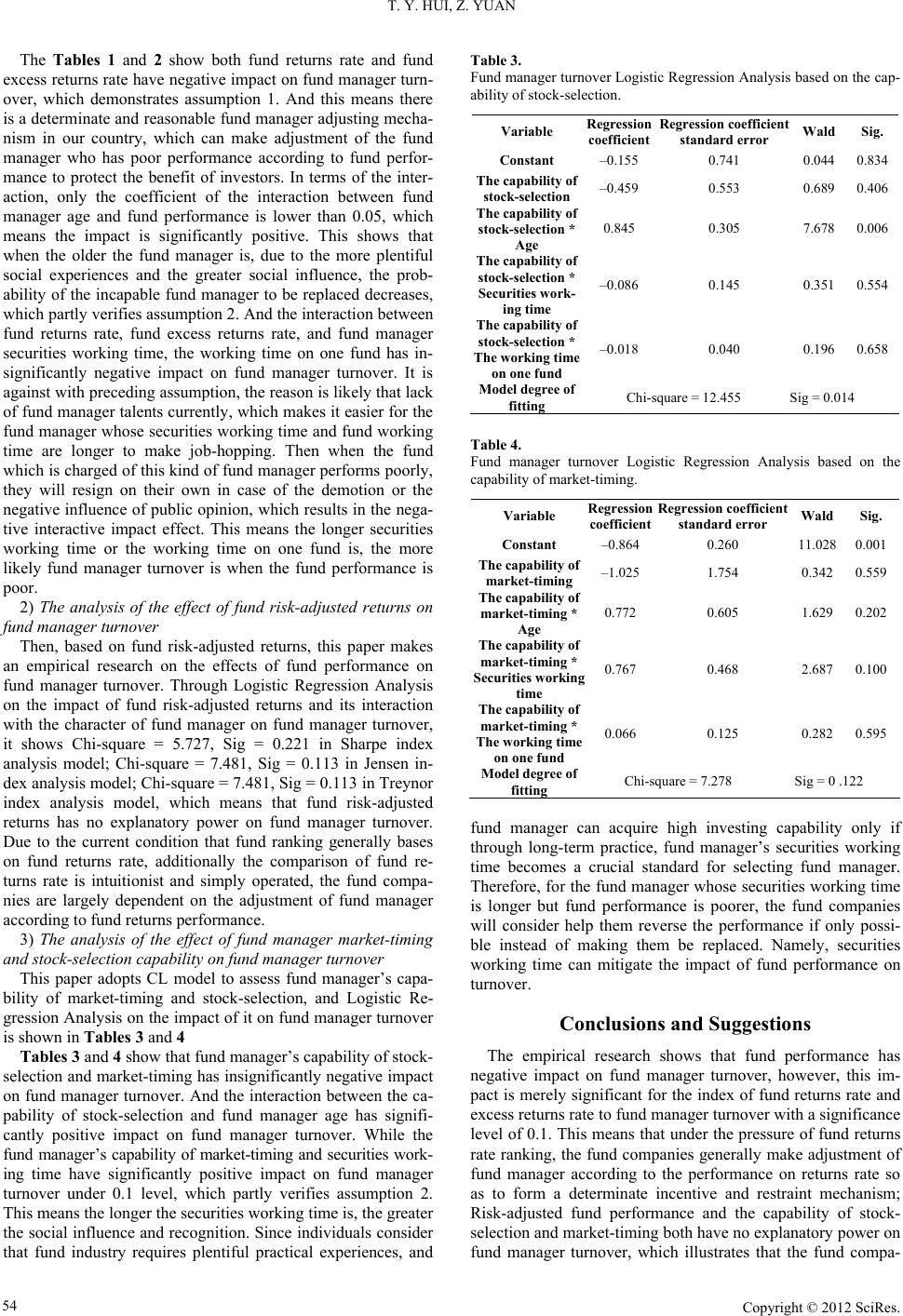 T. Y. HUI, Z. YUAN The Tables 1 and 2 show both fund returns rate and fund excess returns rate have negative impact on fund manager turn- over, which demonstrates assumption 1. And this means there is a determinate and reasonable fund manager adjusting mecha- nism in our country, which can make adjustment of the fund manager who has poor performance according to fund perfor- mance to protect the benefit of investors. In terms of the inter- action, only the coefficient of the interaction between fund manager age and fund performance is lower than 0.05, which means the impact is significantly positive. This shows that when the older the fund manager is, due to the more plentiful social experiences and the greater social influence, the prob- ability of the incapable fund manager to be replaced decreases, which partly verifies assumption 2. And the interaction between fund returns rate, fund excess returns rate, and fund manager securities working time, the working time on one fund has in- significantly negative impact on fund manager turnover. It is against with preceding assumption, the reason is likely that lack of fund manager talents currently, which makes it easier for the fund manager whose securities working time and fund working time are longer to make job-hopping. Then when the fund which is charged of this kind of fund manager performs poorly, they will resign on their own in case of the demotion or the negative influence of public opinion, which results in the nega- tive interactive impact effect. This means the longer securities working time or the working time on one fund is, the more likely fund manager turnover is when the fund performance is poor. 2) The analysis of the effect of fund risk-adjusted returns on fund manager turnover Then, based on fund risk-adjusted returns, this paper makes an empirical research on the effects of fund performance on fund manager turnover. Through Logistic Regression Analysis on the impact of fund risk-adjusted returns and its interaction with the character of fund manager on fund manager turnover, it shows Chi-square = 5.727, Sig = 0.221 in Sharpe index analysis model; Chi-square = 7.481, Sig = 0.113 in Jensen in- dex analysis model; Chi-square = 7.481, Sig = 0.113 in Treynor index analysis model, which means that fund risk-adjusted returns has no explanatory power on fund manager turnover. Due to the current condition that fund ranking generally bases on fund returns rate, additionally the comparison of fund re- turns rate is intuitionist and simply operated, the fund compa- nies are largely dependent on the adjustment of fund manager according to fund returns performance. 3) The analysis of the effect of fund manager market-timing and stock-selection capability on fund manager turnover This paper adopts CL model to assess fund manager’s capa- bility of market-timing and stock-selection, and Logistic Re- gression Analysis on the impact of it on fund manager turnover is shown in Tables 3 and 4 Tables 3 and 4 show that fund manager’s capability of stock- selection and market-timing has insignificantly negative impact on fund manager turnover. And the interaction between the ca- pability of stock-selection and fund manager age has signifi- cantly positive impact on fund manager turnover. While the fund manager’s capability of market-timing and securities work- ing time have significantly positive impact on fund manager turnover under 0.1 level, which partly verifies assumption 2. This means the longer the securities working time is, the greater the social influence and recognition. Since individuals consider that fund industry requires plentiful practical experiences, and Table 3. Fund manager turnover Logistic Regression Analysis based on the cap- ability of stock-selection. Variable Regression coefficient Regression coefficient standard error WaldSig. Constant –0.155 0.741 0.044 0.834 The capability of stock-selection –0.459 0.553 0.689 0.406 The capability of stock-selection * Age 0.845 0.305 7.678 0.006 The capability of stock-selection * Securities work- ing time –0.086 0.145 0.351 0.554 The capability of stock-selection * The working time on one fund –0.018 0.040 0.196 0.658 Model degree of fitting Chi-square = 12.455 Sig = 0.014 Table 4. Fund manager turnover Logistic Regression Analysis based on the capability of market-timing. Variable Regression coefficient Regression coefficient standard error WaldSig. Constant –0.864 0.260 11.028 0.001 The capability of market-timing –1.025 1.754 0.342 0.559 The capability of market-timing * Age 0.772 0.605 1.629 0.202 The capability of market-timing * Securities working time 0.767 0.468 2.687 0.100 The capability of market-timing * The working time on one fund 0.066 0.125 0.282 0.595 Model degree of fitting Chi-square = 7.278 Sig = 0 .122 fund manager can acquire high investing capability only if through long-term practice, fund manager’s securities working time becomes a crucial standard for selecting fund manager. Therefore, for the fund manager whose securities working time is longer but fund performance is poorer, the fund companies will consider help them reverse the performance if only possi- ble instead of making them be replaced. Namely, securities working time can mitigate the impact of fund performance on turnover. Conclusions and Suggestions The empirical research shows that fund performance has negative impact on fund manager turnover, however, this im- pact is merely significant for the index of fund returns rate and excess returns rate to fund manager turnover with a significance level of 0.1. This means that under the pressure of fund returns rate ranking, the fund companies generally make adjustment of fund manager according to the performance on returns rate so as to form a determinate incentive and restraint mechanism; Risk-adjusted fund performance and the capability of stock- selection and market-timing both have no explanatory power on fund manager turnover, which illustrates that the fund compa- Copyright © 2012 SciRes. 54  T. Y. HUI, Z. YUAN Copyright © 2012 SciRes. 55 nies in our country pay immoderate attention to fund manager’s earning capability but overlook their capability of coping with risk and deep-seated trading. This kind of elimination mecha- nism makes many fund managers adopt high risk and high re- turns investing strategy, which significantly decreases the prac- tical level of returns. Therefore, we should introduce foreign advanced fund performance evaluation system into our country in order to make scientific, reasonable and objective evaluation for fund practical performance. In addition, on this basis, we also need to make adjustment of fund manager to form a sur- vival of the fittest incentive and restraint mechanism so as to ignite the work passion of fund manager. Finally, for adjusting variables, the interaction between fund manager age, securities working time and fund performance has positive impact on fund manager turnover, which means that when the operation is poor, the turnover of older fund managers is lower than that of younger ones and the turnover rate of the fund managers whose securities working time are longer is lower than that of the ones whose working time is shorter. The fund companies should try their best to avoid the evaluation on the character of fund man- ager, well embody fairness, and ensure the benefits of investors, so as to inspire the fund managers’ working enthusiasm and ac- hieve the coordination of the fund companies, fund manager and investors. REFERENCES Bao, R. (2008). Empirical analysis of the replacement of fund manager and the character of fund behavior in China. Shanghai: Shanghai Jiao- tong University Press. Hu, F. A, Hall, R., & Harvey, C. R. (2000). Pro mot io n or d em oti on ? An empircal investigation of the determinants of top mutual manager change. Working paper, Durham: Duke university. Khorana, A. (1996). Top management turnover: An empirical investi- gation of mutual fund managers. Journal of Financial Economics, 40, pp. 403-427. doi:10.1016/0304-405X(95)00852-6 Lu, J. C., & Wang, M. B. (2007). What decide the replacement of fund manager. Securities Market Guide, 3 , 68-77. Morck, R., Shleifer, A., & Vishny, R. (1989). Management ownership and market valuation: An empirical analysis. Journal of Financial Economics, 20, 293-315. doi:10.1016/0304-405X(88)90048-7 Warmers, R., Wu, Y. C., & Zechner, J. (2005). Portfolio performance, discount dynamics and the turnover of closed-end fund managers. EFA 2006 Zurich Meetings Paper; AFA 2008 New Orleans Meetings Paper. Zhang, L. Q., & Deng, F. (2011). Research on the effect of performance on the replacement of fund manager. Knowledge Economics, 8, 135- 136. |