

Paper Menu >>
Journal Menu >>
 Open Journal of Veterinary Medicine, 2012, 2, 124-128 http://dx.doi.org/10.4236/ojvm.2012.23021 Published Online September 2012 (http://www.SciRP.org/journal/ojvm) Evaluation of Endectocides and Conventional Acaricides in the Control of the Boophilus microplus on Field-Kept Dairy Cattle in the State of Pernambuco-Brazil Vania Lucia Assis Santana1, Maria Aparecida Da Gloria Faustino2, Erika Korinfsky Vanderley2, Marilene Maria Lima3, Leucio Camara Alves2 1Ministry of Agriculture, Livestock and Food Supply, National Laboratory of Animal and Plant, Rua Dom Manoel de Medeiros, Recife, Brazil 2Department of Veterinary Medicine, Federal Rural University of Pernambuco, Recife, Brazil 3Academic Unit of Serra Talhada, Federal Rural University of Pernambuco, Serra Talhada, Brazil Email: [email protected] Received July 2, 2012; revised July 30, 2012; accepted August 10, 2012 ABSTRACT The aim of the present study was to evaluate different acaricide treatments for the control of Boophilus microplus on field-kept dairy cattle in the state of Pernambuco, Brazil. The first phase of the experiment consisted of collecting the ingurgitated female Boo philus microplus directly from the hosts for attainment of larvae. After the attainment of larvae, the artificial infestation procedure began on the cattle, with larvae ages ranging from 7 to 14 days. On Day 0, animals were separated into 12 groups to receive the corresponding treatment: Abamectin; Ivermectin; Ivermectin LA; Amitraz; Amitraz + Ivermectin; Amitraz + Ivermectin LA; Amitraz + Abamectin; Association (Cypermethrin + Chlorpyrifos + Citronella); Association + Ivermectin; Association + Ivermectin LA; Association + Abamectin; and Control. Subse- quent evaluations were made on post-treatment days +7, +14, +21, +28, +35, +42, +49, +56 and +63. Analyzing the post-treatment effectiveness per day, indices revealed considerable variation ranging from 0% to 96.63%. Such indices demonstrate the significant reduction in the number of ticks on the animals in some groups, especially in the Abamectin group. The analysis of the results demonstrates that the use of different avermectines can assist in the development of Boophilus microplus control programs, thereby reducing the number of acaricide applications and production costs re- lated to ticks. Keywords: Boophilus microplus; Tick; Carrapaticide; Efficiency; Resistance 1. Introduction The control of the tick Boophilus microplus includes the systematic use of acaricide products on cattle, which has had diverse consequences for the animal as well as for livestock farmers and the tick itself. Jonsson [1] states that even when losses are controlled, there are costs in- volving chemicals, labor and equipment as well as pro- duction losses associated to the treatment and the cost of restricting access of the animals to determined areas. While the effective control of the tick seems to be a so- cioeconomic necessity for farmers, the environmental ef- fects generated by such products are often not considered and such effects on non-targeted organisms vary from product to product [2]. Along with the problem of resistance, other factors limit the effectiveness of acaricides, such as the method of preparation and application of the product as well as the time and frequency of treatment. Solution preparation can be considered one of the most important phases in the use of products aimed at killing ticks [1,3]. The use of endectocides thus becomes in an additional alternative for controlling resistant ticks along with for- mularizations of prolonged action, which have recently been launched in the market [4]. The aim of the present work was to evaluate different acaricide treatments for the control of Boophilus microplus on field-kept dairy cattle in the state of Pernambuco, Brazil. 2. Materials and Methods The present study was carried out on the farm of the Ex- perimental Station of the Agriculture and Livestock Re- search Institute, located in the city of São Bento of Una, Pernambuco, using Holstein cattle. Female cattle in the re- productive phase were used, weighing an average of 600 kg and totaling 66 animals. The animals fed on grass (grass native and Brachiaria), also receiving a mineral sup- C opyright © 2012 SciRes. OJVM  V. L. A. SANTANA ET AL. 125 plement twice a day, mesquite and the fodder plant Pen- nisetum purpureum with palm leaves and sugarcane leaves. The first phase of the experiment consisted of collect- ing the ingurgitated female Boophilus microplus directly from the hosts for attainment of larvae. Specimens were sent to the Laboratory of Parasitic Diseases in Domesti- cated Animals of the Department of Medicine Veterinary at the UFRPE, where they were cleaned, placed in Petri dishes and kept at room temperature (25˚C to 31˚C; rela- tive humidity above 70%) in the laboratory. After the attainment of larvae, the artificial infestation procedure began on the cattle, with larvae ages ranging from 7 to 14 days. For such, the animals were duly contained and the larvae deposited along the dorsal line, placing about 2500 larvae per animal 21 days prior to treatment (Day −21); the procedure was repeated on Day −14 and Day −7. On Day 0 (day of treatment), the animals were sepa- rated into groups, each composed of 04 (four) to 08 (eight) animals under the same sanitary and feeding con- ditions, selected non-probabilistically by convenience for the formation of the following experimental groups: Group I: Abamectin1 (08 animals) Group II: Ivermectin1 (08 animals) Group III: Ivermectin LA1 (08 animals) Group IV: Amitraz (05 animals) Group V: Amitraz + Ivermectin (06 animals) Group VI: Amitraz +Ivermectin LA (04 animals) Group VII: Amitraz + Abamectin (05 animals) Group VIII: Association2 (04 animals) Group IX: Association + Ivermectin (04 animals) Group X: Association + Ivermectin LA (04 animals) Group XI: Association + Abamectin (05 animals) Group XII: Control (04 animals) The initial degree of infestation of the animals was measured, counting the number of females with a diame- ter ≥4 mm [5] on the left side of the animal and recording the results. The experimental groups then received the corresponding treatment. Products were applied following the manufac- turers’ instructions. For the control group, the only proce- dure carried out was the tick count. Subsequent evalua- tions were made on post-treatment Days +7, +14, +21, +28, +35, +42, +49, +56 and +63. The final effectiveness of the treatments was calcu- lated by post-treatment Day 56, using the following equ- ation [6]: 100 ab a treatment groups, the F test (ANOVA) was used and 3. Results and Discussion ll tick instars was evi- ed am tudy of the animals revealed differ- en effectiveness on D of treatment. The administration of abamectin together E where E = Therapeutic effectiveness a = Average number of ticks in the group control b = Average number of ticks in the treated group For the determination of statistical differences between paired comparisons were evaluated using the Tukey test. The level of statistical significance was set at 5.0%. The Statistical Package for Social Sciences (version 11) was used for the calculations. On Day 0, high infestation for a denced, with a predominance of females. The arithmetic average of the number of ticks ranged from 136 to 370.75, oscillating in all groups treated in the period from 7 to 63 days following treatment. Table 1 displays the average number and standard deviation of the number of ticks per day analyzed. With the exception of the groups treated with the Association and the group control, there was a reduction in counts from Day 0 to Day +7. On Day +7, the lowest averages of ticks occurr ong the Amitraz + Abamectin (33.00), Abamectin (30.13), Amitraz + Ivermectin (41.33) and Amitraz + Ivermectin LA (46.25) groups. The Tukey test for paired comparisons revealed significant differences between treatments, except on Days 0 and 63. The analysis of the effectiveness of the groups per post-treatment day (Table 2) revealed that indices obtained a great variation (0% - 96.63%), reaching considerable values of effectiveness. Such indices revealed the reduction in the number of ticks on the animals. However, the effectiveness of the treatments can better be evaluated by analyzing the ani- mals individually. The individual s ces in the behavior of the infestations by the tick; some animals exhibited more or less parasites than others in the same treatment group, demonstrating the resistance of the host to tick attacks, consisting of the optimum method of non-chemical control of the tick, as cited by Jonsson et al. [7]. Animals with a predominantly white hide exhibited greater resistance to ticks that those with a predominance of black; this fact was previously reported by Oliveira and Alencar [8] and Teodoro et al. [9]. The control group exhibited increasing levels of tick infesta- tion and was submitted to treatment on Day +56. Lacking a control group thereafter, the effectiveness of the other groups was not calculated on Day +63. Abamectin presented good levels of ays +7, +14 and +21, with average indices of 88.78%, 79% and 84.01%, respectively, which were higher than the indices of standard ivermectin and ivermectin LA. Constancy in the effectiveness of treatments on the ani- mals in the abamectin group is evident and the animals from this group were the only ones that did not undergo a repetition of the treatment on Day +28. When abamectin was associated jointly with amitraz, there was consider- able effectiveness on Days +7, +14 and +21, but tick counts were higher on Day +28, which led to a repetition Copyright © 2012 SciRes. OJVM 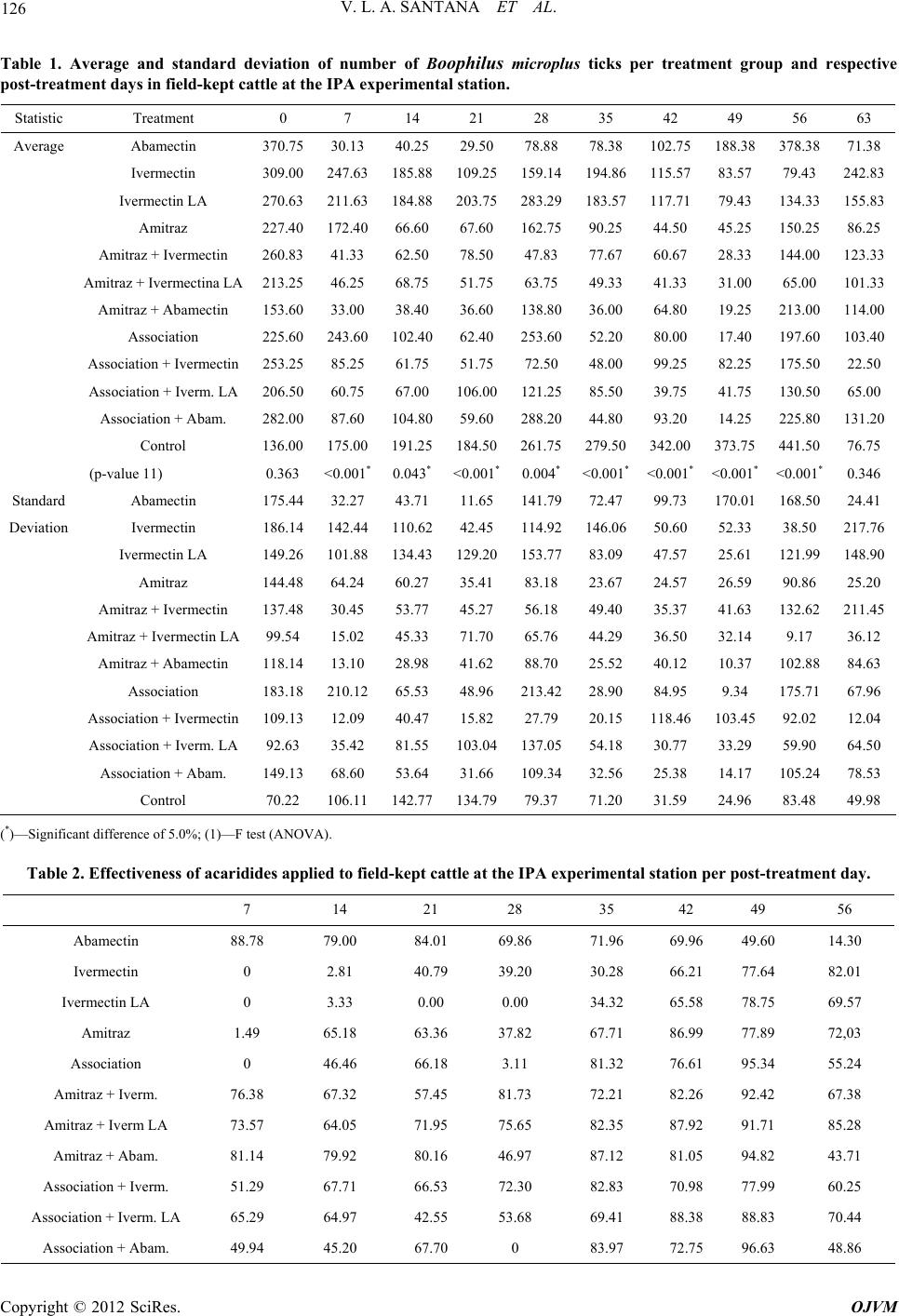 V. L. A. SANTANA ET AL. Copyright © 2012 SciRes. OJVM 126 philus microplus ticks per treatment group and respective station. Table 1. Average and standard deviation of number of Boo post-treatment days in field-kept cattle at the IPA experimental Statistic Treatment 0 7 14 21 28 35 42 49 56 63 Average Abamectin 370.30.78.102.188.378.71.75 13 40.25 29.50 88 78.38 75 38 3838 Ivermectin ermectin LA 309.00 270.63 247. 185. 109. 159. 194. Iv211. 184. 203. 283.155. 150. Am Amitraz + LA 101. 138. 243. 102. Association 288. 131. 191.279. 342. (p <0. <0. Standard Abam Deviation Iectin 186.217. v 129. Am Amitraz ctin LA 210. 213. Association 118.103. Association . LA103.33. 105. 106. 142. 63 63 88 88 25 75 14 29 86 183.57 115.57 83. 117.71 79. 57 43 134. 79.43 242. 33 83 83 Amitraz 227.40 172.4066.60 67.60 162.7590.25 44.50 45.25 2586.25 itraz ectin + Iverm Ivermectina 260.83 213.25 41.33 62. 46.25 68. 50 78. 75 51. 50 75 47.83 77. 63.75 49. 67 60. 33 41. 67 33 28.33 31.00 65. 144.00 00 123.33 33 Amitraz + Abamectin 153.60 33.00 38.40 36.60 8036.00 64.80 19.25 213.00114.00 Association 225.60 253.25 60 85.25 61. 40 75 51. 62.40 75 253.60 72.50 48. 52.20 00 99. 80.00 25 17.40 82.25 197.60 175.50 103.40 22.50 + Ivermectin Association + Iverm. LA Association + Abam. 206.50 60. 282.00 87. 75 60 104. 67.00 106. 80 00 59.60 121.25 20 85.50 44.80 39.75 93.20 41.75 130. 14.25 225. 50 80 65.00 20 Control 136.00 175.0025 184.50 261.755000 373.75 441.5076.75 -value 11) ectin 0.363 175.44 001 32.27 43. *0.043 71 11. *<0.001 65 *0.004 141.79 *<0.001 72.47 99. *<0.001 73 *001 <0. 170.01 *001 168.50 *0.346 24.41 verm14 142.44110.6242.45 114.92146.0650.60 52.33 38.50 76 I ermectin LA Amitraz 149.26 144.48 101.88 64.24 60. 134.43 27 35. 20 41 153.77 83.18 23. 83.09 67 24. 47.57 57 25.61 26.59 90. 121.99 86 25. 148.90 20 itraz ectin + Iverm + Iverme 137.48 99.54 30.45 53. 15.02 45. 77 45. 33 71. 27 70 56.18 49. 65.76 44. 40 35. 29 36. 37 50 41.63 32.14 132.62 9.17 211.45 36.12 Amitraz + Abamectin 118.14 13.10 28.98 41.62 88.70 25.52 40.12 10.37 102.8884.63 Association + Ivermectin 183.18 109.13 12 12.09 40. 65.53 48. 47 15. 96 82 42 27.79 20. 28.90 84. 15 95 46 9.34 175. 45 71 92.02 12. 67.96 04 + Iverm92.63 35.42 81.55 04137.0554.18 30.77 29 59.90 64.50 Association + Abam. Control 149.13 70.22 68.60 53. 11 64 31. 77 66 134.79 109.34 79.37 71. 32.56 25. 20 31. 38 59 14.17 24.96 83. 24 48 49. 78.53 98 (*)—Snificant differen; (1)—F tesA to field-kept cattle at the IPA experimental station per post-treatment day. igce of 5.0%t (ANOV). Table 2. Effectiveness of acaridides applied 7 14 21 28 35 42 49 56 Abamectin 8 7 8 6 7 6 4 1 8.789.004.019.861.969.969.604.30 Ivermectin 0 2.81 40.79 39.20 30.28 66.21 77.64 82.01 Iv 65. 37. Association 0 Am. 76.81. Am Association + I. Association + I Association + Abam. 49.94 45.20 67.70 0 83.97 72.75 96.63 48.86 ermectin LA 0 3.33 0.00 0.00 34.32 65.58 78.75 69.57 Amitraz 1.49 18 63.36 82 67.71 86.99 77.89 72,03 46.46 66.18 3.11 81.32 76.61 95.34 55.24 itraz + Iverm38 67.32 57.45 73 72.21 82.26 92.42 67.38 itraz + Iverm LA 73.57 64.05 71.95 75.65 82.35 87.92 91.71 85.28 Amitraz + Abam. 81.14 79.92 80.16 46.97 87.12 81.05 94.82 43.71 verm51.29 67.71 66.53 72.30 82.83 70.98 77.99 60.25 verm. LA65.29 64.97 42.55 53.68 69.41 88.38 88.83 70.44  V. L. A. SANTANA ET AL. 127 withciatio anophus/pyr throidproduce the goolts as e ots contbamectin and re also demonstrated hi s infesting th esults were achieved ag tronella, a greater reduction effect in infestations was obtaIt can rmethistocidbits long-term effectiveness anoulded irol projectng contionalcidings. Toma et is amidine can be used if tick control is im 4. d production costs related to ticks infesta- REFERENCES f Cattle Ticks (Boophilus mi- tment of Cattle on the Structure of Dung Beetle Communities,” Agriculture Ecosystems an5, No. 4, 2005, pp. 649-656. co, the chemical asson orgosphore- /citronel failed to her two treatment e sam aining a d resu th - quired further treatment on Day +28. The good performance of abamectin corroborates the results of Bridi et al. [10], who, in comparing the appli- cation of abamectin with ivermectin, gher degrees of effectiveness with abamectin, which performed better than ivermectin, as in the present study. Comparing the action of four endectocides on Boophilus microplus infestations, Alves-Branco et al. [11] found considerable degrees of effectiveness with abamectin of 74.30% by the 35th day, obtaining the highest rate on Day +21. However, these authors obtained a “knock down” effect on Day 4, with a rate of 85.80%, superior to the other endectocides tested. Thus, abamectin can be rec- ommended for the control of the Boophilus microplus in naturally infected cattle during periods of intense para- sitic infestation, allowing animal handlers to obtain ade- quate levels of protection for their animals. Ivermectin only exhibited a certain level of effective- ness on Day +21 (40.79%), which was not sufficient for a significant reduction in the number of tick e animals and a further application of this endectocide was required on Day +28. However, in the individual analysis of the animals from this group, a satisfactory degree of effectiveness was observed in two animals (78.98% and 96.17%) on Day +28. The indices found in the present study for ivermectin differ from those found by Marques et al. [12], who obtained 100% effectiveness on Day +8. In associating ivermectin with conventional acaricides, better effectiveness of the treatments was evidenced. The data presented here may reveal the de- velopment of resistance to this endectocide in the Boophi- lus microplus sample. Confirmative “in vitro” tests are necessary to determine this. The resistance of this ixodi- dae to ivermectin has been described by Martins & Fur- long [13] and Sabatini et al. [14]. Bovines medicated with ivermectin LA also exhibited wide variation in effectiveness, requiring repetition of treatment on Day +28, as no effective r ainst Boophilus microplus. The degree of effectiveness from Day +7 to Day +42 was less than 70%, thereby dif- fering from results found by Silva and Marra [15] in the state of Minas Gerais, who obtained levels above 90% on post-treatment Days 7, 14 and 21. In the city of Candiota, RS, Alves-Branco et al. [16] obtained an 86.18% degree of effectiveness on Day +4, with a therapeutic average of 94.8% from Day +7 to Day +28. Carvalho et al. [17], however, obtained lower tick counts from Day +14 to Day +84 using this product. When ivermectin LA was associated to acaricide baths with amitraz or the synthetic chemical association organophosphorus/pyrethroid/ci- al. [18] suggest a strategic spraying program with the application of endectocides on properties with a high degree of infestation. The authors also state that the tick control program should be adapted to each case, increas- Emb ined. be affid that endece exhi d sh acari be us e spray n cont s usiven ing the intervals between treatments as the parasitic load diminishes. It is important to verify the results with the use of ami- traz, as there was a significant reduction of the number of ticks on Day +7 and the treatment became more effective as the study elapsed, especially when associated with the endectocides. Post-treatment effectiveness ranged from 0% to 93.85% in the different animals. The treatment revealed that th plemented adequately, thereby prolonging the effec- tive life of this acaricide. The association group only produced satisfactory re- sults after a second application of the treatment on Day +28. A reduction in infestation was observed on Day +35, with degrees of effectiveness above 81.32%. This treat- ment had a better performance when associated with en- dectocides. Conclusion The analysis of the results from the present study de- monstrates that the use of different avermectines can assist in the development of Boophilus microplus control programs, thereby reducing the number of acaricide ap- plications an tions. 5. Acknowledgements We are thankful to Institute of Research in Animal and Plant of Pernambuco, Brazil, for providing the study fa- cilities to complete this research. [1] N. N. Jonsson, “Control o croplus) on Queensland Dairy Farms,” Australian Ve- terinary Journal, Vol. 75, No. 11, 1997, pp. 802-807. [2] U. Kryger, C. Deschodt and C. H. Sholtz, “Effects of Fluazuron and Ivermectin Trea d Environment, Vol. 10 [3] J. Furlong, “Control of the Tick of Bovine from Southeast Brazil,” In: T. P. Charles and J. Furlong, Eds., Doenças Parasitárias dos Bovinos de Leite, Coronel Pache rapa, Cnpgl, 1992, 134 p. [4] F. de P. J. Alves-Branco, I. F. Correa, M. de F. M. Sapper, et al., “Economic Impact of Health-Fluazuron in Control Copyright © 2012 SciRes. OJVM  V. L. A. SANTANA ET AL. 128 of Boophilus microplus in Beef Cattle from Rio Grande do Sul,” A Hora Veterinária, Vol. 129, No. 22, 2002, pp. ssessment of Tick Num 19-26. [5] R. H. Wharton and R. B. W. Utech, “The Relation be- tween Engorgement and Dropping of Boophilus microplus (Canestrini) (Ixodidade) to the A- bers on Cattle,” Australian Journal of Entomology, Vol. 9, No. 3, 1970, pp. 171-182. doi:10.1111/j.1440-6055.1970.tb00788.x [6] N. K. Amaral, L. F. S. Monmany and L. A. F. Carvalho, “Acaricida AC 84, 63: First Trials for Control of Boophi- s),” Veterinary Parasitology lus microplus,” Journal of Economy Entomology, Vol. 67, No. 3, 1974, pp. 387-389. [7] N. N. Jonsson, A. L. Matschoss, P. Pepper, et al., “Resis- tance of Holtein-Friesian Cows to Infestation by Cattle Tick (Boophilus microplu Vol. 89, No. 4, 2000, pp. 297-305. , doi:10.1016/S0304-4017(00)00213-2 [8] G. P. Oliveira and M. M. Alencar, “The Resistance of the Cattle Tick Boophilus microplus I Artificial Infestation,” Pesquisa Agropecuária Brasileira, Vol. 22, No. 4, 1987 Sociedade Bras a, 2004. rinária, Vol. 1, No. 1, 1992, pp. 35-40. tion and , “Tests to 95, No.1, 2001, pp. , pp. 433-438. [9] R. L. Teodoro, M. L. Martinez, M. V. G. B. Silva, et al., “Resistance to the Cattle Tick Boophilus microplus: The Brazilian Experience,” Simpósio da de Melhoramento Animal, Pirassunung ileira [10] A. A. Bridi, L. A. F. Carvalho, L. G. Cramer, et al., “Efficacy of Abamectin against the Cattle Tick Boophilus microplus Acarina, Ixodidae,” Revista Brasileira de Para- sitologia Vete [11] F. P. J. Alves-branco, “Efficacy of Four Endectocidas on Natural Infestation in Cattle for Boophilus microplus,” A Ho r a Veterinária, Vol. 111, No. 19, 1999, pp. 41-44. [12] A. O. Marques, G. J. Arantes and C. R. Silva, “Evalua of the Efficacy of Ivermectin to 1% (Injectable Solution) in the Treatment of Cattle Naturally Infected for Tick Boophilus microplus (Can., 1887) (Acari: Ixodidae) Kept in Pasture,” Revista Brasileira de Parasitologia Veterinaria, Vol. 4, No. 2, 1995, pp. 117-119. [13] J. R. Martins and J. Furlong, “Avermectin Resistance of Cattle Tick Boophilus microplus in Brazil,” Veterinary Record, Vol. 149, No. 2, 2001, p. 64. [14] G. A. Sabatini, D. H. Kemp, S. Hughes, et al. Determine LC50 and Discrimitation Doses for Macrocyc- lic Lactones against the Cattle Tick, Boophilus micro- plus,” Veterinary Parasitology, Vol. 53-62. doi:10.1016/S0304-4017(00)00406-4 [15] C. R. Silva and A. O. M. Marra, “Activity of the Acari- cide Ranger LA (LA Ivermectin 1%) in the Control of Boophilus microplus in Cattle Naturally Infested,” A Hora Veterinária, Vol. 140, No. 24, 2004, pp. 46-48. roplus in . 18, 1998, pp. 53-58. [16] F. P. de J. Alves-Branco, M. F. M. Sapper and J. C. B. Franco, “Evaluation of the Efficacy of a Formulation of Ivermectin to 1.13% W/V Injectable Front of Natural In- festation of Cattle with Natural Boophilus mic Bage, Rio Grande do Sul,” A Hora Veterinária, Vol. 137, No. 23, 2004, pp. 69-71. [17] L. A. F. Carvalho, I. Bianchin, A. A. BridI, et al., “Con- trol Antiparasitic in Beef Cattle with Long-Acting En- dectocide Compared to Conventional Product,” A Hora Veterinária, Vol. 106, No [18] S. B. Toma, F. A. Marson and H. Lorenzoni, “Current Considerations on the Main Infestation of Dairy Cattle,” A H o ra Veterinária, Vol. 131, No. 22, 2003, pp. 21-25. Copyright © 2012 SciRes. OJVM |