

Paper Menu >>
Journal Menu >>
 American Journal of Analytical Chemistry, 2012, 3, 632-637 http://dx.doi.org/10.4236/ajac.2012.39082 Published Online September 2012 (http://www.SciRP.org/journal/ajac) Simultaneous Determination of Amlodipine with H1-Receptor Antagonists by Reversed Phase High Performance Liquid Chromatography and Application to Interaction Studies Muhammad Saeed Arayne1, Najma Sultana2, Saima Sher Bahadur1, Muhammad Nawaz3* 1Department of Chemistry, University of Karachi, Karachi, Pakistan 2Research Institute of Pharmaceutical Sciences, Department of Pharmaceutical Chemistry, Faculty of Pharmacy, University of Karachi, Karachi, Pakistan 3Department of Chemistry, United Arab Emirates University, Al-Ain, UAE Email: *[email protected] Received May 29, 2012; revised July 12, 2012; accepted July 27, 2012 ABSTRACT A rapid, fast and precise method has been developed and validated for the simultaneous determination of amlodipine with H1-receptor antagonists (cetirizine, fexofenadine, and buclizine) from dosage forms. The chromatography was performed on a Purospher® Star, C18 (5 μm, 250 × 4.6 mm) column using acetonitrile: buffer (0.01 mM) (40:60, v/v, pH adjusted to 3.0), as a mobile phase. The mobile phase was pumped at a flow rate of 1.0 mL·min−1 and UV detection was performed at 240 nm. The method was validated for linearity, accuracy, precision and specificity. The method was ap- plied to study the interaction between amlodipine and H1-receptor antagonists. These interactions were carried out in simulated gastric juice (pH 1), simulated full stomach (pH 4), blood pH (pH 7.4) and simulating GI (pH 9). The inter- acting drugs were heated at 37˚C with intermittent shaking and the samples were withdrawn every thirty minutes for three hours and drug contents were analyzed by RP-HPLC techniques. In most cases the in vitro availability of am- lodipine was decreased. It was observed that the change in in vitro availability was pH dependent. Keywords: Amlodipine; Cetirizine; Fexofenadine; Buclizine; Interactions; Reversed Phase High Performance Liquid Chromatography 1. Introduction Amlodipine (Figure 1) is a 1, 4-dihydropyridine-based calcium antagonist, chemically it is R, S-2 [(2-amino- ethoxy)methyl]-4-(2-chlorophenyl)-ethoxy carbonyl-5-me- thoxycarbonyl-6-ethyl-1,4-dihydro pyridine or 2-[(2-ami- noethoxy)methyl]-4-(2-chlorophenyl)-3-ethoxy cabonyl- 5-methoxycarbonyl-6-methyl-1,4-dihydropyridine. It dif- fers from other members of this group including the trial product nifedipine, by the presence at 2-position of a dihydropyridine ring of a side-chain which carries a basic amino group [1]. According to Burges and his colleagues [2] it is the presence of this side-chain with its basic amino group which is primarily responsible for setting this particular antagonist apart from other chemically similar antagonists. A number of HPLC methods are reported for the de- termination of amlodipine in literature. Some of them quan- titate amlodipine in pharmaceutical formulations [3,4], while the others in human serum [5-11] or in combina- tion with other formulations [12-15]. H1-receptor antagonists are the mainstay of treatment for several allergic disorders, particularly rhinitis, conjunc- tivitis, dermatitis, urticaria and asthma [16,17]. Antihyp- ertensive drugs and H1-receptor antagonists can be co- administered in a number of cases. Numerous HPLC methods were reported for the quantitation of cetirizine dihydrochloride or fexofenadine hydrochloride with pse- udoephedrine in combined pharmaceutical dosage forms [18], a method for cetirizine dihydrochloride and related impurities is also reported [19]. Simultaneous quantifica- tion of cetirizine or levocetirizine with cefpirome was reported by Arayne et al. [20], and buclizine with pyri- doxine and meclizine were reported by Arayne et al. [21]. The objective of our study was to develop a new method for the simultaneous determination of amlodipine with H1-receptor antagonists (cetirizine, fexofenadine hydro- chloride and buclizine hydrochloride) since these drugs are co-prescribed at high frequency. The proposed method *Corresponding author. C opyright © 2012 SciRes. AJAC 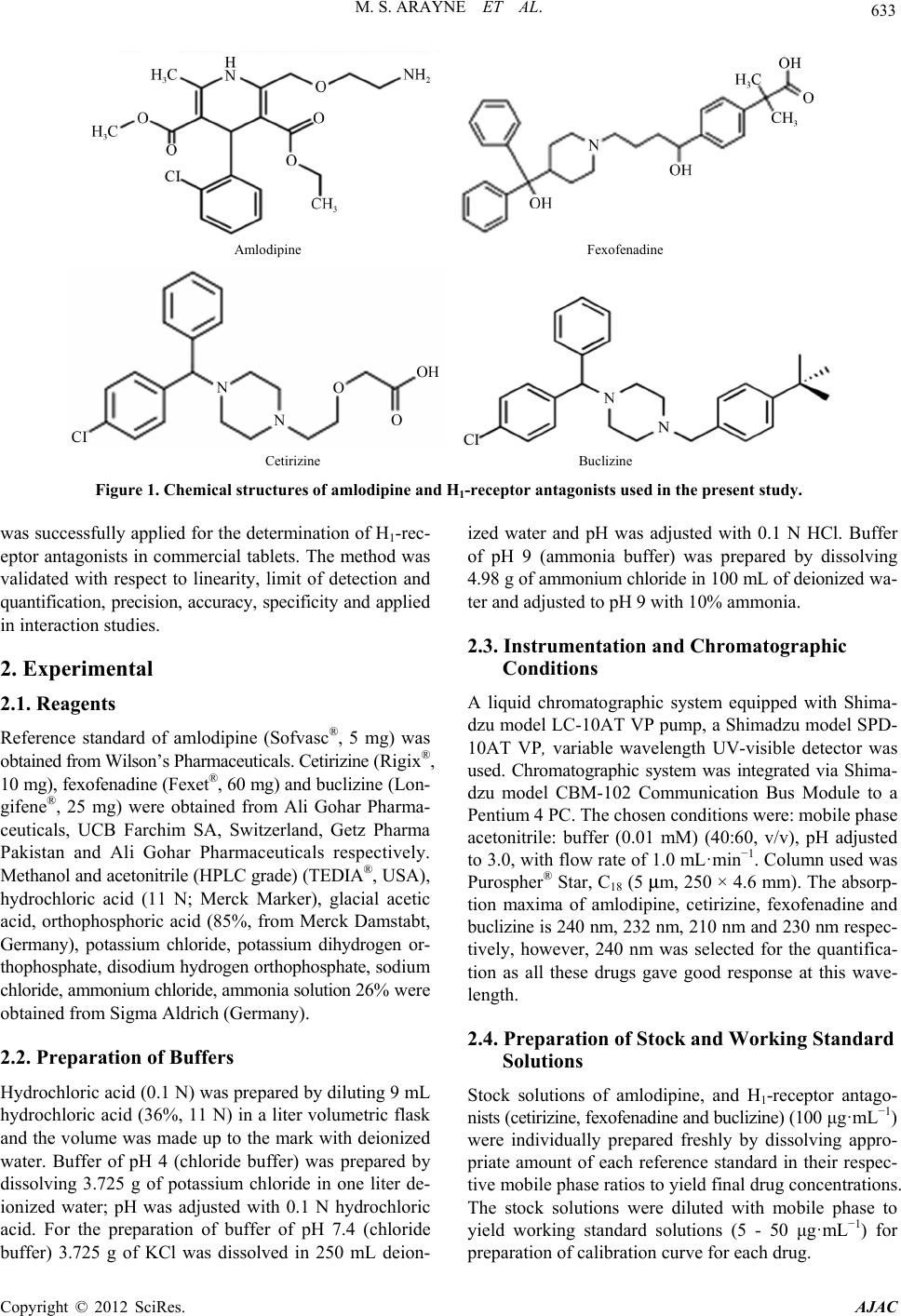 M. S. ARAYNE ET AL. 633 Amlodipine Fexofenadine Cetirizine Buclizine Figure 1. Chemical structures of amlodipine and H1-receptor antagonists used in the present study. was successfully applied for the determination of H1-rec- eptor antagonists in commercial tablets. The method was validated with respect to linearity, limit of detection and quantification, precision, accuracy, specificity and applied in interaction studies. 2. Experimental 2.1. Reagents Reference standard of amlodipine (Sofvasc®, 5 mg) was obtained from Wilson’s Pharmaceuticals. Cetirizine (Rigix®, 10 mg), fexofenadine (Fexet®, 60 mg) and buclizine (Lon- gifene®, 25 mg) were obtained from Ali Gohar Pharma- ceuticals, UCB Farchim SA, Switzerland, Getz Pharma Pakistan and Ali Gohar Pharmaceuticals respectively. Methanol and acetonitrile (HPLC grade) (TEDIA®, USA), hydrochloric acid (11 N; Merck Marker), glacial acetic acid, orthophosphoric acid (85%, from Merck Damstabt, Germany), potassium chloride, potassium dihydrogen or- thophosphate, disodium hydrogen orthophosphate, sodium chloride, ammonium chloride, ammonia solution 26% were obtained from Sigma Aldrich (Germany). 2.2. Preparation of Buffers Hydrochloric acid (0.1 N) was prepared by diluting 9 mL hydrochloric acid (36%, 11 N) in a liter volumetric flask and the volume was made up to the mark with deionized water. Buffer of pH 4 (chloride buffer) was prepared by dissolving 3.725 g of potassium chloride in one liter de- ionized water; pH was adjusted with 0.1 N hydrochloric acid. For the preparation of buffer of pH 7.4 (chloride buffer) 3.725 g of KCl was dissolved in 250 mL deion- ized water and pH was adjusted with 0.1 N HCl. Buffer of pH 9 (ammonia buffer) was prepared by dissolving 4.98 g of ammonium chloride in 100 mL of deionized wa- ter and adjusted to pH 9 with 10% ammonia. 2.3. Instrumentation and Chromatographic Conditions A liquid chromatographic system equipped with Shima- dzu model LC-10AT VP pump, a Shimadzu model SPD- 10AT VP, variable wavelength UV-visible detector was used. Chromatographic system was integrated via Shima- dzu model CBM-102 Communication Bus Module to a Pentium 4 PC. The chosen conditions were: mobile phase acetonitrile: buffer (0.01 mM) (40:60, v/v), pH adjusted to 3.0, with flow rate of 1.0 mL·min−1. Column used was Purospher® Star, C18 (5 μm, 250 × 4.6 mm). The absorp- tion maxima of amlodipine, cetirizine, fexofenadine and buclizine is 240 nm, 232 nm, 210 nm and 230 nm respec- tively, however, 240 nm was selected for the quantifica- tion as all these drugs gave good response at this wave- length. 2.4. Preparation of Stock and Working Standard Solutions Stock solutions of amlodipine, and H1-receptor antago- nists (cetirizine, fexofenadine and buclizine) (100 μg·mL−1) were individually prepared freshly by dissolving appro- priate amount of each reference standard in their respec- tive mobile phase ratios to yield final drug concentrations. The stock solutions were diluted with mobile phase to yield working standard solutions (5 - 50 μg·mL−1) for preparation of calibration curve for each drug. Copyright © 2012 SciRes. AJAC 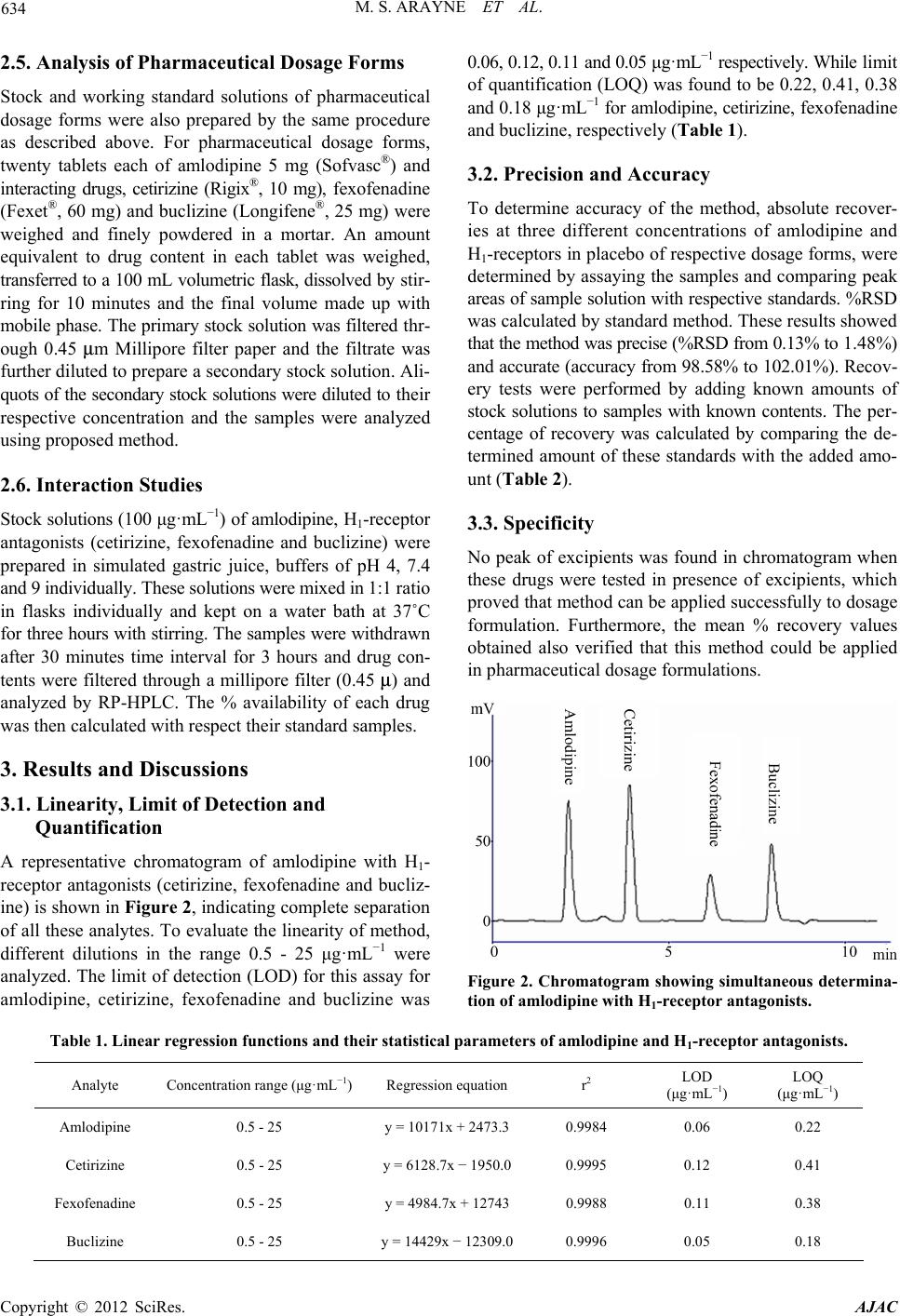 M. S. ARAYNE ET AL. 634 2.5. Analysis of Pharmaceutical Dosage Forms Stock and working standard solutions of pharmaceutical dosage forms were also prepared by the same procedure as described above. For pharmaceutical dosage forms, twenty tablets each of amlodipine 5 mg (Sofvasc®) and interacting drugs, cetirizine (Rigix®, 10 mg), fexofenadine (Fexet®, 60 mg) and buclizine (Longifene®, 25 mg) were weighed and finely powdered in a mortar. An amount equivalent to drug content in each tablet was weighed, transferred to a 100 mL volumetric flask, dissolved by stir- ring for 10 minutes and the final volume made up with mobile phase. The primary stock solution was filtered thr- ough 0.45 μm Millipore filter paper and the filtrate was further diluted to prepare a secondary stock solution. Ali- quots of the secondary stock solutions were diluted to their respective concentration and the samples were analyzed using proposed method. 2.6. Interaction Studies Stock solutions (100 μg·mL−1) of amlodipine, H1-receptor antagonists (cetirizine, fexofenadine and buclizine) were prepared in simulated gastric juice, buffers of pH 4, 7.4 and 9 individually. These solutions were mixed in 1:1 ratio in flasks individually and kept on a water bath at 37˚C for three hours with stirring. The samples were withdrawn after 30 minutes time interval for 3 hours and drug con- tents were filtered through a millipore filter (0.45 μ) and analyzed by RP-HPLC. The % availability of each drug was then calculated with respect their standard samples. 3. Results and Discussions 3.1. Linearity, Limit of Detection and Quantification A representative chromatogram of amlodipine with H1- receptor antagonists (cetirizine, fexofenadine and bucliz- ine) is shown in Figure 2, indicating complete separation of all these analytes. To evaluate the linearity of method, different dilutions in the range 0.5 - 25 μg·mL−1 were analyzed. The limit of detection (LOD) for this assay for amlodipine, cetirizine, fexofenadine and buclizine was 0.06, 0.12, 0.11 and 0.05 μg·mL−1 respectively. While limit of quantification (LOQ) was found to be 0.22, 0.41, 0.38 and 0.18 μg·mL−1 for amlodipine, cetirizine, fexofenadine and buclizine, respectively (Table 1). 3.2. Precision and Accuracy To determine accuracy of the method, absolute recover- ies at three different concentrations of amlodipine and H1-receptors in placebo of respective dosage forms, were determined by assaying the samples and comparing peak areas of sample solution with respective standards. %RSD was calculated by standard method. These results showed that the method was precise (%RSD from 0.13% to 1.48%) and accurate (accuracy from 98.58% to 102.01%). Recov- ery tests were performed by adding known amounts of stock solutions to samples with known contents. The per- centage of recovery was calculated by comparing the de- termined amount of these standards with the added amo- unt (Table 2). 3.3. Specificity No peak of excipients was found in chromatogram when these drugs were tested in presence of excipients, which proved that method can be applied successfully to dosage formulation. Furthermore, the mean % recovery values obtained also verified that this method could be applied in pharmaceutical dosage formulations. Figure 2. Chromatogram showing simultaneous determina- tion of amlodipine with H1-receptor antagonists. Table 1. Linear regression functions and their statistical parameters of amlodipine and H1-receptor antagonists. Analyte Concentration range (μg·mL−1) Regression equation r2 LOD (μg·mL−1) LOQ (μg·mL−1) Amlodipine 0.5 - 25 y = 10171x + 2473.3 0.9984 0.06 0.22 Cetirizine 0.5 - 25 y = 6128.7x − 1950.0 0.9995 0.12 0.41 Fexofenadine 0.5 - 25 y = 4984.7x + 12743 0.9988 0.11 0.38 Buclizine 0.5 - 25 y = 14429x − 12309.0 0.9996 0.05 0.18 Copyright © 2012 SciRes. AJAC 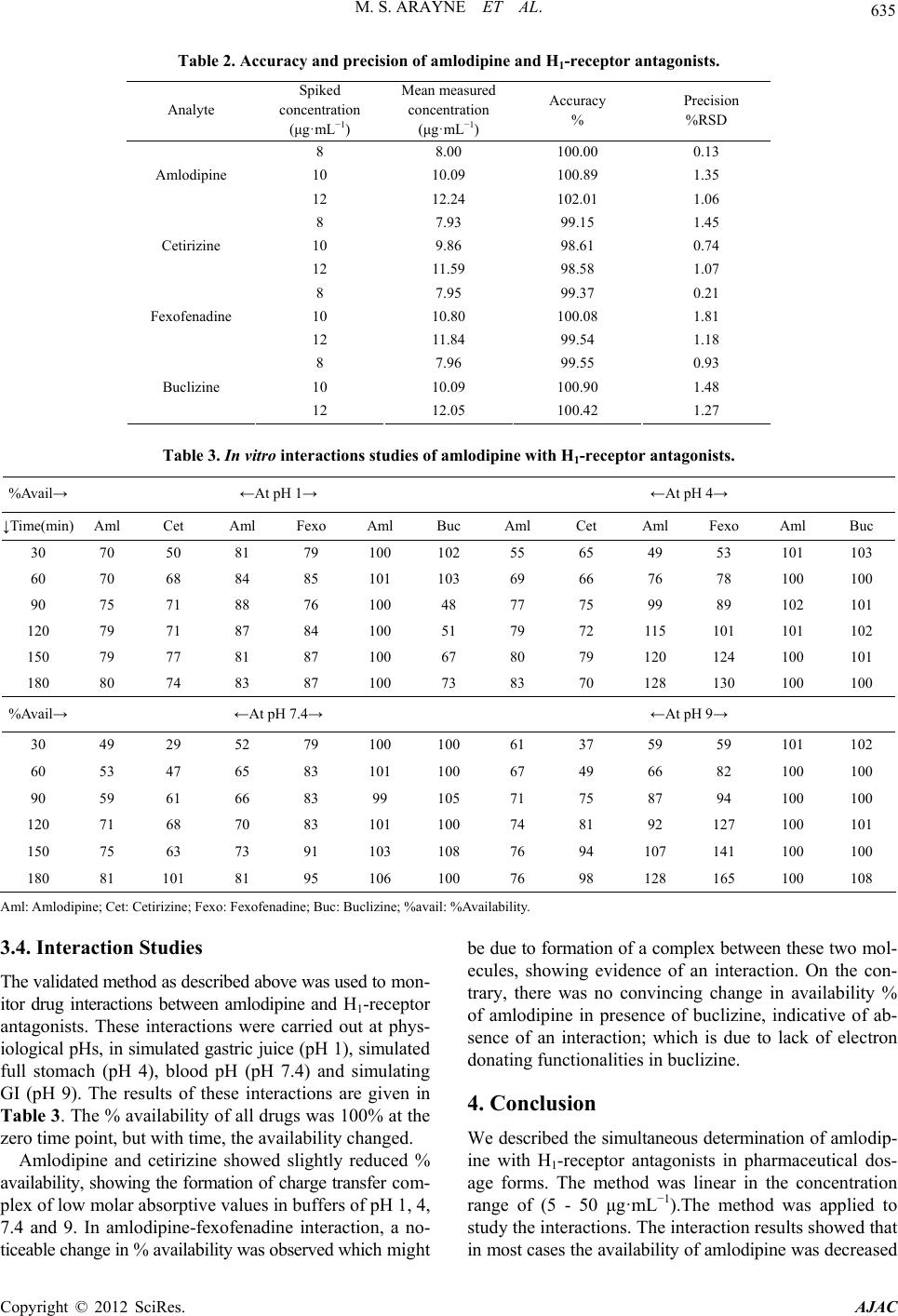 M. S. ARAYNE ET AL. 635 Table 2. Accuracy and precision of amlodipine and H1-receptor antagonists. Analyte Spiked concentration (μg·mL−1) Mean measured concentration (μg·mL−1) Accuracy % Precision %RSD 8 8.00 100.00 0.13 10 10.09 100.89 1.35 Amlodipine 12 12.24 102.01 1.06 8 7.93 99.15 1.45 10 9.86 98.61 0.74 Cetirizine 12 11.59 98.58 1.07 8 7.95 99.37 0.21 10 10.80 100.08 1.81 Fexofenadine 12 11.84 99.54 1.18 8 7.96 99.55 0.93 10 10.09 100.90 1.48 Buclizine 12 12.05 100.42 1.27 Table 3. In vitro interactions studies of amlodipine with H1-receptor antagonists. %Avail→ ←At pH 1→ ←At pH 4→ ↓Time(min) Aml Cet Aml Fexo Aml Buc Aml Cet Aml Fexo Aml Buc 30 70 50 81 79 100 102 55 65 49 53 101 103 60 70 68 84 85 101 103 69 66 76 78 100 100 90 75 71 88 76 100 48 77 75 99 89 102 101 120 79 71 87 84 100 51 79 72 115 101 101 102 150 79 77 81 87 100 67 80 79 120 124 100 101 180 80 74 83 87 100 73 83 70 128 130 100 100 %Avail→ ←At pH 7.4→ ←At pH 9→ 30 49 29 52 79 100 100 61 37 59 59 101 102 60 53 47 65 83 101 100 67 49 66 82 100 100 90 59 61 66 83 99 105 71 75 87 94 100 100 120 71 68 70 83 101 100 74 81 92 127 100 101 150 75 63 73 91 103 108 76 94 107 141 100 100 180 81 101 81 95 106 100 76 98 128 165 100 108 Aml: Amlodipine; Cet: Cetirizine; Fexo: Fexofenadine; Buc: Buclizine; %avail: %Availability. 3.4. Interaction Studies The validated method as described above was used to mon- itor drug interactions between amlodipine and H1-receptor antagonists. These interactions were carried out at phys- iological pHs, in simulated gastric juice (pH 1), simulated full stomach (pH 4), blood pH (pH 7.4) and simulating GI (pH 9). The results of these interactions are given in Table 3. The % availability of all drugs was 100% at the zero time point, but with time, the availability changed. Amlodipine and cetirizine showed slightly reduced % availability, showing the formation of charge transfer com- plex of low molar absorptive values in buffers of pH 1, 4, 7.4 and 9. In amlodipine-fexofenadine interaction, a no- ticeable change in % availability was observed which might be due to formation of a complex between these two mol- ecules, showing evidence of an interaction. On the con- trary, there was no convincing change in availability % of amlodipine in presence of buclizine, indicative of ab- sence of an interaction; which is due to lack of electron donating functionalities in buclizine. 4. Conclusion We described the simultaneous determination of amlodip- ine with H1-receptor antagonists in pharmaceutical dos- age forms. The method was linear in the concentration range of (5 - 50 μg·mL−1).The method was applied to study the interactions. The interaction results showed that in most cases the availability of amlodipine was decreased Copyright © 2012 SciRes. AJAC  M. S. ARAYNE ET AL. 636 in the presence of H1-receptor antagonists. This suggested that for coadministration of amlodipine with H1-receptor antagonists, a proper interval should be given to avoid such interactions. REFERENCES [1] R. A. Burges and M. G. Dodd, “Amlodipine,” Cardio- vascular Drug Reviews, Vol. 8, No. 1, 1990, pp. 25-44. doi:10.1111/j.1527-3466.1990.tb00427.x [2] R. A. Burges, M. G. Dodd and D. G. Gardiner, “Pharma- cologic Profile of Amlodipine,” American Journal of Cardiology, Vol. 64, No. 17, 1989, pp. 101-201. doi:10.1016/0002-9149(89)90956-9 [3] K. Basavaiah, U. Chandrashekar, H. C. Prameela and P. Nagegowda, “Spectrophotometric and High Performance Liquid Chromatographic Determination of Amlodipine Besylate in Pharmaceuticals,” Science Asia, Vol. 31, No. 1, 2005, pp. 13-21. doi:10.2306/scienceasia1513-1874.2005.31.013 [4] K. Kamat and S. C. Chaturved, “Stability Indicating As- say Method for Amlodipine Tablets,” Indian Journal of Pharmaceutical Sciences, Vol. 67, No. 2, 2005, pp. 236- 239. [5] K. Shimooka, Y. Sawada and H. Tatematsu, “Analysis of Amlodipine in Serum by a Sensitive High Performance Liquid Chromatographic Method with Amperometric Detection,” Journal of Pharmaceutical and Biomedical Analysis, Vol. 7, No. 11, 1989, pp. 1267-1272. doi:10.1016/0731-7085(89)80130-X [6] P. K. F. Yeung, S. J. Mosher and P. T. Pollak, “Liquid Chromatography Assay for Amlodipine: Chemical Stabil- ity and Pharmacokinetics in Rabbits,” Journal of Phar- maceutical and Biomedical Analysis, Vol. 9, No. 7, 1991, pp. 565-571. doi:10.1016/0731-7085(91)80178-C [7] M. Josefsson and B. Norlander, “Coupled-Column Chro- matography on a Chiral-AGP Phase for Determination of Amlodipine Enantiomers in Human Plasma: An HPLC Assay with Electrochemical Detection,” Journal of Phar- maceutical and Biomedical Analysis, Vol. 15, No. 2, 1996, pp. 267-277. doi:10.1016/0731-7085(96)01836-5 [8] S. Tatar and S. Atmaca, “Determination of Amlodipine in Human Plasma by High-Performance Liquid Chromatog- raphy with Fluorescence Detection,” Journal of Chroma- tography B: Biomedical Sciences and Applications, Vol. 758, No. 2, 2001, pp. 305-310. doi:10.1016/S0378-4347(01)00197-9 [9] G. Bahrami and S. Mirzaeei, “Simple and Rapid HPLC Method for Determination of Amlodipine in Human Se- rum with Fluorescence Detection and Its Use in Pharma- cokinetic Studies,” Journal of Pharmaceutical and Bio- medical Analysis, Vol. 36, No. 1, 2004, pp. 163-168. doi:10.1016/j.jpba.2004.05.016 [10] M. Josefsson, A. Zackrisson and B. Norlander, “Sensitive High-Performance Liquid Chromatographic Analysis of Amlodipine in Human Plasma with Amperometric Detec- tion and a Single-Step Solid-Phase Sample Preparation,” Journal of Chromatography B: Biomedical Sciences and Applications, Vol. 672, No. 2, 1995, pp. 310-313. doi:10.1016/0378-4347(95)00231-7 [11] A. Zarghi, S. M. Foroutan, A. Shafaati and A. Khoddam, “Validated HPLC Method for Determination of Am- lodipine in Human Plasma and Its Application to Phar- macokinetic Studies,” II Farmaco, Vol. 60, No. 9, 2005, pp. 789-792. doi:10.1016/j.farmac.2005.06.012 [12] S. Aryal and N. Skalko-Basnet, “Stability of Amlodipine Besylate and Atenolol in Multi-Component Tablets of Mono-Layer and Bi-Layer Types,” Acta Pharmaceutica, Vol. 58, No. 3, 2008, pp. 299-308. doi:10.2478/v10007-008-0012-5 [13] C. B. Ganeshbhai, N. M. Patel and P. B. Shah, “Stability Indicating RP-HPLC Method for Simultaneous Determi- nation of Atorvastatin and Amlodipine from Their Com- bination Drug Products,” Chemical and Pharmaceutical Bulletin, Vol. 55, No. 2, 2007, pp. 241-246. doi:10.1248/cpb.55.241 [14] R. K. Rajeshwari, G. G. Sankar, A. L. Rao and J. V. L. N. Seshagirirrao, “RP-HPLC Method for the Simultaneous Determination of Atorvastatin and Amlodipine in Tablet Dosage Form,” Indian Journal of Pharmaceutical Sci- ences, Vol. 68, No. 2, 2006, pp. 275-277. doi:10.4103/0250-474X.25738 [15] K. R. Naidu, U. N. Kale and M. S. Shingare, “Stability Indicating RP-HPLC Method for Simultaneous Determi- nation of Amlodipine and Benazepril Hydrochloride from Their Combination Drug Product,” Journal of Pharma- ceutical and Biomedical Analysis, Vol. 39, No. 1-2, 2004, pp. 147-55. doi:10.1016/j.jpba.2005.04.001 [16] C. Chen, E. Hanson, J. W. Watson and J. S. Lee, “P-Glycoprotein Limits the Brain Penetration of Nonse- dating but Not Sedating H1-Antagonists,” Drug Metabo- lism and Disposition, Vol. 31, No. 3, 2003, pp. 312-318. doi:10.1124/dmd.31.3.312 [17] W. T. Stauber, S. H. Ong and R. S. McCuskey, “Selective Extravascular Escape of Albumin into the Cerebral Cor- tex of the Diabetic Rat,” Diabetes, Vol. 30, No. 6, 1981, pp. 500-503. doi:10.2337/diabetes.30.6.500 [18] S. Karakuş, I. Kuçukgüzel and S. G. Kuçukgüzel, “De- velopment and Validation of a Rapid RP-HPLC Method for the Determination of Cetirizine or Fexofenadine with Pseudoephedrine in Binary Pharmaceutical Dosage Forms,” Journal of Pharmaceutical and Biomedical Analysis, Vol. 46, No. 2, 2008, pp. 295-302. doi:10.1016/j.jpba.2007.10.018 [19] A. M. Y. Jaber, H. A. Al Sherife, M. M. Al Omari and A. A. Badwan, “Determination of Cetirizine Dihydrochlo- ride, Related Impurities and Preservatives in Oral Solu- tion and Tablet Dosage Forms Using HPLC,” Journal of Pharmaceutical and Biomedical Analysis, Vol. 36, No. 2, 2004, pp. 341-50. doi:10.1016/j.jpba.2004.07.002 [20] M. S. Arayne, N. Sultana and M. Nawaz, “Simultaneous Quantitation of Cefpirome and Cetirizine or Levocetiriz- ine in Pharmaceutical Formulations and Human Plasma by RP-HPLC,” Journal of Analytical Chemistry, Vol. 63, No. 9, 2008, pp. 881-887. doi:10.1134/S1061934808090153 [21] M. S. Arayne, N. Sultana and F. A. Siddiqui, “Simulta- neous Determination of Pyridoxine, Meclizine and Bu- Copyright © 2012 SciRes. AJAC  M. S. ARAYNE ET AL. Copyright © 2012 SciRes. AJAC 637 clizine in Dosage Formulations and Human Serum by RP-LC,” Chromatographia, Vol. 67, No. 11-12, 2008, pp. 941-945. doi:10.1365/s10337-008-0615-5 |