

Paper Menu >>
Journal Menu >>
 Vol.2, No.7, 760-763 (2010) Natural Science http://dx.doi.org/10.4236/ns.2010.27095 Copyright © 2010 SciRes. OPEN ACCESS Multidimensional electrostatic energy and classical renormalization Sami M. AL-Jaber College of Applied Sciences, Palestine Technical University-Kadoorie, Tulkarm, Palestine; Permanent Address: Department of Physics, An-Najah National University, Nablus, Palestine; [email protected] Received 8 April 2010; revised 20 May 2010; accepted 26 May 2010. ABSTRACT Recent interest in problems in higher space di- mensions is becoming increasingly important and attracted the attention of many investiga- tors in variety of fields in physics. In this paper, the electrostatic energy of two geometries (a charged spherical shell and a non-conducting sphere) is calculated in higher space dimension, N. It is shown that as the space dimension in- creases, up to N = 9, the electrostatic energy of the two geometries decreases and beyond N = 9 it increases. Furthermore, we discuss a simple example which illustrates classical renormali- zation in electrostatics in higher dimensions. Keywords: Electrostatic Energy; Higher Dimensions; Renormalization 1. INTRODUCTION The space dimension N plays an important role in studying many physical problems. It has been used for the radial wave functions of the hydrogen like atoms in N dimensions [1,2]. Exactly solvable models have also been investigated [3,4]. In addition, a great deal of recent work in field theory [5], high energy physics [6], and in cosmology [7] has been conducted. Furthermore, prob- lems of mathematical interest have been investigated in higher dimensions [8,9]. One of the fundamental quanti- ties in physics is the electrostatic energy which is cur- rently investigated by many workers in various areas [10-12]. Therefore, the present author is motivated to consider the effect of space dimension on the electro- static energy of two simple, but illustrative, systems. A connected technique to electrostatic energy is the renor- malization in classical field theory. Renormalization is needed to eliminate divergences which appear in the computation of Feyman graphs so that sensible physical results can be achieved [13-15]. Just recently, Corbò [16] considered renormalization technique in classical fields and Tort [17] discussed renormalization of electrostatic energy. So in the present paper, we will consider an ex- ample of classical renormalization of electrostatic energy in higher space dimensions. The organization of the pre- sent paper is as follows: In Section 2, we consider elec- trostatic energy in a hyper spherical shell. In Section 3, we calculate the electrostatic energy of a non conducting hyper sphere. In Section 4, we present an example of renormalization of electrostatic energy in higher space dimensions. Section 5 is devoted for conclusions. 2. ELECTROSTATIC ENERGY OF A HYPER SPHERICAL SHELL We consider a charged hyper spherical shell of radius R and charge Q in N-dimensional space. Our purpose is to calculate the electrostatic energy of the shell by two methods. In the first method, we calculate the work done to bring the charge Q infinitesimally from infinity to the surface of the shell, while in the second method, we evaluate the volume integral over the squared of the electric filed, E . The two methods require the electric field and the electric potential in space. Gauss’s Law in N-dimensions is 1 0 Nenc q EdAEr d (1) The angular surface integral gives [18], /2 2 (/2) N dN , (2) where () x is the Gamma function. Since the charge is distributed on the surface, the above two equations yield /2 1 0 (/2) 2NN QN Er , rR (3) and 0E for rR . The electric potential is given by  S. M. AL-Jaber / Natural Science 2 (2010) 760-763 Copyright © 2010 SciRes. OPEN ACCESS 761 761 /2 2 0 (/2) , 2( 2) r NN QN VEdr rR Nr (4) The first method yields the electrostatic energy, W as 2 /2 2 0 1(/2)1 24(2) NN QN WVdA NR , (5) Which can be written as 2 2 0 , 2( 2) N Q WSN R (6) where is the surface charge density and S is the sur- face area of a unit shell as given in Eq.2. The second method enables us to write R N NN drdr r QN dEW 1 22 2 2 2/ 0 2 02 )2/( 2 1 2 1 22/ 0 21 )2(4 )2/( NN RN NQ , (7) Which is the same result given in Eq.5. It is interest- ing to note that our result yields the well-known result [19] for the three-dimensional case (N = 3), namely R Q W 0 2 8 . It is noticed that the electrostatic energy of the hyper shell depends on the space dimension N. It is illustrative to calculate the electrostatic energy (shell W), with R = 1, for different values of N. This is calculated in units of 0 28/ Q and is shown in the second column of Table 1. Our calculated results clearly show that the electrostatic energy has a minimum at the space dimen- sion N = 9. This can be explained as follows: In higher space dimensions, there are more orientations in space and thus more angles (N-1). This implies that it is rela- tively easy to assemble electric charges on the hyper surface of the shell which explains the decrease in the electrostatic energy as the space dimension increases up to N = 9. However, beyond this value of N, the surface area of the shell becomes smaller and smaller so that the decrease in the surface area, as N increases, dominates over the increase in the angular orientation. In mathe- matical terms, the surface area times (N-2) has a maxi- mum at N = 9 and thus the electrostatic energy has a minimum at that value of N. It is tempting to investigate the behavior of the electrostatic energy for very large N. This can be checked by using Stirling’s formula [20] nn ennnn 2 !)1( , (8) and letting 2/)2( Nn, one finds for very large N 2/)3( 2/)2( 0 2 )2( 2 1 4 N N shell N e Q W . (9) In the infinite dimensional space, the above equation gives an infinite electrostatic energy in the limit as N. In this limiting case the surface area of the shell vanishes as can be seen from Eq.2 and the use of Stirling’s formula. Therefore, the shell behaves like a point charge in the infinite dimensional space and thus one expects the divergence of the electrostatic energy as an infinite self energy of a point particle. 3. ELECTROSTATIC ENERGY OF A CHARGED NON-CONDUCTING HPER SPHERE Our main purpose here is to calculate the electrostatic energy of a uniformly charged non-conduction sphere in N-dimensional space. Following the second method of Section 2, we calculate the electric field inside and out- side the sphere. The application of Gauss’s Law given in Eq.1 gives , ˆ ˆ 1 2 )2/( 1 2/ 0Rrr R r Rrr r NQ E N N N (10) where Q is the charge in the sphere. The electrostatic energy of the hyper sphere is thus . 2 )2/( 2 1 2 1 0 2 1 22 1 2 2/ 0 0 2 0 ddr R r dr r rNQ dEW R R N N N N N sphere The integrals in the curly bracket yield 22 1 )4( 2 N RN N and the integral over Ω is given by Eq.2, Therefore, the electrostatic energy is simplified to , )4(2 )2/( 222/ 0 2 NR NQN WNN sphere (11) which can be written as , )4( 22 0 2 N sphere RNV Q W (12) where ))2/(/2(2/ NNV N is the volume of the unit sphere in the N-dimensional space [18]. Clearly, the above electrostatic energy depends on the space dimension N, and it yields the well-known result [19] for N = 3, namely . 5 3 4 1 )3( 2 0R Q NWsphere It is again constructive to calculate the electrostatic energy, in units of 0 24/ Q, with R = 1 for different values of N. This is shown in the last column of Table 1. As before, the electrostatic energy has a minimum at the  S. M. AL-Jaber / Natural Science 2 (2010) 760-763 Copyright © 2010 SciRes. OPEN ACCESS 762 space dimension N = 9. But here, the volume of the hy- per sphere time (N2−4) has a maximum at N = 9 and hence the electrostatic energy has a minimum at that value. As it was checked in the previous section, the electrostatic energy becomes infinite in the infinite di- mensional space (N). In this limiting case the volume of the hyper sphere vanishes and thus the sphere behaves as a point charge with an infinite self energy. 4. RENORMALIZATION OF ELECTRO- STATIC ENERGY Renormalization, as is widely believed, is required in quantum field theory [21-23]. The main task of renor- malization is to handle and eliminate the divergences so that one can obtain sensible physical results. Recently, it has been reported that renormalization can be applied to classical fields: For example, Corbò [16] gave two ex- amples for renormalization of electrostatic potential and Tort [17] presented an example for renormalization of electrostatic energy. Our purpose here is to generalize Tort's example to higher space dimension N. Beside its mathematical interest, we will show that the divergence (or so-called singularity) of the electrostatic energy per- sists in the infinite dimensional space. Following Tort’s model for the classical atom, we consider a point electric charge of magnitude Ze, where Z is the atomic number and e is the electron charge, surrounded by a concentric thin hyper-spherical shell of radius R and electric charge equal to −Ze. Ionization (partial or total) of this atom amounts to the removal of part of or the entire negative charge from the shell. This can be achieved by letting )1( ZeZe , where ]1,0[ . We will show be- low that the renormalization of the electrostatic energy (U) in N dimensions is given by 22/ 0 2 )2(4 )2/()( NN initialfinal RN NZe UUU (13) The electric field inside the shell is only due to the point charge, since there is no contribution comes from the shell. Thus, the application of Gauss’s Law, given in Eq.1, yields Rrr r NZe ENN 0 , ˆ 2 )2/( 12/ 0 (14) and 0E for R r . The initial electrostatic energy before ionization can be calculated as 1 )2(4 )2/( 1 2 )2/( 2 1 2 1 0 22/ 0 22 1 0 22 2 2/ 0 2 0 R NN N R NN N initial rN NeZ drdr r NZe rdEU (15) Obviously, the function )/(1 1N r diverges at the origin and thus we have a singular point at 0r. As Tort suggested, we can avoid this problem by introducing a finite non-null radius for the point charge and thus . 11 )2(4 )2/( 222/ 0 22 NNN initial RN NeZ U (16) Now, when the atom is ionized part of the charge )( Ze of the shell will move to infinity and thus the enclosed charge within a hyper-spherical Gaussian sur- face of radius R r . Will be .)1( ZeZeZeq It is clear that the electric field, for R r , remains the same as before ionization (see Eq.14) and for R r Gauss’s Law immediately gives Rrr r NZe ENN . ˆ 2 )2/( 12/ 0 (17) Therefore the final electrostatic energy becomes drdr r NZe RN NeZ U R N NN NNN final 1 2 12/ 0 0 222/ 0 22 2 )2/( 2 11 )2(4 )2/( (18) The first term is just initial U and the integral in the sec- ond term has the same form as that of Eq.7 and thus, one gets )2(2/ 0 21 )2(4 )2/()( NN initialfinal RN NZe UU (19) Therefore, the change in the electrostatic energy is , 1 )2(4 )2/()( 22/ 0 2 NN initialfinalRN NZe UUU (20) which is exactly the same as the electrostatic energy of a hyper-spherical shell that we found in Section 2. It is no- ticed that the variation of electrostatic energy is finite for all values of space dimension N, except for N where U becomes infinite. Therefore, the renormali- zation of the electrostatic energy works out for all space dimensions but failed in the infinite dimensional space. The persistent of the singularity in the infinite dimensional space is a result of the infinite electrostatic energy of the hyper-shell in that space, as we outlined in Section 2. 5. CONCLUSIONS We have obtained the electrostatic energy of two sys- tems (a charged spherical shell and a charged non- conducting sphere) in the N-dimensional space. Our calculated results show that the electrostatic energy decreases as the space dimension increases up to 9 N and it increases without limit beyond that 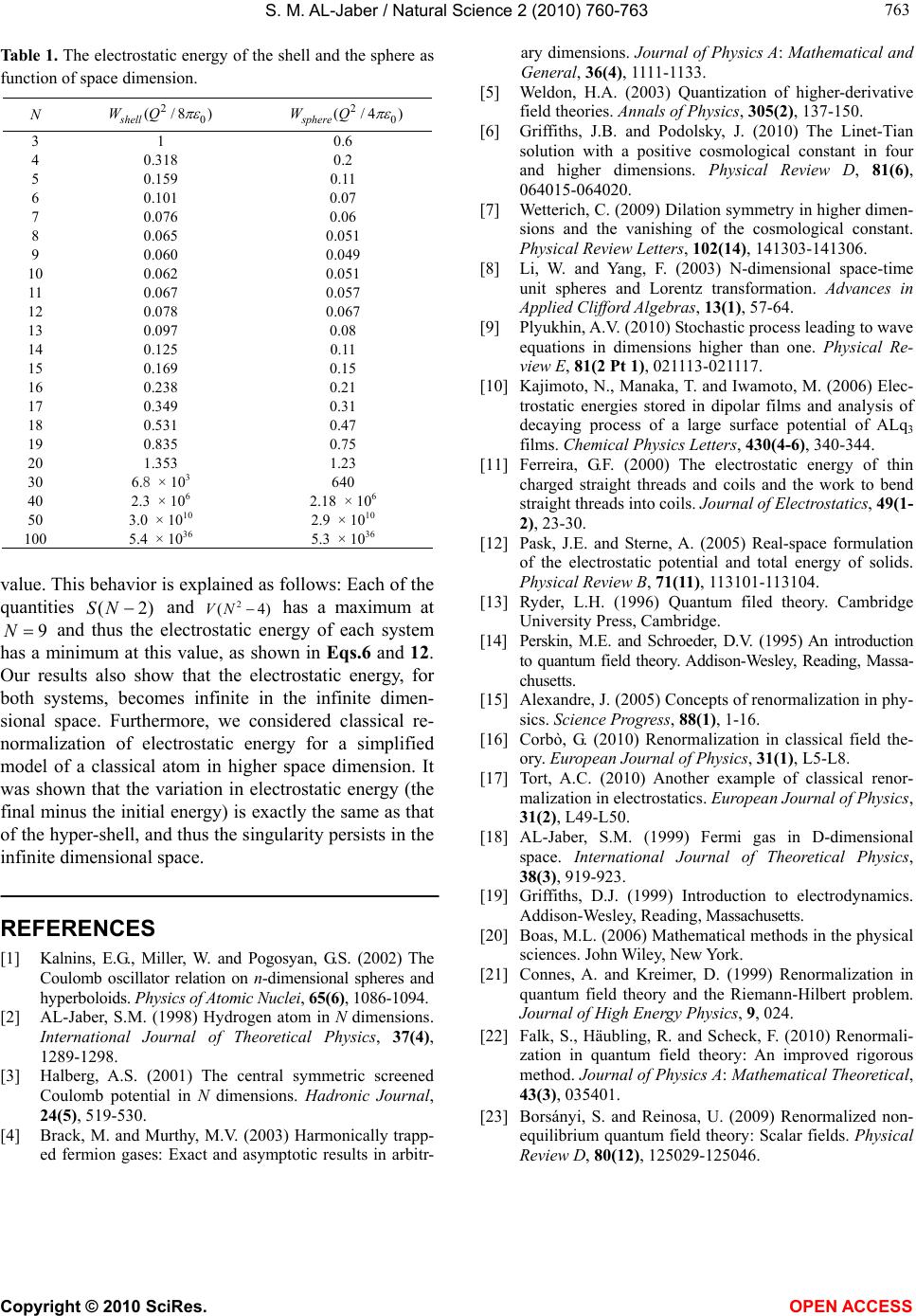 S. M. AL-Jaber / Natural Science 2 (2010) 760-763 Copyright © 2010 SciRes. OPEN ACCESS 763 763 Table 1. The electrostatic energy of the shell and the sphere as function of space dimension. N 2 0 (/8) shell WQ 2 0 (/4) sphere WQ 3 4 5 6 7 8 9 10 11 12 13 14 15 16 17 18 19 20 30 40 50 100 1 0.318 0.159 0.101 0.076 0.065 0.060 0.062 0.067 0.078 0.097 0.125 0.169 0.238 0.349 0.531 0.835 1.353 6.8 × 10³ 2.3 × 10⁶ 3.0 × 10¹⁰ 5.4 × 1036 0.6 0.2 0.11 0.07 0.06 0.051 0.049 0.051 0.057 0.067 0.08 0.11 0.15 0.21 0.31 0.47 0.75 1.23 640 2.18 × 10⁶ 2.9 × 10¹⁰ 5.3 × 1036 value. This behavior is explained as follows: Each of the quantities )2( NS and 2 (4)VN has a maximum at 9N and thus the electrostatic energy of each system has a minimum at this value, as shown in Eqs.6 and 12. Our results also show that the electrostatic energy, for both systems, becomes infinite in the infinite dimen- sional space. Furthermore, we considered classical re- normalization of electrostatic energy for a simplified model of a classical atom in higher space dimension. It was shown that the variation in electrostatic energy (the final minus the initial energy) is exactly the same as that of the hyper-shell, and thus the singularity persists in the infinite dimensional space. REFERENCES [1] Kalnins, E.G., Miller, W. and Pogosyan, G.S. (2002) The Coulomb oscillator relation on n-dimensional spheres and hyperboloids. Physics of Atomic Nuclei, 65(6), 1086-1094. [2] AL-Jaber, S.M. (1998) Hydrogen atom in N dimensions. International Journal of Theoretical Physics, 37(4), 1289-1298. [3] Halberg, A.S. (2001) The central symmetric screened Coulomb potential in N dimensions. Hadronic Journal, 24(5), 519-530. [4] Brack, M. and Murthy, M.V. (2003) Harmonically trapp- ed fermion gases: Exact and asymptotic results in arbitr- ary dimensions. Journal of Physics A: Mathematical and General, 36(4), 1111-1133. [5] Weldon, H.A. (2003) Quantization of higher-derivative field theories. Annals of Physics, 305(2), 137-150. [6] Griffiths, J.B. and Podolsky, J. (2010) The Linet-Tian solution with a positive cosmological constant in four and higher dimensions. Physical Review D, 81(6), 064015-064020. [7] Wetterich, C. (2009) Dilation symmetry in higher dimen- sions and the vanishing of the cosmological constant. Physical Review Letters, 102(14), 141303-141306. [8] Li, W. and Yang, F. (2003) N-dimensional space-time unit spheres and Lorentz transformation. Advances in Applied Clifford Algebras, 13(1), 57-64. [9] Plyukhin, A.V. (2010) Stochastic process leading to wave equations in dimensions higher than one. Physical Re- view E, 81(2 Pt 1), 021113-021117. [10] Kajimoto, N., Manaka, T. and Iwamoto, M. (2006) Elec- trostatic energies stored in dipolar films and analysis of decaying process of a large surface potential of ALq3 films. Chemical Physics Letters, 430(4-6), 340-344. [11] Ferreira, G.F. (2000) The electrostatic energy of thin charged straight threads and coils and the work to bend straight threads into coils. Journal of Electrostatics, 49(1- 2), 23-30. [12] Pask, J.E. and Sterne, A. (2005) Real-space formulation of the electrostatic potential and total energy of solids. Physical Review B, 71(11), 113101-113104. [13] Ryder, L.H. (1996) Quantum filed theory. Cambridge University Press, Cambridge. [14] Perskin, M.E. and Schroeder, D.V. (1995) An introduction to quantum field theory. Addison-Wesley, Reading, Massa- chusetts. [15] Alexandre, J. (2005) Concepts of renormalization in phy- sics. Science Progress, 88(1), 1-16. [16] Corbò, G. (2010) Renormalization in classical field the- ory. European Journal of Physics, 31(1), L5-L8. [17] Tort, A.C. (2010) Another example of classical renor- malization in electrostatics. European Journal of Physics, 31(2), L49-L50. [18] AL-Jaber, S.M. (1999) Fermi gas in D-dimensional space. International Journal of Theoretical Physics, 38(3), 919-923. [19] Griffiths, D.J. (1999) Introduction to electrodynamics. Addison-Wesley, Reading, Massachusetts. [20] Boas, M.L. (2006) Mathematical methods in the physical sciences. John Wiley, New York. [21] Connes, A. and Kreimer, D. (1999) Renormalization in quantum field theory and the Riemann-Hilbert problem. Journal of High Energy Physics, 9, 024. [22] Falk, S., Häubling, R. and Scheck, F. (2010) Renormali- zation in quantum field theory: An improved rigorous method. Journal of Physics A: Mathematical Theoretical, 43(3), 035401. [23] Borsányi, S. and Reinosa, U. (2009) Renormalized non- equilibrium quantum field theory: Scalar fields. Physical Review D, 80(12), 125029-125046. |