

Paper Menu >>
Journal Menu >>
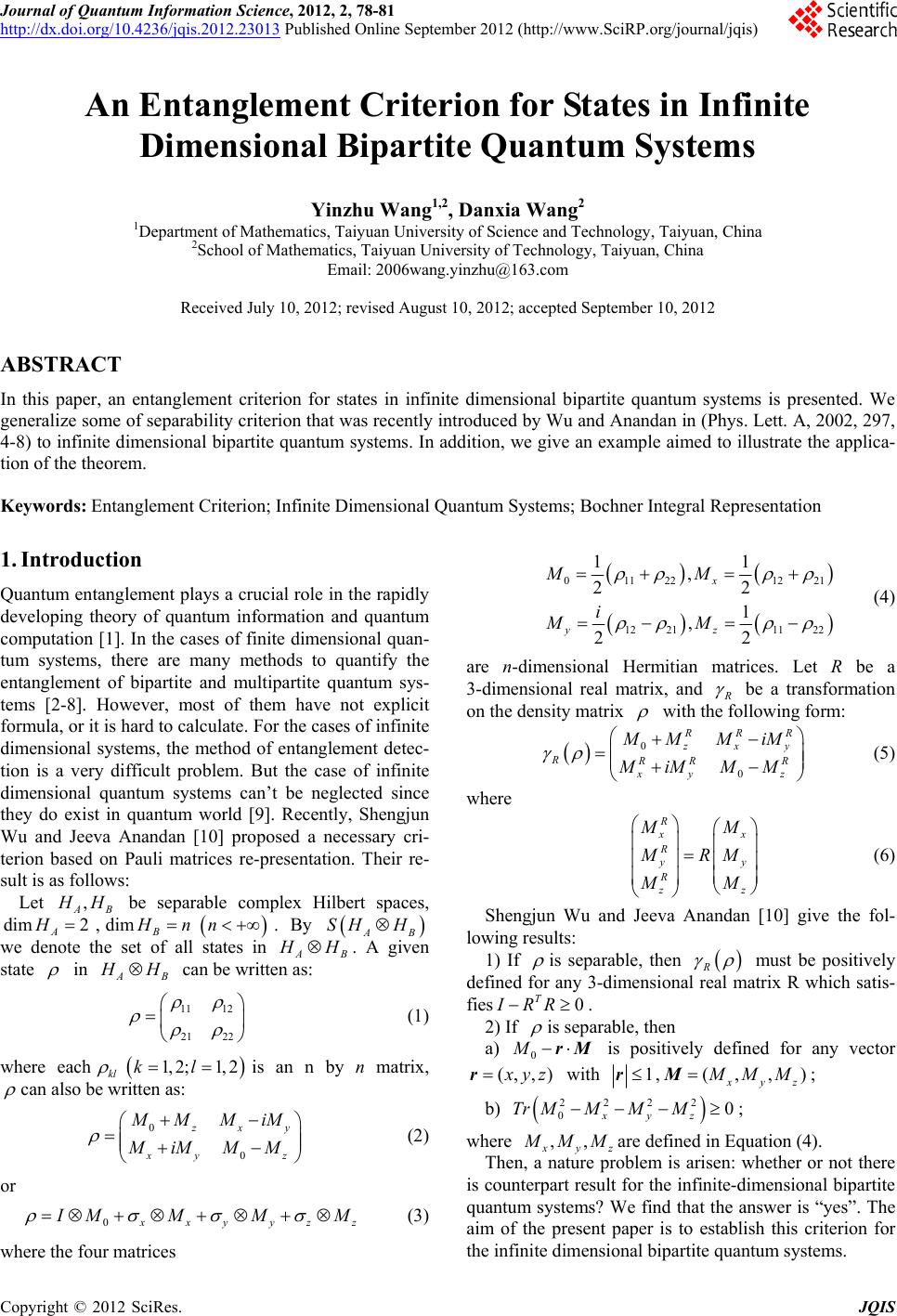 Journal of Quantum Information Science, 2012, 2, 78-81 http://dx.doi.org/10.4236/jqis.2012.23013 Published Online September 2012 (http://www.SciRP.org/journal/jqis) An Entanglement Criterion for States in Infinite Dimensional Bipartite Quantum Systems Yinzhu Wang1,2, Danxia Wang2 1Department of Mathematics, Taiyuan University of Science and Technology, Taiyuan, China 2School of Mathematics, Taiyuan University of Technology, Taiyuan, China Email: 2006wang.[email protected] Received July 10, 2012; revised August 10, 2012; accepted September 10, 2012 ABSTRACT In this paper, an entanglement criterion for states in infinite dimensional bipartite quantum systems is presented. We generalize some of separability criterion that was recently introduced by Wu and Anandan in (Phys. Lett. A, 2002, 297, 4-8) to infinite dimensional bipartite quantum systems. In addition, we give an example aimed to illustrate the applica- tion of the theorem. Keywords: Entanglement Criterion; Infinite Dimensional Quantum Systems; Bochner Integral Representation 1. Introduction Quantum entanglement plays a crucial role in the rapidly developing theory of quantum information and quantum computation [1]. In the cases of finite dimensional quan- tum systems, there are many methods to quantify the entanglement of bipartite and multipartite quantum sys- tems [2-8]. However, most of them have not explicit formula, or it is hard to calculate. For the cases of infinite dimensional systems, the method of entanglement detec- tion is a very difficult problem. But the case of infinite dimensional quantum systems can’t be neglected since they do exist in quantum world [9]. Recently, Shengjun Wu and Jeeva Anandan [10] proposed a necessary cri- terion based on Pauli matrices re-presentation. Their re- sult is as follows: Let , AB H H 2 Adi be separable complex Hilbert spaces, , dim HmB H n n . By we denote the set of all states in A AB SH H B H H. A given state in AB H H can be written as: 11 12 21 22 (1) where eachkl 1, 2;1, 2kl is an n by n matrix, can also be written as: 0 0 z xy xy z MM MiM MiM MM (2) or 0 x xy yz z I MMMM (3) where the four matrices 01122 12 122111 22 11 , 22 1 , 22 x yz MM i MM 21 (4) are n-dimensional Hermitian matrices. Let R be a 3-dimensional real matrix, and R be a transformation on the density matrix with the following form: 0 0 RRR zxy RRR R xy z MM MiM MiM MM (5) where R x x R y y R z z MM MRM MM (6) Shengjun Wu and Jeeva Anandan [10] give the fol- lowing results: 1) If is separable, then R must be positively defined for any 3-dimensional real matrix R which satis- fies 0R T IR . 2) If is separable, then a) 0 M rM (, ,) is positively defined for any vector x yz r with 1 r,(, ,) x yz M MMM; b) 2222 00 xyz TrMMMM ; where ,, x yz M MMare defined in Equation (4). Then, a nature problem is arisen: whether or not there is counterpart result for the infinite-dimensional bipartite quantum systems? We find that the answer is “yes”. The aim of the present paper is to establish this criterion for the infinite dimensional bipartite quantum systems. C opyright © 2012 SciRes. JQIS 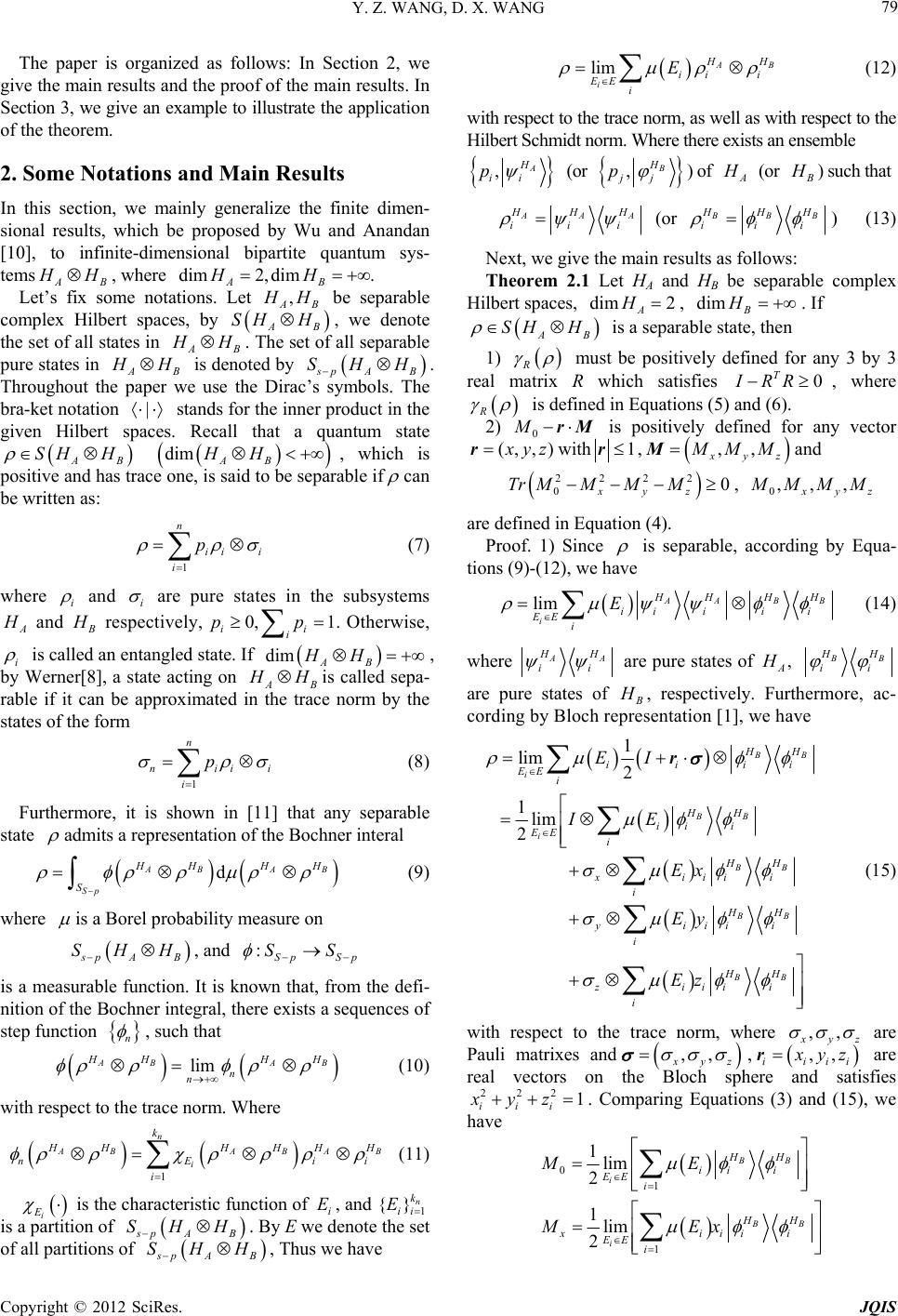 Y. Z. WANG, D. X. WANG 79 The paper is organized as follows: In Section 2, we give the main results and the proof of the main results. In Section 3, we give an example to illustrate the application of the theorem. 2. Some Notations and Main Results In this section, we mainly generalize the finite dimen- sional results, which be proposed by Wu and Anandan [10], to infinite-dimensional bipartite quantum sys- tems AB H H, where dim 2,dim. AB HH , Let’s fix some notations. Let AB H H be separable complex Hilbert spaces, by B , we denote the set of all states in AB A H SH H H. The set of all separable pure states in AB H H is denoted by s pA B . Throughout the paper we use the Dirac’s symbols. The bra-ket notation stands for the inner product in the given Hilbert spaces. Recall that a quantum state AB SHH | AB HSH HHdim , which is positive and has trace one, is said to be separable if can be written as: 1 n ii i i p (7) where i and i are pure states in the subsystems A H and B H respectively, Otherwise, 0, 1. ii i pp i is by Werner[8], a state called an entangled state. If dim AB HH , acting on AB H His called sepa- can be approximated in the trace norm by the states of the form rable if it i 1 n nii i p (8) Furthermore, it is shown in [11] that any separable state admits a representation of the Bochner interal d AB AB Sp HH HH S (9) where is a Borel probability measure on s pA B SHH , and :Sp Sp SS is a measurable function. It is known that, from the defi- nition of the Bochner integral, there exists a sequences of step function n , such that lim AB AB HH HH n n (10) with respect to the trace norm. Where 1 n A BABA i k HH HHHH nEi i B i (11) i E is the characteristic function of i, and 1 {} En k ii E is a partition of lim A B i HH ii i EEi E (12) with respect to the trace norm, as well as with respect to the Hilbert Schmidt norm. Where there exists an ensemble ,A H ii p (or ,B H jj p ) of A H (or B H ) such that A A HHH iii A (or BB HHH iii B ) (13) Next, we give the main results as follows: Theorem 2.1 Let HA and HB be separable complex Hilbert spaces, dim 2 A H , . If dim B H AB SH H is a separable state, then 1) R must be positively defined for any 3 by 3 real matrix R which satisfies , where 0 T IRR R M is defined in Equations (5) and (6). 2) 0 rM (, ,) is positively defined for any vector x yz rwith 1 r, ,, x yz M MMMand 2222 00 xyz TrMMMM , 0,,, x yz M MMM are defined in Equation (4). Proof. 1) Since is separable, according by Equa- tions (9)-(12), we have lim A AB i HH HH iiii i EEi E B (14) where A HH ii A are pure states of , A H B B HH ii are pure states of B H , respectively. Furthermore, ac- cording by Bloch representation [1], we have 1 lim 2 1 lim 2 B B i BB i BB BB BB HH iii EEi HH ii i EE i HH xiiii i HH yiiii i HH ziiii i EI IE Ex Ey Ez r i (15) with respect to the trace norm, where ,, x yz are Pauli matrixes and ,, x yz , ,, iiii x yzr are real vectors on the Bloch sphere and satisfies 222 1 iii xyz . Comparing Equations (3) and (15), we have 0 1 1 1lim 2 1lim 2 BB i BB i HH ii i EE i HH xiii EE i ME MEx i s pA B SHH . By E we denote the set of all partitions of s pA SH B H, Thus we have Copyright © 2012 SciRes. JQIS 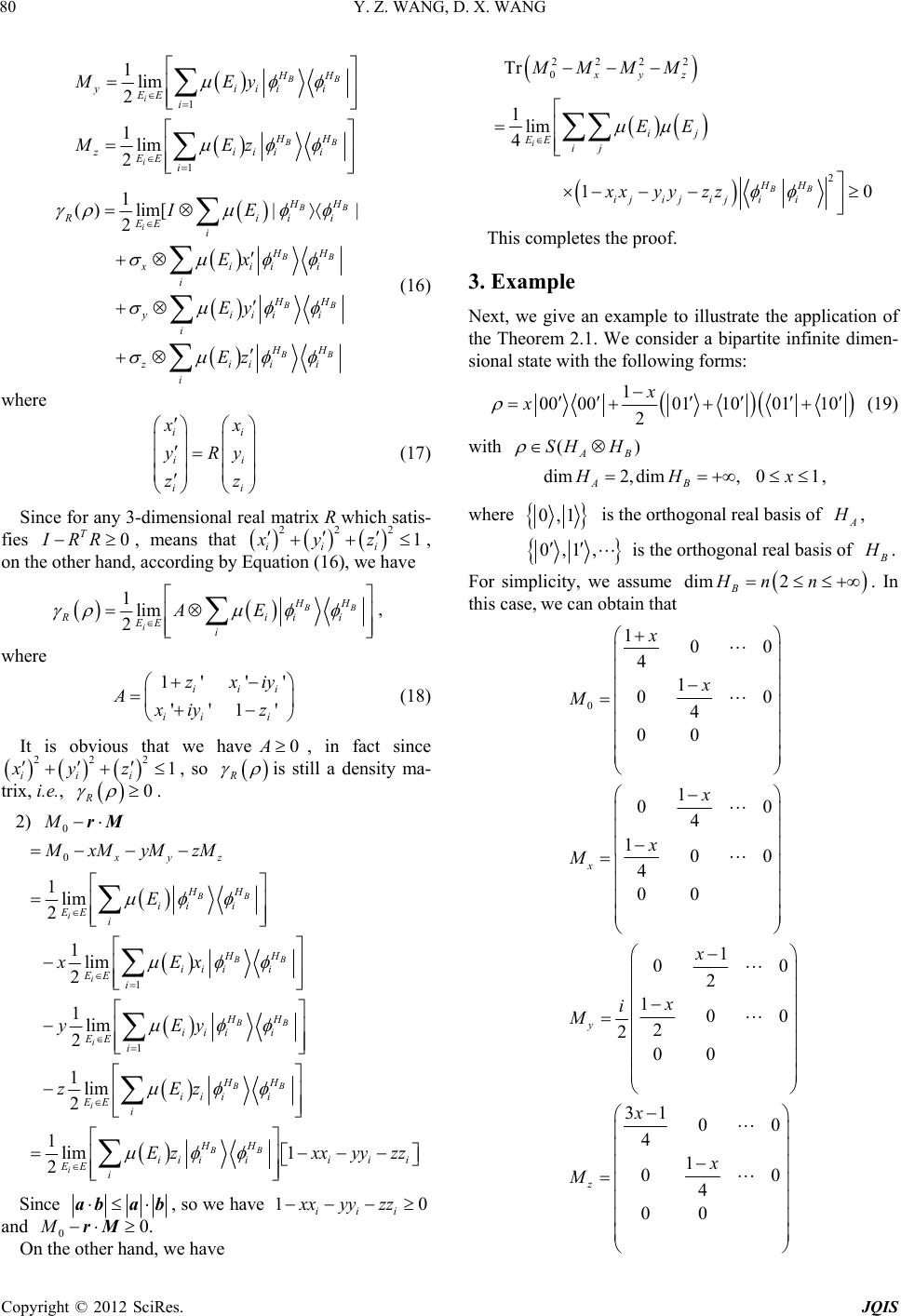 Y. Z. WANG, D. X. WANG 80 1 1 1lim 2 1lim 2 BB i BB i HH yiii EE i HH ziii EE i MEy MEz i i 1 () lim[|| 2 BB i BB BB BB HH Ri EE i HH xiiii i HH yiiii i HH ziiii i IE Ex Ey Ez ii i (16) where ii i ii x x y Ry zz (17) Since for any 3-dimensional real matrix R which satis- fies , means that , on the other hand, according by Equation (16), we have 0 T IRR 222 1 iii xyz 1lim 2 BB i HH Ri EE i AE ii , where 1'' ' ''1' iii ii i zxiy Axiy z (18) It is obvious that we have, in fact since , so 0A 222 1 iii xyz R is still a density ma- trix, i.e., . 0 R 0 0 1 1 2) 1 lim 2 1 lim 2 1 lim 2 1 lim 2 1 lim 2 BB i BB i BB i BB i i xyz HH ii i EE i HH iii i EE i HH iiii EE i HH iiii EE i i EE i M MxMyMzM E xEx yEy zEz Ez rM 1 BB HH iiiii i x xyyzz Since aba b, so we have and 10 iii xxyy zz 0 On the other hand, we have 0.MrM 2222 0 2 Tr 1lim 4 10 i BB xyz ij EE ij HH ijij ijii MMMM EE xx yy zz This completes the proof. 3. Example Next, we give an example to illustrate the application of the Theorem 2.1. We consider a bipartite infinite dimen- sional state with the following forms: 1 00 0001100110 2 x x (19) with () AB SH H dim 2,dim, AB HH 01 x , where 0,1 is the orthogonal real basis of A H , 0,1, is the orthogonal real basis of B H . For simplicity, we assume . In this case,we can obtain that dim 2 B Hn n 0 100 4 1 00 4 00 1 00 4 100 4 00 1 00 2 100 2 2 00 31 00 4 1 00 4 00 x y z x x M x x M x x i M x x M Copyright © 2012 SciRes. JQIS 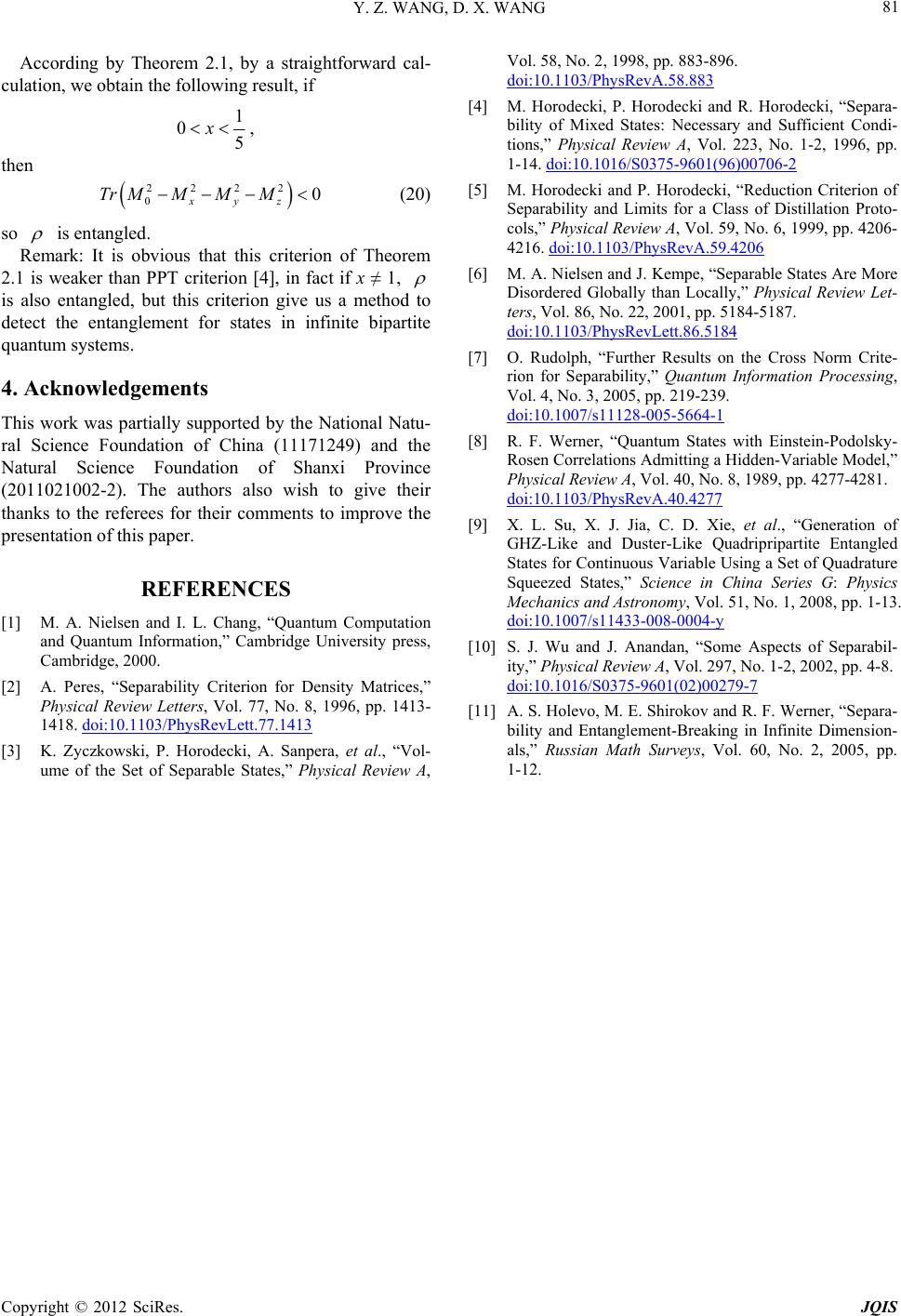 Y. Z. WANG, D. X. WANG Copyright © 2012 SciRes. JQIS 81 According by Theorem 2.1, by a straightforward cal- culation, we obtain the following result, if 1 05 x, then 2222 00 xyz TrMMMM (20) so is entangled. Remark: It is obvious that this criterion of Theorem 2.1 is weaker than PPT criterion [4], in fact if x ≠ 1, is also entangled, but this criterion give us a method to detect the entanglement for states in infinite bipartite quantum systems. 4. Acknowledgements This work was partially supported by the National Natu- ral Science Foundation of China (11171249) and the Natural Science Foundation of Shanxi Province (2011021002-2). The authors also wish to give their thanks to the referees for their comments to improve the presentation of this paper. REFERENCES [1] M. A. Nielsen and I. L. Chang, “Quantum Computation and Quantum Information,” Cambridge University press, Cambridge, 2000. [2] A. Peres, “Separability Criterion for Density Matrices,” Physical Review Letters, Vol. 77, No. 8, 1996, pp. 1413- 1418. doi:10.1103/PhysRevLett.77.1413 [3] K. Zyczkowski, P. Horodecki, A. Sanpera, et al., “Vol- ume of the Set of Separable States,” Physical Review A, Vol. 58, No. 2, 1998, pp. 883-896. doi:10.1103/PhysRevA.58.883 [4] M. Horodecki, P. Horodecki and R. Horodecki, “Separa- bility of Mixed States: Necessary and Sufficient Condi- tions,” Physical Review A, Vol. 223, No. 1-2, 1996, pp. 1-14. doi:10.1016/S0375-9601(96)00706-2 [5] M. Horodecki and P. Horodecki, “Reduction Criterion of Separability and Limits for a Class of Distillation Proto- cols,” Physical Review A, Vol. 59, No. 6, 1999, pp. 4206- 4216. doi:10.1103/PhysRevA.59.4206 [6] M. A. Nielsen and J. Kempe, “Separable States Are More Disordered Globally than Locally,” Physical Review Let- ters, Vol. 86, No. 22, 2001, pp. 5184-5187. doi:10.1103/PhysRevLett.86.5184 [7] O. Rudolph, “Further Results on the Cross Norm Crite- rion for Separability,” Quantum Information Processing, Vol. 4, No. 3, 2005, pp. 219-239. doi:10.1007/s11128-005-5664-1 [8] R. F. Werner, “Quantum States with Einstein-Podolsky- Rosen Correlations Admitting a Hidden-Variable Model,” Physical Review A, Vol. 40, No. 8, 1989, pp. 4277-4281. doi:10.1103/PhysRevA.40.4277 [9] X. L. Su, X. J. Jia, C. D. Xie, et al., “Generation of GHZ-Like and Duster-Like Quadripripartite Entangled States for Continuous Variable Using a Set of Quadrature Squeezed States,” Science in China Series G: Physics Mechanics and Astronomy, Vol. 51, No. 1, 2008, pp. 1-13. doi:10.1007/s11433-008-0004-y [10] S. J. Wu and J. Anandan, “Some Aspects of Separabil- ity,” Physical Review A, Vol. 297, No. 1-2, 2002, pp. 4-8. doi:10.1016/S0375-9601(02)00279-7 [11] A. S. Holevo, M. E. Shirokov and R. F. Werner, “Separa- bility and Entanglement-Breaking in Infinite Dimension- als,” Russian Math Surveys, Vol. 60, No. 2, 2005, pp. 1-12. |