

Paper Menu >>
Journal Menu >>
 iBusiness, 2012, 4, 216-221 http://dx.doi.org/10.4236/ib.2012.43027 Published Online September 2012 (http://www.SciRP.org/journal/ib) A Hybrid Clonal Selection for the Single Row Facility Layout Problem with Unequal Dimensions Hasan Hosseini-Nasab*, Leila Emami Department of Industrial Engineering, Yazd University, Yazd, Iran. Email: *[email protected] Received May 10th, 2012; revised May 29th, 2012; accepted July 23rd, 2012 ABSTRACT The single row facility layout problem (SRFLP) is an important combinatorial optimization problem where a given set of facilities have to be arranged in a single row to minimize the weighted sum of the distances between all pairs of fa- cilities. In this paper, a hybrid method for single row facility layout problem is proposed in which, the simulated an- nealing (SA) is embedded in the clonal selection algorithm (CSA). The performance of the proposed algorithm is tested on benchmark problems. Computational results show the efficiency of the proposed algorithm compared to other heu- ristics. Keywords: Single Row Facility Layout; Clonal Selection Algorithm; Simulated Annealing 1. Introduction The facility layout problem (FLP) is to arrange of a given number of departments while minimizing the total cost associated with the (known or projected) interactions between them. Types of the facility layout problem occur in many environments, such as hospital layout and ser- vice center layout. Generally, these problems are hard problems; most types of these problems are NP-hard. Single row facility layout problem (SRFLP) is a special case of the facility layout that it is to arrange n depart- ments on a straight line to minimize the total weighted distances between all pairs of facilities. If all the facilities have the same length, the SRFLP becomes an instance of the linear arrangement problem [1,2] which is itself a special case of the quadratic assignment problem [3]. Va- rious applications of the SRFLP have been identified in the literature. One such application is in the flexible ma- nufacturing systems, where machines within manufac- turing cells are often placed along a straight path trav- elled by an automated guided vehicle [4]. The minimum linear arrangement problem was proved NP-hard [5], therefore the SRFLP is NP-hard because this is a gener- alization of it. Exact approaches have been proposed for the problem. A branch-and-bound algorithm is presente- din [6-8]. Picard and Queyranne [9] presented dynamic programming algorithms for the SRFLP. Heragu and Ku- siak [10] presented a nonlinear model. Love and Wong [11] and Amaral [12-14] proposed linear mixed-integer programs. The paper has the following structure. Section 2 gives a literature review on SRFLP. Section 3 is the problem description. Section 4 the principles of the original CSA and SA method are briefly introduced, the proposed hy- brid algorithm in more details for SRFLP described in Section 5. In Section 6 computational results are given. Finally, Section 7 contains conclusions. 2. Literature Review Many heuristics and metaheuristic algorithms have been presented to solve the SRFLP because this problem is a NP-complete problem [15]. Neghabat [16] proposed an algorithmto reach a complete solution by adding one ma- chine at a time to the end of the current solution. Drezner [17] presented a heuristic method based on the eigenvec- tors of a transformed flow matrix. Another heuristic has been presented by Heragu and Kusiak [10], in which a pair of facilities with the largest adjusted flow is initially laid and then the partial order is gradually completed through a loop adding new machines to the right and left of the order obtained in the previous iteration. Heragu and Alfa [18] proposed a simulated annealing algorithm to solve SRFLP. A constructive greedy heuristic has been developed by Kumar and Hadjinicola [19]. In this algo- rithm assigns facilities with the largest number of moves between them to adjacent locations on the line. Braglia [20] introduced an algorithm that is combined of simu- lated annealing and genetic algorithm to minimize the total backtracking in the linear ordering of machines. *Corresponding author. Copyright © 2012 SciRes. IB  A Hybrid Clonal Selection for the Single Row Facility Layout Problem with Unequal Dimensions 217 Solimanpur et al. [21] presented a non-linear 0 - 1 pro- gramming model for the SRFLP then was solved by an ant algorithm. Anjos et al. [22], Anjos and Vannelli [23], Anjos and Kong [24], Hungerlander and Rendl [25], had presented semi-definite programming relaxation providing a lower bound on the optimum value of the SRFLP. Recently, many researchers proposed meta-heuristic methods, such as: a scatter search algorithm by Kumar [26], a hybrid algorithm based on ant colony optimization and PSO by Teo and Ponnambalam, [27], a genetic algorithm by Lin [28], a PSO algorithm by Samarghandi et al. [29], and genetic algorithm by Datta et al. [30]. In this paper, a hybrid clonal selection algorithm is presented for SRFLP. The computational experiments show the efficient performance of the proposed algorithm on different instances of various sizes available in the literature. 3. Problem Formulation Heragu and Kusiak [4] presented a model for the prob- lem, which they called ABSMODEL. Let be i u the distance between the centroid of department i and the line origin and let Sij be the minimum separation between departments i and j. Their model is given by, 1 11 min nn ij ij iji cu u (1) 1 .: 2 1, ,;1, ,. ij ijij s tuul ls injin (2) As the absolute value for the distance between the cen- troids are used, it does not matter if department i is to the left or to the right of department j. Note that the mini- mum value that ij can assume could be set greater than uu 2 ij ll if we are given a value Sij. If n the set of all permutations π of . The SRFLP can be mathematically formulated in Amaral, [14]: 1, 2,,N n 1π π11 min n nn ij ij iji cd (3) where dij is the distance between departments i and j with respect to a permutation π. New modeling of the SRFLP in (3) implies that the ABSMODEL searches the set of all permutations of numbers 1, to find the per- mutation which minimizes the objective function. 2,, n 4. Clonal Selection and Simulated Annealing 4.1. AIS, CSA Artificial immune algorithm (AIA) is a recent branch of stochastic search algorithms and classified as a popula- tion-based metaheuristic method. These properties impart a high degree of robustness and performance and at- tracted interest of researches in implementing it to engi- neering systems. This adopted engineering analogue, called AIS, emerged in the 1990s as a new computational research area [31]. Three commonly applied types of AIAs are clonal se- lection algorithm (CSA), immune network algorithm (INA) and negative selection algorithm (NSA). Among these models, CSA is reported to be successful in com- binatorial optimization problems [32]. Therefore, a CSA is employed to solve SRFLP in this study. CSA is treated as biological and random search based general-purpose heuristic methods. The most important component of a CSA is how to represent the solution. The feasible solutions are coded as individuals. Each in- dividual in the population is called an antibody. A CSA starts with a set of random antibodies as an initial popu- lation. Any population in turn is a subset of the solution space. Appropriate solutions are searched within the po- pulation. The new generations are formed through copy- ing (cloning) in proportion to concept called as the affin- ity value. The algorithm does not have a crossover op- erator as in GA. The mutation operators are utilized to search and evaluate new regions in the solution space in- versely proportional to the affinity value of the solution. The mutation rates in CSA are higher compared to Gas. It can be described by the following steps [33]: 1) Initialize the antibody pool init P including the sub- set of memory cells (M); 2) Evaluate the fitness of all the antibodies (affinity with the antigen) in population P; 3) Select the best candidates (Pr) from population P, according to their fitness; 4) Clone Pr into a temporary antibody pool (C); 5) Generate a mutated antibody pool (C1). The muta- tion rate of each antibody is inversely proportional to its fitness; 6) Evaluate all the antibodies in C1; 7) Eliminate those antibodies similar to the ones in C, and update C1; 8) Re-select the antibodies with better fitness from C1 to construct memory set M. Other improved individuals of C1 can replace certain members with poor fitness in P to maintain the antibody diversity; 9) Return back to Step 2, if a pre-set termination crite- rion is not met. 4.2. Simulated Annealing Simulated annealing (SA) proposed by Kirkpatrick et al. [34], belongs to the class of stochastic search algorithms, known as meta-heuristics. This algorithm motivated from Copyright © 2012 SciRes. IB 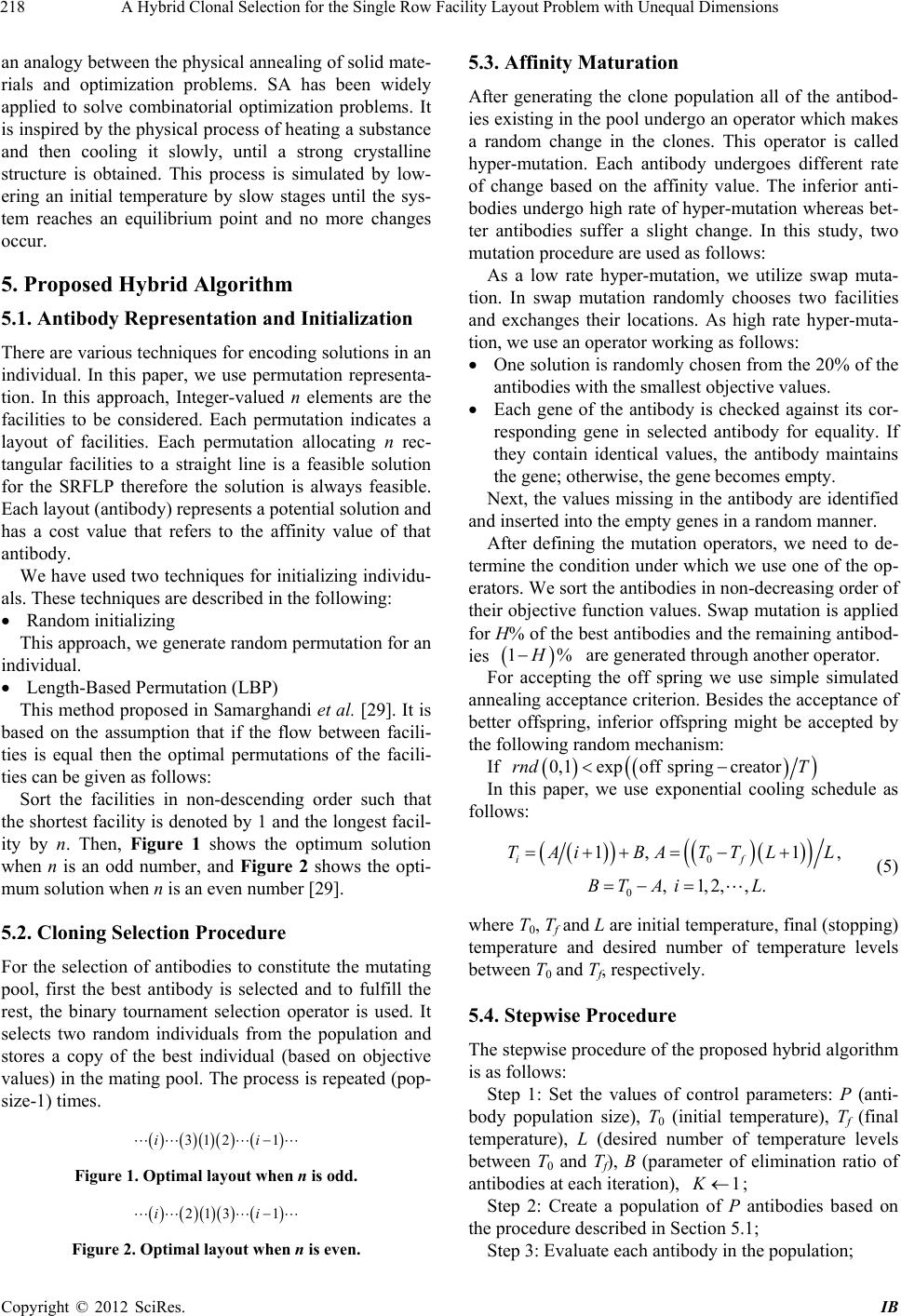 A Hybrid Clonal Selection for the Single Row Facility Layout Problem with Unequal Dimensions 218 an analogy between the physical annealing of solid mate- rials and optimization problems. SA has been widely applied to solve combinatorial optimization problems. It is inspired by the physical process of heating a substance and then cooling it slowly, until a strong crystalline structure is obtained. This process is simulated by low- ering an initial temperature by slow stages until the sys- tem reaches an equilibrium point and no more changes occur. 5. Proposed Hybrid Algorithm 5.1. Antibody Representation and Initialization There are various techniques for encoding solutions in an individual. In this paper, we use permutation representa- tion. In this approach, Integer-valued n elements are the facilities to be considered. Each permutation indicates a layout of facilities. Each permutation allocating n rec- tangular facilities to a straight line is a feasible solution for the SRFLP therefore the solution is always feasible. Each layout (antibody) represents a potential solution and has a cost value that refers to the affinity value of that antibody. We have used two techniques for initializing individu- als. These techniques are described in the following: Random initializing This approach, we generate random permutation for an individual. Length-Based Permutation (LBP) This method proposed in Samarghandi et al. [29]. It is based on the assumption that if the flow between facili- ties is equal then the optimal permutations of the facili- ties can be given as follows: Sort the facilities in non-descending order such that the shortest facility is denoted by 1 and the longest facil- ity by n. Then, Figure 1 shows the optimum solution when n is an odd number, and Figure 2 shows the opti- mum solution when n is an even number [29]. 5.2. Cloning Selection Procedure For the selection of antibodies to constitute the mutating pool, first the best antibody is selected and to fulfill the rest, the binary tournament selection operator is used. It selects two random individuals from the population and stores a copy of the best individual (based on objective values) in the mating pool. The process is repeated (pop- size-1) times. 312 1ii Figure 1. Optimal layout when n is odd. 213 1ii Figure 2. Optimal layout when n is even. 5.3. Affinity Maturation After generating the clone population all of the antibod- ies existing in the pool undergo an operator which makes a random change in the clones. This operator is called hyper-mutation. Each antibody undergoes different rate of change based on the affinity value. The inferior anti- bodies undergo high rate of hyper-mutation whereas bet- ter antibodies suffer a slight change. In this study, two mutation procedure are used as follows: As a low rate hyper-mutation, we utilize swap muta- tion. In swap mutation randomly chooses two facilities and exchanges their locations. As high rate hyper-muta- tion, we use an operator working as follows: One solution is randomly chosen from the 20% of the antibodies with the smallest objective values. Each gene of the antibody is checked against its cor- responding gene in selected antibody for equality. If they contain identical values, the antibody maintains the gene; otherwise, the gene becomes empty. Next, the values missing in the antibody are identified and inserted into the empty genes in a random manner. After defining the mutation operators, we need to de- termine the condition under which we use one of the op- erators. We sort the antibodies in non-decreasing order of their objective function values. Swap mutation is applied for H% of the best antibodies and the remaining antibod- ies 1H% are generated through another operator. For accepting the off spring we use simple simulated annealing acceptance criterion. Besides the acceptance of better offspring, inferior offspring might be accepted by the following random mechanism: If 0,1exp offspring creatorrnd T In this paper, we use exponential cooling schedule as follows: 0 0 1, 1 ,1,2,,. if TAiBATTL L BT AiL , (5) where T0, Tf and L are initial temperature, final (stopping) temperature and desired number of temperature levels between T0 and Tf, respectively. 5.4. Stepwise Procedure The stepwise procedure of the proposed hybrid algorithm is as follows: Step 1: Set the values of control parameters: P (anti- body population size), T0 (initial temperature), Tf (final temperature), L (desired number of temperature levels between T0 and Tf), B (parameter of elimination ratio of antibodies at each iteration), ; 1K Step 2: Create a population of P antibodies based on the procedure described in Section 5.1; Step 3: Evaluate each antibody in the population; Copyright © 2012 SciRes. IB 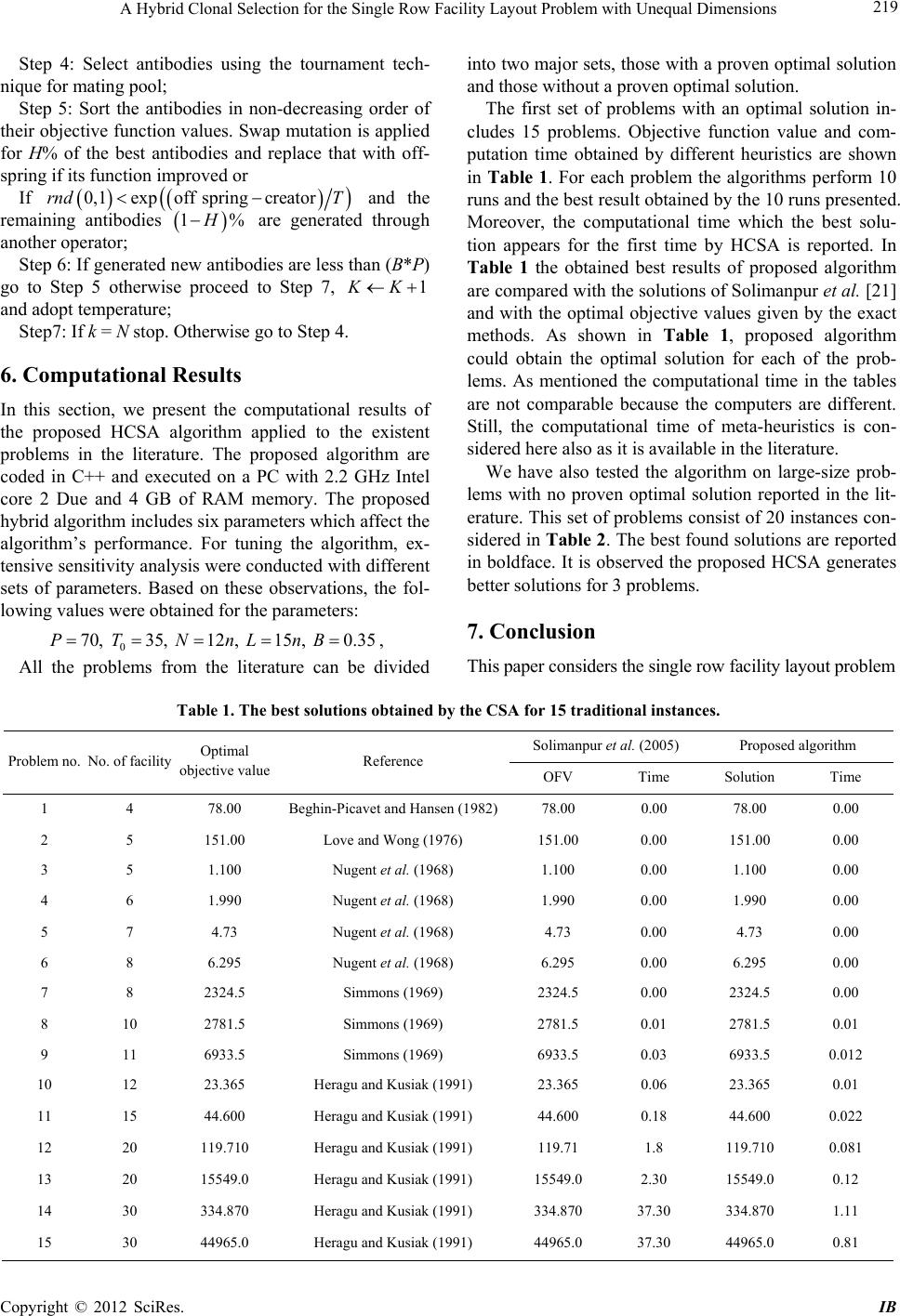 A Hybrid Clonal Selection for the Single Row Facility Layout Problem with Unequal Dimensions Copyright © 2012 SciRes. IB 219 into two major sets, those with a proven optimal solution and those without a proven optimal solution. Step 4: Select antibodies using the tournament tech- nique for mating pool; Step 5: Sort the antibodies in non-decreasing order of their objective function values. Swap mutation is applied for H% of the best antibodies and replace that with off- spring if its function improved or If 0,1exp offspring creatorrnd T % and the remaining antibodies are generated through another operator; 1H The first set of problems with an optimal solution in- cludes 15 problems. Objective function value and com- putation time obtained by different heuristics are shown in Table 1. For each problem the algorithms perform 10 runs and the best result obtained by the 10 runs presented. Moreover, the computational time which the best solu- tion appears for the first time by HCSA is reported. In Table 1 the obtained best results of proposed algorithm are compared with the solutions of Solimanpur et al. [21] and with the optimal objective values given by the exact methods. As shown in Table 1, proposed algorithm could obtain the optimal solution for each of the prob- lems. As mentioned the computational time in the tables are not comparable because the computers are different. Still, the computational time of meta-heuristics is con- sidered here also as it is available in the literature. Step 6: If generated new antibodies are less than (B*P) go to Step 5 otherwise proceed to Step 7, 1KK and adopt temperature; Step7: If k = N stop. Otherwise go to Step 4. 6. Computational Results In this section, we present the computational results of the proposed HCSA algorithm applied to the existent problems in the literature. The proposed algorithm are coded in C++ and executed on a PC with 2.2 GHz Intel core 2 Due and 4 GB of RAM memory. The proposed hybrid algorithm includes six parameters which affect the algorithm’s performance. For tuning the algorithm, ex- tensive sensitivity analysis were conducted with different sets of parameters. Based on these observations, the fol- lowing values were obtained for the parameters: We have also tested the algorithm on large-size prob- lems with no proven optimal solution reported in the lit- erature. This set of problems consist of 20 instances con- sidered in Table 2. The best found solutions are reported in boldface. It is observed the proposed HCSA generates better solutions for 3 problems. 7. Conclusion 0 70, 35, 12, 15, 0.35PT NnLnB , This paper considers the single row facility layout problem All the problems from the literature can be divided Table 1. The best solutions obtained by the CSA for 15 traditional instances. Solimanpur et al. (2005) Proposed algorithm Problem no. No. of facility Optimal objective value Reference OFV Time Solution Time 1 4 78.00 Beghin-Picavet and Hansen (1982)78.00 0.00 78.00 0.00 2 5 151.00 Love and Wong (1976) 151.00 0.00 151.00 0.00 3 5 1.100 Nugent et al. (1968) 1.100 0.00 1.100 0.00 4 6 1.990 Nugent et al. (1968) 1.990 0.00 1.990 0.00 5 7 4.73 Nugent et al. (1968) 4.73 0.00 4.73 0.00 6 8 6.295 Nugent et al. (1968) 6.295 0.00 6.295 0.00 7 8 2324.5 Simmons (1969) 2324.5 0.00 2324.5 0.00 8 10 2781.5 Simmons (1969) 2781.5 0.01 2781.5 0.01 9 11 6933.5 Simmons (1969) 6933.5 0.03 6933.5 0.012 10 12 23.365 Heragu and Kusiak (1991) 23.365 0.06 23.365 0.01 11 15 44.600 Heragu and Kusiak (1991) 44.600 0.18 44.600 0.022 12 20 119.710 Heragu and Kusiak (1991) 119.71 1.8 119.710 0.081 13 20 15549.0 Heragu and Kusiak (1991) 15549.0 2.30 15549.0 0.12 14 30 334.870 Heragu and Kusiak (1991) 334.870 37.30 334.870 1.11 15 30 44965.0 Heragu and Kusiak (1991) 44965.0 37.30 44965.0 0.81 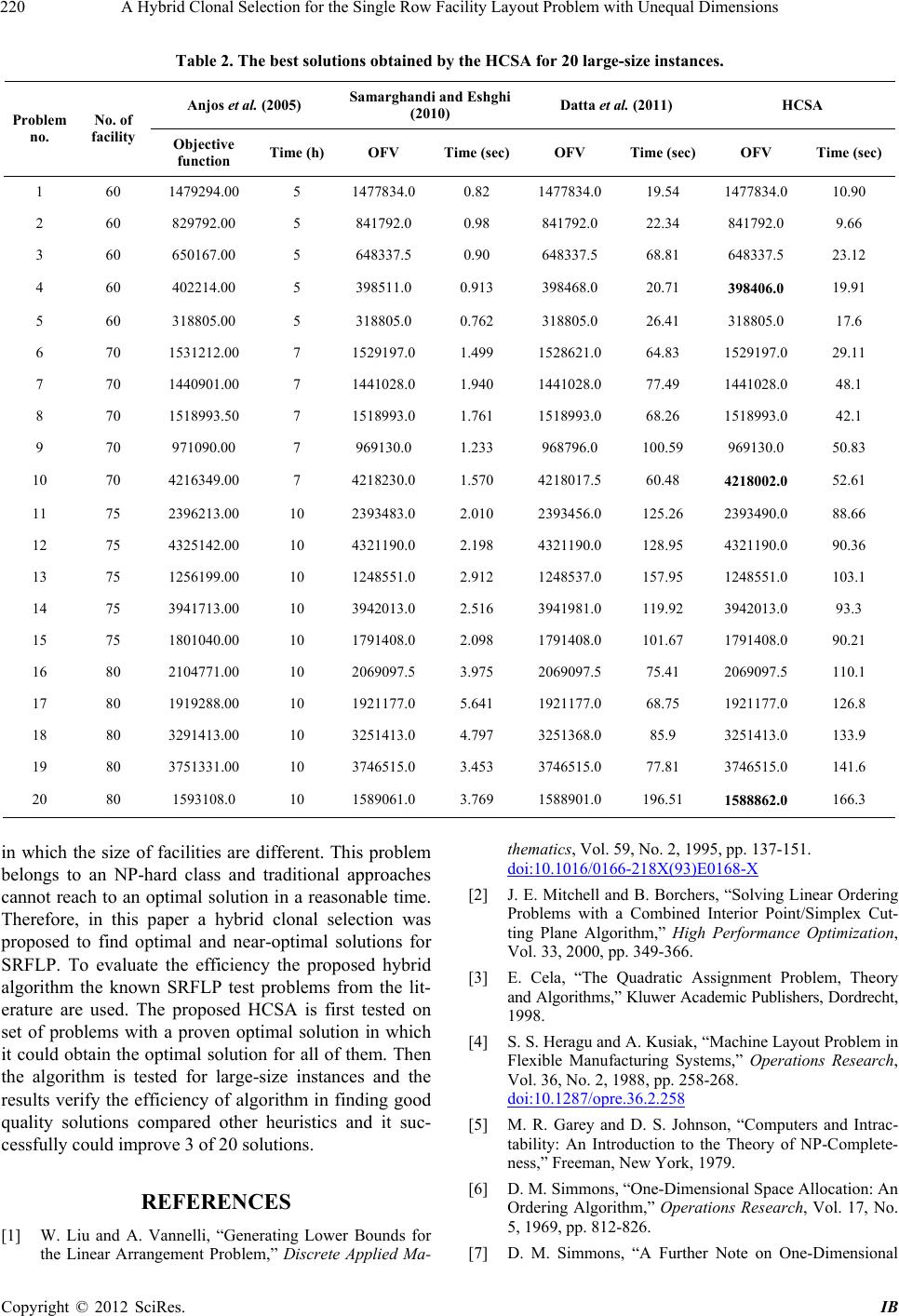 A Hybrid Clonal Selection for the Single Row Facility Layout Problem with Unequal Dimensions 220 Table 2. The best solutions obtained by the HCSA for 20 large-size instances. Anjos et al. (2005) Samarghandi and Eshghi (2010) Datta et al. (2011) HCSA Problem no. No. of facility Objective function Time (h) OFV Time (sec)OFV Time (sec) OFV Time (sec) 1 60 1479294.00 5 1477834.0 0.82 1477834.0 19.54 1477834.0 10.90 2 60 829792.00 5 841792.0 0.98 841792.0 22.34 841792.0 9.66 3 60 650167.00 5 648337.5 0.90 648337.5 68.81 648337.5 23.12 4 60 402214.00 5 398511.0 0.913 398468.0 20.71 398406.0 19.91 5 60 318805.00 5 318805.0 0.762 318805.0 26.41 318805.0 17.6 6 70 1531212.00 7 1529197.0 1.499 1528621.0 64.83 1529197.0 29.11 7 70 1440901.00 7 1441028.0 1.940 1441028.0 77.49 1441028.0 48.1 8 70 1518993.50 7 1518993.0 1.761 1518993.0 68.26 1518993.0 42.1 9 70 971090.00 7 969130.0 1.233 968796.0 100.59 969130.0 50.83 10 70 4216349.00 7 4218230.0 1.570 4218017.5 60.48 4218002.0 52.61 11 75 2396213.00 10 2393483.0 2.010 2393456.0 125.26 2393490.0 88.66 12 75 4325142.00 10 4321190.0 2.198 4321190.0 128.95 4321190.0 90.36 13 75 1256199.00 10 1248551.0 2.912 1248537.0 157.95 1248551.0 103.1 14 75 3941713.00 10 3942013.0 2.516 3941981.0 119.92 3942013.0 93.3 15 75 1801040.00 10 1791408.0 2.098 1791408.0 101.67 1791408.0 90.21 16 80 2104771.00 10 2069097.5 3.975 2069097.5 75.41 2069097.5 110.1 17 80 1919288.00 10 1921177.0 5.641 1921177.0 68.75 1921177.0 126.8 18 80 3291413.00 10 3251413.0 4.797 3251368.0 85.9 3251413.0 133.9 19 80 3751331.00 10 3746515.0 3.453 3746515.0 77.81 3746515.0 141.6 20 80 1593108.0 10 1589061.0 3.769 1588901.0 196.51 1588862.0 166.3 in which the size of facilities are different. This problem belongs to an NP-hard class and traditional approaches cannot reach to an optimal solution in a reasonable time. Therefore, in this paper a hybrid clonal selection was proposed to find optimal and near-optimal solutions for SRFLP. To evaluate the efficiency the proposed hybrid algorithm the known SRFLP test problems from the lit- erature are used. The proposed HCSA is first tested on set of problems with a proven optimal solution in which it could obtain the optimal solution for all of them. Then the algorithm is tested for large-size instances and the results verify the efficiency of algorithm in finding good quality solutions compared other heuristics and it suc- cessfully could improve 3 of 20 solutions. REFERENCES [1] W. Liu and A. Vannelli, “Generating Lower Bounds for the Linear Arrangement Problem,” Discrete Applied Ma- thematics, Vol. 59, No. 2, 1995, pp. 137-151. doi:10.1016/0166-218X(93)E0168-X [2] J. E. Mitchell and B. Borchers, “Solving Linear Ordering Problems with a Combined Interior Point/Simplex Cut- ting Plane Algorithm,” High Performance Optimization, Vol. 33, 2000, pp. 349-366. [3] E. Cela, “The Quadratic Assignment Problem, Theory and Algorithms,” Kluwer Academic Publishers, Dordrecht, 1998. [4] S. S. Heragu and A. Kusiak, “Machine Layout Problem in Flexible Manufacturing Systems,” Operations Research, Vol. 36, No. 2, 1988, pp. 258-268. doi:10.1287/opre.36.2.258 [5] M. R. Garey and D. S. Johnson, “Computers and Intrac- tability: An Introduction to the Theory of NP-Complete- ness,” Freeman, New York, 1979. [6] D. M. Simmons, “One-Dimensional Space Allocation: An Ordering Algorithm,” Operations Research, Vol. 17, No. 5, 1969, pp. 812-826. [7] D. M. Simmons, “A Further Note on One-Dimensional Copyright © 2012 SciRes. IB 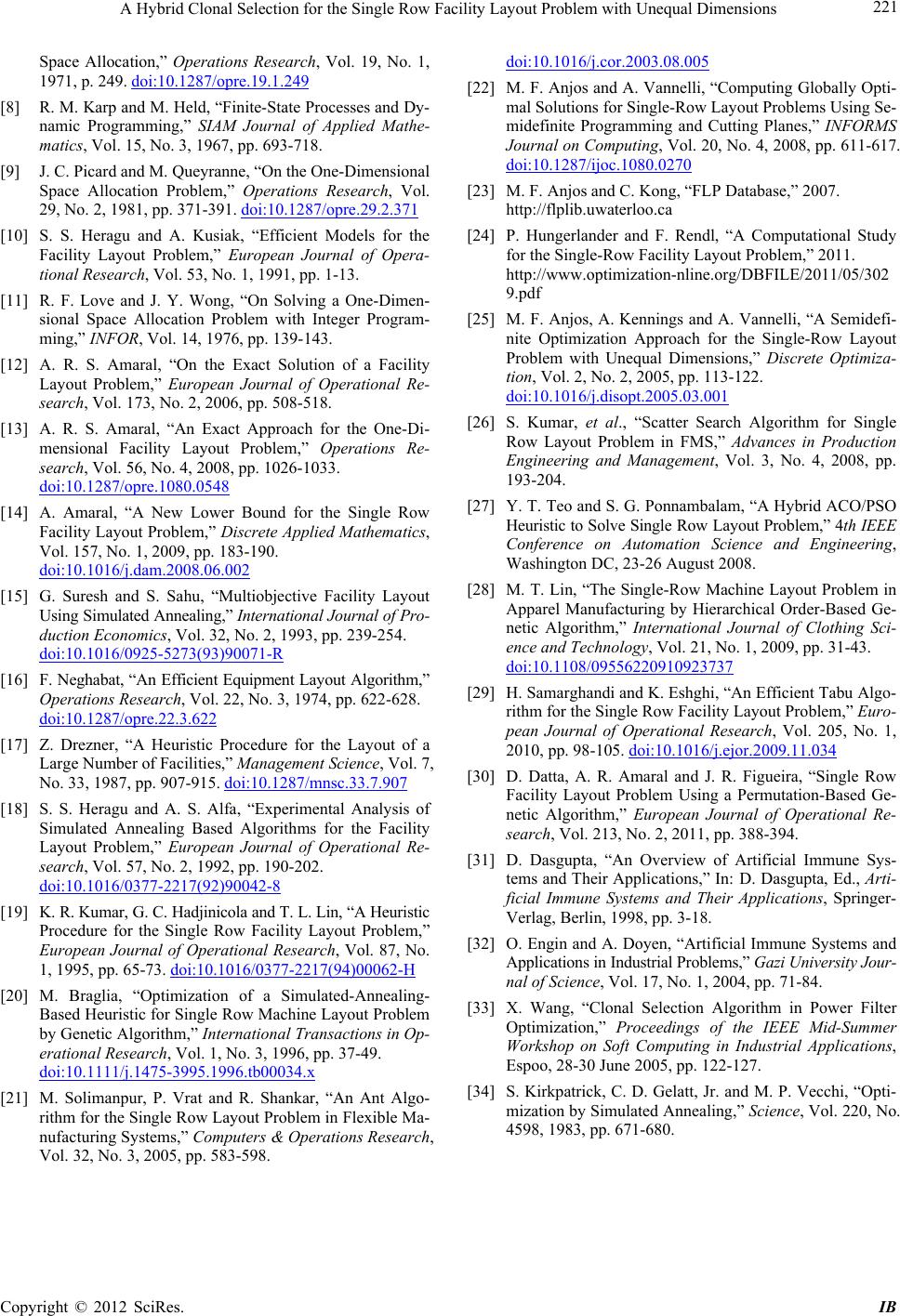 A Hybrid Clonal Selection for the Single Row Facility Layout Problem with Unequal Dimensions 221 Space Allocation,” Operations Research, Vol. 19, No. 1, 1971, p. 249. doi:10.1287/opre.19.1.249 [8] R. M. Karp and M. Held, “Finite-State Processes and Dy- namic Programming,” SIAM Journal of Applied Mathe- matics, Vol. 15, No. 3, 1967, pp. 693-718. [9] J. C. Picard and M. Queyranne, “On the One-Dimensional Space Allocation Problem,” Operations Research, Vol. 29, No. 2, 1981, pp. 371-391. doi:10.1287/opre.29.2.371 [10] S. S. Heragu and A. Kusiak, “Efficient Models for the Facility Layout Problem,” European Journal of Opera- tional Rese arch, Vol. 53, No. 1, 1991, pp. 1-13. [11] R. F. Love and J. Y. Wong, “On Solving a One-Dimen- sional Space Allocation Problem with Integer Program- ming,” INFOR, Vol. 14, 1976, pp. 139-143. [12] A. R. S. Amaral, “On the Exact Solution of a Facility Layout Problem,” European Journal of Operational Re- search, Vol. 173, No. 2, 2006, pp. 508-518. [13] A. R. S. Amaral, “An Exact Approach for the One-Di- mensional Facility Layout Problem,” Operations Re- search, Vol. 56, No. 4, 2008, pp. 1026-1033. doi:10.1287/opre.1080.0548 [14] A. Amaral, “A New Lower Bound for the Single Row Facility Layout Problem,” Discrete Applied Mathematics, Vol. 157, No. 1, 2009, pp. 183-190. doi:10.1016/j.dam.2008.06.002 [15] G. Suresh and S. Sahu, “Multiobjective Facility Layout Using Simulated Annealing,” Internati onal Journal of Pro- duction Economics, Vol. 32, No. 2, 1993, pp. 239-254. doi:10.1016/0925-5273(93)90071-R [16] F. Neghabat, “An Efficient Equipment Layout Algorithm,” Operations Research, Vol. 22, No. 3, 1974, pp. 622-628. doi:10.1287/opre.22.3.622 [17] Z. Drezner, “A Heuristic Procedure for the Layout of a Large Number of Facilities,” Management Science, Vol. 7, No. 33, 1987, pp. 907-915. doi:10.1287/mnsc.33.7.907 [18] S. S. Heragu and A. S. Alfa, “Experimental Analysis of Simulated Annealing Based Algorithms for the Facility Layout Problem,” European Journal of Operational Re- search, Vol. 57, No. 2, 1992, pp. 190-202. doi:10.1016/0377-2217(92)90042-8 [19] K. R. Kumar, G. C. Hadjinicola and T. L. Lin, “A Heuristic Procedure for the Single Row Facility Layout Problem,” European Journal of Operational Research, Vol. 87, No. 1, 1995, pp. 65-73. doi:10.1016/0377-2217(94)00062-H [20] M. Braglia, “Optimization of a Simulated-Annealing- Based Heuristic for Single Row Machine Layout Problem by Genetic Algorithm,” International Transactions in Op- erational Research, Vol. 1, No. 3, 1996, pp. 37-49. doi:10.1111/j.1475-3995.1996.tb00034.x [21] M. Solimanpur, P. Vrat and R. Shankar, “An Ant Algo- rithm for the Single Row Layout Problem in Flexible Ma- nufacturing Systems,” Computers & Operations Research, Vol. 32, No. 3, 2005, pp. 583-598. doi:10.1016/j.cor.2003.08.005 [22] M. F. Anjos and A. Vannelli, “Computing Globally Opti- mal Solutions for Single-Row Layout Problems Using Se- midefinite Programming and Cutting Planes,” INFORMS Journal on Computing, Vol. 20, No. 4, 2008, pp. 611-617. doi:10.1287/ijoc.1080.0270 [23] M. F. Anjos and C. Kong, “FLP Database,” 2007. http://flplib.uwaterloo.ca [24] P. Hungerlander and F. Rendl, “A Computational Study for the Single-Row Facility Layout Problem,” 2011. http://www.optimization-nline.org/DBFILE/2011/05/302 9.pdf [25] M. F. Anjos, A. Kennings and A. Vannelli, “A Semidefi- nite Optimization Approach for the Single-Row Layout Problem with Unequal Dimensions,” Discrete Optimiza- tion, Vol. 2, No. 2, 2005, pp. 113-122. doi:10.1016/j.disopt.2005.03.001 [26] S. Kumar, et al., “Scatter Search Algorithm for Single Row Layout Problem in FMS,” Advances in Production Engineering and Management, Vol. 3, No. 4, 2008, pp. 193-204. [27] Y. T. Teo and S. G. Ponnambalam, “A Hybrid ACO/PSO Heuristic to Solve Single Row Layout Problem,” 4th IEEE Conference on Automation Science and Engineering, Washington DC, 23-26 August 2008. [28] M. T. Lin, “The Single-Row Machine Layout Problem in Apparel Manufacturing by Hierarchical Order-Based Ge- netic Algorithm,” International Journal of Clothing Sci- ence and Technology, Vol. 21, No. 1, 2009, pp. 31-43. doi:10.1108/09556220910923737 [29] H. Samarghandi and K. Eshghi, “An Efficient Tabu Algo- rithm for the Single Row Facility Layout Problem,” Euro- pean Journal of Operational Research, Vol. 205, No. 1, 2010, pp. 98-105. doi:10.1016/j.ejor.2009.11.034 [30] D. Datta, A. R. Amaral and J. R. Figueira, “Single Row Facility Layout Problem Using a Permutation-Based Ge- netic Algorithm,” European Journal of Operational Re- search, Vol. 213, No. 2, 2011, pp. 388-394. [31] D. Dasgupta, “An Overview of Artificial Immune Sys- tems and Their Applications,” In: D. Dasgupta, Ed., Arti- ficial Immune Systems and Their Applications, Springer- Verlag, Berlin, 1998, pp. 3-18. [32] O. Engin and A. Doyen, “Artificial Immune Systems and Applications in Industrial Problems,” Gazi Unive rsity Jour- nal of Science, Vol. 17, No. 1, 2004, pp. 71-84. [33] X. Wang, “Clonal Selection Algorithm in Power Filter Optimization,” Proceedings of the IEEE Mid-Summer Workshop on Soft Computing in Industrial Applications, Espoo, 28-30 June 2005, pp. 122-127. [34] S. Kirkpatrick, C. D. Gelatt, Jr. and M. P. Vecchi, “Opti- mization by Simulated Annealing,” Science, Vol. 220, No. 4598, 1983, pp. 671-680. Copyright © 2012 SciRes. IB |